
Key Takeaways
- Food app ideas span several business models, including delivery marketplaces, restaurant management software, meal planning services, subscription platforms, and surplus food marketplaces.
- Startups can target specific customer groups, such as home cooks, health-conscious consumers, office workers, restaurants, and cloud kitchen operators.
- Food apps generate revenue through commissions, delivery fees, subscriptions, advertising, featured listings, and restaurant software fees.
- AI-powered recommendations, voice ordering, demand forecasting, and automated inventory management create additional opportunities for food technology startups.
- The right food app idea depends on customer demand, operational requirements, acquisition costs, and the potential for sustainable unit economics.
- Food app development generally cost $15,000-$55,000 for a basic MVP and $125,000–$250,000 or more for a complex platform.
The food industry is undergoing a digital shift, and the opportunity extends far beyond ordering meals online. Restaurants are adopting digital ordering systems, cloud kitchens are streamlining operations, and consumers are exploring more convenient ways to discover food, plan meals, and manage dietary needs. These changing expectations are creating new possibilities across the food ecosystem, making food technology an increasingly competitive space for innovation.
Beyond convenience, inefficiencies across the food supply chain also create opportunities for digital solutions. The Food and Agriculture Organization (FAO) estimates that 13.4% of food produced globally is lost between harvest and retail. The United Nations Environment Programme (UNEP) puts consumer-level food waste at 19%, including waste from households, food services, and retail. These challenges create opportunities for apps that help businesses manage surplus food, track inventory, forecast demand, and plan meals more efficiently.
For startups, the goal is to identify a specific gap and build a business around solving it. This guide explores 20 food app ideas, from cloud kitchen management and home-cooked meal marketplaces to AI-powered recommendations and food waste management. An experienced food ordering and delivery app development company can help evaluate the concept, define its essential features, and develop a solution aligned with its target users and business model.
Table of Contents
Food App Market in 2027
Startups exploring food app ideas do not necessarily need to compete directly with established delivery platforms. They can focus on underserved customer groups, specialized services, and operational challenges that existing solutions do not adequately address.
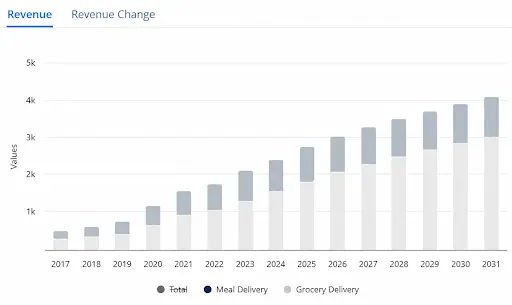
Several market forecasts highlight the growth potential of the food technology sector:
- Global online food delivery: Statista reports worldwide online food delivery revenue projected to grow at a CAGR of 6.24% from 2026 to 2031. Its category includes both prepared meals and grocery delivery.
- Online food delivery market: Grand View Research estimates that the global market will grow up to $505.5 billion by 2030, at a CAGR of 9.4% from 2025 to 2030.
- AI in food and beverages: Grand View Research estimates that the global market will grow up to $84.7 billion by 2030, at a CAGR of 39% from 2024 to 2030.
These estimates use different market definitions and should not be treated as directly comparable. However, they highlight growing interest in AI-based demand forecasting, personalized nutrition, automated restaurant operations, and sustainable food marketplaces.
Quick Comparison of 20 Food App Ideas
The following table compares 20 food app business opportunities by their target users, potential revenue models, and estimated development complexity.
| Food app idea | Target users | Revenue model | Complexity |
| Restaurant ordering marketplace | Consumers and restaurants | Commissions, delivery fees | High |
| Cloud kitchen management app | Cloud kitchen operators | SaaS subscriptions | Medium |
| Home-cooked food marketplace | Home cooks and consumers | Commissions, listing fees | High |
| Corporate meal delivery app | Companies and employees | Contracts, delivery fees | High |
| Quick-commerce food delivery app | Urban consumers | Product margins, delivery fees | High |
| Food subscription app | Regular meal buyers | Recurring subscriptions | Medium |
| Food delivery route optimization app | Delivery startups, cloud kitchens, last-mile operators | SaaS subscriptions, per-driver fees | High |
| QR code menu and ordering app | Restaurants and diners | SaaS subscriptions | Low |
| Restaurant loyalty and rewards app | Restaurants and customers | SaaS, premium plans | Medium |
| Restaurant management and table reservation app | Restaurant owners | SaaS subscriptions | Medium |
| AI kitchen inventory app | Restaurants and kitchens | SaaS subscriptions | High |
| Meal planning app | Health-conscious consumers | Premium subscriptions | Medium |
| Recipe sharing app | Home cooks and food enthusiasts | Advertising, subscriptions | Medium |
| Diet and nutrition app | Fitness and wellness users | Subscriptions, consultations | Medium |
| Allergy-specific food app | Consumers with dietary restrictions | Subscriptions, commissions | Medium |
| Food waste management app | Restaurants and retailers | SaaS, partnerships | Medium |
| Surplus food marketplace | Consumers and food businesses | Transaction commissions | High |
| AI-powered food recommendation app | Consumers and restaurants | Premium plans, advertising | High |
| Voice-based food ordering app | Consumers and restaurants | SaaS, transaction fees | Medium |
| Food demand forecasting app | Restaurants and food retailers | SaaS subscriptions | High |
Development complexity is indicative. Actual requirements depend on platform scope, integrations, automation, security, and operational workflows.
20 Food App Ideas for Startups in 2027
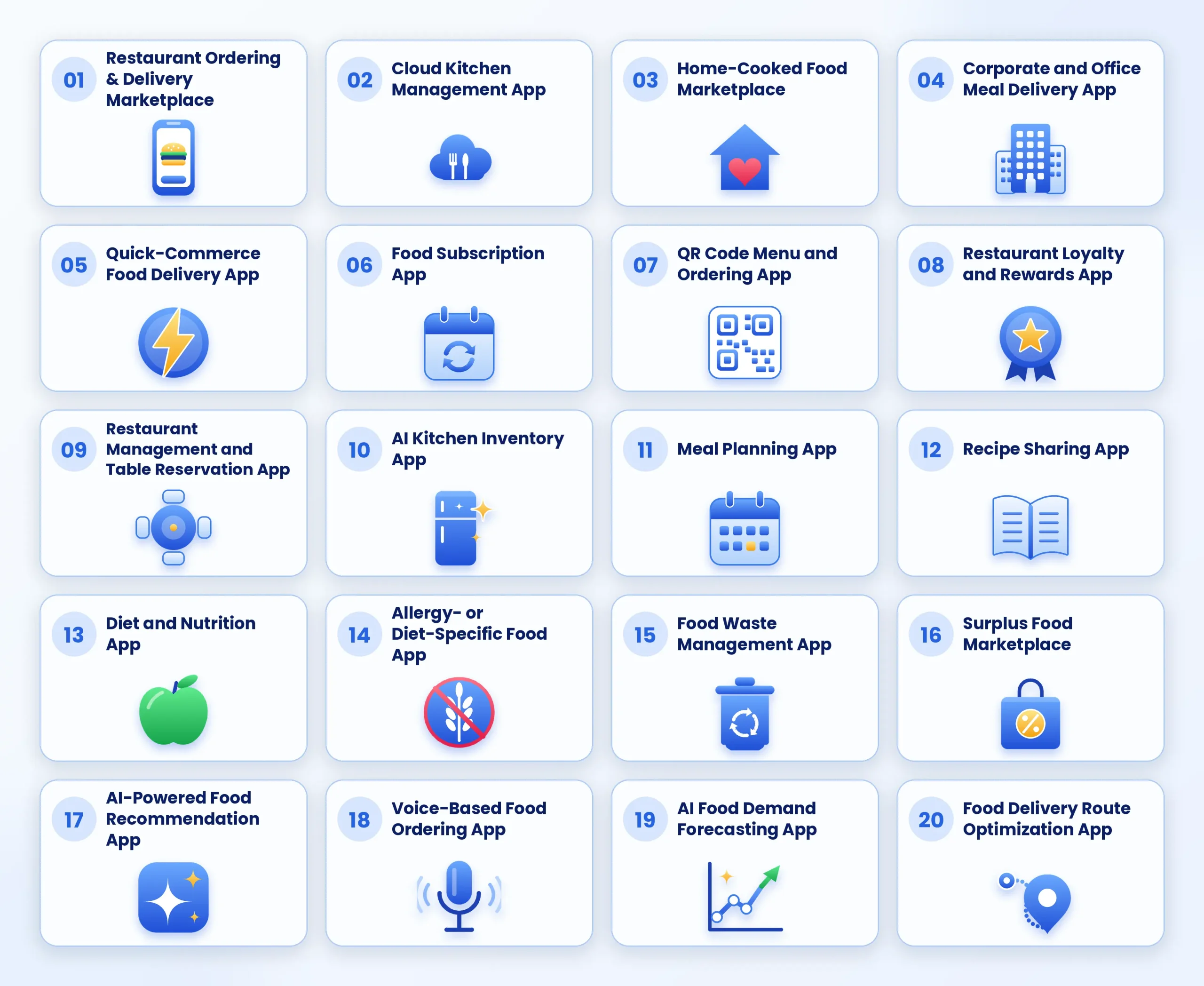
Choosing the right food app business idea requires understanding the different problems within the food ecosystem. Some opportunities improve customer convenience, while others help restaurants manage operations, reduce costs, or increase repeat purchases.
The following ideas are grouped by business model to help founders identify opportunities that align with their target customers and business objectives.
Consumer Ordering and Delivery Apps
Consumer ordering applications connect customers with restaurants, food producers, grocery retailers, and meal providers. Their value comes from making food discovery, purchasing, and delivery more convenient.
1. Restaurant Ordering and Delivery Marketplace
A restaurant ordering marketplace allows customers to discover nearby restaurants, explore menus, compare prices, and order meals through one application. The platform connects multiple food businesses with customers while coordinating ordering and delivery.
Startups can differentiate this model by targeting a particular city, cuisine, customer segment, or underserved restaurant category instead of competing across every market.
Target users: Consumers, independent restaurants, restaurant chains, and local food businesses.
Key features:
- Restaurant listings with searchable menus, ratings, and reviews.
- Location-based restaurant discovery and recommendations.
- Shopping carts, order customization, and secure payments.
- Real-time order status and delivery tracking.
- Restaurant dashboards for managing menus and incoming orders.
Revenue model: Earn commissions on completed orders, charge delivery fees, offer sponsored restaurant listings, and introduce subscription plans for frequent customers. DoorDash connects consumers with restaurants through a marketplace-based ordering and delivery model.
2. Cloud Kitchen Management App
A cloud kitchen management app helps delivery-only food businesses manage orders, menus, inventory, kitchen workflows, and multiple virtual restaurant brands from one platform.
Cloud kitchens may operate several food brands from the same physical kitchen. Managing orders across delivery channels can become complicated without a unified system. A dedicated application reduces manual coordination and improves operational visibility.
Target users: Cloud kitchen owners, multi-brand food operators, and delivery-focused restaurant businesses.
Key features:
- Centralized order management across multiple channels.
- Kitchen display systems and preparation status updates.
- Ingredient inventory and stock monitoring.
- Menu management across virtual restaurant brands.
- Sales reports and kitchen performance analytics.
Revenue model: Offer monthly or annual SaaS subscriptions, charge additional fees for multiple kitchen locations, and provide premium analytics or integration packages. For example, Restroworks provides restaurant management technology for centralized business operations.
3. Home-Cooked Food Marketplace
A home-cooked food delivery app connects customers with local home chefs who prepare and sell meals. It offers an alternative to conventional restaurant delivery by emphasizing homemade dishes, regional cuisines, and personalized food choices.
This model can appeal to students living away from home, busy professionals, and customers seeking home-style meals. Before onboarding home cooks, the platform must establish clear food safety standards, seller verification, and local regulatory compliance.
Target users: Home chefs, students, working professionals, and consumers seeking homemade meals.
Key features:
- Verified home chef profiles and food menus.
- Cuisine, dietary preference, and location filters.
- Pre-ordering and scheduled meal delivery.
- Customer ratings, reviews, and feedback.
- Order tracking and secure payment processing.
Revenue model: Generate commissions from completed orders, charge home chefs for premium listings, and introduce subscriptions for regular meal buyers. Shef is an example of a marketplace connecting customers with independent home cooks.
4. Corporate and Office Meal Delivery App
A corporate meal delivery app helps organizations arrange meals for employees through a centralized ordering platform. Companies can manage meal programs, budgets, and delivery schedules instead of relying on individual employee orders. This model offers a B2B opportunity because startups can build recurring relationships with offices, coworking spaces, and business campuses.
Target users: Employers, HR teams, office administrators, employees, and catering providers.
Key features:
- Corporate meal plans and employee accounts.
- Bulk ordering and scheduled meal deliveries.
- Dietary preferences and meal customization.
- Company-funded allowances and payment management.
- Centralized invoices and expense reports.
Revenue model: Corporate contracts, per-meal service charges, delivery fees, and subscription-based meal management plans. ezCater demonstrates the opportunity in connecting organizations with catering providers.
5. Quick-Commerce Food Delivery App
A quick-commerce food app focuses on delivering groceries, snacks, beverages, and selected ready-to-eat products within a short delivery window. Its business model depends on nearby inventory, efficient order processing, and strategically located fulfillment centers.
This idea is relevant in dense urban markets where customers frequently need small quantities of food products without visiting physical stores. However, promising a quick delivery window requires investment in inventory availability, local logistics, and operational coordination.
Target users: Urban consumers, working professionals, students, and households.
Key features:
- Location-based product availability.
- Real-time inventory and pricing updates.
- Fast checkout and digital payment options.
- Delivery partner assignment and tracking.
- Order history, repeat purchases, and promotional offers.
Revenue model: Earn product margins, delivery charges, retailer commissions, subscription fees, and revenue from promoted product placements.
6. Food Subscription App
A food subscription app allows customers to receive meals, ingredients, or curated food boxes at scheduled intervals. Customers can select weekly or monthly plans based on their preferences, household size, and dietary requirements.
A meal kit version provides pre-portioned ingredients and recipes so customers can prepare meals at home without planning grocery purchases themselves. Recurring subscriptions can create more predictable revenue than relying entirely on individual transactions. However, retention depends on meal quality, convenience, pricing, and flexible subscription management.
Target users: Busy professionals, families, fitness enthusiasts, and people interested in home cooking.
Key features:
- Customizable weekly and monthly meal plans.
- Meal preferences and dietary filters.
- Subscription scheduling and renewal management.
- Ingredient lists and recipe instructions.
- Options to pause, skip, or modify subscriptions.
Revenue model: Generate recurring subscription revenue, sell premium meal kits, offer add-ons, and charge for specialized dietary plans. HelloFresh operates a subscription-based model built around scheduled meal kits and ingredient deliveries.
Restaurant and Kitchen Operations Apps
Restaurant-focused applications help food businesses manage customer interactions, improve service efficiency, and organize daily operations. These products can generate recurring revenue through business subscriptions rather than depending entirely on consumer transactions.
7. QR Code Menu and Ordering App
A QR code menu app allows restaurant customers to scan a code at their table, view the digital menu, customize orders, and place requests directly from their smartphones.
Restaurants can use this approach to reduce printed menu expenses, update item availability, and simplify ordering during busy periods. A basic version can focus on digital menus, while an advanced product can include payments, table management, and kitchen integration.
Target users: Cafes, restaurants, food courts, hotels, and quick-service businesses.
Key features:
- QR code generation for individual tables.
- Digital menus with images, prices, and descriptions.
- Item customization and dietary information.
- Direct ordering and payment integration.
- Kitchen notifications and order status updates.
Revenue model: Charge restaurants monthly or annual software fees, offer premium customization, and introduce transaction-based pricing for integrated payments. Toast provides restaurant ordering and operational technology that illustrates the potential for connected restaurant software.
8. Restaurant Loyalty and Rewards App
A restaurant loyalty application helps businesses encourage repeat visits by rewarding customers for purchases, referrals, and engagement. Instead of depending entirely on third-party marketplaces, restaurants can build direct customer relationships. The application can support individual restaurants or operate as a shared loyalty platform for multiple local businesses.
Target users: Independent restaurants, restaurant chains, cafes, and frequent diners.
Key features:
- Customer profiles and purchase history.
- Points-based rewards and digital memberships.
- Personalized offers and promotional notifications.
- Referral programs and reward redemption.
- Customer segmentation and engagement analytics.
Revenue model: Charge restaurants SaaS subscription fees, offer premium marketing tools, and provide paid loyalty program customization. Starbucks Rewards uses points and personalized offers to encourage repeat purchases.
9. Restaurant Management and Table Reservation App
A restaurant management app can combine table reservations, booking management, staff scheduling, billing, inventory, and sales reporting in one platform. Customers can check table availability, make reservations, and receive booking confirmations, while restaurant owners manage seating capacity and daily operations. This model can serve independent restaurants, cafes, and multi-location restaurant chains that want to simplify reservation management and reduce manual booking coordination.
Target users: Restaurant owners, managers, independent cafes, and multi-location restaurant chains.
Key features:
- Real-time table availability and reservation management.
- Online bookings and confirmation notifications.
- Reservation modifications and cancellation management.
- POS and billing integration.
- Staff scheduling and role-based access.
- Inventory and supplier management.
- Sales reports and business performance dashboards.
Revenue model: Monthly SaaS subscriptions, premium operational modules, additional location fees, and integration services. Square for Restaurants provides POS, order management, and operational tools for food businesses.
10. AI Kitchen Inventory App
An AI kitchen inventory app helps restaurants monitor ingredient availability, track stock movement, and manage purchasing activities. Working with an AI-powered product design & development company helps startups build intelligent inventory features that improve stock visibility, prevent ingredient shortages, and reduce excess inventory.
Key features:
- Real-time ingredient inventory tracking.
- AI-assisted invoice and ingredient recognition.
- Automated low-stock alerts.
- Purchase order suggestions based on ingredient usage.
- Supplier records and purchasing reports.
Revenue model: Offer tiered SaaS subscriptions, charge for multi-location inventory management, and provide enterprise integrations. MarketMan illustrates demand for digital inventory control and purchasing tools in restaurant operations.
Health, Diet and Lifestyle Apps
Health-focused food applications serve consumers who want to make informed dietary choices, plan meals, explore recipes, or manage nutritional requirements. Their success depends on reliable information and an experience that encourages regular engagement.
11. Meal Planning App
A meal planning app helps users organize daily or weekly meals according to their schedules, food preferences, budgets, and nutritional goals. Users can create personalized meal plans, generate grocery lists, and discover recipes that match their requirements. Startups can differentiate their products through specialized plans for busy professionals, families, students, or fitness enthusiasts.
Target users: Working professionals, families, fitness enthusiasts, and people who want structured meal routines.
Key features:
- Personalized weekly meal calendars.
- Recipe recommendations and food preferences.
- Automatic grocery list generation.
- Calorie and nutritional information.
- Meal reminders and progress tracking.
Revenue model: Offer freemium access, premium meal plans, monthly subscriptions, and affiliate partnerships with grocery retailers. Mealime provides personalized meal plans and grocery list features.
12. Recipe Sharing App
A recipe sharing app creates a digital community where users can discover, publish, save, and share cooking instructions. It can combine recipe discovery with social features that encourage users to contribute their own food creations.
A startup can focus on regional cuisines, beginner-friendly cooking, budget recipes, or specific cooking styles to build a differentiated audience.
Target users: Home cooks, food enthusiasts, cooking beginners, and food content creators.
Key features:
- Recipe publishing with images and videos.
- Search filters for ingredients and cuisines.
- Saved recipes and personal collections.
- Ratings, comments, and cooking tips.
- Shopping lists and recipe-sharing options.
Revenue model: Generate advertising revenue, offer premium memberships, collaborate with food brands, and introduce sponsored recipes. Allrecipes demonstrates the value of user-generated cooking content and recipe discovery.
13. Diet and Nutrition App
A diet and nutrition app helps users understand their eating habits and monitor nutritional intake. It can provide food recommendations based on calorie requirements, fitness goals, and dietary preferences.
Unlike a basic calorie counter, an advanced application can combine meal logging, nutrition insights, progress tracking, and consultations with qualified nutrition professionals. If the product offers health-related guidance, its information and recommendations should be reviewed by qualified professionals.
Target users: Fitness enthusiasts, wellness-conscious consumers, athletes, and people seeking structured nutrition guidance.
Key features:
- Food logging and nutritional databases.
- Calorie and macronutrient tracking.
- Personalized nutrition goals.
- Progress reports and meal recommendations.
- Integration with fitness trackers and wearable devices.
Revenue model: Offer premium tracking features, subscription-based nutrition plans, professional consultations, and partnerships with wellness providers. MyFitnessPal demonstrates the market for food logging and nutritional tracking.
14. Allergy- or Diet-Specific Food App
An allergy- or diet-specific food app helps users identify food products and restaurant meals that match their dietary restrictions. It can serve people managing food allergies, intolerances, or preferences such as gluten-free, vegan, and dairy-free diets.
Finding suitable meals can be difficult when ingredient information is incomplete. A specialized platform can make food discovery more convenient by displaying ingredient information and relevant dietary filters. Allergen information should be verified and clearly distinguished from user-submitted claims.
Target users: People with food allergies, individuals with dietary restrictions, vegans, and health-conscious consumers.
Key features:
- Ingredient and allergen databases.
- Dietary preference and restriction filters.
- Restaurant and product discovery.
- Allergen alerts and ingredient explanations.
- Saved dietary profiles and personalized recommendations.
Revenue model: Premium subscriptions, restaurant partnerships, sponsored listings, and affiliate product recommendations. Fig helps users identify products that match their individual food requirements.
Sustainability Apps
Sustainability-focused food applications address challenges such as food waste, excess inventory, and inefficient food distribution. They can create commercial value by helping businesses recover revenue from unsold food while giving customers access to discounted products.
15. Food Waste Management App
A food waste app helps restaurants, grocery stores, and hotels monitor excess food and identify options to reduce unnecessary waste.
The platform can allow businesses to record surplus inventory, track expiry dates, coordinate donations, and analyze waste patterns. For food businesses, reducing waste can also improve inventory efficiency and protect profit margins.
Target users: Restaurants, supermarkets, hotels, and catering businesses.
Key features:
- Food waste recording by item, quantity, and category.
- Surplus food identification and notifications.
- Donation coordination with local organizations.
- Waste analytics and reporting.
- Waste reduction recommendations based on recorded patterns.
Revenue model: Offer business subscriptions, charge for advanced analytics, and introduce partnerships with food redistribution organizations. Winnow provides food waste tracking and analytics solutions that help commercial kitchens monitor waste and improve resource efficiency.
16. Surplus Food Marketplace
A surplus food marketplace takes the food waste concept further by creating a transactional platform where restaurants, bakeries, grocery stores, and cafes can sell unsold food at discounted prices.
Businesses list available surplus products, while nearby customers reserve and collect them within specified time windows. This model creates an additional revenue opportunity from inventory that might otherwise remain unsold.
Target users: Restaurants, bakeries, grocery stores, cafes, and budget-conscious consumers.
Key features:
- Location-based surplus food discovery.
- Discounted food listings and availability.
- In-app reservations and payments.
- Pickup scheduling and order confirmation.
- Merchant dashboards and sales reporting.
Revenue model: Earn commissions on completed transactions, charge merchants listing fees, and introduce premium visibility options. Too Good To Go uses discounted Surprise Bags to connect businesses with customers and recover value from unsold inventory.
AI-Powered Food Apps
AI-powered food applications use data analysis, automation, and natural language processing to improve food discovery, ordering, inventory management, and business decisions. These factors help startups differentiate their products through intelligent functionality.
17. AI-Powered Food Recommendation App
An AI-powered food recommendation app analyzes user preferences, order history, dietary requirements, and browsing behavior to suggest relevant meals and restaurants.
Traditional food discovery platforms often display large menus that make choosing meals time-consuming. Personalized recommendations can simplify discovery while helping restaurants promote relevant menu items.
Target users: Food delivery customers, restaurant chains, food marketplaces, and consumers with specific dietary preferences.
Key features:
- Personalized food and restaurant recommendations.
- AI-based preference and behavior analysis.
- Cuisine and ingredient-based discovery.
- Contextual suggestions based on location and time.
- Feedback-based recommendation improvements.
Revenue model: Premium recommendations, restaurant advertising, sponsored placements, and marketplace commissions. Uber Eats illustrates the potential for personalized discovery within large food ordering platforms.
18. Voice-Based Food Ordering App
A voice-based food ordering app allows customers to browse menus, select meals, customize orders, and place requests through voice commands.
This improves convenience for users who prefer hands-free interactions or find conventional navigation difficult. Restaurants can also integrate voice ordering into their customer service and ordering systems. The application uses speech recognition and natural language processing to understand requests, confirm selections, and reduce ordering errors.
Target users: Restaurants, quick-service businesses, busy consumers, and customers who prefer voice interactions.
Key features:
- Voice-based menu search and navigation.
- Natural language order interpretation.
- Meal customization through voice commands.
- Order confirmation and payment integration.
- Multilingual voice interaction and accessibility options.
Revenue model: Charge restaurants for voice ordering software, offer enterprise integrations, and introduce subscription-based plans. Domino’s has experimented with voice-enabled ordering experiences, demonstrating the potential for conversational food ordering.
19. AI Food Demand Forecasting App
An AI food demand forecasting app helps grocery retailers, food distributors, and food manufacturers predict future product demand using historical sales, seasonal patterns, local events, and market trends.
Accurate forecasts help businesses plan procurement, distribution, and stock allocation across multiple locations. This is particularly valuable for organizations managing large product inventories and changing consumer demand.
Target users: Grocery retailers, food distributors, and food manufacturers.
Key features:
- Historical sales and demand analysis.
- AI-based demand predictions.
- Seasonal and location-based forecasting.
- Inventory and procurement recommendations.
- Performance dashboards and forecasting reports.
Revenue model: Offer monthly SaaS subscriptions, enterprise analytics packages, and integration services for existing business systems. Blue Yonder provides AI-driven demand planning capabilities that illustrate the wider opportunity for predictive food business applications.
20. Food Delivery Route Optimization App
A food delivery route optimization app helps restaurants and delivery businesses assign orders and identify efficient delivery routes. It considers delivery locations, traffic conditions, order preparation times, and driver availability.
Inefficient routes increase fuel expenses, delay orders, and limit the number of deliveries drivers complete. A route optimization platform helps businesses coordinate deliveries, streamline operations, and improve delivery visibility.
Target users: Food delivery startups, restaurant chains, cloud kitchens, and last-mile delivery operators.
Key features:
- Automated delivery assignment.
- Multi-stop route optimization.
- Real-time GPS and traffic information.
- Driver availability and performance tracking.
- Estimated delivery time calculations.
Revenue model: Charge businesses monthly software fees, offer per-driver subscriptions, and provide enterprise integrations. Onfleet provides delivery dispatch, tracking, and route management capabilities.
How to Choose and Validate Your Food App Idea
Having multiple food app ideas does not mean every opportunity is commercially viable. Before investing in development, founders should evaluate customer demand, existing competition, operational requirements, and revenue potential.
The following steps will help validate a food app business idea before development begins.
Identify a Specific Market Problem
Start by identifying a problem that customers or food businesses experience regularly. Avoid beginning with a list of features or technologies. Instead, understand where existing solutions fall short.
For example, cloud kitchen operators might struggle to manage orders from multiple delivery platforms. A meal planning startup might find that existing applications offer limited support for regional cuisines or specific dietary preferences.
Conduct customer interviews, surveys, and industry research to understand:
- What problems do potential customers experience?
- How frequently do these problems occur?
- What solutions are they currently using?
- Would they pay for a better alternative?
Analyze Competitors and Identify Market Gaps
Research existing food applications to understand their business models, features, pricing, customer reviews, and market positioning.
Do not simply replicate successful applications. Look for underserved customer segments, missing functionality, and operational problems that competitors have not adequately addressed. For example, a startup could build a restaurant ordering platform specifically for independent restaurants that want to reduce their dependence on third-party marketplaces.
Evaluate competitors based on customer experience, service availability, pricing, technology, and monetization strategies. Customer reviews can reveal recurring complaints that represent opportunities for differentiation.
Define the Revenue Model
A food app needs a clear monetization strategy before development begins. For example, a restaurant management application could generate recurring SaaS revenue, while a food delivery marketplace could earn commissions from restaurant orders.
Estimate revenue per customer or transaction and compare it with acquisition, payment processing, customer support, and operational expenses.
For delivery businesses, pay particular attention to delivery costs, discounts, refunds, and restaurant commissions. High order volumes do not necessarily translate into profitability when contribution margins remain low.
Define the MVP Scope
Avoid building every proposed feature in the initial version. Instead, identify the minimum functionality required to test whether customers will use and pay for the product.
For example, an MVP for a home-cooked food marketplace could initially include:
- Customer and home chef registration.
- Food listings and basic search.
- Order placement and payment.
- Order notifications.
- Basic ratings and reviews.
Advanced recommendations, loyalty programs, and automated analytics can be introduced after validating the initial business model.
An MVP helps founders test assumptions, gather feedback, and control initial development investment. Working with an experienced MVP development company can also help establish a focused product scope before committing to a larger build.
Evaluate Operational and Financial Feasibility
Food applications often involve physical operations in addition to software development. Delivery logistics, food quality, inventory availability, vendor onboarding, and customer support can significantly influence business performance.
Estimate the costs associated with these activities before launching. A quick-commerce application, for example, requires inventory planning and fulfillment infrastructure. A QR code menu application primarily requires software development and restaurant onboarding.
Consider these factors:
- Customer acquisition cost and expected customer lifetime value.
- Average order value and contribution margin.
- Restaurant or vendor acquisition expenses.
- Delivery, payment processing, and support costs.
- Technology maintenance and infrastructure expenses.
A commercially viable food app should have a realistic path toward positive unit economics as the business scales.
Must-Have Features of a Food App
Feature requirements depend on the business model, but most customer-facing food applications need a reliable foundation for discovery, transactions, communication, and account management.
The following features generally help deliver a consistent user experience.
- User Registration and Profile Management: Enable secure sign-up through email, phone numbers, or social logins, with profiles for managing personal details, saved addresses, dietary preferences, and order history.
- Search and Filtering: Help customers discover restaurants, meals, and food products using filters for cuisine, price, location, ratings, dietary needs, and availability.
- Menu and Product Management: Display product images, descriptions, prices, ingredients, and customization options while allowing merchants to update menus and item availability.
- Shopping Cart and Secure Payments: Let customers review orders, adjust quantities, apply promotional codes, and pay securely through supported payment methods.
- Order Management and Notifications: Keep customers informed with real-time updates on order confirmation, preparation, dispatch, and delivery.
- Ratings, Reviews, and Customer Support: Allow customers to share feedback and access support for cancellations, refunds, complaints, and order-related issues.
- Analytics and Reporting: Help business owners track sales, orders, customer behavior, and product performance to make informed operational decisions.
The feature set should reflect the product’s primary purpose rather than include unnecessary functionality. For a more detailed breakdown, see our guide to must-have mobile app features.
How Food Apps Make Money
Food applications generate revenue through multiple monetization strategies. The right approach depends on the target audience, transaction frequency, business model, and value provided to customers or merchants.
1. Commission on Orders
Food delivery marketplaces can charge restaurants a percentage of each completed order. In return, restaurants receive access to customers, ordering infrastructure, and, depending on the arrangement, delivery services.
For example, DoorDash’s US merchant pricing lists delivery commission tiers of 15%, 25%, and 30%, depending on the merchant plan. These rates are specific to DoorDash’s plans and should not be treated as a universal industry standard.
2. Delivery and Convenience Fees
Applications can charge customers a delivery fee based on distance, order size, location, and delivery conditions.
Some platforms also introduce service fees to cover payment processing, technology, and operational expenses. Pricing should remain transparent to avoid discouraging customers at checkout.
3. Subscription Plans
Subscription-based monetization works well for meal planning applications, meal kit services, and food delivery platforms.
Customers pay recurring fees in exchange for benefits such as free deliveries, exclusive discounts, personalized meal plans, or access to premium features.
4. Advertising and Featured Listings
Food marketplaces can generate advertising revenue by allowing restaurants and food brands to promote their products.
Restaurants can pay for sponsored listings, promotional banners, or enhanced visibility in relevant search results. These placements should remain relevant to customer preferences and search intent.
5. SaaS Subscriptions for Restaurants
Restaurant management, QR ordering, inventory tracking, and cloud kitchen applications can generate recurring revenue through a Software-as-a-Service (SaaS) model.
Restaurants pay monthly or annual subscription fees to access these tools. Startups can offer tiered pricing based on the number of locations, users, integrations, and advanced features included in each plan.
6. White-Label Solutions
Food technology startups can develop customizable ordering and delivery platforms that restaurants or food businesses operate under their own brands. Revenue can come from initial licensing fees, customization, deployment, integrations, and ongoing maintenance contracts.
A combination of monetization models can also work. For example, a restaurant marketplace could earn commissions while offering paid promotional placements and optional customer subscriptions.
How Much Does It Cost to Build a Food App?
The cost of developing a food app depends on its business model, functionality, technology stack, third-party integrations, and overall product complexity. Businesses planning a new product can explore a food app development guide to understand the available app concepts and evaluate which solution best fits their goals.
A basic restaurant ordering application requires fewer resources than a multi-vendor delivery marketplace with separate customer, restaurant, and delivery partner interfaces. For initial planning, food app development can fall into three broad investment categories.
| Development scope | Estimated cost | Typical functionality |
| Basic MVP | $15,000–$55,000 | User registration, menus, search, basic ordering, and payments |
| Mid-level application | $55,000–$125,000 | Advanced ordering, multiple user roles, integrations, notifications, and analytics |
| Complex food platform | $125,000–$250,000+ | Multi-vendor marketplace, AI capabilities, advanced logistics, automation, and scalable infrastructure |
These are indicative planning estimates, not fixed development quotations. Actual costs depend on project requirements, platform selection, integrations, and the development team’s location and composition.
Factors That Influence Food App Development Costs
- Application Complexity: A single-restaurant app generally costs less to build than a multi-vendor marketplace with multiple user roles and complex workflows.
- Platform Selection: Developing for Android, iOS, or both affects the budget, while cross-platform development may reduce duplicated effort.
- UI/UX Design: Custom interfaces, intuitive navigation, and extensive user research can increase design costs.
- Third-Party Integrations: Payment gateways, maps, POS systems, inventory tools, and delivery APIs add integration and testing expenses.
- Advanced Technologies: AI recommendations, voice ordering, demand forecasting, and route optimization require additional development, data infrastructure, and integration.
- Maintenance and Updates: Ongoing security updates, bug fixes, performance improvements, infrastructure management, and feature enhancements contribute to long-term costs.
Founders should prioritize essential MVP functionality before investing in advanced features. This approach helps validate demand and reduces the financial risk of building an unnecessarily complex product.
Benefits of Food Apps for Restaurants
Food applications can help restaurants improve customer accessibility, simplify operations, and develop stronger relationships with their audiences. Beyond accepting digital orders, food apps provide insights into customer preferences and help restaurants make better business decisions.
Some important benefits include:
- Wider Customer Reach: Helps restaurants attract customers beyond walk-in traffic through online menus, location-based discovery, and digital ordering.
- Improved Ordering Convenience: Lets customers browse menus, customize orders, and make payments without waiting for staff assistance.
- Better Operational Efficiency: Streamlines order processing, inventory tracking, and kitchen coordination through automated tools and system integrations.
- Increased Customer Retention: Encourages repeat purchases through loyalty programs, personalized offers, and targeted promotions.
- Data-Driven Business Decisions: Uses sales reports, order patterns, and customer preferences to improve menu planning, pricing, and marketing strategies.
- Reduced Dependence on Manual Processes: Reduces repetitive work by automating tasks such as order entry, payment tracking, and customer notifications, allowing staff to focus on service and food preparation.
Conclusion
The food industry offers startups opportunities far beyond conventional ordering and delivery platforms. From cloud kitchen management and home-cooked meal marketplaces to AI-powered recommendations and food waste solutions, the right idea can address an underserved need and create a sustainable business. Partnering with a startup app development company can help you validate your concept, prioritize essential features, and build a product that meets customer expectations.
Turning that idea into a successful product requires a clear development strategy and the right technology expertise. RipenApps helps businesses transform app concepts into scalable digital solutions through product strategy, UI/UX design, and app development. Whether you are building a food delivery platform or exploring a niche food tech solution, a focused approach can help you move from idea to launch with confidence.
Frequently Asked Questions
1. Which food app is most profitable?
There is no universally most profitable food app category. Profitability depends on customer demand, operating expenses, competition, and monetization. Restaurant SaaS applications, niche food marketplaces, subscription-based meal services, and specialized nutrition platforms can offer attractive business models because they address recurring customer or business needs.
2. How much does it cost to build a food app?
A basic food app MVP typically costs $15,000–$55,000, a mid-level application $55,000–$125,000, and a complex multi-vendor platform $125,000–$250,000 or more. Features, integrations, platforms, and development requirements determine the final budget.
3. How do food apps make money?
Food apps generate revenue through restaurant commissions, delivery charges, subscriptions, advertising, featured listings, SaaS fees, and white-label licensing. Some platforms combine multiple revenue streams to diversify income and improve profitability.
4. Can I build a food app without restaurant partnerships?
Yes. You can build certain food applications without restaurant partnerships, including recipe sharing platforms, meal planning applications, nutrition trackers, and food inventory management tools. However, marketplace and restaurant ordering applications generally require partnerships with food businesses to provide their core services.
5. What features should a food delivery app have?
A food delivery app should include user registration, restaurant discovery, searchable menus, shopping carts, secure payments, order tracking, notifications, ratings, and customer support. Restaurant and delivery partner dashboards are also necessary for managing orders and fulfillment.
6. Which technology is best for food app development?
The technology stack depends on the application’s functionality, scalability requirements, and platform strategy. React Native and Flutter are popular options for cross-platform mobile development, while Node.js and other backend technologies can support APIs, order management, and real-time communication. Cloud infrastructure, payment gateways, mapping services, and database technologies complete the architecture.
7. How long does it take to develop a food app?
A basic food app MVP may take approximately 3–4 months to develop, while a mid-level application may require 5–7 months. Complex marketplaces with multiple user interfaces, integrations, and advanced functionality can take 8–12 months or longer.
8. How can I make my food app stand out from competitors?
Focus on a specific customer problem or underserved market segment instead of replicating established platforms. Offer differentiated features, improve the ordering experience, build reliable partnerships, and use customer feedback to refine the product. Specialized services, personalized recommendations, operational automation, and transparent pricing can also strengthen market positioning.
Discuss your project and request for proposal
SHARE
WRITTEN BY

Prankur Haldiya
Chief Technical Officer
A tech innovator and engineering leader, Prankur Haldiya drives RipenApps’ product development strategy and oversees cutting-edge solutions in mobility, AI, and cloud ecosystems. He is passionate about building high-performance teams and helping brands launch secure, scalable, and user-centric digital products.
View All Articles