
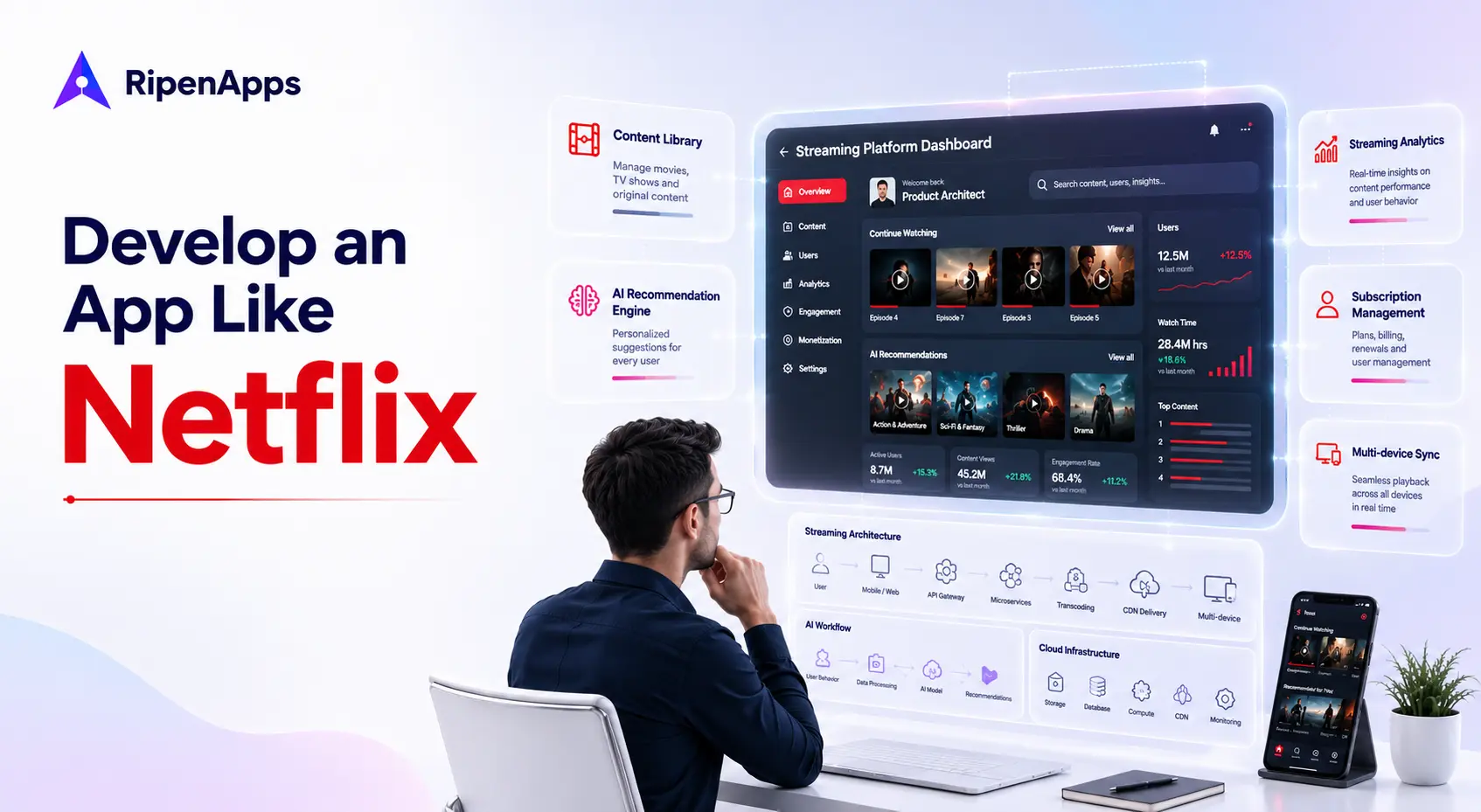

Key Takeaways
- Netflix app development costs vary based on platform complexity, AI capabilities, streaming infrastructure, and supported devices, with most projects ranging from $40,000 to $500,000+.
- An AI recommendation engine is the core differentiator of a Netflix-like app, improving content discovery, watch time, subscriber retention, and user engagement.
- A successful streaming platform requires more than video playback. Adaptive streaming, DRM, CDN, cloud infrastructure, and scalable architecture are essential for delivering a seamless viewing experience.
- Startups can accelerate development by launching an MVP with core streaming features and a managed AI service, then evolve to a custom recommendation engine as the platform grows.
- Choosing the right technology stack, business model, and content licensing strategy lays the foundation for building a scalable and competitive streaming platform.
Building an app like Netflix typically costs $40,000–$500,000+ and takes 4–14 months, depending on its features, AI capabilities, and streaming infrastructure. While video playback is essential, the real competitive advantage comes from an AI recommendation engine that personalizes content discovery and improves viewer retention.
As competition increases in the streaming industry, businesses can no longer compete through content volume alone. Startups and media companies need personalized experiences, scalable infrastructure, and intelligent discovery systems to increase engagement and reduce subscriber churn. Success increasingly depends on delivering intelligent content discovery, reliable streaming performance, and personalized viewing experiences rather than simply offering a larger content library. Businesses that combine quality content with intelligent personalization are better positioned to attract and retain subscribers.
This guide explains how to develop an app like Netflix, covering the development process, AI-powered recommendation engines, essential features, technology stack, estimated costs, and the role of AI recommendation engine services in delivering personalized streaming experiences. You’ll also learn the key business considerations for launching a successful and scalable streaming platform.
Table of Contents
The Streaming Market in 2026
The global streaming market continues to expand as consumers increasingly prefer on-demand entertainment over traditional television. According to Statista, the global subscription video-on-demand (SVoD) market is projected to generate US$98.37 billion in revenue in 2026 and grow at a 5.89% CAGR through 2030, reaching US$123.68 billion.
It also projects the United States to remain the world’s largest SVoD market, generating US$35.21 billion in revenue in 2026, highlighting the continued commercial opportunity for streaming businesses targeting North American audiences.
As competition intensifies, success depends on delivering a superior viewing experience rather than simply offering a larger content library. People expect personalized recommendations and instant content discovery. This creates an opportunity for startups and media companies to build niche streaming platforms powered by an AI recommendation engine, enabling them to compete through personalization instead of content volume alone.
Why Every Successful Netflix Clone Needs an AI Recommendation Engine
Many businesses begin Netflix clone app development believing that success depends on building a large content library. While exclusive content attracts users, it is personalization that keeps them engaged. Netflix has long recognized this.Netflix recognized this early. In their 2015 paper, The Netflix Recommender System: Algorithms, Business Value, and Innovation, Netflix engineers Carlos A. Gomez-Uribe and Neil Hunt explained that the platform’s recommendation system helps users discover relevant content within an increasingly large catalog, making personalization a core part of the viewing experience rather than an optional feature.
Without an AI recommendation engine, a streaming app functions as a digital video catalog where users manually browse categories or search for titles. Over time, this creates friction, increases decision fatigue, and reduces user engagement. This feature learns from watch history, search activity, viewing patterns, and user interactions to recommend movies and shows each viewer is most likely to enjoy. As recommendations become more accurate, users spend more time watching content and return to the platform more frequently.
For businesses investing in Netflix app development, personalization directly improves key performance metrics. It increases watch time, enhances content discovery, strengthens subscriber retention, and maximizes the value of existing content without constantly expanding the library. It increases watch time, enhances content discovery, strengthens subscriber retention, and maximizes the value of existing content without constantly expanding the library.
Simply put, a Netflix clone without an AI recommendation engine is only a video streaming platform. A successful Netflix-like app uses intelligent recommendations to create personalized viewing experiences that drive engagement, reduce churn, and build long-term customer loyalty. Partnering with an experienced mobile app development company can help businesses build these AI-powered capabilities into a scalable streaming platform from the outset.
| Factor | Netflix Clone | Custom Streaming App |
| Cost | Lower | Higher |
| Customization | Limited | Full control |
| Scalability | Moderate | Enterprise-ready |
| AI Capability | Basic | Custom |
How Netflix’s Recommendation Engine Works (Business-Level)
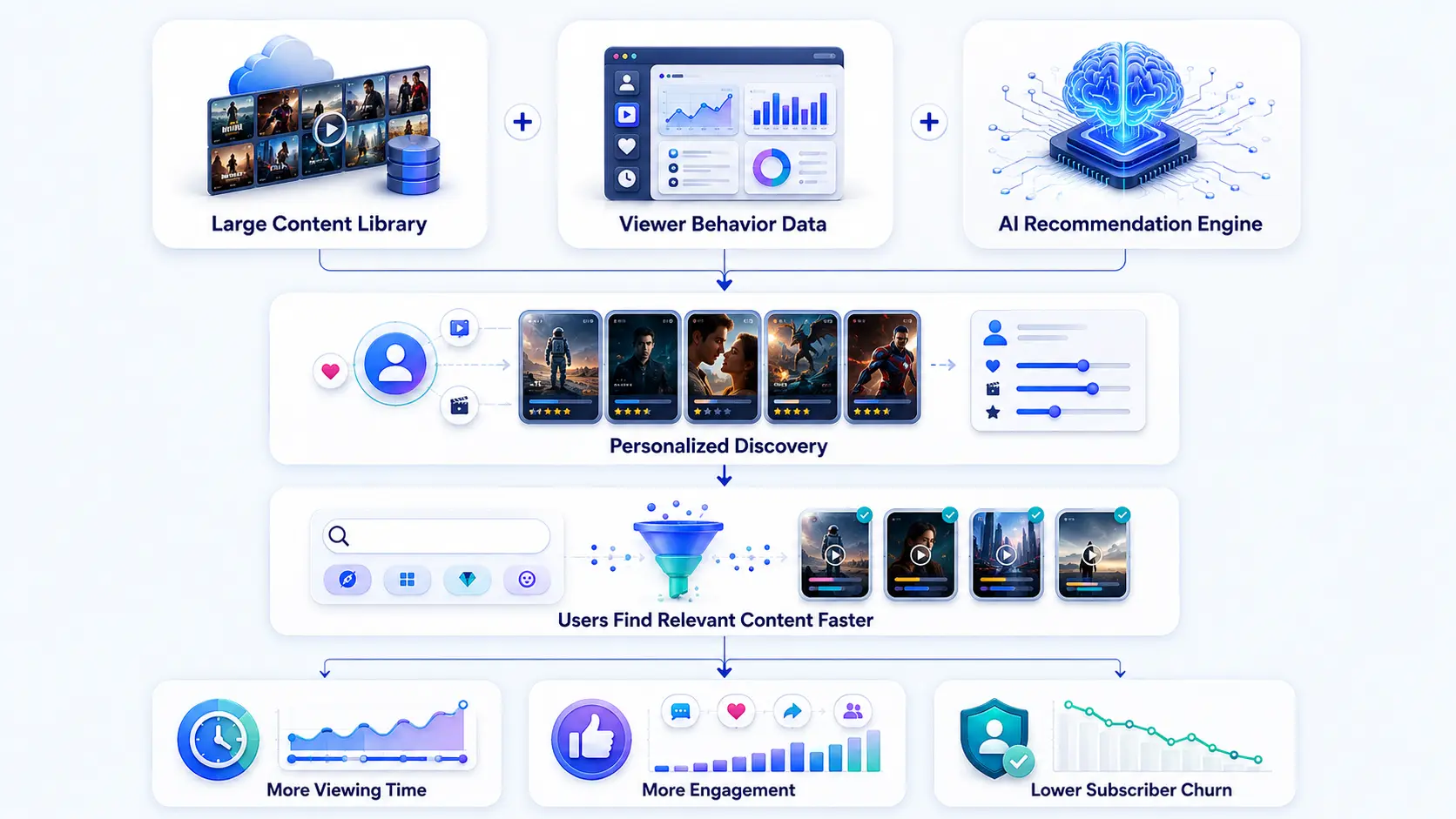
An AI recommendation engine is the intelligence behind a personalized streaming experience. Rather than showing the same homepage to every user, it analyzes viewing behavior and recommends content each viewer is most likely to watch. The objective is simple: help users discover relevant content faster while increasing engagement and retention.
A recommendation engine combines multiple techniques to understand user preferences. Collaborative filtering identifies viewing patterns among users with similar interests and recommends titles they commonly enjoy. Content-based filtering analyzes movie attributes such as genre, cast, language, themes, and release year to suggest similar content based on an individual’s watch history.
The engine also considers contextual signals such as device type, viewing time, location, and recent activity. For example, a user watching on a smartphone during a commute may receive different recommendations than when browsing from a smart TV at home. These signals make recommendations more relevant to the user’s current situation.
New streaming platforms often face the cold-start problem, where limited user data makes personalization difficult during the early stages. Without sufficient watch history or interaction data, recommendation models cannot accurately predict individual preferences. To overcome this challenge, businesses typically begin by asking users to select their favorite genres, languages, actors, or content categories during onboarding. These explicit preferences provide the recommendation engine with an initial understanding of user interests before behavioral data becomes available.
In addition, many platforms combine popularity-based recommendations, trending titles, new releases, and editorially curated collections to keep users engaged. This hybrid approach ensures that new users receive relevant suggestions even before the AI model has accumulated enough viewing data. As users begin watching, searching, rating, and adding content to their watchlists, the recommendation engine continuously learns from these interactions through feedback loops. Machine learning models are periodically retrained using fresh behavioral data, allowing recommendations to become increasingly personalized over time. For startups, using managed AI services during the MVP stage provides an efficient way to overcome the cold-start challenge before investing in a fully custom recommendation engine.
If you want to explore other AI capabilities, including AI-powered search, subtitle generation, content moderation, and predictive analytics, read our AI in OTT Apps guide.
Step-by-Step: How to Build an App Like Netflix
Building a successful streaming platform requires careful planning beyond application development. Businesses must define their target audience, secure content rights, choose the right business model, and create an engaging user experience before investing in advanced AI capabilities. Following a structured development process reduces technical risks and accelerates product growth.
Step 1. Define Your Niche and Target Audience
The first step in how to develop an app like Netflix is identifying a specific audience and content niche. Competing directly with Netflix is challenging, but serving a focused market—such as regional entertainment, sports, education, or independent films—helps businesses differentiate their platform and build a loyal subscriber base.
Before development begins, clearly define your target users, supported devices, geographic markets, content categories, and long-term business goals. These decisions influence product architecture, licensing requirements, and future development costs.
Step 2. Build Your Content Strategy and Secure Licensing
Content is the foundation of every streaming platform. Whether you distribute licensed movies, original productions, live events, or educational videos, you must obtain the necessary distribution rights before launching your service.
Equally important is implementing Digital Rights Management (DRM) to protect premium content from piracy and unauthorized downloads. Addressing licensing and content protection early helps avoid legal risks and creates a secure foundation for future growth.
Step 3. Choose the Right Business Model
Your monetization strategy should align with your audience and content offerings. While subscription-based platforms remain the most popular choice, advertising-supported and pay-per-view models continue to gain traction across different streaming segments.
| Business Model | Description |
| SVOD | Users pay a recurring monthly or annual subscription for unlimited access. |
| AVOD | Revenue is generated through advertisements displayed during video playback. |
| TVOD | Users pay individually to rent or purchase premium content. |
| Hybrid | Combines subscriptions, advertising, and transactional purchases. |
Many businesses start with a single monetization model and expand their revenue strategy as their platform grows. For a deeper understanding of subscription, advertising, and hybrid approaches, explore our business models of successful OTT platforms roadmap.
Step 4. Design an Intuitive User Experience
A seamless user experience is essential for retaining subscribers. Users should be able to discover content quickly, continue watching across devices, and enjoy uninterrupted playback without unnecessary navigation.
Design the platform around personalization from the beginning. Features such as personalized homepages, intelligent search, curated collections, and “Continue Watching” sections help users find relevant content faster while increasing engagement.
Step 5. Develop and Launch Your MVP
Instead of building every feature at once, launch a Minimum Viable Product (MVP) that delivers the core streaming experience. A typical MVP includes user authentication, content browsing, video playback, subscriptions, search, user profiles, and a basic recommendation engine.
Launching early allows businesses to validate product-market fit, collect user feedback, and prioritize future enhancements based on real customer behavior.
Step 6. Measure Performance and Continuously Improve
Launching the platform is only the beginning. Continuous optimization is essential for improving user satisfaction and maximizing subscriber retention.
Track key metrics such as watch time, active users, recommendation click-through rate, average session duration, subscription renewals, and churn rate. These insights help refine the recommendation engine, improve the user experience, and support long-term business growth.
For a broader roadmap covering platform architecture, deployment, and scaling beyond Netflix clone app development, explore the OTT App Development Guide.
Essential Features of a Netflix-Like App
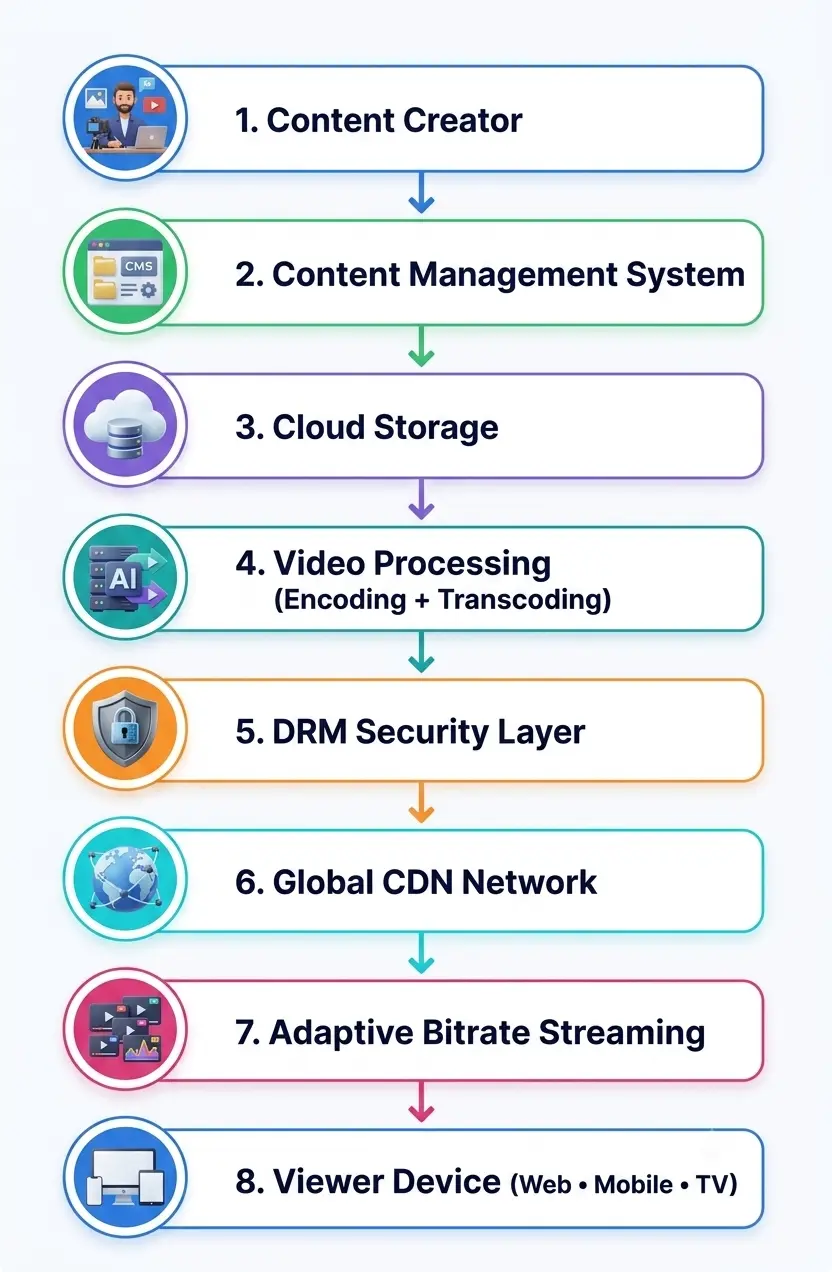
A successful streaming platform should deliver more than smooth video playback. Users expect personalized content discovery, seamless streaming across devices, secure payments, and intuitive navigation. At the same time, administrators need tools to manage content, users, subscriptions, and platform performance efficiently.
The table below outlines the essential features for both users and administrators.
| User Features | Business Value | Admin Features | Business Value |
| User Registration & Login | Secure user authentication and personalized experiences | Admin Dashboard | Monitor platform activity and performance |
| Multi-User Profiles | Supports family members with personalized recommendations | Content Management System (CMS) | Upload, organize, and manage media content |
| AI Recommendation Engine | Improves content discovery and user retention | User Management | Manage accounts, subscriptions, and permissions |
| Smart Search & Filters | Helps users quickly find relevant content | Subscription Management | Handle plans, renewals, and billing |
| Watchlist | Encourages future viewing and increases engagement | Analytics & Reporting | Track user behavior and platform performance |
| Continue Watching | Enables seamless viewing across devices | DRM & Content Protection | Prevent unauthorized access and piracy |
| Adaptive Video Streaming | Delivers smooth playback on varying network speeds | Content Scheduling | Publish or remove content automatically |
| Offline Downloads | Supports viewing without internet connectivity | Push Notification Management | Promote new releases and campaigns |
| Parental Controls | Restricts age-inappropriate content | Role-Based Access Control | Secure administrative operations |
| Multiple Payment Options | Simplifies subscription purchases | Customer Support Tools | Resolves user issues efficiently |
While these features create the foundation of a streaming platform, personalization is what differentiates a Netflix-like app from a standard video library. Features such as AI-powered recommendations, personalized homepages, continue watching, and intelligent search significantly improve user engagement and retention.
AI Features That Enhance Netflix-Like Streaming Apps
Artificial intelligence enhances multiple areas of modern streaming platforms, from content discovery and search to operational automation. Among these capabilities, recommendation engines play the most important role by helping users discover relevant content based on their preferences and behavior.
AI Recommendation Engine: The Core Personalization Layer
A recommendation engine analyzes multiple data points, including watch history, search activity, ratings, content metadata, and contextual signals such as device type or viewing time, to generate personalized content suggestions.
Modern recommendation systems typically combine collaborative filtering, content-based filtering, and machine learning models. Collaborative filtering identifies patterns among users with similar viewing behavior, while content-based filtering recommends titles based on attributes such as genre, cast, language, and themes.
As the platform collects more user interactions, machine learning models continuously refine recommendation accuracy and adapt to changing viewer preferences. For startups, recommendation capabilities can begin with managed AI services and evolve into custom models as the platform gains more users and behavioral data.
Other AI Features That Enhance the Streaming Experience
While the recommendation engine drives engagement, additional AI capabilities improve content discovery and platform operations.
| AI Capability | Purpose |
| AI Recommendation Engine | Personalize content discovery based on user behavior |
| AI Search | Understand natural language queries |
| AI Subtitle Generation | Automate localization |
| AI Content Tagging | Improve content organization |
| Predictive Analytics | Identify viewing trends |
For most startups, the recommendation engine should be the first AI capability included in the MVP because it delivers the highest business impact. Features such as AI search, subtitle generation, content tagging, and predictive analytics can be introduced gradually as the platform grows.
Tech Stack for a Streaming App Like Netflix
Selecting the right technology stack is essential for building a scalable and secure streaming platform. The technology should support high-quality video delivery, AI-powered personalization, cross-platform compatibility, and future business growth. A modular architecture also makes it easier to introduce new features without disrupting existing services.
The table below outlines the core technology stack required for a Netflix-like app.
| Technology Layer | Recommended Technologies | Business Value |
| Frontend (Web) | React.js, Next.js, Angular | Responsive and interactive user experience |
| Mobile Apps | Swift (iOS), Kotlin (Android), Flutter, React Native | Native or cross-platform mobile applications |
| Smart TV Apps | Android TV, tvOS, Fire TV, Roku SDK | Expands reach across connected TV devices |
| Backend | Node.js, Java Spring Boot, Python, .NET | Handles business logic and API requests |
| Database | PostgreSQL, MongoDB, Redis | Stores user, content, and session data efficiently |
| Cloud Infrastructure | AWS, Microsoft Azure, Google Cloud | Scalable and reliable application hosting |
| Video Storage | Amazon S3, Google Cloud Storage | Secure storage for large media libraries |
| CDN | Amazon CloudFront, Cloudflare, Akamai | Delivers fast, low-latency video streaming globally |
| Streaming Protocols | HLS, MPEG-DASH | Enables adaptive bitrate streaming |
| Video Transcoding | AWS Elemental MediaConvert, FFmpeg | Converts videos for multiple resolutions and devices |
| Digital Rights Management (DRM) | Widevine, FairPlay, PlayReady | Protects premium content from piracy |
| Payments | Stripe, PayPal, Razorpay | Supports secure subscription payments |
| AI Recommendation Engine | AWS Personalize, Google Vertex AI, TensorFlow | Delivers personalized content recommendations |
| Analytics | Google Analytics, Mixpanel, Firebase Analytics | Tracks user engagement and platform performance |
Beyond selecting technologies, businesses should adopt a microservices architecture for large-scale streaming platforms. Separating services such as user management, video streaming, payments, notifications, and AI recommendations allows individual components to scale independently as demand grows.
For the AI layer, startups often begin with managed machine learning services to reduce development time. As user data grows, they can transition to custom recommendation models that provide greater flexibility and control.
Build vs Buy: Custom Recommendation Engine or Managed Service?
One of the biggest decisions during Netflix app development is whether to build a custom recommendation engine or use a managed AI service. The right choice depends on business goals, available data, budget, and long-term product strategy.
Managed services significantly reduce development time by providing pre-built machine learning models. They are well suited for startups and businesses launching their first streaming platform. However, as the platform grows, many organizations invest in custom recommendation engines to gain greater control over personalization and customer data.
The following comparison highlights the key differences.
| Criteria | Custom Recommendation Engine | Managed AI Service (AWS Personalize / Google Vertex AI) |
| Initial Cost | Higher development investment | Lower upfront cost |
| Implementation Time | Longer | Faster deployment |
| Customization | Complete control over recommendation logic | Limited to platform capabilities |
| Scalability | Depends on internal infrastructure | Automatically scales with demand |
| Data Ownership | Full ownership and control | Data remains within the cloud provider’s ecosystem |
| Maintenance | Requires an in-house AI team | Managed by the cloud provider |
| Vendor Lock-in | None | Moderate dependency on the chosen platform |
| Best For | Mature streaming businesses with unique personalization needs | Startups and MVPs seeking faster market entry |
When Should You Build a Custom Recommendation Engine?
A custom solution becomes the right choice when personalization is central to your competitive advantage. It enables businesses to create proprietary recommendation models, combine unique user signals, and continuously optimize recommendations based on their own objectives. This approach is ideal for enterprises managing large content libraries and millions of user interactions.
When Should You Choose a Managed AI Service?
Managed platforms such as AWS Personalize and Google Vertex AI allow businesses to launch AI-powered recommendations without building complex machine learning infrastructure from scratch. They shorten development timelines, reduce operational complexity, and enable teams to validate their product before investing in custom AI development.
Many successful streaming businesses follow a hybrid approach. They begin with managed AI services to accelerate product launch and migrate to a custom recommendation engine as their audience, viewing data, and personalization requirements evolve.
For businesses planning long-term growth, the recommendation engine should be viewed as a strategic investment rather than just another feature. Choosing the right approach early can reduce development costs while creating a strong foundation for future innovation.
How Much Does It Cost to Build an App Like Netflix?
The cost to build an app like Netflix depends on the application’s complexity, supported platforms, AI capabilities, streaming infrastructure, and third-party integrations. A basic MVP costs significantly less than an enterprise streaming platform with advanced personalization, multi-device support, and large-scale content delivery.
The table below provides estimated development costs for different project scopes.
| Development Stage | Estimated Cost | Timeline | Suitable For |
| MVP Streaming App | $40,000–$80,000 | 4–6 months | Startups validating an idea |
| Mid-Level Streaming Platform | $80,000–$200,000 | 6–9 months | Growing businesses |
| Enterprise Streaming Platform | $200,000–$500,000+ | 9–14+ months | Large OTT and media companies |
Estimated Netflix App Development Cost by Feature
| Component | Estimated Cost |
| User Authentication & Profiles | $4,000–$10,000 |
| Video Streaming & Playback | $10,000–$25,000 |
| Search & Discovery | $5,000–$15,000 |
| Subscription & Payment Integration | $5,000–$12,000 |
| Content Management System (CMS) | $8,000–$20,000 |
| AI Recommendation Engine | $25,000–$60,000 |
| Cloud Infrastructure Setup | $8,000–$20,000 |
| CDN Integration & Configuration | $5,000–$15,000 |
| Video Transcoding Pipeline | $8,000–$20,000 |
| DRM & Content Security | $10,000–$25,000 |
| Analytics & Reporting | $5,000–$12,000 |
Note: These estimates exclude content licensing costs, which vary significantly depending on distribution rights, geography, and content providers.
Many businesses launch with a single monetization model and expand as their platform grows. Subscription pricing, advertising, and hybrid models should be validated alongside user behavior to ensure sustainable growth, a topic covered in our app monetization guide.
Why Do Cost Estimates Range from $40K–$500K+?
Businesses often see dramatically different estimates when researching Netflix app development. The variation usually comes from differences in project scope rather than pricing alone.
Low-cost estimates generally cover template-based streaming applications with limited customization. These solutions often exclude AI personalization, DRM, adaptive streaming, scalable cloud architecture, and advanced analytics. While they reduce upfront investment, they rarely support long-term business growth.
Businesses should also budget for annual maintenance, which typically costs 15–20% of the initial development investment. This covers platform updates, security improvements, cloud infrastructure, bug fixes, and performance optimization.
For a broader platform budgeting guide, read our OTT App Development Cost breakdown.
Development Timeline
The development timeline depends on application complexity, supported devices, integrations, and AI capabilities. Launching an MVP first allows businesses to validate their product before investing in enterprise-scale functionality.
| Development Stage | Estimated Timeline |
| Discovery & Planning | 2–4 weeks |
| UI/UX Design | 4–6 weeks |
| MVP Development | 4–6 months |
| Mid-Level Platform | 6–9 months |
| Enterprise Streaming Platform | 9–14+ months |
| Testing & Deployment | 3–6 weeks |
Challenges in Netflix App Development
Building a streaming platform involves far more than application development. Businesses must overcome technical, operational, and commercial challenges while maintaining a seamless viewing experience as their platform scales.
Content Licensing and DRM
Before publishing premium movies or television shows, businesses must obtain the necessary distribution rights from content owners. Licensing agreements vary by region and content type, making them a significant part of long-term planning. At the same time, implementing Digital Rights Management (DRM) is essential to protect premium content from unauthorized downloads, piracy, and revenue loss.
Streaming Performance and CDN Scalability
As concurrent users increase, businesses must invest in geographically distributed Content Delivery Networks (CDNs), adaptive bitrate streaming, and efficient caching strategies to minimize buffering and deliver consistent playback across varying network conditions. Poor streaming quality can directly impact customer satisfaction, watch time, subscription renewals, and overall user experience.
Cloud Infrastructure and Operational Costs
Scaling a streaming platform requires continuous investment in cloud infrastructure. Video storage, transcoding, bandwidth consumption, CDN traffic, and machine learning workloads can generate substantial operational expenses. Designing a scalable cloud architecture with automated resource allocation, performance monitoring, and cost optimization helps businesses balance streaming performance with infrastructure efficiency.
Recommendation Quality and AI Model Retraining
Recommendation quality must improve continuously as viewer preferences change, new content is added, and seasonal viewing patterns evolve. Recommendation models require regular retraining using fresh behavioral data to maintain personalization accuracy, improve content discovery, and prevent recommendation fatigue. As recommendation engines evolve, they become more effective at increasing engagement and reducing subscriber churn.
Subscriber Retention and Personalization
Subscriber retention remains one of the biggest challenges for streaming platforms. According to the Deloitte 2026 Digital Media Trends survey, 41% of U.S. consumers canceled at least one paid SVOD service in the past six months, while 22% later resubscribed to the same service. With 90% of U.S. households subscribing to at least one paid streaming service and the average household maintaining four subscriptions, personalized recommendations have become essential for reducing churn and keeping users engaged. This is one of the primary reasons recommendation engines have become a strategic investment rather than an optional feature for streaming businesses.
Content Moderation, Metadata, and Multi-Device Synchronization
Streaming platforms must also address content moderation and metadata management. Incorrect content tags, poor categorization, or low-quality metadata reduce recommendation accuracy, limit content discovery, and make search less effective. AI-assisted tagging and moderation tools help maintain a consistent, searchable content library while improving recommendation quality. In addition, delivering a seamless experience across smartphones, tablets, smart TVs, web browsers, and connected devices requires reliable multi-device synchronization. Features such as Continue Watching, synchronized watchlists, personalized recommendations, and playback history must update in real time across every device while maintaining low latency and high availability.
How RipenApps Redefined Hungama’s AI-Powered Streaming Experience
Developing a successful streaming platform requires more than delivering high-quality video. It demands intelligent content discovery, scalable infrastructure, and a seamless viewing experience across devices.
Challenge
Hungama wanted to enhance user engagement across its digital entertainment platform while delivering smooth streaming to millions of users. Managing a massive content library, supporting high traffic, and helping users discover relevant content efficiently were key business challenges.
Solution
RipenApps developed a scalable streaming platform powered by a recommendation engine that personalizes content based on user behavior and consumption patterns. Although Hungama delivers music, movies, podcasts, and other digital entertainment content, the same AI-powered personalization architecture applies across streaming formats, helping users discover relevant content more efficiently. The solution also incorporated adaptive bitrate streaming, cloud-based infrastructure, and cross-device compatibility to ensure uninterrupted playback under varying network conditions.
Results
- 50M+ monthly active users
- 30M+ songs, movies, podcasts, and entertainment content available
- Improved cross-format content discovery through AI-driven personalization
This project demonstrates how combining AI-powered personalization with modern streaming infrastructure helps media businesses improve user engagement, increase content consumption, and build scalable digital entertainment platforms.
Conclusion
Building an app like Netflix requires more than developing a video streaming application. Partnering with an experienced media and entertainment app development company helps businesses build scalable streaming platforms that combine intelligent personalization, secure infrastructure, and seamless viewing experiences.
If you are planning Netflix app development, start with a scalable MVP, validate user demand, and expand your AI capabilities as your platform grows. This approach reduces development risk while creating a strong foundation for sustainable business success. At RipenApps, we help startups and enterprises build scalable streaming platforms with AI-powered recommendation engines, secure cloud infrastructure, and seamless multi-device experiences. Whether you’re launching a niche streaming service or an enterprise OTT platform, our team can help turn your vision into a market-ready product.
Frequently Asked Questions
1. How much does it cost to build an app like Netflix?
The cost to build an app like Netflix typically ranges from $40,000 to $500,000+, depending on the application’s complexity, supported platforms, AI capabilities, streaming infrastructure, and third-party integrations. An MVP usually costs $40,000–$80,000, while enterprise-grade platforms with advanced personalization and scalable architecture require a significantly higher investment.
2. Can startups build a Netflix-like app with an MVP?
Yes, startups can build a Netflix-like app with an MVP by focusing on essential streaming features and validating user demand before investing in advanced capabilities. An MVP typically includes features such as user registration, content browsing, video streaming, search, subscriptions, user profiles, and a basic recommendation engine.
3. How does Netflix’s recommendation engine work?
Netflix’s recommendation engine analyzes watch history, search activity, viewing behavior, content preferences, and contextual signals to recommend movies and TV shows that match each user’s interests. It combines collaborative filtering, content-based filtering, and machine learning models to continuously improve personalization and content discovery.
4. Can I build a Netflix-like app without an AI recommendation engine?
Yes, but modern streaming platforms increasingly use AI recommendations to improve content discovery and personalize user experiences. Startups can launch with basic recommendation capabilities and upgrade to advanced models as their audience grows.
5. Do I need content licenses to launch a streaming app?
Yes. If your platform streams copyrighted movies, TV shows, or premium media, you must obtain the appropriate content licensing rights before distribution. You should also implement Digital Rights Management (DRM) to protect licensed content from unauthorized access and piracy.
6. Should I build a custom recommendation engine or use AWS Personalize?
For most startups, AWS Personalize or similar managed AI services provide a faster and more cost-effective way to launch personalized recommendations. As your platform grows and collects more user data, a custom recommendation engine offers greater flexibility, customization, and control over recommendation logic.
7. What tech stack does a Netflix-like app need?
A Netflix-like app typically includes React or Angular for web development, Swift and Kotlin (or Flutter/React Native) for mobile apps, Node.js or Java Spring Boot for the backend, PostgreSQL or MongoDB for databases, AWS or Google Cloud for infrastructure, CloudFront or Cloudflare for CDN, HLS/DASH for adaptive streaming, Widevine/FairPlay for DRM, and an AI recommendation engine powered by AWS Personalize, Google Vertex AI, or custom machine learning models. Services like AWS Personalize or custom machine learning models.
Discuss your project and request for proposal
SHARE
WRITTEN BY

Ishan Gupta
CEO & Founder
Ishan Gupta is a seasoned entrepreneur and CEO with extensive 10+ years of experience in business and mobile app development landscape. He believes that the right digital product allows companies to focus on what they do best, while technology handles the rest. With deep exposure to global markets, he understands what makes an app succeed. His approach translates business needs into clear product strategies, ensuring that every feature contributes to measurable ROI.
View All Articles