

Key Takeaways
- Look beyond the lowest quote. A low upfront cost can lead to higher expenses if the project needs major fixes or rebuilding later.
- Choose a complete development team. A reliable team brings expertise across design, development, testing, and project management instead of depending on one developer.
- Review relevant experience and portfolio. Look for similar apps, industries, business models, technical requirements, and real project outcomes.
- Prioritize discovery before development. A good partner should understand your goals, users, features, technical requirements, and scope before giving you a final estimate.
- Choose a partner who can challenge your ideas. They should help prioritize essential features, avoid unnecessary complexity, and keep the product aligned with your business goals.
- Clarify ownership from the start. Your agreement should clearly define ownership of the source code, designs, documentation, intellectual property, and other project assets.
- Evaluate long-term support. Consider how the company handles testing, launch, maintenance, security updates, performance improvements, and future scaling.
The mobile app market is more competitive than ever. With millions of apps available across major app stores, having a good idea is no longer enough to build a successful product. You also need the right team to turn that idea into a reliable, user-friendly, and scalable app.
When you hire a mobile app development company, you are choosing more than a team to build your app. You are choosing a long-term technology partner who can influence your product quality, development timeline, budget, and ability to grow.
One common mistake is choosing a development partner based only on the lowest quote. A lower upfront cost can become expensive when unclear requirements, poor development practices, weak testing, or limited scalability lead to repeated fixes and additional development work. The right partner should help you identify these risks before development begins.
This is why knowing how to choose a mobile app development company matters. You need a partner who understands your business goals, communicates clearly, follows a structured development process, and provides reliable mobile app development services beyond the initial launch. This guide covers the key factors, questions, and practical steps you should consider before making your decision.
Table of Contents
Detailed Analysis of Mobile App Market Revenue
According to Statista’s Worldwide App Market Outlook, total revenue in the app market is projected to reach $739.61 billion in 2026, growing at a compound annual rate of 8.17% between 2026 and 2031 to reach $1.10 trillion by 2031. Downloads are forecast to hit 528.48 billion in 2026, and the United States remains the single largest market at $317.39 billion.
Within that 2026 total, in-app purchases account for $475.84 billion and advertising for $256.87 billion, while paid app downloads contribute only $6.90 billion. That split matters when you brief a development partner, because the monetisation model you choose changes the architecture they need to build.
The exponential rise in smartphone usage globally increases the potential user base. Furthermore, the different categories, including eCommerce, gaming, and entertainment, broaden revenue streams and unlock opportunities.
The recent trends of artificial intelligence and augmented reality have increased innovation and user engagement. Apart from these technologies, monetization strategies like subscriptions, in-app purchases, and targeted advertising contribute significantly. Nowadays, mobile apps have become widely used for various tasks, increasing revenue growth in the app market.
Why Businesses Should Partner With a Mobile App Development Company?
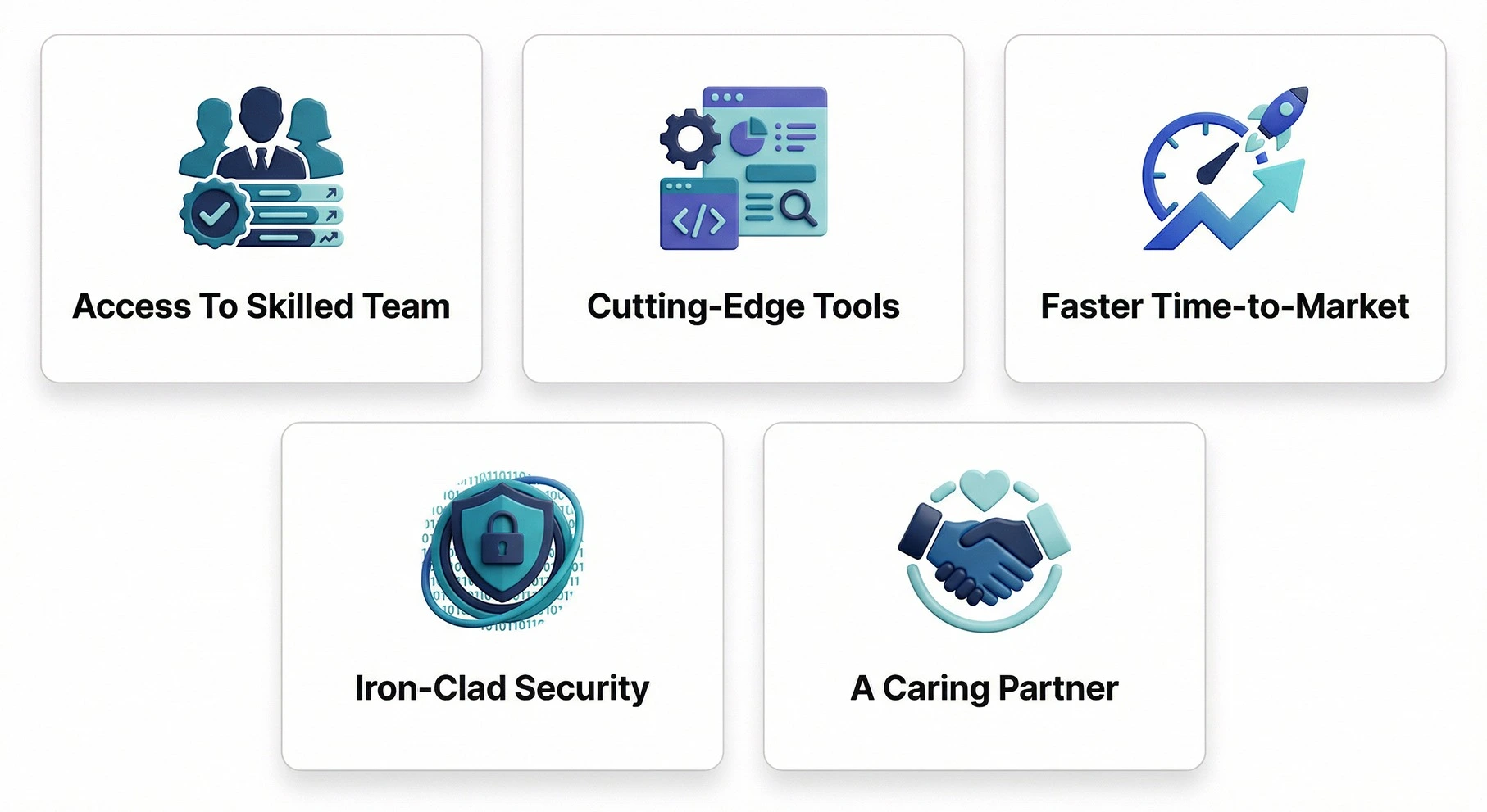
Hiring the best mobile app development company offers many advantages, ensuring successful app development and continued success in a competitive market. There are several players in the market, which makes finding the right one very hectic. But before exploring the steps to hire a mobile app development company, let’s first discover the top reasons to consider this partnership.
Access To An Experienced & Skilled Team
When you hire a mobile app development company, you get a “Full-Stack” ecosystem that stays ahead of modern mobile app development trends.
- Specialized Roles: You get a Project Manager, a UI/UX Designer, a Backend Architect, and a QA Tester.
- Collective Intelligence: A company has solved hundreds of problems similar to yours, meaning they don’t learn on your dime. They bring expert problem-solving skills.
- Reliability: If one developer is unavailable, the project doesn’t stop. The company ensures continuity to help you launch before the others.
Cutting-Edge Tools Without Extra Cost
A top-tier custom application development company invests thousands of dollars in high-end software, testing devices, and AI-driven development tools.
- Device Lab Access: Your app is tested on 50+ different screen sizes and OS versions.
- Modern Tech Stacks: They stay updated on the latest technologies, ensuring your app isn’t built on dying technology.
- Efficiency: Professional tools mean faster builds and fewer bugs, saving you money in the long run.
Faster Time-to-Market
In the mobile app development business, speed is everything. If you take 12 months to launch, a competitor might beat you in 6. When you hire a company, they help you with:
- Pre-Built Modules: Established companies have libraries of secure, pre-tested code (like login or payment flows) that speed up development.
- Agile Workflows: They use proven systems to ship features every two weeks, keeping your project moving at lightning speed.
- Focused Execution: Unlike an in-house team that might get distracted by daily office tasks, a partner is contractually bound to hit your deadlines.
Iron-Clad Security & Compliance
Whether you are from the USA, India, or the UK, you need to follow strict laws to avoid legal problems after launch. Partnering with a company allows you to include:
- Security-by-Design: Professionals build security into the “bones” of the app, protecting you from data breaches.
- Legal Safety: They ensure your app meets App Store and Google Play review requirements, along with the data-protection rules that apply in your target markets, such as GDPR in the EU or HIPAA for US healthcare products.
- IP Protection: A professional company provides clear contracts ensuring you own 100% of the code and intellectual property.
A Partner Who Cares
Partnering with the best mobile app development company means that you are getting a consultant who can answer all your questions and treat your project as theirs. Having them by your side provides you with:
- Market Insight: They can tell you if a feature is a waste of money based on real-world user data.
- Future-Proofing: They help you choose a mobile development partner strategy that allows your app to grow from 1,000 to 1,000,000 users without crashing.
- Post-Launch Support: They don’t just build and bolt. They provide a roadmap for updates, bug fixes, and top mobile app features to keep your users happy.
How to Choose the Right Mobile App Development Company: Start With Discovery
Before you compare vendors, you need to know what you are asking them to build. The strongest partners will not quote a number until they have run a discovery phase, and the way a company handles that phase tells you more than any portfolio page.
A proper discovery covers four things.
Problem Validation
A good partner will ask who has the problem you are solving, how they solve it today, and why they would switch. If nobody on their side asks these questions, they are positioned to build what you describe rather than what your users need. Our guide on the mobile app development process sets out where discovery sits relative to design and build.
Scope Challenge
Expect the partner to argue with your feature list. A team that agrees to everything in the first call is optimising for the contract, not the product. The right response to a twenty-feature brief is a conversation about which three features prove the idea.
MVP Definition
Discovery should end with a defined first release, not an open-ended scope. If you are unsure whether you need a working first version or a testable concept, our breakdown of MVP vs prototype explains what each one is meant to prove.
Success Metrics
Ask what the partner would measure after launch. A vendor who cannot name the metrics that would show the app is working has not thought past delivery.
If a company skips all four and goes straight to a quote, treat that as the first data point in your evaluation rather than as efficiency.
How To Hire A Mobile App Development Company?
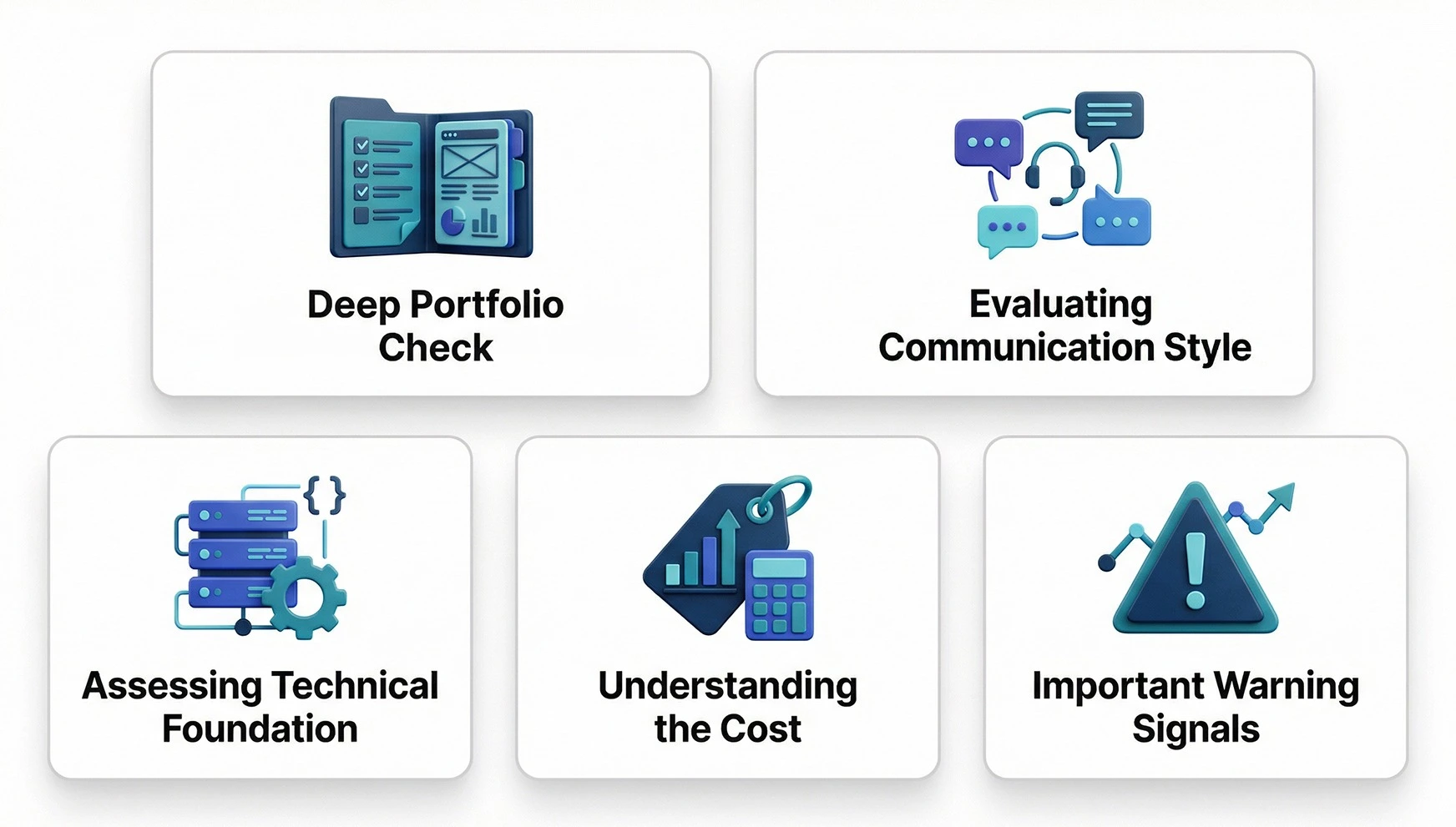
Choosing your best app development partner is crucial for the continued success of your project. You need to follow some important steps to make an informed decision and partner with a trustworthy mobile app development company in USA. Here are the crucial steps:
Step 1: The “Look Beyond the Surface” Portfolio Check
In the world of digital growth, a portfolio is a testament to a company’s ability to solve real business problems. When you decide to hire a mobile app development company, the first thing you usually see is a “Success Stories” page. But to find a true mobile development partner, you have to dig deeper.
Screenshots can be bought or faked, but performance cannot. Here’s how to perform a forensic audit to ensure they can deliver on their promises:
Download and Use
Head to the App Store or Google Play and download at least three of their recent projects. Check the feel of the application they have built and pay attention to the visual polish to understand their approach to design and aesthetics.
Check the Industry Fit
A mobile app development company in USA might be great at building games but terrible at building a secure medical platform. Look for apps that share your business logic and their compliance knowledge, such as HIPAA for Healthcare and PCI-DSS for Fintech app development.
Spot the Truth
Every app development company will show you 5-star testimonials. To find the best, you need to look for “Substance.” Reviews like Great Work or Fast Delivery are often filler. You need to look for reviews that mention specific hurdles.
Client Longevity
The ultimate criterion for these mobile app development companies is their relationship history. Do they build one app for a client and disappear? Or do they handle Version 1.0, 2.0, and 3.0? A client staying for 3+ years is the strongest “5-star review” you can find. It proves the company is a partner, not just a service provider.
Domain Experience
A company that has operated for a decade in gaming brings almost nothing transferable to a regulated fintech build. Ask how many years they have worked in your specific category, how many products they have shipped in it, and which regulatory or integration problems they have already solved there. Length of time in business is a weak signal on its own; depth in your domain is the one that matters.
Step 2: Evaluate Their Communication Style
Once you have shortlisted potential development partners, assess how clearly and consistently they communicate. You may work with the team for months or even years, so communication should be simple, transparent, and easy to manage.
A Good Partner Should Challenge Your Ideas
A development partner should not agree with every feature without reviewing its value. Too many features can increase development time, costs, and product complexity. Look for a team that can suggest alternatives, identify unnecessary features, and help you prioritize what matters most for the first release.
Choose a Team That Explains Things Clearly
You should not need technical expertise to understand your project’s progress. The team should explain technical decisions, challenges, timelines, and risks in clear business language. Clear communication also makes it easier to make decisions and address issues before they affect the project.
Set Clear Communication Channels
Discuss how you will communicate before development begins. Ask which tools the team uses for meetings, project updates, task management, and day-to-day communication. A dedicated point of contact can also make it easier to track progress, share feedback, and get timely responses.
Step 3: Assess the Technical Foundation
Before you hire a mobile app development company, look beyond the app’s design and evaluate the technology behind it. A strong technical foundation helps your app perform reliably, remain secure, and support future growth.
Your development partner should be able to explain the technology stack, architecture, integrations, security measures, and scalability plans in clear and practical terms. This helps you understand whether the app is being built to meet your current requirements while leaving room for future updates and growing users.
Safeguarding Your Digital Assets
In 2026, data is extremely valuable for businesses. When you hire an experienced team, ask specifically how they protect sensitive information like credit card numbers and passwords. Modern businesses become successful because they are trustworthy.
Your data should be unreadable even if a hacker gets into the server. Think of APIs as the doors to your app; ensure the doors are locked with modern authentication (like OAuth 2.0). Ask your partner to use native phone features like Face ID or fingerprint sensors for an extra layer of safety.
Future Readiness: Testing for Scalability
What happens if your app goes viral tomorrow? The best company won’t let your app crash when 10,000 people log in at once. Use cloud services like AWS or Azure that “breathe” with your traffic. By breaking the app into smaller, independent pieces, one slow feature won’t bring down the entire mobile app.
Ownership Rights: You Pay, You Own
This is a non-negotiable rule in the mobile app development process. You pay for the code; you should own the code. Ensure your contract explicitly states that all intellectual property (IP) belongs to you. A professional mobile app development company will give you access to the source code so you aren’t trapped with one developer forever.
Using AI in Modern Development
Are they still hand-coding every single line? Or are they using AI-powered shortcuts? A growth-focused company will focus on adapting modern tools, allowing developers to build AI-powered applications 30-50% faster by automating repetitive tasks. Make sure your development partner uses AI to track how users behave, which can result in fixing “drop-off” points before they happen.
Step 4: Understand Where Your Money Goes
When you prepare to hire a mobile app development company, the initial quote can often feel like a black box. In 2026, the cost to develop an app in the U.S. typically ranges from $50,000 to over $300,000+ for complex solutions. To ensure your investment translates into a high-performance product, you must understand the mechanics of the pricing models and the long-term commitments involved in the process.
Fixed Price vs. Hourly: Predictability or Flexibility?
Choosing the right billing structure is less about the total sum and more about the nature of your project.
- Fixed Price: This is the safe bet for startups focusing on MVP development. You agree on a specific scope and a set price upfront. It provides budget certainty, which is ideal if your requirements are crystal clear and unlikely to change mid-build.
- Hourly (Time & Material): This model gives you the freedom to pivot. You pay for the actual hours the development team spends on design, coding, and testing. It is the preferred choice for complex, long-term projects where features evolve based on real-time user feedback.
Costs Beyond Development
The app development process doesn’t end at the launch. There are recurring hidden costs that every founder must include in their financial roadmap:
- App Store Fees: Apple requires an annual $99 membership, while Google Play charges a one-time $25 fee.
- Infrastructure & Servers: Cloud hosting (AWS, Google Cloud) operates on a pay-as-you-go model. For an app with moderate traffic, expect to spend between $500 and $5,000+ per month on servers and data storage.
- Monthly Maintenance: Security patches, OS updates, and bug fixes are non-negotiable. Typically, annual maintenance costs sit at 15-20% of your original development budget.
Milestone-Based Payments
When you hire mobile app developer teams, never pay the full amount upfront. The industry standard is Milestone Payments, which protects both you and the vendor. Payments are tied to specific, verifiable deliverables:
- Kickoff (10-15%): Covers the discovery and planning phase.
- Design Completion (20%): Paid once you approve the final UI/UX design.
- Beta Release (30-40%): Paid after the core functionality is built and testable.
- Final Launch (15-25%): Released only after the app is live and stable in the stores.
Step 5: Warning Signals You Shouldn’t Ignore
Learning how to choose a company is as much about knowing who to avoid as it is about finding the right fit. In a market where 2026 user expectations are at an all-time high, a single mistake in your selection process can lead to technical debt that sinks your startup. If you encounter any of the following red flags during your search for a partner, it is time to walk away.
Unrealistically Low Pricing
If you get a quote that is 50% lower than everyone else, be very careful. In the process, a “too good to be true” price usually means the agency is cutting corners on code quality, security, or testing. The risk is that you might end up with complex code that crashes under traffic or contains massive security holes. The outcome is that you will likely spend 3x more later to have a professional team fix or rebuild the app from scratch.
Unclear or Open-Ended Timelines
Professional mobile app development companies live by Milestones. If a company cannot provide a clear app development procedure with specific dates for wireframes, prototypes, and beta testing, they lack a structured workflow.
Without a timeline, your project can drag on for months, causing you to miss critical market windows or run out of funding. A reliable partner uses Agile methodology to show you progress every 2 weeks (sprints).
No Strategy Beyond Launch
A common mistake in the app development world is thinking the work ends at launch. If a vendor doesn’t discuss a long-term maintenance agreement, they aren’t looking out for your success.
Apps require constant updates to stay compatible with each annual iOS and Android release, and to fix post-launch bugs. If the company doesn’t offer support, your mobile app will become obsolete and start crashing within six months of release.
Agreement Without Discovery
Transparency is one of the most important criteria for the partnership between businesses and app development companies. If you only ever speak to a sales manager and never the actual developers, you might be dealing with a “Ghost” team.
Some agencies show you a senior portfolio but then hire mobile app developer interns or low-cost offshore freelancers to do the actual work. So, you should always ask for a video call with the lead developer or project manager who will be working on your project daily.
Beyond the Price Tag: Critical Factors to Consider Before Hiring
Choosing to hire a mobile app development company based only on the lowest quote is a risky move. We have listed the “under-the-radar” factors that truly separate a vendor from a mobile development partner.
Ask for a “Developer Account” Verification
A professional company should have its own registered Developer Accounts on the Apple App Store and Google Play. While you will eventually host the app on your own account, verifying their accounts proves they have successfully navigated the legal and technical hurdles of app publishing dozens of times. If they don’t have an active account, it’s a sign they might be new to the mobile app development business.
Request a “GitHub Repo” Walkthrough
GitHub is where the truth of the code lives. When you hire a mobile app development company, ask them to walk through a sample repository of a past project (where an NDA allows). Remember, you are looking for version control, not secret logic. A partner who uses GitHub correctly ensures that if you ever need to switch developers, the new team won’t have to spend weeks deciphering a mess.
The “Whiteboard” Data-Flow Test
During your final interview, ask their lead architect to whiteboard the data flow of your app in five minutes. If they can explain how your app’s data moves from the user’s screen to the server and back in simple terms, they truly understand your project. If they struggle or use vague geek-speak, they likely haven’t thought through your app’s Future Readiness.
Post-Launch Documentation
Many startups are held hostage by developers because they don’t have the “instruction manual” for their own app. Ensure your contract includes the delivery of Technical Documentation. This should include:
- Server Credentials: How to access your data.
- API Documentation: How your app talks to other services.
- Architecture Map: A mobile app architecture guide for future developers to improve functionality without breaking the app.
Business Intelligence & Analytics Integration
A coder builds what you ask for, but a partner builds what helps you grow. Ask if they automatically integrate tools like Mixpanel, Google Analytics, or Hotjar. Without these, you won’t know where users are dropping off. An experienced company that prioritizes data ensures you have the insights needed to make your app popular.
Should You Hire an Agency at All?
An external partner is not automatically the right model. An in-house team gives you direct control and builds a permanent technical function, at the cost of hiring time and fixed salaries. Freelancers work for contained scopes but leave you managing coordination, QA, and maintenance yourself. Our comparison of in-house vs outsourcing app development sets out where each model makes sense so you are choosing deliberately rather than by default.
The Bottom Line
Choosing the right mobile app development partner requires looking beyond coding skills or the lowest project quote. You need a team that understands your business goals, evaluates your app idea realistically, follows a clear development process, communicates consistently, and can support the product after launch.
Before making a decision, consider the company’s relevant experience, portfolio, technical capabilities, discovery and planning process, security practices, pricing structure, ownership terms, and post-launch support. These factors can help you compare potential partners and make a more informed decision when you hire mobile app developers for your project.
At RipenApps, these are the same factors we consider when working with businesses on their mobile app projects. Whether you are validating an app idea, planning an MVP, or preparing for a larger product build, having the right development partner can create a more structured and predictable path from idea to launch.

FAQs
Q1. What factors should I consider when choosing a mobile app development company?
Look beyond just the price tag. Focus on industry expertise, technical proficiency, and their development process. Most importantly, evaluate their security protocols and whether they provide a clear agreement on IP ownership so you own 100% of your code.
Q2. How do I evaluate a mobile app development company’s portfolio and experience?
Don’t just look at screenshots; download and test their live apps from the stores. Check for speed, intuitiveness, and crash rates. Look for domain-specific experience and recent work to understand their approach and expertise.
Q3. What questions should I ask before hiring a mobile app development company?
Some important questions you should ask before hiring a company are:
- Who will be my daily point of contact?
- How do you handle feature changes mid-development?
- Can you whiteboard the data flow for my app in five minutes?
Q4. How important is post-launch support when selecting an app development company?
This is critical. An app development project doesn’t end at development. It requires regular updates for new OS versions, security patches, and bug fixes based on real user feedback.
Q5. How much does it cost to hire the right mobile app development company?
Cost varies by complexity and region. As indicative US bands, an MVP or single-platform first release typically runs $15,000 to $50,000, a mid-complexity cross-platform app with integrations runs $50,000 to $120,000, and a complex or enterprise build involving AI, real-time features, or regulatory compliance runs $150,000 to $250,000 and above. These are planning ranges rather than quotes, and the final figure depends on scope, integrations, and the size of your testing matrix.
Discuss your project and request for proposal
SHARE
WRITTEN BY

Vaibhav Sharma
Business Head
Vaibhav Sharma bridges product vision with real-world execution. He shares consultation with startups and enterprises to shape digital strategies, refine user journeys, and create app experiences that feel intuitive from day one. His strength lies in transforming early concepts into clear development roadmaps that set products up for long-term success.
View All Articles