


Quick Summary
React Native remains one of the leading frameworks for mobile app development in 2026, enabling businesses to build high-performance Android and iOS applications from a single codebase. With its New Architecture, strong ecosystem, cost efficiency, and growing AI capabilities, React Native offers a scalable and future-ready solution for startups, enterprises, and digital-first businesses.
Key Takeaways
- React Native enables Android and iOS development from a single codebase.
- The New Architecture significantly improves performance and scalability.
- Businesses can reduce development costs and accelerate time-to-market.
- Fast Refresh improves developer productivity.
- Strong community support and a mature ecosystem simplify development.
- React Native is ideal for startups, enterprises, SaaS platforms, marketplaces, and AI-powered mobile applications.
- While highly versatile, certain graphics-intensive applications may still benefit from native development.
Mobile applications have become the primary touchpoint between businesses and their customers. Whether it’s shopping, banking, healthcare, education, entertainment, or enterprise operations, users now expect seamless mobile experiences that are fast, intuitive, and reliable.
The mobile app industry continues to grow at a remarkable pace, with global app-market revenue projected to reach $633.71 billion in 2026 and $781.70 billion by 2029. In this increasingly competitive landscape, frameworks like React Native are helping businesses build and launch mobile applications more efficiently than ever before. For businesses, however, delivering those experiences across both Android and iOS can be challenging. Building separate native applications often means managing two development teams, two codebases, longer timelines, and significantly higher costs. This is why many organizations continue to choose React Native for mobile app development. For companies already familiar with mobile app development with React, React Native offers a natural path into the mobile ecosystem without requiring an entirely new technology stack.
Today, startups, enterprises, and global brands rely on React Native to accelerate development, reduce costs, and launch products faster. As the framework continues to evolve with its New Architecture, improved performance, and growing enterprise adoption, it remains one of the strongest choices for cross-platform mobile development.
This is also why many businesses choose to partner with an experienced React Native app development company to streamline product development, minimize technical risks, and bring high-quality mobile applications to market more efficiently.
Table of Contents
What is React Native For Mobile App Development?
React Native is an open-source framework developed by Meta that allows developers to build mobile applications using JavaScript and React.
Unlike traditional hybrid frameworks, React Native renders native UI components, allowing applications to deliver a user experience that feels much closer to native apps while maintaining the efficiency of a shared codebase.
For businesses exploring react native for mobile app development, the framework provides a practical balance between development speed, performance, and long-term scalability.
One of the reasons mobile app development with React Native has become so popular is its ability to leverage existing React knowledge. Teams already using React for web products can often transition into React for mobile development with a shorter learning curve compared to entirely new ecosystems.
This flexibility has made React Native app development a preferred choice for startups and enterprises looking to build high-quality mobile applications efficiently across multiple platforms.
Inside React Native’s New Architecture
React Native has undergone a major transformation over the last few years. Beginning with React Native 0.76, the New Architecture became the default experience.
By React Native 0.82, support for the legacy architecture was fully removed, making the New Architecture the standard foundation for modern applications. This evolution has strengthened React Native for app development, particularly for businesses seeking better performance and future scalability.
The New Architecture is built around five key pillars:
JSI (JavaScript Interface)
JSI is one of the core components of React Native’s New Architecture. It enables direct communication between JavaScript and native code, eliminating the need for the legacy bridge.
By reducing communication overhead and avoiding data serialization delays, JSI improves application responsiveness, enables smoother interactions, and supports more advanced native integrations.
Fabric Renderer
Fabric is React Native’s modern rendering engine built to deliver faster and more efficient UI updates. It improves synchronization between JavaScript and native components, resulting in smoother animations, quicker screen transitions, and a more responsive user experience.
Fabric also provides a stronger foundation for complex user interfaces and future React Native enhancements.
TurboModules
TurboModules optimize application performance by loading native modules only when they are required instead of initializing everything at startup.
This lazy-loading approach reduces startup time, improves resource utilization, and helps applications scale more efficiently as new features and integrations are added.
Codegen
Codegen automatically generates strongly typed interfaces between JavaScript and native code, reducing the amount of manual development work required.
This improves consistency across platforms, minimizes integration errors, and helps developers build more reliable and maintainable applications with greater confidence.
Hermes JavaScript Engine
Hermes is the optimized JavaScript engine designed specifically for React Native. It enhances application startup speed, lowers memory consumption, and improves overall runtime performance. These optimizations contribute to faster load times, smoother user experiences, and better performance on a wide range of Android and iOS devices.
Is React Native Worth It in 2026?
Yes. React Native remains one of the most practical frameworks for organizations that need to launch Android and iOS applications quickly while controlling development costs. Its mature ecosystem, strong community support, enterprise adoption, and modern architecture make it a dependable choice for both startups and established businesses.
Whether you’re working with an in-house team or partnering with a custom app development company, React Native offers the flexibility, scalability, and efficiency needed to build high-quality mobile applications for today’s competitive market.
10 Benefits of Choosing React Native for Mobile App Development
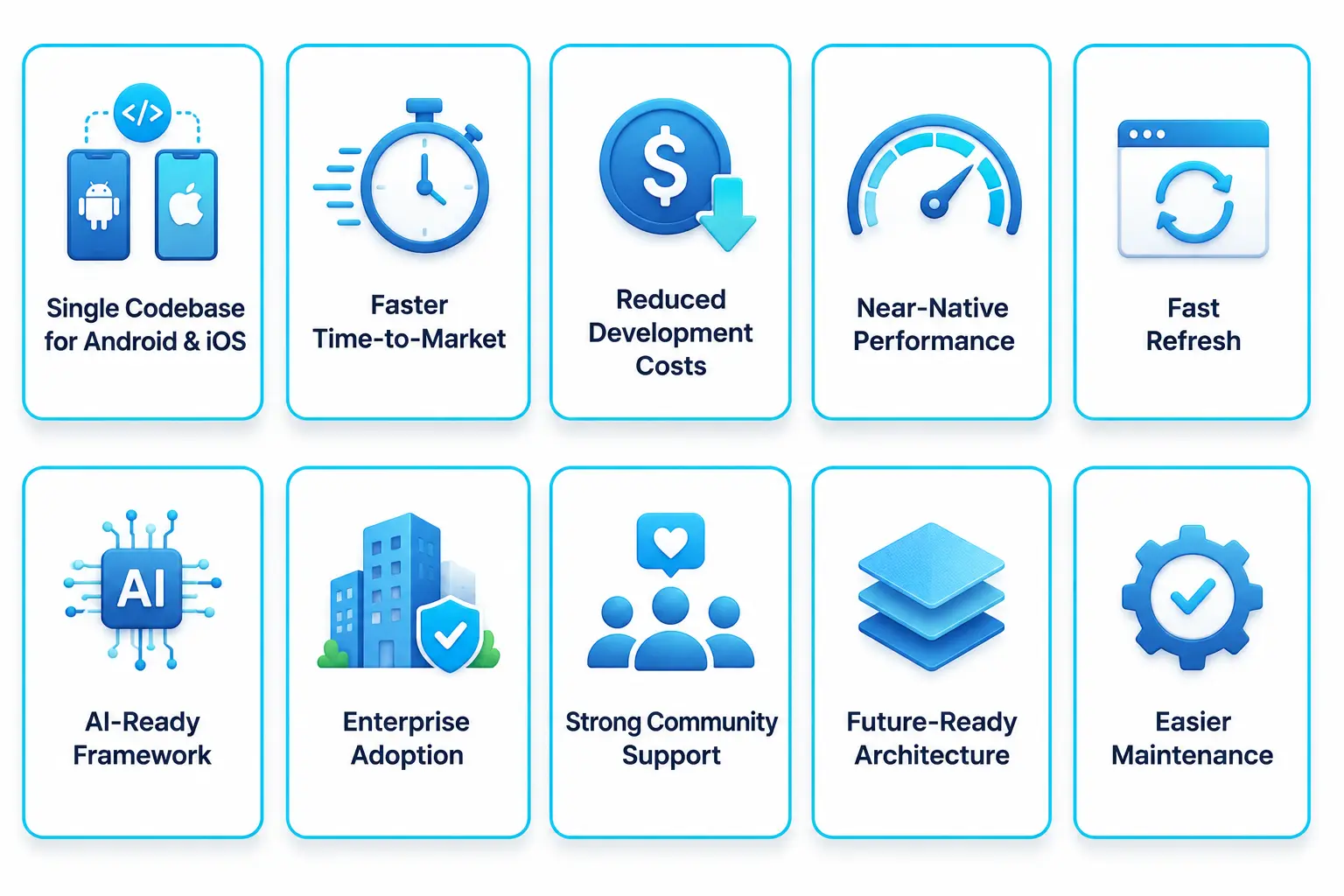
Here are the prominent reasons why businesses should choose react native for their next mobile app project. So, check out the following benefits of React Native technology:
1. Develop Android and iOS Apps from a Single Codebase
One of the biggest advantages of React Native is code reusability. Rather than building separate applications for Android and iOS, businesses can share a substantial portion of their codebase across both platforms. This significantly reduces development effort, maintenance requirements, and project complexity. While businesses should still consider Android vs. iOS user behavior when tailoring user experiences, React Native allows them to reuse most of the underlying code without sacrificing platform-specific optimization.
For example, a company building an Android app with React can simultaneously create an iOS version without duplicating most of the business logic. Similarly, React Native for iOS and Android enables teams to maintain consistency across platforms while accelerating product delivery.
Business Benefits:
- Faster development cycles
- Lower maintenance costs
- Consistent user experience
- Easier feature deployment
2. Reduced Development Costs
Cost efficiency remains one of the primary reasons businesses adopt React Native. Because developers can work from a shared codebase, organizations can significantly reduce React Native development costs compared to maintaining separate native teams for iOS and Android.
This makes the framework particularly attractive for startups, SMBs, and enterprises looking to maximize their development budgets. Rather than allocating resources to duplicate work, teams can focus on product innovation, faster releases, and long-term business growth.
3. Faster Time-to-Market
Launching quickly is often critical in competitive markets. React Native enables businesses to accelerate product development by streamlining coding, testing, deployment, and maintenance workflows.
Whether you’re building a startup MVP or expanding an enterprise platform, faster delivery allows you to gather feedback sooner and iterate more efficiently. This is one reason many businesses choose react native for mobile apps when speed is a key business objective.
Businesses evaluating cross-platform frameworks often compare React Native with Flutter before making a technology decision. While a Flutter app development company may recommend Flutter for projects requiring highly customized UI experiences, React Native is frequently preferred by organizations seeking faster onboarding, a mature ecosystem, and seamless integration with existing React development expertise.
4. Fast Refresh Improves Developer Productivity
Modern React Native development includes Fast Refresh, a feature that allows developers to see code changes almost instantly during development.
This reduces waiting time, improves debugging efficiency, and accelerates feature iteration. For development teams, even small productivity improvements can create substantial time savings across large projects.
5. Near-Native Performance
Performance concerns were once a common criticism of cross-platform development. However, the New Architecture has significantly narrowed the gap between React Native and native development.
Today, a modern React Native app for Android or iOS can deliver excellent performance for most business applications, including:
- eCommerce platforms
- Fintech solutions
- Healthcare applications
- Social networking apps
- Enterprise software
- On-demand service platforms
For the majority of commercial use cases, users are unlikely to notice any meaningful difference between React Native and native experiences.
6. Large and Active Developer Community
One of React Native’s biggest strengths is its vast and active developer community. According to Stack Overflow, 2025 Developer Survey, part of that strength comes from the language itself: JavaScript remains the most commonly used programming language among developers, which gives React Native one of the deepest and most accessible talent pools in mobile development — making it easier and faster for businesses to hire and scale teams. As one of the most widely adopted cross-platform frameworks, React Native is supported by thousands of contributors, developers, and technology companies worldwide.
Businesses benefit from extensive documentation, a rich collection of open-source libraries, community-driven solutions, educational resources, and access to experienced development talent. This strong ecosystem helps reduce development risks, accelerates problem-solving, and enables teams to build and scale applications more efficiently.
The availability of pre-built solutions and access to a top React Native component ecosystem further helps developers accelerate development while maintaining consistency across mobile applications.
7. Mature Ecosystem and Tooling
Over the years, React Native has evolved into a mature development ecosystem backed by powerful tools and frameworks that simplify the app development process. Solutions such as Expo, EAS Build, React Navigation, Redux Toolkit, Firebase, RevenueCat, and Sentry help developers streamline workflows, improve productivity, and accelerate deployment.
These tools reduce the time and effort required to build production-ready applications while ensuring better scalability and maintainability. For organizations already using React for app development, React Native offers a familiar and highly productive environment for extending their products to mobile platforms.
Developers also benefit from access to top React Native UI libraries, which simplify interface design and help create visually appealing, production-ready mobile experiences more efficiently.
8. Easier Maintenance and Updates
Maintaining two separate native applications can become expensive and time-consuming. React Native simplifies maintenance because updates can often be deployed across platforms simultaneously. This reduces technical debt while helping businesses deliver new features more efficiently.
The result is a more sustainable development process over the long term, making it an attractive option for organizations looking to streamline their application maintenance services and ongoing product improvements.
9. Ideal for Startup MVP Development
Startups frequently need to validate ideas quickly. React Native enables founders to launch MVPs faster while keeping development costs under control. By reducing development complexity, startups can focus on:
- User acquisition
- Product-market fit
- Customer feedback
- Revenue generation
This makes React Native particularly attractive for early-stage companies looking to scale efficiently.
10. Future-Ready Architecture
The mobile development landscape continues to evolve rapidly. React Native’s modern architecture provides a strong foundation for future technologies, including AI-powered applications, advanced integrations, and next-generation mobile experiences.
Businesses investing in React Native for mobile app development today gain access to a framework that continues to receive significant support from Meta and the broader developer community. As mobile technologies advance, React Native remains well-positioned to support long-term growth and innovation.
Read Also: React Native vs Native Apps: Which is Best For Your Business in 2026?
The Growing Significance of React Native for Mobile App Development in 2026
As mobile applications become increasingly intelligent, businesses need development frameworks that can adapt to evolving user expectations and emerging technologies. AI has moved from a competitive differentiator to a business standard. According to McKinsey & Company’s The State of AI 2025 report, 88% of organizations now use AI in at least one business function, up from 78% the previous year. As intelligent features become integral to mobile applications, React Native is well-positioned to support this shift through its mature ecosystem, improved performance with the New Architecture and Hermes engine, and seamless integration with AI-powered services. Combined with its cross-platform capabilities and enterprise adoption, React Native remains a future-ready framework for building scalable, high-performance mobile applications in 2026 and beyond.
Common AI Use Cases Built with React Native
Businesses are using React Native to develop:
- AI-powered chatbots
- Virtual assistants
- Smart search functionality
- Personalized content recommendations
- Voice-enabled applications
- Customer support automation
- Content generation tools
- Predictive analytics dashboards
As organizations continue investing in AI and application modernization services, React Native offers a practical foundation for delivering intelligent mobile experiences across multiple platforms.
Popular Mobile Apps Built with React Native
One of the strongest indicators of a framework’s reliability is real-world adoption. React Native has been embraced by some of the world’s most recognized technology companies, demonstrating its ability to scale across industries and user bases.
Some notable examples include:
Instagram leverages React Native to streamline development workflows and maintain feature consistency across Android and iOS platforms. By adopting React Native for various parts of its application, Instagram has been able to accelerate feature delivery while ensuring a seamless user experience for its global audience.
As a framework developed and maintained by Meta, React Native continues to play an important role within Facebook’s mobile ecosystem. The technology helps support efficient cross-platform development while enabling teams to deliver consistent experiences across multiple devices and operating systems.
Shopify
Shopify has made significant investments in React Native and has publicly shared its success in using the framework to improve development productivity, application performance, and team collaboration. By standardizing on React Native for mobile development, Shopify has been able to streamline engineering efforts and deliver a more unified user experience.
Microsoft Office
Microsoft utilizes React Native across several mobile experiences, including products within the Microsoft Office ecosystem. The framework enables development teams to deliver features consistently across Android and iOS while maintaining performance, scalability, and a high-quality user experience for millions of users worldwide.
How RipenApps Uses React Native to Build Scalable Mobile Apps
At RipenApps, we’ve helped businesses accelerate cross-platform mobile development by leveraging React Native’s shared-codebase architecture and performance-focused ecosystem. Our experience spans industries such as education, fintech, eCommerce, and digital commerce, where businesses need faster development cycles without compromising user experience.
eGurukul: Transforming Medical Exam Preparation Through Digital Learning
eGurukul is a large-scale EdTech platform designed to support medical aspirants through digital learning. The platform offers video-based courses, assessments, study resources, and community-driven learning experiences, helping students prepare more effectively for competitive examinations.
Al Muzaini: Simplifying Cross-Border Money Transfers with Secure Fintech Solutions
Al Muzaini is a fintech solution that enables users to securely transfer money, access real-time exchange rates, and manage remittance transactions with ease. The platform focuses on delivering a seamless, secure, and user-friendly financial experience across mobile devices.
Cobone: Enhancing Digital Commerce with a Unified Shopping Experience
Cobone, one of the Middle East’s leading deals and discounts platforms, leverages a unified React Native architecture to provide a consistent shopping experience across Android and iOS. The platform enables users to discover offers, purchase deals, and engage with merchants through a high-performance mobile application.
Why Choose React Native Over Flutter?
When comparing React Native vs Flutter, both frameworks are leading cross-platform solutions for building high-quality mobile applications. While each supports a single codebase for multiple platforms, React Native is often preferred for its mature ecosystem, JavaScript foundation, and strong enterprise adoption. The ideal framework ultimately depends on your project requirements, development expertise, scalability goals, and long-term business objectives.
| Factors | React Native | Flutter |
| Programming Language | JavaScript / TypeScript | Dart |
| Learning Curve | Easier for teams already using React or JavaScript | Requires learning Dart |
| Development Speed | Faster onboarding for web and React developers | Strong productivity once the team is familiar with Dart |
| Ecosystem Maturity | Large and mature ecosystem with extensive third-party libraries | Growing ecosystem with strong Google support |
| Community Support | Large global community and enterprise adoption | Active and rapidly growing community |
| Performance | Near-native performance with the New Architecture | Excellent performance with its own rendering engine |
| UI Customization | Supports native platform components with customization flexibility | Highly customizable UI with pixel-perfect control |
| Enterprise Adoption | Widely adopted by companies like Microsoft, Shopify, Discord, Coinbase, and Walmart | Used by several startups and enterprises across industries |
| Best For | Businesses seeking faster development, React expertise reuse, and mature integrations | Applications requiring highly customized user interfaces and consistent rendering |
| Cross-Platform Support | Android, iOS, Web, Windows, macOS (via community support) | Android, iOS, Web, Windows, macOS, Linux |
Both frameworks are capable of building high-quality cross-platform applications. However, React Native often stands out for organizations looking to accelerate development, reuse existing React expertise, and benefit from a mature ecosystem with proven enterprise adoption. The best choice depends on your project requirements, available resources, and long-term business objectives.
Conclusion
Choosing the right framework is one of the most important decisions in any mobile app development project. Businesses need solutions that balance performance, scalability, speed, and cost efficiency without compromising user experience. This is exactly why React Native for mobile app development continues to be one of the leading choices in 2026.
For organizations seeking reliable mobile application development services, React Native offers a scalable and cost-effective way to build high-quality Android and iOS applications while accelerating time-to-market. At RipenApps, we’ve seen businesses across industries leverage React Native to launch scalable mobile products faster while maintaining a consistent user experience across Android and iOS platforms. As mobile technologies continue to evolve, React Native remains a future-ready framework capable of supporting innovative, scalable, and user-centric digital experiences.

FAQs
Q1. Is React Native still relevant in 2026?
Yes. React Native remains one of the most widely used cross-platform frameworks for building modern mobile applications. Backed by Meta and supported by a large global developer community, it continues to evolve through performance improvements, ecosystem growth, and New Architecture enhancements. Businesses choose React Native because it offers an effective balance between development speed, scalability, and user experience.
Q2. Why should businesses choose React Native for mobile app development?
Businesses choose React Native for mobile app development because it enables them to build Android and iOS applications from a shared codebase. This approach helps reduce development costs, shorten time-to-market, simplify maintenance, and accelerate future feature releases while still delivering near-native performance.
Q3. What are the biggest benefits of mobile app development with React Native?
Some of the biggest advantages of mobile app development with React Native include faster development cycles, reduced development costs, a shared codebase across platforms, Fast Refresh for improved productivity, strong ecosystem support, near-native performance, easier maintenance, and long-term scalability. These benefits make it a popular choice for startups and enterprises alike.
Q4. Can React Native build both Android and iOS applications?
Absolutely. One of React Native’s greatest strengths is its ability to support React Native for iOS and Android from a single codebase. Developers can reuse a large portion of application logic while still delivering platform-specific experiences where necessary, reducing complexity and improving development efficiency.
Q5. Does React Native provide native-level performance?
For most business applications, yes. The introduction of JSI, Fabric, TurboModules, Codegen, and Hermes has significantly improved startup performance, responsiveness, rendering speed, and memory efficiency. Today, a modern React Native app for Android or iOS can deliver a user experience that is very close to native development across most commercial use cases.
Q6. Which databases work best with React Native?
React Native supports a variety of data storage solutions depending on application requirements. Popular React Native databases include Firebase, Realm, SQLite, WatermelonDB, and MongoDB integrations, allowing businesses to build secure, scalable, and data-driven mobile applications.
Q7. Is React Native suitable for startups?
Yes. React Native is particularly valuable for startups because it enables rapid MVP development, lower development costs, and faster product launches. Instead of building separate native applications, startups can validate ideas quickly and focus on growth, user acquisition, and product improvement.
Q8. Can React Native be used for AI-powered mobile applications?
Absolutely. React Native supports integrations with AI platforms such as OpenAI, Gemini, Claude, TensorFlow Lite, and Core ML. Whether you’re building an AI-based app with React Native or adding intelligent capabilities to an existing application, the framework enables features like AI chatbots, virtual assistants, smart recommendation systems, voice-enabled applications, content generation tools, and predictive analytics, making it a strong foundation for modern AI-powered mobile experiences.
Q9. Which major companies use React Native?
Many globally recognized organizations use React Native, including Meta, Shopify, Microsoft Office, Microsoft Copilot, Discord, Coinbase, Bloomberg, Walmart, Amazon Fire TV (VegaOS), and Vercel. Their adoption demonstrates React Native’s ability to support applications used by millions of users around the world.
SHARE
WRITTEN BY

Ishan Gupta
CEO & Founder
Ishan Gupta is a seasoned entrepreneur and CEO with extensive 10+ years of experience in business and mobile app development landscape. He believes that the right digital product allows companies to focus on what they do best, while technology handles the rest. With deep exposure to global markets, he understands what makes an app succeed. His approach translates business needs into clear product strategies, ensuring that every feature contributes to measurable ROI.
View All Articles