


Key Takeaways
- Choose your app monetization model early to align revenue goals with product scope, features, and user experience.
- Subscriptions, in-app purchases, freemium, advertising, and sponsorships suit different audiences, app categories, and engagement patterns.
- The best monetization strategy depends on user value, engagement frequency, audience preferences, and overall business objectives.
- Healthcare apps require monetization approaches that prioritize user trust, privacy, data handling, and seamless product experiences.
- Planning monetization during MVP development helps businesses build required payment flows, features, analytics, and user journeys effectively.
Building an app is only one part of creating a sustainable digital product. The bigger question is how that app will generate revenue without weakening the user experience or limiting long-term growth. In 2026, mobile app monetization is no longer limited to placing advertisements inside an app or charging users for downloads. Businesses can combine subscriptions, in-app purchases, freemium access, affiliate programs, sponsorships, data monetization, and other approaches depending on their audience, app category, and product value.
The opportunity is significant. Sensor Tower reported that global consumer spending on mobile apps reached $167 billion in 2025, with in-app purchases increasing 10% year over year. AppsFlyer’s 2026 monetization report also found subscription revenue growing faster than advertising and in-app purchase revenue in its measured dataset.
The challenge, therefore, is not simply finding a way to make money. It is choosing the best app monetization strategy for the product you are building. Working with an MVP development company can also help founders incorporate the right monetization requirements into the product scope from the beginning. This guide explains the major mobile app monetization strategies, how they work, which app types they fit, and how founders can choose the right model before development decisions become expensive to change.
Table of Contents
What is Mobile App Monetization?
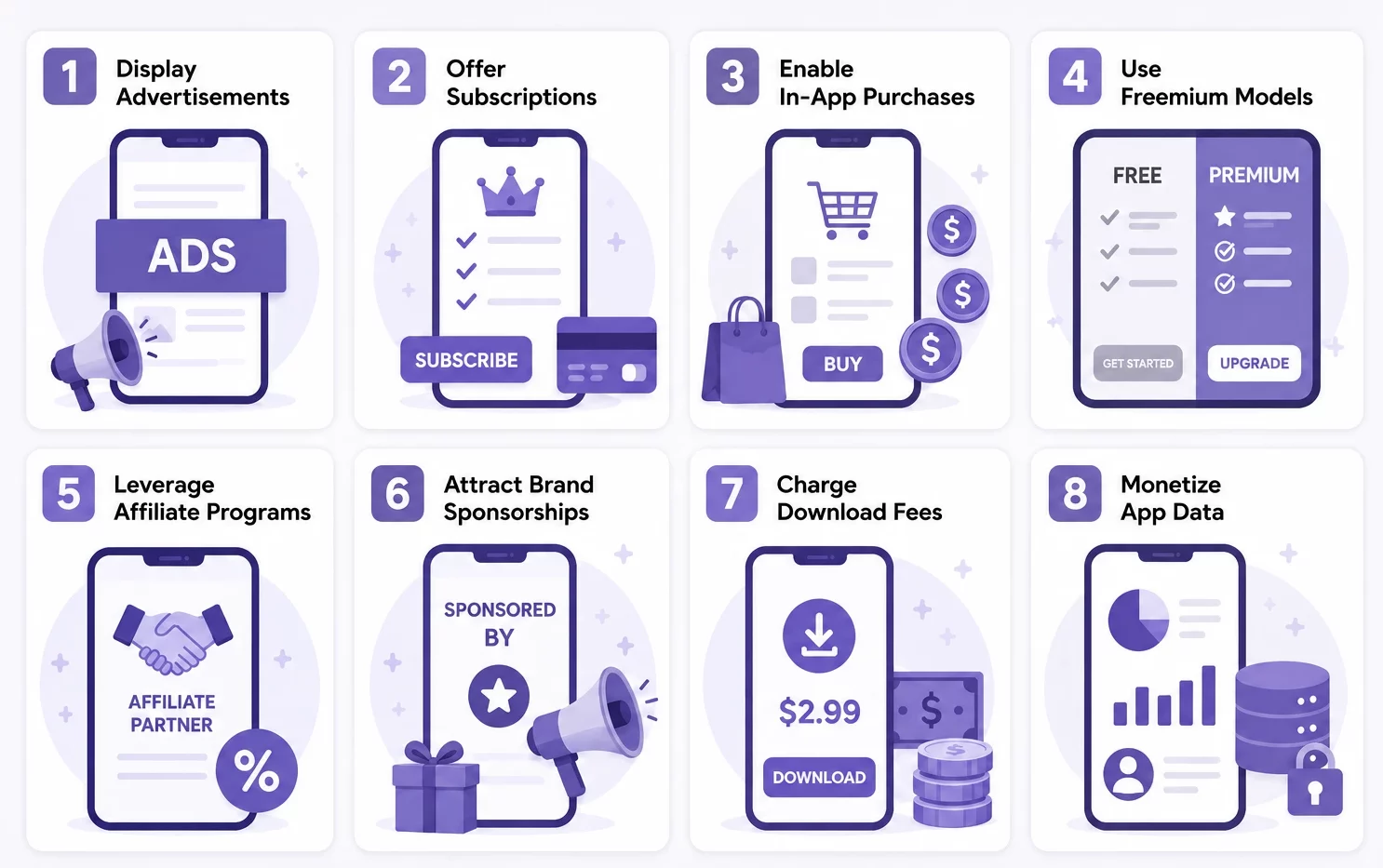
Mobile app monetization is the process of generating revenue from an app and its users. An app can earn money directly from users, through advertisers and sponsors, through partnerships, or through other commercial models built around the product. Common app monetization models include advertisements, subscriptions, in-app purchases, freemium access, affiliate programs, sponsorships, pay-per-download, and data monetization.
The right approach depends on what the app offers and how users receive value from it. A productivity app that delivers continuing value may work well with subscriptions, while a gaming app may rely more heavily on in-app purchases. A free content-driven app may have stronger opportunities through advertising or sponsorships. The goal is to create a model that supports revenue while keeping the product useful and sustainable.
How to Choose the Right Monetization Model for Your App?
Choosing between different app monetization strategies should happen before the product scope is finalized. The monetization model can influence features, user journeys, pricing, analytics requirements, payment flows, and development priorities. Start by answering four questions.
1. What value does the app provide?
Identify the core reason users would continue using the product. If the value comes from continuous access to features, content, or services, a subscription may be appropriate. If users want optional enhancements, in-app purchases may work better.
2. Who is the target user?
Consider whether your audience is willing to pay directly, more comfortable using a free product supported by advertising, or likely to respond to a combination of free and paid features. Understanding these preferences is also important when building an MVP (minimum viable product), as it helps teams prioritize features and monetization options that align with the target audience.
3. How frequently do users receive value?
Recurring value can support recurring revenue. If users return regularly because the product continuously delivers benefits, subscriptions can be considered. If value is associated with individual features or transactions, one-time purchases may be more suitable.
4. What does the app category support?
App category matters. Healthcare, media, gaming, productivity, education, and other categories can have different user expectations and monetization opportunities.
A useful approach is to compare the model against the app’s value proposition rather than choosing a revenue model simply because it is popular. The best mobile app monetization approach is ultimately the one that fits the product, audience, engagement pattern, and business objectives together.
Once the model is selected, it should be considered as part of product discovery and MVP planning rather than added after the core product has already been defined. A product discovery workshop can help turn the selected monetization approach into a clearer product scope, feature plan, and development direction.
Top Mobile App Monetization Strategies
1. Advertisements
Advertising is one of the most established ways to monetize a free mobile app. Instead of charging users directly, the business generates revenue by displaying advertisements within the application.
Common advertising placements can include banners, interstitials, and other in-app advertising formats. The model can be suitable for apps that attract a large audience and generate frequent engagement. The major advantage is accessibility. Users can access the app without paying upfront, which can reduce the barrier to adoption.
However, advertisements need to be integrated carefully. Excessive or poorly timed ads can interrupt the experience and reduce the perceived value of the product. Advertising can be particularly relevant when the app’s audience is broad and the business wants to maintain free access. It can also be considered as part of a hybrid approach alongside other revenue streams.
2. Subscription
The subscription model charges users repeatedly, usually in exchange for continued access to features, content, services, or other benefits. Subscriptions are particularly relevant to products that provide ongoing value. Apps in areas such as health and fitness, productivity, education, generative AI, and other continuing-use categories can naturally align with recurring access. For fitness products, understanding fitness app monetization and models for fitness apps can help businesses determine which approach best fits their users and ongoing product value.
AppsFlyer’s 2026 monetization research found subscription revenue growing 105% year over year in Q1 2026 within its measured dataset, compared with 14% growth for ad revenue and 29% for store-based in-app purchase revenue.
The model can create recurring revenue, but the product must continue giving users a reason to remain subscribed. The subscription experience should therefore be connected closely to product value and retention.
3. In-App Purchases
In-app purchases allow users to pay for individual features, digital goods, upgrades, or other items inside an application. This approach is widely associated with mobile games, but it is not limited to gaming. Other apps can use purchases when users benefit from unlocking specific functionality or content without committing to a recurring subscription. For Android apps, the Google Play billing system for Android apps can support in-app purchase and subscription-based payment flows.
Sensor Tower reported that global in-app purchase revenue reached $167 billion in 2025. It also reported that non-gaming in-app purchase revenue increased 21% year over year, highlighting the growing contribution of apps outside gaming.
In-app purchases work best when the paid offering has clear value. Businesses should avoid making essential parts of the experience unnecessarily difficult to access simply to encourage purchases.
4. Freemium Model
Freemium combines free access with paid features, upgrades, or additional functionality. The free version allows users to experience the product before making a purchasing decision. Paid functionality then provides a path to revenue from users who want additional value. This model can work well when the product has enough free functionality to demonstrate its usefulness while retaining meaningful premium features.
The main challenge is deciding where to draw the boundary between free and paid access. If too little functionality is available for free, users may leave before understanding the product’s value. If too much is available for free, there may be little reason to upgrade. A well-designed freemium model should therefore make the value of premium functionality clear without damaging the free user experience.
5. Affiliate Programs
Affiliate monetization allows an app to earn revenue by promoting products or services offered by another business. When users complete qualifying actions through affiliate relationships, the app can receive a commission according to the applicable arrangement.
This model can be relevant for apps where recommendations naturally form part of the user experience. For example, an app may connect users with relevant products or services that complement its core functionality. The important consideration is relevance. Affiliate promotions should support the purpose of the app rather than appearing as unrelated commercial placements.
For founders, affiliate programs can provide another revenue stream without requiring every product or service promoted through the app to be developed internally.
6. Sponsorship
Sponsorship involves partnering with a brand or organization that pays to be associated with an app, its audience, or specific experiences within the product. This can work when an app has a clearly defined audience that is relevant to a sponsor. Sponsored content, branded experiences, or sponsored sections can become part of the monetization strategy, depending on the nature of the application.
The model requires careful consideration of user trust. Sponsorship should be relevant to the product and clearly presented so that commercial relationships do not undermine the credibility of the application.
For niche products with a focused audience, sponsorship can complement other monetization approaches rather than functioning as the only revenue source. OTT platform monetization and the business models of successful OTT platforms also demonstrate how content-driven platforms can combine different revenue approaches to support sustainable growth.
7. Pay-Per-Download
Pay-per-download requires users to pay before downloading or accessing the application. This is a straightforward monetization approach because the revenue mechanism is clear: users purchase access to the app. When planning this model, businesses can work with an ios app development company to ensure the app’s pricing, value proposition, and purchase experience align with iOS user expectations.
The model works best when the product offers clear value and the target audience is comfortable paying upfront. Founders should compare it with free access, subscriptions, and freemium options before deciding. The final choice should depend on the app category, audience, and how users prefer to pay for the product.
8. Data Monetization
Data monetization involves generating commercial value from data associated with an app. Because this model involves sensitive considerations around privacy, compliance, transparency, and user expectations, it must be approached carefully and responsibly.
Businesses should not assume that user data can simply be collected and sold. Any data-related monetization approach needs to be designed around applicable requirements, clear policies, appropriate permissions, and responsible handling.
For this reason, data monetization should be considered as a carefully governed business model rather than a simple revenue shortcut. When evaluating it, product teams should consider what data is collected, why it is collected, how it is handled, and whether the proposed commercial use is appropriate and compliant.
Mobile App Monetization Strategies Comparison
| Strategy | Best-Fit App Type | Typical Revenue Timeline |
| Advertisements | Free, high-engagement apps | Builds with audience and engagement |
| Subscription | Apps delivering ongoing value | Recurring after subscription conversion |
| In-App Purchases | Gaming and feature-driven apps | Revenue when users make purchases |
| Freemium | Apps with free and premium functionality | Revenue after users upgrade |
| Affiliate Programs | Recommendation or commerce-oriented apps | Revenue after qualifying actions |
| Sponsorship | Focused-audience or niche apps | Revenue through sponsorship agreements |
| Pay-Per-Download | Apps with clear upfront value | Revenue at purchase/download |
| Data Monetization | Data-driven products with appropriate governance | Depends on compliant commercial use |
No single model is automatically the best. The table should be used as a starting point for evaluating fit rather than as a universal ranking.
Real-World Example: emmyHealth
A real RipenApps example that demonstrates relevant product-building experience is emmyHealth, a wellness management and benefits platform. The platform combines mental and physical health tracking with stress-management tools, supplemental benefits, claims management, health learning quizzes, flexible benefits management, and personalised dashboards.
This example is useful because it demonstrates how monetization decisions need to sit within a broader product experience. A product in the wellness and benefits space has to bring together multiple functions while keeping the user journey coherent.
The example should be viewed as capability-focused proof rather than evidence of a particular monetization outcome. There are no unsupported adoption, rating, download, or revenue figures being attributed to emmyHealth. For founders, the broader lesson is that monetization should be considered alongside product functionality, user needs, and the technical scope required to deliver the experience.
Vertical Spotlight: Monetization for Healthcare/Medical Apps
Healthcare and medical apps require particular attention when choosing a monetization strategy because the product can involve sensitive user information, ongoing engagement, and trust. A medical app monetization strategy should begin with the app’s actual purpose and the value it provides to users. The monetization approach should not compromise the clarity, accessibility, or trustworthiness of the healthcare experience.
Potential models can include subscriptions, freemium access, in-app purchases, or other approaches depending on the product and its intended users. The right choice depends on whether the app provides continuing services, premium functionality, educational resources, tracking capabilities, or another form of ongoing value.
Healthcare products also need a carefully considered product and development strategy. Monetization cannot be separated from requirements around user journeys, data handling, feature scope, and the overall product experience.
RipenApps’ work on emmyHealth demonstrates experience with a wellness management and benefits platform that brings together health learning quizzes, flexible benefits management, claims management, mental and physical health tracking, stress-management tools, and personalised dashboards.
For founders exploring a medical or healthcare product, working with a healthcare app development company can help align monetization with product discovery, MVP planning, user journeys, and technical requirements rather than treating it as a separate business decision.
Conclusion
Choosing among different mobile app monetization strategies is a product decision as much as a revenue decision. Advertising, subscriptions, in-app purchases, freemium, affiliate programs, sponsorships, pay-per-download, and data monetization can each serve different product and audience needs.
The right choice depends on the value your app provides, how users engage with it, and how the monetization model fits into the overall product experience. For content-driven products, working with a media and entertainment app development company can also help align content delivery, user engagement, and monetization requirements.
For founders and product owners, the most effective approach is to make this decision before finalizing the MVP scope. Build your MVP with the right monetization model baked in from the start through a product discovery and development process that connects business objectives with product requirements.
FAQs
Q1. What is the best mobile app monetization strategy?
The best mobile app monetization strategy depends on the app’s audience, value proposition, engagement pattern, and category. Subscriptions can suit products delivering ongoing value, while in-app purchases, advertising, freemium, sponsorships, affiliate programs, or other models may fit different product structures.
Q2. How do I choose an app monetization model?
Start by identifying what users value, how frequently they receive that value, whether they are likely to pay directly, and what your app category supports. Then compare subscription, advertising, in-app purchases, freemium, and other models against the product’s business objectives and user experience.
Q3. What are the most common mobile app monetization strategies?
Common mobile app monetization strategies include advertisements, subscriptions, in-app purchases, freemium, affiliate programs, sponsorships, pay-per-download, and data monetization. The right combination depends on the app’s audience, functionality, engagement pattern, and the type of value it delivers.
Q4. Can an app use multiple monetization models?
Yes. An app can combine multiple monetization models when they complement the user experience. For example, a product could combine advertising with premium functionality or use subscriptions alongside other revenue streams. The combination should remain aligned with the product’s value proposition rather than adding monetization methods without a clear purpose.
Q5. How much does an app monetization strategy affect development cost?
An app monetization strategy can affect development scope and the total mobile app development cost because different models require different product features, payment flows, user journeys, analytics, and integrations. Making the decision during product discovery or MVP planning helps teams account for these requirements before development scope is finalized.
Q6. Is subscription better than in-app purchases?
Neither model is universally better. Subscription can fit apps that deliver continuing value, while in-app purchases can work when users want to purchase individual features, content, or digital goods. The appropriate model depends on the app’s category, user behavior, and value proposition.
Q7. What is data monetization in mobile apps?
Data monetization refers to generating commercial value from app-related data. Because this approach involves privacy, compliance, transparency, permissions, and responsible data handling, it must be designed carefully. Businesses should evaluate the purpose and permitted use of data before considering any commercial application.
Q8. When should I decide on my app monetization strategy?
The monetization strategy should be considered during the pre-build or MVP-scoping stage. Deciding early allows the team to incorporate the required features, user journeys, payment mechanisms, and product requirements into the initial scope instead of attempting to retrofit the model later.
SHARE
WRITTEN BY

Ishan Gupta
CEO & Founder
Ishan Gupta is a seasoned entrepreneur and CEO with extensive 10+ years of experience in business and mobile app development landscape. He believes that the right digital product allows companies to focus on what they do best, while technology handles the rest. With deep exposure to global markets, he understands what makes an app succeed. His approach translates business needs into clear product strategies, ensuring that every feature contributes to measurable ROI.
View All Articles