


Over 3.5 billion smartphone users access an average of 40 apps per month. With such high demand for mobile apps, entrepreneurs are constantly looking for ways to reach and engage users across platforms. They need solutions that reduce time to market, simplify updates, and help them explore new business opportunities.
Cross-platform mobile app development offers a practical way to achieve these goals. It allows businesses to build applications for Android and iOS using a shared codebase, reducing duplicated development efforts. Working with a cross platform app development company can further help businesses choose the right technology and build an app that meets the needs of users across platforms.
As Steve Jobs said, “You have got to start with the customer experience and work towards the technology, not the other way around.” This idea closely aligns with cross-platform development, where the focus remains on delivering a consistent and accessible experience across different devices.
Before exploring the core benefits, let’s first understand what cross-platform mobile app development means.
A cross-platform mobile app can run on multiple platforms, such as Android and iOS, without requiring separate native development for each one. This approach offers several benefits for businesses. Let’s explore them.
Table of Contents
Cross-Platform Mobile App Benefits For Businesses
From cost effectiveness, better reach, unlocked business opportunities, and accessibility to flexibility and scaling, the list of cross-platform mobile app benefits stays long. Here are the key benefits in detail.
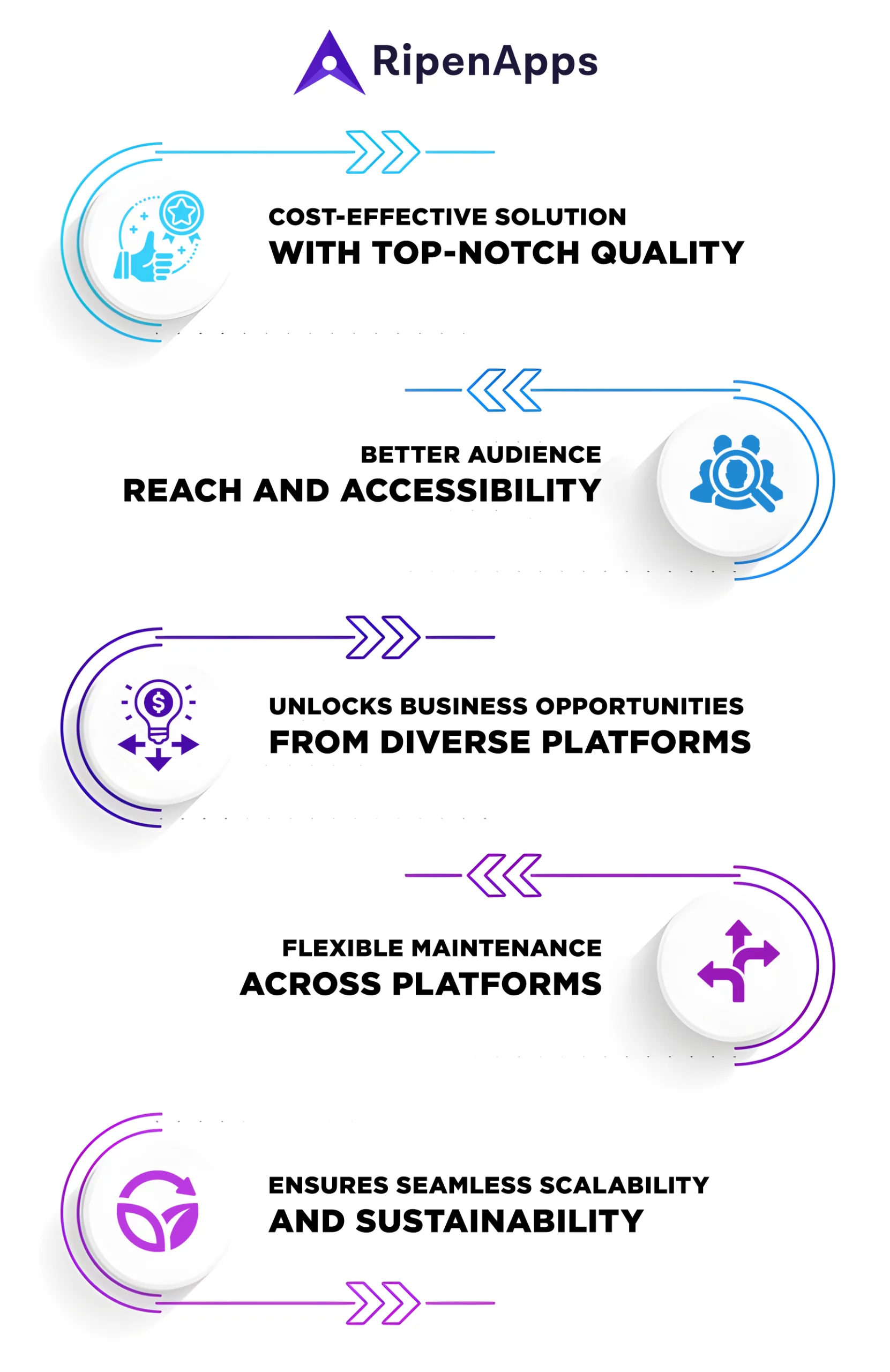
Cost-Effective Solution With Top-Notch Quality
In a market where cost-effective solutions with the highest quality sell faster, there is a high demand for app development technology that can offer the same. Cross-platform mobile app development offers a highly cost-effective solution to businesses looking to generate a maximum return on investment. Ok, let us see an example to gain the concept.
In traditional app development, separate teams worked on each platform. If there is a requirement for Android app development, there would be a separate Android app development team that focuses on the Android project. And vice versa for iOS. These separate teams had higher costs and took more time and resources.
With cross-platform development, the development team just has to write code once and deploy it across multiple platforms. Nearly 70% of the code remains the same across the platforms which highly reduces the time, resources, and prices of the development team. On average, businesses can save up to 60-70% of mobile app development costs by opting for cross-platform app development.
Better Audience Reach and Accessibility
If you analyze the mobile app stores and market, the number of downloads shows the user base of an app. When you go with a cross-platform mobile app, you can significantly expand the reach and accessibility of mobile apps affecting your overall download numbers. This also provides businesses with an opportunity to connect with a broader audience. In a nutshell:
- Through cross-platform app development, businesses can target multiple platforms, ensuring no audience stays untapped.
- By targeting multiple platforms at a time, your business directly unlocks a broader target audience on both iOS and Android platforms.
- Whether a user accesses your app on an iPhone or Android, you can target delivering the same user experience and providing a seamless experience.
Unlocks Business Opportunities from Diverse Platforms
Through cross-platform mobile app development, you not only expand reach but also unlock unique business opportunities that might be hidden on one of the platforms. For example, if your target market is a massive user base in Asia and you opt for building an iOS app, then your business opportunities will stay hidden in Android app development.
However, with cross-platform app development, you can deploy your app for both platforms without any added turn-around time, investments, or resources, unlocking a larger user base and wider business opportunities.
Flexible Maintenance Across Platforms
Maintaining consistency across platforms is highly essential for ensuring the success of a mobile app. With consistency there is a requirement of flexibility in maintaining the app in terms of updates, bug fixes, and the introduction of new features.
Due to the single-codebase benefit of cross-platform app development, updating the application becomes flexible for businesses. To give you a clearer view, a cross-platform mobile app ensures:
- Managing, updating, and addressing bugs is simpler, allowing developers to make the desired changes to multiple platforms without dedicatedly working for each platform.
- Uniform user experience since whatever changes are made to one platform are seamlessly visible on the other platforms as well without any dedicated time required for development.
Ensures Seamless Scalability and Sustainability
As your business grows, your app requires scaling too. And, if you go for native app development, the turn-around time to the market significantly increases. With cross-platform development, you can reduce time frames by as much as 30%. Whether it is about adapting your mobile app to new devices and platforms or introducing advanced features like AI and AR, cross-platform is your way to go.
Talking about the support, all the third-party integrations are flawlessly introducing their support for cross-platform frameworks. You can seamlessly ensure that your app continuously evolves and grows alongside your business.
Success Stories of Tech Giants Who Opted for Cross-Platform App Development
You are now well-informed about the benefits of cross-platform app development; it is time for us to explore some well-known cross-platform apps that have registered success by opting for cross-platform development. Here are some of the leading examples.
Spotify
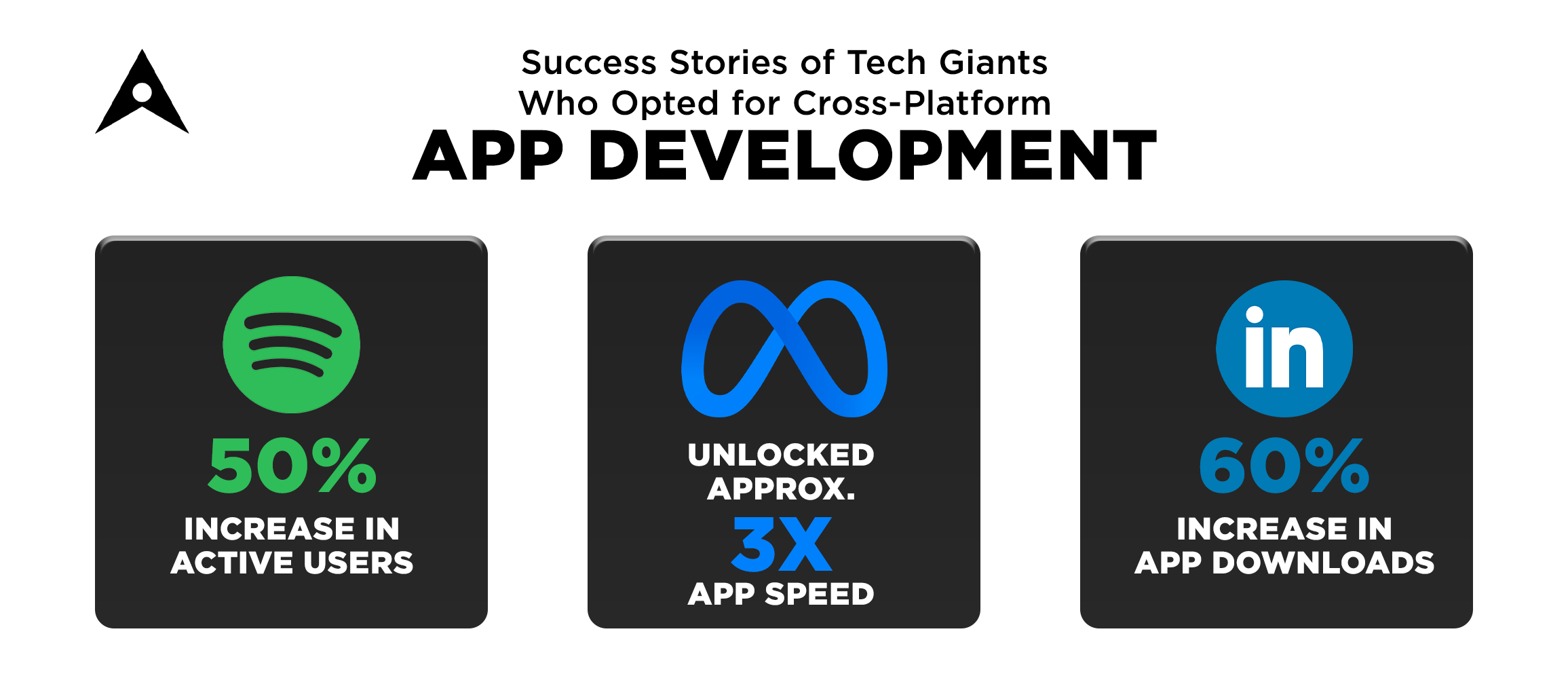
The world’s leading music streaming platform, Spotify, has expanded its reach by utilizing cross-platform app development. It shifted from Swift/Kotlin to React Native, achieving a cross-platform nature, and by using it, they have also unlocked improved app performance and user satisfaction. To be specific, the app witnessed nearly a 50% increase in active users across Android and iOS.
Meta (previously Facebook)
The largest social media platform from Meta was once known for using a lot of memory and running slow on mobile devices. But when they built React Native, a cross-platform technology, they were able to overcome the challenges they were facing. Today, Meta uses React Native on Instagram, Whats App, and Facebook delivering them positive user feedback across the app store and Play Store.
A premier professional networking platform, LinkedIn leverages cross-platform technology to improve its mobile app experience and cater to the diverse needs of its audience. By adopting Xamarin, LinkedIn achieved a 60% increase in app downloads and a 45% boost in user engagement within the first 6 months of launching their cross-platform app. This also allows the company to release features and updates faster to the users.
Want To Build A Flawless And Seamlessly Performing Cross-Platform Mobile App?
If you have finally planned to go with cross-platform app development for your mobile app idea after reading the robust benefits it offers, we would love to help you. When you work with RipenApps Technologies, a leading cross-platform app development company, you unlock:
- Seamless performing app across diverse platforms
- Wider business reach unlocking more business opportunities
- Competitive cross-app development pricing in the market
- Faster time to market with an agile development approach

FAQs
Q1. What are the main benefits of cross-platform mobile app development?
Cross-platform development allows businesses to build for multiple platforms using a shared codebase. It can reduce development costs, speed up time to market, simplify maintenance, and provide a consistent user experience.
Q2. Is cross-platform app development cheaper than native development?
In many cases, yes. Reusing code across platforms can reduce development effort, resources, and maintenance costs compared with building separate native applications.
Q3. Can cross-platform apps provide a good user experience?
Yes. Modern cross-platform frameworks can support responsive interfaces and near-native performance across iOS and Android. With proper UI/UX planning, businesses can deliver a consistent experience across devices.
Q4. Is cross-platform app development suitable for startups?
Yes. Startups can use cross-platform development to launch an MVP or product across multiple platforms without maintaining separate codebases. This can help them validate the idea while keeping initial development resources under control.
Q5. How does cross-platform development help businesses scale?
A shared codebase makes it easier to introduce updates, fix bugs, and add features across platforms. This can simplify ongoing maintenance as the user base and product requirements grow.
Q6. Which businesses can benefit from cross-platform mobile app development?
Startups, ecommerce businesses, fintech companies, healthcare providers, social platforms, and on-demand businesses can all benefit from the approach. It is particularly useful when reaching both Android and iOS users is a priority.
SHARE
WRITTEN BY

Vaibhav Sharma
Business Head
Vaibhav Sharma bridges product vision with real-world execution. He shares consultation with startups and enterprises to shape digital strategies, refine user journeys, and create app experiences that feel intuitive from day one. His strength lies in transforming early concepts into clear development roadmaps that set products up for long-term success.
View All Articles