




Most businesses don’t struggle with building web applications. They struggle with building the right ones. They invest time and money into systems that look functional on the surface but fail to support real business operations. The issue is not development speed or tools. It is the lack of clarity on what the system is supposed to achieve.
Web application development in 2026 is no longer about creating a presence online. It is about building systems that manage workflows, connect data, and support decision-making at scale. Whether it is an internal dashboard or a customer-facing platform, your web application directly impacts how efficiently your business runs.
For founders, CTOs, and product teams, the challenge has become sharper. Technology has made development faster, but it has also increased the risk of building the wrong system. If your architecture, scope, or execution is misaligned, the result is higher costs, delays, and limited scalability.
This web application development guide focuses on helping you make the right decisions before you start building. From understanding cost and ROI to choosing the right architecture, it is designed to help you evaluate and invest in web application development services that actually deliver business outcomes.
Key Takeaways
- Building a web application without clear business goals leads to wasted investment and poor outcomes.
- The right type, features, and architecture decide whether your system scales or becomes a bottleneck.
- Web application development cost depends on complexity, integrations, and long-term scalability planning.
- ROI is driven by efficiency, faster workflows, and better decision-making, not just revenue.
- Choosing the right enterprise web application development company directly impacts system quality and long-term success.
Table of Contents
What Does Web Application Development Mean For Your Business?
Web Application Development is the process of creating software that runs on remote servers and is accessed through web browsers. These applications provide a seamless cross-platform experience across desktops, tablets, and mobile devices.
You can build enterprise-grade web applications to manage operations, serve customers, and improve internal workflows. These systems range from customer portals to advanced e-commerce platforms, depending on the complexity and needs of the business.
Today, web applications are no longer just digital tools. They are business systems that improve efficiency, enable faster decision-making, and support scalable growth. This is why, in 2026, businesses are adopting modern web application development approaches such as AI-driven features and serverless architectures to improve performance and flexibility.
By availing professional website design and development services, you can ensure that your system is built with the right architecture, integrations, and scalability in mind. This helps you deliver better user experiences while maintaining long-term business efficiency.
Current Market Scenario of Web Application Development
The global web app development market has been growing rapidly for the past few years. According to the Business Research Insights report, the market size is expected to reach by $165.13 billion by 2035 at a CAGR of 8.03%, from 2026 to 2035. This demand is skyrocketing in various sectors, including healthcare, education, e-commerce, and others.
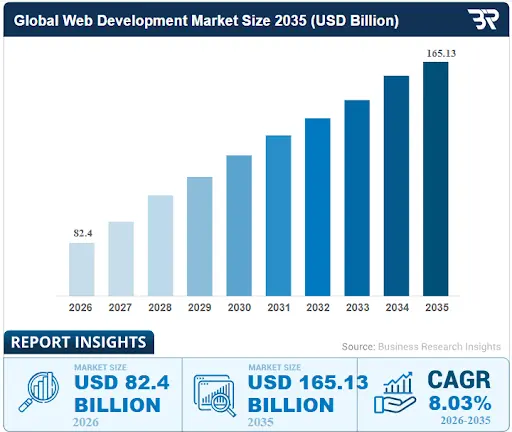
The scope of web applications will continuously expand in 2026. This is because of the digital transformation, wider cloud adoption, the rise of Progressive Web Apps (PWAs), AI, and various other emerging security protocols. Thus, by leveraging web application development, business owners can provide a better user experience than ever before.
The growth is fueled by continuous technological advancements and the ongoing shift toward online-first business models. No doubt, in 2026 and the upcoming years, web apps will evolve with more advanced features meeting the user expectations and highest standards of security, scalability, and personalisation.
Why Most Web Applications Fail When Businesses Start Scaling
Many enterprise-grade web applications perform well in the early stages. The problems begin when user load, workflows, and integrations increase. Systems that were built for launch speed start breaking under real business conditions.
The root cause is not development quality. It is an engineering decisions. Poor database structuring, tightly coupled systems, and a lack of scalability planning create bottlenecks. Without distributed systems, asynchronous workflows, and fault-tolerant architecture, performance starts degrading as usage grows.
We’ve seen businesses rebuild entire systems within 18 to 24 months because the original architecture was not designed for scale. This leads to higher infrastructure costs, slower operations, and constant rework. Therefore, if your system is not built for scalability from day one, growth will expose its limitations.
How To Know If Your Business Needs a Web Application
Not every business needs a web application immediately. But many delay the decision until inefficiencies start affecting growth. The key is to identify the right moment to invest.
If your team is spending time on repetitive manual tasks, you are already losing efficiency. If your tools are disconnected, your operations are fragmented. If reporting takes too long, decision-making slows down.
These are not small issues. They are signals that your business needs a system.
Clear signs you need a web application:
- Your workflows rely heavily on manual processes
- Your tools do not integrate with each other.
- Your team struggles with data visibility
- Your operations are not scalable
Failure signals you should not ignore:
- Development decisions are based on assumptions
- No clear ROI was defined before starting
- The scope keeps changing without structure
If these problems exist, building a web app is not optional. It is necessary.
Benefits of Developing Web Applications in 2026
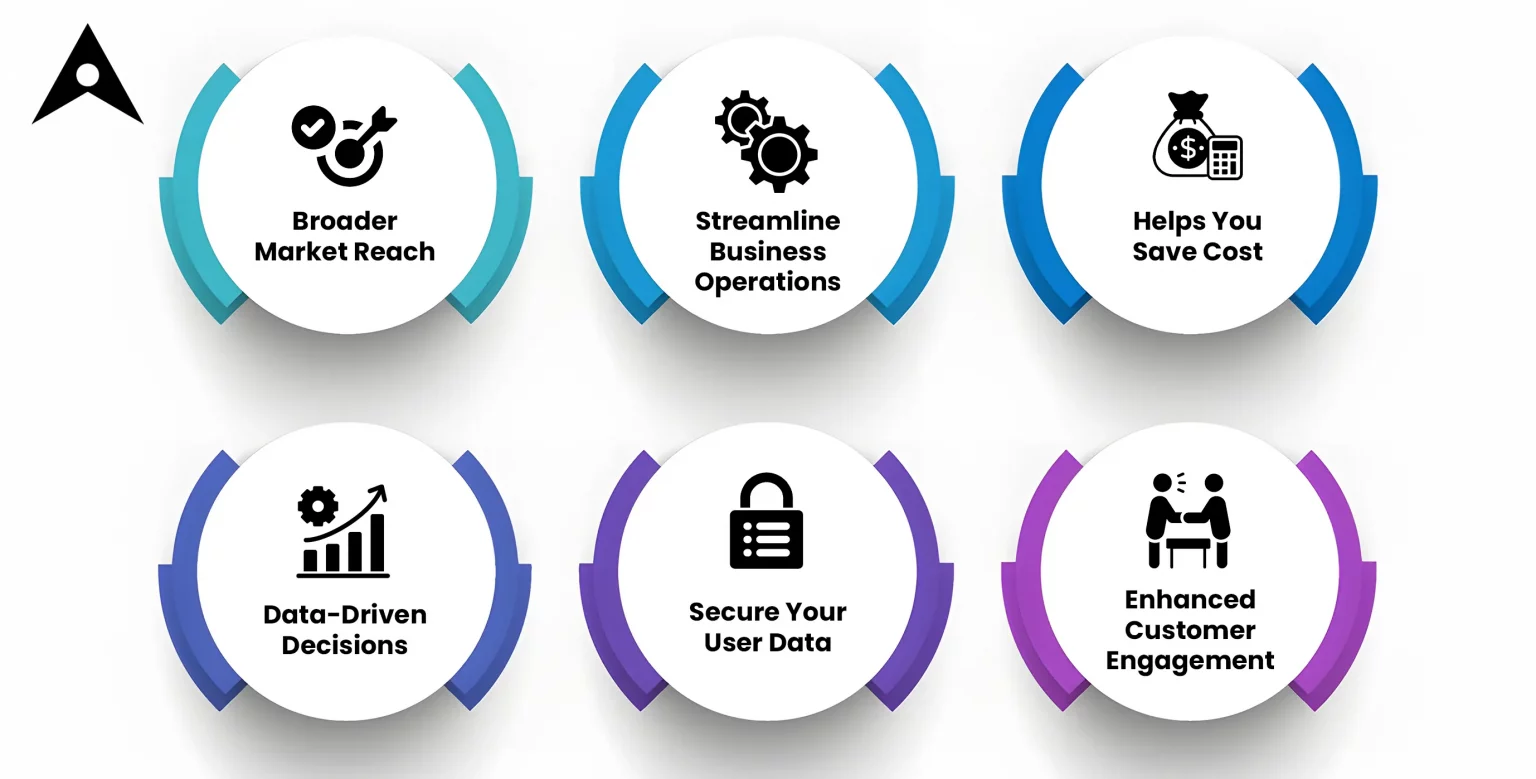
Custom web application development comes with numerous advantages that help app owners grow their businesses. Business owners can also make the best use of web application architecture for developing a dashboard to manage large datasets. To give you a bigger picture, here we have mentioned some major key benefits that showcase why enterprise-grade web applications are an important part of business strategies.
1. Global Accessibility and Broader Market Reach
Users can easily access your web applications anywhere, anytime, or from any device or browser. Therefore, investing in web and application development offers you cross-platform solutions to reach a wider target audience globally. Due to this universal accessibility, entrepreneurs can reach more target audiences. You can also opt for custom business web app development services to support international growth and simplify your customer engagement as well.
2. Business Automation To Streamline Operations
Intelligent automation solutions, including building AI-driven web apps, can minimise your operational costs and enhance efficiency. If you are planning to create enterprise-grade web applications, they can help automate several tasks, such as customer service and inventory management. Therefore, these AI-driven web apps can reduce the workload on employees and aim to enhance efficiency. After that, your team can focus on high-level priority tasks.
3. Develop and Maintain Your Web App At Minimum Cost
You can host your web apps on the cloud, which also eliminates the need to incur higher upfront costs due to extensive hardware requirements. But when your app is hosted on-premise, it will need some investment in hardware and infrastructure.
Moreover, if you choose to develop a single web app, it will be more cost-effective compared to building separate apps for each operating system. Businesses can invest in enterprise web application development services to save their development and maintenance costs in the long run and maximise their ROI.
4. Helps You To Make Data-Driven Decisions
Web applications allow you to gather valuable user data and offer some valuable insights into customer preferences and their buying behaviour. Entrepreneurs can make the best use of collected data to drive better decisions, make strategic plans, and improve their custom web application development services over time.
Moreover, business owners are also using web application architecture for developing a dashboard for a large dataset on AWS to make even better decisions.
5. Secure Your User Data and Business Assets
The security concern is increasing continuously. During the development of a web-based application, you need to implement various security measures, such as secure authentication, data encryption, and other industry standards, to secure your sensitive user data and business assets.
You need to ensure secure communication between the server and the user via end-to-end encryption. You can opt to add more security layers, such as OAuth protocols and MFA, to improve authentication processes.
6. Engage More Targeted Users Like Never Before
Web applications give businesses the ability to create more interactive and user-focused experiences. A well-built system helps you connect with the right audience and keep them engaged through meaningful interactions.
Features like personalised content, real-time notifications, and chat support improve how users interact with your platform. These capabilities help you build stronger engagement, increase retention, and create a more dynamic experience that aligns with user expectations.
Choosing The Wrong Type of Web Application Can Limit Your Growth
Most businesses make a critical mistake early. They chose the wrong type of web application. This decision affects scalability, cost, and performance.
Some businesses adopt SaaS platforms when they actually need custom systems. Others build complex solutions when a simpler model would work better. These mismatches create long-term inefficiencies.
Understanding different types of web applications helps you make better decisions. The focus should be on alignment with your business model.
Key options businesses evaluate:
- SaaS platforms for quick deployment
- Custom web applications for flexibility
- Progressive web apps for mobile-like experiences
- Enterprise systems for large-scale operations
The type of web application you choose defines what your system can or cannot do. The right choice supports scalability and efficiency. The wrong choice creates limitations that affect performance, cost, and future growth.
Once the right model is in place, the next step is to ensure your web application is built with the right features. Because even the best-suited application type will fail if it lacks the capabilities needed to handle real business operations at scale.
Must-Have Web Application Features That Drive Performance
Most enterprise-grade web applications look functional at launch. The real difference shows when usage increases. Systems built around workflows perform better than those built around isolated features. If your web app does not support execution at scale, it will slow your business down.
Features alone do not improve outcomes. The right combination of features creates a system that handles operations, users, and data without friction.
Core features every high-performing web application should include:
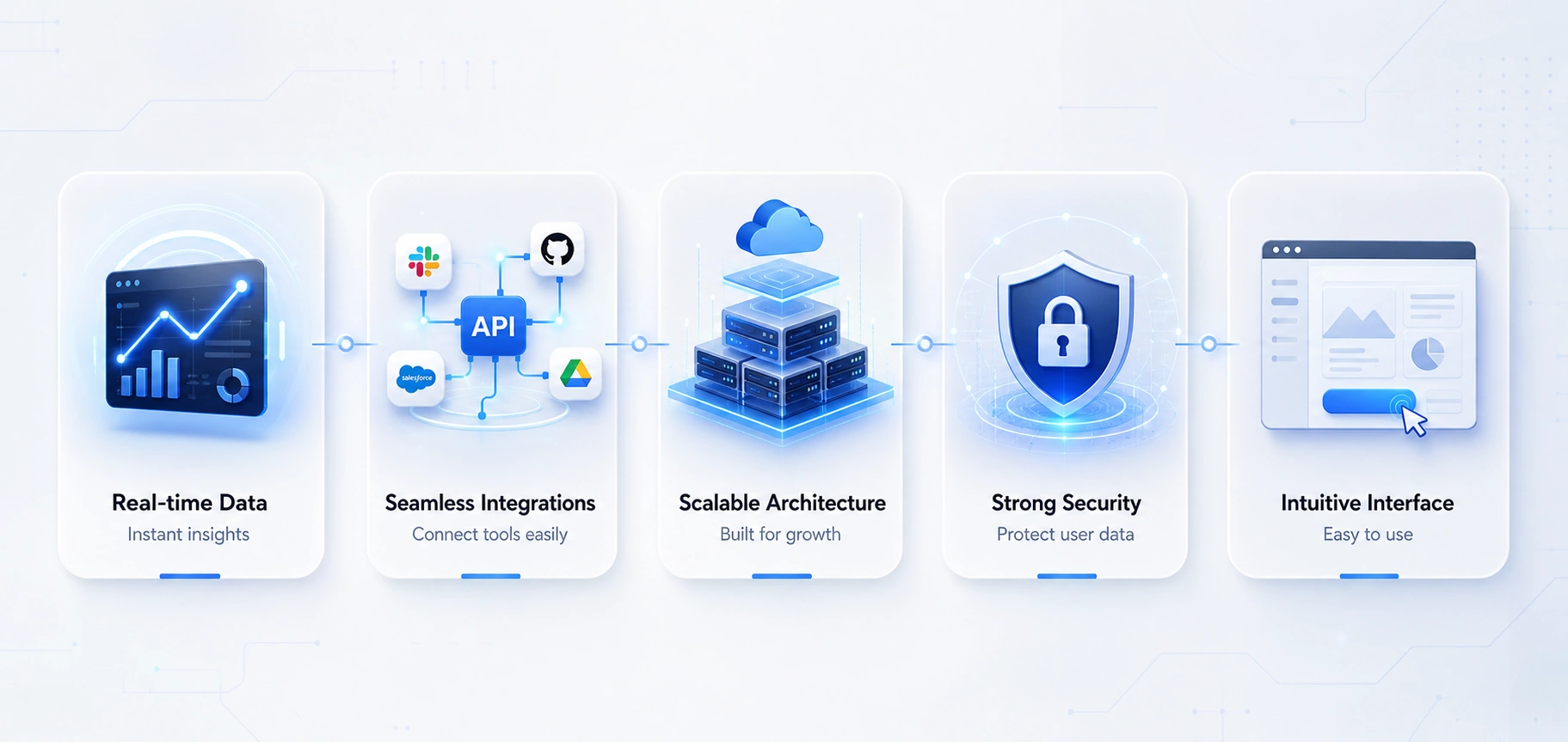
- Real-time data access
Your teams should always work with updated information. Real-time access reduces delays, improves coordination, and supports faster decision-making across departments. - Seamless integrations with existing tools
A strong web application connects with CRMs, ERPs, and third-party systems. This removes data silos and ensures smooth information flow across your business. - Scalable architecture foundation
Your web app should handle increasing users, data, and operations without performance issues. Scalability ensures your system grows with your business without constant rebuilding. - Strong security and access control
Security is not optional. Your web application should include role-based access, data protection, and compliance measures to safeguard business-critical information. - Simple and intuitive user interface
A clean interface improves adoption. If your team finds the system complex, usage drops and the system fails to deliver value.
If your web application cannot support scale and usability together, it will become a bottleneck instead of a growth enabler.
Web Application Architecture Decisions That Impact Long-Term Performance
Architecture is not visible to users, but it controls how your web application performs under real conditions. A weak foundation may seem stable at the start, but as users, data, and operations grow, it begins to slow down, break integrations, and increase costs.
The right architecture depends on your business model, expected scale, and system complexity. Choosing it early helps you avoid rebuilding your system later.
Common architecture approaches businesses evaluate:
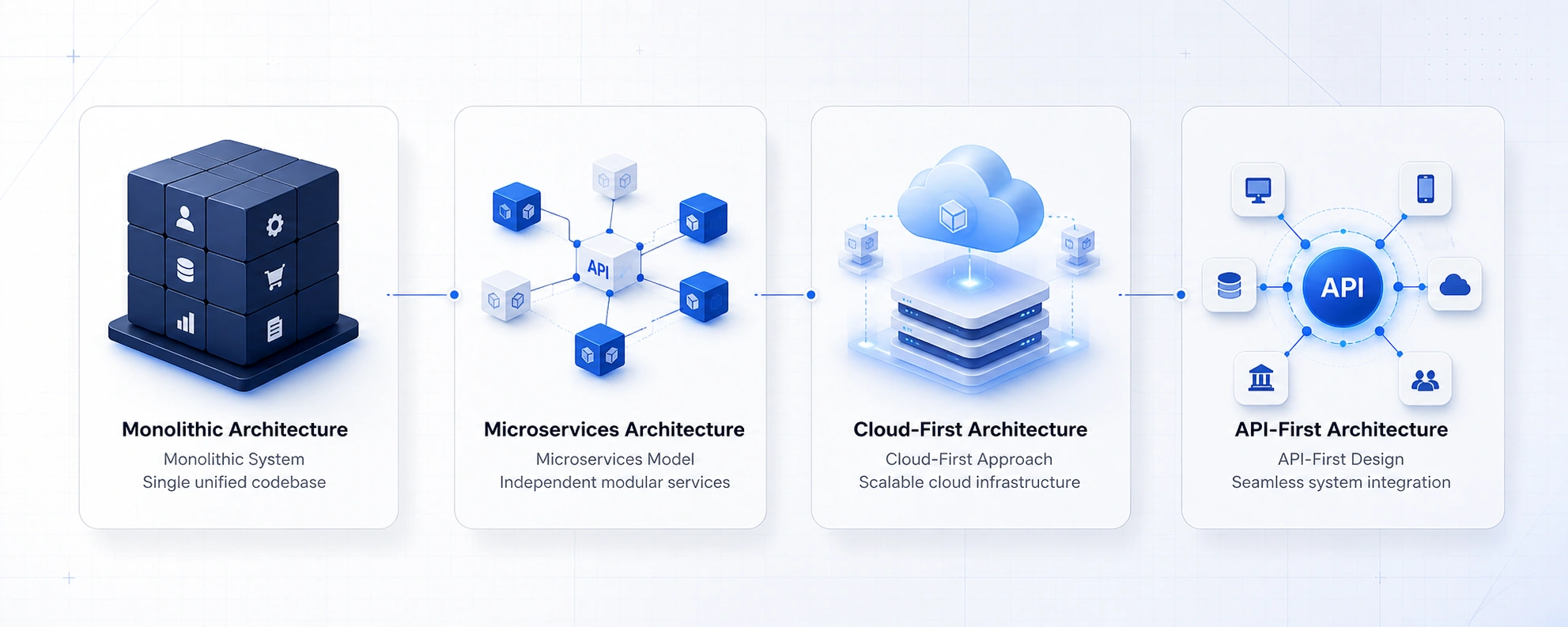
- Monolithic architecture for simpler systems
Suitable for early-stage or less complex applications where speed of development is the priority. - Microservices architecture for scalable enterprise systems
Breaks the application into smaller services, making it easier to scale, update, and manage complex workflows. - Cloud-first architecture for flexibility and performance
Enables better scalability, reduced infrastructure costs, and faster deployment cycles. Many businesses also invest in professional cloud infrastructure services to maintain application stability, security, and performance as user demand grows. - API-first architecture for seamless integrations
Ensures your web application can connect with multiple tools and platforms without friction.
Every architecture comes with trade-offs. The key is to align your choice with long-term business goals, not just short-term development speed. Bad architecture does not fail immediately. It fails when growth begins.
Once your architecture is defined, the next step is to understand how these decisions translate into actual development effort, timelines, and execution. This is where the development process plays a critical role.
Key Steps in the Web Application Development Process
If you are looking to create a successful web application, then it will involve some critical steps. Each of the web application processes contributes to the functionality, design, and user experience of your app.
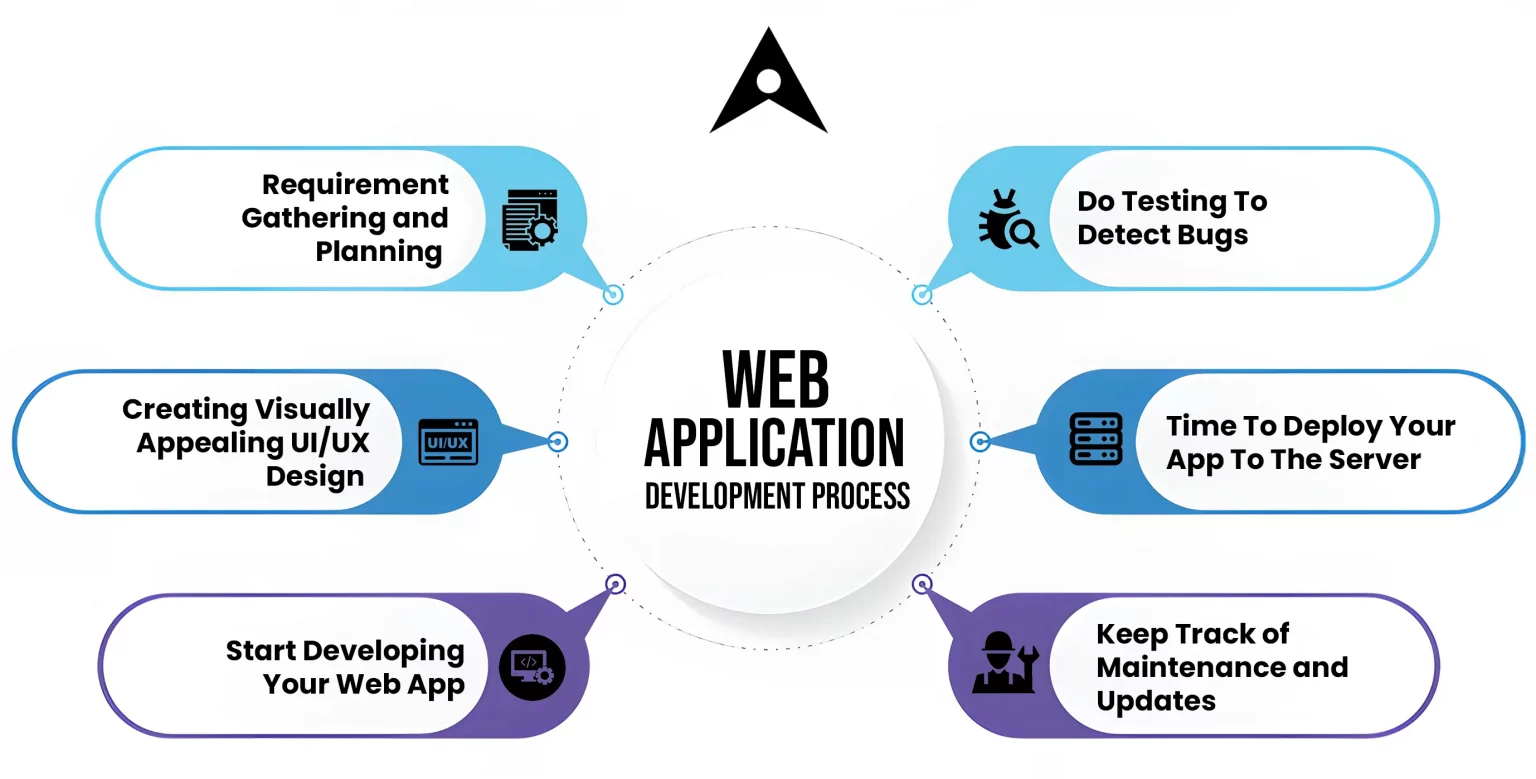
Here we have mentioned the step-by-step web app development process:
1. Requirement Gathering and Planning
Making an effective plan acts as the groundwork for the development of web-based applications. First, you need to understand your target audience and define your mobile application goals. Business owners need to gather all the necessary information to build a high-performing web app.
During this initial step, you also need to decide what features or functionalities you need to include in your app. In 2026, business owners should also leverage AI in web development to validate ideas and prioritise features with a more accurate prediction.
2. Creating Visually Appealing UI/UX Design
User Interface (UI) and User Experience (UX) design play a very crucial role in creating intuitive and more visually appealing applications. One of the major advantages of having a unique and well-designed web application is that it not only attracts more targeted users. It also helps you to improve retention and engagement rates.
With the help of wireframing and prototyping, you can easily visualise your web app design before moving toward a full-fledged development process. A well-recognised UI UX design agency can work with you to create more unique and appealing designs for your apps.
3. Start Developing Your Web App
The next crucial custom web application development process includes the actual coding of building the app. The front-end developers are responsible for working on the look and feel of your application, whereas the back-end developers ensure seamless performance and functionality. That’s why it’s advisable to full stack development services that have an in-depth knowledge of both front-end and back-end development processes.
Business owners should work closely with a globally recognised web application development company. They are familiar with multiple programming languages such as React, Angular, Node.js, and Django and adopt modern frameworks such as Next.js, and work according to your project needs.
Read More: A Guide On Web & Mobile App Development Using AngularJS Framework
4. Do Testing To Detect Bugs
Testing is a necessary stage in the web application development process. It ensures your application remains bug-free, secure, and compatible across different browsers, devices, and operating systems.
During the testing phase, the custom website development company focuses on usability, security improvements, and overall application performance. Modern development teams also rely on automated testing suites, CI/CD pipelines, and AI-enabled testing tools to identify issues faster and improve deployment efficiency.
Businesses investing in full stack development services often benefit from more streamlined testing workflows because both frontend and backend systems are optimized together for stability and performance.
5. Time To Deploy Your App To The Server
After the testing of your web app, it’s time to deploy it to the server so that users can easily access your application. This process also includes several steps, such as setting up the server environment, configuring databases, incorporating various security measures, etc.
Many modern deployments now use serverless platforms like Vercel or Cloudflare Workers, microservices-based architectures, and containerization tools such as Docker and Kubernetes for smooth scaling.
6. Keep Track of Maintenance and Updates
Once the development and deployment process is completed, you need to continuously keep track and monitor your app to ensure that it performs well post-launch. A top-notch web application development company can monitor your app in the best possible way.
Your application may need regular updates to add new exciting features and fix bugs to improve app performance. With the evolving user demand, your web app should also adapt to stay useful for a long period. You can consider to hire mobile app developers to monitor and improve the ongoing performance of your web application.
The Complete Web App Development Cost Breakdown
Cost is the first question most businesses ask. The better question is what you are paying for and how it impacts long-term performance. Business web application development cost is not fixed. It depends on how complex your system is, how scalable it needs to be, and how well it is planned from the start.
A typical web app development cost in 2026 ranges between $10,000 to $120,000+. Simple applications with limited features fall on the lower end. Scalable enterprise systems with integrations, real-time capabilities, and advanced architecture can cost you more.
Most businesses overspend not because development is expensive, but because decisions are unclear. When scope, architecture, and features are not defined properly, costs increase during development. To help you estimate more accurately, here’s a detailed breakdown of web app development costs based on features, project type, and development location:
1. Cost Breakdown by Features
Understanding the cost by feature set helps you estimate how spending scales as you add more functionality. The more capabilities your app needs, the more time, expertise, and engineering effort will be required. Below is a table comparison of how features influence your enterprise web application development budget:
| Feature Set Category | Core Features Included | Estimated Cost Range (In USD) |
| Basic Features | Static pages, basic forms, CMS, and login | $10,000 to $25,000 |
| User Accounts & Roles | Authentication, dashboards, and permission controls | $7,000 to $30,000 |
| Admin Reporting Panel | Analytics, insights, and content management | $8,000 to $40,000 |
| Payment Systems | Gateways, invoices, and checkout | $10,000 to $50,000 |
| 3rd-party API Integrations | CRM, ERP, email, maps, and SMS | $5,000 to $40,000 |
| Real-Time Features | Live chat, notifications, and tracking | $12,000 to $60,000 |
| AI/ML Enhancements | Recommendations, chatbots, and automation | $15,000 to $80,000 |
| Security Upgrades | MFA, encryption, audits, and compliance | $8,000 to $50,000 |
2. Cost Breakdown by Project Type
Every web project falls into a different category depending on how much functionality, scalability, and customisation you need. Whether you’re building a simple tool or a complex business platform, your project type will have a direct impact on timelines, effort, and cost. Use these ranges to benchmark where your idea fits. So, have a look at the table below:
| Project Type | Estimated Cost Range (In USD) | Ideal For |
| Simple Web App | $15,000 to $35,000 | Business site, basic portal |
| Mid-Level Web App | $35,000 to $80,000 | Bookings, dashboards, workflows |
| E-commerce Platform | $80,000 to $150,000 | Products, payments, orders |
| Enterprise or SaaS System | $150,000 to $300,000+ | Automation, multi-role access, integration-heavy |
3. Cost Breakdown by Development Location
The location of your chosen development team can significantly affect overall pricing. Hourly rates vary across countries depending on talent availability, technical experience, and market demand. Here is a table that outlines typical cost expectations based on the top 5 web application development regions:
| Country | Average Hourly Rate (In USD) | One-time Project Development Cost (In USD) |
| India | $20 to $50/hr | $20,000 to $100,000 |
| Poland | $40 to $80/hr | $50,000 to $150,000 |
| United Kingdom | $70 to $150/hr | $100,000 to $250,000 |
| Canada | $80 to $160/hr | $120,000 to $300,000 |
| United States | $90 to $180/hr | $150,000 to $350,000+ |
How to Measure Web Application ROI and Evaluate Real Business Impact
Most businesses evaluate ROI only through revenue. That is incomplete. The real value of enterprise web application development comes from how much it improves operations, speed, and decision-making across your business.
A well-built web application reduces manual effort, connects systems, and enables teams to work faster with better data. These improvements directly influence cost efficiency and overall business performance.
Key metrics to evaluate web app ROI:
- Reduction in operational costs
Automation and streamlined workflows reduce dependency on manual processes and lower recurring expenses. - Increase in team productivity
When systems are connected and processes are simplified, teams complete tasks faster with fewer errors. - Faster decision-making with real-time data
Access to accurate and updated information helps leadership make quicker and more informed decisions. - Improved customer experience and retention
A responsive and reliable web application enhances user satisfaction, leading to better engagement and repeat usage.
If your web application is not improving efficiency, speed, or user experience, it is not delivering real value. A strong web application should operate as a business asset that drives measurable outcomes, not as a cost that needs continuous justification.
Common Web Application Development Challenges
Most web application projects don’t fail due to technology. They slow down because of poor decisions during planning and execution. These issues are predictable, but many businesses ignore them until delays and cost overruns begin to show. So, if your web application is not delivering expected results, the problem usually lies in how it was defined, built, or adopted.
Key challenges that affect web application development:
- Unclear requirements and weak planning
When goals are not defined, development teams build based on assumptions. This leads to rework, delays, and systems that don’t solve real business problems. - Frequent scope changes during development
Expanding features without structure increases cost and disrupts timelines. A lack of clarity at the start often leads to continuous changes later. - Poor integrations with existing systems
If your web application does not connect properly with other tools, workflows break and data becomes inconsistent across teams. - Low user adoption across teams
Even a well-built system fails if users don’t adopt it. Complex interfaces and a lack of usability reduce engagement and overall impact.
Failure signals you should not ignore:
- Development timelines keep extending without clear reasons
- Features are added continuously without prioritization
- System performance drops as users or data increase
These challenges don’t appear suddenly. They build over time due to early-stage decisions. Identifying them early helps you avoid costly mistakes and ensures your web application supports growth instead of slowing it down.
Industries Where Web Applications are Driving Real Business Impact
Web application development is not one-size-fits-all. Different industries require different systems, workflows, and compliance levels. What works for one business model may fail in another.
Where businesses are investing heavily:
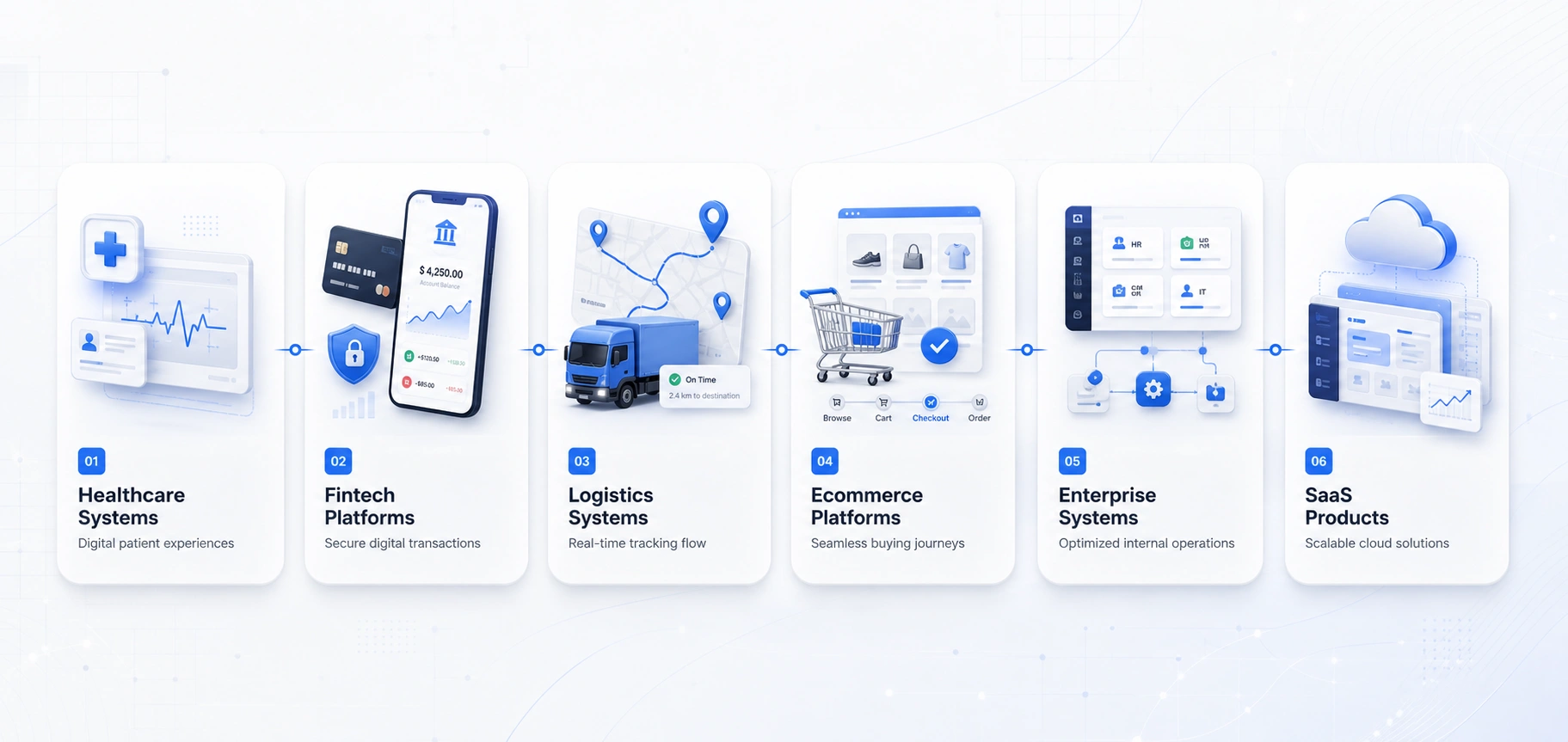
- Healthcare platforms
Patient portals, telemedicine systems, and hospital dashboards require secure, low-latency systems with strict data compliance. - Fintech and insurance systems
Financial dashboards, onboarding systems, and claims processing platforms demand high security, fault tolerance, and real-time processing. - Logistics and supply chain platforms
Fleet tracking, warehouse systems, and operational dashboards rely on event-driven architecture and real-time data synchronization. - Marketplace and ecommerce platforms
Multi-vendor systems, inventory management, and order processing require scalable backend systems and high-availability infrastructure. - Enterprise internal systems
Workflow automation, ERP integrations, and reporting dashboards need tightly integrated and scalable enterprise-grade systems. - SaaS platforms
Subscription-based products require multi-tenant architecture, horizontal scaling, and strong observability systems.
Building for your industry changes everything from architecture to tech stack. The most successful enterprise-grade web applications are not generic systems. They are built to solve industry-specific problems at scale with strong infrastructure and reliable backend development services supporting performance, security, and scalability. To understand how these systems work in practice, let’s look at real-world web application examples and how businesses are scaling with them.
Real-World Web Application Examples That Show How Businesses Scale
Seeing how real businesses use web applications gives better clarity on what actually works. High-performing & scalable enterprise systems are not built around features. They are built to solve specific business problems and scale with demand.
Examples of successful web applications:
- Airbnb platform for global booking and inventory management
Airbnb built a web application that manages listings, pricing, and bookings across regions. The system handles large user volumes while maintaining a seamless user experience. - Shopify ecosystem for scalable online businesses
Shopify created a web application that allows businesses to set up, manage, and scale their online stores. Its architecture supports millions of merchants without performance issues. - Slack system for team collaboration and workflows
Slack developed a web-based platform that centralizes communication, integrates with tools, and improves team productivity across organizations.
Each of these web applications focused on solving a clear problem. They were built with scalability, integrations, and performance in mind from the beginning. Therefore, successful enterprise web application development is not about adding more features. It is about building scalable enterprise systems that handle real-world usage and scale without breaking.
Custom Web Application vs SaaS: Which Option Aligns With Your Growth Plans
Choosing between SaaS and custom web application development is a critical business decision. The impact is not immediate, but it becomes visible as your operations grow. Many businesses choose SaaS for speed, only to face limitations when workflows become complex and scale increases.
SaaS platforms are designed for standard use cases. Custom web applications are built around your business logic, workflows, and long-term goals. The right choice depends on how much flexibility, control, and scalability your business requires.
SaaS vs Custom Web Application Comparison
| Factor | SaaS Platform | Custom Web Application |
| Ownership | Limited control | Full ownership |
| Scalability | Restricted by platform limits | Designed for high growth and scale |
| Integrations | Limited and predefined | Fully customizable integrations |
| Cost Over Time | Recurring subscription cost | Long-term business asset |
| Custom Workflows | Difficult to implement | Built as per business needs |
When SaaS works for your business:
- Quick deployment with minimal setup
SaaS tools help you go live faster without heavy development effort. - Standard workflows and common use cases
If your processes match industry norms, SaaS solutions can handle your needs efficiently. - Lower initial investment
Subscription-based pricing reduces upfront cost, making it suitable for early-stage businesses.
When custom web application development makes more sense:
- Unique workflows and business logic
Custom systems are designed around how your business operates, not the other way around. - Need for scalability and flexibility
As your business grows, custom business web applications allow you to add features and scale without restrictions. - Control over data, integrations, and performance
You get complete ownership of your system, ensuring better security and seamless integrations.
SaaS works well in the beginning. But as your business grows, its limitations start affecting flexibility, scalability, and control. Therefore, if your goal is long-term growth and system ownership, custom web application development becomes a more strategic investment.
How to Choose The Right Web Application Development Company for Long-Term Success
Most businesses make the wrong decision at this stage. They choose a development partner based on cost instead of capability. The result is predictable. Delays, rework, and systems that fail under real usage.
A reliable web application development company does more than write code. It understands your business model, defines the right architecture, and builds systems that perform at scale. This is where the difference between average and high-performing web apps is created.
What you should evaluate before you hire web app developers:
- Experience in building scalable systems
Look for teams that have handled high-traffic applications, complex workflows, and real-world scalability challenges. - Understanding of business workflows and goals
The right partner focuses on solving business problems, not just delivering features. They align development with outcomes. - Strong technical and architectural expertise
A capable team will guide you on the right architecture, integrations, and tech stack based on your requirements. - Post-launch support and system maintenance
Web applications need continuous updates, monitoring, and improvements to stay efficient and secure.
You are not just hiring developers. You are choosing the quality, scalability, and future of your entire system.
Choosing the Right Tech Stack Shapes How Your Web Application Performs
Technology decisions directly impact how your web application performs, scales, and evolves. Many businesses treat tech stack selection as a development choice. In reality, it is a business decision that affects speed, cost, and long-term flexibility.
In 2026, there is no single “best” tech stack. The right choice depends on your product complexity, scalability needs, and integration requirements. Selecting the right full stack web development technologies ensures your frontend, backend, and database work together efficiently to support performance and scalability. Choosing the wrong stack may not show issues immediately, but it creates limitations as your system grows.
Best tech stack based on business use cases
Choosing the right stack depends on what you are building, not trends.
| Business Type | Recommended Stack |
| SaaS Platform | React + Node.js + PostgreSQL |
| Enterprise Dashboard | Angular + .NET |
| Real-Time Systems | Node.js + WebSockets |
| AI Web Applications | Python + FastAPI |
| Ecommerce Platforms | Next.js + Node.js |
Key considerations while selecting a web app development tech stack:
- Frontend technologies for user experience
Frameworks like React or Angular help build responsive and interactive interfaces that improve usability and adoption. Many businesses also partner with a reliable react js development company to create scalable frontend experiences with faster performance and seamless user interactions. - Backend technologies for system performance
Technologies like Node.js or Python support fast processing, scalability, and efficient handling of business logic. Businesses often work with a leading node js development company to build high-performance backend systems capable of handling large-scale application demands - Database selection based on data structure
SQL or NoSQL databases should be chosen based on how your application stores and processes data at scale. - Cloud and infrastructure for scalability
Cloud platforms ensure your application can handle increasing users and workloads without performance issues.
The tech stack should not be chosen based on trends. It should be selected based on how your business operates and how your system needs to scale.
Wrapping Up
Web application development is no longer a technical initiative. It is a business decision that directly impacts how your company operates, scales, and competes. From choosing the right type and features to defining architecture and cost, every step shapes the final outcome. If these decisions are made with clarity, your web application becomes a system that drives efficiency and growth. If not, it becomes a long-term bottleneck that limits performance.
The difference comes down to how you approach the investment. Evaluating ROI, selecting the right development partner, and planning for scalability are not optional steps. They define whether your system delivers results or creates challenges later. At RipenApps, the focus stays on building web applications that align with business goals, not just technical requirements. If you are planning your next move, the right strategy today will decide how your system performs tomorrow.
FAQs
Q1.What is the basic difference between a website and a web application?
A web application is a type of program or software that a user can easily access through any device or web browser without installing it on a device. Whereas a website is a complete collection of related web pages with the same domain name.
Q2.What is the difference between a web application and a mobile application?
A web app can be accessed through a browser, and users can use it on any device over the internet. On the other hand, the web application is installed and downloaded on a device. Web applications are cross-platform, whereas mobile apps are often platform-specific.
Q3.How long does it take to develop a web application?
The time to develop a web application depends on various factors such as the web app’s complexity, features and functionalities you need to add, and many more. The more custom features and integrations you need, the more the web development time will be.
Q4.What technologies are best for web application development in 2026?
Most of the developers choose React for web development. However, other emerging technologies such as Angular, React.js, Node.js, Django, and Ruby on Rails are also best suited for web application development. Apart from these, technologies such as cloud integration, AI, and blockchain also play a crucial role in developing web applications.
Q5. How much does it cost to build a web application in 2026?
Web application development costs can range from $15,000 for a basic web app solution to over $300,000 for enterprise-scale applications. Pricing depends on the app’s scope, number of features, design needs, integrations, developer expertise, and country of development. The more complex your requirements, the higher the cost.
Discuss your project and request for proposal
SHARE
WRITTEN BY

Ishan Gupta
CEO & Founder
Ishan Gupta is a seasoned entrepreneur and CEO with extensive 10+ years of experience in business and mobile app development landscape. He believes that the right digital product allows companies to focus on what they do best, while technology handles the rest. With deep exposure to global markets, he understands what makes an app succeed. His approach translates business needs into clear product strategies, ensuring that every feature contributes to measurable ROI.
View All Articles