


Key Takeaways
- Application maintenance ensures software remains secure, high-performing, scalable, and aligned with evolving business and customer expectations over time.
- Proactive maintenance minimizes downtime, strengthens security, reduces technical debt, and maximizes long-term return on software development investments.
- Continuous monitoring, performance optimization, and timely updates help businesses deliver reliable user experiences while supporting future digital growth.
- AI, automation, DevOps, and cloud-native technologies are transforming application maintenance through predictive insights, faster updates, and operational efficiency.
- Partnering with professional application maintenance services providers helps organizations reduce costs, improve reliability, and accelerate innovation with expert support.
Modern applications are no longer static software products that can be launched and forgotten. Whether it is a mobile app, web platform, SaaS solution, or enterprise application, every digital product requires continuous monitoring, updates, and optimization to remain secure, reliable, and aligned with evolving business needs.
As technologies advance, operating systems change, cyber threats become more sophisticated, and user expectations continue to rise, ongoing application maintenance has become a strategic business necessity rather than an optional IT activity.
Application maintenance goes beyond fixing bugs after deployment. It involves improving performance, strengthening security, ensuring compatibility with new platforms, enhancing user experiences, and introducing feature updates that keep applications competitive in a rapidly changing digital landscape.
Businesses that invest in proactive application maintenance services not only minimize downtime and reduce operational risks but also maximize application lifespan, improve customer satisfaction, and achieve a stronger return on their technology investments.
Whether you’re planning a long-term maintenance strategy for an existing application or evaluating ways to improve its performance, scalability, and security, this guide will help you make informed decisions to ensure your software continues to deliver long-term business value.
Table of Contents
What is Application Maintenance?
Application maintenance is the ongoing process of monitoring, updating, optimizing, and supporting a software application after it has been deployed. While launching an application is a significant milestone, it marks the beginning, not the end of its lifecycle. To remain secure, high-performing, and relevant, applications require continuous improvements that address changing business requirements, user expectations, technological advancements, and security threats.
Businesses often allocate 15–25% of an application’s initial development cost annually toward maintenance because ongoing support directly impacts business continuity, customer retention, and long-term return on investment. Rather than viewing maintenance as a reactive expense, leading organizations treat it as a proactive strategy that enables continuous innovation and sustainable growth.
Why Application Maintenance Matters?
Digital products operate in an environment that is constantly evolving. New operating systems are released, third-party APIs change, cybersecurity threats emerge, and customer expectations continue to rise. Without regular maintenance, applications can quickly become outdated, vulnerable, and expensive to manage.
Effective application maintenance helps businesses:
- Minimize downtime and service disruptions
- Protect sensitive business and customer data
- Improve application speed and reliability
- Enhance user satisfaction and retention
- Extend the lifespan of software assets
- Reduce long-term operational and development costs
- Support business scalability and future growth
By addressing issues proactively rather than reactively, organizations can avoid costly failures while maintaining a competitive advantage.
Where Application Maintenance Fits in the Software Development Lifecycle?
Application maintenance is the longest phase of the Software Development Lifecycle (SDLC). While planning, design, development, testing, and deployment may take several months, maintenance often continues for many years after an application goes live.
The maintenance phase begins immediately after deployment and includes continuous monitoring, issue resolution, performance optimization, feature enhancements, security updates, compliance improvements, and technology upgrades. Every change made during this phase ensures the application remains aligned with evolving business goals and user needs.
Rather than being a final step, maintenance is a continuous cycle that supports the application’s long-term success.
Why Businesses Should Invest in Application Maintenance?
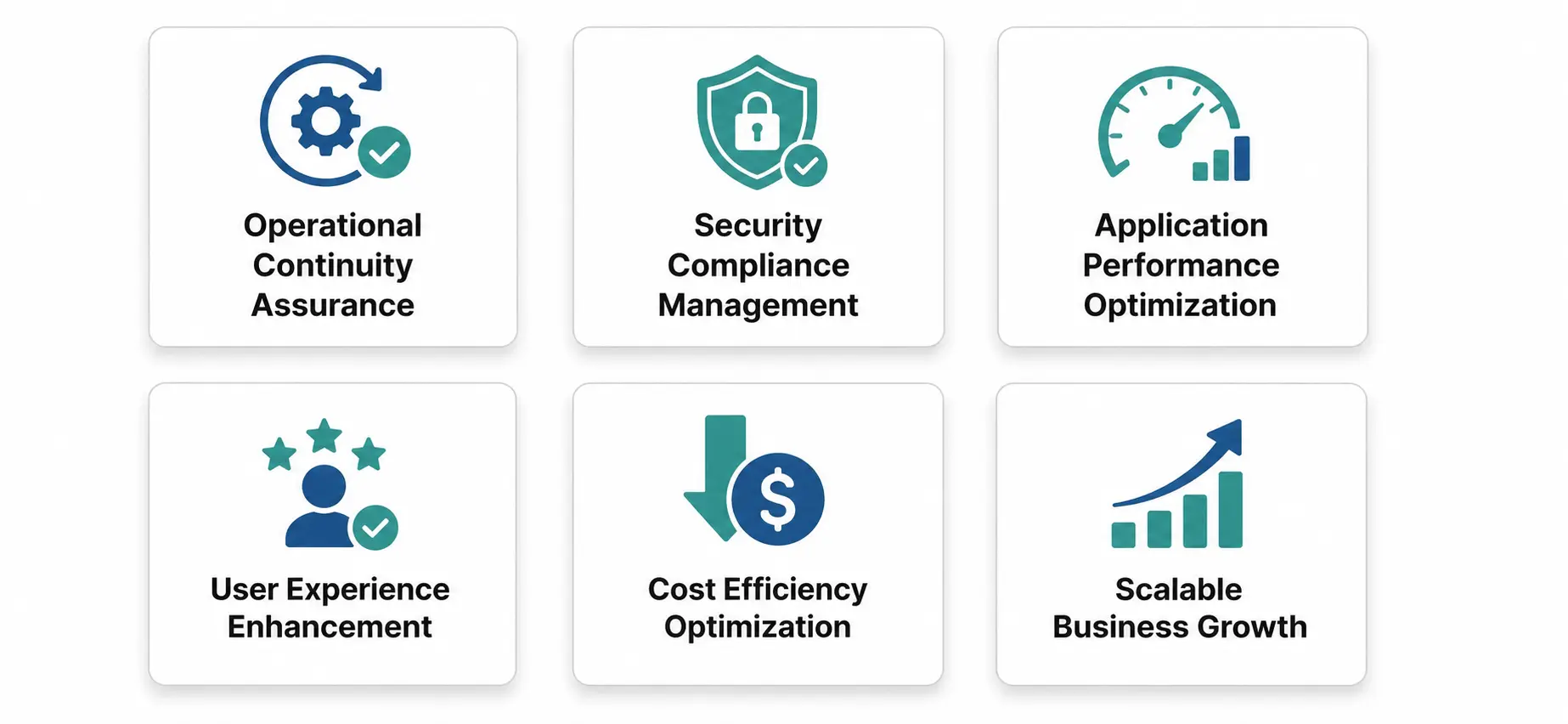
Application maintenance is not merely about fixing bugs; it is a long-term investment that protects business operations, improves customer satisfaction, and maximizes the value of software assets. Organizations that prioritize ongoing maintenance can respond quickly to changing market demands, introduce new features efficiently, and reduce the risk of costly downtime or unexpected failures.
Below are the key reasons why businesses should make application maintenance an integral part of their digital strategy.
1. Business Continuity & Reliability
Unexpected application failures can disrupt operations, impact customer trust, and lead to significant financial losses. Regular maintenance helps identify and resolve potential issues before they escalate into major incidents. Continuous monitoring, proactive troubleshooting, and timely updates ensure applications remain available, stable, and capable of supporting critical business processes with minimal downtime.
2. Enhanced Security & Compliance
Cybersecurity threats continue to evolve, making outdated applications prime targets for attacks. Routine maintenance includes applying security patches, updating dependencies, fixing vulnerabilities, and implementing the latest security standards to safeguard sensitive data.
For businesses operating in regulated industries, maintenance also helps ensure compliance with standards such as GDPR, HIPAA, PCI DSS, or industry-specific regulations, reducing the risk of legal penalties and reputational damage.
3. Improved Application Performance
As applications grow and user bases expand, performance can gradually decline if left unmanaged. Maintenance activities such as database optimization, code refactoring, infrastructure tuning, and performance monitoring help maintain fast load times, efficient resource utilization, and consistent responsiveness.
A well-maintained application not only performs better but also provides a smoother experience for users across devices and platforms.
4. Better User Experience & Customer Retention
Users expect applications to function flawlessly, load quickly, and evolve with their changing needs. Frequent crashes, outdated interfaces, or unresolved bugs can quickly drive users toward competitors.
Application maintenance enables businesses to continuously improve usability, introduce valuable features, resolve user-reported issues, and optimize customer journeys. These enhancements contribute to higher engagement, stronger customer loyalty, and improved retention rates.
5. Cost Optimization & Long-Term ROI
Delaying maintenance often results in larger, more expensive problems in the future. Small performance issues can evolve into critical failures, while outdated technologies may require costly redevelopment projects.
A proactive maintenance strategy helps businesses minimize emergency fixes, reduce technical debt, extend the lifespan of their applications, and maximize the return on their initial development investment. Preventive maintenance is almost always more cost-effective than rebuilding or replacing an aging application.
6. Scalability for Business Growth
As organizations expand, their applications must support increasing numbers of users, transactions, integrations, and business processes. Regular maintenance ensures applications can scale efficiently without compromising performance or security.
By continuously optimizing architecture, upgrading cloud infrastructure, and adapting to new technologies, businesses can confidently support future growth while delivering a consistent user experience. In today’s competitive digital landscape, application maintenance is a strategic enabler that allows software to evolve alongside business objectives rather than becoming a barrier to innovation.
The Complete Application Maintenance Lifecycle
Application maintenance is not a one-time activity performed only when something goes wrong. Instead, it is a continuous lifecycle that enables applications to evolve alongside changing business requirements, user expectations, and technological advancements. A structured maintenance lifecycle helps organizations improve software quality, strengthen security, reduce downtime, and ensure applications remain reliable and scalable throughout their operational lifespan.
1. Continuous Monitoring
The maintenance lifecycle begins with continuously monitoring the application’s health, performance, and security. Instead of waiting for users to report issues, businesses proactively use application monitoring tools, analytics platforms, error logs, and infrastructure dashboards to track system performance. This helps identify performance bottlenecks, application crashes, server downtime, unusual user behavior, security vulnerabilities, API failures, and infrastructure resource utilization before they affect end users. Continuous monitoring enables faster issue detection and minimizes business disruptions.
2. Issue Identification & Prioritization
Once issues are detected, they are analyzed and prioritized based on their severity, business impact, and urgency. Since every issue does not require immediate attention, organizations categorize maintenance requests into critical production incidents, security vulnerabilities, functional bugs, performance issues, user experience improvements, feature enhancement requests, and technical debt reduction. A clear prioritization process ensures that business-critical problems are resolved first while balancing immediate operational needs with long-term product improvements.
3. Planning & Resource Allocation
After maintenance tasks have been prioritized, teams create an execution plan by defining objectives, estimating development effort, assigning developers, QA engineers, and DevOps resources, scheduling maintenance windows, assessing deployment risks, and coordinating with business stakeholders. Effective planning ensures maintenance activities are completed efficiently while minimizing disruptions to business operations and aligning with the organization’s overall product roadmap.
4. Bug Fixes & Enhancements
During this phase, development teams implement the planned improvements by fixing software defects, optimizing existing functionality, and introducing enhancements that improve application performance and user experience. Maintenance activities often include resolving bugs, refactoring inefficient code, updating APIs and third-party integrations, improving database performance, strengthening application security, adding new features, and enhancing accessibility. Many organizations follow Agile development practices to deliver these updates through frequent, incremental releases.
5. Testing & Quality Assurance
Before updates are deployed, they undergo comprehensive testing to verify functionality, stability, performance, and compatibility. This phase includes functional testing, regression testing, performance testing, security testing, integration testing, compatibility testing, and user acceptance testing (UAT). Many businesses also incorporate automated testing within CI/CD pipelines, allowing faster validation of code changes while maintaining consistent software quality and reducing the risk of introducing new defects.
6. Deployment & Release Management
Once testing is complete, updates are deployed to the production environment using structured release management practices. Organizations commonly use deployment strategies such as rolling deployments, blue-green deployments, canary releases, feature flags, and automated CI/CD pipelines to minimize downtime and reduce operational risks. Effective release management also includes version control, deployment validation, rollback planning, and stakeholder communication to ensure a smooth and reliable release process.
7. Performance Monitoring & Continuous Improvement
Application maintenance continues even after deployment. Organizations continuously monitor performance metrics, analyze crash reports and error logs, collect user feedback, measure customer engagement, and identify opportunities for further optimization. The insights gathered during this phase help evaluate the success of recent updates while guiding future maintenance activities. This continuous improvement approach ensures applications remain secure, high-performing, scalable, and aligned with evolving business goals and customer expectations.
Common Application Maintenance Activities
Application maintenance involves a wide range of technical and operational tasks that keep software secure, reliable, and efficient after deployment. While every application has unique maintenance requirements, most organizations perform a set of recurring activities to improve performance, strengthen security, maintain compatibility, and enhance the user experience.
These ongoing efforts help businesses minimize disruptions, adapt to evolving market demands, and maximize the long-term value of their software investments.
1. Bug Fixing
Bug fixing is one of the most fundamental application maintenance activities. As users interact with the software across different devices, operating systems, and usage scenarios, new issues inevitably emerge. Development teams continuously identify, diagnose, and resolve defects such as application crashes, broken workflows, data processing errors, UI inconsistencies, functional issues, and integration failures.
Prompt bug resolution improves software stability, enhances user satisfaction, and helps maintain customer trust by delivering a reliable application experience.
2. Security Patch Management
Regular security updates are essential for protecting applications against evolving cyber threats and maintaining regulatory compliance. Security patch management involves identifying vulnerabilities and applying updates before they can be exploited by attackers. This includes updating software dependencies, installing operating system security patches, addressing known vulnerabilities (CVEs), strengthening authentication mechanisms, updating encryption protocols, managing SSL/TLS certificates, and reviewing user access controls.
A proactive security maintenance strategy significantly reduces the risk of data breaches, ransomware attacks, and unauthorized access.
3. Performance Optimization
As applications grow in complexity and user traffic increases, maintaining optimal performance becomes increasingly important. Performance optimization focuses on improving application speed, responsiveness, and scalability by optimizing database queries, reducing server resource consumption, implementing caching mechanisms, enhancing API performance, improving page load times, and scaling cloud infrastructure when necessary.
Regular performance tuning ensures applications continue delivering seamless user experiences while supporting future business growth.
4. Feature Enhancements
Application maintenance also includes continuously improving functionality to meet changing customer expectations and business objectives. Feature enhancements may involve adding new capabilities, refining existing workflows, improving user dashboards, introducing personalization features, expanding reporting and predictive analytics, supporting additional payment methods, or integrating AI-powered functionality.
By continuously evolving their applications, businesses can remain competitive, improve customer engagement, and increase user retention over time.
5. Third-Party API & Integration Updates
Most modern applications rely on external APIs, cloud services, payment gateways, analytics platforms, and communication tools. As these services release new versions or deprecate existing ones, applications must be updated to maintain seamless integrations.
Maintenance activities typically include updating API versions, replacing deprecated libraries, modifying authentication methods, validating third-party integrations, monitoring integration performance, and resolving compatibility issues. Keeping integrations current prevents service interruptions and ensures uninterrupted application functionality.
6. Database Optimization
Over time, growing data volumes can impact application performance if databases are not properly maintained. Database optimization focuses on improving efficiency through query optimization, index management, database cleanup, archiving outdated records, storage optimization, backup and recovery testing, and data integrity validation.
Well-maintained databases reduce latency, improve system responsiveness, and contribute to overall application reliability and operational efficiency.
7. UI/UX Improvements
User expectations continue to evolve, making ongoing UI and UX improvements an important part of application maintenance. Organizations regularly refine application interfaces by simplifying navigation, updating visual designs, enhancing accessibility, improving mobile responsiveness, streamlining user journeys, optimizing forms and workflows, and addressing customer feedback. Even small usability improvements can significantly enhance customer satisfaction, increase engagement, and improve long-term user retention.
8. Platform Compatibility Updates
Operating systems, browsers, devices, cloud platforms, and development frameworks are continuously evolving, making compatibility updates a critical maintenance activity. Organizations regularly update applications to support the latest Android and iOS versions, ensure browser compatibility, upgrade development frameworks, maintain cloud platform compatibility, adapt to new hardware capabilities, and verify cross-device functionality.
By keeping applications compatible with modern technologies, businesses can deliver consistent user experiences, extend application lifespan, and minimize the risk of unexpected compatibility issues.
Application Maintenance Across Different Application Types
While the core principles of application maintenance remain the same, the maintenance strategy varies depending on the type of application. A mobile app has different update cycles and compatibility requirements than a SaaS platform or an enterprise application. Similarly, cloud-native applications require a different maintenance approach compared to legacy systems.
Understanding these differences helps businesses allocate resources effectively, choose the right maintenance practices, and ensure every application continues to meet performance, security, and scalability expectations.
1. Mobile Application Maintenance
Mobile applications operate in a rapidly changing ecosystem where operating systems, devices, app store policies, and user expectations evolve continuously. To deliver a seamless experience, businesses must regularly update their mobile apps to maintain compatibility and improve functionality.
Businesses offering or investing in Android application development services should prioritize continuous maintenance to ensure their applications remain compatible with the latest Android versions, security standards, and user expectations. Regular mobile app maintenance not only improves user satisfaction but also helps maintain higher app ratings, better retention, and compliance with app marketplace requirements.
2. Web Application Maintenance
Web applications require continuous updates to deliver consistent performance across multiple browsers, devices, and internet environments. Since users access web applications directly through browsers, even minor compatibility or performance issues can significantly affect the user experience. Routine maintenance ensures web applications remain fast, secure, and responsive while supporting evolving business requirements and increasing user traffic.
3. Enterprise Application Maintenance
Enterprise applications often support mission-critical business operations such as finance, human resources, supply chain management, customer relationship management (CRM), and enterprise resource planning (ERP). Because these systems handle large volumes of sensitive data and complex workflows, maintenance must prioritize reliability, security, and business continuity.
Given the business impact of downtime, enterprise maintenance usually follows structured Service Level Agreements (SLAs) and change management processes to minimize operational risks.
4. SaaS Application Maintenance
Software-as-a-Service (SaaS) products require continuous maintenance because users expect regular improvements without service interruptions. Unlike traditional software, SaaS platforms are updated centrally, allowing businesses to release enhancements more frequently. Successful SaaS providers often rely on Agile development, DevOps practices, and CI/CD pipelines to deliver small, frequent updates while maintaining high application availability.
5. Cloud-Native Application Maintenance
Cloud-native applications are designed to leverage cloud infrastructure, microservices, containers, and scalable architectures. Their maintenance strategy focuses on automation, resilience, and efficient resource utilization. Organizations maintaining cloud-native applications often automate many routine tasks using DevOps, AIOps, and cloud management platforms to improve operational efficiency.
6. Legacy Application Maintenance
Many businesses continue to rely on legacy applications that support essential operations despite being built on older technologies. Maintaining these systems presents unique challenges due to outdated architectures, limited documentation, aging infrastructure, and compatibility constraints. In some cases, businesses may combine maintenance with application modernization strategies, allowing them to extend the application’s lifespan while progressively migrating to newer technologies.
Regardless of the application type, the objective of maintenance remains consistent: ensuring software continues to perform reliably, securely, and efficiently while adapting to evolving technologies and business needs. By tailoring maintenance strategies to the specific characteristics of each application, organizations can improve operational resilience, maximize software value, and support long-term digital growth.
Best Practices for Effective Application Maintenance
An effective application maintenance strategy goes beyond fixing bugs after they occur. It requires a proactive and structured approach that focuses on performance, security, scalability, and continuous improvement throughout the software lifecycle.
Organizations that adopt maintenance best practices can reduce downtime, minimize technical debt, improve user satisfaction, and extend the lifespan of their applications. Whether maintaining a mobile app, web application, SaaS platform, or enterprise software, following these best practices helps ensure long-term stability and business success.
1. Build a Preventive Maintenance Strategy
Application maintenance should be proactive rather than reactive. Waiting until issues impact users often leads to costly downtime, emergency fixes, and poor customer experiences. Instead, businesses should establish a preventive maintenance strategy that includes regular code reviews, scheduled software updates, infrastructure health checks, dependency upgrades, and security assessments.
By identifying and resolving potential issues early, organizations can reduce operational risks, minimize technical debt, and make future enhancements more efficient and cost-effective.
2. Automate Monitoring & Alerts
Modern applications operate across cloud environments, APIs, microservices, and multiple platforms, making manual monitoring insufficient. Automated monitoring tools provide real-time visibility into application health by tracking key performance metrics such as uptime, response time, CPU and memory utilization, database performance, API latency, error rates, crash reports, and security events.
Real-time alerts enable development teams to detect anomalies quickly, respond faster to incidents, and prevent minor issues from escalating into major disruptions.
3. Maintain Proper Documentation
Comprehensive documentation is a critical component of successful application maintenance. As applications become more complex and development teams grow, accurate documentation improves collaboration, simplifies troubleshooting, and accelerates onboarding for new team members.
Organizations should maintain up-to-date system architecture diagrams, source code documentation, API references, database schemas, deployment procedures, configuration settings, incident response guides, and release notes. Well-maintained documentation also supports smoother upgrades, easier maintenance, and faster disaster recovery when unexpected issues occur.
4. Implement Regular Security Audits
Security is an ongoing responsibility rather than a one-time implementation. Regular security audits help organizations identify vulnerabilities before they can be exploited, reducing the risk of cyberattacks and compliance violations.
An effective security maintenance strategy includes vulnerability assessments, penetration testing, dependency and library updates, security patch management, access control reviews, encryption validation, compliance audits, and backup and recovery testing. By integrating security into routine maintenance activities, businesses can better protect sensitive data, maintain regulatory compliance, and preserve customer trust.
5. Use CI/CD for Faster Updates
Continuous Integration and Continuous Deployment (CI/CD) streamline the maintenance process by automating code integration, testing, and deployment. Instead of relying on large, infrequent releases, organizations can deliver smaller, more frequent updates with greater confidence. CI/CD pipelines reduce deployment errors, accelerate bug fixes, automate quality assurance, improve collaboration between development and operations teams, and shorten recovery times when issues arise.
This enables businesses to respond more quickly to customer needs while maintaining application quality and stability.
6. Track Performance Metrics
Effective application maintenance should be guided by measurable insights rather than assumptions. Monitoring key performance indicators (KPIs) allows organizations to evaluate application health, identify optimization opportunities, and make informed maintenance decisions. Important metrics include application uptime, Mean Time to Resolution (MTTR), response time, crash rate, API performance, infrastructure utilization, user retention, customer satisfaction scores, and release frequency.
Regular performance analysis helps teams identify trends, improve system reliability, and deliver a better overall user experience.
7. Plan Regular Technology Upgrades
Technology evolves rapidly, and applications built on outdated frameworks, libraries, or infrastructure become increasingly difficult to maintain. Regular technology upgrades help ensure applications remain secure, compatible, scalable, and capable of supporting future business growth.
Organizations should periodically upgrade development frameworks, replace deprecated libraries, modernize cloud services, improve application architecture, refactor legacy code, and adopt the latest security standards. By incorporating application modernization services into a long-term maintenance roadmap, businesses can avoid costly technical debt while keeping their applications competitive and future-ready.
By following these best practices, organizations can transform application maintenance from a reactive operational task into a strategic business advantage. A proactive maintenance approach improves application reliability, strengthens security, reduces long-term costs, and enables businesses to deliver consistent, high-quality digital experiences while adapting to evolving technologies, customer expectations, and market demands.
Key Metrics & KPIs for Measuring Application Maintenance Success
Effective application maintenance is not just about deploying updates or resolving issues; it is about delivering measurable business and technical outcomes. Tracking the right Key Performance Indicators (KPIs) helps organizations evaluate the effectiveness of their maintenance strategy, identify areas for improvement, and make data-driven decisions that enhance application performance and reliability.
By regularly monitoring these metrics, businesses can reduce downtime, improve user satisfaction, optimize maintenance costs, and ensure their applications continue to support long-term business objectives.
1. Mean Time to Resolution (MTTR)
Mean Time to Resolution (MTTR) measures the average time required to identify, diagnose, and resolve an application issue after it has been reported or detected. It is one of the most important indicators of maintenance efficiency.
A lower MTTR demonstrates that maintenance teams can quickly restore normal operations, minimizing business disruptions and improving customer experiences.
Businesses can improve MTTR by:
- Automating incident detection
- Implementing proactive monitoring
- Maintaining clear escalation processes
- Using centralized issue-tracking systems
- Documenting recurring issues and solutions
Reducing MTTR not only improves operational efficiency but also helps organizations meet Service Level Agreement (SLA) commitments.
2. Application Availability & Uptime
Application uptime measures the percentage of time an application remains available and fully operational. For customer-facing applications, high availability is critical, as even short periods of downtime can result in lost revenue, reduced productivity, and dissatisfied users.
Most businesses strive for uptime targets of 99.9% or higher, depending on the application’s criticality.
To maximize availability, organizations should:
- Continuously monitor infrastructure
- Implement redundancy and failover mechanisms
- Perform regular maintenance during scheduled windows
- Use cloud auto-scaling and load balancing
- Conduct disaster recovery testing
Consistently high uptime reflects a stable and well-maintained application.
3. Crash Rate
Crash rate measures how frequently an application unexpectedly stops functioning. A high crash rate often indicates underlying issues such as software defects, memory leaks, compatibility problems, or infrastructure failures.
Maintenance teams should continuously monitor:
- Mobile application crashes
- Server-side failures
- API exceptions
- Browser errors
- Device-specific crashes
Analyzing crash reports enables teams to identify root causes, prioritize fixes, and improve application stability over time.
4. Response Time
Application response time measures how quickly the system processes user requests and returns results. Slow response times negatively impact user experience, reduce engagement, and may even affect search engine rankings for web applications.
Maintenance teams should regularly evaluate:
- Page load times
- API response latency
- Database query performance
- Server processing speed
- Network latency
Optimizing response time through code improvements, caching, infrastructure scaling, and database tuning helps deliver faster and more reliable digital experiences.
5. Release Frequency
Release frequency indicates how often maintenance updates, bug fixes, security patches, or feature enhancements are deployed to production.
Organizations with mature maintenance processes often release smaller, more frequent updates instead of large, infrequent releases. This approach allows businesses to:
- Respond faster to customer feedback
- Resolve issues more quickly
- Reduce deployment risks
- Continuously improve application quality
Tracking release frequency also helps evaluate the effectiveness of Agile development and CI/CD practices.
6. SLA Compliance
For organizations offering managed application maintenance services, Service Level Agreement (SLA) compliance is a critical performance metric. SLAs define expectations for response times, issue resolution, system availability, and service quality.
Maintenance teams typically monitor:
- Incident response times
- Resolution time commitments
- Application uptime guarantees
- Maintenance window adherence
- Customer support responsiveness
Consistently meeting or exceeding SLA targets builds customer trust and demonstrates operational excellence.
7. User Satisfaction Metrics
Ultimately, the success of application maintenance is reflected in the experiences of its users. Monitoring user satisfaction helps businesses understand whether maintenance efforts are delivering meaningful improvements.
Common user-focused metrics include:
- Customer Satisfaction Score (CSAT)
- Net Promoter Score (NPS)
- App Store and Google Play ratings
- User retention rate
- Feature adoption rate
- Customer support feedback
- User-reported issues
Combining technical KPIs with customer-centric metrics provides a complete view of application health and maintenance effectiveness.
Rather than tracking isolated metrics, businesses should establish a comprehensive maintenance dashboard that combines operational, performance, security, and user experience indicators. Regularly reviewing these KPIs enables teams to identify trends, prioritize improvements, and continuously optimize application performance. A data-driven maintenance strategy not only improves software reliability but also supports better business outcomes, stronger customer relationships, and long-term application success.
Common Challenges in Application Maintenance
Application maintenance is essential for ensuring long-term software reliability, but it also presents several technical, operational, and business challenges. As applications become more complex and user expectations continue to evolve, maintenance teams must balance performance, security, scalability, and costs while minimizing disruptions to daily operations. Recognizing these challenges early enables organizations to build proactive maintenance strategies, allocate resources effectively, and reduce the risk of unexpected failures.
1. Technical Debt
Technical debt accumulates when development teams prioritize short-term fixes or rapid releases over long-term code quality. While this approach may speed up initial development, it often makes future maintenance more complex, time-consuming, and expensive.
Common indicators of technical debt include poorly structured code, outdated frameworks, duplicate functionality, limited documentation, recurring bugs, and slower development cycles. Regular code refactoring, architecture reviews, and adherence to coding standards help organizations reduce technical debt and simplify future maintenance efforts.
2. Legacy Systems
Many organizations continue to rely on legacy applications that support critical business operations. However, maintaining these systems becomes increasingly difficult due to outdated technologies, unsupported frameworks, limited scalability, and a shrinking pool of developers with expertise in older platforms. Legacy systems also face integration challenges and higher maintenance costs.
Rather than replacing them entirely, many businesses adopt a phased modernization approach that combines ongoing maintenance with gradual upgrades to modern technologies.
3. Security Risks
As cyber threats become more advanced, security remains one of the most significant challenges in application maintenance. Applications that are not updated regularly become vulnerable to malware, ransomware, data breaches, and unauthorized access. Common security issues include unpatched vulnerabilities, outdated third-party libraries, weak authentication mechanisms, insecure APIs, misconfigured cloud environments, and inadequate access controls.
Implementing regular security patches, vulnerability assessments, penetration testing, and compliance audits helps organizations strengthen their security posture and reduce cybersecurity risks.
4. Performance Bottlenecks
As applications grow in complexity and user traffic increases, performance bottlenecks can negatively impact the user experience and business productivity. Slow-loading applications often result from inefficient database queries, poorly optimized code, excessive server utilization, memory leaks, API latency, or insufficient infrastructure capacity. Continuous performance monitoring, infrastructure optimization, and regular performance tuning help ensure applications remain fast, responsive, and capable of supporting increasing workloads.
5. Compatibility Issues
The technology ecosystem evolves rapidly, with frequent updates to operating systems, browsers, devices, cloud platforms, and third-party services. Without regular compatibility testing and updates, applications may experience broken functionality, browser rendering issues, API integration failures, device-specific errors, or framework incompatibilities. Maintaining compatibility across different environments ensures users receive a consistent and reliable experience regardless of the platform or device they use.
6. Resource Constraints
Many organizations face challenges in allocating sufficient resources for ongoing application maintenance. Limited budgets, developer shortages, competing business priorities, and expanding application portfolios often delay critical maintenance activities. These constraints can lead to postponed security updates, growing maintenance backlogs, and increased operational risks.
Businesses can address these challenges by prioritizing maintenance tasks, automating repetitive processes, adopting efficient workflows, and partnering with experienced application maintenance providers when additional expertise is required.
7. Compliance Requirements
Organizations operating in regulated industries must continuously maintain their applications to comply with evolving legal, privacy, and industry-specific standards. Failing to meet compliance requirements can result in financial penalties, legal consequences, and reputational damage.
Ongoing maintenance activities such as updating privacy controls, maintaining audit logs, strengthening data encryption, implementing robust access management policies, conducting compliance assessments, and applying regulatory updates help ensure applications remain compliant with standards such as GDPR, HIPAA, and PCI DSS.
Although these challenges are common, they can be effectively managed with a proactive maintenance strategy. Organizations that continuously monitor application health, leverage automation, reduce technical debt, strengthen security, optimize performance, and plan for future scalability are better equipped to minimize maintenance risks. By addressing these challenges strategically, businesses can extend the lifespan of their applications, improve operational efficiency, and deliver secure, reliable, and high-quality digital experiences to their users.
How Much Does Application Maintenance Cost?
Application maintenance is an ongoing investment that ensures software remains secure, reliable, and aligned with evolving business needs. Unlike one-time app development costs, maintenance expenses continue throughout an application’s lifecycle and vary depending on its complexity, technology stack, infrastructure, and business requirements.
While there is no universal pricing model, many organizations allocate 15–25% of the initial application development cost annually for maintenance. However, the actual cost depends on factors such as application size, update frequency, security requirements, compliance obligations, and the level of ongoing support required. Understanding these cost drivers helps businesses plan realistic budgets and maximize their return on investment.
Cost by Application Complexity
Application complexity is one of the biggest factors affecting maintenance costs. More features, integrations, and infrastructure components require additional development, testing, monitoring, and support.
| Application Type | Estimated Annual Maintenance Cost |
| Simple mobile or web application | 15–20% of development cost |
| Medium-complexity business application | 20–25% of development cost |
| Enterprise or SaaS platform | 20–30% (or more) of development cost |
Please note that actual costs vary depending on business requirements, maintenance scope, and engagement model. For example, a basic business application may primarily require bug fixes and periodic updates, while an enterprise platform may need continuous monitoring, security audits, infrastructure optimization, and frequent feature enhancements.
Tips to Reduce Maintenance Expenses
Although application maintenance is unavoidable, businesses can significantly optimize costs through proactive planning and efficient maintenance practices.
Some proven strategies include:
- Invest in preventive maintenance instead of reactive fixes.
- Keep software dependencies and frameworks up to date.
- Automate testing, monitoring, and deployment using CI/CD pipelines.
- Regularly refactor code to reduce technical debt.
- Continuously monitor application performance to identify issues early.
- Optimize cloud infrastructure and eliminate unused resources.
- Maintain comprehensive documentation to simplify future updates.
- Consider outsourcing maintenance to experienced specialists for greater efficiency.
The most expensive maintenance strategy is often delaying maintenance altogether. Ignoring minor issues can lead to security vulnerabilities, application downtime, poor user experiences, and costly redevelopment projects in the future.
Rather than viewing maintenance as an operational expense, businesses should consider it a strategic investment that protects software assets, improves application performance, extends product lifespan, and supports sustainable business growth. A well-planned maintenance strategy ultimately reduces long-term costs while ensuring applications continue to deliver value in an increasingly competitive digital landscape.
In-House vs Outsourced Application Maintenance
Once an application is live, businesses must decide who will be responsible for its ongoing maintenance. The two most common approaches are managing maintenance with an internal team or outsourcing it to a specialized application maintenance provider. Each model offers distinct advantages and challenges, and the right choice depends on factors such as business size, technical expertise, budget, application complexity, security requirements, and long-term growth plans. While large enterprises often have the resources to maintain dedicated internal teams, many startups and growing businesses choose outsourcing to gain access to specialized expertise, advanced tools, and scalable support without the overhead of expanding their workforce.
Benefits of In-House Teams
An in-house maintenance team consists of employees who work exclusively on the organization’s applications and technology ecosystem. Because they are closely aligned with internal operations, they typically have a deeper understanding of business objectives, product roadmaps, organizational workflows, and user requirements. This enables better collaboration with product, design, and development teams while giving businesses greater control over maintenance priorities, release schedules, and sensitive data. However, maintaining an in-house team also requires significant investment in recruitment, salaries, employee benefits, training, software licenses, infrastructure, and continuous upskilling to keep pace with rapidly evolving technologies.
Benefits of Outsourcing
Outsourcing application maintenance involves partnering with an experienced service provider that specializes in application support, monitoring, optimization, and long-term maintenance. This approach gives businesses access to skilled professionals without the costs and complexities of building and managing an internal maintenance team. Outsourcing offers several advantages, including specialized technical expertise, lower operational costs, faster issue resolution, flexible engagement models, 24/7 monitoring and support, and the ability to scale maintenance resources as business needs evolve. Organizations also benefit from access to modern automation tools, cloud-native technologies, DevOps practices, and AI-driven maintenance solutions that may be difficult or costly to implement internally.
Cost Comparison
Cost is often one of the most important considerations when choosing between in-house and outsourced application maintenance. Building an internal maintenance team requires ongoing investments in developer and QA salaries, DevOps engineers, recruitment, onboarding, employee training, monitoring tools, software licenses, hardware, infrastructure, and workspace expenses. In contrast, outsourced maintenance providers typically offer predictable pricing through fixed-cost, hourly, or dedicated team engagement models, allowing businesses to pay only for the services they need. For startups, small and medium-sized businesses, and organizations with fluctuating maintenance requirements, outsourcing often provides a more cost-effective and flexible solution while reducing administrative overhead.
Which Option Is Right for Your Business?
There is no universal solution when it comes to application maintenance. The right approach depends on your organization’s goals, available resources, application complexity, compliance requirements, and long-term technology strategy. Businesses with large IT budgets, highly confidential systems, complex internal workflows, and experienced development teams may benefit from maintaining an in-house team that offers maximum operational control. On the other hand, organizations looking to reduce costs, access specialized expertise, scale quickly, or provide round-the-clock application support often find outsourcing to be the more practical option.
Many businesses also adopt a hybrid maintenance model, combining the strengths of both approaches. In this model, the internal product team focuses on business strategy, product planning, and feature prioritization, while an external maintenance partner manages routine monitoring, bug fixes, security updates, infrastructure management, and performance optimization. This balanced approach enables organizations to retain strategic control while leveraging specialized technical expertise and operational efficiency.
Ultimately, the best application maintenance model is the one that aligns with your business objectives, technical capabilities, and future growth plans. Whether managed by an internal team, outsourced to a specialized provider, or supported through a hybrid approach, the primary goal remains the same: ensuring applications remain secure, reliable, scalable, and capable of delivering consistent value to users over the long term.
Modern Technologies Transforming Application Maintenance
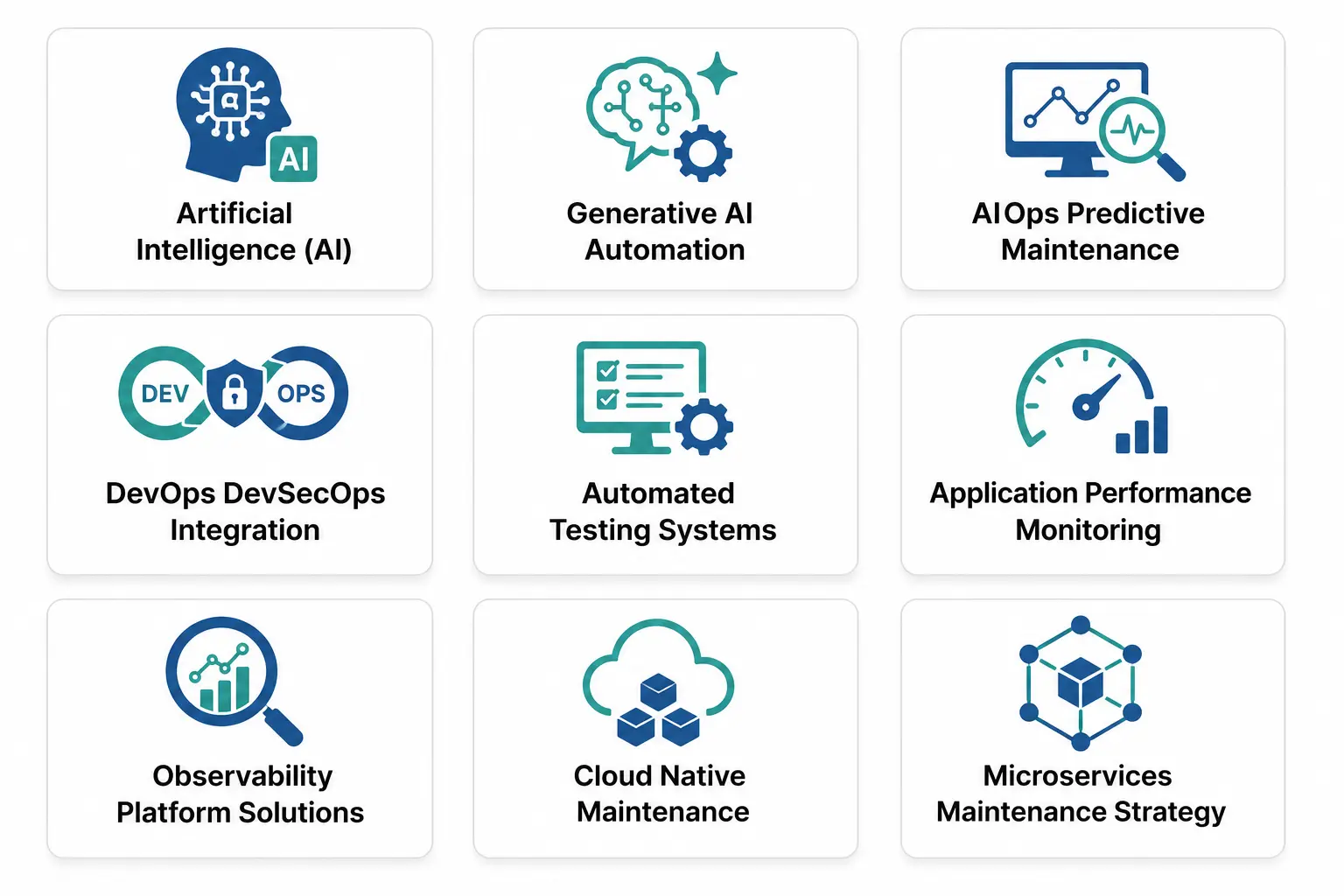
Application maintenance has evolved far beyond manual bug fixes and scheduled updates. Today, organizations are leveraging advanced technologies to automate repetitive tasks, detect issues before they impact users, and optimize application performance in real time. From Artificial Intelligence (AI) and AIOps to cloud-native platforms and observability tools, modern maintenance practices are enabling businesses to deliver more reliable, scalable, and resilient applications.
By adopting these technologies, organizations can reduce maintenance costs, improve operational efficiency, accelerate software releases, and enhance user experiences while staying ahead of rapidly changing business and technology landscapes.
1. Artificial Intelligence (AI)
Artificial Intelligence is transforming how maintenance teams monitor, analyze, and optimize applications. Instead of relying solely on manual analysis, AI can process massive volumes of application logs, performance metrics, and user behavior data to identify patterns and detect anomalies much faster.
By providing actionable insights in real time, AI enables maintenance teams to make faster, data-driven decisions while improving overall application reliability.
2. Generative AI for Maintenance Automation
Generative AI is becoming a valuable assistant for development and maintenance teams by accelerating repetitive tasks and improving productivity. Rather than replacing developers, it helps automate routine activities, allowing teams to focus on solving more complex challenges.
For example, when a production issue occurs, a Generative AI assistant can analyze logs, suggest possible causes, recommend code fixes, and generate automated test cases, significantly reducing the time required to resolve incidents.
3. AIOps & Predictive Maintenance
AIOps (Artificial Intelligence for IT Operations) combines AI, machine learning, and big data analytics to automate IT operations and proactively manage application health. Instead of responding to failures after they occur, AIOps enables predictive maintenance by identifying potential issues before they affect business operations.
Predictive maintenance minimizes downtime, improves system reliability, and helps organizations shift from reactive maintenance to proactive application management.
4. DevOps & DevSecOps
DevOps has transformed application maintenance by fostering collaboration between development and operations teams while automating software delivery processes. Combined with Continuous Integration and Continuous Deployment (CI/CD), DevOps enables businesses to release updates faster, reduce deployment errors, and improve application stability.
DevSecOps extends this approach by integrating security throughout the software lifecycle rather than treating it as a separate phase. By embedding security into every stage of development and maintenance, DevSecOps helps organizations build more resilient applications while reducing security vulnerabilities.
5. Automated Testing
Modern applications undergo frequent updates, making manual testing alone insufficient. Automated testing enables organizations to validate code changes quickly while ensuring application quality remains consistent. Automated testing reduces human error, accelerates release cycles, and gives development teams greater confidence when deploying maintenance updates.
6. Application Performance Monitoring (APM)
Application Performance Monitoring (APM) provides continuous visibility into how applications perform in production environments. Rather than waiting for users to report issues, APM tools monitor application health in real time and alert teams to potential performance problems. These insights allow maintenance teams to identify bottlenecks, optimize system performance, and maintain consistent user experiences.
7. Observability Platforms
As applications become increasingly distributed across microservices, containers, and cloud environments, traditional monitoring is no longer enough. Observability platforms provide deeper visibility into complex systems by combining metrics, logs, traces, and events. This comprehensive view helps maintenance teams resolve issues faster while improving overall system resilience.
8. Cloud-Native Maintenance
Cloud-native applications require a maintenance strategy built around automation, scalability, and resilience. Unlike traditional infrastructure, cloud-native environments rely on containers, orchestration platforms, and Infrastructure as Code (IaC), allowing organizations to automate many maintenance activities. By leveraging cloud-native technologies, businesses can improve operational efficiency while ensuring applications remain highly available and scalable.
9. Microservices Maintenance
Applications built using a microservices architecture consist of multiple independent services that communicate through APIs. While this architecture offers greater flexibility and scalability, it also introduces unique maintenance challenges.
When supported by automation, observability, and DevOps practices, microservices enable organizations to deploy updates faster, isolate failures more effectively, and continuously improve application performance without affecting the entire system.
Modern application maintenance is increasingly driven by automation, intelligence, and continuous optimization. Organizations that embrace AI, AIOps, DevSecOps, automated testing, observability, and cloud-native technologies can resolve issues more quickly, improve software quality, and reduce operational costs. As digital ecosystems become more complex, adopting these technologies is no longer a competitive advantage; it is becoming a fundamental requirement for delivering secure, scalable, and future-ready applications.
Future Trends in Application Maintenance
Application maintenance is undergoing a significant transformation as businesses increasingly adopt AI, automation, cloud-native technologies, and data-driven operations. Over the next few years, maintenance will evolve from a reactive process focused on fixing issues to a proactive, intelligent discipline that continuously optimizes applications with minimal human intervention. Organizations that embrace these emerging trends early will be better positioned to reduce operational costs, improve application resilience, accelerate innovation, and deliver exceptional digital experiences.
1. Self-Healing Applications
Self-healing applications are becoming a cornerstone of modern maintenance strategies by automatically detecting, diagnosing, and resolving common issues without manual intervention. Powered by AI, automation, and predefined remediation workflows, these applications can restart failed services, recover from server failures, replace unhealthy containers, resolve configuration issues, and restore functionality after minor disruptions. As cloud-native architectures continue to mature, self-healing capabilities are expected to become a standard feature of enterprise applications.
2. AI-Driven Autonomous Maintenance
Artificial Intelligence is rapidly evolving from a support tool into an autonomous maintenance assistant capable of handling routine operational tasks. Future AI-powered maintenance platforms will continuously detect anomalies, prioritize incidents based on business impact, generate automated fixes for common issues, optimize infrastructure resources, and learn from historical maintenance data.
Rather than replacing development teams, AI will enhance productivity by automating repetitive maintenance work and allowing engineers to focus on strategic innovation.
3. Hyperautomation
Hyperautomation combines Artificial Intelligence (AI), Machine Learning (ML), Robotic Process Automation (RPA), intelligent automation, and workflow automation to streamline end-to-end maintenance processes. By automating activities such as incident management, ticket routing, security patch deployment, compliance reporting, infrastructure provisioning, software testing, release management, and routine operational workflows, organizations can significantly improve efficiency, reduce manual errors, and accelerate software delivery while maintaining higher operational consistency.
As businesses increasingly adopt intelligent automation, maintenance teams can optimize repetitive tasks, improve decision-making, and deliver faster, more reliable application maintenance.
4. Green Software Engineering
As sustainability becomes a business priority, application maintenance is increasingly focused on reducing the environmental impact of software systems. Green software engineering emphasizes optimizing application resource consumption, minimizing unnecessary cloud usage, improving energy-efficient coding practices, reducing infrastructure waste, optimizing database and storage utilization, and monitoring application carbon footprints.
These practices not only lower operational costs but also support broader environmental, social, and governance (ESG) objectives while improving overall application efficiency.
5. Platform Engineering
Platform engineering is emerging as a critical practice for simplifying application operations and standardizing maintenance across development teams. Instead of each team managing its own infrastructure independently, organizations are building internal developer platforms that automate deployment, monitoring, security, and maintenance workflows.
This approach improves developer productivity, simplifies infrastructure management, strengthens governance, reduces operational complexity, and enables faster, more consistent software delivery across large-scale digital ecosystems.
6. Intelligent Observability
The future of application maintenance extends beyond traditional monitoring through the adoption of intelligent observability platforms powered by AI and machine learning. These solutions analyze logs, metrics, traces, and system events collectively to provide deeper insights into application behavior.
Intelligent observability enables organizations to predict incidents before they occur, automatically identify root causes, detect hidden performance bottlenecks, improve maintenance planning, and reduce Mean Time to Resolution (MTTR), allowing teams to shift from reactive troubleshooting to continuous optimization.
7. Evolving Security & Compliance Requirements
As cyber threats become more sophisticated and regulatory requirements continue to evolve, security and compliance will remain central to application maintenance strategies. Future maintenance practices will increasingly incorporate AI-powered threat detection, continuous vulnerability scanning, automated compliance monitoring, Zero Trust security models, enhanced identity and access management, and ongoing regulatory updates.
By adopting modern app security ways, businesses can proactively protect their applications, strengthen their security posture, and ensure compliance with evolving industry and regulatory standards.
Embedding security into every stage of the maintenance lifecycle will help organizations protect sensitive data, maintain customer trust, and meet evolving legal and industry standards.
The future of application maintenance will be defined by intelligence, automation, and continuous optimization. Organizations that invest in technologies such as AI-driven maintenance, self-healing systems, hyperautomation, intelligent observability, platform engineering, and sustainable software practices will be better equipped to build resilient, scalable, and cost-efficient applications.
Rather than simply preserving software functionality, future-ready maintenance strategies will enable applications to evolve continuously, adapt to changing business needs, and deliver long-term competitive advantages in an increasingly digital world.
Why Choose Professional Application Maintenance Services?
Maintaining modern applications requires far more than occasional bug fixes. Businesses must continuously monitor performance, strengthen security, ensure compatibility with evolving technologies, optimize infrastructure, and introduce enhancements that align with changing customer expectations. As applications become increasingly complex, managing these responsibilities internally can strain development teams and divert focus from innovation.
Professional application maintenance services provided by a top app development company give businesses access to dedicated expertise, proven processes, and modern tools to keep applications running at peak performance throughout their lifecycle. Instead of reacting to issues after they occur, experienced maintenance partners adopt a proactive approach that minimizes downtime, reduces operational risks, and supports long-term business growth.
Business Benefits of Managed Maintenance
Partnering with a professional application maintenance provider offers far more than routine software updates. It enables businesses to adopt a proactive maintenance approach that improves application performance, security, and long-term reliability while reducing the burden on internal teams.
Managed maintenance services provide continuous monitoring to detect and resolve issues before they impact users, faster bug fixes and incident resolution through experienced maintenance specialists, and regular security updates to protect applications against emerging cyber threats. They also help improve application performance, reduce technical debt through ongoing code optimization, and ensure applications can scale efficiently as user demands grow.
Additionally, businesses benefit from predictable maintenance costs through flexible engagement models, access to specialized expertise in cloud computing, DevOps, AI, and modern technologies, and support for meeting industry compliance and security requirements. By outsourcing application maintenance to experienced professionals, organizations can leverage proven best practices, advanced automation tools, and dedicated technical resources that are often costly to develop in-house, allowing their internal teams to focus on product innovation, strategic initiatives, and business growth.
When to Consider Professional Support
While every application requires ongoing maintenance, there are certain situations where professional support becomes particularly valuable.
You should consider partnering with an application maintenance provider if:
- Your application experiences frequent bugs or unexpected downtime.
- Internal development teams are overloaded with maintenance requests.
- Performance issues are affecting user experience and retention.
- Security vulnerabilities require continuous monitoring and patching.
- Your application must comply with evolving industry regulations.
- You’re planning to scale your application to support more users or markets.
- Legacy systems need modernization without disrupting business operations.
- Your business requires 24/7 monitoring and rapid incident response.
- You want to adopt AI, DevOps, cloud-native technologies, or automation but lack in-house expertise.
Professional maintenance services allow businesses to respond more quickly to changing technology landscapes while ensuring applications remain secure, efficient, and future-ready.
CTA-5:
Looking for a Reliable Application Maintenance Partner?
Contact Us Today
Final Thoughts
Application maintenance is not simply a post-launch responsibility; it is a strategic investment that determines how effectively your software performs, adapts, and delivers value over time. From improving security and performance to supporting scalability, compliance, and continuous innovation, a well-planned maintenance strategy helps businesses maximize the return on their technology investments while delivering exceptional user experiences.
As applications become more intelligent, cloud-native, and AI-driven, maintenance practices must also evolve. Organizations that embrace proactive monitoring, automation, modern development practices, and continuous optimization will be better positioned to reduce operational risks, accelerate innovation, and stay competitive in an ever-changing digital landscape.
Whether you’re maintaining a mobile app, enterprise platform, SaaS product, or web application, investing in professional application maintenance services ensures your software remains secure, reliable, and future-ready. With the right strategy and an experienced technology partner like RipenApps, you can confidently extend your application’s lifecycle, improve business performance, and continue delivering meaningful value to your users for years to come.

FAQs
Q1. What is application maintenance?
Application maintenance is the ongoing process of monitoring, updating, optimizing, and supporting a software application after its deployment. It includes activities such as bug fixing, performance optimization, security patching, feature enhancements, compatibility updates, and continuous monitoring to ensure the application remains secure, reliable, and aligned with evolving business needs.
Q2. Why is application maintenance important?
Application maintenance helps businesses keep their software secure, high-performing, and compatible with changing technologies. Regular maintenance reduces downtime, fixes vulnerabilities, improves user experience, extends the application’s lifespan, and minimizes long-term development costs while supporting business growth and customer satisfaction.
Q3. What are the four types of application maintenance?
The four primary types of application maintenance are Corrective Maintenance, which focuses on fixing bugs and software defects; Adaptive Maintenance, which updates applications to remain compatible with changing environments, technologies, or regulations; Perfective Maintenance, which enhances existing features, performance, and user experience; and Preventive Maintenance, which reduces future risks through code optimization, security improvements, and technical debt reduction. Together, these maintenance types ensure applications remain reliable, secure, and scalable throughout their lifecycle.
Q4. What is the difference between application maintenance and application support?
Application maintenance focuses on continuously improving an application’s performance, security, scalability, and functionality through updates and optimizations. Application support, on the other hand, is centered on assisting users, resolving incidents, troubleshooting issues, and maintaining day-to-day operational continuity. While application support is generally reactive, application maintenance is a proactive process designed to ensure the software’s long-term success.
Q5. How much does application maintenance cost?
Application maintenance costs vary depending on factors such as application complexity, technology stack, infrastructure, user base, security requirements, and support needs. As a general guideline, businesses often allocate between 15% and 25% of the initial application development cost annually for maintenance. Enterprise applications or SaaS platforms with extensive integrations and compliance requirements may require larger maintenance budgets.
Q6. How often should applications be maintained?
Application maintenance should be an ongoing process rather than a one-time activity. Critical tasks such as application monitoring, security updates, and incident response should occur continuously, while performance optimization, feature enhancements, compatibility testing, and infrastructure upgrades should be performed regularly based on business requirements, user feedback, and evolving technology updates.
Q7. What is included in application maintenance services?
Application maintenance services typically include continuous application monitoring, bug fixing and issue resolution, security patch management, performance optimization, feature enhancements, operating system and platform compatibility updates, database optimization, API and third-party integration maintenance, cloud infrastructure optimization, testing, deployment, and ongoing technical support. The exact scope varies depending on the application’s complexity and the chosen maintenance engagement model.
Q8. Can AI automate application maintenance?
Yes. Artificial Intelligence is increasingly being used to automate several aspects of application maintenance. AI-powered tools can detect anomalies, predict failures, automate incident management, analyze logs, recommend code improvements, optimize infrastructure usage, and accelerate root cause analysis. While AI significantly improves efficiency, human expertise remains essential for strategic decision-making, complex debugging, and implementing business-specific enhancements.
Q9. Should I outsource application maintenance?
Outsourcing application maintenance is often a cost-effective option for businesses that want access to specialized expertise, modern technologies, and scalable support without maintaining a large in-house team. It is particularly beneficial for organizations requiring 24/7 monitoring, rapid issue resolution, cloud expertise, security management, or long-term application optimization. The right approach depends on your application’s complexity, internal capabilities, budget, and long-term business objectives.
Q10. How do I choose the right application maintenance company?
When selecting an application maintenance partner, evaluate its technical expertise, experience with similar applications and industries, security and compliance practices, Service Level Agreements (SLAs), engagement models, proactive monitoring capabilities, communication processes, client testimonials, case studies, scalability, and ability to provide long-term strategic support. Choosing an experienced maintenance partner helps ensure your applications remain secure, high-performing, and well-positioned to support future business growth.
Discuss your project and request for proposal
SHARE
WRITTEN BY

Prankur Haldiya
Chief Technical Officer
A tech innovator and engineering leader, Prankur Haldiya drives RipenApps’ product development strategy and oversees cutting-edge solutions in mobility, AI, and cloud ecosystems. He is passionate about building high-performance teams and helping brands launch secure, scalable, and user-centric digital products.
View All Articles