


Key Takeaways
- Cloud infrastructure provides the foundational compute, storage, networking, and virtualization resources required to power modern digital applications.
- Effective cloud infrastructure architecture balances scalability, security, performance, resilience, and cost efficiency to support business growth.
- Cloud infrastructure management requires continuous monitoring, automation, governance, and optimization to maintain operational excellence at scale.
- Organizations must combine cloud infrastructure security best practices with automation and compliance controls to minimize operational risks.
- Successful cloud infrastructure planning and design focuses on business objectives, ensuring technology investments deliver measurable outcomes.
Cloud infrastructure is the foundation that powers modern cloud computing. It consists of the hardware, software, networking, storage, and virtualization resources that enable businesses to deliver applications and services over the internet. Rather than investing heavily in physical servers and data centers, organizations can access scalable computing resources on demand through cloud providers.
Over the last decade, cloud infrastructure has evolved from a technology upgrade into a business growth strategy. Whether a startup is launching its first SaaS platform or an enterprise is modernizing legacy systems, cloud infrastructure enables faster innovation, improved operational efficiency, and greater scalability. As organizations increasingly adopt AI, automation, and data-driven business models, the role of cloud infrastructure has become even more critical.
Understanding cloud-based infrastructure is no longer optional. Decisions around cloud computing infrastructure directly impact application performance, customer experience, security posture, and long-term operating costs. Whether organizations are building new digital products or investing in cloud infrastructure services to modernize legacy systems, the right cloud infrastructure architecture enables faster scalability, improved resilience, and stronger business outcomes.
This guide explores what cloud infrastructure is, how it works, its core components, architectural principles, management best practices, and the strategies organizations use to build scalable, future-ready cloud environments.
Table of Contents
What is Cloud Infrastructure?
At its core, cloud infrastructure is the technology foundation that enables cloud computing. It includes all the physical and virtual resources required to deliver cloud services, from servers and storage devices to networking systems and management platforms.
When people ask, “what is infrastructure in cloud computing?”, they are referring to the underlying environment that supports cloud-based applications, databases, analytics platforms, and digital services. These resources are abstracted through virtualization and delivered as on-demand services, allowing organizations to scale resources based on business needs.
Unlike traditional IT environments, cloud infrastructure eliminates the need for businesses to purchase, maintain, and upgrade physical hardware. Instead, resources are provisioned dynamically through cloud providers such as Amazon Web Services (AWS), Microsoft Azure, and Google Cloud Platform (GCP). While cloud infrastructure and cloud computing are closely related, they are not the same thing. Understanding this distinction is important for business leaders evaluating cloud investments.
| Term | Definition | Primary Purpose |
| Cloud Infrastructure | Physical and virtual resources including servers, storage, networking, and virtualization | Provides the foundation |
| Cloud Architecture | The design and structure of cloud resources and services | Defines how systems operate |
| Cloud Computing | Delivery of applications and computing services through the cloud | Provides business functionality |
Simply put, cloud infrastructure is what powers cloud computing. Cloud architecture determines how those resources are organized. Cloud computing represents the services businesses and end users ultimately consume. This distinction becomes increasingly important as organizations move from simple cloud adoption to large-scale cloud infrastructure planning and design initiatives.
What is Cloud Computing and How Does it Work?
Cloud computing is the broader concept of delivering computing resources and technology services over the internet. Instead of owning and operating all computing infrastructure internally, organizations can access resources such as servers, storage, databases, networking, analytics, and software from cloud providers.
Cloud infrastructure provides the underlying foundation, while cloud computing describes the delivery and consumption of those resources as services. For example, Amazon Web Services, Microsoft Azure, and Google Cloud provide cloud computing services that allow businesses to provision infrastructure and technology capabilities according to their requirements.
Cloud Infrastructure vs Cloud Computing vs Cloud Architecture
These three terms are closely related but describe different concepts.
| Concept | Meaning | Primary Focus |
| Cloud infrastructure | Resources supporting cloud workloads | Compute, storage, networking and security |
| Cloud computing | Delivery of computing resources over the internet | Access and consumption of technology services |
| Cloud architecture | Design of how cloud components work together | Application structure, data flow and resource relationships |
Think of cloud infrastructure as the building blocks, cloud architecture as the blueprint, and cloud computing as the service model through which those capabilities are delivered.
How Does Cloud Infrastructure Work?
Cloud infrastructure operates through a combination of physical data centers, virtualization, networking, software platforms, and management systems. Cloud providers maintain physical servers, storage systems, networking equipment, and data centers. Virtualization technologies divide these physical resources into logical resources that customers can provision and manage through cloud platforms.
A typical workflow looks like this:
- Physical infrastructure
- Virtualization
- Cloud resources
- Applications and services
- End users
When traffic increases, businesses can provision additional computing resources. When demand decreases, resources can be reduced to avoid unnecessary infrastructure costs. This flexibility is one of the major advantages of cloud infrastructure compared with traditional on-premises environments.
Core Components of Cloud Infrastructure
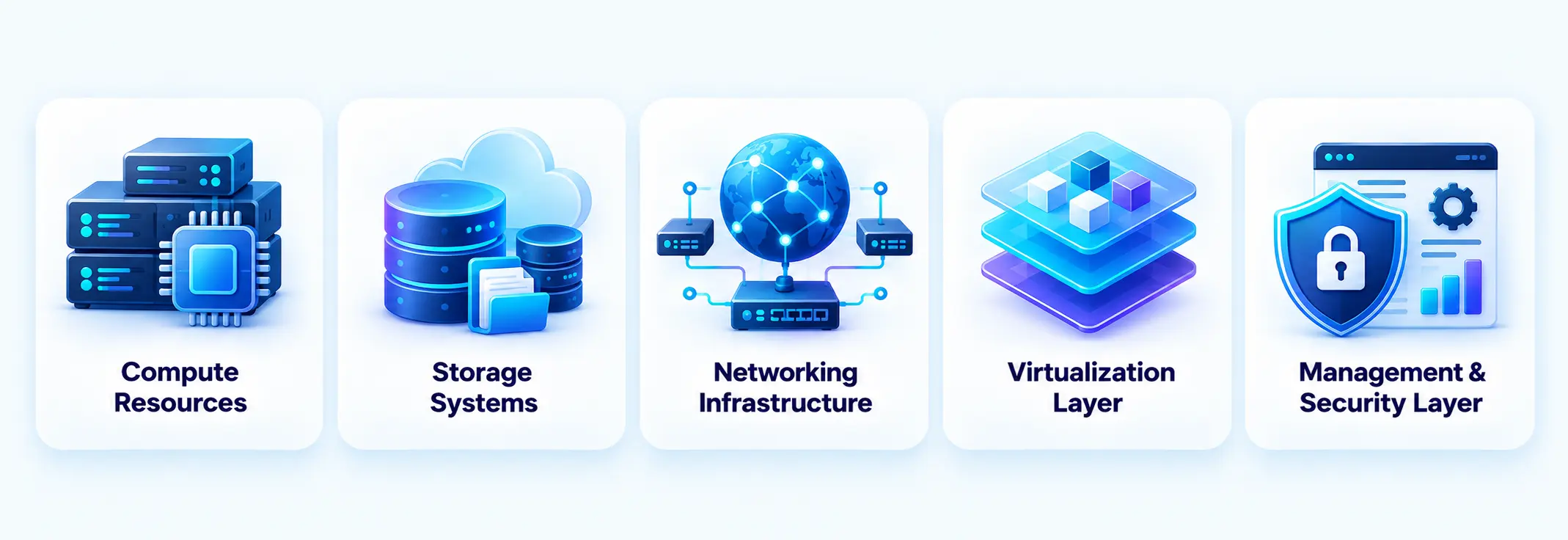
Every cloud computing infrastructure is built on several interconnected components. While cloud providers offer hundreds of services, most environments can be understood through what we call the Three-Layer Cloud Stack: the physical infrastructure layer, the virtualization layer, and the management layer.
Understanding these cloud infrastructure components helps business leaders make more informed decisions regarding scalability, performance, and cost optimization. Let’s have a look at these key components:
1. Compute Resources Power Digital Workloads
Compute resources provide the processing power required to run applications, databases, analytics workloads, and AI models. In modern cloud environments, organizations can choose from virtual machines, containers, serverless computing platforms, and bare-metal servers depending on workload requirements.
For example, a startup launching a SaaS platform may begin with virtual machines because they are simple to deploy and manage. As traffic grows, containerized environments powered by Kubernetes often provide greater scalability and operational efficiency. Organizations pursuing AI initiatives may leverage specialized compute resources optimized for machine learning workloads.
The key advantage of cloud compute resources is flexibility. Businesses can increase or decrease capacity based on demand without investing in physical hardware. However, poor resource allocation often leads to unnecessary costs, making continuous optimization essential.
2. Storage Systems Manage Business Data
Storage is another critical component of cloud hosting infrastructure. Every application generates data, and cloud environments provide multiple storage options to support different use cases.
Block storage is typically used for databases and transactional systems that require high performance. Object storage supports large volumes of unstructured data such as images, videos, backups, and analytics datasets. File storage enables shared access across applications and teams. Selecting the right storage strategy directly affects application performance, compliance requirements, disaster recovery capabilities, and long-term cloud spending.
3. Networking Connects Everything
Networking serves as the communication backbone of cloud infrastructure architecture. It enables applications, databases, users, and services to interact securely and efficiently. Modern cloud networking includes virtual private clouds (VPCs), load balancers, firewalls, DNS services, content delivery networks, and traffic routing mechanisms. Together, these technologies ensure applications remain accessible and responsive even during periods of heavy demand.
Poor networking design remains one of the most common causes of cloud performance issues. Organizations often focus on compute resources while underestimating the importance of network architecture.
4. Virtualization Makes the Cloud Possible
Virtualization is the technology that transformed traditional infrastructure into cloud infrastructure. Through hypervisors and virtualization software, physical resources are divided into virtual resources that can be allocated dynamically across multiple workloads. This abstraction enables organizations to provision servers in minutes rather than weeks.
Without virtualization, modern cloud server infrastructure would not exist. It remains one of the most important innovations behind cloud computing infrastructures.
5. Management and Security Create Operational Control
The management layer sits above compute, storage, networking, and virtualization resources. It provides the visibility, automation, governance, and security controls required to operate cloud environments effectively. This layer includes identity management, infrastructure orchestration, monitoring platforms, compliance controls, encryption services, and resource provisioning tools.
Many organizations initially focus on infrastructure deployment but discover that long-term success depends more on cloud infrastructure management than infrastructure acquisition. Effective management enables businesses to maintain performance, control costs, and reduce operational risks as environments grow in complexity.
What Are the Different Types of Cloud Infrastructure?
Not every organization has the same operational requirements, regulatory obligations, or growth objectives. As a result, cloud providers offer several infrastructure deployment models that allow businesses to balance flexibility, control, security, and cost efficiency.
Understanding the different types of cloud infrastructure is essential for selecting the right strategy for your product, platform, or enterprise ecosystem. Selecting which cloud solution works best for your business depends on factors such as scalability requirements, compliance obligations, budget constraints, and long-term growth objectives.
Public Cloud Infrastructure
Public cloud infrastructure is the most widely adopted deployment model today. In this environment, cloud resources are owned and managed by third-party providers such as AWS, Microsoft Azure, and Google Cloud. Organizations access compute, storage, networking, and application services on a pay-as-you-go basis.
The primary advantage of public cloud infrastructure is scalability. Businesses can launch resources within minutes, expand globally without building data centers, and access advanced services such as AI, analytics, and automation. This flexibility makes public cloud particularly attractive for startups and rapidly growing businesses. However, public cloud adoption also requires careful governance. Organizations operating in highly regulated industries may face compliance challenges, while poorly managed environments can result in unexpected cloud spending.
Private Cloud Infrastructure
Private cloud infrastructure is dedicated to a single organization. Resources are either hosted internally or managed through a dedicated cloud provider. Businesses often choose private cloud environments when they require greater control over infrastructure, security policies, and compliance frameworks. Industries such as healthcare, finance, and government frequently rely on private cloud deployments to address strict regulatory requirements.
While private cloud infrastructure offers increased customization and governance, it often requires greater investment in infrastructure management, operational expertise, and ongoing maintenance. Hybrid is becoming the default model; Gartner predicts 90% of organizations will adopt a hybrid cloud approach through 2027.
Hybrid Cloud Infrastructure
Hybrid cloud infrastructure combines public and private cloud environments into a unified ecosystem. This approach enables organizations to run sensitive workloads in private environments while leveraging public cloud resources for scalability and innovation.
For example, a healthcare organization may store patient records within a private cloud while running analytics workloads in a public cloud environment. This strategy provides flexibility without compromising compliance requirements. As organizations modernize legacy systems and transition workloads across environments, cloud migration services often play a critical role in ensuring a smooth, secure, and cost-effective transformation journey.
Hybrid cloud infrastructure has become increasingly popular because it enables organizations to modernize at their own pace. However, managing multiple environments introduces integration challenges and requires strong governance practices.
Multi-Cloud Infrastructure
Multi-cloud infrastructure involves using services from multiple cloud providers simultaneously. Organizations adopt this strategy to reduce vendor lock-in, improve resilience, and leverage specialized capabilities from different providers.
A company may use AWS for infrastructure services, Microsoft Azure for enterprise applications, and Google Cloud for machine learning initiatives. This approach creates flexibility but also increases operational complexity. Without standardized security policies, monitoring frameworks, and management processes, multi-cloud environments can become difficult to govern effectively.
Cloud Service Models: Understanding IaaS, PaaS, SaaS, and FaaS
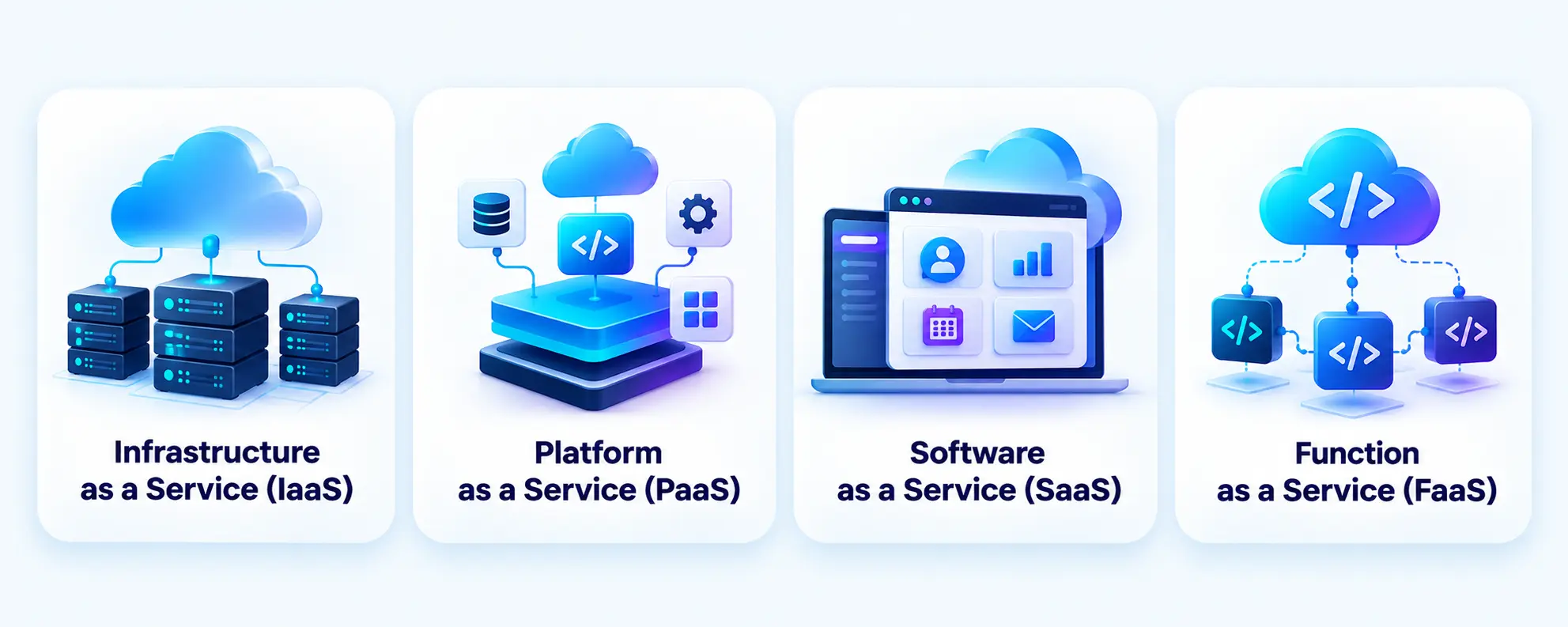
Cloud computing services are generally categorized according to how much infrastructure, software, and operational management the cloud provider handles. The four primary cloud service models are Infrastructure as a Service (IaaS), Platform as a Service (PaaS), Software as a Service (SaaS), and Function as a Service (FaaS).
Each model provides a different level of control, flexibility, and management responsibility. Understanding these differences helps businesses select the right cloud approach based on their application requirements, technical capabilities, scalability needs, and operational goals.
1. Infrastructure as a Service
Infrastructure as a Service, or IaaS, provides fundamental computing resources such as virtual machines, storage, networking, and other infrastructure components through the cloud. Businesses gain greater control over their technology environment while remaining responsible for managing operating systems, applications, configurations, security settings, and workloads. This makes IaaS suitable for organizations that require flexibility and control over their infrastructure without purchasing and maintaining physical hardware.
IaaS provides considerable control and flexibility but also requires more infrastructure management. Businesses must evaluate factors such as computing requirements, storage capacity, networking, security, scalability, and pricing when selecting an IaaS provider.
When evaluating Infrastructure as a Service offerings, decision-makers frequently compare AWS vs Azure vs Google Cloud to determine which ecosystem best aligns with their technical and business requirements.
2. Platform as a Service
Platform as a Service, or PaaS, provides an application development and deployment environment managed by the cloud provider. Instead of managing servers, operating systems, and much of the underlying infrastructure, developers can use a managed platform to build, test, deploy, and maintain applications.
PaaS typically provides runtime environments, development tools, databases, middleware, and other services required for application development. The cloud provider manages infrastructure provisioning, operating system maintenance, platform updates, and scaling, allowing development teams to focus primarily on application functionality.
PaaS can help businesses accelerate development and reduce infrastructure management overhead. However, organizations should evaluate supported programming languages, integrations, scalability, security, deployment options, pricing, and potential vendor lock-in before selecting a platform.
3. Software as a Service
Software as a Service, or SaaS, delivers complete software applications over the internet. Users generally access SaaS applications through a web browser or client application without managing the underlying infrastructure, operating systems, or application hosting environment.
The cloud provider is responsible for hosting the application, maintaining infrastructure, applying updates, managing availability, and supporting the software environment. This allows businesses to use enterprise and business applications without investing heavily in their own infrastructure.
SaaS is commonly used for customer relationship management, accounting, project management, collaboration, communication, human resources, and other business operations. Organizations evaluating SaaS solutions should consider factors such as subscription pricing, data security, integrations, customization, scalability, compliance, and vendor support.
For businesses planning to create their own cloud-based software product, understanding the SaaS development process can help teams evaluate architecture, features, development requirements, and long-term scalability.
4. Function as a Service
Function as a Service, commonly associated with serverless computing, allows developers to execute individual functions without managing traditional servers. Instead of deploying an entire application to a continuously running server, developers can deploy individual pieces of code that execute in response to specific events.
These functions can be triggered by API requests, database changes, file uploads, scheduled events, or other application activities. The cloud provider automatically handles infrastructure provisioning, resource allocation, execution, and scaling based on demand.
FaaS can be useful for event-driven applications, APIs, background processing, automation, and workloads with variable traffic. Because resources are generally consumed when functions execute, organizations can also reduce the need to maintain continuously running infrastructure.
However, businesses should consider execution limits, cold-start performance, monitoring, security, pricing, application architecture, and vendor lock-in before adopting a FaaS approach. For applications with complex or consistently running workloads, other cloud service models may provide greater control and predictability.
Cloud Deployment Models vs Service Models
Cloud deployment models define where and how the cloud environment is deployed, while cloud service models define how much of the infrastructure and software stack the provider manages. The two can be combined based on business and technical requirements.
Cloud Deployment Models
| Deployment Model | Description | Best Suited For |
| Public Cloud | Cloud infrastructure is operated by a third-party provider and shared across multiple customers. | Startups, scalable applications, and general business workloads |
| Private Cloud | Cloud infrastructure is dedicated to a single organization, providing greater control and customization. | Regulated industries and businesses with strict security requirements |
| Hybrid Cloud | Combines private and public cloud environments to balance control, security, and scalability. | Enterprises with mixed workloads and data requirements |
| Multi-Cloud | Uses cloud services from multiple providers rather than relying on a single provider. | Businesses seeking flexibility, redundancy, or specialized cloud capabilities |
Cloud Service Models
| Service Model | Description | Business Responsibility |
| IaaS | Provides virtualized computing, storage, and networking resources while the business manages the operating system and applications. | OS, applications, configurations, and workloads |
| PaaS | Provides a managed development and deployment platform so developers can focus on applications. | Application code and data |
| SaaS | Delivers complete software applications over the internet with most technical management handled by the provider. | Application usage, configuration, and business data |
| FaaS | Allows developers to run individual functions without managing servers or traditional infrastructure. | Functions and application logic |
The key distinction is simple: deployment model determines where the cloud operates, while service model determines who manages what.
How Do You Design Cloud Infrastructure Architecture?
Building cloud infrastructure is only the first step. The real value comes from designing a cloud infrastructure architecture that aligns technology decisions with business objectives, application requirements, security needs, scalability goals, and cost constraints.
Many organizations assume that moving workloads to the cloud automatically improves performance and scalability. In reality, poor architecture can create bottlenecks, increase costs, and introduce operational risks regardless of the infrastructure provider. A structured design process helps businesses build an environment that is reliable, scalable, secure, and cost-efficient.
Start With Business and Application Requirements
Effective cloud infrastructure design begins with understanding business goals and application requirements rather than choosing technologies first. A startup focused on rapid user growth may prioritize scalability and deployment speed, while a financial institution may place greater emphasis on security, compliance, and disaster recovery. AI-driven applications may require specialized compute resources for machine learning workloads.
The architecture should therefore be designed around expected traffic, application workloads, data requirements, performance targets, compliance needs, and future growth.
Choose the Right Cloud Model
The next step is selecting the appropriate cloud deployment and service models based on business and technical requirements. Organizations may choose public, private, hybrid, or multi-cloud environments depending on their security, control, scalability, and operational needs. Similarly, IaaS, PaaS, SaaS, or FaaS can be selected based on how much infrastructure management the business wants to retain.
The right combination should provide the required flexibility without introducing unnecessary complexity or operational overhead.
Select Compute, Storage and Networking Resources
Once the cloud model is defined, organizations need to select the appropriate compute, storage, and networking resources. Compute resources should match application workloads and performance requirements. Storage should be selected based on data volume, access patterns, durability, and availability. Networking architecture should account for traffic flow, connectivity, latency, load balancing, and communication between application components.
Selecting resources based on actual workload requirements helps prevent both under-provisioning and unnecessary infrastructure spending.
Design for High Availability
High availability should be incorporated into the architecture from the beginning rather than added after deployment. Organizations can use redundancy, load balancing, multiple availability zones, automated failover, backups, and disaster recovery mechanisms to reduce the impact of infrastructure failures.
The level of redundancy should match the application’s business importance. Critical systems may require multi-zone or multi-region architectures, while less critical workloads may not justify the additional cost.
Build for Scalability
Cloud infrastructure should be capable of handling changes in application demand without creating performance bottlenecks. Businesses can use horizontal scaling, auto-scaling, load balancing, caching, and distributed architectures to accommodate changing workloads. Designing for scalability also means considering future growth rather than optimizing infrastructure only for current traffic.
A scalable architecture allows businesses to increase capacity as demand grows without requiring major architectural changes.
Implement Security Controls
Security should be integrated into every layer of cloud infrastructure architecture. Organizations should implement identity and access management, encryption, network segmentation, secure configurations, vulnerability management, logging, and continuous security monitoring. Access should follow the principle of least privilege so users and services receive only the permissions they require.
Security requirements should also account for industry regulations, data sensitivity, application architecture, and geographic requirements.
Plan Monitoring and Observability
Cloud infrastructure requires continuous visibility into system performance, availability, resource usage, and potential failures. Monitoring tools can track metrics such as CPU utilization, memory consumption, network traffic, application performance, and infrastructure health. Logs and traces provide additional context for identifying errors and troubleshooting distributed applications.
A strong observability strategy helps engineering teams detect issues earlier, understand system behavior, and improve infrastructure reliability over time.
Design for Cost Efficiency
Cost optimization should be considered during architecture design rather than after cloud spending becomes difficult to control. Organizations should select resources based on actual workloads, avoid unnecessary over-provisioning, implement auto-scaling, monitor resource utilization, and regularly review unused or underutilized resources.
Cost efficiency does not simply mean choosing the cheapest infrastructure. The objective is to achieve the required performance, reliability, and scalability at an appropriate total cost.
Cloud-Native Principles Improve Long-Term Scalability
Modern cloud infrastructure architecture increasingly incorporates cloud-native principles such as microservices, API-driven communication, containerization, and distributed computing. These approaches can allow organizations to deploy services independently, scale specific components, and reduce dependencies across systems. However, cloud-native adoption is not always appropriate for every organization.
For smaller teams with limited engineering resources, an overly complex architecture can create unnecessary operational overhead. Effective cloud infrastructure planning therefore requires balancing scalability and innovation with simplicity and maintainability. Many cloud application development companies use these principles to help businesses build scalable and resilient digital products.
Infrastructure and Architecture Must Work Together
Infrastructure provides the technical building blocks, while architecture determines how those components work together to support business requirements. Organizations that invest heavily in cloud resources without sufficient architectural planning can end up with inefficient scaling, rising infrastructure costs, security gaps, and technical debt.
A well-designed cloud infrastructure architecture brings together business requirements, cloud models, compute, storage, networking, availability, scalability, security, observability, and cost efficiency to create an environment that can support both current workloads and future growth.
What Are Real-World Examples of Cloud Infrastructure Architecture?
Understanding cloud infrastructure architecture becomes easier when viewed through real-world applications. Whether supporting millions of users, processing large amounts of data, or handling unpredictable traffic spikes, modern digital products rely on carefully designed cloud environments to ensure scalability, reliability, and performance.
The following examples demonstrate how different businesses leverage cloud computing infrastructure to solve unique operational challenges while maintaining seamless user experiences.
Netflix: Scaling Global Streaming Through Distributed Cloud Infrastructure
Netflix is one of the most recognized examples of cloud infrastructure at scale. Serving millions of viewers worldwide requires an infrastructure capable of handling enormous traffic volumes, fluctuating demand, and content delivery across diverse geographic regions.
Its cloud infrastructure architecture utilizes distributed computing resources, microservices, content delivery networks, and advanced automation frameworks. This approach allows Netflix to scale dynamically while maintaining high performance and minimizing service disruptions. The company’s cloud-native strategy has become a benchmark for organizations designing highly available digital platforms.
Airbnb: Supporting Global Travel Experiences with Cloud-Native Infrastructure
Airbnb operates in thousands of cities and serves millions of users searching, booking, and managing accommodations simultaneously. Such a dynamic environment demands a highly flexible cloud computing infrastructure capable of handling sudden increases in traffic and transaction activity.
To support global operations, Airbnb leverages cloud-native architecture principles including containerization, distributed databases, automated deployment pipelines, and real-time monitoring systems. This infrastructure enables rapid feature releases, improved operational efficiency, and a consistent user experience across international markets.
Spotify: Using Cloud Infrastructure to Power Personalized Experiences
Spotify processes billions of listening events, recommendations, and content requests every day. Delivering personalized music experiences at this scale requires sophisticated cloud infrastructure management and highly scalable data-processing capabilities.
Its architecture combines cloud storage, analytics platforms, machine learning services, and automated resource management to process large datasets efficiently. By leveraging modern cloud server infrastructure and predictive scaling techniques, Spotify can continuously deliver personalized recommendations while maintaining reliable performance for users worldwide.
How RipenApps Scaled Cobone Through Resilient Cloud Infrastructure Architecture
As one of the Middle East’s leading daily deals and eCommerce platforms, Cobone experiences significant traffic fluctuations during promotions, seasonal campaigns, and limited-time offers. Supporting these demand spikes requires a cloud infrastructure architecture capable of scaling rapidly without affecting performance.
To address this challenge, the platform relies on elastic compute resources, load balancing, distributed storage systems, and automated scaling mechanisms. This cloud-based infrastructure enables Cobone to maintain fast response times and uninterrupted user experiences even during periods of peak demand. The architecture also supports high availability and operational resilience, ensuring business continuity while managing large transaction volumes.

How Do You Manage Cloud Infrastructure Effectively?
Managing cloud infrastructure effectively requires continuous monitoring, automation, security management, and cost control. Unlike traditional infrastructure, cloud environments can change rapidly as workloads scale, resources are added, and applications are updated. A structured management approach helps organizations maintain performance, reliability, security, and predictable cloud spending.
Cloud Infrastructure Monitoring
Cloud infrastructure monitoring provides visibility into the health and performance of cloud resources. Organizations should continuously track metrics such as CPU and memory utilization, network traffic, storage usage, application performance, availability, and error rates.
Centralized logging and alerting can help teams identify performance issues, infrastructure failures, and unusual activity before they significantly affect users. Monitoring should also provide historical data that helps teams identify trends and optimize resource usage.
Cloud Infrastructure Automation
Automation reduces repetitive infrastructure management tasks and minimizes the risk of human error. Organizations can automate resource provisioning, application deployments, scaling, backups, configuration updates, and incident responses.
Auto-scaling is particularly useful for workloads with fluctuating demand because resources can automatically increase or decrease based on predefined conditions. This helps maintain application performance without requiring teams to manually adjust infrastructure.
Organizations can also leverage DevOps consulting services to establish automation frameworks, streamline deployment pipelines, and improve collaboration between development and operations teams.
Infrastructure as Code
Infrastructure as Code (IaC) allows teams to define and manage cloud infrastructure through configuration files and code instead of manually creating resources through cloud provider interfaces.
Tools such as Terraform, AWS CloudFormation, and Pulumi can make infrastructure configurations repeatable, version-controlled, and easier to reproduce across development, testing, and production environments. IaC can also simplify infrastructure changes, improve collaboration, and reduce configuration inconsistencies.
Cloud Infrastructure Security
Cloud infrastructure security requires continuous management of identities, access permissions, networks, workloads, data, and configurations. Organizations should implement least-privilege access, encryption, network segmentation, secure configuration practices, vulnerability management, and continuous security monitoring.
A strong cloud application security strategy is also important for protecting applications against evolving threats throughout the development and deployment lifecycle. Security should be integrated into infrastructure management from the beginning rather than treated as a separate activity after deployment. Regular assessments, automated security checks, employee awareness, and governance processes can further reduce operational risks.
Cloud Infrastructure Cost Management
Cloud infrastructure costs can increase quickly when resources are over-provisioned, underutilized, or left running unnecessarily. Effective cost management requires organizations to monitor spending and regularly evaluate resource utilization.
Unused virtual machines, idle databases, underutilized storage, and forgotten development environments can create unnecessary expenses. Organizations can address these issues through rightsizing, auto-scaling, resource scheduling, budget alerts, and regular infrastructure reviews.
Effective cloud optimization can help organizations improve resource utilization while controlling infrastructure costs and maintaining application performance. This approach also supports FinOps practices by connecting cloud spending with actual business value rather than focusing only on reducing the infrastructure bill.
How Do You Scale Cloud Infrastructure Effectively?
Scalability is one of the primary reasons organizations invest in cloud based infrastructure. Unlike traditional environments where capacity expansion often requires purchasing and deploying new hardware, cloud platforms enable businesses to scale resources dynamically based on demand.
However, this is especially important for growing businesses, where cloud cost optimization for startups can significantly improve operational efficiency and extend available runway. It demands thoughtful architecture, intelligent resource allocation, and continuous performance optimization.
Horizontal Scaling Supports Long-Term Growth
Horizontal scaling involves adding additional servers or instances to distribute workloads across multiple resources. This approach is particularly effective for modern cloud-native applications because it improves fault tolerance and reduces the risk of single points of failure.
For example, an eCommerce platform experiencing a surge in traffic during Black Friday can automatically add additional application instances to handle increased demand. Because workloads are distributed across multiple resources, the platform remains responsive even during peak usage periods.
Horizontal scaling aligns well with microservices-based architectures and containerized environments. However, it often introduces additional complexity in areas such as load balancing, orchestration, and data synchronization.
Vertical Scaling Provides Simplicity
Vertical scaling increases the capacity of existing resources by adding more CPU, memory, or storage. This approach is often easier to implement because applications require fewer architectural changes. Organizations frequently use vertical scaling during the early stages of product development when simplicity and speed are more important than large-scale distribution.
The challenge is that vertical scaling eventually reaches hardware limits. At a certain point, adding more resources becomes either technically impossible or financially impractical. As a result, most mature cloud infrastructure architecture strategies combine both vertical and horizontal scaling approaches.
Scalability and Elasticity Are Not the Same
Although the terms are often used interchangeably, scalability and elasticity represent different capabilities. Scalability refers to a system’s ability to support increased workloads over time. Elasticity refers to a system’s ability to automatically adjust resources in response to real-time demand fluctuations.
A scalable infrastructure can support growth. An elastic infrastructure can adapt instantly as conditions change. This distinction is particularly important for organizations managing seasonal traffic patterns, unpredictable workloads, or rapidly growing digital products.
Auto-Scaling and Load Balancing Drive Performance
Auto-scaling and load balancing work together to create responsive cloud environments. Load balancers distribute traffic across available resources, preventing individual servers from becoming overloaded. Auto-scaling mechanisms monitor demand and automatically provision additional resources when predefined thresholds are reached.
These capabilities help organizations maintain application performance without continuously overprovisioning infrastructure. The result is a more efficient operating model that improves customer experience while reducing unnecessary infrastructure spending. Among the most influential cloud computing trends today is the growing adoption of AI-driven operations and predictive infrastructure management.
How Much Does Cloud Infrastructure Cost?
Cloud infrastructure costs vary significantly depending on the application’s architecture, workload, traffic, storage requirements, cloud provider, and services used. Unlike traditional infrastructure, cloud platforms generally follow usage-based pricing, meaning businesses pay according to the resources they consume.
There is no single fixed price for cloud infrastructure. A small application with limited traffic may operate with relatively low monthly infrastructure expenses, while enterprise platforms, data-intensive applications, and AI workloads can require significantly higher budgets.
Compute Costs
Compute is one of the primary components of cloud infrastructure costs. Businesses typically pay for virtual machines, containers, serverless functions, or other compute resources based on factors such as instance type, processing capacity, memory, operating duration, and usage.
Applications with consistent workloads may benefit from reserved or committed-use pricing, while workloads with variable demand can use auto-scaling to avoid paying for unnecessary capacity.
Storage Costs
Cloud storage costs depend on the amount and type of data stored, storage performance requirements, redundancy, and how frequently data is accessed.
Frequently accessed data may require higher-performance storage, while backups, archives, and infrequently accessed data can often use lower-cost storage tiers. Organizations should also account for data retention policies because unnecessary or duplicate data can increase long-term storage expenses.
Data Transfer Costs
Data transfer costs are associated with moving data between cloud services, regions, availability zones, or external systems. While incoming data transfer is often treated differently from outgoing traffic, charges can vary by provider and architecture.
Applications with high data volumes, content delivery requirements, or cross-region communication should consider network architecture carefully. Reducing unnecessary data movement and using appropriate caching or content delivery strategies can help control these expenses.
Database and Managed Service Costs
Cloud databases and managed services can contribute significantly to infrastructure spending. Costs may depend on database capacity, storage, queries, throughput, availability configuration, backups, and data transfer.
Other managed services such as message queues, API gateways, container platforms, analytics services, and application integration tools can also add recurring costs. Businesses should evaluate the complete service architecture rather than estimating infrastructure costs based only on compute resources.
Monitoring and Backup Costs
Monitoring, logging, security tools, backups, and disaster recovery services are often overlooked when estimating cloud infrastructure costs.
Large applications can generate substantial volumes of logs and monitoring data, while frequent backups and long retention periods increase storage requirements. Organizations should define appropriate monitoring levels, backup frequencies, and retention policies based on business and compliance requirements.
Factors That Influence Cloud Costs
Several factors determine the overall cost of cloud infrastructure:
| Cost Factor | Impact on Cloud Infrastructure Cost |
| Application Workload | Higher processing and memory requirements increase compute costs. |
| Traffic Volume | More users and data transfers can increase compute and networking expenses. |
| Storage Requirements | Larger datasets and longer retention periods increase storage costs. |
| Architecture | Complex architectures with multiple services can increase operational expenses. |
| Availability Requirements | Multi-zone and multi-region redundancy can increase infrastructure costs. |
| Database Usage | High transaction volumes, storage, and performance requirements can increase database costs. |
| Monitoring and Backup | Extensive logging, monitoring, backups, and disaster recovery increase ongoing expenses. |
| Cloud Provider and Pricing Model | Provider pricing, regions, discounts, commitments, and usage-based models affect the final bill. |
| Resource Utilization | Idle or underutilized resources can create unnecessary cloud spending. |
The most effective approach is not simply to choose the lowest-cost resources but to design infrastructure around actual workload requirements. Cloud cost optimization should balance performance, reliability, security, scalability, and business requirements while continuously identifying opportunities to eliminate unnecessary spending
What Are the Most Common Cloud Infrastructure Mistakes?
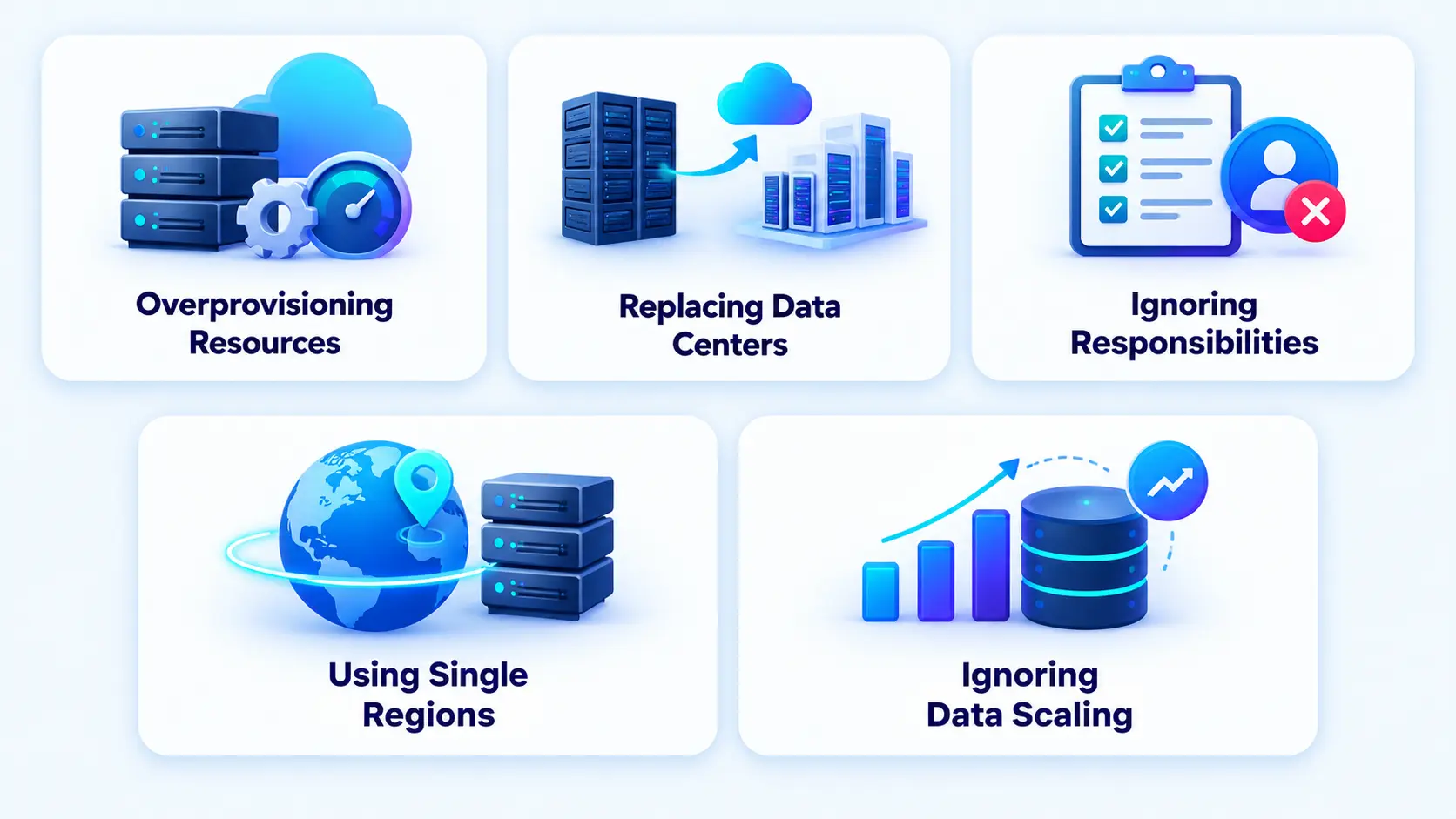
Many cloud initiatives fail to achieve expected outcomes not because of technology limitations, but because of avoidable planning and operational mistakes. Understanding these common challenges can help organizations maximize the value of their cloud investments while avoiding costly setbacks.
1. Overprovisioning Resources
One of the most frequent mistakes is allocating significantly more resources than workloads actually require. Teams often provision excess capacity to prevent performance issues, but this approach frequently results in unnecessary cloud spending. Regular resource reviews, automated right-sizing, and FinOps practices help organizations maintain an optimal balance between performance and cost efficiency.
2. Treating the Cloud as a Data Center Replacement
Moving applications to the cloud without redesigning them for cloud-native environments limits the benefits of cloud adoption. Organizations that simply replicate traditional infrastructure models often struggle with inefficiencies, scalability constraints, and rising operational costs.
To unlock the full value of cloud computing infrastructure, businesses should focus on modernization rather than migration alone. Leveraging cloud consulting services can help organizations re-architect legacy applications, adopt cloud-native principles, and build scalable solutions that fully utilize the flexibility and performance advantages of modern cloud environments.
3. Ignoring the Shared Responsibility Model
Many security incidents occur because organizations misunderstand where cloud provider responsibilities end, and customer responsibilities begin. While providers secure the underlying infrastructure, organizations remain responsible for application security, access controls, data governance, and workload protection. Failing to recognize this distinction can create significant security vulnerabilities.
4. Building Single-Region Architectures
Organizations frequently underestimate the impact of regional outages. Deploying workloads in a single availability zone or region increases operational risk and creates potential business continuity challenges. High-availability architectures should include redundancy across multiple locations whenever possible.
5. Scaling Applications but Not Data Systems
Application layers often scale more easily than databases and backend services. Many organizations focus on application performance while overlooking database bottlenecks. Successful cloud infrastructure planning and design considers scalability across the entire technology stack rather than isolated components.
How Do You Choose the Right Cloud Infrastructure Strategy?
Choosing the right cloud infrastructure strategy requires more than selecting a cloud provider or deciding between public and private cloud. The right approach depends on the application’s technical requirements, business objectives, security needs, expected growth, budget, and the organization’s ability to manage the environment.
Evaluate Application Requirements
Start by understanding the application’s workload, architecture, performance requirements, data requirements, and dependencies. A simple web application may require a different infrastructure strategy than a data-intensive platform, AI application, or enterprise system with multiple integrations.
Consider Scalability
Evaluate expected user growth, traffic patterns, seasonal demand, and future workload requirements. The infrastructure should be capable of scaling as demand increases without requiring major architectural changes.
Assess Security Requirements
Consider the sensitivity of application and customer data, access requirements, encryption needs, network controls, and overall security architecture. Highly sensitive workloads may require greater infrastructure control and additional security measures.
Review Compliance Requirements
Industry and geographic regulations can influence where data is stored, how it is processed, and how infrastructure is managed. Organizations should identify applicable compliance requirements before selecting their cloud environment and architecture.
Define Availability Requirements
Determine how much downtime the application can tolerate and what level of resilience the business requires. Mission-critical applications may require multi-zone or multi-region deployment, automated failover, backups, and disaster recovery capabilities.
Establish the Cloud Budget
Cloud infrastructure decisions should account for both initial and ongoing costs, including compute, storage, networking, databases, monitoring, backups, and managed services. The goal should be to achieve the required performance and reliability without creating unnecessary infrastructure spending.
Assess Team Expertise
The organization’s internal cloud expertise should also influence the strategy. Businesses with limited infrastructure capabilities may benefit from managed services or external cloud expertise, while organizations with experienced cloud engineering teams may have greater flexibility to manage complex environments.
Consider Geography
User locations, data residency requirements, latency, and regional availability can influence cloud architecture decisions. Businesses serving users across multiple regions may need geographically distributed infrastructure to improve performance and availability.
Evaluate the Provider Ecosystem
Cloud providers offer different services, integrations, databases, development tools, AI capabilities, security features, and geographic coverage. Organizations should evaluate the provider ecosystem based on the services their applications require today and may need in the future.
Plan for Long-Term Flexibility
Cloud infrastructure should support the organization’s long-term technology strategy rather than solving only immediate requirements. Businesses should consider future migrations, workload portability, vendor lock-in, architectural flexibility, and evolving application requirements before committing to a specific approach.
Ultimately, the right cloud infrastructure strategy is the one that balances application performance, scalability, security, compliance, availability, cost, team capabilities, geography, provider capabilities, and long-term business objectives.
Cloud Infrastructure Best Practices
Effective cloud infrastructure management requires a combination of sound architecture, security, automation, resilience, and continuous optimization. Rather than treating these as isolated activities, organizations should incorporate them into an ongoing cloud management strategy.
A concise checklist for maintaining an effective cloud infrastructure includes:
- Design around business requirements: Align infrastructure decisions with application workloads, business goals, scalability needs, and user expectations.
- Automate infrastructure: Automate provisioning, deployment, scaling, configuration, and repetitive operational tasks.
- Use Infrastructure as Code: Manage infrastructure through version-controlled configurations to improve consistency and reduce configuration drift.
- Implement least-privilege access: Give users and services only the permissions they need to perform their responsibilities.
- Monitor continuously: Track infrastructure performance, application health, resource utilization, security events, and operational issues.
- Build for resilience: Use redundancy, failover mechanisms, high-availability architecture, and disaster recovery strategies where required.
- Optimize cloud spending: Right-size resources, eliminate idle infrastructure, optimize storage, and monitor spending by workload.
- Maintain backups: Establish appropriate backup schedules, retention policies, and recovery procedures for critical data and systems.
- Test disaster recovery: Regularly test recovery procedures to ensure systems can be restored within required recovery objectives.
- Review infrastructure periodically: Reassess architecture, resource utilization, security controls, costs, and business requirements as the environment evolves.
What is the Future of Cloud Infrastructure?
Cloud infrastructure is evolving beyond traditional virtual machines, centralized data centers, and manually managed environments. As businesses adopt AI, distributed applications, real-time processing, and increasingly complex digital products, cloud infrastructure is becoming more automated, intelligent, scalable, and cost-conscious.
Several trends are shaping how organizations will design and manage cloud environments in the coming years.
AI-Optimized Cloud Infrastructure
AI is increasingly influencing how cloud resources are provisioned, monitored, and optimized. AI-driven infrastructure management can analyze workload patterns, identify performance bottlenecks, predict resource requirements, and recommend or automate infrastructure changes.
AI workloads are also driving demand for specialized compute resources, including GPUs and other accelerators. As organizations deploy more AI-powered applications, cloud infrastructure will need to support higher compute requirements while maintaining performance and cost efficiency.
Serverless and Event-Driven Architecture
Serverless computing allows organizations to run application workloads without directly managing traditional servers. Event-driven architectures can execute functions or services in response to events such as API requests, database updates, user actions, and scheduled processes.
These approaches can reduce infrastructure management overhead and allow applications to scale dynamically based on demand. They are particularly useful for workloads with variable traffic and applications that require flexible, event-based processing.
Edge Computing
Edge computing moves processing and data handling closer to users, devices, and data sources instead of relying entirely on centralized cloud infrastructure.
This approach can reduce latency and improve responsiveness for applications such as IoT platforms, connected devices, real-time analytics, autonomous systems, and other latency-sensitive workloads. Cloud and edge environments are increasingly being used together to distribute workloads based on performance and processing requirements.
Cloud-Native Development
Cloud-native development uses approaches such as containers, microservices, APIs, orchestration, and automated deployment to build applications specifically for distributed cloud environments.
These practices allow teams to develop, deploy, and scale application components independently. As cloud-native architectures mature, organizations are likely to place greater emphasis on platform engineering, automation, observability, and resilient application design.
FinOps and Cost Optimization
As cloud adoption increases, controlling infrastructure spending is becoming a strategic priority. FinOps brings engineering, finance, and business teams together to understand cloud consumption and make informed spending decisions.
Organizations are increasingly using automated cost monitoring, resource optimization, workload-level cost allocation, and usage forecasting to connect infrastructure spending with business value. This makes cost optimization an ongoing part of cloud operations rather than a one-time exercise.
Sustainable Cloud Infrastructure
Sustainability is becoming another consideration in cloud infrastructure planning. Organizations are looking for ways to reduce unnecessary compute usage, optimize resource utilization, improve workload efficiency, and minimize the environmental impact of digital operations.
Cloud providers are also investing in energy-efficient data centers and renewable energy initiatives. Businesses can contribute by right-sizing resources, eliminating idle workloads, optimizing storage, and selecting efficient architectures.
The future of cloud infrastructure will therefore be shaped not by a single technology but by the convergence of AI, automation, distributed computing, cloud-native architectures, financial governance, and sustainability. Organizations that continuously adapt their infrastructure strategy around these developments can build environments that are more resilient, efficient, and prepared for changing business requirements.
Final Thoughts
Cloud infrastructure has become the backbone of digital transformation, enabling organizations to innovate faster, scale efficiently, and respond to changing market demands with greater agility. While the benefits of cloud computing infrastructure are substantial, long-term success depends on thoughtful architecture, strong security practices, automation, continuous optimization, and the strategic adoption of managed cloud services to maintain performance, governance, and operational efficiency as cloud environments grow in complexity.
As cloud computing and infrastructure continue to evolve through AI-driven operations, predictive scaling, and advanced automation, organizations need a strategic approach to cloud adoption and management. Whether you are planning to build cloud infrastructure from scratch, modernize existing environments, or optimize cloud infrastructure management, RipenApps helps businesses design, implement, and scale secure, high-performing cloud ecosystems that drive sustainable growth and competitive advantage.
FAQs
1. What is cloud infrastructure in simple terms?
Cloud infrastructure is the collection of computing, storage, networking, virtualization, security, and management resources that support cloud-based applications and services. Instead of purchasing and maintaining physical hardware, businesses can access these resources through cloud providers based on their workload requirements.
2. What is the difference between cloud infrastructure and cloud computing?
Cloud infrastructure refers to the underlying technology resources that power cloud services, including compute, storage, networking, and virtualization. Cloud computing refers to the broader model of delivering and consuming these resources and services over the internet.
3. What are the main components of cloud infrastructure?
The main components include compute resources, storage, networking, virtualization, databases, security controls, monitoring tools, and infrastructure management technologies. Together, these components provide the foundation required to run and scale cloud applications.
4. What are the different types of cloud infrastructure?
Cloud infrastructure can be deployed through public, private, hybrid, and multi-cloud models. Public cloud uses provider-managed infrastructure, private cloud provides a dedicated environment, hybrid cloud combines different environments, and multi-cloud uses services from multiple cloud providers.
Organizations planning to move workloads between environments should also prioritize cloud migration and data security to protect applications and sensitive information throughout the migration process.
5. What are the main cloud service models?
The main cloud service models are Infrastructure as a Service (IaaS), Platform as a Service (PaaS), Software as a Service (SaaS), and Function as a Service (FaaS). They differ primarily in how much of the underlying infrastructure and software stack is managed by the cloud provider.
6. What is the difference between IaaS, PaaS, and SaaS?
IaaS provides infrastructure resources such as virtual machines, storage, and networking while giving businesses greater management control. PaaS provides a managed development and deployment environment, allowing developers to focus on applications. SaaS delivers complete software applications where most infrastructure and application management is handled by the provider.
7. How much does cloud infrastructure cost?
Cloud infrastructure costs depend on compute usage, storage, data transfer, databases, managed services, monitoring, backups, traffic, availability requirements, and the selected pricing model. Small applications may require relatively limited infrastructure resources, while enterprise and data-intensive workloads can incur significantly higher costs.
8. How can businesses reduce cloud infrastructure costs?
Businesses can reduce cloud infrastructure costs by right-sizing resources, eliminating idle infrastructure, using auto-scaling, optimizing storage, monitoring spending by workload, and establishing cloud cost governance. Regular cost reviews can also help identify underutilized resources and unnecessary services.
Businesses can further improve efficiency through cloud optimization strategies that balance infrastructure performance, scalability, and cost.
9. How does cloud infrastructure support scalability?
Cloud infrastructure supports scalability by allowing businesses to increase or decrease computing, storage, and networking resources according to workload demand. Technologies such as auto-scaling, load balancing, containers, and distributed architectures allow applications to handle changing traffic without requiring businesses to maintain fixed physical infrastructure.
10. Is cloud infrastructure secure?
Cloud infrastructure can provide strong security when it is properly designed and managed. Organizations should implement identity and access management, encryption, network security, continuous monitoring, vulnerability management, backups, and appropriate security policies.
Security also follows a shared responsibility model, meaning the cloud provider secures the underlying cloud infrastructure while the customer remains responsible for securing its workloads, configurations, applications, and data according to the provider’s specific model.
Discuss your project and request for proposal
SHARE
WRITTEN BY

Ishan Gupta
CEO & Founder
Ishan Gupta is a seasoned entrepreneur and CEO with extensive 10+ years of experience in business and mobile app development landscape. He believes that the right digital product allows companies to focus on what they do best, while technology handles the rest. With deep exposure to global markets, he understands what makes an app succeed. His approach translates business needs into clear product strategies, ensuring that every feature contributes to measurable ROI.
View All Articles