


Key Takeaways
- Quick commerce thrives on fast deliveries and a smooth customer experience.
- The GCC market offers strong growth opportunities driven by digital adoption and instant delivery demand.
- A Noon Minutes-like platform requires a Customer App, Delivery Partner App, and Admin Panel.
- AI-powered features improve delivery efficiency, inventory planning, and customer retention.
- A cloud-native tech stack enables your platform to scale with users, orders, and inventory.
- Launching an MVP first helps validate demand, reduce costs, and accelerate market entry.
- Development costs depend on features, integrations, technology stack, and platform complexity.
Speed has become one of the biggest competitive advantages in modern retail. Consumers no longer want to wait hours or even days for groceries and everyday essentials to arrive. They expect a seamless shopping experience with deliveries completed in minutes, pushing businesses to rethink how they serve customers in an increasingly convenience-driven market.
This growing demand has fueled the rapid rise of quick commerce, creating new opportunities for startups, retailers, and enterprises to launch on-demand delivery platforms. However, building a successful quick commerce app involves much more than developing a mobile application. It requires the right business model, a scalable technology stack, intelligent logistics, real-time inventory management, and a customer-first experience that keeps users coming back.
If you’re planning to invest in quick commerce app development, understanding these fundamentals can help you make informed decisions from day one. From choosing essential features and AI-powered capabilities to estimating development costs and timelines, every aspect influences your app’s long-term success.
In this comprehensive guide, you’ll learn everything you need to know about building a quick commerce app like Noon Minutes, including its business model, must-have features, technology stack, development process, estimated costs, and best practices to launch a scalable platform in 2026. This guide is designed to help founders, retailers, and business leaders turn their quick commerce vision into a future-ready digital solution.
Table of Contents
Why Quick Commerce Is Booming in the GCC (2026)
Quick commerce has rapidly evolved from a convenience to an everyday expectation. As consumers increasingly seek groceries, medicines, and daily essentials delivered within minutes, the demand for fast and seamless shopping experiences continues to grow. This shift has made the GCC a promising market for quick commerce mobile app development.
Several factors are driving this growth, including high smartphone penetration, widespread digital payment adoption, and strong logistics infrastructure. Countries like the UAE and Saudi Arabia are also accelerating digital transformation, encouraging retailers and startups to invest in on-demand delivery solutions that meet changing consumer expectations.
Unlike traditional eCommerce, quick commerce relies on strategically located dark stores and intelligent fulfillment systems to process orders faster and optimize last-mile delivery. As a result, businesses can deliver products within minutes while improving operational efficiency and customer satisfaction, making quick commerce a rapidly expanding segment of the digital retail ecosystem.
Key Factors Driving Quick Commerce Growth in the GCC
- Increasing demand for 10–20-minute deliveries among urban consumers.
- High smartphone and internet penetration across GCC countries.
- Growing adoption of cashless and digital payment solutions.
- Expansion of dark-store infrastructure for faster order fulfillment.
- Government-led digital transformation initiatives supporting innovation.
- Rising investments in hyperlocal logistics and AI-powered delivery networks.
- Strong growth of retail and grocery eCommerce across the UAE and Saudi Arabia.
Why the GCC Is an Attractive Market for Quick Commerce Businesses
The GCC offers a unique combination of purchasing power, digital maturity, and dense urban populations, making it an ideal region for launching quick commerce platforms. Consumers increasingly prioritize convenience, while businesses are investing in technology to deliver faster and more personalized shopping experiences.
For startups, retailers, and enterprises, this presents an opportunity to build scalable, AI-enabled delivery ecosystems that extend beyond groceries into categories such as pharmacy, electronics, beauty products, and household essentials. Working with an experienced ecommerce app development company enables businesses to build region-specific platforms with Arabic localization, trusted GCC payment integrations, and seamless shopping experiences tailored to local consumer expectations.
Top 5 Quick Commerce Apps Dominating the GCC & Global Markets
The rapid rise of quick commerce has transformed the way consumers purchase everyday essentials. From groceries and fresh produce to personal care products and household items, leading platforms have built their success around one promise: fast, reliable delivery in minutes, not hours.
For businesses planning quick commerce app development, studying successful platforms is one of the best ways to understand customer expectations, operational models, and competitive advantages. While Noon Minutes dominates the UAE market, several global players have introduced innovative features that continue to shape the future of quick commerce.
The table below highlights some of the leading quick commerce apps across the GCC and international markets.
| App | Region | Delivery Time | Business Model | Key Strength |
| Noon Minutes | UAE | 15–20 Minutes | Dark Store | Ultra-fast grocery delivery |
| InstaShop | UAE & Egypt | 30–60 Minutes | Marketplace | Wide retailer network |
| Talabat Mart | GCC | 20–30 Minutes | Dark Store | Integrated food & grocery ecosystem |
| Instacart | USA & Canada | Same Day / Scheduled | Marketplace | Large partner retailer network |
| Gopuff | USA & UK | 15–30 Minutes | Inventory-led | Owned micro-fulfillment centers |
Noon Minutes
Noon Minutes has redefined quick commerce in the UAE by combining dark stores, AI-driven inventory management, and rapid last-mile delivery. Its customer-first approach makes it one of the strongest benchmarks for businesses planning to build a quick commerce platform.
InstaShop
InstaShop has built one of the largest grocery and retail marketplaces across the UAE and Egypt by connecting users with nearby stores through a seamless ordering experience. Its marketplace model demonstrates how partnerships can drive rapid regional expansion.
Talabat Mart
Talabat Mart extends the Talabat ecosystem with instant grocery delivery powered by strategically located dark stores. Its integrated food and grocery model showcases how existing delivery networks can expand into quick commerce successfully.
Instacart
Instacart transformed grocery shopping in North America by partnering with thousands of retailers instead of managing its own inventory. Businesses planning to build an app like Instacart can learn from its marketplace-first strategy, which enables scalable retail partnerships, efficient order fulfillment, and a flexible delivery model without owning inventory.
Gopuff
Gopuff operates an inventory-led quick commerce model using company-owned micro-fulfillment centers to ensure fast and consistent deliveries. Its vertically integrated approach demonstrates how greater operational control can improve delivery speed and customer experience.
What Makes These Apps Successful?
Although each platform follows a slightly different operational model, they share several common characteristics that contribute to their success. Also, by following the top ecommerce trends, these platforms have improved customer convenience, operational efficiency, and long-term scalability.
1. Fast and Reliable Deliveries
Customers expect orders to arrive within minutes. Efficient rider management, optimized delivery routes, and strategically located fulfillment centers help minimize delivery times while improving customer satisfaction.
2. Intelligent Inventory Management
Modern quick commerce platforms use real-time inventory synchronization to prevent stock discrepancies and ensure customers only see products that are actually available nearby.
3. Seamless User Experience
From browsing products to secure checkout and live order tracking, these apps prioritize convenience at every stage of the customer journey.
4. Personalized Shopping Experience
AI-powered recommendations, smart search, and personalized offers encourage repeat purchases while improving customer engagement.
5. Scalable Technology Infrastructure
Leading platforms rely on cloud-native architectures capable of handling thousands of simultaneous users without compromising speed or performance.
Why Noon Minutes Is an Ideal Benchmark for GCC Businesses?
While several global quick commerce platforms offer valuable inspiration, Noon Minutes stands out for businesses targeting the GCC market. Unlike many international apps, it is specifically designed around regional customer expectations, local logistics, Arabic language support, and GCC payment ecosystems.
For startups and enterprises planning quick commerce mobile app development, Noon Minutes provides practical insights into building a scalable platform that meets the evolving demands of consumers across the UAE and neighboring GCC countries.
How Noon Minutes Works (Customer, Shopper, Dark Store & Admin Flow)
Noon Minutes has simplified grocery shopping by combining intelligent technology with an efficient fulfillment network. Instead of relying solely on traditional supermarkets, it leverages strategically located dark stores, automated inventory systems, and optimized delivery operations to fulfill orders within minutes.
Understanding this workflow is essential for businesses planning quick commerce app development, as it demonstrates how every stakeholder, from customers to administrators, contributes to a seamless delivery experience.
Customer Flow
The customer journey focuses on delivering a fast, intuitive, and hassle-free shopping experience.
Typical Customer Journey
- Create an account or log in.
- Detect or enter the delivery location.
- Browse products by category.
- Search for specific items.
- Add products to the cart.
- Select a preferred payment method.
- Place the order.
- Track the rider in real time.
- Receive the order and provide feedback.
Key Customer Features
- Personalized product recommendations
- Smart product search
- Category-wise browsing
- Secure online payments
- Saved addresses
- Live delivery tracking
- Order history
- Ratings and reviews
- Push notifications
- Customer support
Dark Store Operations
Unlike traditional grocery delivery, quick commerce depends heavily on dark stores, small fulfillment centers strategically located near high-demand neighborhoods. These facilities are optimized exclusively for online orders, enabling businesses to prepare and dispatch deliveries much faster than conventional retail stores.
How the Dark Store Workflow Operates
- Orders are automatically routed to the nearest fulfillment center.
- Inventory availability is verified in real time.
- Store associates receive picking instructions.
- Products are packed according to delivery standards.
- The order is assigned to the nearest available delivery partner.
- Dispatch happens within minutes to meet delivery commitments.
This operational model reduces travel distance, improves inventory accuracy, and enables businesses to consistently achieve delivery windows of 10–20 minutes.
Delivery Partner Workflow
Delivery partners play a critical role in ensuring that orders reach customers quickly and efficiently.
Delivery Process
- Accept incoming delivery requests.
- Navigate to the assigned dark store.
- Pick up the packed order.
- Follow AI-optimized delivery routes.
- Deliver the order to the customer.
- Confirm successful delivery.
- Receive performance updates and earnings summaries.
Features for Delivery Partners
- Route optimization
- Real-time navigation
- Order management
- Earnings dashboard
- Delivery history
- Availability controls
- In-app communication
Admin Panel Workflow
The admin dashboard acts as the central control hub for the entire quick commerce ecosystem, providing complete visibility into inventory, orders, customers, and delivery operations.
Core Administrative Functions
Inventory Management
- Product catalog management
- Stock updates
- Warehouse synchronization
- Low-stock alerts
Order Management
- Monitor live orders
- Assign deliveries
- Handle cancellations and refunds
- Resolve customer issues
Delivery Management
- Rider allocation
- Fleet performance tracking
- Delivery analytics
- Service area management
Customer Management
- User accounts
- Loyalty programs
- Coupons and promotions
- Customer support
Business Analytics
- Revenue reports
- Order trends
- Inventory insights
- Customer retention metrics
- Delivery performance dashboards
Why This Workflow Matters for Businesses?
An efficient workflow is the backbone of every successful quick commerce platform. By integrating customers, dark stores, delivery partners, and administrators into a single connected ecosystem, businesses can reduce operational delays, improve customer satisfaction, and scale efficiently.
Whether you’re a startup or an established retailer, partnering with an experienced quick commerce app development company ensures that every component, from inventory synchronization to last-mile delivery, is designed to support high-volume operations and deliver a seamless user experience.
Business & Revenue Models for a Quick Commerce App Like Noon Minutes
Building a successful quick commerce platform isn’t just about developing a fast and feature-rich mobile application. Choosing the right business model is equally important, as it determines how your platform operates, generates revenue, and scales over time.
Leading quick commerce brands like Noon Minutes, InstaShop, Talabat Mart, and Gopuff follow different operating models depending on their inventory strategy, logistics capabilities, and target audience. Before investing in quick commerce app development, it’s essential to identify the model that best aligns with your business goals and available resources.
Below are the most popular business models adopted by successful quick commerce businesses.
1. Dark Store Model
The dark store model has become the foundation of modern quick commerce. Instead of fulfilling orders from retail supermarkets, businesses operate dedicated micro-warehouses, also known as dark stores, strategically located close to high-demand residential areas.
Since these facilities are designed exclusively for online orders, businesses can significantly reduce picking and delivery times while maintaining better inventory control.
How It Works
- Customers place an order through the mobile app.
- The nearest dark store receives the request.
- Staff pick and pack the products.
- The order is assigned to the nearest delivery rider.
- Customers receive their order within 10–20 minutes.
Advantages
- Faster order fulfillment
- Better inventory management
- Higher operational efficiency
- Consistent customer experience
- Greater control over product availability
Best For
- Grocery delivery startups
- Hyperlocal delivery businesses
- Retail chains
- Businesses targeting ultra-fast delivery
2. Marketplace Model
Unlike the dark store approach, multi-vendor eCommerce marketplace development connects customers with multiple local grocery stores and supermarkets through a single platform. Instead of maintaining inventory, the platform acts as a bridge between retailers and consumers. Thus, enabling seamless product discovery, ordering, and fulfillment.
This model allows businesses to expand rapidly without significant investment in warehousing infrastructure.
How It Works
- Customers browse products from partner stores.
- Orders are forwarded to the selected retailer.
- The retailer prepares the order.
- Delivery partners collect and deliver the items.
Advantages
- Lower operational investment
- Larger product catalog
- Faster market expansion
- Easy onboarding of retail partners
Best For
- Aggregator platforms
- Regional marketplaces
- Multi-vendor grocery applications
3. Hybrid Model
Many leading quick commerce companies combine both dark stores and retail partnerships to maximize efficiency and product availability.
Frequently ordered essentials are stocked in company-owned fulfillment centers, while specialty or premium products are sourced from third-party retailers.
This hybrid approach offers greater flexibility while ensuring customers have access to a broader range of products.
Advantages
- Improved product availability
- Reduced stock-out risks
- Better scalability
- Enhanced customer satisfaction
Best For
- Growing quick commerce platforms
- Enterprise retailers
- Businesses expanding across multiple cities
Which Business Model Should You Choose?
Selecting the right model depends on your business objectives, investment capacity, and target market. The comparison below highlights the strengths of each approach.
| Business Model | Initial Investment | Inventory Ownership | Scalability | Delivery Speed | Best For |
| Dark Store | High | Yes | High | Excellent | Quick commerce startups |
| Marketplace | Low | No | High | Moderate | Multi-vendor platforms |
| Hybrid | Medium–High | Partial | Very High | Excellent | Large retailers & enterprises |
Expert Tip: If your goal is to build a platform similar to Noon Minutes, the dark store model offers the strongest foundation for delivering consistent 10–20-minute deliveries and maintaining full control over inventory and customer experience.
Revenue Models That Power Successful Quick Commerce Apps
Once you’ve finalized the operational model, the next step is identifying sustainable revenue streams. Most successful quick commerce businesses generate income through multiple channels rather than relying on a single source.
A diversified revenue strategy not only improves profitability but also creates long-term business stability.
Delivery Fees
Charging a delivery fee remains one of the most common revenue sources for quick commerce platforms. Businesses may apply standard, distance-based, or surge pricing depending on factors such as order value, delivery location, and peak demand.
Common Pricing Strategies
- Flat delivery fee
- Distance-based pricing
- Peak-hour charges
- Express delivery fee
- Minimum order surcharge
Commission from Partner Stores
Platforms operating under the marketplace model typically earn a commission on every successful order processed through partner retailers.
The commission percentage may vary depending on the retailer, product category, or promotional agreements.
Benefits
- Recurring revenue
- Low operational costs
- Easy business scalability
Subscription Plans
Subscription programs encourage customer loyalty while creating predictable recurring revenue.
Members generally receive benefits such as:
- Unlimited free deliveries
- Exclusive discounts
- Faster delivery priority
- Early access to offers
- Cashback rewards
This model significantly improves customer retention and increases average order frequency.
Sponsored Listings & In-App Advertising
Retailers and consumer brands often pay to promote their products within the app, increasing visibility among customers.
Popular advertising opportunities include:
- Featured products
- Sponsored categories
- Homepage banners
- Promotional campaigns
- Search result advertisements
As user traffic grows, advertising can become one of the platform’s highest-margin revenue streams.
Value-Added Services
Many quick commerce businesses generate additional income by offering premium services that enhance customer convenience.
Examples include:
- Scheduled deliveries
- Priority delivery slots
- Gift packaging
- Corporate accounts
- Membership benefits
- Product insurance for high-value purchases
Revenue Model Comparison
| Revenue Stream | Profitability | Scalability | Suitable For |
| Delivery Fees | High | Medium | All platforms |
| Store Commission | High | High | Marketplace & Hybrid |
| Subscription Plans | Very High | High | Customer retention |
| In-App Advertising | Very High | Very High | Large user bases |
| Premium Services | Medium | High | Enterprise platforms |
Which Revenue Model Delivers the Highest ROI?
Rather than depending on a single income source, leading quick commerce platforms combine multiple revenue streams to maximize profitability. For example, a platform like Noon Minutes can earn from delivery fees while also offering subscription memberships and sponsored product placements.
If you’re planning quick commerce mobile app development, it’s advisable to adopt a hybrid monetization strategy from the outset. This approach not only diversifies revenue but also creates a more resilient and scalable business model as your user base and merchant network grow.
Must-Have Features for a Quick Commerce App Like Noon Minutes
The success of a quick commerce platform depends on more than just fast deliveries. Customers today expect a seamless digital experience, from discovering products and placing orders to tracking deliveries in real time. At the same time, businesses need powerful backend systems to manage inventory, riders, payments, and analytics efficiently.
Whether you’re a startup or an established retailer, your quick commerce app development strategy should focus on building a platform that delivers convenience for users while simplifying day-to-day operations.
Below are the essential features every quick commerce app should include.
Customer App Features
The customer application serves as the primary touchpoint between your business and end users. A simple, intuitive, and responsive interface can significantly improve customer satisfaction and retention.
1. User Registration & Profile Management
Allow users to sign up using their email address, phone number, or social media accounts. Personalized profiles help save delivery addresses, payment methods, and order history for faster repeat purchases.
2. Smart Product Search & Category Browsing
Customers should be able to locate products quickly using intelligent search, filters, and organized product categories. AI-powered search suggestions can further enhance the shopping experience.
3. Real-Time Inventory Availability
Display live inventory to prevent customers from ordering out-of-stock items. Synchronizing inventory with nearby dark stores ensures accurate product availability.
4. Personalized Product Recommendations
Recommend products based on browsing history, previous purchases, and shopping preferences to increase engagement and average order value.
5. Secure Shopping Cart & Checkout
A frictionless checkout process should support multiple payment methods, promo codes, and one-click reordering while ensuring transaction security.
6. Live Order Tracking
Real-time tracking allows customers to monitor order preparation, rider assignment, and estimated delivery time, improving transparency and trust.
7. Ratings & Reviews
Enable users to rate products, delivery experience, and overall service while providing valuable feedback to improve business performance.
8. Push Notifications
Keep customers informed with updates about order status, promotional offers, delivery alerts, and personalized recommendations.
Delivery Partner Features
Delivery partners are at the heart of every successful quick commerce platform. Equipping them with the right tools helps improve delivery efficiency and customer satisfaction.
Essential Features
- Rider registration and verification
- Order acceptance or rejection
- AI-powered route optimization
- GPS navigation
- Real-time order status updates
- Earnings dashboard
- Availability management
- In-app communication
- Delivery history
- Performance analytics
These capabilities help reduce delivery times while enabling riders to manage their workload more effectively.
Merchant & Dark Store Features
Whether operating company-owned dark stores or collaborating with retail partners, businesses require centralized tools to manage inventory and fulfill orders efficiently.
1. Inventory Management
Maintain accurate stock levels with automatic inventory synchronization and low-stock alerts to minimize stockouts.
2. Product Catalog Management
Easily add, edit, categorize, and update product listings, including pricing, discounts, and availability.
4. Order Processing
View incoming orders, manage packing workflows, and coordinate dispatch operations to ensure timely deliveries.
5. Promotion Management
Create discount campaigns, coupon codes, loyalty rewards, and seasonal offers to drive customer acquisition and retention.
Admin Panel Features
The admin dashboard serves as the operational backbone of your quick commerce platform, providing complete visibility into business performance.
Business Management
- User management
- Merchant onboarding
- Delivery partner management
- Role-based access control
Order & Delivery Management
- Live order monitoring
- Rider assignment
- Delivery tracking
- Refund and cancellation management
Analytics & Reporting
Gain actionable insights through detailed dashboards that track:
- Sales performance
- Customer acquisition
- Delivery success rates
- Inventory turnover
- Revenue growth
- Customer retention
These insights enable businesses to make informed decisions and continuously optimize operations.
Advanced AI Features Powering Modern Quick Commerce Apps
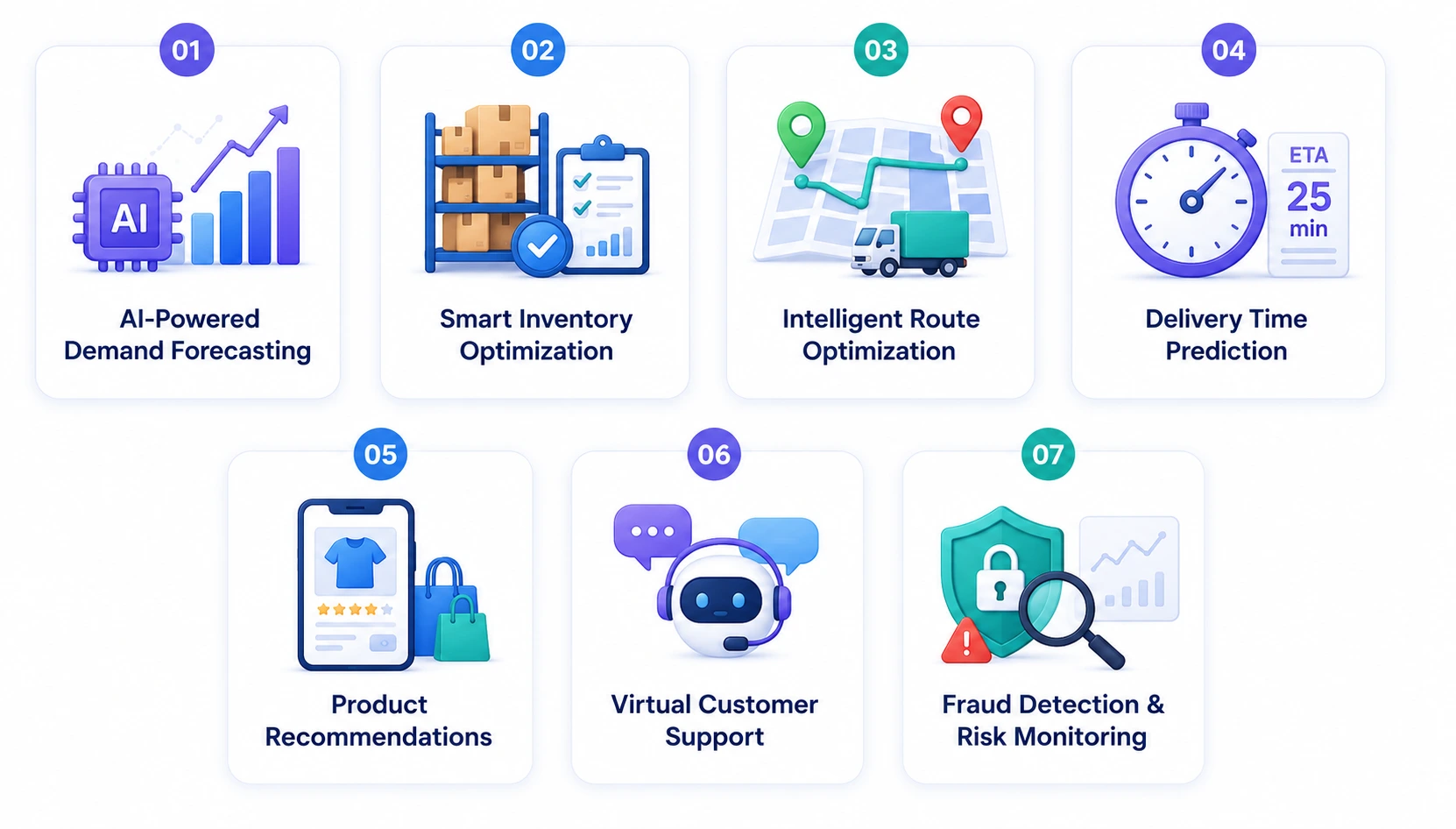
Artificial Intelligence has become a key differentiator for successful quick commerce platforms. The growing role of AI in mobile app development enables businesses to predict customer demand, optimize logistics, and deliver highly personalized experiences while reducing operational costs.
For businesses investing in quick commerce mobile app development, integrating AI-driven capabilities can significantly improve efficiency, customer satisfaction, and long-term scalability.
1. AI-Powered Demand Forecasting
Predict future demand by analyzing historical sales patterns, seasonal trends, weather conditions, and local events. This helps businesses maintain optimal inventory levels while minimizing product wastage.
Benefits:
- Reduced stock shortages
- Improved inventory planning
- Lower operational costs
- Better customer satisfaction
2. Smart Inventory Optimization
AI continuously monitors stock movement and automatically recommends inventory replenishment based on purchasing behavior and regional demand.
This enables dark stores to maintain high product availability without overstocking.
3. Intelligent Route Optimization
Rather than assigning deliveries based solely on proximity, AI evaluates traffic conditions, rider availability, order priority, and delivery zones to identify the fastest and most efficient routes.
Advantages include:
- Faster deliveries
- Reduced fuel consumption
- Lower delivery costs
- Improved rider productivity
4. Accurate Delivery Time Prediction (ETA)
Customers appreciate knowing exactly when their orders will arrive. AI-powered ETA calculations continuously update estimated delivery times based on real-time traffic, weather conditions, and rider location.
This improves transparency and builds customer trust.
5. Personalized Product Recommendations
Machine learning algorithms analyze customer preferences, purchase history, and browsing behavior to recommend products that align with individual shopping habits.
Benefits include:
- Increased average order value
- Higher conversion rates
- Better customer engagement
- Improved repeat purchases
6. AI Chatbots & Virtual Customer Support
AI-powered chatbots provide instant assistance for common customer queries, including:
- Order tracking
- Refund requests
- Product availability
- Delivery updates
- Payment issues
This reduces customer support workload while ensuring faster response times.
7. Fraud Detection & Risk Monitoring
Artificial Intelligence helps identify suspicious transactions, unusual login activity, duplicate accounts, and payment fraud before they impact the business.
This strengthens platform security and protects both customers and merchants.
Why AI Is Becoming Essential for Quick Commerce?
As customer expectations continue to rise, AI is no longer a premium feature; it’s a competitive necessity. Businesses building AI-powered ecommerce mobile apps are better positioned to automate operations, deliver faster services, and scale efficiently while meeting evolving customer demands.
From predicting inventory demand to optimizing delivery routes and personalizing shopping experiences, AI empowers quick commerce platforms to operate smarter while creating exceptional customer experiences.
Step-by-Step Process to Build a Quick Commerce App Like Noon Minutes
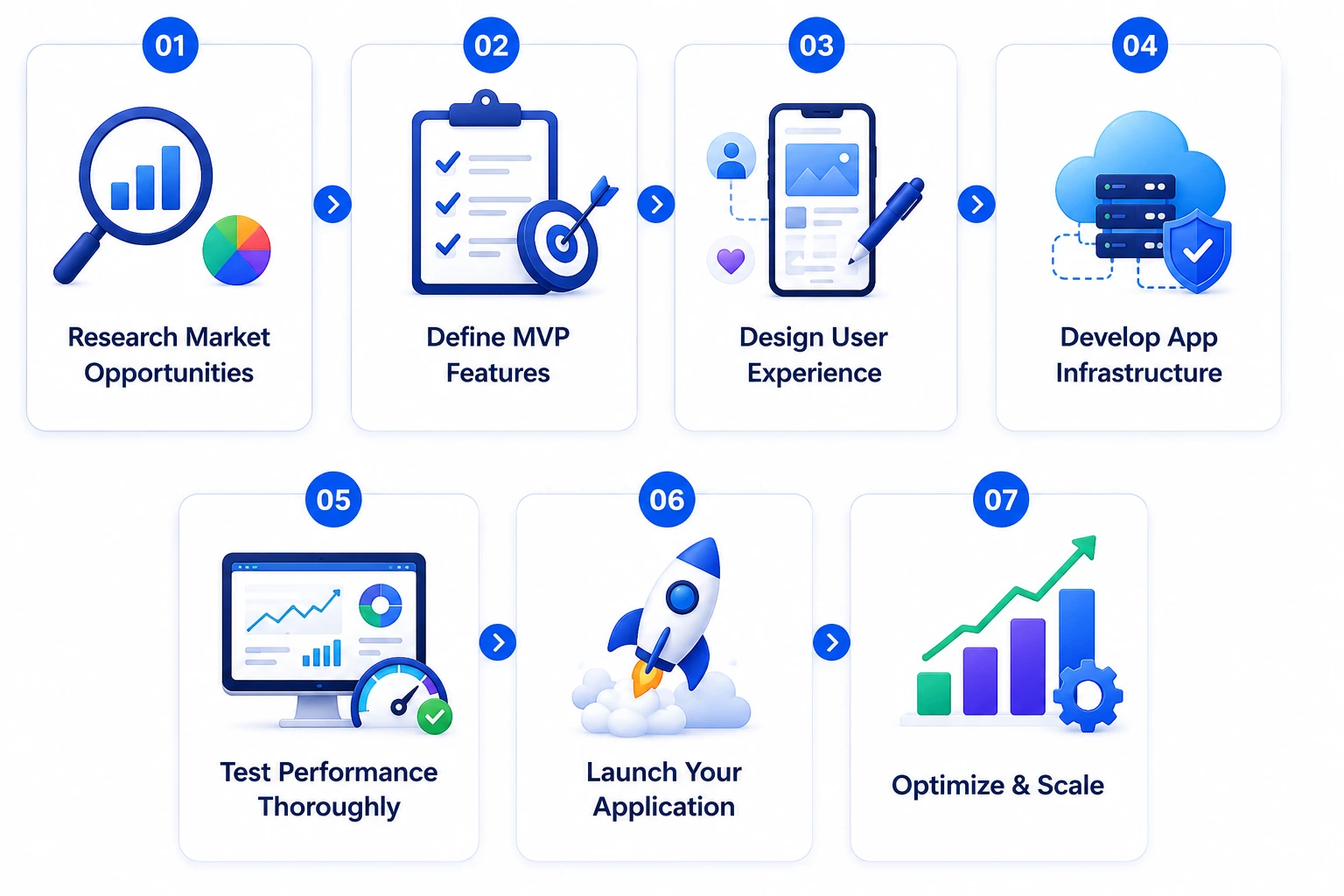
Building a successful quick commerce platform requires more than developing a mobile application. It involves understanding customer behavior, designing scalable architecture, integrating real-time logistics, and creating an ecosystem that seamlessly connects customers, dark stores, delivery partners, and administrators.
Whether you’re a startup launching your first MVP or an enterprise expanding into the GCC market, following a structured mobile app development process helps reduce risks, optimize development costs, and accelerate time to market. This approach ensures every stage, from planning and design to deployment, is aligned with your product and business goals.
Below is a proven quick commerce app development roadmap followed by leading product engineering companies.
Step 1: Market Research & Business Planning
Every successful quick commerce platform starts with a well-defined business strategy. Before writing a single line of code, it’s important to validate your business idea, understand your target audience, and identify market opportunities.
Key Activities
- Define your target market (UAE, Saudi Arabia, Qatar, etc.)
- Study competitors like Noon Minutes, InstaShop, Talabat Mart, and Gopuff
- Identify customer pain points
- Choose your business and revenue model
- Finalize your monetization strategy
Outcome: A clear product vision backed by market insights.
Step 2: Define Core Features & Build an MVP
Rather than launching with every possible feature, businesses should first focus on building a Minimum Viable Product (MVP). This approach enables you to validate the product with real users while minimizing development costs and time.
Typical MVP Features
- Customer registration
- Product catalog
- Cart & checkout
- Online payments
- Live order tracking
- Delivery partner app
- Admin dashboard
- Push notifications
Once customer feedback is collected, advanced features can be introduced in future releases.
Step 3: UI/UX Design
A clean, intuitive, and visually appealing interface plays a crucial role in customer acquisition and retention. Users should be able to browse products, place orders, and complete payments with minimal effort.
The design phase generally includes:
- User journey mapping
- Wireframes
- Interactive prototypes
- High-fidelity UI design
- Usability testing
A user-friendly interface directly impacts customer satisfaction and conversion rates.
Step 4: Backend & Mobile App Development
This is where the product comes to life. Developers build the customer app, delivery partner app, merchant portal, and admin dashboard while creating secure backend services to handle authentication, inventory, payments, and order processing.
During this phase, developers also integrate:
- Maps & navigation APIs
- Payment gateways
- Push notification services
- Inventory management
- Order management system
- Real-time tracking
Choosing an experienced quick commerce app development company ensures that every module is built with scalability, security, and performance in mind.
Step 5: Testing & Quality Assurance
Before launch, the application undergoes comprehensive testing to ensure it performs reliably across devices and operating conditions.
Testing Includes
- Functional testing
- Performance testing
- Security testing
- Payment testing
- API testing
- Device compatibility testing
- User acceptance testing
This stage helps identify and resolve issues before they impact customers.
Step 6: Deployment & Launch
Once testing is complete, the application is deployed to production servers and submitted to the Google Play Store and Apple App Store.
Businesses typically launch with a controlled rollout to monitor performance, gather user feedback, and address any initial issues before expanding to additional markets.
Step 7: Continuous Maintenance & Scaling
Launching your app is only the beginning. Regular updates are essential to improve security, introduce new features, optimize performance, and adapt to changing customer expectations.
Ongoing support may include:
- Performance optimization
- Feature enhancements
- Security updates
- API upgrades
- AI model improvements
- Infrastructure scaling
A proactive application maintenance strategy keeps your app reliable, secure, and ready for future enhancements.
Best Tech Stack for Quick Commerce Mobile App Development
The technology stack you choose determines your app’s speed, scalability, security, and long-term performance. Since quick commerce platforms process thousands of real-time orders, inventory updates, and delivery requests simultaneously, selecting reliable technologies is critical.
Below is a recommended tech stack for building a scalable quick commerce solution.
| Layer | Recommended Technologies |
| Mobile App | Flutter, React Native, Swift, Kotlin |
| Frontend | React.js, Next.js |
| Backend | Node.js, Java, Python |
| Database | PostgreSQL, MongoDB, Firebase |
| Cloud | AWS, Microsoft Azure, Google Cloud |
| Maps & Navigation | Google Maps API, Mapbox |
| Notifications | Firebase Cloud Messaging, OneSignal |
| Payments | Stripe, Telr, PayTabs, Network International |
| Real-Time Communication | WebSockets, Firebase |
| Analytics | Firebase Analytics, Mixpanel |
| AI & ML | TensorFlow, OpenAI APIs, AWS SageMaker |
How Much Does It Cost to Build a Quick Commerce App Like Noon Minutes?
One of the first questions businesses ask before investing in quick commerce mobile app development is, “How much will it cost?”
The answer depends on several factors, including the number of features, supported platforms, AI capabilities, integrations, and the complexity of backend systems. A basic MVP will naturally cost less than a fully featured enterprise platform with advanced automation and analytics.
The table below provides an estimated development cost based on project complexity.
| App Complexity | Estimated Cost (AED) | Estimated Cost (USD) | Development Timeline |
| Basic MVP | AED 180,000–275,000 | $50,000–75,000 | 3–5 Months |
| Mid-Level Platform | AED 275,000–550,000 | $75,000–150,000 | 5–8 Months |
| Enterprise Solution | AED 550,000–1,100,000+ | $150,000–300,000+ | 8–12+ Months |
Note: These estimates are indicative and may vary depending on project scope, third-party integrations, AI capabilities, deployment requirements, and customization needs.
This cost range typically includes:
- Business analysis
- UI/UX design
- Mobile app development
- Backend development
- Admin dashboard
- API integrations
- Testing & quality assurance
- App deployment
Businesses can further optimize investment by launching with an MVP and expanding the platform incrementally based on customer feedback and market demand.
Quick Commerce App Development Timeline
The time required to build a quick commerce platform depends on the project’s scope, feature set, and customization requirements. Businesses that begin with a Minimum Viable Product (MVP) can typically launch faster and introduce advanced features in later phases.
The table below outlines an estimated development timeline.
| Development Phase | Estimated Duration |
| Discovery & Business Analysis | 2–3 Weeks |
| UI/UX Design | 3–5 Weeks |
| Backend Development | 8–12 Weeks |
| Mobile App Development | 10–14 Weeks |
| API Integrations | 2–4 Weeks |
| Testing & Quality Assurance | 3–4 Weeks |
| Deployment & Launch | 1–2 Weeks |
Estimated Timeline: 4–8 months for a production-ready solution, depending on the project’s complexity and customization requirements.
How to Reduce Time-to-Market
Businesses can accelerate development by adopting an MVP-first strategy. Launching with core functionalities enables you to validate your business model, collect user feedback, and gradually expand your platform without delaying market entry.
Challenges in Building a Quick Commerce App (and How to Overcome Them)
Quick commerce presents significant business opportunities, but delivering groceries and essentials within minutes requires careful planning and advanced technology. Understanding these challenges early helps businesses build scalable, high-performing platforms capable of meeting customer expectations.
1. Maintaining 10–20 Minute Deliveries
Fast delivery is the defining feature of quick commerce. Delays can negatively impact customer satisfaction and retention.
Solution:
- Establish strategically located dark stores.
- Use AI-powered route optimization.
- Implement intelligent order assignment.
- Monitor delivery performance in real time.
2. Managing Real-Time Inventory
Customers expect accurate product availability. Outdated inventory data often leads to cancellations and poor user experiences.
Solution:
- Synchronize inventory across all fulfillment centers.
- Automate stock updates.
- Enable low-stock alerts.
- Forecast demand using AI.
3. Optimizing Last-Mile Delivery
Managing a large fleet of delivery partners while minimizing delays and operational costs is one of the biggest operational challenges.
Solution:
- Implement dynamic rider allocation.
- Optimize delivery routes using real-time traffic data.
- Monitor fleet performance through centralized dashboards.
4. Supporting Arabic & RTL Localization
Businesses targeting the GCC must provide localized experiences that meet regional language and cultural expectations.
Solution:
- Offer full Arabic and English support.
- Design RTL-compatible interfaces.
- Localize notifications, invoices, and customer communications.
5. Integrating GCC Payment Gateways
Customers across the GCC rely on trusted regional payment providers for secure transactions.
Solution:
Integrate leading payment gateways such as:
- Telr
- PayTabs
- Network International
- Stripe (where applicable)
This improves payment success rates while enhancing customer trust.
6. Scaling During Peak Demand
Periods such as Ramadan, Eid, and major shopping festivals often result in significant spikes in order volumes.
Solution:
- Deploy scalable cloud infrastructure.
- Use auto-scaling servers.
- Continuously monitor system performance.
- Optimize databases and caching mechanisms.
Why Choose RipenApps for Quick Commerce App Development in the GCC?
Building a successful quick commerce platform requires more than technical expertise. It demands a deep understanding of regional customer expectations, scalable architecture, real-time logistics, and the operational complexities of on-demand delivery. That’s where choosing the right development partner makes all the difference.
At RipenApps, we help startups, retailers, and enterprises build scalable digital products designed for evolving market needs. Our product engineering approach combines intuitive user experiences, modern technologies, and business-focused strategies to create solutions that are secure, scalable, and ready for long-term growth.
Our experience extends across the GCC, where we’ve successfully delivered digital solutions for well-known regional brands such as Cobone, Al Muzaini, and Sportic. These projects demonstrate our expertise in building localized, high-performance applications that align with regional user expectations, business goals, and digital ecosystems. Thus, making us a reliable technology partner for businesses planning to launch a quick commerce platform in the GCC.
What Sets RipenApps Apart?
1. GCC-Focused Development Expertise
We build solutions for GCC businesses, incorporating region-specific considerations such as Arabic localization, trusted payment gateways, VAT compliance, and scalable cloud infrastructure.
2. End-to-End Product Development
From product strategy and UI/UX design to development, testing, deployment, and post-launch support, we provide comprehensive mobile application development services under one roof.
3. Scalable Technology Solutions
Our engineering teams build cloud-native platforms capable of handling high-order volumes, real-time inventory updates, and growing user bases without compromising performance.
4. AI-Driven Innovation
We integrate advanced technologies such as demand forecasting, intelligent route optimization, personalized recommendations, and predictive analytics to help businesses improve operational efficiency and customer satisfaction.
5. Experience Across GCC-Focused Digital Products
Our portfolio includes solutions built for businesses serving the GCC market, demonstrating our expertise in developing secure, scalable, and user-centric applications aligned with regional expectations.
Wrapping Up
The rapid growth of quick commerce is reshaping how consumers purchase groceries and daily essentials, particularly across the GCC. As platforms like Noon Minutes continue to raise customer expectations with ultra-fast deliveries and seamless digital experiences, businesses have a significant opportunity to enter this growing market. Success, however, depends on choosing the right business model, integrating essential features, leveraging AI-driven capabilities, and building a scalable technology foundation that supports long-term growth.
Whether you’re launching a startup or expanding an existing retail business, investing in quick commerce mobile app development requires the right strategy and technology partner. However, by working with an experienced custom app development company, you can build a future-ready solution tailored to your business goals and regional market needs. At RipenApps, we help businesses across the GCC transform innovative ideas into scalable, quick commerce platforms that deliver exceptional customer experiences and sustainable business growth.
FAQ’s
Q1. What is a quick commerce app?
A quick commerce app is an on-demand delivery platform that enables customers to order groceries, daily essentials, and other products, with delivery typically completed within 10 to 30 minutes. It relies on dark stores, real-time inventory management, and optimized last-mile logistics to ensure fast fulfillment.
Q2. How much does it cost to build a quick commerce app like Noon Minutes?
The cost of building a quick commerce app like Noon Minutes generally ranges from AED 180,000 to AED 1,100,000+, depending on the app’s complexity, features, AI capabilities, and platform requirements. A detailed cost estimate should be based on your specific business goals.
Q3. How long does it take to develop a quick commerce app?
Developing a quick commerce app typically takes 4 to 8 months. The timeline depends on factors such as feature complexity, UI/UX design, third-party integrations, testing, and whether you’re building an MVP or a full-scale enterprise solution.
Q4. What features should a quick commerce app include?
A quick commerce app should include product search, real-time inventory, secure payments, live order tracking, push notifications, delivery partner management, and an admin dashboard. AI-powered recommendations and route optimization can further enhance the user experience.
Q5. What is the difference between quick commerce and traditional grocery delivery?
Quick commerce focuses on delivering products within minutes using nearby dark stores, while traditional grocery delivery often relies on retail stores and scheduled deliveries that may take several hours or even days.
Q6. What is a dark store in quick commerce?
A dark store is a fulfillment center designed exclusively for processing online orders. Unlike a retail supermarket, it isn’t open to customers and helps businesses achieve faster order picking, packing, and delivery.
Q7. Which technologies are used for quick commerce app development?
Quick commerce apps commonly use technologies such as Flutter or React Native for mobile development, Node.js or Python for the backend, PostgreSQL or MongoDB for databases, and cloud platforms like AWS or Google Cloud for scalability.
Q8. Can AI improve the performance of a quick commerce app?
Yes. AI helps optimize demand forecasting, inventory management, delivery route planning, estimated delivery times, and personalized product recommendations, enabling businesses to improve operational efficiency and customer satisfaction.
Q9. Why should businesses invest in quick commerce app development?
Quick commerce allows businesses to meet growing consumer demand for faster deliveries, improve customer retention, and create new revenue opportunities. It also helps retailers stay competitive in an increasingly digital and convenience-driven market.
Q10. How do I choose the right quick commerce app development company?
Look for a development company with experience in building on-demand delivery solutions, expertise in scalable technologies, AI integration capabilities, and a strong understanding of regional requirements such as payment gateway integration, localization, and post-launch support. This ensures your platform is built for long-term growth and performance.
Discuss your project and request for proposal
SHARE
WRITTEN BY

Ishan Gupta
CEO & Founder
Ishan Gupta is a seasoned entrepreneur and CEO with extensive 10+ years of experience in business and mobile app development landscape. He believes that the right digital product allows companies to focus on what they do best, while technology handles the rest. With deep exposure to global markets, he understands what makes an app succeed. His approach translates business needs into clear product strategies, ensuring that every feature contributes to measurable ROI.
View All Articles