


Key Takeaways
- Legacy application modernization reduces technical debt while improving security, scalability, operational efficiency, and long-term business competitiveness.
- Choosing the right modernization strategy depends on application complexity, business goals, budget, compliance requirements, and future scalability.
- AI-powered modernization accelerates code analysis, documentation, testing, and migration while reducing project timelines and development effort.
- Successful modernization requires careful data migration, governance, regulatory compliance, and phased implementation to minimize business disruption.
- Partnering with experienced application modernization experts helps organizations reduce risks and maximize modernization return on investment.
Legacy applications continue to power some of the world’s most critical business operations, from banking transactions and healthcare systems to manufacturing platforms and government services. However, the technologies behind many of these applications were built decades ago and are increasingly unable to support today’s business demands.
Rising maintenance costs, growing cybersecurity threats, limited scalability, integration challenges, and the inability to leverage AI have transformed legacy software from a technical concern into a strategic business risk. As organizations accelerate digital transformation in 2026, modernizing legacy applications has become essential for maintaining competitiveness and operational resilience.
Unlike a complete system replacement, legacy application modernization focuses on evolving existing software through cloud migration, code refactoring, architectural improvements, API integration, and data modernization while preserving valuable business logic. This approach enables organizations to reduce technical debt, improve performance, strengthen security, and prepare their technology landscape for AI, automation, and future innovation without disrupting business continuity.
This comprehensive guide explores every stage of the modernization journey, including the business drivers behind modernization, modernization strategies such as the 7Rs Framework, AI-powered modernization, data migration, industry-specific considerations, cost planning, and partner selection. By investing in the right application modernization services, organizations can transform aging systems into scalable, secure, and future-ready digital platforms that support sustainable growth for years to come.
Table of Contents
What is Legacy Application Modernization?
Legacy application modernization is no longer viewed as a routine IT upgrade. In 2026, it has become a strategic business initiative that directly influences an organization’s ability to compete, innovate, and scale. Boards and executive leadership teams now recognize that aging applications create operational bottlenecks, increase security risks, limit AI adoption, and hinder digital transformation. As a result, modernization decisions are increasingly tied to long-term business growth rather than short-term technology improvements.
Organizations are shifting from asking whether they should modernize to determining the most effective modernization strategy for achieving measurable business outcomes. Below are the key reasons why application modernization has become a board-level priority.
Why Legacy Application Modernization Has Become a Board-Level Priority in 2026?
Legacy application modernization is no longer viewed as a routine IT upgrade. In 2026, it has become a strategic business initiative that directly influences an organization’s ability to compete, innovate, and scale. Boards and executive leadership teams now recognize that aging applications create operational bottlenecks, increase security risks, limit AI adoption, and hinder digital transformation. As a result, modernization decisions are increasingly tied to long-term business growth rather than short-term technology improvements.
Organizations are shifting from asking whether they should modernize to determining the most effective modernization strategy for achieving measurable business outcomes. Below are the key reasons why application modernization has become a board-level priority.
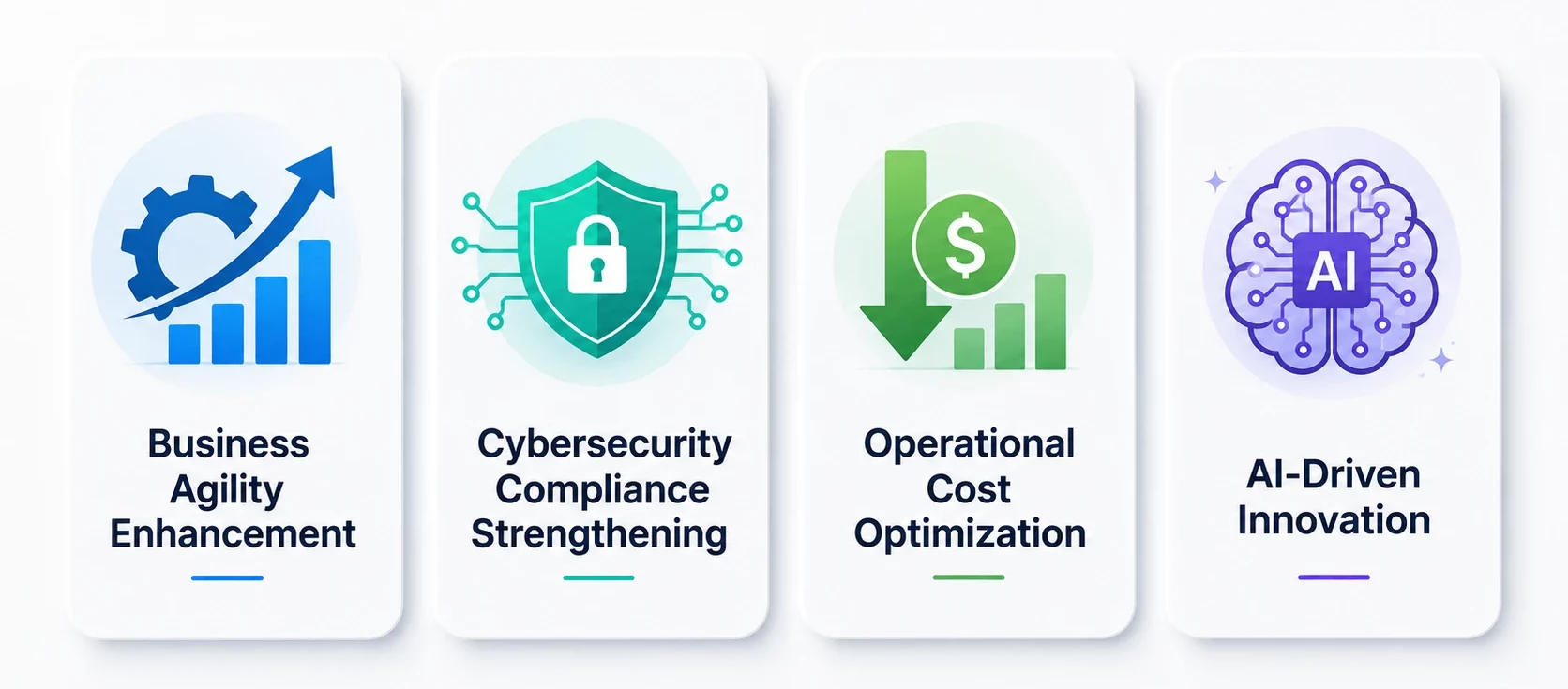
1. Driving Business Agility and Faster Innovation
Modern markets demand rapid prototyping and product launches, continuous feature updates, and the flexibility to respond to changing customer expectations. Legacy applications often rely on rigid architectures that slow development cycles and make introducing new capabilities both expensive and time-consuming.
By modernizing applications with cloud-native technologies, APIs, and microservices, businesses gain the agility to innovate faster, reduce time-to-market, and quickly adapt to evolving market conditions.
2. Strengthening Cybersecurity and Regulatory Compliance
Many legacy systems operate on unsupported software versions, outdated security protocols, and aging infrastructure that expose organizations to cyber threats. At the same time, businesses must comply with increasingly stringent regulations related to data privacy, financial reporting, and industry-specific standards.
Application modernization enables organizations to implement modern security frameworks, automated compliance monitoring, stronger identity management, and continuous security updates, significantly reducing enterprise risk.
3. Improving Operational Efficiency and Reducing Costs
Maintaining legacy applications often requires specialized expertise, expensive hardware, and frequent manual intervention. These systems consume a significant portion of IT budgets without delivering proportional business value.
Modernized applications simplify maintenance, automate operational processes, improve system performance, and reduce infrastructure costs through cloud adoption and scalable architectures, allowing organizations to optimize technology investments.
4. Enabling AI, Automation, and Data-Driven Decision Making
Artificial intelligence and advanced analytics depend on high-quality, accessible, and well-integrated data. Legacy applications frequently store information in isolated systems, making it difficult to leverage AI effectively.
Modern application architectures improve data accessibility, support real-time analytics, integrate seamlessly with AI platforms, and create a strong foundation for automation, predictive insights, and intelligent business operations. Organizations that already invest in application maintenance services often find modernization to be the next logical step in improving long-term software performance, security, and scalability.
Legacy Modernization vs Migration vs Replacement
These three terms are frequently used interchangeably, but they represent very different business strategies.
- Modernization improves an application’s architecture, technology stack, scalability, and maintainability while preserving valuable business capabilities.
- Migration primarily focuses on moving an application from one infrastructure or platform to another, such as migrating from on-premises servers to the cloud, without fundamentally changing how the application works.
- Replacement involves retiring the existing system entirely and implementing a new commercial or custom-built solution to perform the same business functions.
Selecting the right approach depends on business objectives, application complexity, technical debt, modernization budget, and long-term digital transformation goals.
Application Modernization vs Digital Transformation: Where Each Starts and Stops
Application modernization is an important component of digital transformation, but the two are not identical. Application modernization focuses on upgrading software systems, improving mobile app architecture, reducing technical debt, and enabling modern development practices.
Digital transformation is a broader business strategy that encompasses customer experience, operational processes, organizational culture, AI adoption, cloud computing, automation, and new digital business models.
In many organizations, application modernization serves as the technological foundation that makes wider digital transformation initiatives possible.
The Five Signs Your Application Qualifies as Legacy
Many organizations assume legacy systems are simply old systems. In reality, even relatively new applications can become legacy platforms if they limit business growth.
Common indicators include:
- High maintenance costs are consuming IT budgets
- Difficulty integrating with modern APIs and cloud services
- Slow release cycles and lengthy development timelines
- Increasing security, compliance, and operational risks
- Dependence on outdated technologies or difficult-to-find specialist developers
If an application consistently slows innovation, increases operational complexity, or prevents adoption of modern technologies, it has effectively become a legacy system regardless of when it was originally built.
The Hidden Cost of Legacy Software
The cost of legacy software goes far beyond routine maintenance. While older systems may continue to function, they often increase operational expenses, slow innovation, create security risks, and reduce business agility. Over time, these hidden costs accumulate across the organization, making the price of inaction significantly higher than many businesses anticipate.
Understanding both the direct and indirect financial impact of legacy systems helps organizations make informed modernization decisions. By evaluating maintenance costs, productivity losses, security risks, and missed business opportunities, leaders can build a stronger business case for investing in modernization.
Direct Costs of Maintaining Legacy Applications
The direct costs of legacy software are the easiest to identify because they appear in annual IT budgets. As applications age, organizations spend more on maintaining existing systems than improving them. Regular bug fixes, infrastructure maintenance, software licensing, and compatibility updates gradually increase operational expenses while delivering little additional business value.
Vendor support is another significant cost. Once software reaches end-of-life or end-of-support, businesses often pay premium fees for extended support agreements or rely on expensive third-party providers. At the same time, finding developers with expertise in outdated technologies becomes increasingly difficult, resulting in higher salaries, longer hiring cycles, and greater dependence on a limited talent pool.
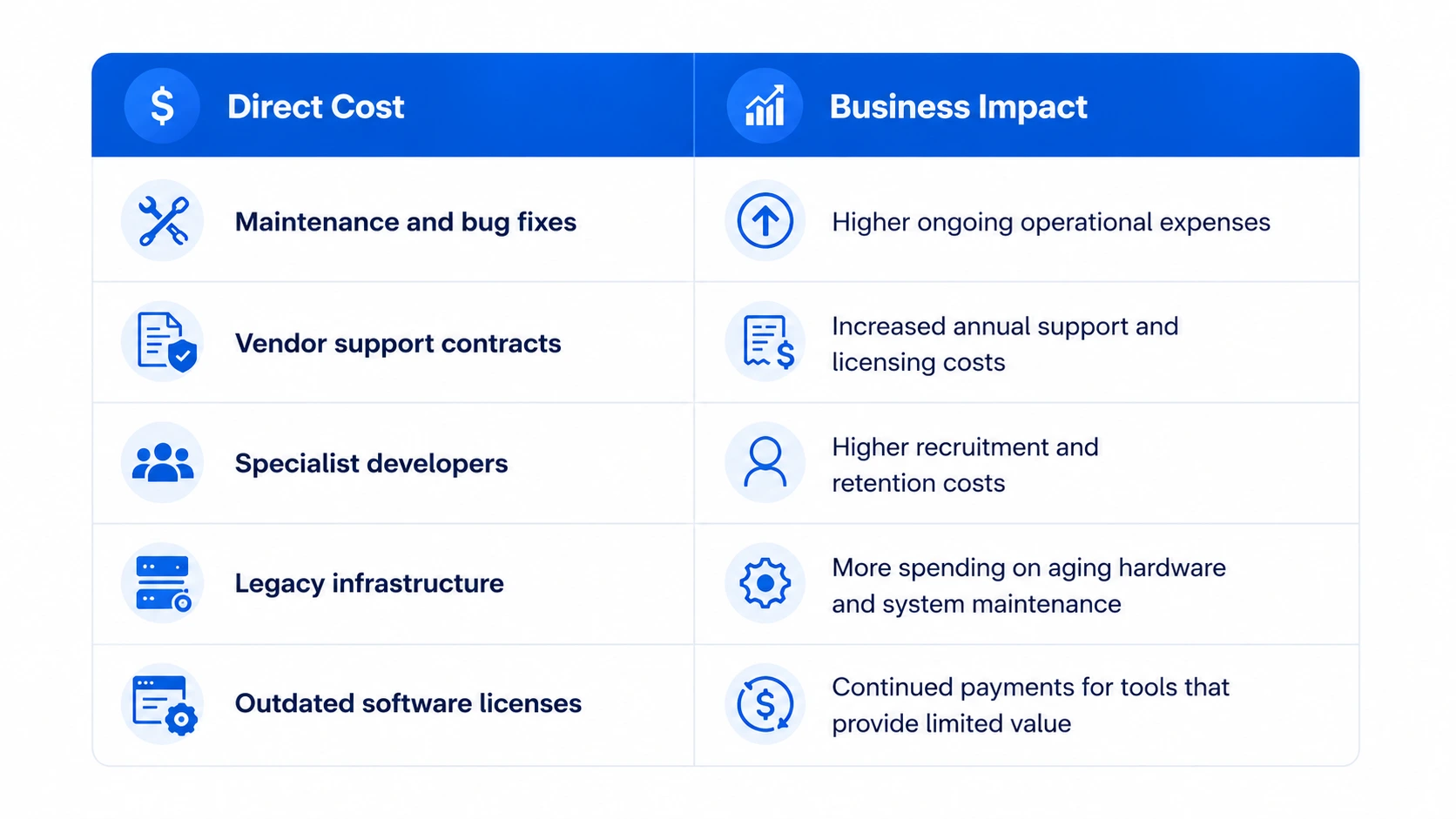
Although each of these expenses may seem manageable individually, together they consume a significant portion of the IT budget, leaving fewer resources available for innovation and business growth.
Indirect Costs That Impact Business Growth
Beyond direct expenses, legacy software creates indirect costs that are often more damaging because they affect business performance and long-term growth. Outdated architectures make it difficult to develop and release new features quickly, forcing development teams to spend more time resolving technical issues than delivering innovation. Legacy systems also struggle to integrate with modern cloud platforms, APIs, AI tools, and third-party applications, resulting in disconnected workflows, manual processes, and reduced operational efficiency.
These limitations can lead to missed business opportunities. Delayed product launches, slower responses to market changes, and an inability to adopt emerging technologies allow competitors with modern systems to innovate faster and deliver better customer experiences. While these costs may not appear in financial reports, they directly impact revenue growth, customer satisfaction, and an organization’s ability to remain competitive in a rapidly evolving digital landscape.
The Business ROI of Legacy Application Modernization
Software modernization is often viewed as a significant investment, but organizations that complete the mobile app development process typically report measurable improvements across operations, technology, and business performance. Modern applications reduce maintenance overhead, improve system reliability, accelerate feature delivery, and provide the flexibility needed to support future business growth. As a result, IT teams can spend less time maintaining outdated systems and more time driving innovation.
Beyond operational efficiency, modernization delivers long-term business value. Enterprises frequently experience faster product releases, improved employee productivity, stronger security, better customer experiences, and lower infrastructure costs through cloud adoption and automation. While the exact return on investment varies by organization, the combination of reduced operating costs, increased agility, and improved scalability enables businesses to recover their modernization investment over time while building a stronger foundation for future digital transformation.
Legacy System Modernization: How It Differs from Legacy Application Modernization
Legacy system modernization is a broader transformation initiative that extends beyond individual software applications. While legacy application modernization focuses on improving a specific application’s architecture, codebase, user experience, and integrations, legacy system modernization addresses the complete technology ecosystem that supports business operations. This can include applications, databases, servers, middleware, network infrastructure, legacy hardware, and interconnected enterprise platforms.
For many organizations, the terms are used interchangeably, but they represent different scopes of modernization. An application may be modernized without replacing the underlying infrastructure, whereas legacy systems modernization often requires coordinated upgrades across multiple technologies to improve performance, security, scalability, and long-term maintainability. Enterprise modernization programs frequently combine cloud migration, infrastructure upgrades, API integration, data modernization, and application modernization into a single roadmap.
In practice, most organizations modernize legacy systems gradually rather than replacing everything at once. They often begin by modernizing business-critical applications, exposing legacy functionality through APIs, migrating workloads to the cloud, and then upgrading the supporting infrastructure in phases. This incremental approach reduces operational risk while allowing businesses to continue delivering uninterrupted services throughout the transformation.
| Legacy Application Modernization | Legacy System Modernization |
| Focuses on a single application or software product | Focuses on the entire enterprise technology ecosystem |
| Improves application architecture, code, UI, APIs, and performance | Modernizes applications, infrastructure, databases, middleware, and integrations |
| Solves application-level technical debt | Addresses organization-wide technical debt and operational complexity |
| Often completed as an individual project | Usually delivered as a phased enterprise transformation program |
| Supports faster feature releases and better user experience | Improves business agility, scalability, resilience, and long-term digital transformation |
Although legacy system modernization covers a much broader scope, application modernization is usually the starting point. By first modernizing high-value applications, organizations establish the foundation needed to modernize legacy systems, simplify future infrastructure upgrades, and accelerate enterprise-wide digital transformation.
A successful legacy system modernization strategy aligns application modernization, cloud adoption, infrastructure upgrades, and data modernization with long-term business goals, helping organizations reduce technical debt while building a scalable and future-ready technology ecosystem. Businesses planning large-scale modernization initiatives often begin with a product modernization strategy that aligns technology investments with long-term business goals.
Legacy Application Modernization Strategies: Choosing the Right Path for Each System
Legacy application modernization is not a one-size-fits-all process. Every application has different business value, technical complexity, and operational requirements, making it essential to choose a strategy that aligns with both current challenges and long-term business goals. Applying the same modernization approach to every system can increase costs, introduce unnecessary risks, and delay expected outcomes.
A successful modernization initiative begins with assessing each application’s condition, dependencies, and future role within the organization. From there, businesses can determine whether an application should be migrated, optimized, re-engineered, replaced, or retired. Selecting the right strategy ensures organizations maximize return on investment while minimizing disruption.
This strategic approach is equally important for businesses modernizing mobile ecosystems, particularly when working with an experienced iOS app development company to upgrade legacy iOS applications for improved performance, security, and scalability.
The 7Rs Framework: Rehost, Replatform, Repurchase, Refactor, Re-Architect, Rebuild and Retire
Not every legacy application requires the same modernization approach. Some systems only need a cloud migration and data security checklist, while others require significant architectural changes or complete replacement. Choosing the right strategy depends on several factors, including the application’s business value, technical complexity, maintenance costs, security requirements, and long-term objectives.
The widely adopted 7Rs Framework helps organizations evaluate each application individually and select the most appropriate modernization path. Rather than applying a one-size-fits-all approach, businesses can align technology decisions with expected outcomes such as cost reduction, improved performance, faster innovation, or enhanced scalability.
| Strategy | What It Means | Best Suited For |
| Rehost | Move the application to a new infrastructure without changing its code. | Quick cloud migrations with minimal disruption. |
| Replatform | Migrate the application while making limited improvements to optimize performance. | Organizations seeking better efficiency without major redevelopment. |
| Repurchase | Replace the existing application with a commercial off-the-shelf (SaaS) solution. | Standard business functions such as CRM, HR, or accounting. |
| Refactor | Improve and restructure the existing codebase without changing core functionality. | Applications that remain valuable but need better scalability and maintainability. |
| Re-Architect | Redesign the application’s architecture to support modern technologies and future growth. | Business-critical systems requiring greater flexibility and cloud-native capabilities. |
| Rebuild | Redevelop the application from the ground up while preserving the business requirements. | Systems with outdated technology that cannot be effectively modernized. |
| Retire | Decommission applications that no longer provide business value. | Redundant, underused, or obsolete systems. |
Using the 7Rs Framework allows organizations to modernize strategically rather than replacing every application unnecessarily. Organizations modernizing browser-based enterprise platforms often combine these strategies with a structured web app modernization roadmap to improve scalability, security, and cloud readiness.
Rehost (Lift and Shift): Cloud Migration Without Code Changes
Rehosting, commonly known as Lift and Shift, is the simplest and fastest modernization strategy. It involves moving an existing application from on-premises infrastructure to a cloud environment without making significant changes to its code or architecture. Because the application remains largely unchanged, organizations can complete migrations relatively quickly while minimizing operational disruption.
This approach is ideal when the primary goal is to reduce infrastructure costs, improve scalability, or exit aging data centers within a limited timeframe. However, while rehosting delivers immediate cloud benefits, it does not resolve underlying architectural issues or technical debt. As a result, many organizations treat Lift and Shift as the first step in a broader modernization roadmap before introducing deeper optimizations in later phases.
Replatform: Infrastructure Upgrades With Minimal Code Changes
Replatforming goes a step beyond Lift and Shift by moving an application to a modern infrastructure while making selective improvements that enhance performance, reliability, or scalability. Unlike refactoring, the application’s core architecture and functionality remain largely unchanged, allowing organizations to modernize without the time and cost of a complete redevelopment.
This strategy is well suited for applications that are stable but could benefit from cloud-native services such as managed databases, containerization, automated scaling, or improved monitoring. By introducing targeted enhancements during migration, businesses can improve operational efficiency and reduce maintenance overhead while keeping project risk and implementation timelines under control.
Refactor: Improve Code Without Changing Functionality
Refactoring focuses on improving the internal structure of an application’s code without changing its core functionality or user experience. The objective is to eliminate technical debt, improve code quality, and make the application easier to maintain, scale, and enhance over time. Although users may notice little to no difference in how the application works, the underlying improvements create a stronger foundation for future development.
Among the modernization strategies, refactoring requires one of the highest levels of effort because it often involves redesigning modules, improving code organization, and adopting modern development practices. However, it also offers significant long-term benefits, including faster feature development, better performance, greater scalability, and reduced maintenance complexity, making it a valuable option for business-critical applications with long-term strategic importance.
Rebuild: When Redeveloping Is Better Than Refactoring
Rebuilding involves developing an application from the ground up while retaining the original business objectives and core functionality. This approach is typically chosen when the existing codebase is outdated, difficult to maintain, or so heavily burdened by technical debt that incremental improvements are no longer practical. Rather than trying to fix years of accumulated issues, organizations create a new application using modern technologies, architectures, and development practices.
Although rebuilding requires a greater investment of time and resources than other modernization strategies, it provides the opportunity to design a scalable, secure, and future-ready solution from the outset. It is often the better choice over refactoring when the existing application has significant architectural limitations, lacks proper documentation, or cannot support evolving business requirements without extensive redevelopment.
Retire and Replace: When to Buy Instead of Build
Not every legacy application should be modernized. Some systems no longer deliver sufficient business value or perform functions that can be handled more effectively by commercially available software. In such cases, retiring the existing application and replacing it with a proven off-the-shelf solution can reduce maintenance costs, simplify operations, and eliminate the burden of supporting outdated technology.
This strategy is commonly adopted for standardized business functions such as customer relationship management, human resources, accounting, or collaboration tools, where mature commercial platforms already exist. Before replacing an application, organizations should evaluate migration requirements, integration needs, data portability, and long-term subscription costs to ensure the new solution aligns with both operational and strategic objectives.
How to Choose the Right Strategy: The Decision Framework That Matches Path to Business Outcome
Selecting the right modernization strategy begins with understanding both the technical condition of the application and the business value it delivers. Factors such as application complexity, maintenance costs, security risks, performance issues, integration requirements, and future scalability should all be evaluated before deciding whether to rehost, refactor, rebuild, replace, or retire a system. The objective is to choose an approach that delivers the greatest business value with the least amount of risk.
Rather than modernizing every application in the same way, organizations should assess each system individually and prioritize based on business impact. Applications that are critical to operations may justify deeper modernization efforts, while systems with limited value may be better suited for replacement or retirement. A structured decision framework helps businesses allocate resources effectively, reduce implementation risks, and ensure that modernization investments align with long-term strategic goals. Businesses modernizing legacy mobile applications should also consider platform-specific architecture, performance, and user experience requirements as part of their broader modernization strategy.
AI-Accelerated Modernization: How GenAI Is Cutting Timelines by 40–50%
Generative AI is transforming legacy application modernization by automating many of the time-consuming tasks traditionally performed by development teams. From analyzing legacy code and generating documentation to recommending code transformations and assisting with testing, AI enables organizations to modernize applications faster while reducing manual effort. This acceleration helps businesses shorten project timelines without compromising quality or reliability.
Rather than replacing developers, AI acts as a productivity multiplier throughout the modernization lifecycle. Organizations can identify dependencies more quickly, migrate code more efficiently, and detect potential issues earlier in the process. By combining AI-powered automation with human expertise, enterprises are reducing modernization timelines, lowering project costs, and accelerating their journey toward modern, scalable applications.
AI for Legacy Code Analysis and Understanding
One of the biggest challenges in legacy application modernization is understanding applications that have little or no documentation. In many organizations, the original developers have retired or moved on, leaving behind complex codebases that are difficult to interpret. Generative AI helps overcome this challenge by analyzing source code, identifying dependencies, explaining business logic, and highlighting potential risks before modernization begins.
These insights also help organizations develop a robust AI strategy for digital products, ensuring legacy systems are modernized in a way that supports future AI integration and intelligent automation. This enables development teams to gain a clearer understanding of how legacy systems function without spending months on manual code analysis.
AI-Powered Legacy Code Translation
Generative AI is also accelerating code migration by assisting in the translation of legacy programming languages into modern development frameworks. While AI can convert significant portions of code, recommend modern equivalents, and identify deprecated functions, the translated code still requires developer review and optimization. This approach reduces repetitive manual work, allowing engineering teams to modernize applications more efficiently while maintaining code quality and business functionality.
AI-Generated Documentation for Legacy Systems
Many legacy applications rely on undocumented business rules that exist only through years of organizational knowledge. AI can generate technical documentation, explain workflows, summarize system architecture, and create readable descriptions of complex code, helping organizations preserve critical knowledge before experienced employees leave. This documentation also improves collaboration between development, operations, and business teams throughout the modernization process.
AI in Testing and Quality Assurance
Testing is one of the most time-intensive phases of application modernization, particularly for business-critical systems. AI streamlines this process by generating test cases, identifying edge scenarios, detecting regressions, and supporting automated quality assurance. These capabilities enable teams to validate modernized applications more quickly, improve software reliability, and reduce the manual effort required to ensure that new systems perform consistently with their legacy counterparts.
Where Human Expertise Still Matters in Modernization
Although AI significantly improves productivity, it cannot replace human expertise in strategic decision-making. Choosing the right modernization approach, interpreting complex business requirements, prioritizing investments, and managing organizational change all require human judgment. Successful modernization combines AI-powered automation with experienced architects, developers, and business stakeholders who understand the broader operational and strategic context, ensuring that technology decisions align with long-term business objectives.
Data Modernization: The Most Overlooked Challenge
While application code often receives the most attention during legacy modernization initiatives, data is usually the most complex and business-critical component of the transformation. Enterprise applications accumulate years or even decades of customer records, financial transactions, operational logs, compliance documents, and business intelligence. Migrating this information incorrectly can lead to operational disruptions, regulatory violations, inaccurate reporting, and permanent data loss.
Successful legacy application modernization therefore requires a comprehensive data modernization strategy rather than treating data migration as a final deployment task. Organizations must carefully assess data quality, eliminate silos, modernize storage architectures, and establish governance processes that ensure data remains secure, accurate, and accessible throughout the modernization journey.
Partnering with an experienced enterprise application development services provider can help organizations manage these complexities while ensuring data integrity and minimizing risks throughout the modernization process.
Why Data Modernization Matters Most
Legacy systems rarely contain clean, standardized, or well-documented data. Instead, they often store information across multiple databases, proprietary formats, spreadsheets, and disconnected applications that have evolved independently over many years. Duplicate records, inconsistent naming conventions, incomplete fields, and undocumented relationships significantly increase migration complexity.
Unlike application code, business data cannot simply be rewritten if something goes wrong. Customer histories, financial transactions, contracts, inventory records, and regulatory documentation represent valuable business assets that must remain accurate throughout the modernization process. Organizations that prioritize data discovery and governance early in the project significantly reduce migration risks while creating a stronger foundation for analytics, automation, and artificial intelligence.
Building a Successful Data Migration Strategy
An effective data migration strategy begins with understanding exactly what data exists, where it resides, and how it supports business operations. Organizations should perform a detailed data inventory to identify critical datasets, dependencies, redundant information, and obsolete records before any migration activities begin.
After discovery, businesses clean inaccurate or duplicate data, standardize formats, and transform legacy structures into modern data models compatible with cloud platforms and contemporary applications. Migration should then be executed in carefully planned phases with continuous validation, rollback mechanisms, and business continuity planning to ensure historical information remains intact while minimizing operational disruption.
Breaking Data Silos for AI-Ready Systems
Many legacy applications operate in isolation, storing valuable business information in proprietary databases that cannot easily communicate with other enterprise systems. These data silos limit collaboration, delay decision-making, and prevent organizations from gaining a unified view of customers, operations, and business performance.
Modernization provides an opportunity to consolidate fragmented data into interoperable platforms that support APIs, cloud-native architectures, data lakes, and enterprise analytics solutions. AI-ready data environments enable organizations to integrate business intelligence tools, predictive analytics, and generative AI applications that depend on consistent, high-quality data across the enterprise.
Ensuring Data Quality During Migration
Migrating poor-quality data simply transfers existing problems into a new platform. Data validation should therefore be embedded throughout every stage of the migration process rather than performed only after deployment.
Organizations should implement automated validation checks to verify record completeness, data accuracy, referential integrity, and consistency between legacy and modern systems. Pilot migrations, reconciliation testing, duplicate detection, and user acceptance testing help identify issues before production deployment. Continuous monitoring after migration further ensures that business operations continue without data inconsistencies affecting customers or internal teams.
Maintaining Compliance During Data Migration
For organizations operating in regulated industries, compliance is a critical component of every modernization initiative. Sensitive customer information, healthcare records, financial transactions, and personally identifiable information must remain protected throughout the migration lifecycle.
Businesses should establish governance policies that include encryption for data at rest and in transit, role-based access controls, audit logging, retention management, and secure backup procedures. Compliance with regulations such as GDPR, HIPAA, PCI DSS, and industry-specific standards should be validated before, during, and after migration to minimize legal, financial, and reputational risks. Incorporating compliance into the modernization roadmap from the outset helps organizations accelerate transformation while maintaining trust with customers, partners, and regulators.
Legacy Application Modernization Across Industries
Although the objectives of legacy application modernization remain consistent across industries, such as improving agility, reducing operational costs, strengthening security, and enabling innovation, the implementation strategy varies significantly depending on the industry’s regulatory requirements, operational complexity, and business continuity needs. Organizations operating in highly regulated sectors often cannot afford system downtime or data inconsistencies, making modernization far more challenging than a standard software upgrade.
Industry-specific modernization strategies account for compliance standards, legacy technology dependencies, customer expectations, and mission-critical operations. Businesses that tailor their modernization roadmap to their industry’s unique challenges achieve smoother transitions, minimize operational risks, and accelerate return on investment. Choosing the right application modernization solutions becomes especially important when modernization must balance innovation with regulatory compliance and uninterrupted service delivery.
1. Modernizing Legacy Systems in Financial Services
Financial institutions continue to operate some of the world’s oldest enterprise applications. Core banking platforms, payment processing systems, insurance platforms, and trading applications often rely on decades-old technologies such as COBOL, mainframes, and proprietary databases that continue to process millions of daily transactions.
Modernizing financial systems requires exceptional planning because even minor disruptions can affect customer accounts, payment processing, regulatory reporting, and financial markets. Rather than replacing entire systems at once, many organizations adopt phased modernization strategies that gradually expose legacy functionality through APIs while migrating services to cloud-native architectures.
Compliance adds another layer of complexity. Financial institutions must maintain strict adherence to regulations such as PCI DSS, SOX, Basel III, PSD2, AML, and KYC requirements while ensuring complete audit trails throughout modernization. Strong encryption, identity management, continuous monitoring, and automated compliance reporting are essential components of every modernization initiative.
Successful banking modernization also focuses on enabling real-time digital services, mobile banking, fraud detection, AI-powered financial insights, and open banking integrations without compromising security or transaction reliability.
2. Modernizing Legacy Healthcare Applications
Healthcare organizations depend on legacy applications to manage electronic health records (EHRs), laboratory systems, imaging platforms, patient scheduling, billing, pharmacy management, and clinical workflows. Many of these systems have evolved independently over decades, creating interoperability challenges and fragmented patient information.
Healthcare modernization emphasizes secure data integration rather than simply replacing software. Standards such as FHIR (Fast Healthcare Interoperability Resources) enable modern applications to exchange patient information across hospitals, clinics, insurance providers, laboratories, and digital health platforms.
Patient privacy remains the highest priority throughout modernization. Organizations must comply with HIPAA and other healthcare data protection regulations by implementing encryption, role-based access controls, detailed audit logs, secure data migration processes, and continuous monitoring.
Modernized healthcare systems improve physician productivity, reduce administrative overhead, enable telemedicine, support AI-assisted diagnostics, and provide patients with faster access to medical information while maintaining the highest standards of data security.
3. Modernizing Manufacturing Systems
Manufacturing companies rely on Enterprise Resource Planning (ERP), Manufacturing Execution Systems (MES), supply chain platforms, inventory management systems, and industrial control software to coordinate production operations. Many of these systems were designed long before IoT devices, predictive analytics, cloud computing, and artificial intelligence became central to modern manufacturing.
Legacy modernization enables manufacturers to integrate production systems with connected devices, robotics, warehouse automation, and enterprise analytics platforms. Instead of operating isolated production environments, businesses gain real-time visibility into equipment performance, inventory levels, production schedules, and supply chain operations.
Modernized manufacturing environments also support predictive maintenance by analyzing equipment data to identify potential failures before they occur. AI-driven production planning, automated quality control, and digital twins further improve operational efficiency while reducing downtime and maintenance costs.
Because manufacturing facilities often operate continuously, modernization projects typically follow phased deployment strategies that minimize production interruptions and protect business continuity.
4. Modernizing Retail and E-Commerce Platforms
Retailers and e-commerce businesses compete in environments where customer expectations evolve rapidly. Legacy monolithic commerce platforms frequently limit development speed, making it difficult to launch new features, personalize shopping experiences, or handle seasonal traffic spikes.
Modernization often involves decomposing monolithic applications into microservices that independently manage functions such as product catalogs, search, checkout, inventory, pricing, recommendations, customer accounts, and payment processing. This architecture enables development teams to deploy updates more frequently without affecting the entire platform.
Cloud-native infrastructure provides automatic scalability during high-demand periods such as Black Friday, holiday sales, and promotional campaigns. AI-powered recommendation engines, personalized marketing, dynamic pricing, and omnichannel commerce become significantly easier to implement once legacy limitations are removed.
Retail modernization also focuses on integrating physical stores, mobile applications, online marketplaces, warehouse systems, and customer loyalty platforms into a unified digital commerce ecosystem.
5. Modernizing Government and Public Sector Systems
Government agencies often operate some of the largest and longest-running legacy applications in the world. Tax administration, public records, social services, transportation, defense, and citizen service platforms frequently depend on aging infrastructure that remains operational because replacing it entirely presents significant operational and financial risks.
Unlike commercial organizations, government modernization projects must navigate complex procurement processes, budget approvals, public accountability, and strict regulatory oversight. Large-scale “rip-and-replace” initiatives rarely succeed due to their cost, implementation complexity, and potential impact on public services.
Instead, many public sector organizations adopt incremental modernization strategies such as the Strangler Fig pattern, API-based integration, and modular service replacement. These approaches allow agencies to modernize one component at a time while maintaining uninterrupted citizen services.
Modern government modernization initiatives also prioritize cybersecurity, digital identity management, cloud adoption, accessibility compliance, and AI-assisted public services. By gradually replacing outdated systems with scalable and interoperable platforms, agencies improve service delivery while reducing long-term maintenance costs and operational risks.
Legacy Application Modernization Cost: What Drives the Budget and How to Plan for It
One of the first questions business leaders ask before beginning a modernization initiative is, “How much will it cost?” The answer varies significantly because every legacy application differs in complexity, architecture, business criticality, integration requirements, and modernization goals. A simple cloud migration for a standalone application may cost tens of thousands of dollars, while modernizing a mission-critical enterprise platform with decades of accumulated business logic can require investments of several million dollars.
Rather than focusing solely on the upfront budget, organizations should evaluate modernization as a long-term business investment. Modernized applications reduce infrastructure expenses, lower maintenance costs, improve developer productivity, strengthen cybersecurity, accelerate product delivery, and create a foundation for AI-driven innovation. Partnering with an experienced custom app development company can help businesses create phased modernization roadmaps that maximize return on investment while minimizing operational disruption.
Why Modernization Cost Estimates Vary From $50K to $5M for What Looks Like the Same Project
Two applications that appear similar may have vastly different modernization costs due to differences in technical complexity and business requirements. Several factors influence the overall investment required.
The size of the application, number of users, age of the codebase, programming language, third-party integrations, database complexity, regulatory requirements, testing effort, and migration strategy all contribute to the final budget. Systems that support core business operations generally require more extensive planning, testing, and phased deployment than internal business applications.
Organizations should begin with a comprehensive application assessment that evaluates technical debt, infrastructure dependencies, security risks, business priorities, and modernization objectives. This assessment provides realistic cost estimates and helps identify the modernization strategy that delivers the greatest business value.
Cost by Modernization Path: Rehost, Replatform, Refactor and Rebuild
The modernization approach selected has the greatest impact on project cost, implementation timeline, and long-term business benefits. Simpler approaches require lower investment but provide fewer long-term improvements, while more comprehensive modernization strategies involve higher upfront costs but deliver greater scalability, maintainability, and innovation potential.
| Modernization Strategy | Typical Cost Range (USD) | Estimated Timeline | Best For |
| Rehost (Lift and Shift) | $50,000 – $150,000 | 1–3 months | Quick cloud migration with minimal code changes |
| Replatform | $100,000 – $300,000 | 3–6 months | Infrastructure upgrades with moderate application improvements |
| Refactor | $250,000 – $1,000,000+ | 6–18 months | Improving scalability, maintainability, and cloud-native readiness |
| Rebuild / Re-Architect | $500,000 – $5M+ | 12–24+ months | Mission-critical systems requiring complete architectural transformation |
| Replace (Commercial Solution) | $150,000 – $2M+ | 6–18 months | Replacing legacy software with SaaS or enterprise platforms |
Note: These are indicative enterprise cost ranges. Actual project costs depend on application complexity, integrations, compliance requirements, data migration scope, geographic location, and team composition.
How to Choose the Right Legacy Application Modernization Partner
Choosing the right modernization partner is crucial to the success of any legacy transformation initiative. Beyond technical expertise, businesses need a partner that understands their industry, minimizes operational risks, and delivers measurable business outcomes. The right partner helps modernize applications while ensuring business continuity, regulatory compliance, and long-term scalability.
1. Portfolio Assessment Capability
A reliable modernization partner begins with a comprehensive assessment of your existing applications rather than providing immediate cost estimates. This evaluation identifies technical debt, business priorities, security risks, and the most suitable modernization strategy for each application.
2. Business Continuity Experience
Legacy applications often support critical business operations, making downtime costly. Choose a partner with proven experience in phased migrations, cloud modernization, automated testing, and rollback planning to ensure seamless modernization without disrupting daily operations.
3. Industry and Compliance Expertise
Industries such as finance, healthcare, manufacturing, and government have unique regulatory requirements. An experienced partner understands standards like GDPR, HIPAA, PCI DSS, and industry-specific compliance, ensuring modernization aligns with both technical and legal requirements.
Legacy Application Modernization Trends in 2026
Legacy application modernization is evolving beyond cloud migration and data security infrastructure upgrades. In 2026, organizations are adopting AI-powered automation, modular architectures, outcome-focused delivery models, and low-code technologies to modernize faster while reducing costs and business risk. These emerging application modernization trends are helping enterprises transform aging systems into flexible, scalable, and AI-ready platforms that can continuously adapt to changing business needs.
1. Agentic AI in Modernization
Generative AI has already accelerated modernization, but Agentic AI is taking automation to the next level. Unlike traditional AI assistants that require continuous human prompts, agentic AI systems can independently analyze legacy codebases, identify dependencies, generate documentation, recommend modernization strategies, translate code into modern programming languages, and execute automated testing workflows.
Although human oversight remains essential for business decisions and architectural planning, these autonomous AI capabilities significantly reduce manual effort, accelerate modernization timelines, and improve developer productivity.
2. Composable Architecture as the Modernization Destination
Many organizations are replacing tightly coupled monolithic applications with composable architectures built on microservices, APIs, cloud-native services, and reusable business components. Instead of maintaining one large application, businesses can independently update, scale, or replace individual services without affecting the entire system.
Composable architecture improves flexibility, accelerates feature releases, simplifies integration with emerging technologies, and reduces the likelihood of creating another generation of legacy applications.
3. Outcome-Based Modernization Contracts
Organizations are increasingly moving away from traditional time-and-materials contracts toward outcome-based modernization engagements. Rather than paying solely for development hours, businesses define measurable objectives such as reducing maintenance costs, improving application performance, increasing deployment frequency, or accelerating cloud migration.
This approach aligns technology partners with business outcomes, improves project accountability, reduces implementation risks, and provides greater confidence that modernization investments will deliver measurable value.
4. Low-Code Bridges
Many enterprises cannot replace business-critical systems overnight. Instead, they are using low-code and no-code platforms to build temporary user interfaces, workflows, dashboards, and integrations while the underlying legacy application is modernized incrementally.
These “bridge” solutions allow organizations to improve user experiences, automate manual processes, and introduce new digital capabilities without waiting for the complete modernization project to finish. Once the legacy core has been fully modernized, these temporary components can either be integrated into the new architecture or retired, enabling a smoother and lower-risk transition to modern enterprise systems.
Final Thoughts
Legacy application modernization is no longer just an IT initiative. It is a business transformation strategy that enables organizations to reduce operational costs, strengthen cybersecurity, improve customer experiences, accelerate innovation, and prepare for AI-driven growth. As legacy systems become increasingly expensive to maintain and more difficult to integrate with modern technologies, delaying modernization only increases technical debt and business risk.
The key to successful modernization lies in selecting the right strategy for each application, modernizing data alongside software, adopting phased implementation approaches, and partnering with experienced technology experts who understand both technical and business challenges.
Rather than viewing modernization as a one-time migration project, organizations should approach it as a continuous journey toward greater agility, resilience, and scalability. Working with a trusted mobile application development company can help businesses execute this transition efficiently while building scalable, future-ready digital solutions that support long-term growth.
FAQs
Q1. What is legacy application modernization and why does it matter in 2026?
Legacy application modernization is the process of upgrading outdated software, infrastructure, and architecture to improve performance, security, scalability, and maintainability. In 2026, it has become a strategic priority because legacy systems limit AI adoption, increase cybersecurity risks, raise maintenance costs, and slow business innovation.
Q2. What is the difference between modernization, migration, and replacement?
Modernization improves an existing application while preserving valuable business functionality. Migration typically involves moving an application to a new environment, such as the cloud, with minimal changes. Replacement involves retiring the legacy system entirely and implementing a new commercial or custom-built solution.
Q3. Which modernization strategy is right for my system: rehost, refactor, or rebuild?
The right strategy depends on your application’s business value, technical debt, budget, and long-term goals. Rehosting is suitable for quick cloud adoption, refactoring improves scalability without changing core functionality, while rebuilding is ideal when the existing application can no longer support future business requirements.
Q4. How long does legacy application modernization take?
Project timelines vary based on application complexity and modernization scope. Smaller applications may take two to four months, while enterprise-wide modernization initiatives involving multiple systems can take one to two years using a phased implementation approach.
Q5. How much does it cost to modernize a legacy application?
Modernization costs typically range from $50,000 to over $5 million, depending on factors such as application size, modernization strategy, integrations, data migration, compliance requirements, and infrastructure complexity. A detailed application assessment provides the most accurate estimate.
Q6. What is the Strangler Fig pattern and when should we use it?
The Strangler Fig pattern is an incremental modernization approach where new components gradually replace legacy functionality while the original system continues operating. It is best suited for business-critical applications that cannot tolerate extended downtime or complete system replacement.
Q7. How do we modernize a legacy system without disrupting live operations?
Businesses minimize disruption by adopting phased modernization strategies, running legacy and modern systems in parallel, using APIs for gradual integration, performing comprehensive testing, and implementing rollback plans to ensure business continuity throughout the migration.
Q8. What is technical debt and how does modernization reduce it?
Technical debt refers to outdated code, unsupported technologies, and architectural limitations that increase maintenance effort and slow innovation. Modernization reduces technical debt by replacing obsolete components, improving code quality, adopting cloud-native architectures, and simplifying future development.
Q9. How is AI being used to accelerate legacy modernization?
AI accelerates modernization by analyzing legacy code, generating technical documentation, translating outdated programming languages, automating software testing, identifying security vulnerabilities, and assisting developers throughout the modernization lifecycle. This reduces project timelines while improving accuracy and productivity.
Q10. How do we build a business case for legacy modernization to present to the board?
An effective business case should quantify the financial impact of maintaining legacy systems, including rising maintenance costs, security risks, operational inefficiencies, compliance challenges, and lost business opportunities. It should also highlight expected benefits such as lower IT costs, faster innovation, improved customer experience, stronger security, AI readiness, and measurable return on investment.
SHARE
WRITTEN BY

Ishan Gupta
CEO & Founder
Ishan Gupta is a seasoned entrepreneur and CEO with extensive 8+ years of experience in business and mobile app development landscape. He believes that the right digital product allows companies to focus on what they do best, while technology handles the rest. With deep exposure to global markets, he understands what makes an app succeed. His approach translates business needs into clear product strategies, ensuring that every feature contributes to measurable ROI.
View All Articles


 India
India USA
USA Australia
 Canada
 UK
UK UAE
UAE