


Key Takeaways
- Successful SaaS startups validate the market before writing production code, helping reduce wasted development costs and improve product-market fit.
- The right SaaS development roadmap combines customer validation, scalable architecture, secure cloud infrastructure, and continuous iteration.
- Multi-tenancy, subscription billing, security, and automation are foundational components that distinguish SaaS application development from traditional software projects.
- Technology choices, pricing strategy, and deployment architecture directly influence scalability, operating costs, and long-term business growth.
- AI-powered features, cloud-native development, and product analytics are becoming competitive differentiators, but they also introduce governance, security, and compliance challenges.
SaaS development is the process of designing, building, deploying, and continuously improving cloud-based software that customers access through a web browser or mobile application on a subscription basis. According to Gartner, worldwide end-user spending on SaaS is projected to grow from $250.8 billion in 2024 to $299.1 billion, making it the largest segment of the global public cloud market. For startups, success depends less on building every feature quickly and more on validating the right problem, launching a focused product, and scaling efficiently as customer demand grows.
Software-as-a-Service has become one of the fastest-growing software business models because it offers predictable recurring revenue, faster product updates, and global scalability. However, building a successful SaaS product requires much more than writing code. Founders must make strategic decisions about customer validation, pricing, cloud infrastructure, security, architecture, AI integration, and long-term scalability. Many startups fail not because of poor technology, but because they build too much before proving customers are willing to pay.
Whether you’re planning your first SaaS product or expanding an existing software business, partnering with an experienced development company for SaaS development services can significantly reduce technical risks while accelerating time to market. From SaaS web development to cloud architecture, AI integration, and scalable product engineering, experienced development teams help founders transform validated ideas into commercially successful products without compromising security, performance, or future growth.
This comprehensive SaaS development guide walks you through every stage of the journey, from understanding what SaaS development means to choosing the right architecture, selecting technologies, estimating development costs, building an MVP, launching successfully, and scaling your platform.
Table of Contents
What is SaaS Development & Why Does It Matter for Startups?
SaaS development is the process of creating cloud-hosted software applications that users access online instead of installing on local devices. Unlike traditional software, SaaS products are centrally managed, continuously updated, and delivered through subscription-based pricing models. This approach enables businesses to serve thousands, or even millions, of customers from a single software platform.
In simple terms, what is SaaS development? It refers to designing, building, deploying, securing, maintaining, and continuously improving cloud-based software that supports multiple customers while delivering a consistent experience across devices.
Understanding the SaaS development meaning is important because SaaS businesses operate differently from traditional software companies. Revenue depends on recurring subscriptions, customer retention, product adoption, and continuous innovation rather than one-time software sales.
The shift toward cloud computing has accelerated SaaS adoption across nearly every industry. Organizations increasingly prefer subscription-based platforms because they reduce infrastructure costs, simplify software updates, and provide greater flexibility. According to Grand View Research, the global SaaS market continues to expand as businesses accelerate digital transformation and cloud adoption, creating significant opportunities for startups entering niche and enterprise markets.
However, SaaS is not the right fit for every product. Businesses operating in highly regulated industries or requiring strict on-premise deployments may face additional compliance, security, and data residency challenges. Building a SaaS product also requires ongoing investments in infrastructure, customer support, security updates, and platform maintenance long after the initial launch.
SaaS Development Goes Beyond Building Software
Modern SaaS application development combines multiple disciplines into a single product ecosystem, including:
- Product strategy and validation
- User experience design
- Cloud architecture
- Backend engineering
- Frontend development
- Subscription billing
- Authentication and authorization
- Data security
- DevOps automation
- Analytics and product optimization
- AI-powered features
- Continuous deployment and maintenance
Unlike traditional software, SaaS products evolve continuously based on customer feedback and usage analytics. New features, security patches, and performance improvements are delivered without requiring users to install updates manually.
Why is a SaaS MVP Different from a Traditional MVP?
Many founders assume an MVP simply means “build the smallest version of the product.” While that principle still applies, SaaS app development introduces additional technical requirements that traditional MVP guides often overlook.
A typical mobile or desktop MVP may only need core functionality to validate an idea. A SaaS MVP, however, must also support subscription management, customer onboarding, authentication, user permissions, data security, and scalable infrastructure from the beginning.
Some foundational capabilities cannot be postponed because they directly affect customer experience and future scalability.
These include:
| Traditional App MVP | SaaS MVP |
| Core features | Core features |
| Simple login | Authentication and authorization |
| Basic database | Multi-tenant data architecture |
| Local storage | Cloud infrastructure |
| One-time purchase | Subscription billing |
| Manual deployment | CI/CD deployment pipeline |
| Basic analytics | Product usage analytics |
For example, a project management SaaS platform may initially support only task creation and team collaboration. However, it still requires secure user authentication, subscription billing, workspace isolation, cloud hosting, and customer account management before real customers can begin paying.
Skipping these foundations often creates expensive technical debt later. Retrofitting multi-tenancy or rebuilding authentication after acquiring customers is significantly more costly than planning for them during the initial SaaS development lifecycle.
Prototype, MVP, and Full SaaS Product Serve Different Business Goals
Founders frequently confuse prototypes with MVPs, resulting in unnecessary development work and delayed market validation.
Understanding these stages helps allocate resources more effectively.
| Stage | Primary Goal | Audience | Investment |
| Prototype | Validate ideas and user flows | Internal teams & investors | Low |
| MVP | Validate customer demand | Early adopters | Moderate |
| Full SaaS Product | Scale the business | Mass market | High |
A prototype answers the question:
“Does this product concept make sense?”
An MVP answers:
“Will customers actually pay for this solution?”
A mature SaaS platform answers:
“Can this business scale profitably while serving thousands of customers?”
Many startups fail because they attempt to build a mature product before validating customer demand. Every additional feature increases development costs, delays launch, and reduces valuable learning opportunities. Instead, successful founders focus on solving one meaningful problem exceptionally well before expanding functionality.
Why do Most SaaS Startups Fail Before They Scale?
Contrary to popular belief, most SaaS startups do not fail because of poor engineering. They fail because they build products customers don’t need, invest heavily before validating demand, or run out of capital before achieving sustainable growth.
CB Insights found that 43% of failed VC-backed startups struggled with poor product-market fit, while 70% eventually ran out of cash, highlighting why validating customer demand is one of the most critical steps in SaaS development.
Technology can amplify success, but it cannot compensate for weak market validation.
Several recurring mistakes appear across unsuccessful SaaS businesses:
- Building too many features before launch
- Ignoring customer interviews
- Choosing technology before validating the business model
- Delaying monetization
- Underestimating cloud infrastructure costs
- Weak onboarding and poor user adoption
- Lack of customer retention strategy
- Scaling engineering before achieving product-market fit
These mistakes become increasingly expensive as teams grow. Every additional sprint invested in the wrong product direction consumes valuable runway that could have been spent learning from real users.
Validation should Always Come Before Development
Experienced founders treat software development as the final step, not the first.
Before investing in engineering, successful startups typically validate:
- Customer pain points
- Existing alternatives
- Willingness to pay
- Market size
- User workflows
- Pricing expectations
- Competitive differentiation
Validation doesn’t eliminate risk, but it significantly reduces the likelihood of building software nobody wants.
Every Growth Stage Has Different Success Metrics
One of the biggest startup mistakes is measuring success using enterprise metrics too early. Each development stage should focus on different business outcomes.
| Stage | Primary Success Metric |
| Idea Validation | Customer interviews |
| Prototype | User feedback |
| MVP | Paying customers |
| Early Growth | Monthly Recurring Revenue (MRR) |
| Scale | Retention, expansion revenue, profitability |
Trying to optimize infrastructure for millions of users before acquiring the first hundred customers often delays product learning without creating meaningful business value.
Instead, startups should invest in scalable architecture gradually as product-market fit becomes clearer.
How do You Research and Validate a SaaS Idea Before Building?
The most successful SaaS startups validate customer demand before investing in product development. Researching the market, understanding customer pain points, and confirming willingness to pay help founders reduce business risk, prioritize the right features, and avoid building software that lacks market demand.
When validating an AI-enabled SaaS idea, market readiness matters. McKinsey reports that 71% of organizations regularly use generative AI in at least one business function, suggesting growing enterprise demand for AI-powered SaaS products that deliver measurable business value.
Validation is not about proving your idea is perfect. It is about collecting enough evidence to justify investing time, money, and engineering resources into SaaS development. It also minimizes costly assumptions before product development begins.
At the same time, founders should recognize that validation is an ongoing process rather than a one-time exercise. Customer needs evolve, competitors launch new features, and market conditions change. The goal is to continuously refine your product based on real customer insights instead of relying solely on internal assumptions.
Validate the Problem Before Writing Code
The strongest SaaS businesses solve meaningful business problems instead of simply introducing new technology. Before writing a single line of production code, founders should understand how potential customers currently address the problem, what frustrations they experience, and whether existing solutions fall short.
Rather than asking prospects whether they like the product idea, focus conversations on their daily workflows. Learn which tools they use today, where inefficiencies occur, how frequently the problem affects their business, and what financial or operational impact it creates. These discussions often reveal opportunities that differ significantly from the founder’s original assumptions.
For example, a startup planning an all-in-one HR platform may discover through customer interviews that employee onboarding is the most painful operational challenge. Building a focused onboarding solution first often delivers stronger market traction than attempting to solve every HR process simultaneously.
This approach also reduces unnecessary development effort. Instead of building features based on assumptions, founders can prioritize capabilities that directly address validated customer needs.
Use Low-Cost Validation Methods Before Building an MVP
Validating an idea does not require a fully functional application. Early-stage startups can gather valuable market insights using simple, low-cost experiments before committing significant engineering resources.
| Validation Method | Primary Purpose | Investment Level |
| Customer Interviews | Understand pain points and workflows | Low |
| Landing Pages | Measure demand and collect leads | Low |
| Waitlists | Estimate customer interest | Low |
| Interactive Prototypes | Validate user experience | Moderate |
| Paid Pilot Programs | Test willingness to pay | Moderate |
| Concierge MVP | Deliver the service manually before automation | Moderate |
Among these methods, customer interviews remain one of the most valuable because they uncover the “why” behind customer behavior. Landing pages and waitlists complement those conversations by measuring actual market interest, while interactive prototypes help validate usability before engineering begins.
Founders often confuse MVP vs Prototype, but they serve different purposes. A prototype validates concepts and user experience, while an MVP is a functional product designed to validate customer demand and real-world adoption.
Revenue validation, however, provides the strongest signal. A customer who is willing to pay, even for an early version of the product, offers significantly stronger evidence of market demand than hundreds of free sign-ups. For that reason, founders should treat vanity metrics such as website visits or email subscriptions as supporting indicators rather than proof of product-market fit.
Analyze Competitors to Identify Market Opportunities
Competitive research is often misunderstood as feature comparison. In reality, its purpose is to identify unmet customer needs and uncover opportunities for differentiation.
Rather than simply comparing product capabilities, evaluate how competitors position themselves in the market. Review their pricing strategies, onboarding experiences, AI capabilities, integration ecosystem, customer support quality, security certifications, and customer feedback. Public reviews are particularly valuable because they frequently highlight recurring frustrations that existing vendors have not addressed.
Many successful startups gain traction by focusing on these overlooked pain points instead of competing feature-for-feature with established software providers.
For example, enterprise project management platforms typically prioritize extensive functionality for large organizations. Smaller businesses, however, may value simplicity, faster onboarding, and AI-powered automation over advanced enterprise capabilities. Addressing that specific gap allows startups to compete on customer experience rather than scale.
This is one reason vertical SaaS businesses continue to grow rapidly. By serving a well-defined industry with specialized workflows, they often deliver greater value than broad horizontal platforms attempting to satisfy every customer segment.
Test Willingness to Pay Early
One of the most effective ways to validate a SaaS idea is by determining whether customers are prepared to pay for it.
Many startups delay pricing discussions until after development, believing customers expect a feature-rich product before making a purchase. In practice, early adopters are often willing to pay for software that solves a high-priority business problem, even if the product includes only essential functionality.
Introducing paid pilots or discounted beta programs allows founders to validate commercial demand while collecting meaningful customer feedback. Paying customers also provide more actionable product insights because they have a direct investment in the platform’s success.
Early pricing experiments rarely establish the final pricing model, but they help answer critical business questions. They reveal which customer segments perceive the highest value, how price-sensitive the market is, and whether the proposed solution creates measurable business outcomes.
Ultimately, validating willingness to pay is far more valuable than validating interest alone. Revenue provides stronger evidence of market demand than positive feedback or large waitlists.
How Should You Define Your Ideal Customer and Pricing Strategy?
Successful SaaS platform development begins with a clear understanding of who the product is built for. One of the most common startup mistakes is trying to serve too many customer segments at once. Broad positioning often leads to unfocused product decisions, ineffective marketing, and slower customer acquisition.
Defining a precise Ideal Customer Profile (ICP) allows product teams to prioritize features that solve specific business problems while creating messaging that resonates with decision-makers. A focused customer strategy also simplifies sales, onboarding, customer success, and future product expansion.
Build Around One Ideal Customer Profile
An Ideal Customer Profile represents the type of organization that receives the greatest value from your solution. Instead of describing your audience as “small businesses” or “enterprises,” define measurable characteristics that influence purchasing decisions.
A well-developed ICP typically includes factors such as industry, company size, annual revenue, geographic market, technology maturity, operational challenges, buying authority, and available budget. These characteristics help product teams make better prioritization decisions throughout the SaaS development lifecycle.
Consider the difference between these two examples:
1. Broad ICP
Businesses looking for HR software.
2. Focused ICP
US-based technology companies with 20–150 employees seeking to automate employee onboarding and compliance documentation.
The second definition provides far greater clarity for product development, marketing campaigns, and sales conversations.
It is also important to revisit your ICP regularly. As your customer base grows, usage analytics and customer interviews often reveal new market segments that offer stronger retention or higher lifetime value than initially expected.
Select the Right SaaS Pricing Model Early
Pricing is much more than a financial decision; it directly influences architecture, feature planning, and customer acquisition.
During SaaS web application development, subscription management, billing automation, user permissions, usage tracking, and feature restrictions often need to be incorporated into the platform from the beginning. Delaying these considerations can introduce unnecessary technical complexity later.
Different pricing models serve different business objectives.
| Pricing Model | Best Suited For | Key Consideration |
| Subscription | Business software with recurring usage | Predictable recurring revenue |
| Freemium | Products focused on rapid user acquisition | Lower free-to-paid conversion rates |
| Tiered Pricing | Growing businesses with varying needs | Requires clear feature segmentation |
| Usage-Based | APIs, AI platforms, developer tools | Revenue scales with customer usage |
| Outcome-Based | Enterprise SaaS solutions | More complex implementation and sales cycle |
No pricing strategy is universally superior. Freemium models can accelerate adoption but may significantly increase infrastructure costs if conversion rates remain low. Usage-based pricing aligns customer value with revenue but introduces less predictable monthly income. Subscription pricing offers greater revenue stability but requires continuous product improvements to maintain customer retention.
The most suitable model depends on customer behavior, operational costs, and long-term growth objectives rather than market trends alone.
Charge Earlier Than You Think
Many founders believe they need dozens of advanced features before customers will consider paying for their software. In reality, early adopters typically prioritize outcomes over functionality.
Charging customers early provides valuable business validation. It demonstrates whether the product solves a meaningful problem, identifies high-value customer segments, and encourages more thoughtful product feedback. Even a modest subscription fee helps distinguish genuine demand from casual interest.
This approach also encourages disciplined product development. Instead of optimizing for downloads or free registrations, teams begin measuring metrics that matter most to a subscription business, including recurring revenue, customer retention, and expansion opportunities.
Although pricing will likely evolve as the product matures, introducing monetization early helps founders make data-driven product decisions instead of relying solely on assumptions.
What Features should Your SaaS MVP Include?
A successful SaaS MVP solves one important customer problem with the smallest possible feature set. Every additional feature increases development time, testing effort, infrastructure costs, and long-term maintenance requirements.
Many founders assume launching with more functionality improves competitiveness. In practice, excessive scope often delays customer feedback and consumes valuable runway before product-market fit is achieved. Before finalizing your feature list, reviewing a comprehensive guide to Minimum Viable Product can help founders distinguish between essential functionality and features that can be introduced in future releases.
The objective of an MVP is not to build a simplified version of the final platform. It is to validate whether customers are willing to adopt and pay for the solution.
Focus on One User Role and One Core Workflow
The strongest SaaS products typically begin by optimizing one workflow for one clearly defined customer segment.
For example, rather than developing an all-in-one business management platform with CRM, HR, accounting, analytics, and project management modules, a startup might focus exclusively on AI-assisted task management for software development teams.
This focused approach simplifies product decisions, accelerates development, and creates a stronger customer experience. Once the initial workflow proves successful, additional capabilities can be introduced based on customer demand rather than assumptions.
As AI capabilities become more accessible, AI in MVP Development allows startups to validate intelligent features such as chatbots, recommendations, or workflow automation early. However, these capabilities should solve a genuine customer problem rather than increase product complexity without measurable value.
Prioritize Features Using the MoSCoW Framework
Feature prioritization becomes significantly easier when teams categorize functionality based on business value rather than personal preference.
| Priority | Description |
| Must Have | Essential functionality required for launch |
| Should Have | Valuable features that can follow shortly after launch |
| Could Have | Enhancements that improve experience but are not critical |
| Won’t Have Yet | Features intentionally postponed for future releases |
Using this framework helps prevent feature creep while ensuring development resources remain focused on delivering the core customer value proposition.
For many SaaS startups, the initial release includes secure authentication, user onboarding, subscription billing, the primary business workflow, basic reporting, and administrative controls. Features such as advanced AI assistants, extensive integrations, white-label capabilities, custom workflows, or native mobile applications can often wait until customer demand justifies the additional investment.
Control Scope Throughout the SaaS Development Process
One of the biggest threats to a startup’s runway is uncontrolled scope expansion. Every new feature request introduces additional engineering effort, quality assurance, documentation, and maintenance costs.
Successful product teams define a clear roadmap before development begins and evaluate every new requirement against measurable business outcomes. A useful question to ask before approving any feature is:
“Will this capability significantly improve customer adoption, retention, or revenue within the next six months?”
If the answer is uncertain, the feature likely belongs on the future roadmap rather than the MVP.
Maintaining this discipline throughout the SaaS development process enables startups to launch earlier, learn from real customers faster, and continuously improve the product based on validated market demand instead of internal assumptions.
How Do You Build a Scalable SaaS Architecture?
Scalable architecture is the foundation of every successful SaaS platform. It determines how efficiently your application handles growing customer demand, protects user data, integrates with third-party services, and supports continuous product evolution. Designing for cloud-native scalability is no longer optional. Gartner predicts that 90% of organizations will adopt a hybrid cloud approach through 2027, making flexible, cloud-ready architecture an essential foundation for modern SaaS platforms.
Many founders assume scalability only becomes important after acquiring thousands of users. In reality, several architectural decisions made during the early stages, such as tenant management, authentication, deployment strategy, and database design, can significantly impact future development costs and operational efficiency.
The goal is to build an architecture that supports today’s MVP while remaining flexible enough to accommodate tomorrow’s growth.
Build the SaaS Foundations That Every Product Needs
Unlike traditional software, SaaS web application development requires several foundational capabilities from the beginning because customers expect a secure, reliable, and continuously available service.
These core building blocks typically include:
- Secure authentication and role-based access control
- Tenant management
- Subscription billing
- Usage monitoring
- Cloud infrastructure
- Backup and disaster recovery
- Continuous deployment pipelines
- Product analytics
- API integrations
- Monitoring and logging
These capabilities rarely differentiate a SaaS product in the marketplace, but they directly influence customer trust, operational stability, and long-term scalability.
For example, a CRM platform may compete based on workflow automation or AI-powered recommendations, but customers still expect secure login, uninterrupted uptime, accurate billing, and reliable data protection. Neglecting these fundamentals often creates technical debt that becomes increasingly expensive to address as the customer base grows.
Choose the Right Multi-Tenant Strategy
One of the most important architectural decisions during SaaS platform development is determining how customer data will be organized and isolated.
Most SaaS products adopt a multi-tenant architecture, where multiple customers share the same application while their data remains securely separated. This model improves resource utilization, simplifies maintenance, and reduces infrastructure costs because software updates can be deployed across all customers simultaneously.
By contrast, a single-tenant architecture provides each customer with dedicated infrastructure and databases. Although this approach offers greater customization and isolation, it also increases hosting costs and operational complexity.
The choice depends largely on your target market.
| Factor | Multi-Tenant SaaS | Single-Tenant SaaS |
| Infrastructure Cost | Lower | Higher |
| Scalability | High | Moderate |
| Maintenance | Easier | More Complex |
| Customer Isolation | Logical Separation | Physical Separation |
| Customization | Limited | Extensive |
| Best Fit | Startups and SMB SaaS | Highly regulated enterprise software |
For most startups, the multi-tenant vs single-tenant SaaS decision favors multi-tenancy because it provides better scalability and lower operating costs. However, businesses serving industries such as healthcare, banking, or government may require dedicated environments to satisfy compliance and security requirements.
The architecture should also account for future growth. Migrating from a single-tenant model to multi-tenancy after acquiring hundreds of customers is considerably more difficult than designing for shared infrastructure from the outset.
Balance Simplicity and Scalability
Many early-stage founders believe microservices are essential for modern software development because they are widely adopted by large technology companies.
However, architecture should reflect business maturity rather than industry trends.
A well-structured modular monolith often enables startups to move faster, simplify deployments, and reduce operational overhead during the MVP stage. Microservices introduce additional complexity through service orchestration, distributed monitoring, API management, and inter-service communication.
The following comparison illustrates when each approach is appropriate.
| Consideration | Monolith | Microservices |
| Initial Development Speed | Faster | Moderate |
| Operational Complexity | Low | High |
| Deployment | Simple | Distributed |
| Independent Scaling | Limited | Excellent |
| Team Size | Small Teams | Larger Engineering Teams |
| Best Stage | MVP and Early Growth | Mature SaaS Platforms |
The monolith vs microservices SaaS debate often creates unnecessary confusion for startups. Microservices become valuable when engineering teams, customer volume, or product complexity increase significantly. Before that point, the additional operational overhead may outweigh the architectural benefits.
A practical strategy is to begin with a modular monolith and gradually extract independent services as business requirements evolve. This approach balances development speed with future scalability.
Design for AI, Integrations, and Continuous Growth
Artificial intelligence has become a strategic differentiator across SaaS products. Features such as intelligent search, automated workflows, predictive analytics, recommendation engines, and conversational assistants are increasingly expected by customers.
However, AI should enhance core workflows rather than define the entire product strategy.
During SaaS application development, it is advisable to design modular APIs and integration layers that allow AI capabilities to evolve independently of the core platform. This flexibility makes it easier to adopt new models or providers without redesigning the application architecture.
Similarly, integration readiness should be considered early. Customers increasingly expect SaaS platforms to connect with CRM systems, payment gateways, communication platforms, identity providers, and analytics tools. Designing an API-first architecture simplifies these integrations while improving extensibility.
Although planning for AI and integrations is important, startups should resist implementing every available technology before validating customer demand. A focused product that solves one problem exceptionally well often outperforms a feature-rich platform with limited adoption.
Product teams should also understand AI vs Automation for SaaS when defining their roadmap. While automation streamlines repetitive rule-based tasks, AI enables systems to learn, predict, and generate insights. Choosing the right approach depends on the business problem rather than following industry trends.
Which Tech Stack Is Best for SaaS Development?
There is no single best technology stack for every SaaS product. The ideal choice depends on business goals, engineering expertise, scalability requirements, hiring availability, and long-term maintenance costs.
Many founders spend weeks comparing programming languages and frameworks before validating their product idea. In practice, selecting widely adopted, well-supported technologies usually delivers greater long-term value than pursuing the newest frameworks.
A practical SaaS tech stack should prioritize developer productivity, ecosystem maturity, security, and scalability rather than novelty.
Select Technologies That Scale With Your Business
Modern SaaS development typically combines frontend technologies, backend frameworks, cloud infrastructure, databases, and DevOps automation into a unified development ecosystem.
The following stack is widely adopted because it balances development speed with long-term scalability.
| Layer | Recommended Technologies |
| Frontend | React, Next.js, Angular, Vue, Svelte |
| Backend | Node.js, Express, NestJS, Django, Spring Boot, Laravel, Ruby on Rails |
| Programming Languages | JavaScript, TypeScript, Python, Go, Java, PHP, Ruby, C# |
| Database | PostgreSQL, MySQL, MongoDB |
| Cloud Infrastructure | AWS, Microsoft Azure, Google Cloud (GCP), DigitalOcean |
| CDN & Security | Cloudflare |
| DevOps | Docker, Kubernetes, GitHub Actions, Terraform |
These technologies have extensive developer communities, mature ecosystems, and strong enterprise adoption, making them easier to maintain as engineering teams grow.
That said, technology decisions should also consider internal expertise. A slightly less optimal framework that your team understands well often delivers better outcomes than adopting unfamiliar technologies with steep learning curves.
Compare Frontend Frameworks Based on Product Needs
Frontend technologies shape user experience, development speed, and long-term maintainability.
Among modern JavaScript frameworks, React continues to dominate SaaS development because of its extensive ecosystem, reusable component architecture, and compatibility with frameworks such as Next.js.
Angular provides a more opinionated architecture with built-in tooling, making it attractive for large enterprise applications. Vue offers a simpler learning curve, while Svelte emphasizes lightweight performance.
The React vs Angular for SaaS decision generally depends on project complexity and team expertise. Businesses building complex customer-facing applications often partner with providers offering ReactJS development services to accelerate frontend development while ensuring performance, maintainability, and scalable user experiences.
| Criteria | React | Angular |
| Learning Curve | Moderate | Higher |
| Flexibility | High | Moderate |
| Ecosystem | Extensive | Strong Enterprise Support |
| Performance | Excellent | Excellent |
| Best Fit | Startups and Product Teams | Large Enterprise Platforms |
For startups building customer-facing SaaS products, React and Next.js often provide greater flexibility and faster development. Angular remains a strong option for organizations requiring standardized architectures across large engineering teams.
Evaluate Backend Technologies Carefully
Backend technologies determine application performance, scalability, security, and integration capabilities.
The Node vs Python for SaaS discussion frequently arises because both ecosystems dominate modern product development. Node.js excels at real-time applications, API development, and event-driven systems due to its asynchronous architecture. Python, particularly with Django, offers rapid development, clean syntax, and exceptional AI and data science integration.
Neither technology is universally better.
Node.js often suits collaboration tools, messaging platforms, and real-time SaaS products, while Python performs exceptionally well for AI-powered platforms, analytics applications, and automation-heavy solutions.
Other backend technologies also serve important roles:
- Go delivers outstanding performance for highly concurrent systems.
- Java and Spring Boot remain enterprise standards for large-scale applications.
- Laravel simplifies rapid PHP application development.
- Ruby on Rails continues to support fast MVP development with strong developer productivity.
- C# and .NET integrate well within Microsoft enterprise ecosystems.
Technology selection should always align with product requirements rather than industry popularity.
This guide focuses primarily on web platforms; organizations planning companion mobile applications should also consider reusable React Native components to maintain consistent user experiences across Android and iOS while improving development efficiency.
Choose the Right Cloud Platform
Cloud infrastructure directly influences scalability, security, availability, and operational costs.
Among leading providers, AWS, Microsoft Azure, and Google Cloud Platform (GCP) dominate enterprise SaaS development, while DigitalOcean appeals to startups seeking operational simplicity.
As infrastructure requirements grow, many organizations also leverage cloud app development services to design resilient cloud architectures, automate deployments, and optimize application performance across distributed environments.
| Cloud Platform | Best For |
| AWS | Mature SaaS platforms with extensive cloud services |
| Microsoft Azure | Enterprise software and Microsoft ecosystem integration |
| Google Cloud (GCP) | AI, analytics, and data-intensive applications |
| DigitalOcean | Cost-effective startup deployments |
The AWS vs Azure vs GCP for SaaS decision should consider existing technical expertise, compliance requirements, pricing structure, managed services, and long-term scalability rather than market share alone.
Cloudflare frequently complements these platforms by providing content delivery, DDoS protection, web application firewall capabilities, and performance optimization.
Although cloud-native infrastructure offers flexibility and rapid scaling, poor resource management can significantly increase operating costs. Startups should continuously monitor infrastructure utilization and automate scaling policies to avoid unnecessary cloud spending.
How Does the SaaS Development Process Work?
A successful SaaS development process is not a single project with a fixed endpoint. It is a continuous lifecycle of planning, development, deployment, optimization, and innovation. Unlike traditional software that may receive occasional updates, SaaS products evolve constantly based on customer feedback, usage analytics, and changing market conditions.
Understanding this lifecycle helps founders set realistic expectations about how to develop a SaaS product while balancing speed, quality, and scalability.
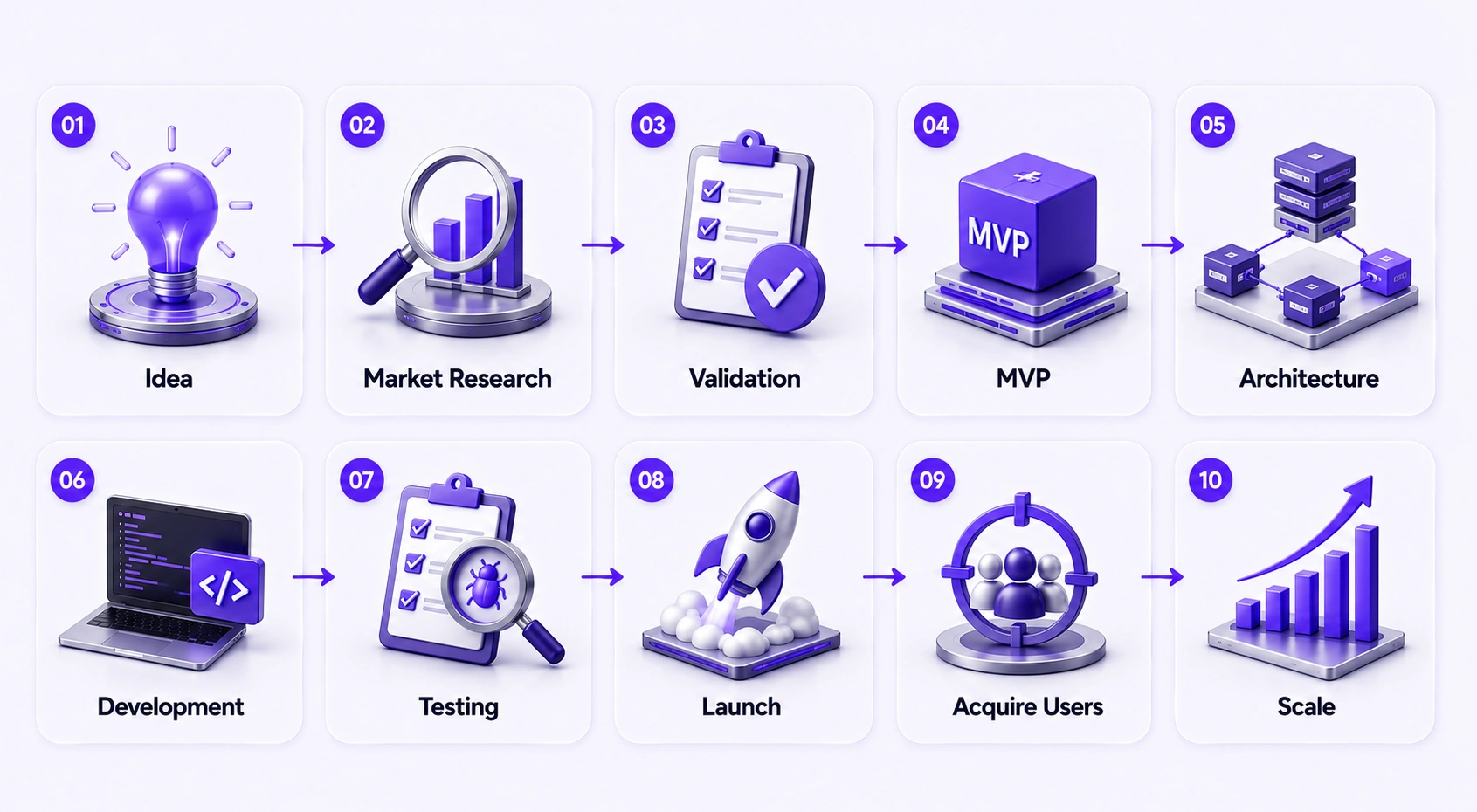
The typical SaaS development lifecycle includes the following stages:
| Stage | Objective |
| Product Discovery | Validate the business problem and market opportunity |
| Planning | Define requirements, roadmap, and architecture |
| UI/UX Design | Design intuitive user experiences and workflows |
| Development | Build frontend, backend, APIs, and cloud infrastructure |
| Testing | Ensure quality, security, and performance |
| Deployment | Release the product using CI/CD pipelines |
| Monitoring | Track performance, security, and customer behavior |
| Continuous Improvement | Release new features and optimize the platform |
Rather than viewing these stages as isolated activities, successful SaaS companies treat them as an iterative cycle.Working with an experienced full stack development company can further streamline this lifecycle by combining frontend, backend, cloud infrastructure, and quality assurance expertise under a unified development process. Customer feedback gathered after launch informs future development priorities, creating a continuous improvement loop.
A well-defined SaaS development roadmap also helps startups allocate resources more effectively. It aligns engineering investments with business objectives, ensuring that each development phase contributes directly to customer value and sustainable growth.
How Has RipenApps Helped Businesses Build Successful SaaS Products?
Building a successful SaaS product requires more than technical expertise. It demands a clear product strategy, scalable architecture, and continuous innovation. At RipenApps, every SaaS development project begins with understanding business goals, validating user needs, and building cloud-native solutions designed for long-term growth.
Auricle: A Scalable Medical Learning SaaS Platform
Auricle is a cloud-based EdTech platform developed by RipenApps to deliver a seamless digital learning experience for medical aspirants. The subscription-based platform offers live classes, recorded lectures, test series, study materials, and progress tracking through a centralized application.
To support a growing user base, RipenApps built a scalable SaaS platform with secure user authentication, subscription management, cloud-based content delivery, learner analytics, and role-based access. The architecture enables continuous content updates, efficient platform management, and a consistent learning experience without compromising performance.
Auricle reflects many of the best practices discussed throughout this SaaS development guide, starting with a focused product vision, building on scalable cloud infrastructure, and evolving the platform through continuous improvements. It demonstrates that successful SaaS platform development is not about launching with every possible feature, but about solving a real customer problem, delivering value consistently, and scaling the product as business needs grow.
Whether you’re building an EdTech platform, enterprise solution, or industry-specific software, a well-planned SaaS application development strategy can accelerate time to market while creating a strong foundation for sustainable growth.
How Do You Launch a SaaS Product and Acquire Your First Customers?
Launching a SaaS product is not the finish line,it is the beginning of the learning process. A successful launch validates assumptions, generates customer feedback, and establishes the foundation for recurring revenue. Instead of waiting until every feature is complete, startups should focus on releasing a reliable MVP to a targeted audience and improving it through continuous iteration.
Many founders spend months perfecting features while delaying customer conversations. This approach increases development costs and postpones valuable market insights. In contrast, successful SaaS companies launch early, measure customer behavior, and refine the product based on real usage rather than assumptions.
Build in Short Iterative Sprints
Breaking development into short, goal-oriented sprints helps teams deliver working software consistently while adapting to changing requirements.
Each sprint should have measurable business objectives rather than simply completing technical tasks. For example, one sprint may focus on user onboarding, while another improves subscription management or customer analytics.
Agile development also reduces project risk by allowing stakeholders to review progress frequently and prioritize improvements based on customer feedback. However, startups should avoid changing priorities every sprint. Excessive changes create uncertainty, delay releases, and reduce engineering productivity.
Prepare Your Go-to-Market Strategy Before Launch
Many SaaS products fail to gain traction because marketing begins only after development is complete. Customer acquisition should start well before the product is publicly available.
Successful startups often build anticipation through educational content, industry communities, webinars, waitlists, newsletters, and early-access programs. These activities generate awareness while creating a pool of potential customers who are already familiar with the product before launch.
The launch strategy should also define:
- Target customer segment
- Primary acquisition channels
- Product messaging
- Pricing and promotional offers
- Customer onboarding process
- Success metrics for the first 90 days
Preparing these elements in advance enables startups to collect meaningful market feedback immediately after release.
Focus on Your First Paying Customers
For an early-stage SaaS company, acquiring ten paying customers is often more valuable than attracting thousands of free users.
Paying customers validate the business model while providing actionable insights into onboarding, usability, pricing, and feature priorities. They also establish recurring revenue that supports future product development.
Rather than chasing rapid growth immediately, founders should focus on building strong relationships with early adopters. Their feedback frequently shapes the roadmap, improves customer retention, and creates valuable testimonials that support future marketing efforts.
How Do You Scale a SaaS Product After Product-Market Fit?
Achieving product-market fit marks the beginning of a new phase rather than the end of product development. As customer adoption increases, priorities shift from validating demand to improving scalability, operational efficiency, customer retention, and sustainable growth.
Scaling too early, however, can create unnecessary complexity. Hiring large engineering teams or investing heavily in infrastructure before consistent revenue growth often increases operational costs without improving business outcomes.
Measure the Metrics That Drive Sustainable Growth
As SaaS businesses mature, decisions should increasingly rely on customer and product data rather than intuition.
Some of the most important performance indicators include Monthly Recurring Revenue (MRR), Customer Acquisition Cost (CAC), Customer Lifetime Value (LTV), churn rate, activation rate, and Net Revenue Retention (NRR). Together, these metrics provide a comprehensive view of business health and long-term growth potential.
Rather than optimizing every metric simultaneously, founders should identify the bottlenecks limiting growth. For one startup, improving onboarding may significantly increase activation rates. For another, reducing churn may generate greater revenue than acquiring additional customers.
Continue Iterating Based on Customer Feedback
Product-market fit is not permanent. Customer expectations evolve, competitors introduce new capabilities, and emerging technologies reshape industries.
Continuous product discovery helps SaaS companies remain competitive by validating new features before committing substantial engineering resources. Product analytics, customer interviews, support requests, and user behavior all provide valuable insights for future development.
Artificial intelligence is increasingly influencing product roadmaps, but AI features should address genuine customer needs rather than follow industry trends. Automating repetitive tasks, improving search, or generating intelligent recommendations often delivers greater value than introducing AI for marketing purposes alone.
Scale Infrastructure Responsibly
As usage grows, infrastructure must scale without compromising reliability or profitability.
Cloud-native services, automated monitoring, database optimization, caching strategies, and load balancing all contribute to maintaining application performance during periods of rapid growth. As deployment environments become more complex, partnering with a reliable DevOps services company helps automate CI/CD pipelines, strengthen infrastructure monitoring, and improve release reliability while reducing operational overhead.
At the same time, infrastructure costs require ongoing attention. Overprovisioning servers, storing unnecessary data, or deploying underutilized services can significantly increase operating expenses. Regular infrastructure reviews help startups balance performance with cost efficiency.
How Much Does SaaS Development Cost?
The cost of SaaS development varies depending on product complexity, feature requirements, team structure, technology stack, compliance needs, and development location. While a lean MVP may require tens of thousands of dollars, enterprise-grade SaaS platforms with advanced AI, integrations, and compliance capabilities can require significantly larger investments.
Instead of asking, “What is the average cost?”, founders should ask which investment level aligns with their business objectives and growth stage.
Typical SaaS Development Cost by Product Complexity
| Product Complexity | Estimated Cost (USD) | Typical Timeline |
| Basic MVP | $30,000–$70,000 | 2–4 months |
| Mid-Level SaaS Platform | $70,000–$180,000 | 4–7 months |
| Enterprise SaaS Solution | $180,000–$500,000+ | 8–12+ months |
These estimates include product planning, UI/UX design, frontend and backend development, quality assurance, cloud deployment, and initial launch support. However, costs vary based on feature scope, compliance requirements, AI integration, and third-party services.
Factors That Influence SaaS Development Cost
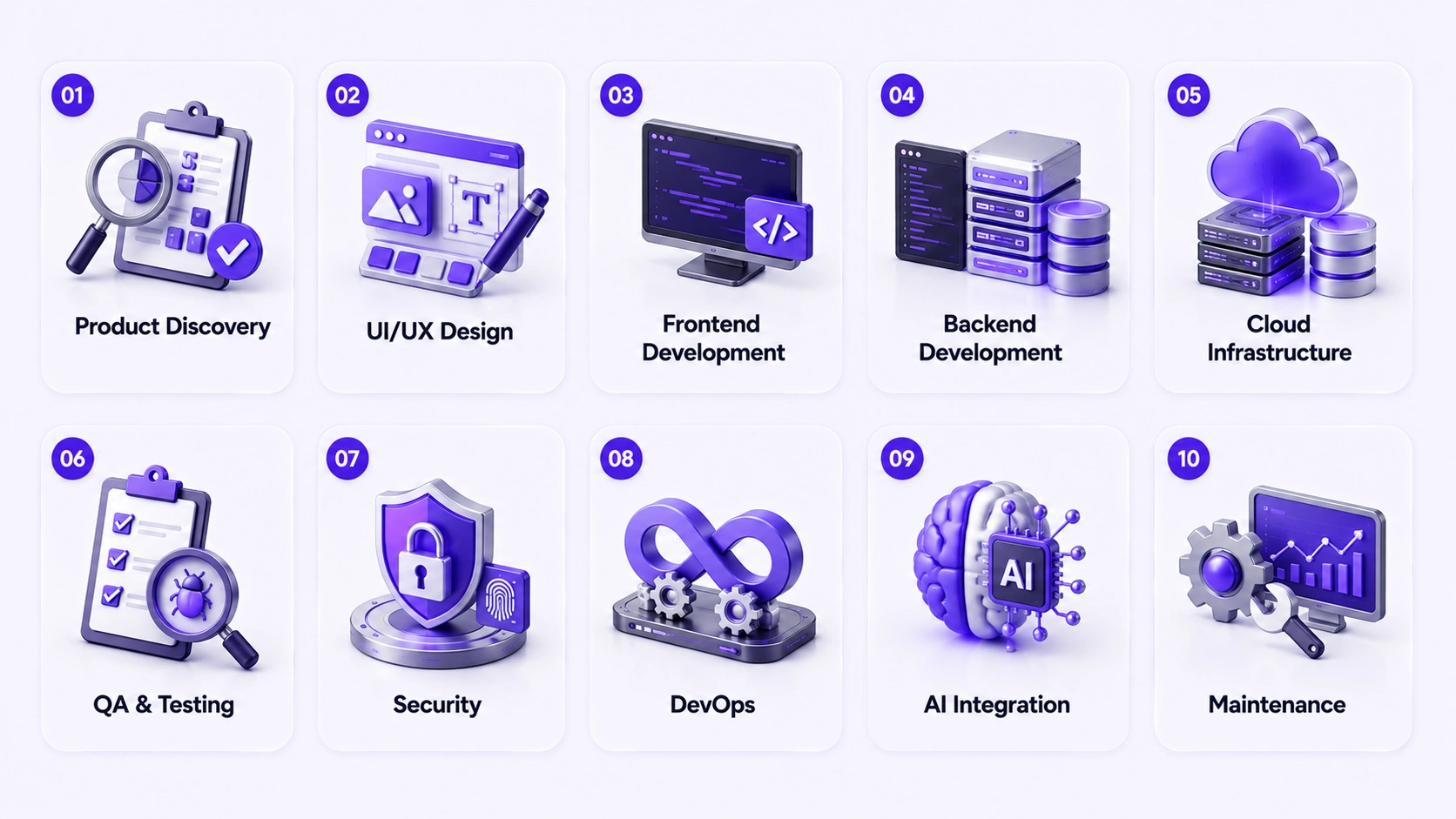
Several variables contribute to the total investment required for SaaS application development.
| Cost Driver | Business Impact |
| Product complexity | More features increase engineering effort. |
| UI/UX requirements | Advanced user experiences require additional design and testing. |
| AI integration | AI features increase infrastructure and development costs. |
| Third-party integrations | Payment gateways, CRMs, and APIs require implementation effort. |
| Security and compliance | HIPAA, SOC 2, or GDPR increase development and audit requirements. |
| Cloud infrastructure | Hosting, monitoring, storage, and networking create ongoing operational costs. |
If your product roadmap includes native or cross-platform mobile experiences alongside the web application, understanding React Native app development cost can help estimate the additional investment required for mobile development, testing, and long-term maintenance.
Where Startups Commonly Overspend
Many startups allocate a disproportionate share of their budget to advanced functionality before validating customer demand.
Common examples include building native mobile applications alongside the web platform, implementing complex AI features without clear use cases, creating highly customized dashboards for a small user base, or investing heavily in infrastructure that remains underutilized.
A phased investment strategy helps control costs by aligning development priorities with measurable business milestones.
How Long Does It Take to Build a SaaS Product?
Most SaaS MVPs can be developed within three to six months, while more sophisticated SaaS platforms generally require six to twelve months or longer. The exact timeline depends on product complexity, team size, compliance requirements, integration needs, and decision-making efficiency.
A typical SaaS development roadmap follows these phases:
| Development Phase | Estimated Duration |
| Discovery and Planning | 2–4 weeks |
| UI/UX Design | 3–5 weeks |
| MVP Development | 8–16 weeks |
| Testing and Quality Assurance | 2–4 weeks |
| Deployment and Launch | 1–2 weeks |
These phases often overlap in Agile environments, enabling teams to deliver incremental functionality more quickly.
Delays usually result from changing requirements, unclear product vision, prolonged stakeholder approvals, or expanding the feature scope after development has begun. Establishing clear priorities before engineering starts remains one of the most effective ways to reduce development timelines.
Should You Build or Buy a SaaS Solution?
The build vs buy SaaS decision depends on how closely existing software aligns with your business requirements. Before making this decision, it’s also important to understand custom web app vs SaaS, as organizations building software for internal operations often require a different development strategy than businesses creating subscription-based products for external customers.
Purchasing an off-the-shelf platform offers faster implementation and lower upfront investment. However, businesses may encounter limitations in customization, integrations, scalability, and competitive differentiation.
Building a custom SaaS product requires greater initial investment but provides complete control over product strategy, user experience, intellectual property, and future innovation.
| Build Custom SaaS | Buy Existing SaaS |
| Complete ownership | Faster implementation |
| Unlimited customization | Lower initial investment |
| Competitive differentiation | Proven functionality |
| Higher upfront investment | Limited flexibility |
| Long-term scalability | Vendor dependency |
Organizations seeking operational efficiency often benefit from purchasing existing software, while businesses developing proprietary digital products or unique customer experiences typically achieve greater long-term value through custom development.
How Does Custom SaaS Compare With Off-the-Shelf Software?
The custom SaaS vs off-the-shelf comparison extends beyond development costs. It affects innovation, scalability, customer experience, and long-term competitive positioning.
Off-the-shelf software works well for standardized business functions such as accounting, collaboration, or customer support. These products are mature, regularly updated, and supported by established vendors.
Custom SaaS platforms become advantageous when organizations require specialized workflows, proprietary automation, industry-specific compliance, or unique customer experiences that commercial software cannot provide.
While custom development involves greater investment and longer implementation timelines, it allows businesses to evolve their products according to changing customer needs rather than vendor roadmaps.
How Does SaaS Compare With PaaS and IaaS?
Cloud computing services are commonly categorized into three models: Software as a Service (SaaS), Platform as a Service (PaaS), and Infrastructure as a Service (IaaS).
| Model | Primary Purpose | Typical Users |
| SaaS | Ready-to-use software | End users and businesses |
| PaaS | Development platform | Developers |
| IaaS | Infrastructure resources | IT and DevOps teams |
Understanding SaaS vs PaaS vs IaaS helps founders make informed cloud strategy decisions.
SaaS delivers complete applications over the internet. PaaS provides managed development environments for building applications, while IaaS offers virtualized computing resources such as servers, networking, and storage.
These models often complement one another. A SaaS company may build its product using PaaS services while hosting infrastructure on an IaaS provider like AWS or Microsoft Azure.
What Common SaaS Development Mistakes Should Startups Avoid?
Building a SaaS product involves hundreds of product, technical, and business decisions. While every startup encounters challenges, certain mistakes repeatedly delay growth, increase costs, and reduce the likelihood of achieving product-market fit.
Recognizing these pitfalls early enables founders to make more informed decisions throughout the SaaS development lifecycle.
Building Too Many Features Too Early
One of the most common startup mistakes is assuming that more functionality automatically creates more customer value.
In reality, feature-heavy products often increase development costs while delaying customer validation. Every additional feature requires design, development, testing, documentation, maintenance, and ongoing support.
Instead of building everything on the roadmap, successful SaaS companies focus on solving one important customer problem exceptionally well before expanding the platform.
Ignoring Market Validation
Technology alone cannot create product-market fit.
Founders who begin development without validating customer demand frequently discover that their assumptions differ from real market needs. Conducting customer interviews, testing prototypes, and validating willingness to pay before development significantly reduces this risk.
Validation should also continue after launch. Customer behavior, product analytics, and user feedback provide ongoing insights that guide future product decisions.
Choosing Technology Based on Trends
New frameworks and programming languages emerge regularly, but adopting unfamiliar technologies simply because they are popular can introduce unnecessary complexity.
Technology decisions should prioritize business objectives, team expertise, hiring availability, and long-term maintainability. Mature frameworks with strong community support often provide greater business value than experimenting with emerging technologies during the early stages.
Delaying Security and Scalability Planning
Security and scalability should not be treated as post-launch activities.
Although startups should avoid overengineering, foundational practices such as secure authentication, encrypted data storage, role-based access control, automated backups, and monitoring should be incorporated from the beginning.
Similarly, planning for scalability does not require enterprise-grade infrastructure on day one. Instead, it involves making architectural decisions that allow the platform to evolve without requiring costly reengineering later.
Measuring the Wrong Success Metrics
Many startups celebrate downloads, website traffic, or social media engagement while overlooking business metrics that determine long-term sustainability.
Recurring revenue, customer retention, activation rates, churn, and customer lifetime value provide far better indicators of product health than vanity metrics. Monitoring these KPIs helps founders identify growth opportunities and operational challenges earlier.
Avoiding these common mistakes does not eliminate risk, but it significantly improves the likelihood of building a scalable and commercially successful SaaS business.
Final Thoughts
Building a successful SaaS product is about making disciplined business decisions as much as writing quality code. Whether you’re launching a cloud-native platform or expanding digital capabilities with an experienced website development company, success depends on validating customer demand, choosing scalable architecture, and continuously improving the product based on real user feedback. Rather than trying to build everything at once, successful startups focus on solving one meaningful problem, learning from customers quickly, and continuously improving the product as the business grows.
Whether you’re planning your first MVP or scaling an established software platform, partnering with an experienced SaaS application development company can help reduce technical risks, accelerate time to market, and build a product designed for long-term success. At RipenApps, we combine product strategy, SaaS web development, scalable cloud engineering, AI integration, and continuous product optimization to help startups and enterprises transform innovative ideas into high-performing SaaS businesses. If you’re ready to build a scalable SaaS platform, our experts are here to help you turn your vision into a market-ready product.
FAQs
1. What is SaaS development?
SaaS development is the process of designing, building, deploying, and maintaining cloud-based software applications that users access through the internet on a subscription basis. Unlike traditional software, SaaS products receive continuous updates, centralized maintenance, and scalable cloud infrastructure that supports multiple customers from a single platform.
2. How do you develop a SaaS product?
To develop a SaaS product, founders typically validate the business idea, define the target audience, prioritize MVP features, design the user experience, select the appropriate technology stack, build the application, test it thoroughly, deploy it on cloud infrastructure, and continuously improve it based on customer feedback and product analytics.
3. How do you create a SaaS platform from scratch?
To build SaaS from scratch, begin by validating market demand and identifying a clear customer problem. Next, create a product roadmap, develop a focused MVP, establish secure cloud infrastructure, implement subscription billing, launch to early adopters, and continuously refine the platform based on customer insights and business metrics.
4. What does a SaaS developer do?
A SaaS developer designs, builds, tests, deploys, and maintains cloud-based software applications. Their responsibilities include frontend and backend development, API integration, database management, cloud deployment, performance optimization, security implementation, and ongoing product improvements throughout the SaaS development lifecycle.
5. How long does it take to build a SaaS platform?
The answer depends on product complexity. Most MVPs require three to six months, while enterprise-grade SaaS platforms with advanced integrations, AI capabilities, and compliance requirements often require six to twelve months or more.
6. What is the best technology stack for SaaS development?
There is no universal best stack. Many startups choose technologies such as React or Next.js for the frontend, Node.js, NestJS, or Django for the backend, PostgreSQL for databases, and cloud platforms like AWS, Microsoft Azure, or Google Cloud. The right choice should align with business goals, engineering expertise, scalability requirements, and long-term maintenance considerations.
7. Is custom SaaS development better than off-the-shelf software?
It depends on business objectives. Off-the-shelf software offers faster deployment and lower upfront costs, making it suitable for standardized business processes. Custom SaaS development provides greater flexibility, competitive differentiation, and ownership, making it a stronger choice for businesses with unique workflows or proprietary digital products.
8. How much does SaaS development cost?
Development costs vary depending on product scope, integrations, security requirements, AI functionality, and engineering resources. A startup MVP typically ranges from $30,000 to $70,000, while enterprise SaaS platforms can exceed $500,000 depending on complexity and compliance requirements.
Discuss your project and request for proposal
SHARE
WRITTEN BY

Ishan Gupta
CEO & Founder
Ishan Gupta is a seasoned entrepreneur and CEO with extensive 10+ years of experience in business and mobile app development landscape. He believes that the right digital product allows companies to focus on what they do best, while technology handles the rest. With deep exposure to global markets, he understands what makes an app succeed. His approach translates business needs into clear product strategies, ensuring that every feature contributes to measurable ROI.
View All Articles