



Key Takeaway
- A structured mobile app development process minimizes risks, controls budgets, and significantly improves overall product quality and scalability.
- Proper planning before development helps businesses validate ideas, understand users, and avoid expensive redesigns during later project stages.
- Every development phase, from research to maintenance, contributes directly to application performance, security, and long-term business success.
- Selecting suitable technologies, development methodologies, and experienced professionals accelerates delivery while ensuring exceptional user experiences across platforms.
- Continuous testing, updates, and optimization keep mobile applications competitive, secure, and aligned with evolving customer expectations and business goals.
The mobile app industry continues to grow at an unprecedented pace, transforming how businesses connect with customers, deliver services, and generate revenue. From startups launching innovative digital products to enterprises digitizing operations, mobile applications have become an essential investment rather than an optional business tool. However, creating a successful application requires much more than a great idea. It demands careful planning, the right technology, a user-centric approach, and a structured development strategy to ensure the final product meets both business objectives and customer expectations.
Many businesses struggle because they begin coding without validating their idea, understanding their audience, or defining clear project requirements. These common mistakes often lead to higher development costs, delayed launches, poor user experiences, and costly revisions. Following a well-defined mobile app development process helps organizations minimize these risks while building scalable, secure, and high-performing applications.
Partnering with experts offering mobile application development services further strengthens this process by bringing strategic planning, technical expertise, and industry best practices into every development stage. Whether you want to build your first application or modernize an existing one, understanding the complete development lifecycle helps you make informed decisions and maximize your return on investment.
In this guide, you’ll learn every stage of the mobile app development process, discover industry best practices, understand the latest technologies, and explore how businesses successfully transform app ideas into market-ready digital products.
Table of Contents
What is the Mobile App Development Process?
The mobile app development process is a structured framework that transforms an idea into a successful mobile application through planning, design, development, testing, deployment, and maintenance. It ensures every phase aligns with business goals, reduces risks, and delivers a scalable, secure, and user-focused digital solution.
Whether you’re learning what is mobile app development or planning how to develop an app, following a systematic process is essential for long-term success. Many businesses streamline development by leveraging technical expertise to build high-performing applications that meet evolving customer expectations and business objectives.
Why Following a Structured Mobile App Development Process Matters
A successful mobile application is never the result of development alone. It is the outcome of careful planning, strategic execution, and continuous collaboration throughout the project lifecycle. Businesses that follow a structured mobile development process consistently deliver higher-quality applications while reducing development risks and controlling project costs.
As customer expectations continue to evolve, organizations must adapt to emerging mobile app development trends to remain competitive. A structured development process enables businesses to adopt new technologies, integrate advanced capabilities, and continuously enhance digital products without disrupting core functionality. This approach also helps improve scalability, performance, and long-term user satisfaction while supporting future innovation.
What Are the 7 Stages of Mobile App Development?
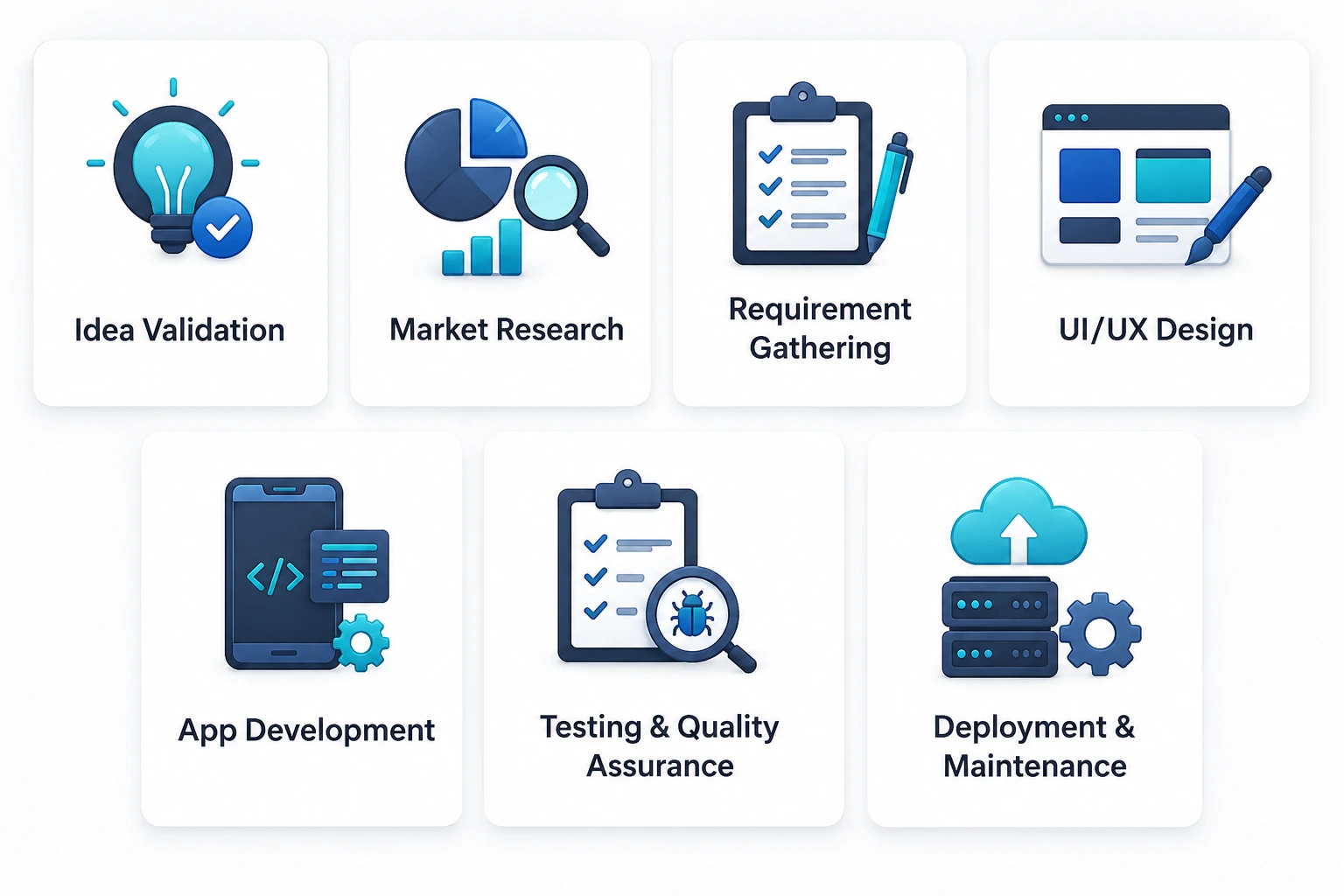
Every successful mobile application progresses through seven essential stages. Each phase builds upon the previous one, ensuring the final product aligns with business objectives, user expectations, and technical requirements.
1. Idea Validation
Every mobile application starts with an idea, but successful businesses validate that idea before investing in development. This stage focuses on identifying the real problem, understanding the target audience, evaluating market demand, and determining whether the proposed solution offers genuine value.
Validation also helps businesses answer important questions such as how do I create a mobile app that users actually need and whether the concept has sufficient commercial potential. By gathering customer feedback early, organizations reduce uncertainty and improve their chances of building a successful product.
2. Market Research
Once the concept is validated, businesses conduct comprehensive market research to understand customer expectations, industry trends, and competitive positioning. This stage examines competing applications, user reviews, pricing models, feature sets, and market gaps.
Competitor analysis enables organizations to differentiate their applications while avoiding common mistakes made by existing products. It also helps define a stronger value proposition before development begins.
3. Requirement Gathering
Requirement gathering converts business goals into technical specifications that guide the entire project. During this phase, stakeholders define functional requirements, user stories, workflows, security expectations, integrations, compliance standards, and project priorities.
Comprehensive documentation minimizes misunderstandings between business teams and developers while providing a clear roadmap for execution.
4. UI/UX Design
The design phase transforms business ideas into intuitive user experiences. Designers create wireframes, user flows, prototypes, and visual interfaces that demonstrate how users will interact with the application.
An effective design balances aesthetics with usability. Every screen, navigation element, and interaction should help users complete tasks quickly while maintaining consistency across the application.
5. App Development
Once the planning, research, and design phases are complete, the project moves into the actual development stage. This is where designers, developers, and engineers work together to transform approved wireframes and technical requirements into a fully functional mobile application. Since this phase consumes the largest share of the project timeline and budget, following a structured development workflow is essential for delivering a high-quality product.
Modern businesses looking to develop mobile applications generally divide this stage into frontend development, backend development, API integration, database management, and third-party service integration. Every component works together to ensure the application delivers excellent performance, scalability, and security.
Frontend Development
Frontend development focuses on everything users see and interact with inside the application. It includes user interfaces, animations, navigation, buttons, forms, and overall responsiveness across different screen sizes.
Developers use technologies such as Swift for iOS, Kotlin for Android, Flutter, or React Native depending on the chosen development approach. Every screen must be optimized for speed, accessibility, and usability while maintaining consistency with the approved UI/UX design.
An intuitive frontend significantly improves user satisfaction because even powerful features lose their value if users struggle to navigate the application.
Backend Development
The backend serves as the foundation of the application by managing business logic, authentication, databases, notifications, cloud storage, and server communication.
Developers build secure APIs and scalable infrastructures capable of handling increasing user traffic without affecting performance. Businesses planning enterprise-grade applications often prioritize cloud-native architectures that support rapid scaling and simplified maintenance.
A well-designed backend also ensures seamless synchronization between mobile devices and cloud servers, allowing users to access updated information in real time.
API Integration
Modern applications rarely operate independently. Instead, they connect with multiple external services through Application Programming Interfaces (APIs).
These integrations may include payment gateways, location services, social media authentication, SMS gateways, cloud storage, artificial intelligence tools, customer relationship management systems, analytics platforms, and communication services.
Selecting reliable APIs improves functionality while reducing development time because businesses do not need to build every feature from scratch.
Database Development
Every mobile application stores and retrieves data. Depending on business requirements, developers choose relational or NoSQL databases that balance performance, scalability, and security.
The database architecture must support user authentication, transaction records, media storage, search history, notifications, and analytics while maintaining fast response times.
Efficient database optimization also minimizes loading delays and enhances overall application performance.
Third-Party Integrations
Most successful applications integrate external services to improve functionality and accelerate development.
Examples include payment processors, cloud messaging platforms, mapping services, video conferencing APIs, customer support tools, analytics dashboards, and marketing automation platforms.
Although third-party integrations provide significant advantages, developers carefully evaluate compatibility, security, documentation quality, and long-term support before implementation.
6. Testing & Quality Assurance
Developing an application is only one part of the journey. Before launch, businesses need to ensure every feature performs reliably in real-world conditions. Thorough testing helps identify issues early, improve application stability, and deliver a seamless user experience.
Rather than treating quality assurance as the final stage, modern development teams integrate testing throughout the entire development lifecycle. Understanding the role of mobile app quality assurance helps businesses see how continuous testing improves product reliability, reduces defects, and ensures a consistent user experience across devices and platforms.
Functional Testing
Functional testing verifies that every feature performs according to the documented business requirements.
Testers validate user registration, authentication, payments, notifications, search functionality, navigation, and every user interaction to ensure the application behaves as expected.
Performance Testing
Application performance directly impacts user retention.
Performance testing evaluates loading speed, response time, memory consumption, battery usage, and system stability under varying traffic conditions.
Applications capable of maintaining consistent performance during peak usage generally receive higher user ratings and experience lower uninstall rates.
Security Testing
Security has become one of the most critical aspects of modern mobile application development.
Testing focuses on protecting sensitive user information, preventing unauthorized access, identifying vulnerabilities, securing APIs, and validating encryption mechanisms.
Businesses operating in industries such as healthcare, fintech, and eCommerce often perform additional compliance testing to satisfy regulatory requirements.
Usability Testing
Even technically flawless applications can fail if users find them confusing.
Usability testing evaluates navigation, accessibility, readability, visual consistency, and task completion efficiency by observing how real users interact with the application.
The feedback collected during this stage helps designers refine the overall user experience before launch.
7. Deployment, Launch & Maintenance
Once testing confirms that the application meets quality standards, it is prepared for public release. Deployment involves much more than publishing an application on an app store. It requires careful planning, compliance verification, performance monitoring, and long-term support.
Before launch, developers optimize application performance, prepare store assets, generate release builds, configure analytics tools, and complete platform-specific submission requirements.
For Android applications, the release process involves publishing through Google Play, while iOS applications undergo Apple’s App Store review process before becoming available to users.
After approval, businesses closely monitor user feedback, crash reports, downloads, retention rates, and performance metrics to identify opportunities for improvement.
Application maintenance continues long after launch because operating systems, devices, security standards, and user expectations constantly evolve. Regular updates ensure compatibility with new devices, resolve reported issues, introduce new features, and improve overall performance.
Successful organizations view deployment as the beginning of continuous product improvement rather than the end of development.
Complete Mobile App Development Lifecycle
The mobile application development lifecycle provides a structured roadmap that guides businesses from concept to continuous optimization. Every phase contributes to delivering a scalable, secure, and user-focused application capable of supporting long-term business growth.
| Stage | Primary Deliverables | Estimated Timeline |
| Idea Validation | Business goals, market validation, feasibility analysis | 1–2 Weeks |
| Market Research | Competitor analysis, user personas, feature roadmap | 1–3 Weeks |
| Requirement Gathering | Functional specifications, user stories, project scope | 1–2 Weeks |
| UI/UX Design | Wireframes, prototypes, visual designs | 2–4 Weeks |
| Development | Frontend, backend, APIs, database, integrations | 8–20+ Weeks |
| Testing & QA | Functional, performance, security, usability testing | 2–4 Weeks |
| Deployment & Maintenance | App launch, monitoring, updates, enhancements | Ongoing |
Although timelines vary depending on project complexity, businesses that complete each phase thoroughly experience fewer delays during later stages. Skipping research or reducing testing efforts may appear to save time initially, but these shortcuts often lead to expensive corrections after launch.
Another important aspect of the lifecycle is continuous collaboration. Product managers, designers, developers, testers, and stakeholders should communicate regularly to ensure the project remains aligned with business objectives. Many organizations adopt agile workflows because they encourage iterative development, faster feedback, and continuous improvement throughout the entire app development process.
Choosing the Right Technology Stack
Selecting the right technology stack is one of the most important decisions in the mobile app development process. The technologies chosen during the planning phase influence development speed, scalability, maintenance costs, security, and future upgrades.
A technology stack generally consists of frontend frameworks, backend technologies, databases, cloud infrastructure, APIs, and development tools. The right combination depends on business objectives, target users, expected traffic, budget, and long-term growth plans.
Businesses planning native applications often choose Swift for iOS and Kotlin for Android because these technologies deliver exceptional performance and seamless integration with platform-specific features. Partnering with an experienced iOS app development company can further help organizations build secure, high-performing applications that fully leverage Apple’s ecosystem while delivering a seamless user experience.
Cross-platform frameworks such as Flutter and React Native allow developers to build applications for multiple platforms using a shared codebase. This approach reduces development time while maintaining near-native performance for many business applications.
Backend development commonly relies on technologies such as Node.js, Python, Java, or .NET, supported by cloud platforms that provide scalability, reliability, and security.
Database selection depends on application requirements. Relational databases are suitable for structured business data, while NoSQL databases support applications requiring flexible data models and high scalability.
Businesses should also pay close attention to application architecture because it determines how efficiently the application handles future growth, integrations, and maintenance. Understanding mobile app architecture helps organizations choose scalable design patterns that support long-term product evolution while minimizing technical debt.
Selecting technologies based solely on current trends is rarely the best strategy. Instead, businesses should prioritize technologies that align with their product vision, technical expertise, scalability requirements, and long-term maintenance goals.
Read Also: React Native VS Flutter: Which is Better For Your Business?
Key Features Every Successful Mobile App Should Have
Regardless of industry or business model, every successful mobile application shares a common set of features that improve usability, engagement, security, and long-term customer retention. While feature selection depends on the application’s objectives, certain functionalities have become standard expectations among users.
Businesses planning to develop mobile apps should prioritize features that solve real user problems instead of adding unnecessary complexity. A feature-rich application is valuable only when those features improve the overall user experience and support business goals. If you’re planning your product roadmap, exploring essential mobile app features can help identify the functionalities that deliver the highest business value.
1. User Authentication
Secure user authentication forms the foundation of every modern application. Whether users sign in through email, mobile numbers, social accounts, or biometric authentication, the login experience should be fast, secure, and intuitive.
Modern authentication methods such as Face ID, fingerprint recognition, and multi-factor authentication improve both convenience and security while protecting sensitive user information.
2. Push Notifications
Push notifications help businesses maintain meaningful communication with users after installation. Personalized notifications encourage user engagement, promote new features, remind customers about pending actions, and improve retention rates.
However, excessive notifications often lead users to disable alerts or uninstall applications. Businesses should therefore focus on delivering timely and relevant messages that provide genuine value.
3. Secure Payment Integration
Applications involving subscriptions, eCommerce, food delivery, travel bookings, or digital services require secure payment gateways.
Supporting multiple payment methods, including digital wallets, credit cards, net banking, and regional payment solutions, creates a seamless checkout experience while increasing customer trust.
4. Analytics and User Insights
Understanding user behavior is essential for continuous improvement.
Analytics tools provide valuable insights into user engagement, session duration, feature adoption, conversion rates, retention, and drop-off points. These insights enable businesses to make data-driven decisions when planning future updates.
5. Offline Functionality
Reliable internet connectivity cannot always be guaranteed.
Applications that offer offline access to critical features provide a significantly better user experience. Data synchronization can occur automatically once connectivity is restored, allowing users to continue their tasks without interruption.
6. Robust Security
Security should never be treated as an optional feature.
Applications should implement encryption, secure APIs, protected databases, authentication protocols, role-based access controls, and regular security updates to safeguard user information against evolving cyber threats.
7. AI-Powered Personalization
AI in mobile app development enables applications to deliver highly personalized experiences by analyzing user preferences, browsing history, purchasing behavior, and interaction patterns.
Personalized recommendations, intelligent search results, adaptive interfaces, and predictive suggestions improve customer satisfaction while increasing user engagement.
8. Advanced Search
As applications grow, efficient search functionality becomes increasingly important.
Smart search capabilities supported by filters, predictive suggestions, voice search, and natural language processing help users quickly locate relevant information without unnecessary navigation.
9. Real-Time Chat and Communication
Many businesses now integrate chat functionality directly into their applications to improve customer support and user engagement.
Real-time messaging enables users to communicate with customer service representatives, vendors, healthcare professionals, educators, or other users without leaving the application.
10. Administrative Dashboard
An effective administrative dashboard simplifies application management by allowing businesses to monitor users, content, transactions, analytics, support requests, and overall platform performance from a centralized interface.
Administrative controls improve operational efficiency while reducing manual management efforts.
Agile vs Traditional Mobile App Development Process
Selecting the right development methodology significantly influences project success. Two of the most widely adopted approaches are the traditional Waterfall model and Agile development methodology.
While both methodologies aim to deliver successful applications, they differ considerably in planning, execution, collaboration, and flexibility.
| Feature | Agile Development | Traditional (Waterfall) Development |
| Planning | Iterative planning throughout project | Complete planning before development |
| Flexibility | High adaptability to changes | Limited flexibility after planning |
| Customer Feedback | Continuous throughout development | Usually collected after completion |
| Delivery | Incremental releases | Single final release |
| Risk Management | Early issue identification | Risks often discovered later |
| Testing | Continuous testing | Testing after development |
| Best For | Startups, evolving products, MVPs | Fixed-scope enterprise projects |
Traditional development follows a sequential workflow where each phase begins only after the previous stage has been completed. While this methodology works well for projects with clearly defined requirements, it offers limited flexibility when business priorities change during development.
Agile development, on the other hand, divides projects into smaller iterations known as sprints. Each sprint delivers working functionality that stakeholders can review, test, and improve before moving to the next phase.
This continuous feedback loop reduces development risks while enabling businesses to respond quickly to changing market conditions.
Why Agile Has Become the Preferred Choice
Modern businesses operate in rapidly changing digital environments where customer expectations evolve continuously. Agile methodologies allow organizations to release features faster, gather real-world feedback, and improve products through continuous iterations.
Sprint planning, daily collaboration, regular demonstrations, and retrospective meetings ensure every team member remains aligned with project goals throughout development.
Organizations interested in accelerating delivery while maintaining quality often adopt agile methodology for mobile app development because it encourages collaboration, transparency, and continuous improvement across every development phase.
How Much Does Mobile App Development Cost?
One of the most common questions businesses ask before starting a project is how much it costs to develop an application. The answer depends on several technical and business factors rather than a fixed price.
The overall investment varies according to application complexity, supported platforms, design requirements, technology stack, third-party integrations, security standards, development location, and long-term maintenance requirements.
Simple applications generally require fewer development hours because they include basic functionality and limited integrations. Medium-complexity applications involve user accounts, payment gateways, APIs, cloud infrastructure, and advanced business logic. Enterprise applications require highly scalable architectures, robust security, extensive integrations, and continuous maintenance, making them significantly more expensive.
The expertise of the development team also influences pricing. Hiring experienced architects, designers, developers, and quality assurance specialists may require a higher initial investment, but it often reduces long-term maintenance costs by producing better-quality software.
The chosen development approach also affects overall expenses. Native development usually requires separate codebases for Android and iOS, while cross-platform frameworks can reduce development time by sharing a significant portion of the code.
The inclusion of emerging technologies such as artificial intelligence, machine learning, augmented reality, blockchain, or IoT integrations further impacts development costs because these capabilities require specialized expertise.
The following table provides a general estimate of development costs based on project complexity.
| Application Complexity | Estimated Development Time | Estimated Cost Range |
| Basic Application | 2–4 Months | $15,000–$35,000 |
| Medium Complexity Application | 4–7 Months | $35,000–$80,000 |
| Complex Business Application | 7–12 Months | $80,000–$200,000+ |
| Enterprise-Grade Application | 12+ Months | $200,000+ |
Beyond initial development, businesses should also allocate budgets for application maintenance, cloud infrastructure, security updates, operating system compatibility, feature enhancements, analytics, and customer support.
Project costs vary depending on factors such as app complexity, platform selection, features, design requirements, technology stack, and third-party integrations. Understanding app development cost helps organizations estimate their investment more accurately and make informed decisions when planning budgets, prioritizing features, and defining project scope.
A successful mobile application should never be evaluated solely by its development cost. Instead, businesses should consider the long-term value it delivers through improved customer engagement, operational efficiency, increased revenue, and sustainable business growth.
Should You Build In-House or Outsource?
One of the most important decisions during the mobile app development process is determining whether to build an internal development team or outsource the project to a specialized technology partner. Both approaches offer unique advantages, and the right choice depends on your budget, business objectives, technical expertise, project complexity, and long-term product strategy.
The following comparison highlights the differences between both approaches.
| Criteria | In-House Development | Outsourced Development |
| Initial Investment | High | Moderate |
| Hiring Time | Long | Minimal |
| Development Speed | Moderate | Faster |
| Specialized Expertise | Limited to internal team | Access to experienced specialists |
| Scalability | Slower | Highly flexible |
| Long-Term Maintenance | Managed internally | Can be included in engagement |
| Best For | Long-term internal digital products | Startups, SMEs, enterprises, MVPs |
For startups and growing businesses, outsourcing often provides greater flexibility because experienced teams already have established development processes, quality standards, and technical expertise. Enterprises with ongoing digital initiatives may adopt a hybrid approach by combining internal product ownership with external development specialists.
When comparing these approaches, understanding the differences between in-house vs outsourcing app development can help businesses evaluate the trade-offs in cost, scalability, resource availability, and long-term project management before choosing the most suitable engagement model.

Common Challenges During Mobile App Development
Although modern technologies have simplified application development, building a successful mobile product still presents several technical and business challenges. Identifying these obstacles early allows organizations to prepare effective strategies before they impact timelines, budgets, or product quality.
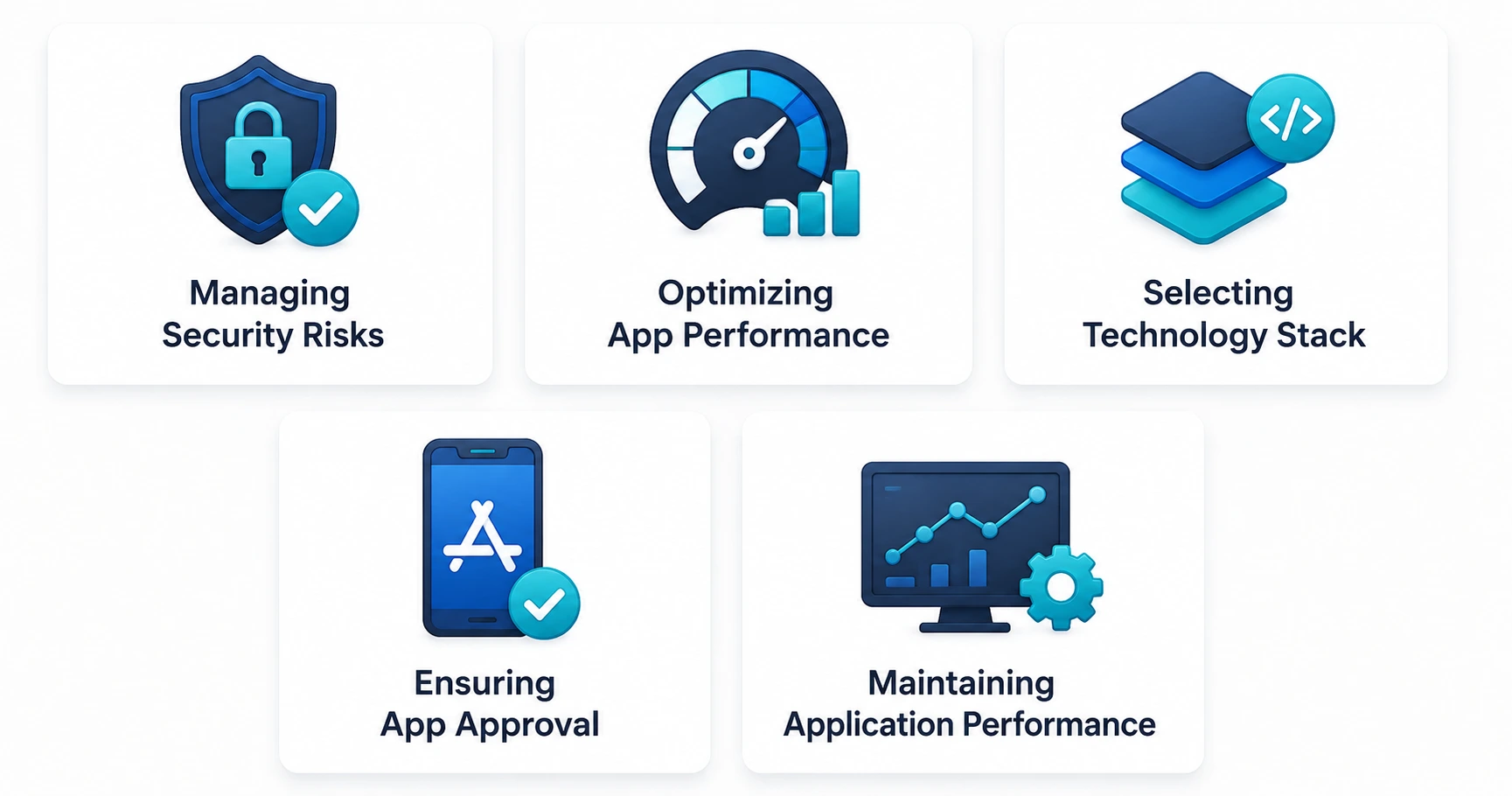
1. Security Risks
Cybersecurity threats continue evolving, making application security a critical business priority. Applications should implement secure authentication, encrypted communication, protected APIs, regular security testing, and compliance with industry regulations to safeguard user information.
2. Performance Issues
Users expect applications to load quickly and respond instantly. Poor optimization, inefficient database queries, memory leaks, and excessive background processes negatively affect performance and increase uninstall rates. Continuous performance monitoring and optimization should remain part of every development cycle.
3. Choosing the Wrong Technology Stack
Choosing the wrong technology stack can limit an application’s scalability, increase maintenance costs, and create challenges as business requirements evolve. Organizations developing complex digital solutions often benefit from enterprise application development services, ensuring the selected technologies align with long-term business goals, future growth, and seamless integration requirements.
4. App Store Approval Challenges
Publishing applications involves complying with platform-specific guidelines. Failure to satisfy security, privacy, accessibility, or content requirements may delay approval or result in application rejection. Preparing thoroughly before submission minimizes these risks.
5. Ongoing Maintenance
Launching an application does not conclude the development journey. Businesses must continuously update applications to maintain compatibility with operating system updates, improve performance, introduce new features, and address user feedback.
As technology evolves, many organizations invest in application modernization services to upgrade legacy applications, strengthen security, improve scalability, and extend the lifespan of their digital products without rebuilding them from scratch. Businesses that treat maintenance as an ongoing investment consistently achieve better customer retention and higher application ratings.
Conclusion
A well-defined mobile app development process serves as the foundation for building secure, scalable, and user-centric mobile applications. From validating an idea and conducting market research to designing intuitive interfaces, developing robust functionality, performing comprehensive testing, and maintaining the application after launch, every stage contributes to the product’s long-term success.
Businesses that invest in careful planning consistently reduce development risks, control project costs, improve software quality, and accelerate time-to-market. Equally important is selecting the right technology stack, adopting modern development methodologies, and partnering with experienced professionals who understand both technical execution and business strategy.
As mobile technologies continue evolving through artificial intelligence, cloud computing, 5G, IoT, and immersive digital experiences, organizations that follow structured development practices will be better positioned to adapt, innovate, and grow.
Whether you’re planning your first mobile application or scaling an enterprise digital ecosystem, partnering with an experienced custom app development company can significantly improve your project’s success. RipenApps helps businesses transform innovative ideas into powerful mobile applications that drive engagement, improve operational efficiency, and create lasting business value.

FAQs
Q1. What is the Mobile App Development Process?
The mobile app development process is a structured approach that includes idea validation, market research, planning, UI/UX design, development, testing, deployment, and ongoing maintenance to build high-quality, scalable mobile applications.
Q2. What are the seven stages of app development?
The seven stages include idea validation, market research, requirement gathering, UI/UX design, development, testing, and deployment, followed by ongoing maintenance and performance optimization after launch.
Q3. How long does it take to develop a mobile app?
Development timelines vary depending on project complexity. A simple app typically takes 3–4 months, a medium-complexity application requires 4–7 months, and an enterprise-grade app with advanced features may take 9–12 months or longer.
Q4. How much does app development cost?
App development costs depend on factors such as application complexity, supported platforms, features, integrations, UI/UX requirements, and the development team’s location. On average:
- Simple app: $20,000–$50,000
- Medium-complexity app: $50,000–$120,000
- Complex or enterprise app: $120,000–$300,000+
A detailed project discovery phase provides the most accurate cost estimate.
Q5. Which technology is best for mobile app development?
There is no one-size-fits-all solution. Swift and Kotlin are ideal for high-performance native iOS and Android applications, while Flutter and React Native are excellent choices for cross-platform development that reduces time-to-market and development costs. The right technology depends on your business goals, budget, performance requirements, and scalability needs.
Q6. Should I choose native or cross-platform development?
Native development offers superior performance, deeper platform integration, and the best user experience. Cross-platform development reduces development time and costs by using a shared codebase across multiple platforms. The right choice depends on your business objectives, target audience, budget, and long-term product strategy.
Q7. How do I choose the right mobile app development company?
Evaluate a company’s technical expertise, portfolio, communication approach, industry experience, and post-launch support before making your decision. To better understand what to look for, explore our guide on tips for choosing the right app development partner, which outlines the key factors that can help you select the best fit for your project.
Q8. Why is app testing so important?
Testing ensures your application functions reliably across different devices, operating systems, and network conditions. It helps identify bugs early, improves security, enhances performance, reduces post-launch issues, and delivers a consistent user experience.
Q9. Can I modernize my existing application instead of rebuilding it?
Yes. In many cases, our application modernization services offer a more cost-effective solution than rebuilding an application from scratch. They can improve performance, security, scalability, compatibility with modern platforms, and user experience while preserving valuable business logic. The best approach depends on your application’s architecture, technical debt, and long-term business goals.
Q10. What are the latest trends shaping mobile app development?
Some of the biggest trends include Artificial Intelligence (AI), Generative AI, on-device AI, 5G connectivity, the Internet of Things (IoT), edge computing, cloud-native architectures, low-code/no-code development, super apps, wearable integrations, and hyper-personalized user experiences. Businesses adopting these technologies can improve operational efficiency, user engagement, and long-term competitiveness.
Discuss your project and request for proposal
SHARE
WRITTEN BY

Ishan Gupta
CEO & Founder
Ishan Gupta is a seasoned entrepreneur and CEO with extensive 10+ years of experience in business and mobile app development landscape. He believes that the right digital product allows companies to focus on what they do best, while technology handles the rest. With deep exposure to global markets, he understands what makes an app succeed. His approach translates business needs into clear product strategies, ensuring that every feature contributes to measurable ROI.
View All Articles