



Your competitors are shipping AI features. Most of them will regret it. Open any product changelog from the last 18 months, and you’ll see a surge of AI releases. But here’s the real question: how many of those features actually get used beyond the first week? This is where an effective AI strategy for digital products becomes the difference between adoption and abandonment.
Data consistently shows a clear pattern across AI product deployments: many AI features struggle to maintain engagement after initial adoption. In most cases, this happens not because the models are weak, but because teams define what to build before clearly understanding why users need it and how the feature fits into real workflows. These early decisions often determine whether an AI feature becomes part of long-term usage or fades after initial curiosity.
Market pressure is pushing companies to ship AI quickly, but AI only works when it solves a real user problem in a way that feels intuitive. That makes AI a strategy problem before an engineering one.
At RipenApps, we’ve built AI-powered digital products across HealthTech, FinTech, EdTech, Logistics, and Enterprise SaaS. And the dividing line between AI that drives retention and AI that gets quietly abandoned is almost never the model itself.
It’s the thinking that happened before the model was chosen. If you’re looking for a team that starts with that thinking, our AI feature integration services are built exactly around it.
This guide breaks down what AI strategy actually means in 2026, how to evaluate your integration options without getting lost in hype, and how to build AI experiences users consistently engage with, not just features your marketing team can announce.
Key Takeaways
- AI features built without validated user needs create costly technical debt, impacting engineering effort, user trust, and market positioning.
- The right AI integration approach depends on product stage, data readiness, and user expectations, not short-term model trends.
- Most AI failures stem from poor user experience design, where implementation and interaction matter as much as model performance.
- Rebuilding AI features after launch can cost five to ten times more than validating the right approach beforehand.
- Industry-specific domain experience remains one of the most underestimated yet critical factors when selecting the right AI development partner.
Table of Contents
What AI Strategy Actually Means for a Digital Product in 2026
The Real Problem Isn’t Access to AI. It’s Knowing What to Do With It. Three years ago, the conversation around AI in digital products was dominated by access, who could afford foundation model APIs, who had ML engineers, and who could run inference at scale. That conversation is over.
In 2026, any product team with a development budget can integrate GPT-4, Claude, or Gemini within weeks, while open-source models like LLaMA 3 and Mistral and no-code tools have made AI more accessible than ever.
The real barrier now is clarity. Which AI use cases actually matter to your users? Which creates real value instead of impressive demos? Which can your data infrastructure support without creating compliance risks, and which will still be relevant 18 months from now?
These are not technical decisions but strategic ones, requiring a deep understanding of user needs to distinguish meaningful AI from unnecessary complexity. Generative AI development services are typically used when teams need help turning an AI strategy into production-ready systems.
This is what an AI product strategy really means: a validated, user-grounded framework that defines which AI capabilities to build, where they fit in the product, how they will be delivered, and what success looks like before a single engineering hour is committed.
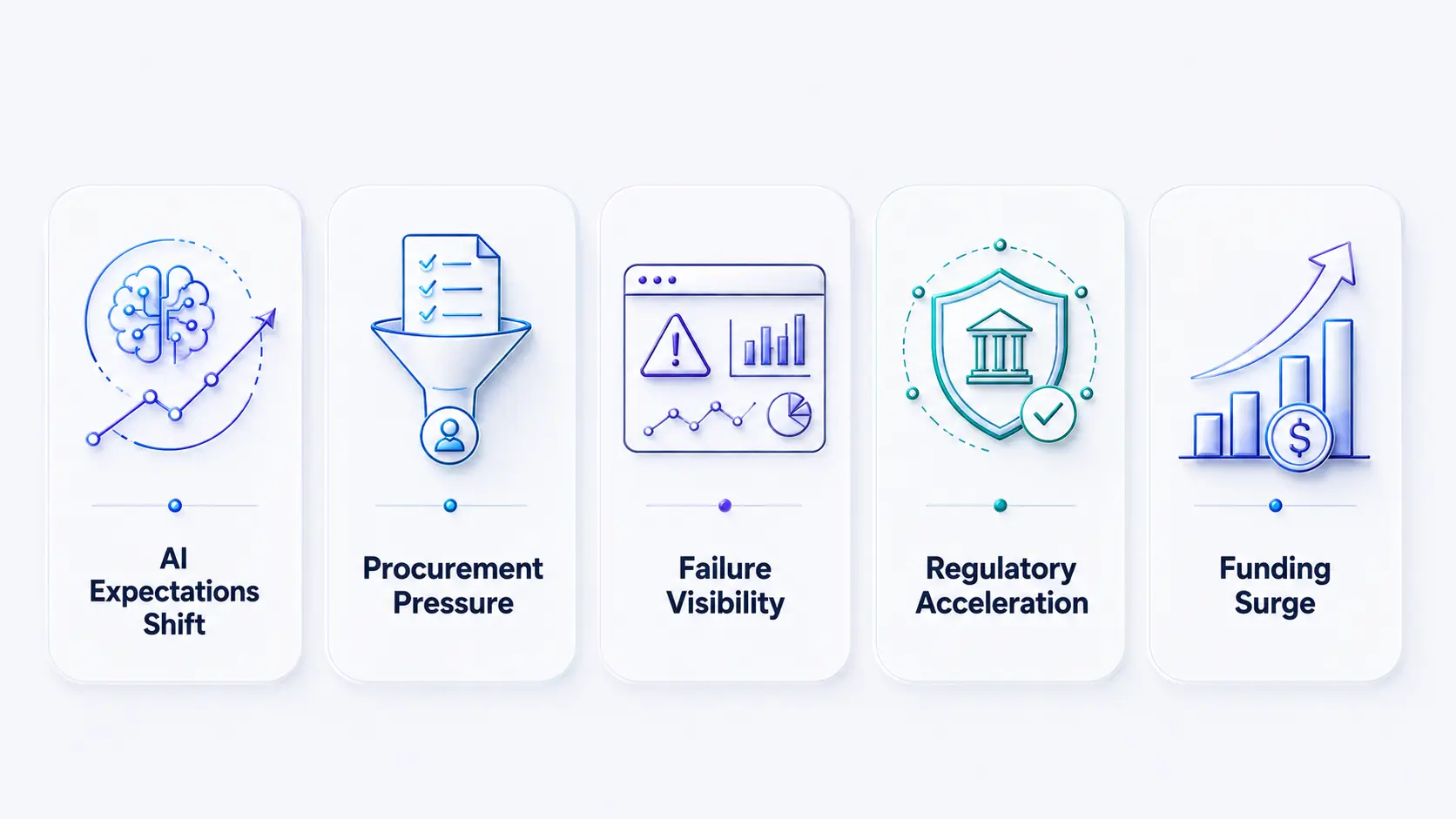
What’s Actually Driving the Urgency in 2026
The pressure to add AI to digital products isn’t imaginary. But understanding what’s actually driving it beyond competitive anxiety helps you make smarter decisions about where to focus.
1. AI has become part of the user’s baseline expectation
Users no longer experience AI as a premium feature. They experience its absence. When products fail to deliver intelligent recommendations, proactive insights, or workflow automation, they increasingly feel outdated compared to competitors that do.
2. Enterprise procurement has added AI to the evaluation checklist
For B2B products, AI capabilities are now part of enterprise buying decisions. Buyers want clarity around AI functionality, data handling, customisation, compliance, and measurable accuracy. Products that cannot answer those questions confidently are increasingly losing deals during procurement.
3. The cost of building AI wrong has become very public
Poorly implemented AI features have created public failures across industries, from inaccurate chatbots to recommendation systems that damage trust. Businesses are realising that rushed AI implementation creates long-term product, compliance, and reputation risks.
4. Regulatory pressure is accelerating
The EU AI Act is in enforcement. Similar frameworks are active or in progress across the UK, Canada, Singapore, and several US states. Products integrating high-impact AI use cases without a compliance-aware architecture are accumulating regulatory risk that will become expensive to remediate.
Data handling, model transparency, prohibited use cases, and user disclosure obligations are now product architecture decisions, not legal afterthoughts.
5. AI-native competitors are being funded at a pace
AI-focused startups continue capturing significant investor attention and market share across industries. The pressure is no longer just to “add AI,” but to implement the right AI capabilities with enough strategic clarity to avoid expensive rebuilds later.
This isn’t a reason to panic-build AI features. It is a reason to build the right ones now using predictive analytics services, with enough strategic clarity.
AI Integration Services: Where AI Should Actually Live in Your Product
One of the most important structural decisions in an AI strategy is determining how deeply AI needs to be embedded in your product to deliver real value. Teams that embed too little create AI features that feel very robotic.
Teams that embed too deeply before validating the use case create expensive system architecture that they may need to rebuild.
Most AI products fail because teams treat AI integration as a feature decision instead of an architectural decision. In practice, AI systems operate at different levels of product depth, and each level creates different requirements for data, UX, infrastructure, and user trust.
The AI Integration Depth Model
1. AI Overlay Layer
AI is added as a discrete, bounded feature within an existing product. The core product works without it; AI enhances specific moments. Examples: a support chatbot, AI-generated content suggestions, and intelligent search powered by semantic embeddings.
This is the right depth for: early AI validation, products where AI is an enhancement rather than a differentiator, and time-constrained launches where speed of validation matters. Businesses should leverage top-notch AI chatbot development services to ensure accurate, scalable, and user-friendly interactions.
This is the wrong depth for: products where the competitive differentiation depends on AI being woven into the core product experience rather than sitting on top of it.
2. Contextual Intelligence Layer
AI capabilities are integrated into the product’s primary user journeys. The product still functions without AI, but the experience degrades meaningfully when AI is removed. Examples: intelligent onboarding that adapts based on user behaviour, dashboards that surface proactive insights before users query for them, workflow AI vs automation that removes manual steps from high-frequency tasks.
This is the right depth for: products where retention and engagement are driven by personalisation and intelligence, B2B products with high-repetition workflows that benefit from automation, and products with sufficient user data to improve AI performance over time.
This is the wrong depth for: products in early stages without sufficient data infrastructure, or teams not yet ready to manage the ongoing model performance requirements this depth creates.
3. AI-Native Core
The entire product is designed around AI as its primary value delivery mechanism. Removing AI doesn’t degrade the experience; it eliminates the product. Examples: AI diagnostic tools in clinical HealthTech, autonomous risk-scoring engines in FinTech lending, adaptive learning systems in EdTech platforms.
This is the right depth for: products where the core value proposition is only achievable through AI, categories where AI capability is the competitive moat, organisations with mature data infrastructure and dedicated AI engineering.
This is the wrong depth for: products in early validation, teams that haven’t yet established the data foundation that AI-native products require to perform reliably.
Which AI Integration Services Approach Fits Your Product Best
The integration approach that’s right for you depends on your product stage, your data situation, your team’s capability, and your users’ actual tolerance for AI imperfection. Getting this wrong is where most AI budgets go to die.
Path 1: Build Custom AI
Best for: Organisations with proprietary datasets, dedicated ML engineering teams, and products where AI behaviour itself becomes the competitive advantage.
Advantages: Full control over model behaviour, data handling, and proprietary AI capability that competitors cannot easily replicate.
Trade-offs: Highest upfront investment, longer development cycles, and ongoing infrastructure, retraining, and maintenance overhead.
Biggest risk: When teams pursue custom app development before validating that the AI use case is worth the investment, or when they underestimate the ongoing operational cost of running a model in production. Building a custom model before your data is ready and your use case is validated is one of the most expensive mistakes in AI product development.
Path 2: API-First Integration
Best for: Teams validating AI use cases quickly or adding AI as an enhancement rather than the core product experience.
Advantages: Fastest route from AI idea to production with lower infrastructure complexity and access to advanced foundation models immediately.
Trade-offs: Growing API costs at scale, less control over model behaviour, and potential privacy concerns for sensitive data workflows.
Biggest risk: When API-first teams don’t plan for the eventual migration to custom models as scale demands it, creating technical debt in the architecture that makes that migration painful. And when data privacy requirements for the product (HealthTech, FinTech, enterprise) make sending data to third-party APIs architecturally untenable.
Path 3: Hybrid Architecture
Best for: Growth-stage teams with validated product-market fit that are scaling AI in mobile app development capabilities, and any team that wants to de-risk custom AI investment.
Advantages: Combines fast deployment with a scalable long-term architecture. Teams validate use cases first, then deepen AI investment using real user data and adoption signals.
Trade-offs: Requires stronger upfront planning to ensure API integrations can evolve cleanly into custom AI systems later.
Biggest risk: Treating hybrid architecture as a short-term shortcut instead of a planned long-term transition strategy.
At RipenApps, the hybrid AI architecture approach is the approach we implement most often for growth-stage products because it reduces risk, accelerates validation, and prevents unnecessary AI infrastructure costs early on.
Validate with APIs. Collect real user data. Build proprietary capability when scale and data justify the investment. It’s how you avoid both the risk of under-investing in AI and the risk of over-engineering before product-market fit on the AI layer is established.
Key Takeaway:
Maximizing the benefits of AI integration requires choosing the right integration model based on product maturity, data readiness, and long-term scalability rather than model sophistication alone.
Prioritising AI Use Cases: A Decision Framework
Before choosing an integration path, you need to know which AI use cases are actually worth building. Most product teams generate more AI ideas than they can execute. The discipline is in prioritisation, not ideation.
Evaluate each candidate AI use case against these dimensions:
User value: Does this AI feature solve a problem users feel frequently and acutely? Or does it solve a problem they’re mildly aware of occasionally? High-frequency, high-acuity problems create high engagement. Low-frequency, low-acuity problems create features users enable once and forget.
Data readiness: Does the data this AI feature needs already exist in your system, in the volume and quality required? If not, how long and how much does it take to get there? AI features that require data you don’t have aren’t features; they’re dependencies.
Implementation complexity: How complex is the integration, maintenance, and ongoing model management? High-complexity AI features require longer validation before commitment, not enthusiasm about the technical challenge.
Business impact: Which AI use cases have the clearest line to the metrics that matter: retention, conversion, revenue, NPS, support, AI integration cost reduction? AI for its own sake is not a strategy. AI that moves a business metric is.
The use cases that score high on user value, high on data readiness, and have a clear business impact line are your first-wave priorities, regardless of how exciting the more complex ones sound.
Most teams don’t struggle with AI ideas; they struggle with choosing the right ones. If you’re facing that challenge, this is typically where teams partner with experts to leverage top recommendation system development services to validate use cases before committing development resources.
When AI Should NOT Be Added to a Product
One of the clearest signs of a weak AI strategy is adding AI because competitors are doing it, not because users genuinely benefit from it. In many products, AI increases complexity, reduces trust, and creates operational overhead without improving the core experience. The strongest AI product teams are often the ones disciplined enough to decide where AI should not exist.
1. When the User Problem Isn’t Important Enough
AI works best in workflows that users repeat frequently and care about deeply. If the problem is low-impact or infrequent, AI often becomes a feature users try once and never return to.
2. When Rules-Based Logic Works Better
Not every workflow needs AI. Many processes are better handled through structured automation, business rules, or better UX design. In predictable systems, AI can increase inconsistency while reducing transparency.
3. When There Isn’t Enough Data
AI systems rely heavily on high-quality data and feedback loops. Without sufficient behavioural or domain-specific data, even advanced models can produce inaccurate or generic outputs that users quickly stop trusting.
4. When Human Oversight Is Critical
In healthcare, finance, legal workflows, and enterprise operations, AI outputs without human review can create compliance and operational risks. High-trust workflows require accountability, explainability, and escalation paths.
5. When the Core Product Experience Is Still Weak
AI rarely fixes poor onboarding, unclear workflows, or weak product-market fit. If the core experience is already struggling, adding AI often amplifies those problems instead of solving them.
Building In-House vs Working with an AI Development Partner
Choosing between building AI capabilities in-house or working with an external AI development partner depends on your product maturity, internal expertise, data readiness, and speed-to-market requirements. Both approaches can work effectively, but they solve different operational challenges.
| What You’re Evaluating | Building In-House | Working with an
AI development partner |
| Speed to first validated AI feature | Slower, internal priorities fragment focus | Faster, dedicated AI sprint workflows |
| AI/ML engineering depth | Depends on existing team composition | Guaranteed across integration types |
| Domain experience in your industry | Only if you’ve been hired for it | Built into the engagement from day one |
| Data strategy and compliance | Often reactive and underplanned | Proactive, mapped in the discovery phase |
| User research informing AI design | Frequently skipped | Structured requirement of every engagement |
| Cost of getting it wrong | High, you absorb the rework cost | Lower, the validation process catches issues pre-build |
Building in-house AI capability is the right long-term direction for most mature product organisations. But it’s the right execution model only when you have validated AI use cases, a clean data infrastructure, and a dedicated AI engineering headcount.
For teams still in the strategy and validation phase or teams building AI into a product for the first time, working with an experienced AI app development company is beneficial. It reduces the risk of the most expensive category of mistake: building the wrong AI feature with confidence.
Based on patterns observed across 250+ AI product engagements at RipenApps Technologies, teams in the 0–18 month AI maturity stage often benefit from external guidance during AI validation, workflow design, and integration planning before scaling AI capabilities internally.
Should You Build AI In-House or Hire an AI Development Company?
Choose in-house if:
- You already have experienced AI/ML engineers
- Your data infrastructure is mature and production-ready
- You have time for longer experimentation and iteration cycles
Work with an AI app development company if:
- You need to validate AI use cases quickly (within weeks, not months)
- Your team lacks hands-on expertise in AI architecture, RAG, or MLOps
- Your product involves compliance requirements (HealthTech, FinTech, enterprise SaaS)
- You want to avoid costly rebuilds caused by wrong early decisions
If you’re still evaluating which direction to take, this is typically where you should work with product teams to define the right AI roadmap, integration depth, and execution approach before development begins.
When Should You Hire an Exclusive AI App Development Company?
1. When your team lacks AI/ML expertise
Your team may be strong in product or engineering, but AI requires specialised skills in areas like model integration, prompt engineering, RAG architecture, and MLOps that don’t directly translate from traditional development. An experienced AI app development partner can provide the technical expertise needed to build scalable and production-ready AI solutions.
2. When you need faster validation
If you need to test AI use cases quickly, working with an external partner helps you move from idea to validation in weeks, not months, reducing time-to-market and risk.
3. When your product has compliance requirements
In industries like HealthTech or FinTech, AI systems must be built with data privacy, regulatory alignment, and secure workflows from the start, not added later.
4. When you want to avoid costly AI rebuilds
Many teams end up rebuilding AI features because they were based on assumptions rather than validated user needs. Early expert involvement helps prevent this.
5. When you are integrating AI for the first time
If this is your first AI initiative, guidance on selecting the right use cases, tools, and architecture can prevent both overengineering and under-delivering.
6. When competitors are already shipping AI
If competitors are adding AI, the goal is not just speed but quality. A well-designed AI experience will outperform a rushed feature.
7. When AI is part of your product or investor narrative
When AI becomes central to your product positioning or funding story, you need clear use cases, measurable outcomes, and a credible strategy, not just feature claims.
The Real Cost of AI Integration in 2026
AI app development cost is one of the most searched topics in AI product development, and also one of the most misleading ones when discussed without context. The numbers below are real, but the context is what makes them useful.
1. AI Strategy + Use Case Validation Sprint: $5,000 – $15,000
A dedicated discovery engagement that produces a validated AI use case roadmap, data readiness assessment, integration architecture recommendation, and defined success metrics. No code is written. This is the investment that determines whether everything that follows is money well spent or money at risk.
2. Single AI Feature (API Integration): $15,000 – $40,000
Design, integration, testing, and deployment of one AI feature using foundation model APIs. Appropriate for early AI validation in a live product or for products adding a bounded AI enhancement.
3. Multi-Feature AI-Augmented Product Layer: $40,000 – $120,000
Multiple AI features integrated into core product flows. Includes data pipeline architecture, API integration, AI UX design, compliance mapping, and post-launch monitoring setup.
4. AI-Native Product Development: $120,000 – $500,000+
Full-cycle AI product development from strategy through custom model development, data infrastructure build, MLOps setup, and ongoing model management. For products where AI is the core competitive IP.
These costs vary significantly based on whether the right approach is chosen from the start. This is the stage where many AI projects either prevent expensive downstream rework or quietly create it. RipenApps works with product teams here to validate architecture, AI feasibility, and implementation strategy before larger development budgets are committed.
The question that reframes every AI budget discussion is simple: what happens if the feature fails after launch and needs to be rebuilt? In practice, rebuilding AI systems often costs significantly more than validating the right strategy upfront because the impact extends beyond engineering effort to user trust, delayed product timelines, workflow disruption, and lost adoption momentum.
5–10x Higher Rebuild Costs
Across AI product engagements, teams that skip validation, workflow analysis, and architecture planning often spend significantly more rebuilding underperforming AI systems after launch.
That’s not a hypothetical; it’s a pattern we see consistently when teams bring us in to fix AI integration mistakes that weren’t designed correctly from the start.
What Happens When Teams Skip the Strategy
Case A: The Chatbot That Made Support Worse
Cobone, a MENA-based retail and deals platform operating at a large consumer scale, introduced a GPT-based support chatbot to reduce customer support load and improve response efficiency.
The rollout prioritised speed of deployment over structured AI design, with limited upfront focus on user workflow mapping and knowledge structuring across key product journeys such as bookings, refunds, and deal-related queries.
While the chatbot handled generic queries effectively, it struggled with high-frequency transactional use cases that formed the core of user support demand. Over time, users began bypassing the assistant and escalating directly to human support, reducing the intended efficiency gains.
The system ultimately required a redesign using a retrieval-augmented generation (RAG) architecture combined with structured internal knowledge systems and workflow-aligned information retrieval.
Case B: AI Designed Around What Users Actually Needed
In a subsequent iteration, Cobone re-evaluated its AI support strategy by first analysing real user support patterns across its core platform workflows.
This analysis revealed that a small set of recurring categories accounted for the majority of support volume. Based on this insight, the AI assistant was redesigned to prioritise these workflows, ensuring higher accuracy and relevance for high-frequency user requests.
Structured escalation paths were introduced for edge cases, allowing the system to balance automation with human support where required.
The redesigned approach significantly improved response relevance for targeted workflows and reduced dependency on manual support channels over the rollout period.
Real-World Outcome
At Cobone, implementing a RAG-based AI support assistant aligned with actual user workflows.
Outcome Achieved:
32% Reduction in Support Ticket Volume
Achieved after implementing a RAG-based AI support assistant aligned with real user workflows.
The system combined workflow-specific retrieval, structured knowledge mapping, and controlled escalation logic to improve response accuracy, user trust, and overall operational efficiency.
What the Research Consistently Shows
- Across 250+ AI product engagements at RipenApps, AI features built without validated user needs consistently show weak sustained engagement after launch.
- Across our AI product work, validated AI use cases are significantly more likely to improve retention and workflow adoption compared to unvalidated feature-led implementations.
- In real product deployments, AI systems that are designed around user workflows (not features) show significantly higher adoption and retention.
- Projects that define an AI integration strategy and data readiness before development experience fewer post-launch rebuilds and faster time-to-production.
How to Execute AI Strategy in 2026 (and Why RipenApps Gets It Right)
You have the understanding. You’ve evaluated the options. What follows is the execution reality: how to run an AI product engagement correctly, how to evaluate a development partner without being misled by surface signals, and what real outcomes look like when the process is done right.
How to Choose the Right AI Development Company in 2026
As AI adoption accelerates, businesses are no longer evaluating whether they need AI. They’re evaluating which AI development company can help them execute the right strategy, avoid costly implementation mistakes, and build AI systems that actually drive adoption.
The challenge is that many vendors can integrate AI APIs, but far fewer can validate use cases, design AI user experiences, manage compliance requirements, and build scalable AI architectures aligned with long-term product goals.
Before choosing an AI development partner, these are the questions that separate strategic AI product teams from feature vendors.
Read More: How to Hire the Right Mobile App Development Company: A Practical Guide
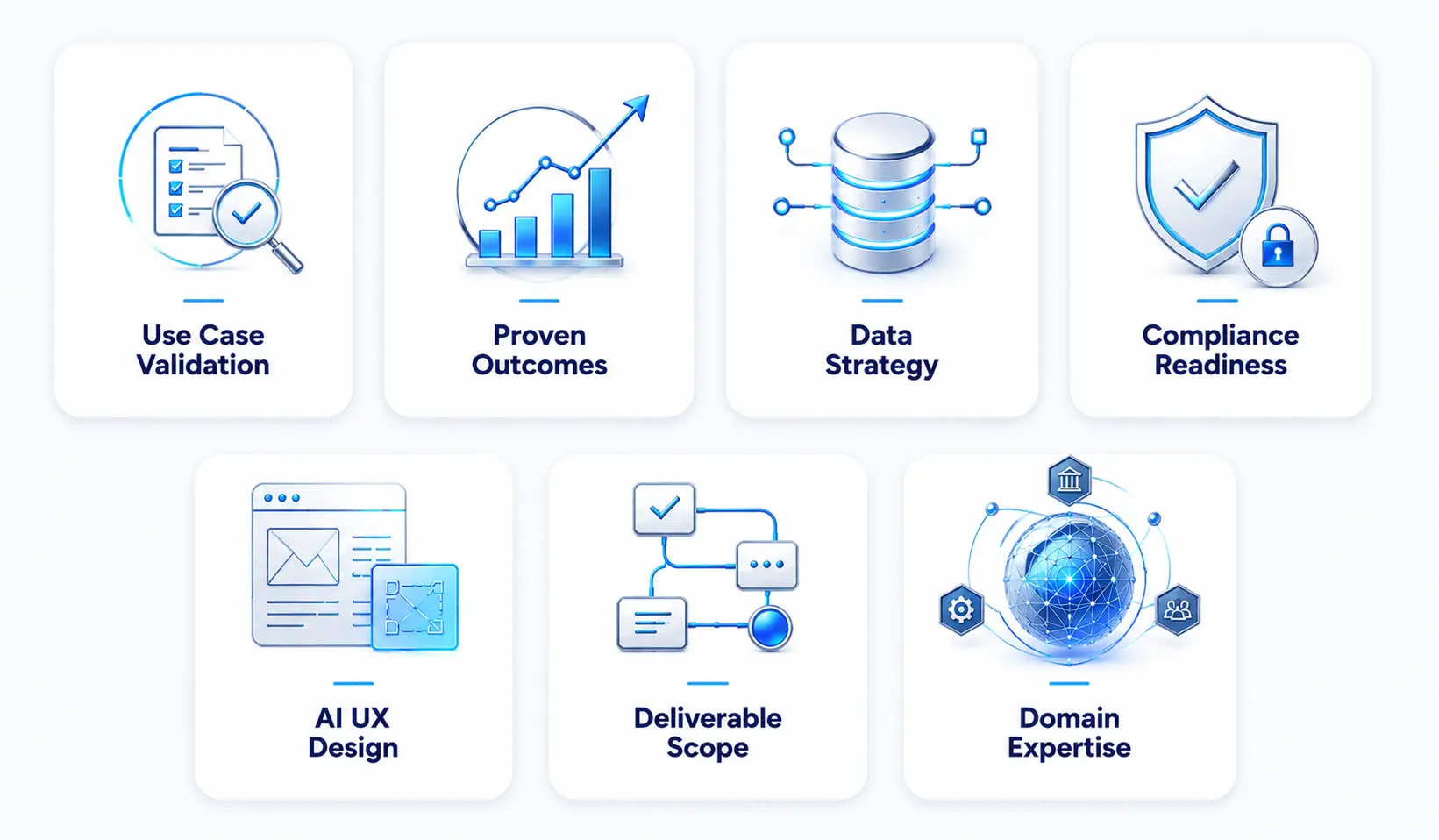
7 Questions That Separate Real AI Partners From Feature Vendors
Before you engage any AI development partner, get specific answers to these:
1. Do they validate the AI use case before proposing a solution?
Any partner who leads with model recommendations or tool preferences before understanding your user problem in depth is a feature vendor. You need a product partner that understands AI from both a user experience and execution standpoint.
The difference costs you nothing to test in the first conversation. Ask them what their first step is when starting an AI engagement. The right answer involves users. The wrong answer involves technology.
2. Can they produce case studies with specific, measurable outcomes?
“We’ve built AI products” is not a case study. Specific user adoption rates, retention impact, accuracy metrics, time-to-market reduction, and revenue attribution are AI case studies. If a partner can’t name numbers from their prior work, they can’t be held to numbers in yours.
3. How do they approach data strategy in an AI engagement?
If data readiness assessment isn’t a named phase in their process, their AI features will be designed around data assumptions that may or may not exist in your system. The most expensive AI rework scenarios always trace back to data problems that weren’t identified until development was underway.
4. What’s their AI compliance process?
This question separates teams building enterprise-grade AI from teams building demos. If they can’t articulate how they handle data handling requirements, model transparency, bias testing, and regulatory mapping for your specific industry and geography, they are not qualified to build AI into a regulated product.
5. How do they design the user experience of AI features?
AI UX is a distinct design discipline. How AI surfaces outputs, communicates confidence, handles uncertainty, and recovers from errors requires specific design thinking that general product design doesn’t cover. If your partner treats AI UX as a standard design task, their AI features will underperform regardless of model quality.
6. What do you receive at the end of an engagement?
The AI feature in production is not the deliverable. A complete engagement produces model documentation, integration specs, monitoring setup, retraining triggers, and a post-launch performance management plan. If the deliverable is “working code,” you’re inheriting an AI system you can’t manage independently.
7. Do they have industry-specific experience in your domain?
Building and integrating conversational AI in Healthcare without understanding clinical workflow constraints, patient psychology, and HIPAA architecture is building in the dark. Building AI in FinTech without understanding fraud detection logic and financial data sensitivity is building liability.
Domain experience isn’t a nice-to-have in AI product development. It directly determines how quickly and accurately the right architecture decisions get made.
Are You Ready to Execute? A Decision Checklist
If you can check five or more of the following, you’re ready to move from research to engagement:
- You have a specific user problem you believe AI solves better than any non-AI solution
- You have a realistic sense of what data you have and what data you’d need
- You have a budget allocated for AI strategy and development, not just development
- You have a timeline with real stakes, an investor deadline, a launch window, and competitive pressure
- You understand that AI built without validation produces features, not value
- You’ve seen competitors move on to AI and need to respond with quality, not just speed
- You need to present AI capability credibly to investors, enterprise buyers, or a board
- You’ve built AI features that underperformed before, and you’re done making that mistake
Five or more checked: the next right action is a conversation, not more desk research.
What Best-in-Class AI Integration Produces: The Full Picture
When an AI engagement is run correctly, here’s what the output actually looks like:
- Validated use cases grounded in real user research and behavioural evidence
- Data strategies mapped before implementation begins
- Compliance-aware architecture designed around regulatory requirements from day one
- AI UX users trust with clear interaction logic and confidence in handling
- Post-launch monitoring systems that improve AI performance over time
- Success metrics tied to business outcomes like retention, engagement, and efficiency
This is what AI integration looks like when it’s treated as a product discipline rather than a technology project.
The RipenApps AI Strategy and Integration Framework
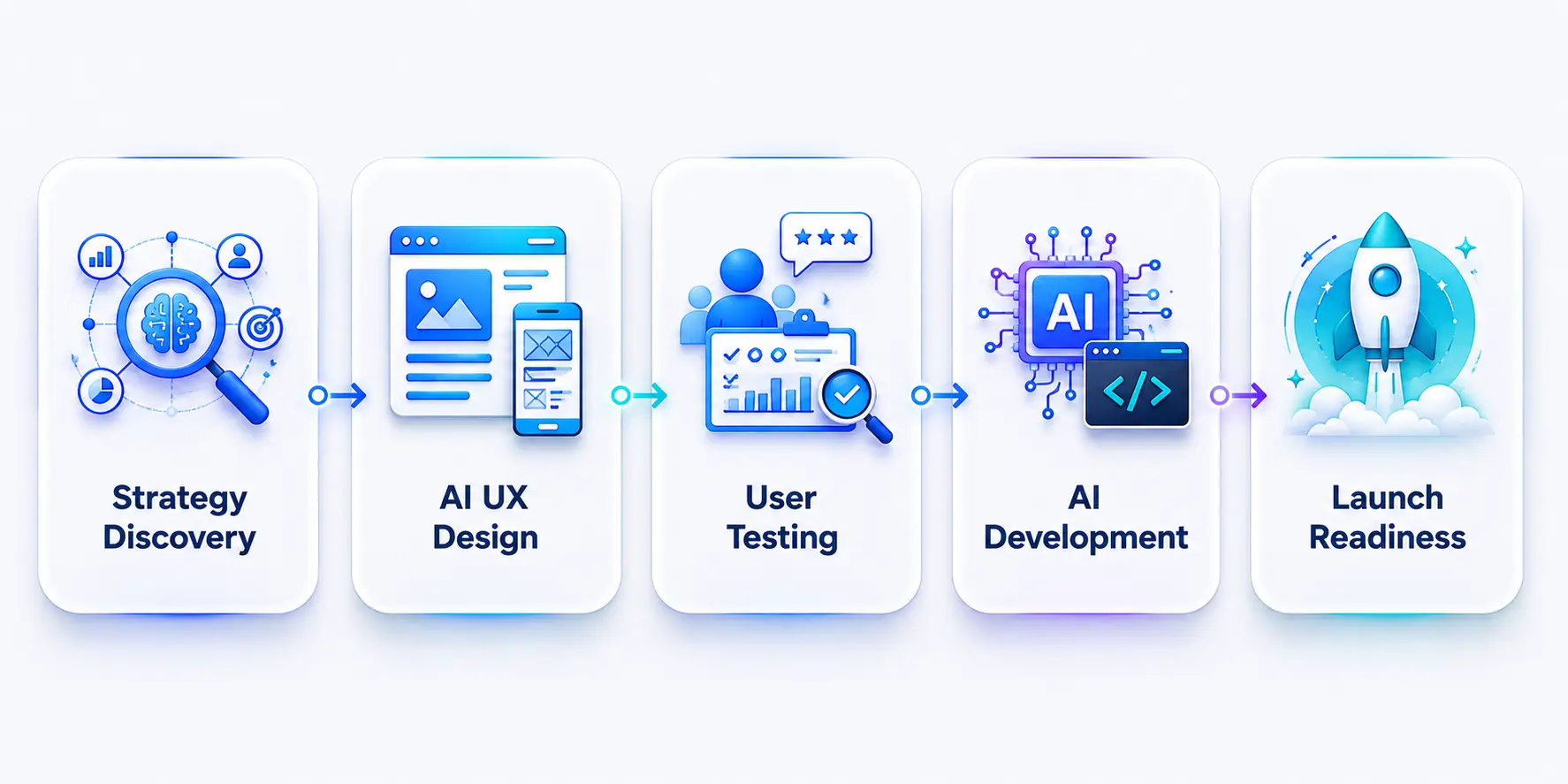
Our conviction at RipenApps is simple: AI that users engage with was designed around how real users think and make decisions, not around which model was most impressive in a vendor demo.
Across 250+ product engagements spanning HealthTech, FinTech, EdTech, Logistics, and Enterprise SaaS, we’ve developed an AI integration process that reduces post-launch rework, accelerates time-to-market, and produces measurably higher AI feature adoption than industry benchmarks.
Phase 1: AI Discovery and Strategy Sprint
Duration: Week 1 to 2
The engagement doesn’t start with a technology recommendation. It starts with the hardest questions: Which user problems does AI solve better than everything else you’ve tried? What does your data infrastructure actually look like, not what you think it looks like? What are the compliance obligations for your specific use case and market?
This phase includes stakeholder workshops, user research interviews, a competitive AI audit, a data readiness assessment, and a technical feasibility review run by AI engineers, not sales engineers.
The output is an AI Strategy Blueprint: a validated, prioritised use case roadmap with integration approach, data requirements, compliance mapping, and success metrics defined. Everything that follows is built on this foundation.
Phase 2: AI UX Design and Prototyping
Duration: Week 2 to 4
Before any model is selected or any API is called, every AI feature is designed and prototyped at the interaction level, where strong UI/UX Design Services ensure that AI outputs are intuitive, trustworthy, and easy to interact with. How does the AI surface its output? What does uncertainty look like? What happens in the error state? How does the design communicate what the AI is doing without overwhelming the user with explanations?
These questions get answered in design and testing, not discovered post-launch. We build clickable prototypes of every AI feature and test them with real users before development begins. This phase alone eliminates the majority of post-launch AI UX failures we see when teams skip it.
Phase 3: User Testing of AI Interactions
Duration: Weeks 4 to 6
The AI feature prototypes are tested with real users from your target segment in structured sessions. We test task completion with AI-assisted flows versus baseline flows, user perception of AI output quality and trustworthiness, drop-off moments where AI suggestions are ignored or confusing, and qualitative feedback on how the AI interaction feels versus how it was designed to feel.
This is where the gap between design intention and user reality gets surfaced and closed before development investments are made.
Phase 4: AI Development and Integration
Duration: Week 6 to 12
With a validated design, clear architecture, and a compliance framework in place, development proceeds without the ambiguity that generates the most expensive rework. Our AI engineering team handles foundation model API integration or custom model development, data pipeline architecture, vector database setup for RAG-based features, backend AI service design, security and compliance implementation, and frontend integration with AI interaction components.
Phase 5: Testing, Monitoring, and Launch Readiness
Duration: Week 12 to 16
Before any AI feature reaches users, it goes through structured evaluation: output quality testing across edge cases and adversarial inputs, performance and latency benchmarking, security and data handling audit, compliance documentation, and monitoring and alerting infrastructure setup.
The product that ships has a documented model performance baseline and a clear plan for how that baseline gets maintained and improved post-launch.
Real-World AI Product Examples: How Scalable AI Systems Are Actually Built
AI strategy becomes much clearer when you look at how leading digital products actually apply it in production. The biggest misconception is that successful AI systems are built around advanced models or cutting-edge tools. In reality, they are built around clearly defined user problems, supported by the right data, and designed to scale from the beginning.
Here’s how some of the world’s most successful platforms use AI in practice:
1. Netflix: Personalisation as a Core Product Engine
Netflix does not use AI as a feature. It uses AI as a core mechanism of engagement. Its recommendation system analyzes user behavior, watch history, interaction patterns, and contextual signals to surface highly relevant content for each user. The goal is not just accuracy. It is retention. Every recommendation is designed to increase watch time and reduce churn.
2. Amazon: AI That Directly Drives Revenue
Amazon applies AI across multiple layers of its platform, including product recommendations, search ranking, pricing optimisation, and demand forecasting. These systems are not experimental. They are directly tied to business outcomes like conversion rate, average order value, and inventory efficiency.
3. Uber: Real-Time AI at Operational Scale
Uber’s platform relies on AI systems that operate in real time across highly dynamic environments. From matching drivers with riders to calculating estimated arrival times and surge pricing, every decision is powered by data and machine learning models.
4. Spotify: Continuous Personalisation and Engagement Loops
Spotify uses AI to create highly personalised user experiences through features like Discover Weekly, Daily Mix, and content recommendations. These systems learn continuously from listening habits, skips, replays, and user preferences.
What These AI Systems Have in Common
Across all these examples, a few patterns consistently appear:
- AI is built around a specific and high-impact user problem
- AI is integrated into core product workflows, not added as a surface feature
- Systems are designed to scale with users, data, and usage complexity
- Success is measured through business outcomes like retention, conversion, and engagement
- Data strategy and architecture are defined before implementation begins
This is the core difference between AI features that succeed and those that get ignored after launch.
How This Applies to Your Product
Most AI failures do not happen because of poor models. They happen because teams:
- Choose AI use cases without validating the user’s need
- Integrate AI at the wrong depth, either too shallow or too complex
- Build without a clear data or architecture strategy
The result is AI that looks impressive in demos but fails in real usage.
If you are evaluating how to apply AI in your product, this is the stage where getting the strategy right matters most. Many teams choose to validate their use cases, architecture, and integration approach before committing development resources because fixing AI after launch is significantly more expensive than getting it right upfront. If your AI feature is not directly tied to a user action or business metric, it will not scale, no matter how advanced the model is.
Final Thoughts
There’s a version of AI strategy that sounds impressive in a board presentation and fails in production because it was built around what seemed technically exciting rather than what users genuinely needed. We’ve seen it enough times to know exactly how it ends.
The AI strategies that produce real outcomes, higher retention, measurable revenue impact, and competitive differentiation that holds start with the same unglamorous truth: your users have specific problems, in specific moments, that AI can solve better than anything else if it’s designed with enough understanding of those problems to do the job precisely. That’s the work. The most valuable AI decisions happen before development begins.
At RipenApps, a leading AI app development company, across 250+ product engagements, we’ve seen the same pattern repeatedly: AI failures rarely come from weak models. They come from building the wrong AI capability before validating user needs, architecture, and scalability requirements.
If you’re planning to integrate AI into your product, the biggest risk isn’t cost; it’s building the wrong AI. That’s where a strategy-first approach makes the difference.
FAQs
Q1: How long does it take to add AI to an existing product?
It depends significantly on the integration type and feature complexity. A single API-based AI feature can typically be validated and in production within 6–10 weeks. Multi-feature AI-augmented product layers run 12–20 weeks. AI-native architecture builds run longer. Every engagement begins with a discovery sprint that produces a realistic, scoped timeline before any development commitment is made, so you know exactly what you’re committing to before you commit.
Q2: Do I need my own data to use AI in my product?
Not necessarily, but your data situation shapes which approach is right. Foundation model APIs work without proprietary training data. For personalised, domain-specific AI behaviour, proprietary data, user behaviour history, structured domain knowledge, and historical records significantly improve performance. Our discovery process always includes a data readiness assessment so you know exactly what you have, what you need, and how to close the gap.
Q3: How do I know which AI features are worth building first?
Prioritise by the intersection of user value (how frequently and acutely does this problem occur?), data readiness (do you have what the AI needs to work?), and business impact (does this feature move a metric that matters?). Features that score high on all three are first-wave priorities. Features that score high on excitement but low on data readiness or user frequency are where AI budgets disappear without producing results.
Q4: How do we handle AI compliance requirements?
Compliance mapping is a mandatory component of our discovery phase, not a legal review added before launch. We map every AI use case against applicable regulations (HIPAA, GDPR, EU AI Act, FCA, and others relevant to your market) and design architecture to satisfy those requirements from the start. This includes data handling decisions (on-premise vs. cloud inference), disclosure requirements, model transparency documentation, and prohibited use case review.
Q5: Can RipenApps integrate AI into our existing product without requiring a full rebuild?
Yes. Many of our AI engagements involve clean integration into existing product architectures. Our technical discovery process identifies integration points, dependency constraints, and the cleanest architectural path for adding AI to your current codebase. Contact us and share your tech stack details, and we’ll assess the integration complexity accurately.
Q6: What industries has RipenApps built AI products in?
HealthTech, FinTech, EdTech, Logistics and Supply Chain, Real Estate Technology, and Enterprise SaaS. Domain experience matters in AI development, the regulatory environment, user psychology, and data patterns specific to your industry change what the right architecture looks like. Generalist AI development experience doesn’t transfer to domain-specific constraints. Ours does.
Discuss your project and request for proposal
SHARE
WRITTEN BY

Ishan Gupta
CEO & Founder
Ishan Gupta is a seasoned entrepreneur and CEO with extensive 10+ years of experience in business and mobile app development landscape. He believes that the right digital product allows companies to focus on what they do best, while technology handles the rest. With deep exposure to global markets, he understands what makes an app succeed. His approach translates business needs into clear product strategies, ensuring that every feature contributes to measurable ROI.
View All Articles