


Key Takeaways
- AI Integration Cost in 2026 can range from $15,000 for basic AI features to over $500,000 for enterprise-grade AI agents and scalable automation ecosystems.
- The biggest factors influencing AI development cost include AI model complexity, infrastructure requirements, data readiness, security compliance, and long-term operational scalability.
- Businesses are increasingly investing in AI copilots, recommendation engines, RAG systems, and autonomous AI agents to improve efficiency, personalization, and competitive advantage.
- Hidden expenses such as token usage, AI monitoring, observability, prompt optimization, and infrastructure scaling significantly impact long-term AI software development costs.
- Companies that adopt AI strategically with scalable architecture, phased implementation, and ROI-focused deployment models are achieving stronger business growth, operational efficiency, and customer retention in 2026.
AI integration cost in 2026 ranges from $15,000 for basic AI features to over $500,000 for enterprise-grade AI agents, and choosing the wrong budget estimate can stall your entire product roadmap. As AI shifts from experimental to essential, startup founders, CTOs, and product leaders need a clear, honest breakdown of what AI actually costs to build, run, and scale in today’s market.
As AI adoption accelerates across industries, startup founders, CTOs, and enterprise leaders are under increasing pressure to integrate intelligent capabilities into their products faster and more strategically. From AI copilots and conversational assistants to predictive analytics and autonomous AI agents, businesses now view AI as a competitive necessity rather than an experimental innovation. However, one of the biggest challenges remains accurately estimating the true AI integration cost before development begins.
The complexity increases further when organizations evaluate modern service requirements like custom AI feature integration, intelligent automation systems, scalable AI infrastructure, and enterprise-grade deployment models. Whether businesses are building AI-powered SaaS platforms, customer support assistants, workflow automation engines, or predictive recommendation systems, understanding the cost structure is critical for long-term ROI and product scalability.
In this guide, we break down the real cost of AI integration in 2026, including development pricing, hidden operational expenses, AI agent implementation costs, infrastructure considerations, and strategic budgeting insights for modern apps and SaaS products.
Table of Contents
How Much Does AI Integration Cost in 2026?
The average AI integration cost varies significantly based on feature sophistication, user volume, and deployment architecture. Businesses integrating basic AI automation features can spend as little as $15,000–$30,000, while enterprise-grade AI ecosystems with advanced orchestration layers may exceed $500,000.
The table below reflects 2026 market rates across client engagements and industry benchmarks, broken down by AI feature type to help you scope your budget before development begins.
Here is a practical pricing overview for modern digital products:
| AI Feature Type | Estimated Development Cost |
| AI Chatbot | $15,000–$60,000 |
| AI Recommendation Engine | $30,000–$120,000 |
| AI Copilot | $50,000–$250,000 |
| AI Search with RAG | $40,000–$180,000 |
| AI Workflow Automation | $35,000–$150,000 |
| AI Voice Assistant | $50,000–$200,000 |
| AI Agent Development | $80,000–$350,000+ |
For startups, the biggest concern is balancing innovation with operational sustainability. Many organizations underestimate recurring AI expenses such as inference costs, token usage, vector databases, retraining cycles, and observability tooling.
In 2026, companies are also shifting from isolated AI tools toward embedded intelligence inside core business systems. This transition is significantly increasing overall AI development costs because products now require:
As a result, AI budgeting is becoming a strategic board-level conversation rather than just a technical implementation discussion.
Key Factors That Drive AI Development Cost in 2026
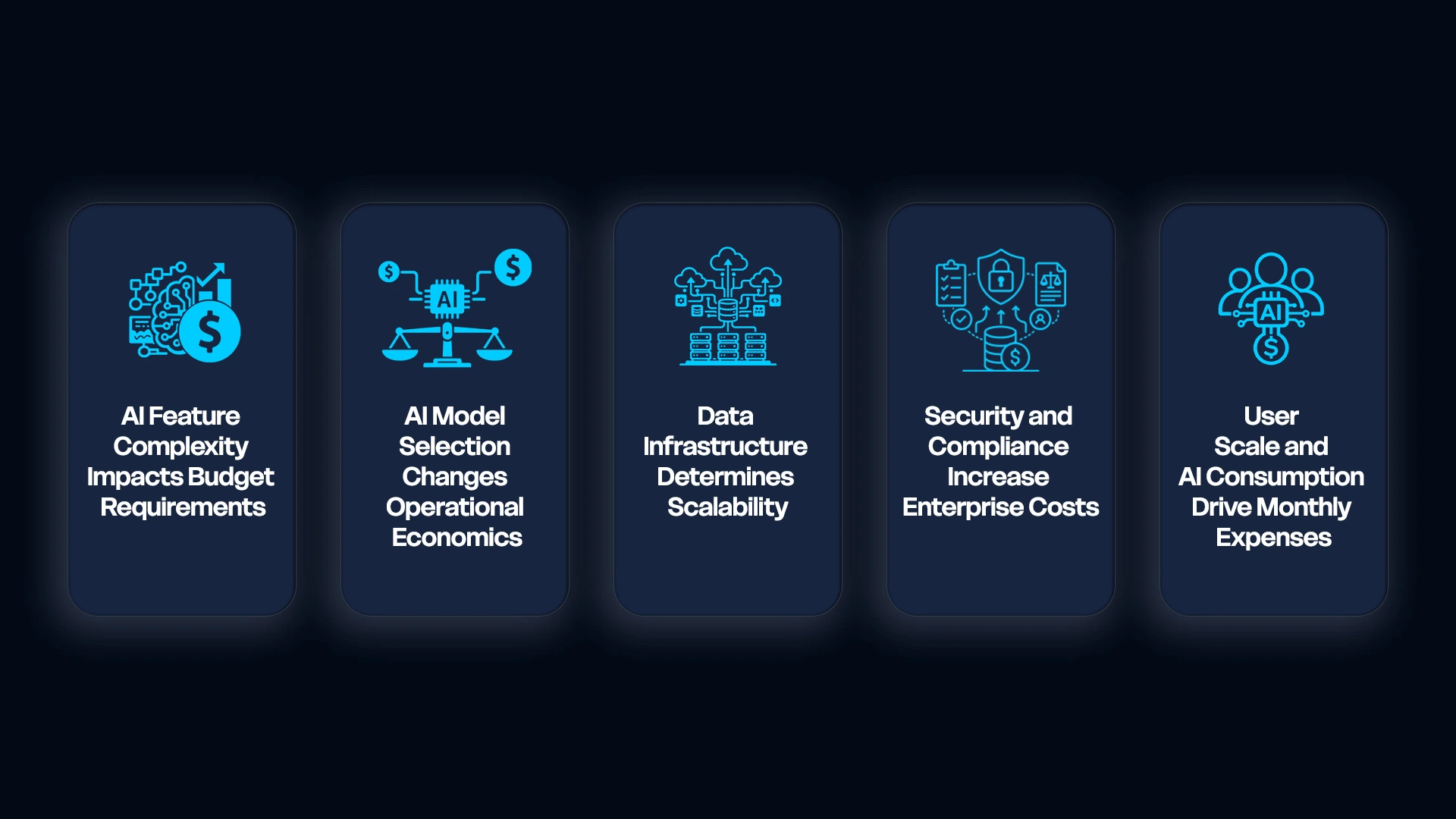
Several technical and business variables directly influence the overall cost of AI development. Understanding these factors helps organizations build realistic investment plans and avoid budget overruns.
1. AI Feature Complexity Impacts Budget Requirements
Simple AI implementations such as FAQ chatbots cost substantially less than advanced systems capable of reasoning, workflow execution, and autonomous decision-making.
For example:
- AI summarization tools require lower infrastructure complexity
- AI copilots require contextual memory and orchestration
- Agentic AI systems require planning engines and tool execution layers
The more contextual intelligence required, the higher the development and operational expenses.
2. AI Model Selection Changes Operational Economics
Businesses now choose between:
- OpenAI models
- Anthropic Claude
- Gemini
- Open-source LLMs
- Fine-tuned proprietary models
API-based AI deployment reduces upfront costs but increases long-term operational spending. Open-source deployments lower inference costs over time but require DevOps, GPU management, and MLOps expertise.
This decision heavily influences AI software development cost projections.
3. Data Infrastructure Determines Scalability
AI systems depend on clean, structured, and accessible data. Businesses often underestimate the engineering work needed to:
- Build data pipelines
- Prepare embeddings
- Configure vector databases
- Implement retrieval systems
- Establish governance frameworks
For SaaS products with fragmented legacy architecture, integration costs can increase rapidly.
4. Security and Compliance Increase Enterprise Costs
For healthcare, fintech, and enterprise SaaS platforms, compliance requirements significantly increase AI development costs.
Common cost drivers include:
- SOC 2 readiness
- HIPAA compliance
- GDPR frameworks
- Secure AI gateways
- PII masking
- Human review systems
Security-first AI architecture is now mandatory for enterprise adoption.
5. User Scale and AI Consumption Drive Monthly Expenses
Many organizations budget for development but ignore operational usage growth.
As user adoption scales, businesses face rising:
- Token consumption
- API request costs
- GPU usage
- Vector search queries
- Real-time inference processing
This becomes especially important for high-engagement SaaS products serving thousands of users daily.
AI App Development Cost by Feature: Chatbots, Copilots & Agents
The AI app development cost depends heavily on the functionality being integrated into the product ecosystem.
1. AI Chatbots Require More Than Conversational Interfaces
The average AI chatbot development cost ranges between $15,000 and $60,000 for standard SaaS implementations.
Modern AI chatbots now include:
- Context retention
- CRM integrations
- Workflow automation
- Multi-language support
- Knowledge retrieval systems
- Sentiment analysis
Enterprise-grade customer support bots can exceed $100,000 when advanced integrations and analytics are included.
Organizations exploring conversational AI often combine chatbot deployment with broader initiatives like AI Automation in Web Development to streamline customer operations and internal productivity simultaneously.
2. AI Copilots Are Becoming Core SaaS Differentiators
AI copilots assist users in performing tasks directly inside products. Examples include:
- Writing assistants
- Coding copilots
- Sales assistants
- Analytics copilots
- Workflow guidance systems
These systems usually cost between $50,000 and $250,000 because they require:
- User context awareness
- Long-session memory
- Tool integrations
- Permission systems
- Real-time orchestration
Copilot experiences are rapidly becoming standard expectations in modern SaaS platforms.
3. AI Recommendation Engines Improve Retention and Revenue
AI recommendation engines analyze user behavior and preferences to deliver more relevant content, products, or services. Businesses exploring AI-powered app ideas can use these personalized recommendations to increase engagement, encourage repeat interactions, and create opportunities for higher conversions and revenue.
Recommendation systems power:
- E-commerce personalization
- Content suggestions
- Product discovery
- Upselling
- Behavioral targeting
Development costs generally range from $30,000–$120,000 depending on:
- Dataset complexity
- Real-time learning needs
- Personalization depth
- Infrastructure scale
For B2B SaaS businesses, recommendation engines increasingly influence customer retention metrics.
4. AI Search and RAG Systems Require Advanced Infrastructure
Retrieval-Augmented Generation (RAG) architecture has become one of the most requested AI implementations in 2026.
These systems combine:
- Vector databases
- Semantic search
- Enterprise knowledge retrieval
- LLM-generated responses
Typical development costs range from $40,000–$180,000.
Businesses investing in Scalable Web Applications for Businesses increasingly prioritize RAG infrastructure because it improves knowledge accessibility and enterprise productivity.
5. AI Agent Development Represents the Highest Complexity Tier
The AI agent development cost is significantly higher because these systems execute autonomous workflows instead of simple prompt-response interactions.
AI agents can:
- Analyze objectives
- Plan tasks
- Execute tools
- Access systems
- Coordinate actions
- Self-correct outputs
Most agentic AI development cost estimates range between $80,000 and $350,000+.
Key cost drivers include:
- Multi-agent orchestration
- Long-term memory
- Tool execution frameworks
- Monitoring systems
- AI governance
- Reliability engineering
As autonomous workflows become mainstream, agentic AI is expected to dominate enterprise AI spending over the next three years.
API-Based AI vs Custom Development: Cost Comparison
The choice between API-first and custom AI architecture is one of the most consequential budget decisions you’ll make. Here’s how they compare across four dimensions that matter most for scaling SaaS products.
| Development Approach | Initial Cost | Long-Term Cost | Scalability | Best Fit |
| AI APIs | Lower | Higher | Moderate | Startups |
| Custom AI Development | Higher | Lower | High | Enterprises |
| Open-Source AI Stack | Moderate | Moderate | High | AI-native SaaS |
| Hybrid AI Architecture | Moderate-High | Balanced | Very High | Growth-stage products |
API-Based AI Accelerates Time-to-Market
Using APIs from OpenAI, Anthropic, or Google significantly reduces upfront development costs while enabling businesses to realize the benefits of AI integration much faster. Instead of building foundation models from scratch, organizations can leverage pre-trained AI services to accelerate development and focus on delivering business value.
Benefits include:
- Faster deployment
- Reduced infrastructure complexity
- Easier experimentation
- Lower engineering overhead
This approach is ideal for early-stage startups validating AI use cases.
Businesses beginning with MVP Development often prefer API-first AI integration because it allows faster market testing with lower initial investment.
Custom AI Development Enables Long-Term Control
Custom AI systems offer:
- Better data ownership
- Lower inference costs at scale
- Greater customization
- Improved privacy
- Enterprise-grade flexibility
However, the initial AI development cost becomes much higher because organizations must build:
- AI infrastructure
- MLOps pipelines
- Model optimization workflows
- Security frameworks
- Monitoring systems
For companies expecting high AI usage volume, custom systems often become financially beneficial over time.
Hidden AI Integration Costs Most Businesses Overlook
Many businesses underestimate the operational complexity of production-grade AI systems.
The actual cost of AI development extends far beyond implementation. Recent findings from Deloitte’s 2026 State of AI in the Enterprise Report reveal that organizations are increasingly struggling with AI scalability, governance, workforce readiness, and long-term ROI realization as they move from AI pilots into enterprise-wide deployment.
Similar to evaluating the Cost to develop an iOS App, businesses integrating AI must also account for long-term infrastructure, maintenance, scalability, and operational expenses beyond initial development.
This placement works well because:
- It feels contextual and organic
- Connects traditional app budgeting with AI budgeting
- Maintains SEO relevance without keyword stuffing
- Fits naturally into the discussion around hidden costs and operational complexity
1. Token and Inference Costs Grow Rapidly
Every AI interaction consumes tokens and compute resources. As usage scales, recurring monthly costs increase dramatically.
For large SaaS platforms, AI inference expenses can reach:
- $10,000/month
- $50,000/month
- Or significantly higher
This is especially true for generative AI-heavy products.
2. AI Monitoring and Evaluation Require Dedicated Infrastructure
Businesses must continuously evaluate:
- Hallucination rates
- Accuracy
- Bias
- Response quality
- Latency
- Reliability
AI observability tools now represent a major operational expense category.
3. Prompt Optimization Requires Ongoing Engineering
Prompt engineering is no longer a one-time task.
Companies continuously optimize prompts to:
- Reduce token usage
- Improve response quality
- Minimize hallucinations
- Increase efficiency
This operational layer adds hidden staffing and maintenance costs.
4. Human Oversight Remains Essential
Despite AI advancements, human review is still critical for:
- Compliance-sensitive outputs
- High-risk workflows
- Customer support accuracy
- Content moderation
Human-in-the-loop systems substantially impact AI development costs over time.
How Much Does AI Integration Cost for Startups vs Enterprises?
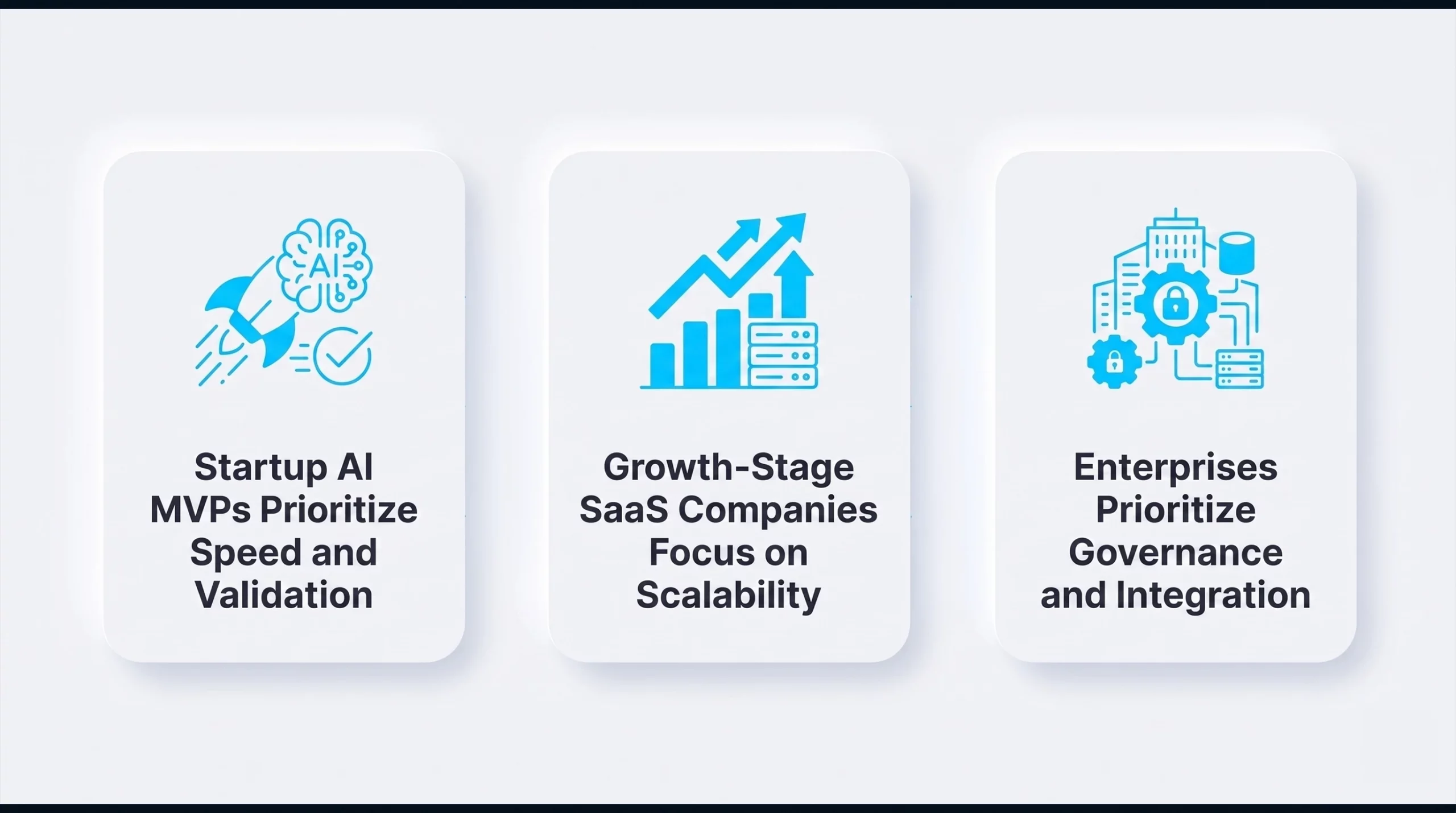
AI investment requirements vary significantly based on organizational maturity, infrastructure readiness, scalability goals, compliance requirements, and operational complexity. While startups typically prioritize faster validation and lean AI adoption, enterprises invest heavily in scalable AI ecosystems, governance frameworks, security architecture, and organization-wide automation initiatives. Understanding these differences helps businesses create more realistic AI budgeting strategies aligned with long-term growth objectives and product scalability.
1. Startup AI MVPs Prioritize Speed and Validation
Startups typically focus on:
- AI-powered differentiation
- Faster product validation
- Investor appeal
- Automation efficiency
A startup AI MVP may cost between $15,000 and $75,000, depending on feature scope.
Founders evaluating both AI capabilities and platform economics often compare investments against benchmarks like SaaS Web Application Development Cost before finalizing product roadmaps.
2. Growth-Stage SaaS Companies Focus on Scalability
Growth-stage organizations invest more heavily in:
- Infrastructure scalability
- AI personalization
- User retention
- Workflow automation
- AI copilots
Budgets often range between $75,000 and $250,000.
3. Enterprises Prioritize Governance and Integration
Enterprise AI implementation usually involves:
- Legacy system integration
- Compliance management
- Security frameworks
- Department-wide automation
- Multi-model architecture
Enterprise AI budgets can easily exceed $500,000.
How Can Businesses Reduce AI Development Costs Without Sacrificing Quality?
Businesses can significantly optimize AI spending with the right implementation strategy.
1. Start With High-Impact AI Use Cases
Instead of deploying AI everywhere, focus on:
- Customer support automation
- Sales enablement
- Knowledge retrieval
- Productivity optimization
High-ROI features justify investment faster.
Organizations evaluating Top AI Trends for 2026 are increasingly prioritizing focused AI deployments instead of broad experimental implementations.
2. Use Retrieval-Augmented Generation Instead of Fine-Tuning
RAG architecture often reduces costs because businesses can:
- Avoid expensive model training
- Maintain fresher data
- Improve response reliability
- Lower infrastructure complexity
For many SaaS platforms, RAG is more cost-efficient than full model fine-tuning.
3. Optimize Token Consumption
Reducing prompt length and improving context management lowers operational spending substantially.
Smart prompt architecture can reduce AI operational costs by 20–40%.
4. Build AI Incrementally
Companies should avoid overengineering early AI features.
A phased rollout strategy allows:
- Faster iteration
- Better ROI tracking
- Lower initial investment
- More informed scaling decisions
This approach minimizes risk while maximizing business agility.
Should Businesses Build AI In-House or Partner With an AI Development Company?
This decision significantly impacts budget, delivery speed, and long-term scalability. Before investing in talent and infrastructure, businesses should evaluate whether to build an internal AI team or choose an AI development partner that can accelerate delivery while reducing upfront costs.
In-House AI Teams Require Significant Investment
Building an internal AI team involves hiring:
- ML engineers
- AI architects
- MLOps specialists
- Data engineers
- AI product managers
In the USA, annual AI talent costs can exceed:
- $180,000 per engineer
- $250,000+ for senior AI architects
Internal teams offer long-term ownership but require substantial operational investment.
AI Development Partners Accelerate Execution
Partnering with experienced AI development firms helps businesses:
- Reduce hiring delays
- Access specialized expertise
- Accelerate deployment
- Minimize technical risk
This approach is particularly valuable for startups and mid-sized SaaS companies lacking mature AI capabilities.
Businesses planning long-term AI adoption should also develop a scalable AI strategy for digital products to align AI investments with business goals, customer experience, operational efficiency, and future product innovation.
Offshore Development Improves Cost Efficiency
Global development models can reduce AI software development costs while maintaining quality if the right technical partner is selected.
However, businesses should evaluate:
- Security standards
- Communication processes
- AI expertise
- Scalability experience
- Product strategy alignment
Choosing the wrong vendor often creates higher long-term expenses.
Many organizations also begin with a product discovery workshop to validate AI feasibility, identify ROI opportunities, and create a scalable implementation roadmap before development begins.
What Are Real-World AI Integration Cost Examples?
Understanding realistic implementation scenarios helps businesses plan budgets more accurately.
AI Customer Support Assistant for SaaS
An AI-powered support system that automates customer interactions, improves response efficiency, and enhances support scalability for SaaS businesses.
Typical implementation:
- GPT-powered chatbot
- CRM integration
- Knowledge base retrieval
- Ticket summarization
Estimated cost:
- Development: $25,000–$70,000
- Monthly operations: $3,000–$12,000
AI Sales Copilot
An intelligent AI assistant designed to streamline sales workflows, automate CRM tasks, and improve lead conversion through data-driven insights.
Features:
- Email drafting
- Lead scoring
- Meeting summaries
- CRM automation
Estimated cost:
- Development: $60,000–$180,000
- Monthly operations: $8,000–$25,000
AI Workflow Automation Agent
An advanced autonomous AI system that executes multi-step business processes, integrates enterprise tools, and optimizes operational efficiency at scale.
Capabilities:
- Autonomous task execution
- Workflow orchestration
- API integrations
- Multi-step reasoning
Estimated cost:
- Development: $120,000–$350,000+
- Monthly operations: $15,000–$60,000
Companies exploring broader AI transformation initiatives often combine these implementations with strategic evaluations around App development to create unified omnichannel user experiences.
Organizations also increasingly reference AI Product Development Cost Insights when prioritizing AI investments across multiple digital products and business units.
What Are Real-World Examples of AI Integration in Successful Apps?
AI integration is now a major competitive differentiator for modern digital products. Leading platforms are using AI to improve personalization, engagement, scalability, and operational efficiency at a massive scale.
1. Netflix Uses AI to Improve Personalization
Netflix’s AI recommendation systems influence over 80% of content watched on the platform. While exact infrastructure spend isn’t publicly disclosed, analyst estimates place their annual AI and personalization engineering costs are in the hundreds of millions. For mid-sized SaaS platforms, a comparable (scaled-down) recommendation engine runs $30,000–$120,000 in initial development, with $5,000– $20,000/month in ongoing inference and retraining costs.
2. Spotify Uses AI to Drive User Engagement
Spotify uses AI for personalized playlists, recommendations, and interactive listening experiences. During Spotify’s 2026 Investor Day, the company revealed that Spotify Wrapped 2025 generated more than 620 million shares globally, demonstrating the massive engagement impact of AI-driven personalization.
Spotify also reported having over 761 million monthly active users globally while continuing to expand AI-powered discovery and recommendation systems.
3. Duolingo Uses Generative AI to Scale Learning
Duolingo launched 148 AI-generated language courses in 2025, dramatically reducing per-course content costs. Their approach, using LLMs to generate and adapt course content with human review, mirrors a RAG + human-in-the-loop architecture that typically costs $40,000–$150,000 to build for EdTech platforms.
4. eGurukul Demonstrates AI-Ready EdTech Scalability
RipenApps built a scalable AI-powered content delivery and recommendation system supporting over 500,000 active learners. The implementation involved intelligent content sequencing, adaptive learning paths, and real-time engagement tracking, a project scope that falls in the $80,000–$180,000 range for AI feature development.
5. Hungama Uses AI-Powered Content Discovery
Another successful platform is Hungama, which leverages AI-powered recommendation systems and personalized content discovery to improve engagement across millions of multimedia users.
These examples show how businesses across entertainment, education, and SaaS industries are increasingly investing in AI-powered personalization, automation, and intelligent user experiences to drive long-term scalability and competitive advantage in 2026.
ROI of AI Integration: Is It Worth the Investment in 2026?
For most modern SaaS businesses, AI integration is no longer optional. The competitive landscape now rewards products that deliver:
- Faster workflows
- Personalized experiences
- Intelligent automation
- Predictive insights
- Operational efficiency
AI is becoming a core driver of:
- Customer retention
- Revenue expansion
- Productivity optimization
- Product differentiation
Businesses delaying AI adoption risk falling behind competitors that already leverage intelligent automation at scale.
According to McKinsey’s 2025 State of AI Report, nearly two-thirds of organizations are still in the experimentation or pilot phase of AI adoption, while 62% are already exploring AI agents in some capacity. The report also found that 64% of businesses say AI is actively enabling innovation across their organizations.
This signals a major shift in enterprise priorities. Businesses are no longer questioning whether AI should be integrated into products and operations; they are now focused on how quickly they can scale AI while maintaining ROI, governance, and operational efficiency.
Final Thoughts
AI integration in 2026 is fundamentally reshaping how SaaS companies, startups, and enterprises build competitive digital products. While the upfront AI Integration Cost can vary significantly, the long-term business value often outweighs the investment when organizations focus on strategic implementation, scalable infrastructure, operational efficiency, and measurable ROI. Businesses that approach AI adoption with clear product goals and phased execution plans are far more likely to achieve sustainable growth and competitive differentiation.
For organizations planning intelligent product transformation, partnering with experienced digital product experts can dramatically reduce implementation risk and improve scalability outcomes. RipenApps helps startups and enterprises build future-ready AI-powered applications through strategic consulting, scalable architecture planning, AI-driven product engineering, and advanced AI integration solutions. As an experienced provider of AI chatbot development services, we help businesses create intelligent conversational experiences that support customer engagement, automation, and long-term digital growth.
Frequently Asked Questions
1. How much does AI integration cost in 2026?
AI integration costs typically range from $15,000 to $500,000+, depending on feature complexity, infrastructure requirements, security standards, and scalability goals.
2. How much does it cost to develop an AI app?
The average AI app development cost ranges between $30,000 and $250,000, depending on the AI functionality, user scale, integrations, and operational requirements.
3. What is the average AI chatbot development cost?
The average AI chatbot development cost ranges from $15,000 to $60,000 for standard business implementations, while enterprise-grade AI assistants can exceed $100,000.
4. How much does it cost to develop an AI agent?
The AI agent development cost generally starts around $80,000 and can exceed $350,000 for autonomous multi-agent systems with advanced orchestration and reasoning capabilities.
5. What affects AI software development cost the most?
The biggest cost factors include:
- AI model complexity
- Infrastructure scale
- Security requirements
- Data readiness
- User volume
- Operational monitoring
6. How much does it cost to develop an AI chatbot for SaaS products?
Businesses asking how much it costs to develop an AI chatbot should expect costs between $20,000 and $80,000, depending on integrations, memory capabilities, analytics, and automation workflows.
7. How much does it cost to add AI to an existing app?
Integrating AI into an existing application typically costs between $20,000 and $120,000, depending on how well-structured the existing codebase is, the complexity of AI features being added, and whether legacy data pipelines need to be rebuilt. API-first AI additions (chatbots, summarization, search) sit at the lower end, while agentic or real-time AI features require bigger architectural changes and cost more.
8. What is the best way to reduce AI development costs?
Businesses can reduce AI development costs by:
- Starting with APIs
- Using RAG architecture
- Optimizing token usage
- Prioritizing high-ROI use cases
- Scaling incrementally
Discuss your project and request for proposal
SHARE
WRITTEN BY

Ishan Gupta
CEO & Founder
Ishan Gupta is a seasoned entrepreneur and CEO with extensive 10+ years of experience in business and mobile app development landscape. He believes that the right digital product allows companies to focus on what they do best, while technology handles the rest. With deep exposure to global markets, he understands what makes an app succeed. His approach translates business needs into clear product strategies, ensuring that every feature contributes to measurable ROI.
View All Articles