


Key Takeaways
- The strongest AI applications solve specific recurring problems instead of adding AI simply because it is commercially popular.
- Finance, healthcare, productivity, automation, education, retail, and industry AI applications offer varying market potential, complexity, and monetisation opportunities.
- Existing AI models and APIs reduce development barriers, but data architecture, integrations, security, evaluation, and product design remain critical.
- AI app development costs vary from focused MVPs to complex enterprise platforms, depending on integrations, data, security, scalability, and AI requirements.
- Founders should validate customer problems, competition, data availability, feasibility, monetisation models, and willingness to pay before committing to development.
AI is no longer limited to experimental chatbots or standalone automation tools. Businesses are using artificial intelligence to personalise customer experiences, automate workflows, analyse large datasets, improve decision-making, and create entirely new digital products. For founders, this has created a much broader opportunity to turn an AI capability into a focused mobile application that solves a real problem.
If you are researching AI Mobile app ideas for 2026, the strongest opportunities are not necessarily the apps with the most advanced models. They are the products where AI creates a clear advantage for a specific audience, the problem occurs frequently enough to support adoption, and the business can build a sustainable revenue model around the resulting value.
The opportunity is substantial, but so is the competition. That makes idea selection more important than simply adding an AI feature to an existing application.
If you are evaluating an idea from both a business and technical perspective, AI-powered product development consulting can help assess the problem, validate the opportunity, define the right AI approach, and determine a practical MVP scope before development begins.
This guide compares 30 AI mobile app ideas across finance, healthcare, business, content, retail, education, operations, and emerging categories. Each idea is evaluated through the same framework: the problem it solves, target users, MVP features, monetisation approach, technology requirements, estimated development cost and timeline, real-world example, and difficulty.
Table of Contents
Quick Answer: The 5 Strongest AI Mobile App Ideas for 2026
If you want to shortlist the strongest opportunities quickly, five categories stand out: AI financial advisors, AI health assistants, AI productivity assistants, AI workflow automation agents, and AI document or knowledge-search applications.
AI financial advisors have a clear consumer and fintech use case because users want personalised financial information without navigating complex tools. AI health assistants can simplify health information and patient workflows, although regulatory and safety requirements make them more complex to build. Productivity assistants have a broad market because professionals already manage calendars, emails, documents, meetings, and tasks across multiple applications.
Workflow automation agents are particularly interesting for B2B products because they can move beyond generating information to actually executing multi-step tasks. AI document and knowledge-search products also have strong potential because organisations have large amounts of unstructured information that employees struggle to find and use efficiently.
The right choice, however, depends on your audience, access to data, distribution advantage, technical resources, and willingness of customers to pay.
What Makes a Good AI App Idea in 2026?
A good AI app is not simply a conventional mobile application with a chatbot added to the interface. An AI app uses artificial intelligence as a meaningful part of the product experience. Depending on the use case, AI may predict an outcome, recommend an action, generate content, understand natural language, analyse images, interpret speech, automate a workflow, or adapt the experience to an individual user.
A viable idea of a chatbot usually has five characteristics. First, it solves a problem that users already experience. AI should improve an existing workflow rather than create unnecessary complexity.
Second, the AI capability should create measurable value. That could mean saving time, improving accuracy, reducing operational costs, increasing conversions, personalising recommendations, or helping users make better decisions.
Third, the application needs access to appropriate data. Some products can operate using user-provided information and general-purpose models, while others require proprietary datasets, historical records, sensor data, transactions, or business documents.
Fourth, there must be a credible monetisation path. A technically impressive application can still fail if users have no reason to pay for it. Finally, the idea needs some form of differentiation. Access to the same public AI model is rarely a sufficient competitive advantage on its own.
Why Build an AI App in 2026?
Stronger AI Investment
AI investment continues to expand across infrastructure, software, services, models, and applications. Gartner’s May 2026 forecast places worldwide AI spending at approximately $2.59 trillion for the year, demonstrating the scale of the technology shift. (Gartner)
For app founders, the important takeaway is not that every AI idea will succeed. It is that AI infrastructure and customer adoption are becoming sufficiently mature to support more specialised applications.
Personalisation at Scale
AI can analyse behaviour, preferences, context, and history to deliver more relevant recommendations and experiences. This creates opportunities across finance, fitness, retail, travel, education, and productivity.
Workflow Automation
AI applications can coordinate multiple steps instead of handling isolated tasks. An AI agent can interpret a request, retrieve information, call APIs, update systems, and prepare results for approval. This creates opportunities to automate complete business workflows.
More Natural Experiences
Voice, text, image, and multimodal interfaces allow users to interact with applications more naturally without navigating complex workflows.
Accessible AI Infrastructure
Founders no longer need to train foundation models to build sophisticated AI applications. APIs, cloud infrastructure, open-source models, vector databases, and development frameworks make advanced capabilities more accessible to smaller teams.
The challenge is now less about accessing AI and more about designing a product that uses it effectively.
30 Best AI Mobile App Ideas to Launch in 2026
The following ideas are grouped by industry and evaluated using the same structure so that you can compare them on business value, complexity, cost, and monetisation potential.
| AI App Idea | Industry | Revenue Model | Estimated Cost | Difficulty |
| AI Financial Advisor | Finance & Compliance | Subscription / B2B | $60K–$150K | High |
| AI Fitness & Nutrition Coach | Health & Wellness | Subscription | $45K–$100K | Medium |
| AI Virtual Health Assistant | Health & Wellness | Subscription / B2B | $70K–$180K | High |
| Automated Hiring Platform | Business & Productivity | SaaS / Per-seat | $55K–$140K | High |
| AI Real Estate Advisor | Industry & Operations | Subscription / Lead fee | $60K–$150K | High |
| AI Social Media Monitoring Tool | Content & Creative | SaaS | $45K–$110K | Medium |
| AI Personal Productivity Assistant | Business & Productivity | Subscription | $45K–$110K | Medium |
| Smart Retail Experience | Retail & Commerce | SaaS / Transaction | $60K–$150K | High |
| AI Meeting Assistant | Business & Productivity | Subscription / Per-seat | $45K–$110K | Medium |
| AI Customer Service Platform | Business & Productivity | SaaS / Usage | $60K–$160K | High |
| AI Language Learning App | Education | Freemium / Subscription | $50K–$120K | Medium |
| AI Agent-Based App | Emerging | Subscription / Usage | $80K–$200K | High |
| AI Virtual Interior Designer | Emerging | Freemium / Subscription | $60K–$150K | High |
| AI Supply Chain Assistant | Industry & Operations | B2B SaaS | $90K–$220K | High |
| AI Travel Planning App | Retail & Commerce | Subscription / Affiliate | $45K–$110K | Medium |
| AI Contract Review & Legal Assistant | Business & Productivity | B2B SaaS | $60K–$150K | High |
| AI Sales Call Coach | Business & Productivity | Per-seat SaaS | $70K–$170K | High |
| AI Document & Knowledge Search | Business & Productivity | Per-seat SaaS | $50K–$130K | Medium |
| AI Workflow Automation Agent | Business & Productivity | Usage / Per-seat | $80K–$200K | High |
| AI Video Generation & Repurposing | Content & Creative | Subscription / Usage | $70K–$180K | High |
| AI Podcast Production Assistant | Content & Creative | Subscription | $45K–$120K | Medium |
| AI Brand Design Generator | Content & Creative | Freemium / Subscription | $50K–$130K | Medium |
| AI Mental Health Companion | Health & Wellness | Subscription / B2B | $50K–$130K | High |
| AI Medical Scribe | Health & Wellness | Per-seat / B2B | $80K–$180K | High |
| AI Fraud Detection & Risk Scoring | Finance & Compliance | B2B / Usage | $90K–$220K | High |
| AI Bookkeeping & Tax Assistant | Finance & Compliance | Subscription / B2B | $50K–$140K | Medium |
| AI Tutor with Adaptive Learning | Education | Subscription / Licensing | $60K–$150K | High |
| AI Predictive Maintenance | Industry & Operations | B2B / Licensing | $100K–$250K+ | High |
| AI Energy Optimisation | Industry & Operations | B2B SaaS | $90K–$220K | High |
| AI Personal Data & Memory Assistant | Emerging | Subscription | $50K–$140K | Medium |
All costs are indicative development estimates rather than fixed quotations. Actual costs vary according to scope, platform, integrations, data, AI architecture, security requirements, and development resources.
Finance & Compliance
1. AI Financial Advisor: Personalise Everyday Financial Decisions
The Problem It Solves
Many consumers have access to financial information but struggle to turn that information into useful decisions. Spending patterns, investment options, savings goals, and changing financial circumstances can make personal finance difficult to manage consistently.
An AI financial advisor can combine user goals, transaction information, risk preferences, and financial behaviour to provide personalised insights through a mobile interface. Partnering with an experienced AI integration agency can help businesses connect these intelligent capabilities with financial data, workflows, and existing digital platforms while maintaining scalability and security.
Who It’s For
The primary users include retail investors, young professionals, digital banking customers, wealth-management platforms, and the role of AI in fintech startups.
Core AI Features
- Personalised financial insights
- Spending and cash-flow analysis
- Investment recommendations
- Portfolio monitoring
- Risk profiling
- Natural-language financial queries
How It Makes Money
A consumer application could use a freemium model with basic budgeting features and a premium subscription for advanced insights. A reasonable consumer range could be $8–$30 per month, while fintech partnerships can use licensing or revenue-sharing models.
Tech Stack
The application can combine an LLM for natural-language interactions with financial-data APIs, a recommendation engine, Python-based analytics, PostgreSQL, secure authentication, encryption, and a mobile framework such as Flutter or React Native. A Fintech app development company can also implement secure service layers to isolate financial data rather than exposing it directly to the AI model.
Build Cost & Timeline
Estimated cost: $60,000–$150,000.
Estimated timeline: 16–26 weeks.
Real-World Example
Betterment, Wealthfront, Cleo AI, Plum, and Acorns demonstrate different approaches to automated financial guidance and personal financial management.
Difficulty
High, because financial integrations, security, recommendation accuracy, and compliance requirements add substantial complexity.
2. AI Fraud Detection & Risk Scoring: Detect Suspicious Transactions Earlier
The Problem It Solves
Digital financial services process large volumes of transactions, making it difficult for human teams to identify suspicious behaviour consistently. Fraud can also evolve quickly as attackers change their patterns.
An AI fraud-detection application can evaluate transaction history, behavioural signals, device information, and other contextual data to identify anomalies and prioritise potentially risky activity.
Who It’s For
Banks, fintech companies, payment processors, insurance providers, marketplaces, and high-volume e-commerce businesses are the strongest targets.
Core AI Features
- Real-time transaction risk scoring
- Anomaly detection
- Behavioural analysis
- Fraud alerts
- Pattern recognition
- Investigation prioritisation
How It Makes Money
This is primarily a B2B opportunity. Pricing can be based on transaction volume, monitored accounts, API calls, or annual enterprise licensing. Usage-based pricing is particularly suitable when the application’s infrastructure costs scale with transaction volume.
Tech Stack
Python-based machine-learning services, event-stream processing, feature stores, PostgreSQL or analytical databases, cloud infrastructure, secure APIs, and monitoring systems can form the core architecture. ML models should be evaluated continuously against false-positive and false-negative rates.
Build Cost & Timeline
Estimated cost: $90,000–$220,000.
Estimated timeline: 20–32 weeks.
Real-World Example
Modern payment platforms use machine learning and behavioural analytics to identify suspicious transactions and prioritise fraud investigations.
Difficulty
High, because accuracy, latency, data quality, security, and continuous model evaluation are essential.
3. AI Bookkeeping & Tax Assistant for SMBs: Simplify Financial Administration
The Problem It Solves
Small businesses often spend significant time processing receipts, categorising expenses, matching transactions, organising invoices, and preparing information for accountants.
An AI bookkeeping assistant can automate document extraction and categorisation while allowing business owners to ask questions about their financial information in natural language.
Who It’s For
Freelancers, agencies, small businesses, startups, accountants, and independent professionals are suitable audiences.
Core AI Features
- Invoice and receipt extraction
- Expense categorisation
- Transaction matching
- Financial summaries
- Document organisation
- Natural-language financial queries
How It Makes Money
A subscription model can charge according to transaction volume, users, connected accounts, or business size. A B2B version can offer accountant dashboards and multi-client management.
Tech Stack
OCR, document-processing APIs, LLMs, accounting APIs, Python, PostgreSQL, secure cloud storage, and financial-data integrations are suitable components.
Build Cost & Timeline
Estimated cost: $50,000–$140,000.
Estimated timeline: 12–22 weeks.
Real-World Example
QuickBooks and Xero demonstrate the demand for digital accounting and bookkeeping platforms. An AI-first product can focus on reducing manual financial administration rather than attempting to replace the complete accounting platform.
Difficulty
Medium, although tax-specific functionality can increase the complexity significantly.
Health & Wellness
4. AI Fitness & Nutrition Coach: Personalise Health and Fitness Plans
The Problem It Solves
Generic fitness plans do not always account for a user’s schedule, progress, preferences, equipment, dietary requirements, or changing goals. Users can also struggle to stay consistent when plans do not adapt to real-world circumstances.
An AI fitness coach can create personalised workouts and nutrition guidance and adjust recommendations according to progress.
Who It’s For
Fitness consumers, beginners, wellness platforms, personal trainers, gyms, and health-focused startups can use this model.
Core AI Features
- Personalised workout plans
- Nutrition recommendations
- Progress analysis
- Conversational coaching
- Goal tracking
- Adaptive plan adjustments
How It Makes Money
Consumer subscriptions in the range of $10–$30 per month can provide recurring revenue. Premium coaching, trainer dashboards, and wellness-program partnerships can create B2B revenue.
Tech Stack
LLMs, recommendation models, wearable APIs, mobile sensors, nutrition databases, PostgreSQL, cloud services, and Flutter or React Native can support the product. Fitness tracking app development can also enable integration with activity monitoring, workout tracking, wearable data, and personalised progress insights.
Build Cost & Timeline
Estimated cost: $45,000–$100,000.
Estimated timeline: 10–18 weeks.
Real-World Example
MyFitnessPal, Fitbod, Noom, Freeletics, and Future show different approaches to digital fitness and personalised wellness.
Difficulty
Medium, provided the product remains focused on coaching and wellness rather than clinical diagnosis.
5. AI Virtual Health Assistant: Improve Patient Support and Engagement
The Problem It Solves
Patients frequently need help understanding health information, managing appointments, remembering medications, tracking symptoms, and navigating healthcare workflows.
An AI virtual health assistant can provide conversational support and health-information guidance while routing clinical or high-risk situations to qualified professionals.
Who It’s For
Patients, healthcare providers, digital-health startups, clinics, insurers, and AI in healthcare platforms can benefit from this type of product.
Core AI Features
- Conversational health assistance
- Health information retrieval
- Medication reminders
- Appointment assistance
- Patient-data summaries
- Escalation workflows
How It Makes Money
Consumer subscriptions can support direct-to-user products, while healthcare providers and insurers can use B2B licensing. Enterprise pricing should reflect the number of users, integrations, and security requirements.
Tech Stack
Healthcare APIs, LLMs, secure databases, FHIR integrations where required, role-based access control, audit logging, encryption, and mobile application infrastructure are important.
Build Cost & Timeline
Estimated cost: $70,000–$180,000.
Estimated timeline: 16–28 weeks.
Real-World Example
Ada Health, HealthTap, Buoy Health, and Mediktor demonstrate different approaches to digital health assistance and patient information.
Difficulty
High, particularly when the application handles regulated health information or interacts with clinical systems.
6. AI Mental Health Companion: Provide Personalised Everyday Support
The Problem It Solves
People increasingly use digital tools for journaling, reflection, mood tracking, and emotional support. However, generic content can feel repetitive and does not always adapt to an individual’s circumstances.
An AI mental health companion can provide structured conversations, reflective prompts, journaling support, and personalised wellness activities while maintaining appropriate safety boundaries.
Who It’s For
Consumers, wellness platforms, employee wellness providers, and mental-health organisations are potential customers.
Core AI Features
- Conversational support
- Guided journaling
- Mood tracking
- Personalised prompts
- Pattern summaries
- Safety escalation workflows
How It Makes Money
A consumer subscription can provide premium access, while B2B employee wellness programs can use per-user licensing.
Tech Stack
LLMs, intent and sentiment classification, secure databases, privacy controls, notification systems, and mobile development frameworks are appropriate. The system should include carefully designed safety policies and escalation mechanisms.
Build Cost & Timeline
Estimated cost: $50,000–$130,000.
Estimated timeline: 14–24 weeks.
Real-World Example
Woebot demonstrates how conversational AI in healthcare apps can support structured mental-health interactions.
Difficulty
High, because safety, privacy, responsible AI design, and appropriate escalation are central to the product.
7. AI Medical Scribe for Clinicians: Reduce Documentation Burden
The Problem It Solves
Clinical documentation can consume significant time and can distract clinicians from direct patient interaction. Medical scribes powered by AI can capture conversations and convert them into structured documentation for clinician review.
Who It’s For
Doctors, clinics, hospitals, medical groups, and healthcare software providers are the primary users.
Core AI Features
- Speech-to-text transcription
- Speaker identification
- Clinical entity extraction
- Medical summarisation
- Structured note generation
- EHR integration
How It Makes Money
Per-clinician subscription pricing is a natural model. Enterprise healthcare organisations can negotiate annual contracts based on clinician count, documentation volume, and integration requirements.
Tech Stack
Speech-recognition APIs, healthcare-focused LLMs, secure cloud infrastructure, FHIR/EHR APIs, encrypted databases, role-based access controls, and audit logging are required.
Build Cost & Timeline
Estimated cost: $80,000–$180,000.
Estimated timeline: 18–30 weeks.
Real-World Example
Abridge and Nuance DAX illustrate how ambient clinical documentation can reduce manual note-taking and support clinicians.
Difficulty
High, due to clinical accuracy, healthcare integrations, privacy, security, and workflow requirements.
Business & Productivity
8. Automated Hiring Platform: Find and Qualify Talent Faster
The Problem It Solves
Recruiters can spend significant time reviewing resumes, comparing candidates, coordinating interviews, and communicating with applicants.
An AI hiring platform can automate repetitive screening and matching tasks while keeping human recruiters involved in important decisions.
Who It’s For
HR teams, recruitment agencies, enterprises, startups, and high-volume hiring organisations are the primary customers.
Core AI Features
- Resume parsing
- Candidate matching
- Job-description analysis
- Candidate ranking
- Interview assistance
- Automated communication
How It Makes Money
Per-recruiter or per-seat SaaS pricing works for SMBs. Enterprise customers can use annual licensing based on hiring volume and number of recruiters.
Tech Stack
LLMs, NLP, vector search, candidate databases, ATS integrations, workflow automation, PostgreSQL, and secure APIs are appropriate.
Build Cost & Timeline
Estimated cost: $55,000–$140,000.
Estimated timeline: 14–24 weeks.
Real-World Example
HireVue, Paradox AI, Zoho Recruit, and iCIMS demonstrate how AI can automate parts of recruitment and candidate management.
Difficulty
High, especially where candidate ranking or automated decisions influence employment outcomes.
9. AI Personal Productivity Assistant: Manage Work More Intelligently
The Problem It Solves
Professionals manage tasks, calendars, email, documents, meetings, and project updates across multiple applications. Switching between these systems creates friction and leaves many repetitive activities manual.
An AI productivity assistant can interpret priorities, organise information, and automate routine workflows.
Who It’s For
Professionals, founders, managers, freelancers, consultants, and knowledge workers are the core audience.
Core AI Features
- Task prioritisation
- Calendar management
- Email summarisation
- Meeting summaries
- Document assistance
- Workflow automation
How It Makes Money
Consumer subscriptions can range from approximately $10–$40 per month, while team plans can use per-seat pricing.
Tech Stack
LLMs, calendar APIs, email integrations, task-management APIs, workflow orchestration, PostgreSQL, vector search, and mobile frameworks are suitable.
Build Cost & Timeline
Estimated cost: $45,000–$110,000.
Estimated timeline: 10–18 weeks.
Real-World Example
Motion, Notion AI, Reclaim AI, and Sunsama demonstrate different approaches to AI-supported productivity and planning.
Difficulty
Medium.
10. AI Contract Review & Legal Assistant: Analyse Documents Faster
The Problem It Solves
Legal and procurement teams spend significant time reviewing contracts, comparing versions, extracting clauses, and identifying obligations.
An AI legal assistant can accelerate document analysis without removing human professionals from final decisions.
Who It’s For
Legal departments, law firms, procurement teams, startups, and enterprise businesses are suitable customers.
Core AI Features
- Contract summarisation
- Clause extraction
- Risk identification
- Document comparison
- Obligation tracking
- Natural-language document search
How It Makes Money
B2B subscription pricing can be based on users, documents, or usage. Enterprise licensing can support larger legal teams.
Tech Stack
LLMs, RAG, vector databases, document parsers, secure storage, access control, audit logging, and enterprise authentication are relevant.
Build Cost & Timeline
Estimated cost: $60,000–$150,000.
Estimated timeline: 14–24 weeks.
Real-World Example
Legora demonstrates the potential of vertical AI software for legal work. Bessemer reported that Legora crossed $100 million ARR in April 2026, highlighting the commercial potential of deeply integrated vertical AI products. (Bessemer Venture Partners)
Difficulty
High, because legal accuracy, document security, and workflow reliability matter.
11. AI Sales Call Coach: Improve Sales Conversations
The Problem It Solves
Sales leaders cannot manually review every customer conversation. Important objections, buying signals, competitor mentions, and missed opportunities can remain hidden in call recordings.
An AI sales coach can analyse calls and convert them into actionable coaching insights.
Who It’s For
Sales teams, SaaS companies, revenue operations teams, sales managers, and customer-success organisations are the primary audience.
Core AI Features
- Call transcription
- Objection detection
- Sentiment analysis
- Competitor-mention tracking
- Sales coaching
- Follow-up recommendations
How It Makes Money
Per-seat B2B SaaS pricing is the most suitable model, with enterprise pricing based on users and call volume.
Tech Stack
Speech-to-text, LLMs, CRM APIs, vector search, analytics infrastructure, secure audio storage, and reporting dashboards can support the application.
Build Cost & Timeline
Estimated cost: $70,000–$170,000.
Estimated timeline: 16–26 weeks.
Real-World Example
Gong and other revenue-intelligence platforms demonstrate the value of analysing sales conversations for coaching and forecasting.
Difficulty
High.
12. AI Document & Knowledge Search: Make Organisational Information Discoverable
The Problem It Solves
Companies accumulate information across PDFs, internal documents, knowledge bases, emails, project systems, and other repositories. Employees often waste time searching for information that already exists.
An AI knowledge-search product can allow employees to ask natural-language questions and retrieve answers grounded in authorised organisational data.
Who It’s For
Enterprises, SaaS companies, professional-services firms, agencies, and internal operations teams are suitable customers.
Core AI Features
- Semantic search
- Document ingestion
- Conversational Q&A
- Source citations
- Permission-aware retrieval
- Knowledge summarisation
How It Makes Money
Per-seat SaaS pricing works well, with enterprise plans based on users, storage, integrations, and usage.
Tech Stack
LLMs, RAG, embeddings, vector databases, document parsers, PostgreSQL, enterprise authentication, and permission-aware retrieval are central.
Build Cost & Timeline
Estimated cost: $50,000–$130,000.
Estimated timeline: 12–22 weeks.
Real-World Example
Glean demonstrates how enterprise search can evolve into a conversational AI knowledge platform.
Difficulty
Medium.
13. AI Workflow Automation Agent: Execute Multi-Step Business Tasks
The Problem It Solves
Businesses still rely on employees to perform repetitive multi-step workflows such as collecting information, updating systems, preparing reports, sending messages, and coordinating tasks.
An AI workflow agent can interpret a goal and execute a sequence of actions across connected applications.
Who It’s For
Operations teams, enterprises, SMBs, customer-service teams, finance teams, and startups are potential customers.
Core AI Features
- Goal interpretation
- Task planning
- Tool calling
- API-based execution
- Human approval checkpoints
- Workflow monitoring
How It Makes Money
Usage-based pricing works when customers pay per workflow or task. Per-seat pricing is appropriate for organisations with recurring internal usage.
Tech Stack
LLMs, agent orchestration, API integrations, workflow engines, event processing, databases, authentication, logging, and observability infrastructure are required.
Build Cost & Timeline
Estimated cost: $80,000–$200,000.
Estimated timeline: 18–30 weeks.
Real-World Example
Agentic AI products demonstrate the shift from systems that only answer questions to systems that can perform multi-step actions.
Difficulty
High, because reliability, permissions, error handling, and human oversight are essential.
14. AI Meeting Assistant: Turn Conversations Into Action
The Problem It Solves
Important decisions and action items can disappear after meetings when notes are incomplete or participants remember different outcomes.
An AI meeting assistant can capture conversations, summarise discussions, identify decisions, and convert action items into follow-up tasks.
Who It’s For
Remote teams, sales teams, project managers, consultants, enterprises, and distributed organisations are suitable audiences.
Core AI Features
- Meeting transcription
- Speaker identification
- Summary generation
- Action-item extraction
- Decision tracking
- Follow-up task creation
How It Makes Money
Freemium access can support acquisition, while premium subscriptions can be priced according to meeting hours, users, and team features.
Tech Stack
Speech-to-text, LLMs, calendar APIs, cloud storage, task-management integrations, authentication, and mobile/web applications are appropriate.
Build Cost & Timeline
Estimated cost: $45,000–$110,000.
Estimated timeline: 10–18 weeks.
Real-World Example
Otter AI, Fireflies AI, Avoma, and Fathom demonstrate the commercial demand for AI meeting assistance.
Difficulty
Medium.
15. AI Customer Service Platform: Scale Personalised Support
The Problem It Solves
Customer-service teams receive large volumes of repetitive questions while complex issues require human attention.
An AI customer-service application can answer common questions, retrieve information, classify requests, and escalate more complicated cases.
Who It’s For
E-commerce companies, SaaS businesses, travel companies, financial services, consumer brands, and marketplaces are strong candidates.
Core AI Features
- AI customer chat
- Knowledge retrieval
- Ticket classification
- Sentiment analysis
- Agent assistance
- Automated escalation
How It Makes Money
Per-agent SaaS pricing, usage-based pricing, and enterprise licensing are appropriate models.
Tech Stack
LLMs, RAG, vector databases, CRM/helpdesk APIs, analytics, authentication, workflow automation, and cloud infrastructure are required.
Build Cost & Timeline
Estimated cost: $60,000–$160,000.
Estimated timeline: 14–26 weeks.
Real-World Example
Zendesk, Freshdesk, Intercom, and Ada show how AI can automate customer-support interactions while assisting human agents.
Difficulty
High.
Content & Creative
16. AI Social Media Monitoring Tool: Understand Brand and Audience Signals
The Problem It Solves
Brands need to track mentions, sentiment, competitors, trends, and audience conversations across multiple platforms. Manual monitoring becomes increasingly difficult as content volume grows.
An AI in social media monitoring tool can identify relevant conversations and transform large amounts of social data into actionable insights.
Who It’s For
Marketing teams, agencies, brands, PR teams, and creators are the primary audience.
Core AI Features
- Brand-mention monitoring
- Sentiment analysis
- Competitor tracking
- Trend detection
- Content recommendations
- Automated reporting
How It Makes Money
Subscription plans can vary by monitored accounts, users, data volume, and reporting frequency.
Tech Stack
Social-platform APIs, NLP models, LLMs, analytics databases, dashboards, notification systems, and cloud infrastructure are relevant.
Build Cost & Timeline
Estimated cost: $45,000–$110,000.
Estimated timeline: 10–18 weeks.
Real-World Example
Hootsuite Insights, Brandwatch, Agorapulse, and Sprout Social demonstrate the demand for social-media intelligence.
Difficulty
Medium.
17. AI Video Generation & Repurposing: Turn Long-Form Content Into More Assets
The Problem It Solves
Creating video content involves scripting, editing, captioning, clipping, formatting, and publishing. These tasks can consume significant time even after the original content has been produced.
An AI video application can identify useful segments and transform long-form material into short-form content.
Who It’s For
Creators, media companies, marketing teams, agencies, and businesses are the main users.
Core AI Features
- Video summarisation
- Automatic clip generation
- Script creation
- Caption generation
- Voice generation
- Multi-format export
How It Makes Money
A freemium model can attract creators, while paid subscriptions and usage-based plans can charge according to processing minutes or generation volume.
Tech Stack
Video-processing infrastructure, multimodal AI models, speech-to-text, generative AI APIs, cloud storage, rendering services, and mobile/web interfaces are needed. Generative AI development services can help integrate models for automated video creation, voice generation, summarisation, and content repurposing.
Build Cost & Timeline
Estimated cost: $70,000–$180,000.
Estimated timeline: 16–28 weeks.
Real-World Example
Descript and CapCut demonstrate how AI-assisted editing and content creation can simplify video production.
Difficulty
High.
18. AI Podcast & Audio Production Assistant: Automate Post-Production
The Problem It Solves
Podcast creators often spend hours transcribing recordings, removing unwanted sections, creating summaries, generating clips, and preparing promotional content.
An AI audio assistant can automate these repetitive post-production tasks.
Who It’s For
Podcasters, creators, media companies, agencies, and marketing teams are suitable customers.
Core AI Features
- Audio transcription
- Speaker identification
- Audio cleanup
- Episode summarisation
- Clip generation
- Promotional-content generation
How It Makes Money
Subscription plans can be based on monthly audio-processing minutes, storage, and advanced editing features.
Tech Stack
Speech-to-text models, audio-processing APIs, LLMs, cloud storage, media-processing infrastructure, and mobile/web interfaces are appropriate.
Build Cost & Timeline
Estimated cost: $45,000–$120,000.
Estimated timeline: 10–20 weeks.
Real-World Example
Descript and Riverside show how AI can simplify podcast and video workflows.
Difficulty
Medium.
19. AI Brand Design & Asset Generator: Create Consistent Marketing Assets
The Problem It Solves
Small businesses and startups need logos, social posts, banners, presentations, advertisements, and other visual assets but may not have dedicated design teams.
An AI brand-design application can generate assets while maintaining predefined brand colours, typography, tone, and visual guidelines.
Who It’s For
Startups, SMBs, creators, marketing teams, and agencies are suitable users.
Core AI Features
- Brand asset generation
- Logo concepts
- Social-media designs
- Presentation assets
- Brand-style controls
- Image generation
How It Makes Money
Freemium access can attract users, with paid subscriptions for additional generations, brand kits, exports, and commercial usage.
Tech Stack
Image-generation APIs, multimodal models, asset storage, design templates, vector processing, and mobile/web interfaces can support the application.
Build Cost & Timeline
Estimated cost: $50,000–$130,000.
Estimated timeline: 12–22 weeks.
Real-World Example
Canva demonstrates the demand for accessible design software, while generative AI is expanding what users can create without specialised design skills.
Difficulty
Medium.
Retail & Commerce
20. Smart Retail Experiences: Make Product Discovery More Personal
The Problem It Solves
Large product catalogues can overwhelm shoppers, while retailers need better ways to personalise product recommendations and improve conversion.
An AI retail assistant can understand customer preferences, answer product questions, compare products, and provide personalised recommendations.
Who It’s For
E-commerce businesses, retailers, marketplaces, D2C brands, and online grocery platforms are potential customers.
Core AI Features
- Personalised recommendations
- Conversational shopping
- Product comparison
- Visual product search
- Customer segmentation
- Inventory-aware recommendations
How It Makes Money
Retailers can pay through SaaS subscriptions, transaction-based pricing, or usage-based plans. A marketplace can additionally take transaction commissions.
Tech Stack
LLMs, recommendation systems, vector search, product databases, e-commerce APIs, analytics, and cloud services are relevant.
Build Cost & Timeline
Estimated cost: $60,000–$150,000.
Estimated timeline: 14–24 weeks.
Real-World Example
Sephora Virtual Artist, Amazon Go, Vue.ai, and Walmart’s Intelligent Retail Lab demonstrate different applications of AI in retail.
Difficulty
High.
21. AI Travel Planning App: Create Personalised Itineraries
The Problem It Solves
Planning a trip requires users to compare destinations, transportation, accommodation, activities, timing, and budgets.
An AI travel app can combine these inputs into a personalised itinerary and adapt it when users change preferences.
Who It’s For
Leisure travellers, families, business travellers, travel agencies, and tourism companies are suitable audiences.
Core AI Features
- Personalised itinerary generation
- Destination recommendations
- Budget planning
- Route optimisation
- Activity recommendations
- Real-time travel assistance
How It Makes Money
Subscriptions can unlock premium planning features, while affiliate commissions from hotels, flights, activities, and travel partners can provide additional revenue.
Tech Stack
LLMs, maps APIs, travel APIs, recommendation engines, booking integrations, payment systems, cloud infrastructure, and mobile development frameworks are relevant.
Build Cost & Timeline
Estimated cost: $45,000–$110,000.
Estimated timeline: 10–18 weeks.
Real-World Example
TripIt, Hopper, Kayak, Skyscanner, and Mindtrip demonstrate different approaches to travel planning and personalised travel assistance.
Difficulty
Medium.
22. AI Real Estate Advisor: Make Property Decisions More Data-Driven
The Problem It Solves
AI in Real estate decisions involve property prices, market conditions, neighbourhood information, rental yields, historical trends, and financing considerations.
An AI real estate advisor can bring these signals together and provide personalised property insights.
Who It’s For
Property buyers, investors, agents, brokers, property platforms, and real estate businesses are potential customers.
Core AI Features
- Property recommendations
- Market trend analysis
- Property valuation assistance
- Investment scoring
- Rental-yield analysis
- Natural-language property search
How It Makes Money
Consumer subscriptions, agent subscriptions, lead-generation fees, and property-platform licensing are possible.
Tech Stack
Property APIs, geospatial data, predictive analytics, recommendation engines, LLMs, PostgreSQL, mapping APIs, and mobile infrastructure can support the application.
Build Cost & Timeline
Estimated cost: $60,000–$150,000.
Estimated timeline: 14–26 weeks.
Real-World Example
Zillow’s Zestimate demonstrates how machine learning can estimate property values using market and historical data.
Difficulty
High, because property data quality, geographic coverage, valuation accuracy, and integrations are significant challenges.
Read More: How Much Does It Cost to Develop a Real Estate App Like Zillow?
Education
23. AI Language Learning App: Provide a Personalised Virtual Tutor
The Problem It Solves
Language learners need regular conversation practice, pronunciation feedback, vocabulary reinforcement, and personalised lessons. Traditional courses often provide limited opportunities for real-time interaction.
An AI language-learning app can provide an always-available conversational tutor that adapts to the learner’s ability.
Who It’s For
Students, professionals, travellers, language-learning companies, and educational institutions are potential users.
Core AI Features
- Conversational practice
- Pronunciation feedback
- Grammar correction
- Personalised lessons
- Vocabulary recommendations
- Progress tracking
How It Makes Money
Freemium access can attract learners, while premium subscriptions provide advanced conversations, personalised learning paths, and additional languages.
Tech Stack
LLMs, speech-recognition APIs, pronunciation analysis, recommendation systems, learning analytics, and mobile frameworks are suitable.
Build Cost & Timeline
Estimated cost: $50,000–$120,000.
Estimated timeline: 12–22 weeks.
Real-World Example
Duolingo demonstrates the scale of demand for personalised and gamified language learning.
Difficulty
Medium.
24. AI Tutor With Adaptive Learning Paths: Personalise Education
The Problem It Solves
Students learn at different speeds, but traditional educational products often deliver the same content sequence to everyone.
An AI tutor can analyse learner performance and adjust explanations, exercises, difficulty, and revision recommendations.
Who It’s For
Students, parents, schools, EdTech companies, and professional-learning platforms are the primary audience.
Core AI Features
- Conversational tutoring
- Adaptive learning paths
- Personalised explanations
- Automated quizzes
- Performance analysis
- Progress recommendations
How It Makes Money
Consumer subscriptions can be combined with school licensing and institutional contracts.
Tech Stack
LLMs, recommendation engines, learning-management integrations, content databases, vector search, learning analytics, and mobile/web applications are appropriate.
Build Cost & Timeline
Estimated cost: $60,000–$150,000.
Estimated timeline: 14–24 weeks.
Real-World Example
Khan Academy’s AI learning initiatives demonstrate how conversational AI is transforming the e-learning landscape, resulting in personalised educational experiences.
Difficulty
High, because content quality, educational accuracy, learner modelling, and safety all matter.
Industry & Operations
25. AI Supply Chain Assistant: Improve Forecasting and Inventory Decisions
The Problem It Solves
Supply chain teams must coordinate demand, inventory, suppliers, logistics, and changing market conditions. Manual analysis makes it difficult to identify disruptions early.
An AI supply-chain application can analyse operational data and provide forecasts, alerts, and recommendations.
Who It’s For
Manufacturers, retailers, distributors, logistics providers, and e-commerce businesses are the primary customers.
Core AI Features
- Demand forecasting
- Inventory optimisation
- Supplier risk analysis
- Stockout prediction
- Logistics recommendations
- Operational alerts
How It Makes Money
B2B SaaS, enterprise licensing, and usage-based pricing can work depending on the number of facilities, products, and data volume.
Tech Stack
Predictive ML models, ERP integrations, inventory databases, time-series analytics, cloud data pipelines, APIs, and operational dashboards are important.
Build Cost & Timeline
Estimated cost: $90,000–$220,000.
Estimated timeline: 20–32 weeks.
Real-World Example
Logistimo demonstrates how technology can support supply-chain and logistics management using data-driven workflows.
Difficulty
High.
26. AI Predictive Maintenance: Identify Equipment Problems Before Failure
The Problem It Solves
Unexpected equipment failures can cause downtime, lost production, expensive repairs, and operational disruption. Predictive maintenance applications analyse historical and real-time equipment data to identify patterns that may indicate future failures.
By leveraging predictive analytics services, businesses can detect potential issues earlier, optimize maintenance schedules, reduce unplanned downtime, and improve overall equipment performance.
Who It’s For
Manufacturing companies, energy businesses, logistics operators, industrial facilities, and equipment providers are suitable customers.
Core AI Features
- Equipment health scoring
- Failure prediction
- Sensor-data analysis
- Anomaly detection
- Maintenance recommendations
- Automated alerts
How It Makes Money
The application can use enterprise SaaS, licensing, per-equipment pricing, or performance-based contracts.
Tech Stack
IoT sensors, time-series databases, machine-learning models, cloud infrastructure, data pipelines, edge processing where required, and monitoring dashboards are relevant.
Build Cost & Timeline
Estimated cost: $100,000–$250,000+.
Estimated timeline: 22–36 weeks.
Real-World Example
Industrial IoT platforms increasingly combine equipment data and predictive analytics to help companies move from reactive maintenance toward predictive operations.
Difficulty
High.
27. AI Energy Optimisation for Buildings: Reduce Unnecessary Consumption
The Problem It Solves
Commercial buildings often waste energy because HVAC, lighting, and other systems are not dynamically adjusted according to occupancy, environmental conditions, and usage patterns.
An AI energy application can forecast demand and recommend or automate adjustments.
Who It’s For
Facility managers, commercial property operators, smart-building companies, hotels, and large organisations are potential customers.
Core AI Features
- Energy forecasting
- Consumption analysis
- Occupancy prediction
- HVAC optimisation
- Anomaly detection
- Energy-saving recommendations
How It Makes Money
B2B SaaS subscriptions, licensing, implementation fees, and performance-based contracts are possible.
Tech Stack
IoT sensors, time-series analytics, machine learning, building-management integrations, cloud infrastructure, and monitoring dashboards are required.
Build Cost & Timeline
Estimated cost: $90,000–$220,000.
Estimated timeline: 20–32 weeks.
Real-World Example
Smart-building systems increasingly use IoT and predictive analytics to optimise energy consumption and building operations.
Difficulty
High.
Emerging AI Applications
28. AI Agent-Based App: Move From Answers to Autonomous Actions
The Problem It Solves
Traditional applications require users to complete each stage of a workflow manually. AI agents can instead interpret goals, decide what steps are required, use connected tools, and return results.
This creates an opportunity for mobile applications that function as digital operators rather than simple assistants.
Who It’s For
Professionals, entrepreneurs, operations teams, developers, and businesses with repetitive multi-step workflows are suitable users.
Core AI Features
- Goal interpretation
- Task planning
- Tool calling
- Multi-step execution
- Contextual memory
- Human approval
How It Makes Money
Subscription pricing can work for individual users, while usage-based or enterprise pricing can reflect the number of tasks completed.
Tech Stack
LLMs, agent orchestration, APIs, vector databases, workflow engines, event systems, authentication, and observability infrastructure are required.
Build Cost & Timeline
Estimated cost: $80,000–$200,000.
Estimated timeline: 18–30 weeks.
Real-World Example
AutoGPT, AgentGPT, Devin, Adept, and OpenAI Operator illustrate the movement toward agentic software that can perform multi-step tasks.
Difficulty
High.
29. AI Virtual Interior Designer: Visualise Spaces Before You Build Them
The Problem It Solves
Homeowners often find it difficult to visualise how furniture, colours, layouts, and design styles will look together before making purchasing or renovation decisions.
An AI interior-design application can analyse a room image and generate design concepts based on user preferences.
Who It’s For
Homeowners, interior designers, furniture retailers, real estate companies, and home-improvement platforms are potential users.
Core AI Features
- Room-image analysis
- Style recommendations
- AI room visualisation
- Furniture placement
- Colour recommendations
- 3D or AR visualisation
How It Makes Money
Freemium access can attract consumers, while premium designs, furniture affiliate commissions, and retailer partnerships can generate revenue.
Tech Stack
Computer vision, image-generation models, 3D rendering, AR capabilities, product catalogues, recommendation engines, and AI in mobile app development are relevant.
Build Cost & Timeline
Estimated cost: $60,000–$150,000.
Estimated timeline: 14–26 weeks.
Real-World Example
Roomle, Planner 5D, Roomstyler, and DecorMatters demonstrate demand for digital interior visualisation.
Difficulty
High.
30. AI Personal Data & Memory Assistant: Make Personal Information Searchable
The Problem It Solves
People accumulate notes, documents, conversations, reminders, photos, saved links, and other information across multiple applications. Finding the right piece of information later can become difficult.
A personal AI memory assistant can connect authorised information sources and allow users to retrieve context through natural-language queries.
Who It’s For
Professionals, researchers, students, entrepreneurs, consultants, and knowledge workers are potential users.
Core AI Features
- Personal knowledge search
- Semantic memory
- Document retrieval
- Contextual reminders
- Conversational queries
- Personal summaries
How It Makes Money
Subscription pricing is the most straightforward model, with premium tiers based on storage, integrations, AI usage, and advanced memory features.
Tech Stack
LLMs, embeddings, vector databases, secure cloud storage, encryption, device integrations, permission controls, and retrieval systems are central.
Build Cost & Timeline
Estimated cost: $50,000–$140,000.
Estimated timeline: 12–22 weeks.
Real-World Example
Personal knowledge-management tools are increasingly using semantic search and AI retrieval to help users interact with their own information.
Difficulty
Medium.
How to Choose the Right AI App Idea for Your Startup
The best AI app idea is the one that balances customer need, business opportunity, technical feasibility, and development effort. Working with an experienced AI chatbot development company can also help businesses evaluate conversational AI opportunities and turn viable ideas into scalable products.
Instead of choosing an idea because it sounds innovative, score your shortlist against six criteria.
| Criterion | 1 Point | 3 Points | 5 Points |
| Market demand | Weak | Moderate | Strong recurring demand |
| User problem | Nice-to-have | Useful | Critical |
| Differentiation | Easy to copy | Some differentiation | Strong advantage |
| Technical feasibility | Experimental | Achievable with effort | Proven approach |
| Monetisation | Unclear | Possible | Clear willingness to pay |
| Development complexity | Very high | Moderate | Manageable |
An idea scoring strongly across most criteria deserves deeper validation.
A Build decision makes sense when the problem is meaningful, customers are identifiable, the AI advantage is clear, and the MVP can be developed within your budget.
A Park decision is appropriate when the opportunity looks promising but you currently lack the necessary data, distribution, technical expertise, or customer access.
A Kill decision is better than building when the problem is weak, customers will not pay, or the proposed AI capability does not create enough additional value.
How to Validate an AI App Idea Before You Build
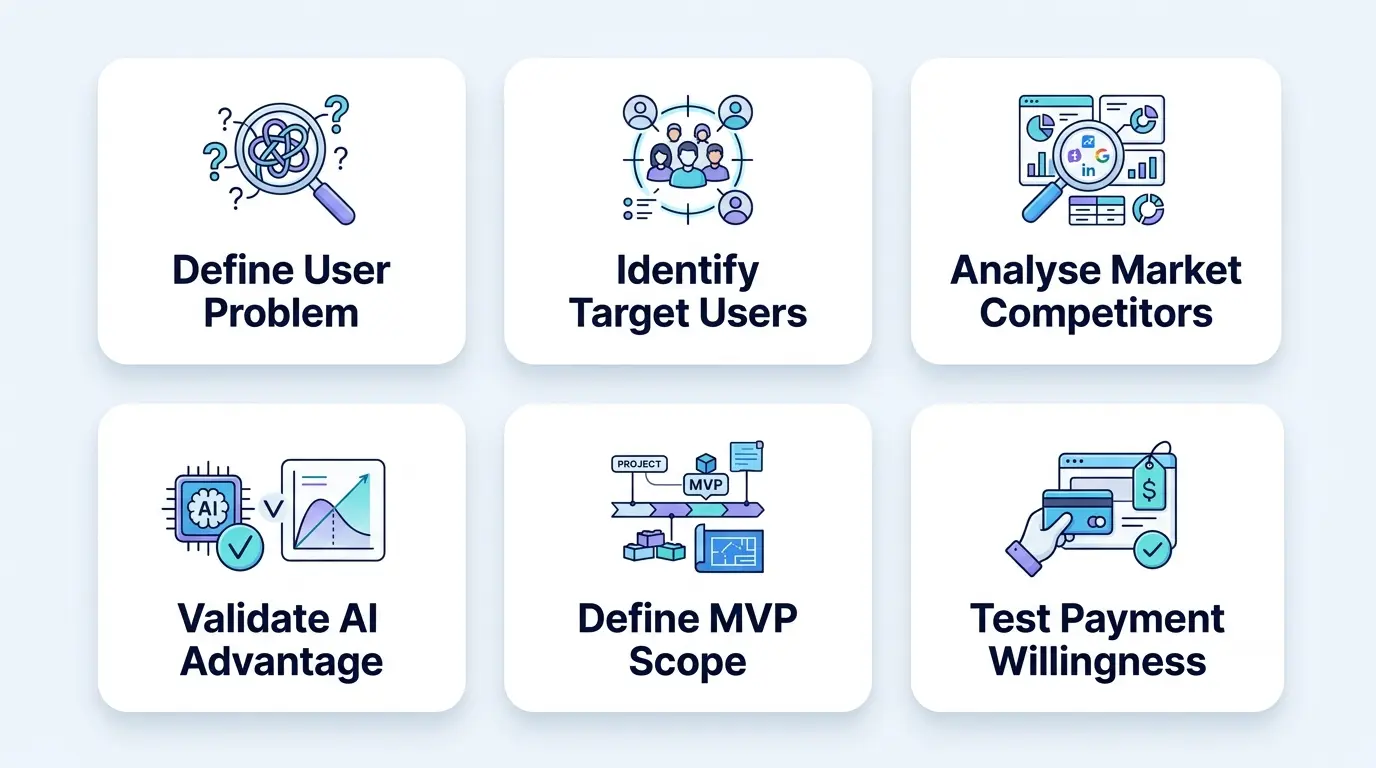
Step 1: Define the Problem
Start with the user’s problem rather than the technology.
Instead of saying, “I want to build an AI travel app,” define the problem as, “Travellers struggle to create realistic multi-city itineraries that fit their budget and available time.”
The second statement is specific enough to validate.
Step 2: Identify the Target User
Define who experiences the problem and who will pay for the solution.
For B2B applications, identify the person experiencing the problem, the decision-maker, and the budget owner. They may be different people.
Step 3: Study Competitors
Existing competitors can actually be useful evidence.
Analyse their pricing, target audience, features, customer reviews, positioning, integrations, and limitations. The objective is not simply to find an idea nobody has built. It is to identify a problem that existing products do not solve sufficiently well.
Step 4: Validate the AI Advantage
Ask what AI changes.
If the application would deliver essentially the same value using conventional software, AI may not be necessary.
If AI enables prediction, personalisation, automation, natural-language interaction, or large-scale analysis, the technology may provide a meaningful advantage.
Step 5: Define the MVP
The Minimum Viable Product (MVP) should solve the core problem with the smallest reasonable feature set.
For an AI meeting assistant, transcription, summarisation, and action-item extraction may be sufficient initially. CRM automation, advanced analytics, multilingual support, and complex enterprise controls can come later.
Step 6: Test Willingness to Pay
Ask potential customers what they currently spend to solve the problem.
For B2B products, calculate the cost of the existing workflow. If a company spends 30 hours each month performing a repetitive process, an AI product that reduces that workload can communicate value more clearly than a generic claim about AI productivity.
AI App Monetization Models Compared
| Model | How It Charges | Best For | Indicative Price | Time to First Revenue |
| Subscription | Recurring monthly/annual fee | Productivity, education, wellness | $10–$50/user/month | Fast |
| Freemium | Free base + paid features | Consumer apps | Free + $10–$30/month | Medium |
| Usage-based | Charges according to usage | AI generation, agents | Per task/minute/API use | Fast |
| Transaction fee | Percentage of transaction | Commerce, marketplaces | 1%–10% | Medium |
| Per-seat B2B | Charges per business user | Enterprise software | $20–$100/user/month | Medium |
| Licensing | Annual platform fee | Enterprise applications | Custom | Slow |
| Affiliate | Commission from referrals | Travel, retail | Category-dependent | Medium |
Subscription works well for products delivering recurring value, while usage-based pricing suits applications where AI costs vary with activity. B2B products can support higher prices when tied to measurable business outcomes, although they may involve longer sales cycles and integration requirements.
The AI Tech Stack Behind These Apps in 2026
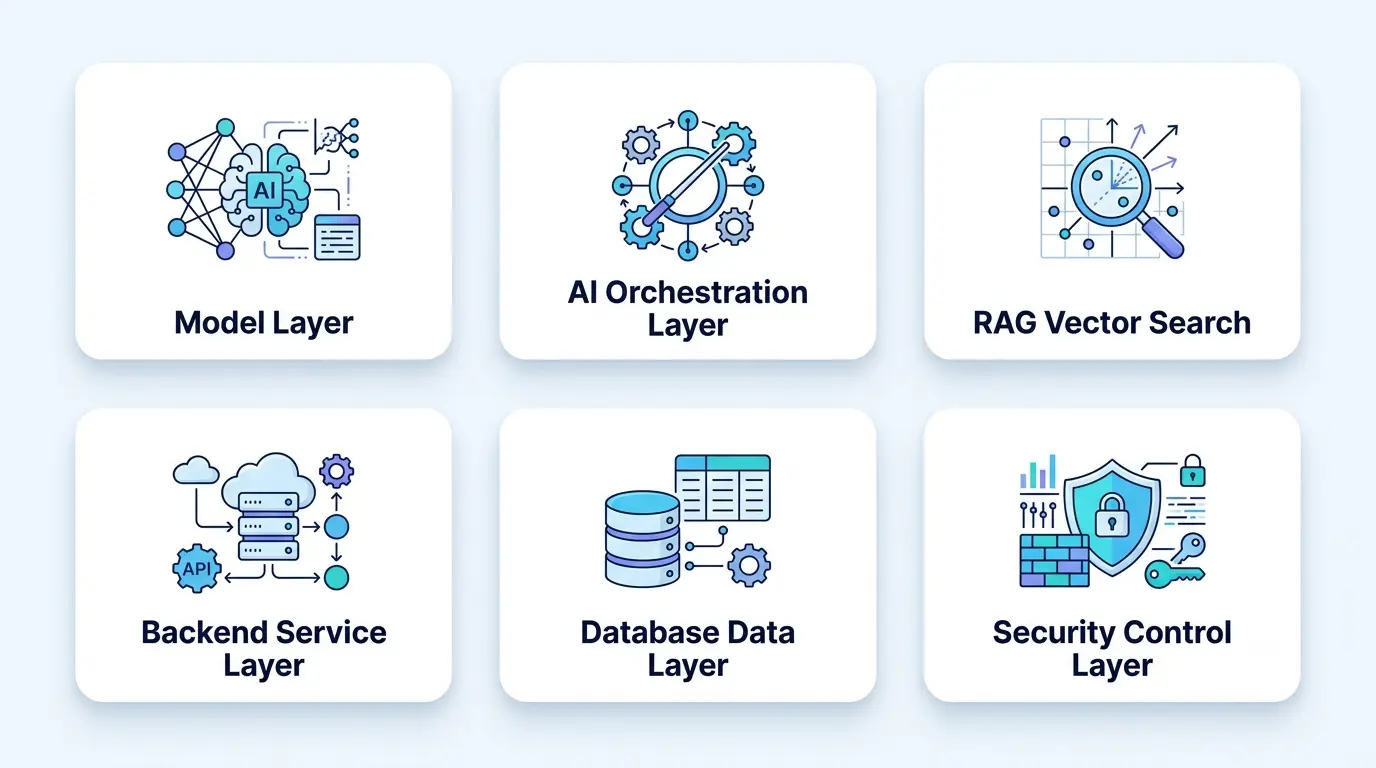
An AI mobile application is more than an interface connected to an LLM. Its architecture typically includes several layers.
Model Layer
Depending on the product, this may include language, multimodal, speech, image-generation, recommendation, classification, or predictive models. Model selection should balance accuracy, latency, cost, privacy, and task requirements.
AI Orchestration Layer
This layer manages prompts, tool calls, retrieval, agent workflows, model routing, guardrails, evaluation, and error handling.
RAG and Vector Search
RAG helps applications use private or domain-specific information. The workflow typically involves retrieving relevant context and passing it to the AI model for a grounded response. Vector databases enable semantic search beyond exact keyword matching.
Backend
Technologies such as Node.js, Python, Java, and .NET can handle authentication, business logic, APIs, AI requests, payments, integrations, and data processing.
Database and Data Layer
PostgreSQL, MySQL, MongoDB, Redis, vector databases, and object storage may support different AI workflows. The architecture should match the product’s actual data requirements.
Security
AI applications should address authentication, authorisation, encryption, API security, access controls, audit logs, sensitive-data handling, prompt-injection protection, and output validation. Healthcare, finance, legal, and enterprise products require stronger controls.
How Much Does It Cost to Build an AI App?
AI app development cost depends on AI complexity, scope, integrations, data requirements, platform requirements, security, and team composition.
| AI App Type | Estimated Cost | Timeline |
| Basic AI MVP | $40,000–$80,000 | 10–16 weeks |
| Mid-Level AI App | $80,000–$180,000 | 16–26 weeks |
| Advanced AI App | $180,000–$250,000+ | 24–36 weeks |
| Enterprise AI Platform | $250,000+ | 30+ weeks |
These estimates retain the article’s existing cost model while adding timeline context.
AI model requirements affect cost significantly. Using an existing model API is generally less expensive than developing and maintaining a specialised model.
Data requirements can add costs for collection, cleaning, annotation, storage, governance, and processing.
Integrations with EHRs, CRMs, ERPs, payment systems, social APIs, IoT devices, or financial platforms can require additional engineering.
Security and compliance increase costs, particularly for healthcare and finance applications that require stronger data protection, access controls, auditability, and testing.
Platform scope also matters. A focused mobile MVP typically costs less than a product requiring native iOS, Android, web dashboards, and administrative systems.
AI operating costs should also be considered. Inference, storage, vector search, transcription, image generation, monitoring, and data processing can become significant recurring expenses as usage grows.

Common Mistakes Founders Make When Picking an AI App Idea
| Mistake | What It Costs You | Better Approach |
| Building AI for novelty | Weak adoption | Start with a real problem |
| Copying a popular AI app | High competition | Identify a specific underserved segment |
| Ignoring data requirements | Delays and redesign | Validate data access early |
| Building too many features | Higher cost | Define a focused MVP |
| Assuming an API solves everything | Poor product quality | Design the complete AI workflow |
| Ignoring inference costs | Weak unit economics | Model AI operating costs |
| Skipping customer validation | Wasted development | Test demand before coding |
| Treating AI output as always correct | Trust and safety problems | Add validation and human oversight |
| Ignoring privacy | Security and compliance risk | Design data governance from the beginning |
| Choosing technology before the problem | Overengineering | Start with customer needs |
The most common strategic mistake is confusing technological possibility with business opportunity. A model may be able to perform a task, but that does not mean users need an application built around it.
What Investors Ask Before Funding an AI Startup
Investors generally want to understand the business value behind the AI technology.
What Problem Are You Solving?
A founder should be able to explain the problem clearly without relying on AI terminology.
Why Is AI Necessary?
Investors want to know what AI enables that conventional software cannot provide efficiently.
Who Pays?
A clear customer and purchasing model is more valuable than a broad statement that the product can serve everyone.
How Are You Different?
If competitors can reproduce the product simply by connecting to the same model API, differentiation may be weak.
Defensibility can come from proprietary data, specialised workflows, integrations, domain expertise, distribution, network effects, or superior user experience.
What Is Your Data Advantage?
Data can become a competitive asset when it is high quality, legally accessible, useful for the product, and difficult for competitors to replicate.
What Are Your Unit Economics?
AI startups should understand revenue per customer alongside model, infrastructure, support, and acquisition costs.
A simple contribution-margin model is:
Revenue per user − AI costs − infrastructure costs − support costs = contribution margin
Can the Product Scale?
Investors need confidence that revenue can grow faster than infrastructure and support costs.
The growth potential of AI-native businesses is real, but it should not be treated as a guarantee. Bessemer’s 2025 Cloud 100 research found that AI companies in its cohort reached $100 million ARR in an average of 5.7 years, compared with 7.5 years for the broader Cloud 100. (Bessemer Venture Partners)
Real AI Apps That Scaled: and What They Did Right
Successful AI products solve a specific problem rather than using AI simply for its own sake.
Mednovate Connect
Mednovate Connect is a telemedicine application focused on medication management. It combines personalised medication plans, virtual consultations with licensed clinical pharmacists, medication reminders, drug interaction and dose-checking tools, and secure communication. RipenApps developed the iOS and Android application in three months.
The key lesson is that specialised digital products can create value by bringing multiple capabilities together around a clear, recurring healthcare need.
Motion Learning
Motion Learning is an AI-powered education platform for students preparing for JEE, NEET, CUET, Boards, and Olympiads. RipenApps integrated machine-learning models for personalised study plans, practice recommendations, and weak-area tracking, alongside AI-enabled study materials and real-time performance insights.
The platform reports 500K+ downloads, 100K+ daily active users, 12.8K positive reviews, and a 4.5 App Store rating.
The key lesson is that AI becomes more valuable when personalisation is connected to a specific user outcome. Motion Learning integrates AI into the broader learning experience rather than treating it as a standalone feature.
AI Mobile App Ideas for Solo Founders and Micro-SaaS
Solo founders should avoid starting with AI products that require massive proprietary datasets, complex enterprise integrations, or expensive infrastructure.
A better approach is to identify a narrow workflow that can be automated using existing AI APIs.
An AI proposal generator can create customised proposals from client requirements and predefined business information. This is relatively easy to validate because the output is tangible and the target users are easy to identify.
An AI review-response assistant can help local businesses respond to customer reviews while maintaining brand tone. The MVP can remain focused on review analysis and response generation.
An AI meeting assistant for a specific profession can be more defensible than a general meeting assistant. For example, a product designed specifically for recruitment agencies, consultants, or property managers can use domain-specific templates and workflows.
An AI knowledge assistant for a specific profession can also work as a micro-SaaS model. Instead of competing with general enterprise search platforms, the product can focus on a particular document set and user group.
The micro-SaaS principle is straightforward: choose a narrow audience, solve a recurring problem, use AI where it provides a measurable advantage, and keep the MVP small enough to validate quickly.
AI Mobile App Ideas for Small Businesses
Small businesses generally benefit most from AI products tied directly to revenue, customer service, or operational efficiency.
An AI customer-support assistant can answer repetitive questions and reduce the workload on staff.
An AI invoice and expense assistant can extract information from receipts and organise financial records.
An AI lead qualification application can score incoming leads according to predefined business criteria and prioritise prospects for sales teams.
An AI marketing assistant can help businesses generate campaigns, analyse customer segments, and prepare content.
An AI appointment assistant can handle booking questions, reminders, cancellations, and schedule changes.
An AI inventory assistant can analyse sales history and alert businesses about potential stockouts or slow-moving products.
The strongest SMB applications usually have an easily understandable financial benefit. Saving staff time is valuable, but showing how that saved time affects revenue, customer response, or operating costs is even more persuasive.
AI Mobile App Ideas for Students and Beginners
Students and beginner developers should generally select ideas that can be built with established APIs and straightforward application architecture.
An AI study planner can generate schedules based on exams, deadlines, and learning progress.
An AI flashcard generator can convert notes or documents into revision material.
An AI interview practice application can simulate interviews and provide feedback on answers.
An AI language-practice application can provide conversational exercises and corrections.
An AI resume assistant can help users tailor resumes to specific job descriptions.
An AI coding tutor can explain programming concepts and create practice problems.
The purpose of a beginner AI project should not necessarily be to create a groundbreaking startup. It can be an opportunity to understand model APIs, prompt design, backend integration, data handling, authentication, user experience, and AI evaluation.
AI Mobile App Ideas That Make Money Fastest
No AI app idea guarantees fast profitability. Revenue depends on customer acquisition, retention, pricing, competition, AI operating costs, and product quality.
However, certain categories have characteristics that can shorten the path to monetisation.
| Idea Category | MVP Speed | Revenue Potential | Acquisition Difficulty |
| Niche B2B productivity | Fast | High | Medium |
| Document assistant | Fast | High | Medium |
| Meeting assistant | Fast | Medium–High | High |
| SMB automation | Medium | High | Medium |
| Fitness application | Medium | Medium | High |
| Travel planner | Fast | Medium | High |
| Enterprise agent | Slow | Very High | High |
| Healthcare AI | Slow | High | High |
B2B applications can support higher revenue per customer because the value is connected to operational efficiency. However, enterprise sales cycles can take longer.
Consumer applications can launch quickly but often require stronger distribution and retention strategies.
Therefore, the fastest MVP is not necessarily the fastest path to sustainable revenue.
Can You Build an AI App Without Coding?
Yes, no-code and low-code tools can help founders test simple AI workflows before investing in a complete engineering project.
This approach can be useful for prototypes, internal tools, proof-of-concept workflows, and early customer validation.
However, no-code tools have limitations.
A simple AI content generator may work well with an existing platform. A regulated healthcare assistant, enterprise workflow agent, or high-volume recommendation platform will generally require professional engineering.
Professional development becomes more important when the product needs custom integrations, scalable architecture, complex authentication, advanced AI orchestration, native mobile capabilities, enterprise security, regulated data handling, or specialised analytics.
A sensible approach is to use lightweight tools for validation where appropriate and then move to production-grade architecture once the concept demonstrates demand.
Why Build Your AI App With RipenApps
An AI product requires more than connecting an application to a model API.
The development process needs to connect product strategy, user experience, AI architecture, backend engineering, integrations, testing, security, deployment, and ongoing optimisation.
RipenApps can support AI product development across these areas, from defining an AI use case and shaping the MVP to integrating AI capabilities into a scalable application architecture.
The important consideration is not simply whether a development team can add AI to an application. It is whether the team can help translate the AI capability into a reliable product workflow that users will actually adopt.
Final Thoughts
The best AI app idea is not always the most advanced or ambitious. It is one that solves a meaningful problem, serves a specific audience, creates measurable value, and has a viable path to monetisation.
Start by validating the problem, understanding your target users, studying competitors, and confirming willingness to pay. Then determine whether AI genuinely improves the experience, define a focused MVP, and estimate development and ongoing AI costs.
If the idea is validated, MVP development services can help turn the concept into a focused, testable product while reducing unnecessary development risks. Ultimately, the right AI app is not simply the one you can build, but the one customers genuinely need and are willing to pay for.
FAQs
Which AI app idea is most profitable?
There is no universally most profitable AI app idea. B2B applications such as workflow automation, enterprise knowledge search, fraud detection, sales intelligence, and specialised healthcare AI can have strong revenue potential because businesses may pay more for measurable operational value. Profitability ultimately depends on customer acquisition, retention, pricing, competition, and AI operating costs.
How do I know if my AI app idea is already taken?
Search app stores, Google, startup databases, product directories, and industry-specific platforms for similar products. Compare their target audience, pricing, features, reviews, integrations, and positioning. An existing competitor does not automatically invalidate your idea. It may actually demonstrate that demand already exists. The more important question is whether you can serve the market differently.
Can I build an AI app without an ML team?
Yes. Many applications can initially use established AI APIs instead of custom machine-learning models. An ML team becomes more important when the product needs specialised prediction models, proprietary training data, custom model optimisation, advanced computer vision, or model performance beyond general-purpose APIs.
How much does it cost to build an AI app MVP?
A focused AI MVP can generally fall around $40,000–$80,000, while more sophisticated MVPs may require $80,000–$180,000 or more. The actual cost depends on features, AI architecture, integrations, platform scope, security, data requirements, and development resources.
What’s the fastest AI app idea to launch?
Narrow AI productivity tools, document assistants, content-generation applications, meeting summarisation tools, and specialised workflow assistants can generally be launched faster than applications requiring custom models, complex hardware integrations, or regulated data.
Do I need my own AI model or can I use an API?
You can use an existing AI API for many applications. This is often the most practical approach for an MVP because it reduces development complexity and allows faster validation. A proprietary model may become valuable later if you have specialised data, high usage, unique performance requirements, or a strong model-based competitive advantage.
How long does it take to build an AI-powered app?
A focused AI MVP can take roughly 10–16 weeks, while mid-level applications may take 16–26 weeks. Advanced products involving custom models, multiple integrations, complex workflows, or enterprise security can take six months or longer.
What AI Mobile app ideas work for a small business?
AI customer-support assistants, lead-qualification tools, bookkeeping assistants, marketing assistants, appointment assistants, inventory tools, and document-processing applications can work well for SMBs because they address specific operational problems and can provide measurable time or cost savings.
Can you build an AI app without coding?
Yes. No-code and low-code platforms can be useful for prototypes and simple AI workflows. Production applications generally need professional development when they require custom integrations, scalability, complex business logic, advanced AI orchestration, security, regulated data handling, or native mobile functionality.
Discuss your project and request for proposal
SHARE
WRITTEN BY

Prankur Haldiya
Chief Technical Officer
A tech innovator and engineering leader, Prankur Haldiya drives RipenApps’ product development strategy and oversees cutting-edge solutions in mobility, AI, and cloud ecosystems. He is passionate about building high-performance teams and helping brands launch secure, scalable, and user-centric digital products.
View All Articles