

Quick Summary
AI in real estate helps businesses improve property valuations, personalize property searches, automate workflows, and strengthen fraud detection. This blog explores key benefits, practical app use cases, implementation challenges, and ways to measure ROI. It also highlights real-world examples, including MMH House Design Services, developed by RipenApps, to demonstrate how AI can enhance home design experiences.
AI is becoming part of everyday real estate operations, from property marketing and valuation to customer service and property management. According to the National Association of REALTORS 2026 Technology Report, 41% of surveyed agents use AI-generated content, while 75% of agents using AI rely on it to write listing descriptions.
Beyond marketing, AI can personalize property searches, analyze market trends, and automate document processing. However, successful adoption requires reliable data, appropriate integrations, and strong privacy safeguards.
In this blog, we explore the key benefits, app use cases, and implementation challenges of AI in real estate, including how AI integration services can help businesses integrate intelligent capabilities into existing platforms and workflows.
Table of Contents
What Does AI in Real Estate Mean?
Artificial intelligence (AI) in real estate refers to the use of intelligent technologies to analyze property data, automate workflows, and support decisions across buying, selling, investing, and property management. Real estate businesses use AI-powered applications to understand market trends, assess property values, personalize property searches, and improve customer service.
Several AI technologies enable these capabilities, each addressing different business needs. The most common include:
- Machine Learning (ML): Analyzes historical property data, pricing patterns, and market trends to support property valuation and investment forecasting.
- Natural Language Processing (NLP): Powers AI chatbots, virtual assistants, and conversational property searches that help buyers and tenants find relevant information.
- Computer Vision: Analyzes property photos, videos, and other visual data to classify property features, assess visible conditions, and support inspection workflows.
- Predictive Analytics: Uses historical and current data to forecast property demand, rental trends, maintenance requirements, and potential investment risks. Learn more about predictive analytics for mobile apps.
- Intelligent Automation: Automates repetitive tasks such as lead qualification, appointment scheduling, document processing, and customer follow-ups, reducing manual effort.
Together, these technologies help real estate businesses turn property data into actionable insights, improve operational efficiency, and deliver more relevant customer experiences.
Top Benefits of AI in Real Estate
AI is helping real estate businesses improve property valuations, personalize customer experiences, streamline operations, and make better-informed decisions. From predictive analytics to automated workflows, these capabilities can reduce manual work and help businesses respond more effectively to market demands.
1. Improved Property Valuation
AI-powered valuation models analyze historical sales, property characteristics, location data, and market trends to estimate property values. These insights help agents and investors compare properties, identify pricing patterns, and make more informed decisions.
However, AI estimates should complement professional judgment rather than replace property inspections or formal appraisals.
2. Enhanced Customer Experience
AI enables real estate platforms to deliver personalized property recommendations based on users’ budgets, preferred locations, property types, and search behavior. Chatbots and virtual assistants can answer routine questions, share listing details, and help users shortlist properties outside business hours.
This makes property discovery more convenient while allowing agents to focus on complex customer needs.
3. More Effective Marketing and Lead Generation
AI helps real estate businesses create compelling property descriptions, personalize marketing campaigns, segment audiences, and identify promising leads. By analyzing customer preferences, browsing behavior, and past interactions, AI tools can recommend relevant properties and tailor outreach to potential buyers.
AI-powered lead scoring can also help sales teams prioritize prospects based on their likelihood of converting. Combined with timely follow-ups and personalized communication, these capabilities can improve marketing efficiency and help businesses turn more inquiries into qualified leads.
4. Predictive Analytics and Market Insights
AI models can analyze historical transactions, demand patterns, inventory levels, and economic indicators to identify potential market shifts. Investors and property managers can use these insights to assess emerging opportunities, forecast demand, and evaluate investment risks.
Predictions remain estimates, so decisions should also account for local market conditions and changing economic factors.
5. Optimized Property Management and Energy Efficiency
AI-powered property management systems can monitor equipment performance, identify unusual energy consumption, and predict maintenance requirements. These capabilities help property managers address potential issues before they lead to costly breakdowns.
Smart building systems can also adjust lighting, heating, and cooling based on occupancy patterns, supporting more efficient energy use.
6. Faster Transactions and Document Management
Real estate transactions involve contracts, disclosures, identity checks, and other documents that require careful review. AI can extract relevant information, organize records, summarize documents, and flag missing fields for further review.
Combined with digital signatures and workflow automation, these capabilities can reduce administrative delays while keeping professionals involved in important legal and financial decisions.
7. Better Fraud Detection and Risk Management
AI can identify unusual transaction patterns, suspicious account activity, inconsistent documentation, and potential identity mismatches. When the system flags suspicious activity, it can route the transaction for manual verification before funds are transferred or documents are finalized.
Human review remains essential because AI alerts can produce false positives or miss sophisticated fraud attempts.
AI can help real estate businesses make faster decisions, improve customer service, and manage operational risks. The greatest value comes from applying it to specific business problems and evaluating results through measurable outcomes such as lead conversion, response times, maintenance costs, and transaction efficiency.
Read also: Real Estate App Development: All-inclusive Guide to Pave Light in your Path
How to Use AI in Real Estate
Implementing AI in real estate requires more than choosing the right technology. Businesses need to identify operational problems, assess data readiness, select appropriate solutions, and measure whether those solutions deliver tangible results. According to McKinsey’s AI measurement framework, organizations should connect technical performance and user adoption to operational improvements and financial outcomes.
1. Identify Business Problems and Define Success Metrics
Start by identifying processes where AI could improve efficiency, reduce costs, or increase revenue. Common opportunities include lead qualification, property search, document processing, valuation, and maintenance management.
Define measurable success criteria before selecting a solution. For example, a brokerage could track lead response time, qualified appointments booked, and lead-to-viewing conversion. A property management company might measure maintenance response time, recurring repair costs, and operating expenses per property.
2. Assess Data Quality and System Readiness
AI depends on reliable data, including property listings, transaction histories, customer interactions, maintenance records, and lease documents. Review whether these records are accurate, consistent, current, and accessible to authorized systems.
Identify integration requirements for existing CRMs, property management platforms, listing databases, and document management tools. Establish data access controls and privacy safeguards before using sensitive customer or transaction information.
3. Select the Right AI Approach
Choose AI capabilities based on the business problem rather than adopting technology without a clear purpose. Predictive models may support property valuation and maintenance forecasting, while natural language processing can power conversational search and document extraction.
For example, a real estate agency seeking faster lead qualification could pilot an AI assistant connected to its CRM. Evaluate whether the solution improves response times and qualified appointments without increasing inaccurate recommendations or unnecessary follow-ups.
4. Run a Pilot and Measure Operational Performance
Test the solution in a limited workflow before expanding it across the business. Compare its performance with a documented baseline from the existing process, using comparable properties, transactions, teams, or time periods.
Relevant evaluation criteria include:
- Lead management: Average response time, qualified appointments booked, and lead conversion rate.
- Document processing: Average time to process leases or transaction documents, extraction accuracy, and manual rework.
- Property valuation: Difference between AI estimates and verified sale prices across comparable properties.
- Maintenance operations: Response and resolution times, unplanned repairs, and operating costs per property.
- Financial performance: Labor hours saved, cost per transaction, total implementation and operating costs, and net savings.
These measures help determine whether AI improves the workflow, not simply whether employees use the tool.
5. Calculate ROI and Scale What Works
Before expanding deployment, compare measurable benefits with the full cost of implementation. Include software licenses, integration, data preparation, training, maintenance, and ongoing AI usage.
For example, if automated document processing reduces staff time, calculate the value of hours saved and subtract the solution’s operating costs. Similarly, a lead qualification tool should be evaluated against changes in qualified appointments and conversions, not chatbot interactions alone.
Scale the solution when results demonstrate sustained operational improvement, acceptable accuracy, and a credible financial return. Continue monitoring performance after deployment to identify errors, changing data patterns, rising costs, or declining results.
The most effective AI strategy connects each use case to a business objective, establishes measurable targets, and reviews results regularly. By prioritizing verified improvements in revenue, cost efficiency, customer experience, and operational performance, real estate businesses can make more informed investment decisions.
Use Cases of AI in Real Estate App Development
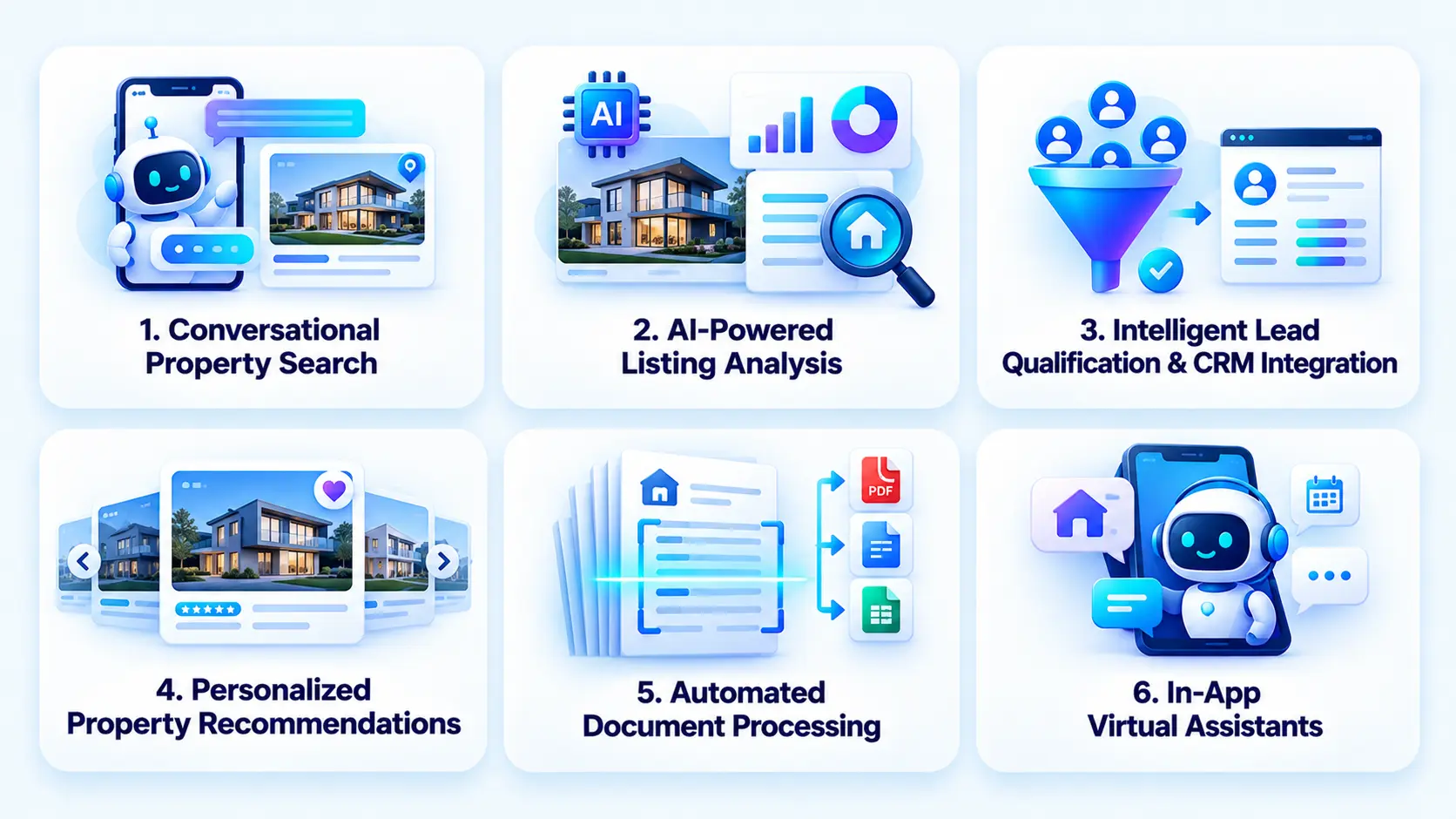
AI in real estate app development enables product teams to build features that simplify property discovery, automate communication, and connect users with relevant services. The following use cases focus on how these capabilities work within an app and support real estate workflows.
1. Conversational Property Search
AI-powered conversational search lets users describe their requirements in natural language instead of relying only on filters. For example, a user might search for “a two-bedroom apartment near metro stations with parking under $300,000.” Natural language processing interprets the budget, property type, location preferences, and amenities, then matches them against listing data.
Developers can connect this feature to property databases, geolocation services, and listing APIs to return relevant results. Follow-up prompts can refine the search as users change their preferences.
2. AI-Powered Listing Analysis
Real estate apps can use computer vision and natural language processing to organize listing information and make property details easier to explore. Image recognition can identify visual features in uploaded photos, while language models can extract key details from descriptions and documents.
For example, the app could let users search for listings with a balcony or hardwood floors, provided the system can reliably identify those features. These capabilities depend on accurate listing data and should allow agents or property owners to correct incorrect classifications.
Read Also: AR/VR in Real Estate: Benefits, Use Cases & Future Impact
3. Intelligent Lead Qualification and CRM Integration
AI chatbots can collect information about a user’s budget, preferred location, property type, purchase timeline, and financing readiness. Based on predefined qualification rules, the app can classify the lead and recommend a relevant next step, such as scheduling a viewing or speaking with an agent.
With CRM integration, qualified leads can be sent to the appropriate agent along with conversation history and stated preferences. The system can also trigger follow-up tasks or appointment reminders, reducing manual data entry and helping sales teams respond promptly. Users should know when they are interacting with AI and how their information will be used.
4. Personalized Property Recommendations
Recommendation engines can use saved listings, search history, stated preferences, and app interactions to suggest relevant properties. For instance, when a user repeatedly views homes within a particular price range, the app can prioritize similar listings and notify them when matching properties become available.
Developers can connect recommendation models to listing databases, user profiles, and notification services. Users should also be able to update their preferences and control notifications to keep recommendations relevant.
5. Automated Document Processing
Real estate apps can use optical character recognition (OCR) and AI-based information extraction to process lease agreements, property disclosures, application forms, and other documents. The system can identify key fields, categorize files, and flag missing information before submission.
For example, a rental app could extract applicant details from an uploaded form and populate relevant fields for review. Integration with document storage, electronic signature platforms, and workflow systems can reduce repetitive data entry. Because these documents may have legal or financial implications, users and authorized professionals should verify extracted information before acting on it.
6. In-App Virtual Assistants
An AI assistant can guide users through specific app tasks, such as saving a listing, comparing property details, checking viewing availability, or understanding the next step in an application. Unlike a general chatbot, an integrated assistant can retrieve information from approved app services and initiate permitted actions through connected APIs.
For example, a user asking to schedule a property viewing could receive available appointment slots from a calendar integration and confirm a suitable time within the app. Access controls and confirmation steps should protect personal information and prevent unintended actions.
Challenges in Real Estate When Implementing AI
AI can improve property valuation, customer experiences, and operational efficiency. However, successful implementation depends on data quality, security, integration, and responsible use. Real estate businesses should assess the following challenges before adopting AI solutions.
1. Data Privacy and Security
Real estate platforms handle sensitive information, including customer details, financial records, transaction histories, and property documents. Protecting this data requires strong access controls, encryption, and secure data-handling practices.
Businesses must also comply with applicable privacy laws, such as GDPR or CCPA, depending on their markets and operations.
2. Data Quality and Availability
AI systems rely on accurate, consistent, and relevant data to generate reliable predictions. Incomplete property records, outdated listings, inconsistent pricing information, and fragmented market data can undermine model performance.
Real estate businesses need effective data management processes to consolidate information from multiple sources and maintain its quality over time.
3. High Implementation and Maintenance Costs
Integrating AI into real estate applications can require significant investment in development, data infrastructure, system integration, and testing. Ongoing expenses include model monitoring, security updates, and performance improvements.
Working with an experienced AI app development company can help businesses evaluate technical requirements, prioritize valuable features, and plan costs before development begins.
4. Integration With Existing Systems
Real estate companies may rely on legacy property management platforms, customer relationship management (CRM) systems, and transaction tools. Connecting AI features with these systems can be complex when data formats, APIs, or workflows are incompatible.
Businesses should evaluate integration requirements early to reduce disruptions and avoid unnecessary changes to established operations.
5. Algorithmic Bias and Regulatory Uncertainty
AI models can produce biased recommendations or valuations when trained on incomplete or historically biased data. In real estate, these issues can affect property recommendations, pricing decisions, and access to housing opportunities.
Businesses need to test models for bias, maintain appropriate human oversight, and review applicable housing, privacy, and AI regulations as they evolve.
6. Employee Adoption and Skills Gaps
Real estate professionals may hesitate to adopt AI because of unfamiliar workflows, concerns about job security, or uncertainty about the technology’s reliability. Limited in-house expertise can also make implementation and ongoing management more difficult.
Clear communication, practical training, and phased adoption can help teams understand AI’s role and use it effectively in daily operations.
Real-World Examples of AI in Real Estate Apps
AI helps real estate platforms estimate property values, improve property search, and automate agent workflows. The following examples demonstrate how companies apply AI to real-world real estate challenges.
Zillow
Zillow uses machine learning models to power its Zestimate tool, which estimates a property’s market value. It analyzes property characteristics, public records, multiple listing service (MLS) data, and market trends.
The estimate helps buyers and sellers understand potential property values but does not replace a professional appraisal.
Compass
Compass uses AI to help real estate agents streamline daily operations. Its AI Assistant can manage tasks, draft follow-up emails, create saved searches, and identify potential seller leads.
These capabilities reduce administrative work and allow agents to focus more on client relationships.
MMH House Design Services App Developed by RipenApps
RipenApps developed MMH House Design Services, an AI-enabled home design platform that connects homeowners with architects, interior designers, and Vastu specialists. Available on Android and iOS, the app brings professional consultations, design inspiration, and secure payments into one convenient experience.
The platform includes an AI-powered design scoring feature that evaluates home design ideas, helping users compare options during the planning process. It also supports real-time chat and calls for direct consultation with design professionals.
RipenApps delivered the app in three months, combining scalable AWS-powered infrastructure, professional matching, and payment integration. According to the case study, the platform achieved 10K+ downloads and 9,000+ daily active users.
MMH demonstrates how AI-driven features can complement real estate and home design applications by making design discovery more accessible and connecting users with relevant professionals.

Conclusion
AI is creating new opportunities for real estate businesses to improve decision-making, automate workflows, and deliver more relevant customer experiences. Successful implementation starts with clearly defined business goals, reliable data, appropriate integrations, and measurable performance targets. Businesses planning these solutions can work with an experienced real estate app development company to align technology with their operational needs.
RipenApps helps businesses develop real estate applications with intelligent features tailored to their goals. From AI integration to scalable app development, the focus is on creating practical solutions that improve workflows and support long-term business growth.
FAQs
1. How is AI used in real estate apps?
AI in real estate apps supports property valuation, personalized property recommendations, image recognition, virtual assistants, predictive analytics, and automated customer support. These capabilities help buyers find suitable properties and enable agents to manage their workflows more efficiently.
2. What are the benefits of AI in real estate?
AI helps real estate businesses improve operational efficiency, automate repetitive tasks, analyze market trends, personalize property searches, and support data-driven decisions. It can also enhance customer experiences through faster responses and more relevant property recommendations.
3. How much does it cost to develop an AI-powered real estate app?
Developing an AI-powered real estate app can cost approximately $30,000 to $150,000 or more, depending on its features, complexity, integrations, and AI model requirements. Advanced capabilities such as predictive analytics, virtual property tours, and custom AI models can increase development costs.
4. What AI features can be integrated into a real estate app?
Common AI features include property recommendation engines, automated property valuation, AI chatbots, image-based property search, virtual assistants, predictive market analysis, and lead scoring. The right features depend on the app’s target audience and business objectives.
5. What challenges do businesses face when implementing AI in real estate?
Common challenges include data privacy, cybersecurity risks, inconsistent property data, integration with existing systems, and the cost of implementation. Businesses should establish strong data governance, validate AI-generated insights, and monitor system performance to address these concerns.
6. How can businesses develop an AI-powered real estate app?
Businesses should identify their target audience, define key use cases, select suitable AI technologies, and plan integrations with property databases and other systems.
Discuss your project and request for proposal
SHARE
WRITTEN BY

Prankur Haldiya
Chief Technical Officer
A tech innovator and engineering leader, Prankur Haldiya drives RipenApps’ product development strategy and oversees cutting-edge solutions in mobility, AI, and cloud ecosystems. He is passionate about building high-performance teams and helping brands launch secure, scalable, and user-centric digital products.
View All Articles