

Quick Summary
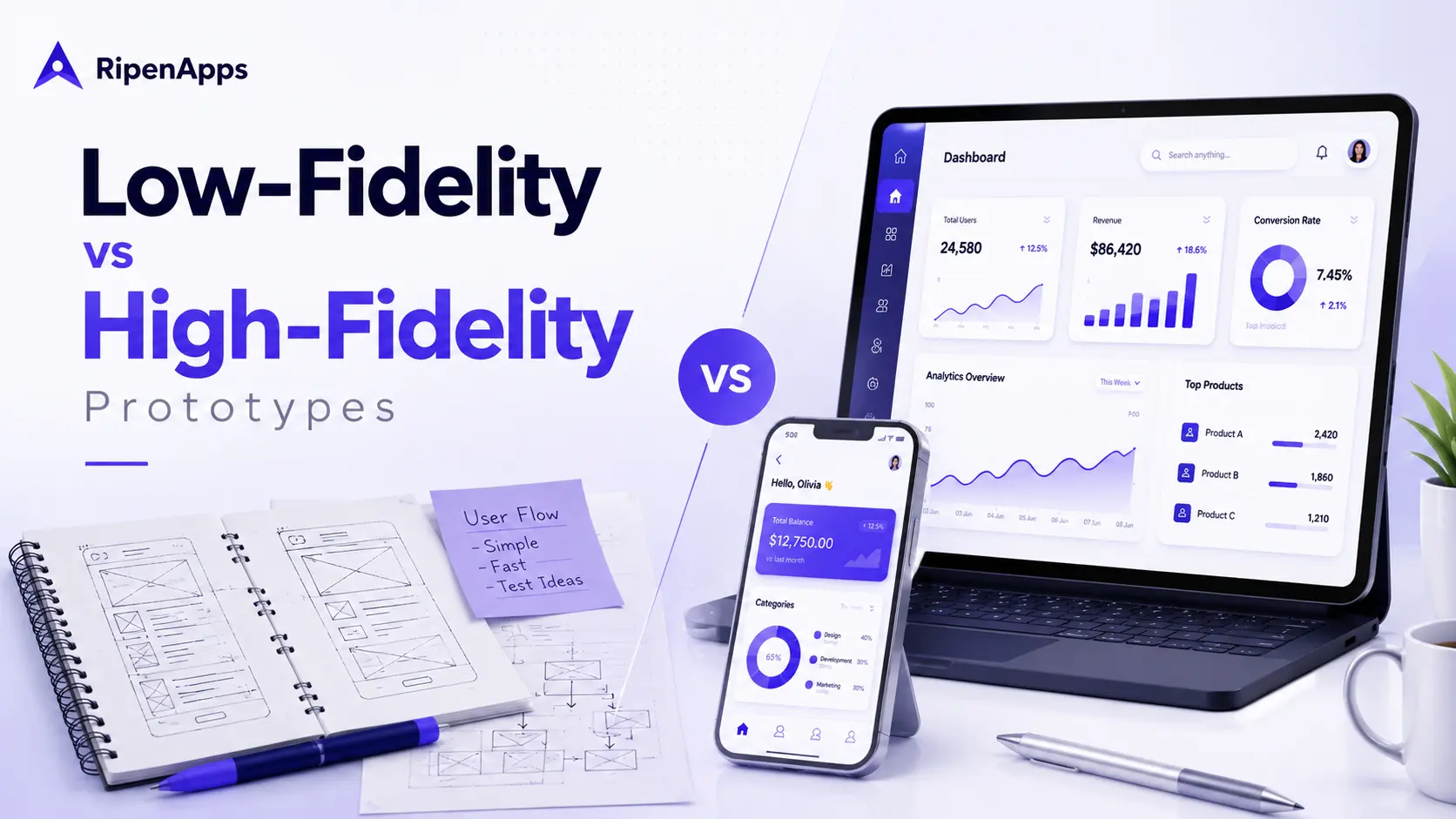
Low-fidelity vs. high-fidelity prototypes differ in realism, cost, and purpose. A low-fidelity prototype enables fast idea validation and user-flow testing, while a high-fidelity prototype supports realistic usability testing, stakeholder alignment, and development planning. The most effective product teams use both strategically to reduce risk, minimize rework, and accelerate product success.
Key Takeaways
- Low-fidelity prototypes prioritize speed, exploration, and early validation.
- High-fidelity prototypes focus on realism, usability testing, and development readiness.
- Mid-fidelity prototypes often provide the most cost-effective balance between speed and clarity.
- Choosing the wrong fidelity level creates unnecessary rework and delays.
- Prototype fidelity should align with project uncertainty, budget, and business goals.
- The best product teams move progressively from low fidelity to higher fidelity rather than jumping directly into polished designs.
Low-fidelity and high-fidelity prototypes are not simply a design choice; they are a business decision that directly impacts product costs, development speed, user validation, and long-term ROI. Choosing the wrong prototype fidelity at the wrong stage can lead to unnecessary spending, delayed releases, and costly product rework.
Prototype fidelity determines how effectively ideas are validated before development begins. While low-fidelity prototypes help teams test concepts quickly and inexpensively, high-fidelity prototypes provide realistic user experiences that support usability testing, stakeholder alignment, and development planning.
As organizations increasingly invest in digital products, the ability to select the right prototyping approach has become a competitive advantage. Strategic UX design, digital transformation initiatives, and a reliable rapid prototyping service rely heavily on making informed fidelity decisions that balance speed, cost, user feedback, and learning outcomes.
In this guide, we’ll compare low fidelity vs high fidelity prototypes, explore their cost implications, highlight common decision-making mistakes, and introduce practical frameworks that help businesses choose the right fidelity level for every stage of product development.
Table of Contents
What does “Fidelity” Mean in Prototyping?
Prototype fidelity refers to how closely a prototype resembles the final product in terms of design, functionality, content, and user interaction.
Rather than viewing fidelity as a simple low-versus-high decision, modern UX teams treat it as a spectrum. Different levels of fidelity help answer specific business and product questions throughout the development lifecycle, much like understanding the distinction between UI vs UX Design helps teams balance visual aesthetics with overall user experience.
A low-fidelity prototype may look like rough sketches and simple wireframes, while a high-fidelity prototype can closely replicate a finished application.
The Three Dimensions of Fidelity
Prototype fidelity is measured across three key dimensions: visual appearance, user interactions, and content realism. Together, these dimensions determine how closely a prototype represents the final product experience and the quality of insights it can generate during testing.
Visual Fidelity
Visual fidelity refers to how closely a prototype matches the final user interface. It includes colors, typography, spacing, branding, and visual hierarchy.
Functional Fidelity
Functional fidelity measures how realistically users can interact with a prototype. This includes navigation, animations, transitions, and user flows.
Content Fidelity
Content fidelity focuses on the realism of information displayed within the prototype. Placeholder text provides less value than real content when conducting advanced usability testing.
Understanding these dimensions helps product teams avoid a common mistake: assuming a visually polished design automatically provides meaningful validation.
What is a Low-Fidelity Prototype?
A low fidelity prototype is a simple representation of a product concept designed to test ideas quickly before investing heavily in design and development.
Low fidelity meaning in UX primarily revolves around speed, flexibility, and exploration. These prototypes intentionally avoid visual polish so stakeholders focus on structure and functionality rather than aesthetics.
Common Low-Fidelity Formats
- Paper Sketches: Hand-drawn concepts remain one of the fastest ways to explore ideas.
- Digital Wireframes: Basic layouts created in design tools help teams organize content and workflows.
- Clickable Wireframes: Simple navigation paths provide lightweight interaction testing without requiring detailed designs.
Understanding the differences between Wireframe vs Prototype vs MVP helps teams choose the right validation approach at each product development stage. Organizations often begin with these low-fidelity wireframes to validate assumptions before progressing to interactive prototypes and functional MVPs. Many also leverage a professional wireframing service to accelerate product discovery, improve stakeholder alignment, and establish a strong foundation for future design and development efforts.
Strengths of Low-Fidelity Prototypes
- Extremely fast to create
- Minimal design investment
- Encourages honest stakeholder feedback
- Reduces fear of making changes
- Ideal for brainstorming and concept validation
Limitations of Low-Fidelity Prototypes
While low-fidelity prototypes are fast and cost-effective, they have certain limitations. Their simplified nature provides limited realism, making it difficult to accurately evaluate user behavior and usability issues.
They may also make it challenging for investors and stakeholders to visualize the final product experience. Additionally, low-fidelity prototypes often lack the detail needed for effective developer handoff and implementation planning.
When Should You Use a Low-Fidelity Prototype?
A low-fidelity prototype is best suited for the early stages of product development when the goal is to explore ideas, test information architecture, validate user flows, and gather stakeholder feedback quickly. It is particularly useful during product discovery workshops and brainstorming sessions, where rapid iteration is more valuable than visual polish.
For example, a food delivery app may begin with a series of hand-drawn screens that outline the ordering journey before moving into more detailed design stages.
A low-fidelity prototype example could be a series of hand-drawn screens representing a food delivery app’s ordering journey.
What is a High-Fidelity Prototype?
A high-fidelity prototype closely resembles the final product in appearance, content, and functionality. What does high fidelity mean? The answer is simple: it means creating a realistic simulation that allows users and stakeholders to experience the product before development begins.
The right choice often depends on the UI/UX design tools your team already works in, as each supports different levels of interaction and realism. According to McKinsey, The State of AI, 2025 report, those tools include AI-assisted design and prototyping features, unsurprising given that around 78% of organizations now use AI in at least one business function, with product and service development among the leading areas. Used well, AI can compress the time and cost of producing high-fidelity prototypes, but it doesn’t change when high fidelity is the right choice.
Common High-Fidelity Formats
- Interactive Figma Prototypes: Designs include advanced navigation, interactions, and visual elements.
- ProtoPie Experiences: These prototypes support sophisticated user testing through realistic behaviors and animations.
- Coded Prototypes: Some organizations create lightweight coded versions for technical validation and stakeholder demonstrations.
The right choice often depends on the UI/UX design tools your team already works in, as each supports different levels of interaction and realism.
Strengths of High-Fidelity Prototypes
- Realistic user testing
- Better stakeholder alignment
- Stronger investor presentations
- Improved developer handoff
- Reduced implementation ambiguity
Organizations investing in professional ux research service frequently rely on high-fidelity prototypes to validate experiences before allocating engineering resources.
Limitations of High-Fidelity Prototypes
Despite the benefits, high-fidelity prototyping has challenges:
- Higher design costs
- Longer creation timelines
- Increased stakeholder expectations
- Risk of premature design commitment
One common issue is the “looks finished” trap. Stakeholders often assume a polished prototype is ready for development when significant technical work remains.
Mid-Fidelity Delivers Practical Validation
Mid-fidelity prototypes typically combine the speed of low-fidelity designs with the clarity of more detailed interfaces. They often feature grayscale screens, defined layouts, structured content, basic navigation flows, and limited interactions, allowing teams to test user journeys and functionality without investing in full visual design.
These prototypes help teams evaluate user journeys without investing heavily in visual design.
For many startups, mid-fidelity becomes the most cost-effective option because it delivers meaningful feedback while avoiding unnecessary design expenses.
Low Fidelity vs High Fidelity Prototypes: What Are the Key Differences?
The following comparison highlights the major differences between low fidelity vs high fidelity prototypes.
| Dimension | Low-Fidelity | High-Fidelity |
| Build Time | Hours to Days | Days to Weeks |
| Relative Cost | Low | Higher |
| Visual Detail | Minimal | Near-Final |
| Interactivity | Limited | Advanced |
| User Testing Accuracy | Moderate | High |
| Stakeholder Buy-In | Moderate | Strong |
| Iteration Speed | Very Fast | Slower |
| Developer Handoff | Limited | Strong |
| Risk Reduction | Early Validation | Detailed Validation |
| Best Use Case | Idea Exploration | Product Refinement |
The best approach is rarely choosing one over the other permanently. Successful product teams progress from low fidelity to higher fidelity as confidence increases and uncertainty decreases.
How Does the Fidelity Cost Curve Affect Product Budgets?
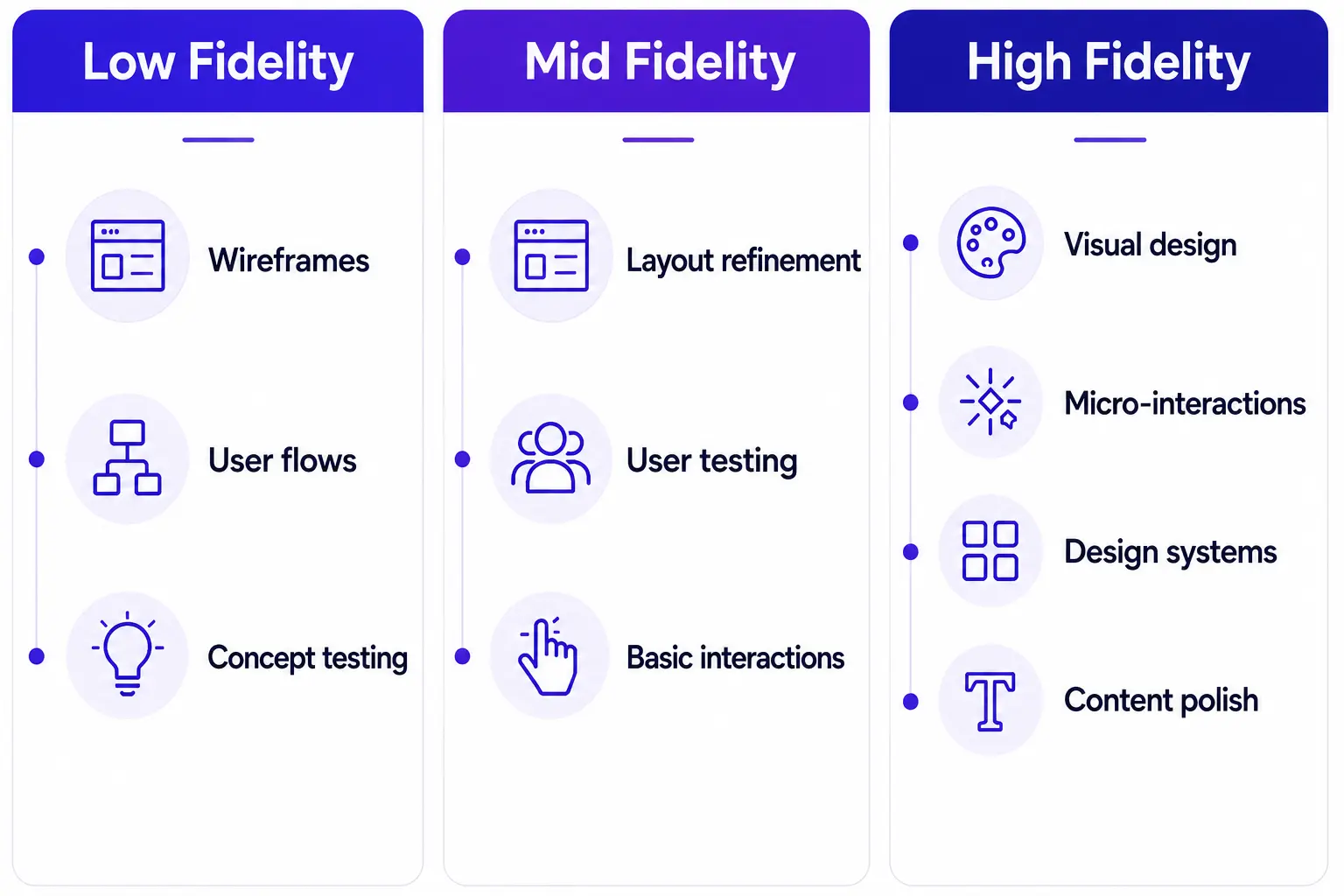
The Fidelity Cost Curve illustrates how costs increase as prototype realism improves.
However, the relationship is not linear.
As teams move from low fidelity design to high fidelity design, they invest more time in:
- Visual design
- User interactions
- Content refinement
- Design systems
- Testing scenarios
Understanding the Fidelity Cost Curve
Here is a table for convenience:
| Fidelity Level | Learning Speed | Build Cost | Rework Cost |
| Low Fidelity | Very High | Low | Very Low |
| Mid Fidelity | High | Moderate | Low |
| High Fidelity | Moderate | High | Lowest Development Risk |
The goal is not to maximize fidelity. The goal is to maximize learning per dollar invested.
At a certain point, additional design polish produces diminishing validation returns. This is where many startups overspend without gaining meaningful insights.
Before committing significant development resources, leaders should carefully estimate your build cost and align fidelity decisions with business objectives.
What Are the Real Cost Implications of Each Fidelity Level?
The cost of prototype fidelity extends beyond design expenses. Each fidelity level impacts validation speed, rework risk, stakeholder alignment, and development efficiency, making it a critical factor in overall product investment and long-term ROI.
Direct Design Costs
Low fidelity prototyping requires fewer hours and fewer specialized resources.
High fidelity prototyping demands:
- Senior UX designers
- UI specialists
- Interaction designers
- Advanced testing tools
These additional resources naturally increase project costs.
The Hidden Cost: Rework
Rework often becomes the largest expense in digital product development.
Identifying usability issues during low-fidelity testing typically requires minimal effort to fix.
Finding those same issues after development begins can significantly increase timelines, budgets, and engineering workloads.
Industry research consistently shows that design-stage validation reduces downstream changes, although exact cost multipliers vary across studies and project types.
Opportunity Cost
Over-investing in prototype polish can delay learning. Under-investing in validation can result in expensive pivots. The most successful organizations balance experimentation with execution.
Avoiding common prototyping mistakes requires aligning fidelity with business objectives rather than stakeholder preferences.
How Can You Choose the Right Fidelity Level?
The right fidelity level depends on your goals, project stage, and the type of feedback you need to gather before moving forward.
The Fidelity Decision Matrix:
| Primary Goal | Recommended Fidelity |
| Problem Validation | Low Fidelity |
| User Flow Testing | Low or Mid Fidelity |
| Navigation Testing | Mid Fidelity |
| Interaction Testing | High Fidelity |
| Stakeholder Buy-In | High Fidelity |
| Investor Presentations | High Fidelity |
| Development Handoff | High Fidelity |
Practical Decision Rules
Teams preparing for product launch often transition from prototype validation toward MVP execution. This approach helps organizations move efficiently from concept validation to product delivery. Partnering with an experienced MVP development company can further streamline this process by ensuring that validated ideas are translated into scalable, market-ready products with minimal risk and rework.
- High Problem Uncertainty: Start with low fidelity.
- Information Architecture Validation: Use low or mid-fidelity prototypes.
- Interaction Testing: Choose high-fidelity prototypes.
- Investor Demonstrations: Use high-fidelity prototypes.
- Development Readiness: High-fidelity designs reduce ambiguity and improve implementation efficiency.
Can You Skip Straight to High-Fidelity?
In some cases, yes. Organizations with mature design systems, well-defined requirements, and strong market insights may move directly to high-fidelity prototypes to accelerate design and development.
However, when user needs, workflows, or product assumptions remain uncertain, skipping early validation can increase the risk of costly redesigns, usability issues, and product-market misalignment later in the development process.
How Do Real-World Apps Use Low-Fidelity and High-Fidelity Prototypes?
The debate around low fidelity vs high fidelity prototypes becomes much clearer when viewed through real product development scenarios. Successful digital products rarely jump directly into polished interfaces. Instead, teams move progressively from low-fidelity prototypes for concept validation to high-fidelity prototypes for usability testing, stakeholder alignment, and development readiness.
This structured approach is a key component of modern product development services, helping businesses reduce risk, validate ideas faster, and make informed investment decisions before development begins. Here are five examples that illustrate how different products can benefit from the right fidelity strategy.
Airbnb: Testing User Flows Before Scaling Globally
Airbnb’s product experience depends heavily on search, booking, and host-management workflows. During product expansion, teams often rely on low-fidelity design to experiment with new features and user journeys quickly.
Once concepts are validated, high-fidelity design enables realistic usability testing to ensure a seamless booking experience across devices and markets.
Uber: Optimizing Rider and Driver Experiences
Ride-hailing applications require highly intuitive interactions for both riders and drivers. Teams typically begin with low fidelity prototypes to validate booking flows, navigation structures, and service logic.
They then transition into high-fidelity prototyping to test real-time interactions, location-based experiences, and transaction workflows before launch.
Spotify: Perfecting User Engagement Through High-Fidelity Testing
Music streaming platforms rely heavily on personalization, content discovery, and engagement. Spotify-like applications often start with low-fidelity wireframes to define navigation and recommendation flows.
As the experience evolves, high-fidelity prototypes help evaluate animations, user interactions, and personalized listening journeys, ensuring a premium user experience before development.
CILIO: How RipenApps Validated Complex Contractor Workflows Before Development
As a contractor and installation management platform, CILIO required seamless workflows for lead management, job scheduling, quoting, retailer integrations, and payment processing. Low-fidelity prototypes would have helped validate information architecture, operational workflows, and user journeys early, allowing stakeholders to refine complex business processes before investing in detailed design.
Once the workflows were validated, high-fidelity prototypes became essential for testing dashboard interactions, task management, navigation, and overall usability. This phased prototyping approach helped establish a user-centric foundation for a scalable platform that streamlines installation management and supports complex contractor operations.
CargoMe: How RipenApps Refined Logistics Workflows Through Progressive Fidelity
Logistics platforms involve complex user journeys, including shipment booking, route tracking, driver coordination, and delivery management. For a platform like CargoMe, starting with a low fidelity prototype helps map operational workflows and identify process bottlenecks.
As requirements mature, high-fidelity prototypes allow teams to test real-world interactions and ensure that every workflow is intuitive before development begins. This approach reduces operational risks and improves product adoption.
Key Insights:
Whether building a logistics solution like CargoMe or global products such as Airbnb, Uber, and Spotify, the most successful teams do not choose between low fidelity vs high fidelity prototype.
Whether you are launching a startup, validating a new product idea, or optimizing an enterprise digital experience, the right UX strategy can dramatically improve ROI. According to Gartner, with worldwide IT spending projected to reach $6.31 trillion in 2026, the gap between validated and invalidated investment compounds quickly.
They strategically use both. Low-fidelity prototypes accelerate learning and reduce uncertainty, while high-fidelity prototypes improve usability validation, stakeholder confidence, and development efficiency. This staged approach minimizes rework, controls costs, and increases the likelihood of product success.
What Is Fidelity Debt and Why Should Businesses Care?
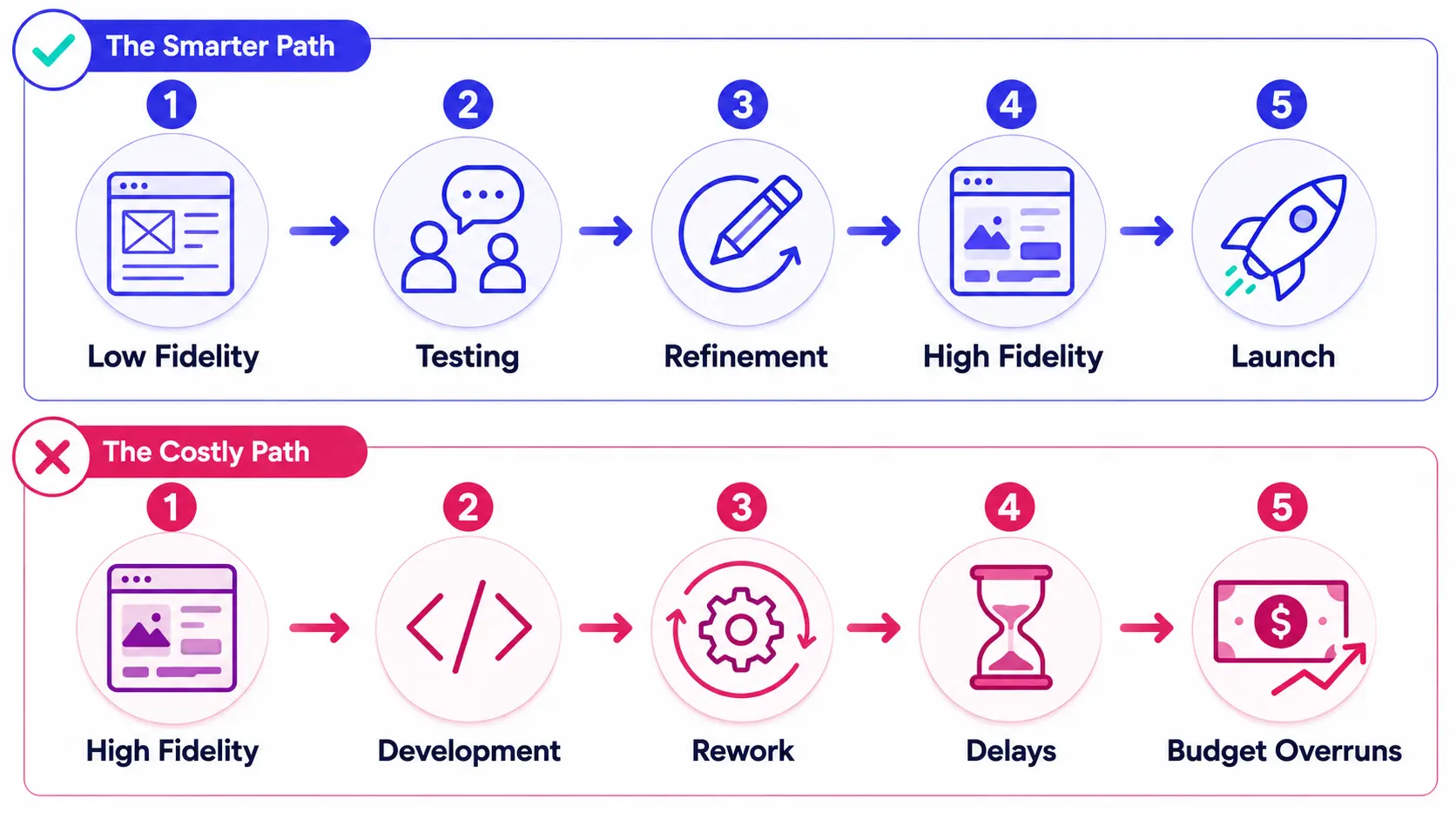
Fidelity Debt refers to the accumulated cost created by choosing the wrong fidelity level at the wrong time.
Just as technical debt creates future engineering challenges, fidelity debt creates future product and design challenges.
The Vanity Polish Trap
One of the most common forms of fidelity debt occurs when teams invest heavily in high-fidelity designs before validating the core product concept. Weeks may be spent perfecting visual elements, animations, and interface details only to discover that the underlying user problem has not been solved.
This premature focus on polish increases design costs, slows learning, and can divert resources away from critical product validation activities.
The Skipped-Validation Pivot
The opposite mistake happens when teams move too quickly from low-fidelity concepts to development without sufficient testing and refinement. While this approach may appear to save time initially, it often results in usability issues, workflow bottlenecks, or feature gaps being discovered after development begins.
Addressing these problems later typically requires expensive redesigns, engineering rework, and project delays.
What UX Decision Pitfalls Should Product Teams Avoid?
Choosing the right prototype fidelity is only part of the equation. Product teams often make strategic mistakes that lead to misleading feedback, wasted design effort, delayed development, and higher costs. A well-planned UI UX design service strategy can help teams avoid these challenges by aligning design decisions with user needs, business goals, and development requirements from the outset.
Testing the Wrong Thing
Different fidelity levels are designed to answer different questions. A low-fidelity prototype is ideal for validating concepts, user flows, and information architecture, while a high-fidelity prototype is better suited for testing detailed interactions and usability.
Using a high-fidelity prototype to assess market demand or validate an unproven idea can result in unnecessary costs without generating meaningful insights.
Confusing Polish with Product-Market Fit
A visually impressive interface can create a false sense of confidence. Stakeholders may assume a product is ready for market simply because it looks complete. However, attractive design alone does not validate user demand, solve customer problems, or guarantee adoption.
Product teams should focus on validating user needs and business value before investing heavily in visual refinement.
Collecting Unrealistic Feedback
The quality of feedback depends heavily on prototype fidelity. Users may overlook usability issues in a low-fidelity prototype because they expect it to be unfinished, while highly polished prototypes can distract stakeholders from providing strategic feedback.
To gain accurate insights, teams should align testing objectives and stakeholder expectations with the appropriate fidelity level.
Ignoring Development Handoff Requirements
A prototype that lacks sufficient detail can create ambiguity for engineering teams. Missing interaction states, unclear workflows, or incomplete specifications often lead to implementation inconsistencies and costly revisions during development. As products move closer to launch, increasing prototype fidelity helps improve developer alignment, reduce rework, and accelerate delivery.
Organizations looking to build MVPs faster should ensure prototype fidelity aligns with both business and technical goals.

Final Thoughts
The debate around low fidelity vs high fidelity prototypes is not about determining which approach is better. It is about identifying which approach is most appropriate for a specific business objective, project stage, and validation requirement. Organizations that align fidelity with uncertainty consistently reduce waste, accelerate learning, and improve product outcomes.
Whether you are launching a startup, validating a new product idea, or optimizing an enterprise digital experience, the right UX strategy can dramatically improve ROI. At RipenApps, we help businesses leverage rapid prototyping for product development, product discovery, UI/UX design, MVP development, and digital transformation solutions to build scalable products with confidence, clarity, and long-term success.
FAQs
1. What is the difference between low-fidelity and high-fidelity prototypes?
A low-fidelity prototype focuses on structure, concepts, and user flows with minimal visual detail. A high-fidelity prototype closely resembles the final product and supports advanced usability testing, stakeholder reviews, and development planning.
2. When should you use a low-fidelity prototype?
Use a low-fidelity prototype during idea validation, concept exploration, information architecture planning, and early-stage stakeholder discussions when rapid iteration is more important than visual realism. It is particularly valuable during the product discovery phase, where teams test assumptions, refine user flows, and gather early feedback before investing in detailed design and development.
3. Is high-fidelity prototyping more expensive than low-fidelity?
Yes. High-fidelity prototyping generally requires more design effort, advanced interactions, detailed content, and usability testing preparation, resulting in higher project costs and longer timelines.
4. What is a mid-fidelity prototype?
A mid-fidelity prototype combines structured layouts, grayscale interfaces, and limited interactions. It offers a balance between rapid iteration and meaningful usability feedback.
5. Can you skip straight to a high-fidelity prototype?
Yes, but only when product requirements are well-defined and uncertainty is low. Skipping early validation stages can increase risk for new or untested concepts.
6. Which is better for usability testing: low or high fidelity?
It depends on the testing objective. Low-fidelity prototypes work well for validating concepts and user flows, while high-fidelity prototypes provide more accurate insights into user behavior, interactions, and overall experience.
Discuss your project and request for proposal
SHARE
WRITTEN BY

Prankur Haldiya
Chief Technical Officer
A tech innovator and engineering leader, Prankur Haldiya drives RipenApps’ product development strategy and oversees cutting-edge solutions in mobility, AI, and cloud ecosystems. He is passionate about building high-performance teams and helping brands launch secure, scalable, and user-centric digital products.
View All Articles