


Key Takeaways
- Enterprise applications help businesses scale efficiently by automating processes, improving collaboration, and centralizing critical operational data.
- Real-world enterprise app examples show that scalable architecture and integration are essential for sustainable business growth.
- Organizations across industries use enterprise software to enhance productivity, strengthen security, and accelerate digital transformation initiatives.
- Successful enterprise app development focuses on user experience, cloud infrastructure, automation, and long-term scalability requirements.
- Businesses investing in custom enterprise applications gain greater flexibility, competitive differentiation, and stronger operational efficiency outcomes.
Enterprise applications have become the backbone of modern business growth, helping organizations automate operations, improve productivity, centralize data, and scale efficiently. Companies that successfully leverage enterprise software gain greater visibility, faster decision-making capabilities, and a stronger competitive advantage in increasingly digital markets.
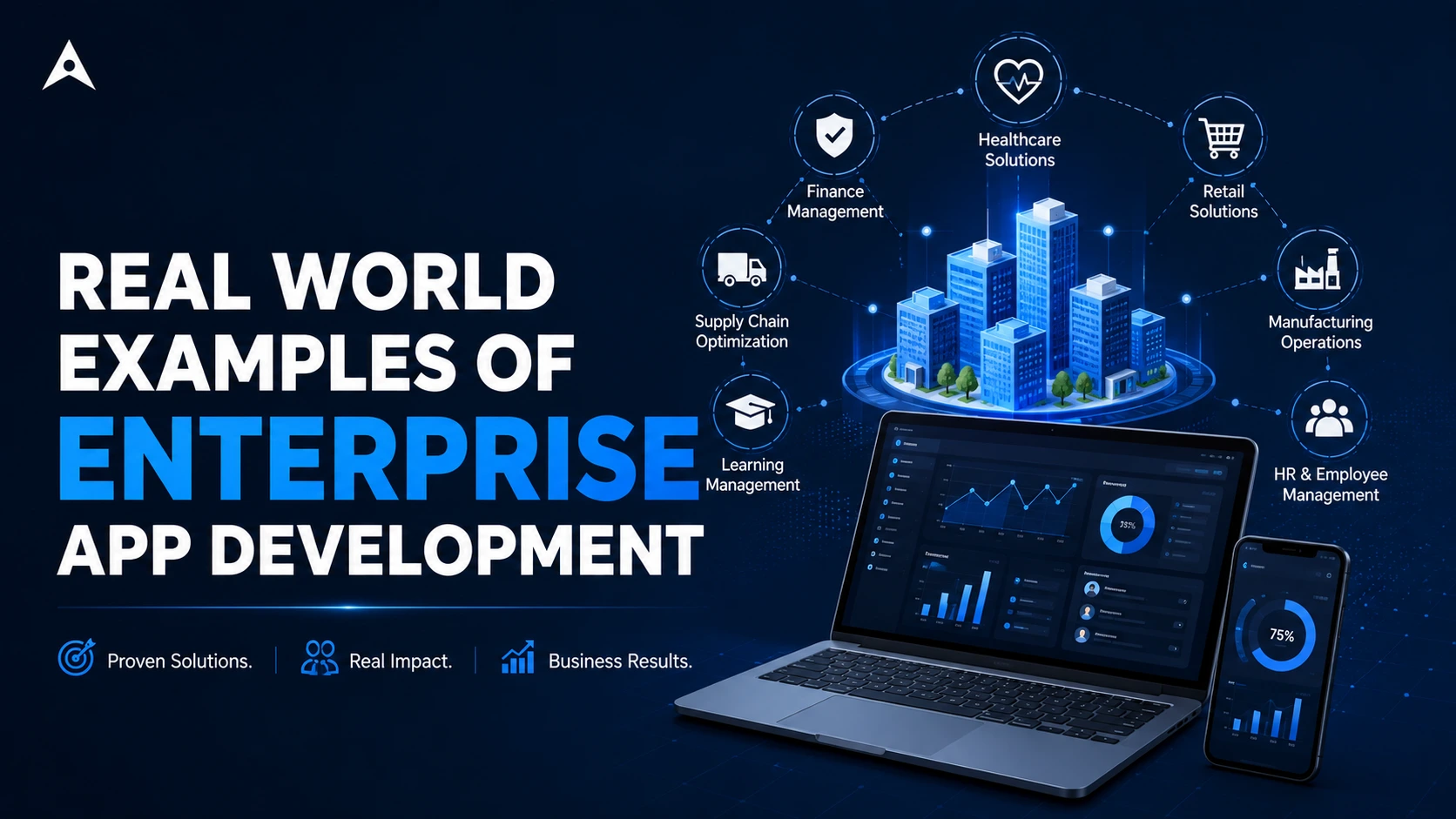
From Amazon’s sophisticated commerce infrastructure to Netflix’s microservices-driven ecosystem, leading organizations use enterprise applications to manage complex operations, enhance customer experiences, and support large-scale growth. These real-world enterprise app development examples demonstrate how businesses across industries are transforming workflows, optimizing resources, and building scalable digital systems that drive measurable business outcomes.
As digital transformation accelerates, enterprise applications are no longer limited to large corporations. Startups, mid-sized businesses, and enterprises are increasingly investing in custom software solutions to streamline processes, strengthen security, improve collaboration, and ensure long-term performance through reliable enterprise application development services. According to McKinsey’s State of AI 2025 report, organizations are rapidly integrating intelligent technologies into their operations, further increasing the value of scalable enterprise systems.
In this blog, you’ll discover how leading organizations leverage enterprise applications to scale operations, drive innovation, improve efficiency, and achieve long-term business growth through digital transformation. Whether you are evaluating an enterprise application development journey, planning a custom enterprise platform, or exploring digital transformation initiatives, these enterprise real-world examples reveal the strategies, technologies, and business outcomes that power sustainable growth.
Table of Contents
Why Have Enterprise Applications Become Essential for Modern Business?
The digital economy rewards speed, efficiency, and adaptability. Organizations that rely on disconnected systems often struggle with operational bottlenecks, data silos, and limited visibility across departments.
Enterprise applications solve these challenges by creating integrated digital environments where information flows seamlessly between teams, systems, and stakeholders.
Modern enterprise applications help organizations:
- Automate repetitive business processes
- Improve operational efficiency
- Enhance employee productivity
- Centralize business data
- Enable real-time decision-making
- Strengthen security and compliance
- Scale operations without proportional cost increases
The growing importance of enterprise applications is closely tied to AI-driven digital transformation. According to McKinsey’s The State of AI 2025 report, 62% of organizations are already experimenting with AI agents, while 64% report that AI is accelerating innovation across their business operations, highlighting how intelligent enterprise systems are becoming critical growth enablers.
As competition intensifies across industries, enterprise software is no longer a technology investment alone; it has become a strategic business necessity.
What Makes an Enterprise Application Different from Traditional Business Software?
Enterprise applications are designed to support large-scale business operations across multiple departments, teams, and locations.
Unlike standalone business tools, enterprise systems are built to handle complex workflows, large data volumes, and enterprise-grade security requirements.
Organizations planning custom enterprise solutions should also evaluate the technical and business considerations involved throughout the enterprise app development process.
These enterprise business applications differ from conventional software because they are designed to support enterprise-wide operations, integrate multiple business functions, and scale alongside organizational growth.
Core Enterprise Application Characteristics
Successful enterprise applications typically include:
- Scalability for business growth
- Centralized data management
- Advanced security controls
- Integration with existing systems
- Workflow automation capabilities
- Multi-user collaboration features
- Real-time analytics and reporting
These capabilities allow businesses to create connected ecosystems rather than isolated software solutions.
Common Types of Enterprise Applications
Organizations use enterprise software across multiple functions. Some of the most common examples of enterprise software applications include ERP systems, CRM platforms, HRMS solutions, business intelligence tools, and supply chain management software.
While enterprise software serves different business functions, selecting the right solution depends on your operational requirements and growth objectives. Understanding the various types of enterprise applications can help organizations identify the most suitable platform for their specific business needs.
| Application Type | Primary Purpose |
| ERP Systems | Resource planning and operations management |
| CRM Platforms | Customer relationship management |
| HRMS Solutions | Workforce and talent management |
| Supply Chain Platforms | Logistics and inventory management |
| Business Intelligence Systems | Analytics and reporting |
| Enterprise Mobility Apps | Employee productivity and collaboration |
Each category addresses specific business challenges while contributing to broader digital transformation goals.
The Best Real-World Enterprise App Development Examples

The following enterprise real-world examples demonstrate how organizations use technology to scale operations and drive measurable business outcomes.
These enterprise apps examples showcase how organizations across industries use technology to improve efficiency, increase productivity, and achieve sustainable growth.
1. Netflix Scaled Global Streaming Through Microservices
Netflix serves millions of users across the globe while delivering personalized experiences in real time.
Its enterprise application architecture relies heavily on microservices. Instead of running a single monolithic platform, Netflix uses hundreds of independent services that handle specific functions.
This architecture enables:
- Faster software deployment
- Improved system reliability
- Better scalability
- Personalized recommendations
- Continuous innovation
The lesson for business leaders is clear: scalable architecture is critical when supporting rapid growth.
2. Amazon Built Enterprise Infrastructure for Massive Commerce Operations
Amazon represents one of the most recognized enterprise application examples and remains a leading example of enterprise software supporting large-scale global operations.
The company manages inventory, logistics, payments, customer support, and analytics through highly integrated enterprise systems.
Key benefits include:
- Real-time inventory visibility
- Automated fulfillment operations
- Predictive demand forecasting
- Supply chain optimization
- Customer experience personalization
Amazon demonstrates how enterprise applications become strategic assets that directly support revenue growth.
3. Adidas Enhanced Customer Engagement Through CRM Systems
Customer expectations continue to evolve, making personalization a competitive requirement.
Adidas uses enterprise CRM technologies to manage customer relationships and deliver tailored experiences across channels.
Business outcomes include:
- Better customer insights
- Personalized marketing campaigns
- Higher retention rates
- Improved customer lifetime value
This example highlights the growing importance of customer-centric enterprise applications.
4. Unilever Improved Global Operations with ERP Integration
Managing global operations across multiple markets presents significant complexity. This is one of the strongest enterprise systems examples, demonstrating how integrated platforms can streamline global operations and improve visibility across business units.
Unilever leverages enterprise resource planning systems to centralize operational data and improve visibility across its global network.
Benefits include:
- Better resource allocation
- Improved inventory management
- Standardized workflows
- Faster reporting capabilities
ERP platforms remain one of the most impactful enterprise software examples for large organizations.
5. Chevron Optimized Resources Through Enterprise Platforms
Energy companies manage extensive operational assets across diverse geographic regions. Chevron uses enterprise technology solutions to improve planning, maintenance, compliance, and resource management.
The result is:
- Enhanced operational efficiency
- Reduced downtime
- Improved asset utilization
- Better decision-making capabilities
This demonstrates how enterprise applications drive measurable operational improvements.
6. Zoom Supported Hypergrowth with Enterprise Systems
Few companies experienced growth comparable to Zoom during recent years. To support rapid expansion, Zoom invested heavily in enterprise platforms for finance, operations, customer management, and workforce collaboration.
Key outcomes included:
- Scalable internal operations
- Better financial management
- Improved workforce productivity
- Enhanced customer support capabilities
Growth-focused organizations can learn valuable lessons from Zoom’s technology infrastructure strategy.
How Does RipenApps Help Businesses Build Scalable Enterprise Applications?
Successful enterprise applications are built around solving real business challenges, improving operational efficiency, and supporting long-term scalability. RipenApps has partnered with startups, growing businesses, and enterprises across industries to develop digital products that enhance user experiences and accelerate business growth.
Businesses seeking modern enterprise applications for business often require custom solutions that align with their industry-specific workflows, compliance requirements, and scalability goals.
Here are some examples of enterprise-grade solutions developed by RipenApps.
Examarly: Scaling Digital Learning Operations Through an Enterprise eLearning Platform
Examarly is a comprehensive eLearning solution developed by RipenApps that helps educational organizations streamline learning management, improve student engagement, and scale digital education delivery efficiently.
Business Challenge
Educational organizations needed a scalable platform to manage online learning, improve student engagement, and deliver a seamless digital education experience across a growing user base.
Solution Delivered
RipenApps developed Examarly, an innovative eLearning platform designed to support digital education workflows, content delivery, student management, and interactive learning experiences through a centralized system.
Key Outcomes
- Improved accessibility to educational resources
- Streamlined digital learning management
- Enhanced student engagement and learning experiences
- Built a scalable foundation for future growth
Cotax: Transforming Tax Management Through a Digital Financial Platform
Cotax is a smart tax management platform developed by RipenApps that simplifies tax filing, automates financial workflows, and enhances compliance through a seamless digital experience.
Business Challenge
Tax preparation and filing processes often involve complex workflows, manual calculations, and compliance-related challenges that affect operational efficiency.
Solution Delivered
RipenApps developed Cotax, an innovative tax-returning application designed to simplify tax management, improve user experiences, and optimize financial processes through automation and digital workflows.
Key Outcomes
- Simplified tax filing processes
- Reduced manual operational effort
- Improved financial workflow efficiency
- Enhanced user convenience and accuracy
SportsNerve: Building a Unified Sports Management Ecosystem
SportsNerve is an all-in-one sports management platform developed by RipenApps that connects athletes, coaches, facilities, and sports communities through a centralized digital ecosystem.
Business Challenge
Sports organizations, athletes, coaches, and facility managers often operate through disconnected systems, limiting collaboration and operational visibility.
Solution Delivered
RipenApps built SportsNerve, a comprehensive sports management platform that connects athletes, coaches, facility managers, and sports communities within a unified digital ecosystem.
Key Outcomes
- Centralized sports operations management
- Improved stakeholder collaboration
- Enhanced user engagement across the platform
- Streamlined communication and scheduling workflows
Mednovate Connect: Enabling Scalable Telehealth and Healthcare Management
Mednovate Connect is a telehealth platform developed by RipenApps that streamlines virtual consultations, patient management, and healthcare service delivery through a secure digital ecosystem.
Business Challenge
Healthcare providers required a secure digital platform to support telemedicine services, medication management, and remote patient engagement while maintaining operational efficiency.
Solution Delivered
RipenApps developed Mednovate Connect, a telemedicine application focused on delivering healthcare services through secure virtual consultations and digital care management workflows.
Key Outcomes
- Improved access to remote healthcare services
- Enhanced patient-provider communication
- Streamlined healthcare management processes
- Supported scalable digital healthcare delivery
Praans Consultech: Building an End-to-End Compliance Management Platform
PRAANS Consultech compliance platform is an end-to-end compliance solution developed by RipenApps to help businesses manage compliance-related processes through a centralized digital platform.
Business Challenge
Businesses managing complex compliance requirements often face challenges with fragmented processes, manual documentation, limited visibility, and maintaining consistency across multiple compliance activities.
Solution Delivered
RipenApps developed the PRAANS Consultech compliance platform to streamline compliance workflows, centralize relevant processes, and provide businesses with a structured digital environment for managing compliance operations more efficiently.
Key Outcomes
- Centralized compliance management workflows
- Reduced dependency on manual processes
- Improved operational visibility and coordination
- Created a scalable foundation for managing evolving compliance requirements

What Best Practices Can Businesses Adopt from Successful Enterprise Applications?
Despite operating in different industries, successful enterprise applications share several common characteristics. While these enterprise application software examples span different industries, they consistently demonstrate the importance of scalability, integration, automation, and user-centric design.
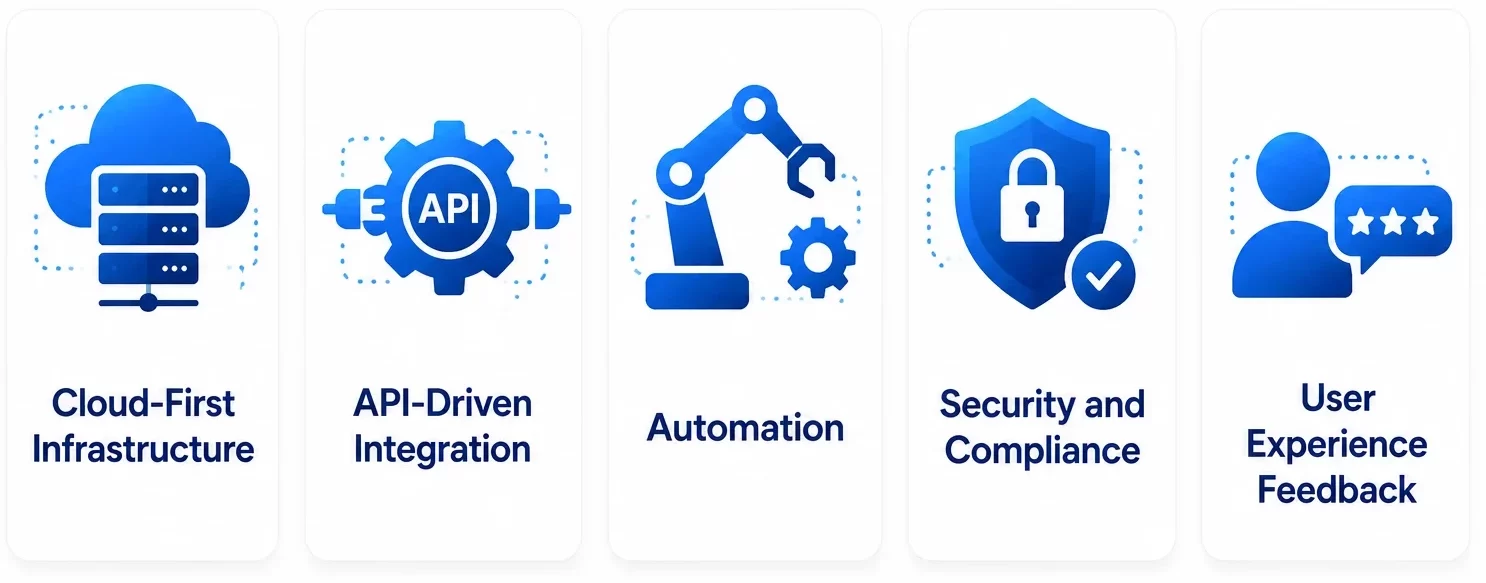
1. Cloud-First Infrastructure Supports Scalability
Cloud-native architectures allow businesses to scale rapidly without significant infrastructure investments.
Benefits include:
- Flexibility
- Cost efficiency
- Improved reliability
- Faster deployments
However, simply migrating to the cloud is not enough. Organizations must continuously optimize cloud resources, application performance, and infrastructure costs to maximize ROI and maintain scalability. Adopting effective cloud optimization strategies helps enterprises improve operational efficiency while supporting long-term business growth.
2. API-Driven Integration Eliminates Data Silos
Enterprise systems rarely operate independently.
Modern applications use APIs to connect:
- CRM platforms
- ERP systems
- Analytics tools
- Customer applications
Integrated ecosystems improve visibility and decision-making. Many successful examples of enterprise systems rely on seamless integration to ensure data consistency, operational visibility, and better decision-making.
3. Automation Drives Operational Efficiency
Workflow automation reduces manual effort and minimizes errors.
Organizations use automation for:
- Approvals
- Reporting
- Customer service
- Finance operations
- HR processes
Automation directly contributes to improved ROI. Automation directly contributes to improved ROI. As enterprise applications become more intelligent, organizations are seeing measurable business value from automation and AI initiatives. McKinsey’s latest enterprise AI analysis found that leading organizations can generate approximately $3 in value for every $1 invested in AI initiatives, reinforcing the business case for enterprise modernization and scalable digital systems.
4. Security and Compliance Remain Critical Priorities
Enterprise applications manage sensitive business and customer information.
Strong security frameworks include:
- Data encryption
- Identity management
- Access controls
- Compliance monitoring
Security investments help organizations maintain trust and reduce risk.
5. User Experience Influences Adoption Rates
Even powerful enterprise applications fail when users struggle to adopt them.
Successful enterprise software prioritizes:
- Intuitive interfaces
- Mobile accessibility
- Workflow simplicity
- Employee productivity
User-centered design is now a strategic business requirement.
How Do Enterprise Applications Support Digital Transformation Across Industries?
Digital transformation initiatives increasingly depend on enterprise software platforms. Different industries leverage enterprise applications in unique ways.
| Industry | Enterprise Application Focus | Business Outcome |
| Manufacturing | ERP and automation | Production efficiency |
| Retail | CRM and analytics | Customer personalization |
| Healthcare | Patient management | Better care delivery |
| Finance | Security and compliance | Risk reduction |
| Logistics | Supply chain visibility | Faster deliveries |
| Telecommunications | Network operations | Service reliability |
While use cases differ, the objective remains consistent: improving efficiency, scalability, and competitiveness.
How can Businesses Build a Scalable Enterprise Application?
Developing an enterprise application requires more than technical expertise. It requires strategic planning aligned with business objectives.
Before moving into development, businesses should clearly define the capabilities their solution requires. A well-structured enterprise app features checklist can help prioritize functionality, improve user adoption, and support long-term scalability.
Discovery and Business Analysis for Success
Every enterprise application should begin with clear business goals.
Organizations must identify:
- Operational challenges
- User requirements
- Integration needs
- Growth objectives
Strong discovery reduces project risk and improves outcomes.
Architecture Planning Supports Future Growth
Scalable architecture decisions influence long-term success.
Business leaders should evaluate:
- Cloud infrastructure
- Microservices
- Security frameworks
- Data architecture
Early architectural planning prevents costly future limitations. Organizations building enterprise ecosystems often leverage mobile application development services to ensure seamless connectivity between enterprise platforms, customer-facing applications, and internal business systems. A well-planned architecture enables these solutions to scale efficiently as business needs evolve.
User Experience Design Improves Adoption
Enterprise users expect modern digital experiences.
Design priorities include:
- Workflow optimization
- Mobile accessibility
- Role-based experiences
- Productivity enhancements
Development and Integration Create Business Value
Successful enterprise application development focuses on:
- Performance
- Reliability
- Scalability
- Security
- System integration
Organizations should ensure new applications connect seamlessly with existing technology ecosystems.
Continuous Optimization Drives Long-Term ROI
Enterprise software is not a one-time investment.
Ongoing improvements include:
- Performance monitoring
- Feature enhancements
- Security updates
- Analytics-driven optimization
Long-term success depends on continuous evolution.
For organizations evaluating custom enterprise software, understanding the complete enterprise app development guide helps ensure strategic alignment between technology investments, business objectives, and long-term growth goals.
What Will Shape the Future of Enterprise App Development?
Enterprise app development is being shaped by emerging technologies that help businesses improve scalability, automation, efficiency, and decision-making. Organizations that adopt these innovations early can build more agile, future-ready digital ecosystems and maintain a competitive advantage.
The next generation of enterprise application packages will increasingly combine AI, automation, analytics, and cloud-native technologies to deliver more intelligent business operations.
Several trends are reshaping enterprise application development:
- AI-Powered Automation: Artificial intelligence is transforming decision-making, workflow automation, and customer interactions.
- Enterprise Super Apps: Unified platforms are replacing fragmented workplace tools.
- Predictive Analytics: Organizations increasingly rely on forecasting models to improve strategic planning.
- Hyperautomation: Businesses are automating end-to-end processes across departments.
Companies that embrace these trends will be better positioned to adapt to changing market conditions and evolving customer expectations.
Final Thoughts
The most successful examples of enterprise software reveal a clear pattern: businesses that invest in scalable digital systems are better equipped to improve efficiency, drive innovation, streamline operations, and adapt to evolving market demands. From ERP and CRM platforms to advanced analytics and custom enterprise applications, these technologies have become essential drivers of sustainable growth and competitive advantage.
For founders and business leaders planning their next phase of digital transformation, the right enterprise application strategy can significantly impact long-term scalability and business performance. With deep expertise in application maintenance services, RipenApps helps organizations design and build secure, scalable, and future-ready software solutions that accelerate innovation, enhance operational efficiency, and create lasting business value.

FAQs
Q1. What is a real-world example of an enterprise application?
Amazon’s commerce platform, Netflix’s streaming infrastructure, and SAP ERP systems are widely recognized enterprise applications examples that support large-scale operations and business growth.
Q2. How do enterprise applications help businesses scale?
Enterprise applications automate workflows, centralize data, improve operational visibility, and support growing user demands without proportional increases in operational costs.
Q3. What industries benefit most from enterprise app development?
Manufacturing, healthcare, finance, retail, logistics, telecommunications, and technology companies benefit significantly from enterprise app development initiatives and modern enterprise software applications.
Q4. What technologies are commonly used in enterprise app development?
Common technologies include cloud computing, microservices, APIs, AI, machine learning, analytics platforms, containerization, and enterprise security frameworks that power modern enterprise application development example projects.
Q5. How long does enterprise application development take?
Timelines vary depending on complexity. Most enterprise application development projects range from several months to over a year for large-scale implementations.
Discuss your project and request for proposal
SHARE
WRITTEN BY

Ishan Gupta
CEO & Founder
Ishan Gupta is a seasoned entrepreneur and CEO with extensive 10+ years of experience in business and mobile app development landscape. He believes that the right digital product allows companies to focus on what they do best, while technology handles the rest. With deep exposure to global markets, he understands what makes an app succeed. His approach translates business needs into clear product strategies, ensuring that every feature contributes to measurable ROI.
View All Articles