


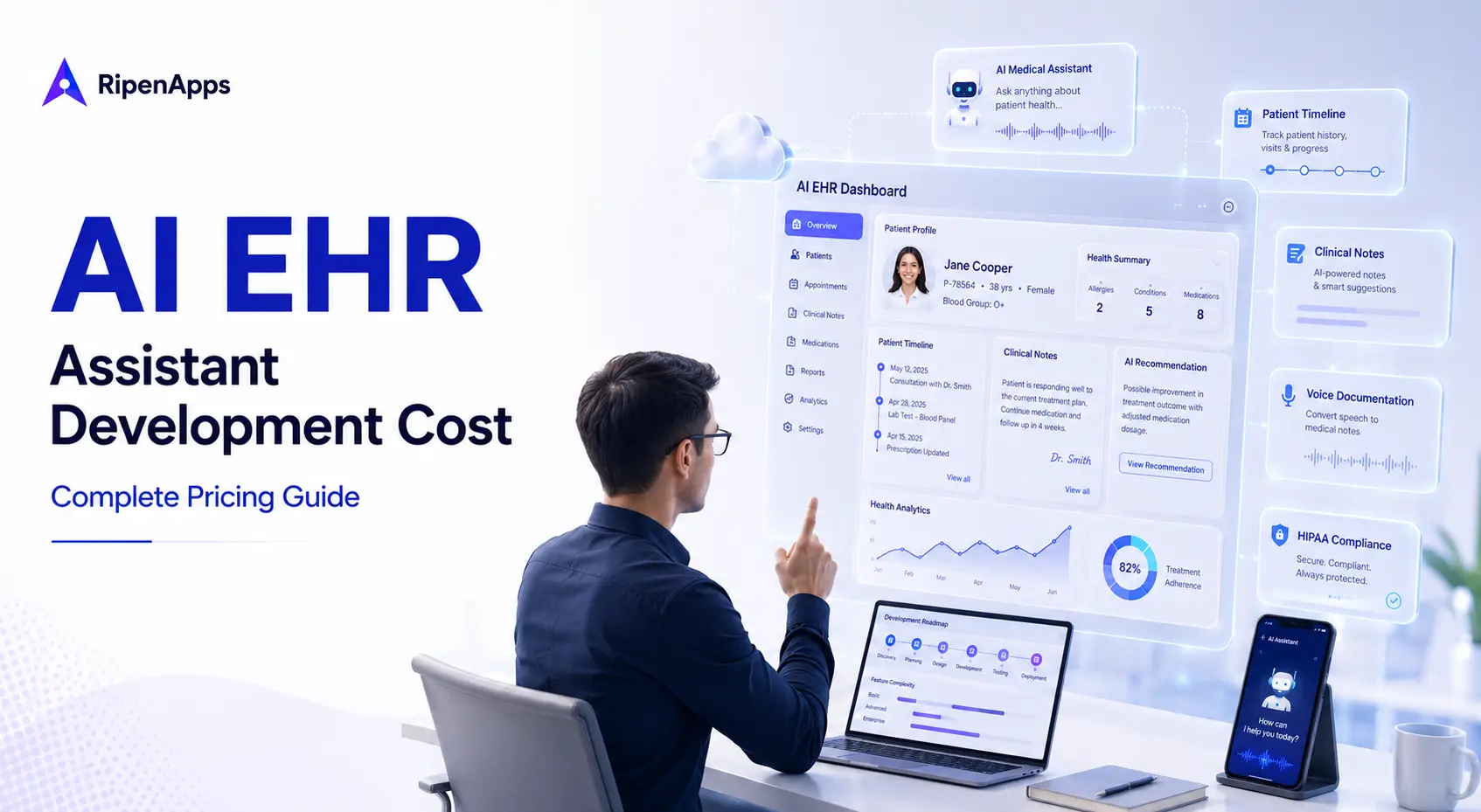

Key Takeaways
- AI EHR assistant development costs vary based on workflow complexity, integrations, compliance requirements, deployment scale, and AI capabilities.
- Building an AI assistant layer is significantly more cost-effective than developing a complete custom EHR platform from scratch.
- EHR integration, HIPAA compliance, and clinical validation contribute more to project costs than AI model implementation alone.
- Starting with a focused MVP helps healthcare organizations validate adoption while reducing initial investment and implementation risks.
- Choosing the right AI architecture and interoperability strategy lowers long-term maintenance costs and supports future healthcare system scalability.
Healthcare organizations are under increasing pressure to reduce physician burnout, improve documentation quality, and streamline clinical workflows without replacing their existing Electronic Health Record (EHR) systems. AI-powered assistants have emerged as a practical solution by automating clinical documentation, summarizing patient conversations, retrieving medical information, and supporting healthcare providers during patient encounters.
For founders building digital health products and healthcare organizations planning AI adoption, one of the first questions is straightforward: How much does it cost to build an AI EHR assistant?
The answer depends on multiple factors, including the complexity of clinical workflows, the number of EHR systems involved, AI model selection, HIPAA compliance requirements, integration depth, and deployment scale. Unlike building a complete EHR platform, developing an AI assistant layer on top of an existing EHR is typically more cost-effective while delivering measurable improvements in clinical efficiency.
Organizations looking to implement these capabilities often rely on AI feature integration services to seamlessly add intelligent documentation, automation, and clinical decision support to their existing healthcare systems without rebuilding their entire EHR infrastructure.
This guide breaks down the complete AI EHR assistant development cost, explains the major cost drivers, compares different implementation approaches, and helps healthcare decision-makers understand where their investment goes.
Table of Contents
AI EHR Assistant Development Cost at a Glance
The AI EHR assistant development cost generally ranges from $60,000 to over $500,000, depending on the deployment scope, AI capabilities, compliance requirements, and EHR integration complexity.
| Build Tier | Estimated Cost | Typical Timeline | Typical Team |
| Pilot / Single-specialty MVP | $60,000–$120,000 | 3–4 months | Small cross-functional team |
| Production Build (Multi-workflow) | $120,000–$300,000 | 5–8 months | Expanded product and engineering team |
| Multi-site, Multi-EHR Deployment | $300,000–$500,000+ | 9–12+ months | Large multidisciplinary team |
These ranges assume that organizations are building an AI assistant that integrates with an existing EHR rather than developing an entirely new Electronic Health Record system from scratch. This distinction significantly affects both development costs and long-term maintenance expenses.
What an AI EHR Assistant Actually is (And What it isn’t)
An AI EHR assistant is an intelligent software layer that works alongside an existing Electronic Health Record platform to automate clinical documentation, retrieve patient information, generate visit summaries, assist with coding, and reduce repetitive administrative work. As one of the most valuable applications of conversational AI in healthcare apps, these assistants help clinicians improve documentation accuracy, streamline patient interactions, and reduce administrative burden.
Instead of replacing an EHR, the assistant enhances physician productivity by connecting with existing healthcare workflows through APIs, interoperability standards, and AI-powered automation.
AI EHR Assistant vs. a Custom EHR System
This distinction is often misunderstood during project planning. A custom EHR system is a complete healthcare platform responsible for managing patient records, scheduling, billing, prescriptions, interoperability, regulatory compliance, reporting, and clinical workflows across an organization. Building such a platform involves substantial engineering effort, extensive certification requirements, and long-term maintenance commitments.
An AI EHR assistant, however, focuses on improving the usability and efficiency of an existing EHR. Rather than recreating healthcare infrastructure, it connects to existing systems and performs tasks such as:
- Ambient clinical documentation
- Clinical note generation
- Voice-to-text transcription
- Intelligent patient summaries
- Medical coding assistance
- Clinical search
- Workflow automation
- Decision support
This narrower scope significantly reduces implementation complexity while still delivering meaningful operational value.
AI EHR Assistant vs. an Off-the-Shelf Ambient Scribe
Healthcare organizations also compare custom AI assistants with licensed ambient documentation products. An off-the-shelf ambient scribe offers predefined capabilities with subscription-based pricing and faster deployment. While suitable for standard documentation workflows, these solutions often provide limited customization, constrained integration flexibility, and less control over AI behavior.
A custom AI EHR assistant offers organizations greater flexibility by allowing them to tailor workflows, integrate multiple systems, maintain ownership of data architecture, and extend AI capabilities as clinical requirements evolve. The decision often depends on whether the organization requires standardized documentation support or a deeply integrated AI platform aligned with its unique clinical workflows.
AI EHR Development Cost Across Different Build Stages
The total cost to build an AI EHR assistant depends largely on the project’s implementation scope. Healthcare organizations typically fall into one of three investment categories.
Pilot / Single-Specialty MVP
Organizations validating a product concept or deploying AI within a single clinical specialty usually begin with a Minimum Viable Product. Typical capabilities include:
- Voice transcription
- Clinical note generation
- Basic FHIR integration
- Single EHR integration
- Limited provider workflows
- Secure authentication
- HIPAA-ready infrastructure
Estimated Cost:
$60,000–$120,000
Typical Timeline:
3–4 months
This approach allows healthcare startups and provider groups to validate clinical adoption before expanding functionality.
Production Build, Multi-Workflow
Once an MVP demonstrates value, organizations typically expand into production-grade deployments supporting multiple specialties, workflows, and AI capabilities. These implementations commonly include:
- Multiple documentation templates
- Clinical summarization
- Coding assistance
- Multi-role access
- Workflow automation
- Advanced analytics
- Expanded EHR integration
- Human review workflows
- Production-grade monitoring
Estimated Cost:
$120,000–$300,000
Typical Timeline:
5–8 months
Production deployments require significantly more engineering effort because they must support larger user bases, higher reliability, stronger security controls, and more sophisticated AI orchestration.
Multi-Site, Multi-EHR Deployment
Large healthcare organizations often require deployments across multiple hospitals, provider groups, or healthcare networks. These enterprise implementations typically involve:
- Multiple EHR vendors
- Cross-site interoperability
- Advanced security architecture
- Role-based access controls
- Audit logging
- High availability
- Disaster recovery
- Enterprise AI governance
- Scalable infrastructure
- Continuous compliance monitoring
Estimated Cost:
$300,000–$500,000+
Typical Timeline:
9–12+ months
At this level, much of the investment shifts from AI functionality itself to interoperability, governance, infrastructure, compliance, and operational scalability.
Key Factors That Influence AI EHR Assistant Costs
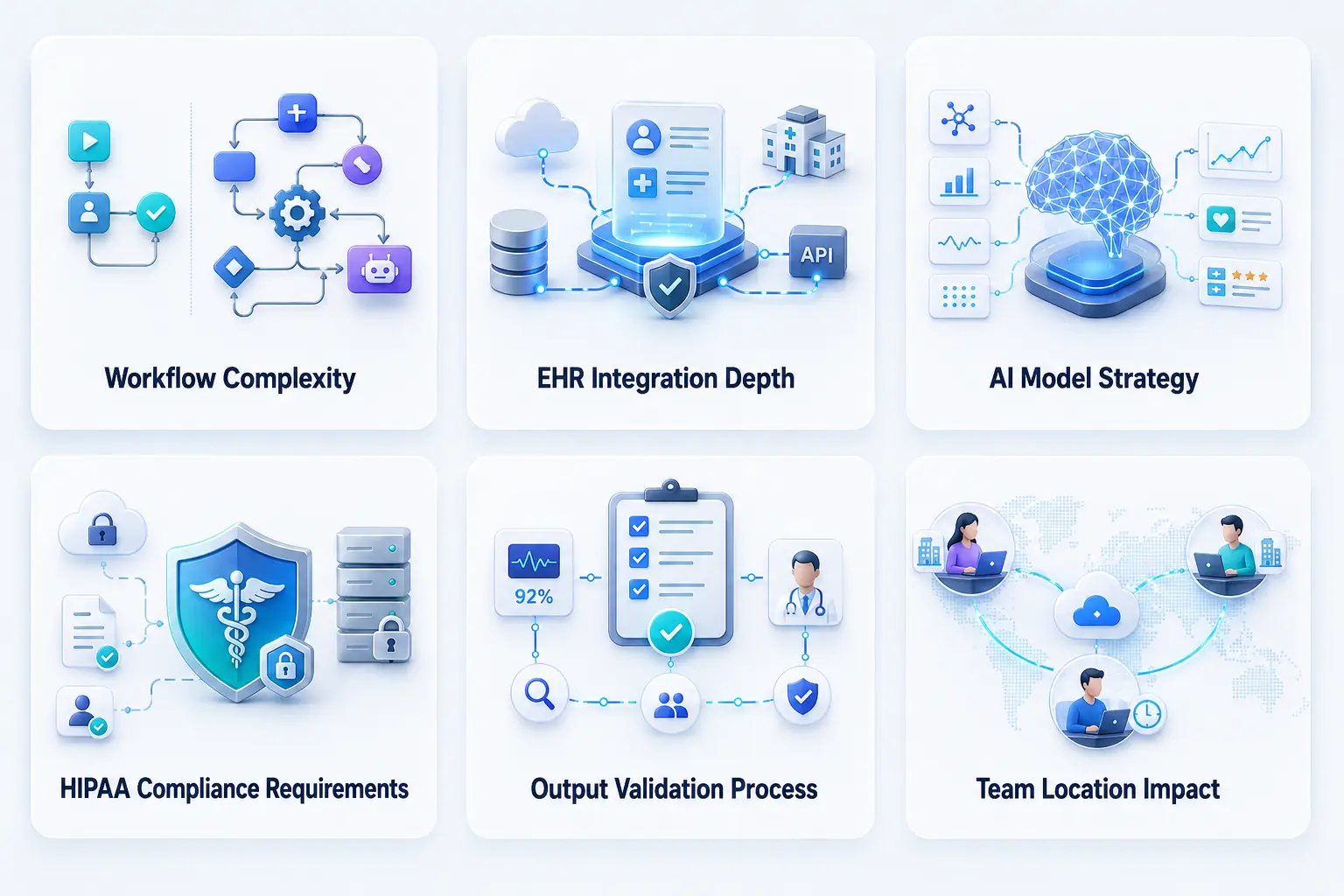
No two AI EHR assistant projects cost the same because every healthcare organization has different clinical workflows, compliance requirements, AI expectations, and existing technology infrastructure.
While the AI model itself is an important component, it is rarely the largest contributor to the overall budget. Integration, security, validation, and deployment often account for a significant portion of the investment. Understanding these cost drivers helps healthcare founders and provider organizations evaluate vendor proposals more accurately and avoid unexpected expenses during implementation.
Scope of Clinical Workflows Covered
The number and complexity of clinical workflows directly influence development effort. An AI assistant designed only for ambient documentation in primary care requires significantly less engineering than one supporting emergency medicine, radiology, cardiology, behavioral health, and inpatient care simultaneously.
Each specialty introduces unique documentation templates, terminology, clinical decision paths, and workflow variations. As the assistant expands to support additional departments, development teams must design, test, validate, and optimize every workflow individually.
For example, a single-specialty assistant focused on SOAP note generation may require relatively straightforward implementation. In contrast, a multi-specialty assistant capable of generating discharge summaries, coding recommendations, medication reconciliation, referral letters, and patient education materials requires substantially more development and clinical validation. The broader the workflow coverage, the greater the investment in product design, AI engineering, quality assurance, and clinical testing.
EHR Integration Depth: FHIR R4, HL7v2, and Vendor APIs
Integration is one of the most significant contributors to the overall custom EHR development cost. Most healthcare organizations already operate mature EHR systems, meaning an AI assistant must communicate seamlessly with existing clinical infrastructure instead of replacing it. The complexity depends on several factors, including:
- Number of EHR platforms
- Available APIs
- Interoperability standards
- Clinical data exchange requirements
- Authentication methods
- Legacy infrastructure
Modern healthcare platforms increasingly support FHIR R4, enabling standardized access to patient records, appointments, medications, observations, and clinical documentation. However, many hospitals continue to rely on HL7v2 messaging for legacy workflows, requiring additional middleware, transformation logic, and interoperability testing.
Vendor-specific APIs also introduce additional engineering work because every platform handles authentication, permissions, rate limits, and available endpoints differently. The deeper the integration, the more engineering effort is required to ensure reliable data synchronization without disrupting existing clinical operations.
Read More: How AI Is Transforming Healthcare App Development
AI Model Strategy: Hosted API vs. Fine-Tuned vs. Self-Hosted
AI infrastructure choices have a major impact on both initial development costs and long-term operating expenses. Organizations generally choose between three deployment approaches. These infrastructure decisions also influence scalability, security, performance, and future feature expansion, making them a key consideration in any AI-powered healthcare product.
Similar architectural considerations are shaping the broader landscape of AI in mobile app development, where choosing the right AI deployment strategy directly affects both user experience and business outcomes.
Hosted AI APIs
Using commercially available AI APIs enables faster implementation with lower upfront investment. Development teams focus on workflow integration while the AI provider manages infrastructure and model updates.
This approach works well for MVPs and pilot deployments but introduces recurring inference costs based on usage.
Fine-Tuned Models
Organizations requiring greater clinical specialization may invest in fine-tuning foundation models using proprietary healthcare datasets.
Although this improves domain-specific performance, it increases development effort through additional data preparation, experimentation, validation, and ongoing maintenance.
Self-Hosted Models
Healthcare organizations with strict governance or data residency requirements sometimes deploy self-hosted large language models within private infrastructure.
While this provides greater control over security, privacy, and customization, it also requires significantly higher investment in infrastructure, DevOps, monitoring, GPU resources, and AI operations.
Selecting the appropriate model strategy depends on regulatory requirements, expected patient volume, customization needs, and long-term scalability goals. Organizations evaluating different deployment strategies often partner with providers offering generative AI development services to build, customize, and optimize AI models that meet healthcare security, compliance, and clinical performance requirements.
HIPAA Compliance and PHI Architecture
Healthcare AI products must be designed around patient privacy from the very beginning. Protected Health Information (PHI) flows through multiple systems during documentation, transcription, summarization, storage, and retrieval. Every stage requires appropriate safeguards to maintain compliance.
Development teams typically invest considerable effort in:
- Secure authentication
- Role-based access controls
- Data encryption
- Audit logging
- Consent management
- Secure API communication
- Infrastructure monitoring
- Backup and disaster recovery planning
Compliance requirements also influence infrastructure architecture, deployment environments, testing procedures, and documentation. Rather than being treated as an additional feature, HIPAA compliance becomes part of every development phase, making it one of the largest cost contributors for healthcare AI applications.
Clinical Accuracy Validation and Human-in-the-Loop Review
Unlike consumer AI products, clinical AI systems cannot rely solely on automated outputs. Healthcare organizations require confidence that AI-generated documentation accurately reflects patient encounters and supports clinical decision-making.
As a result, AI EHR assistants typically include human review workflows where clinicians validate generated notes before they become part of the permanent medical record. Development teams must design interfaces that allow providers to:
- Review generated documentation
- Edit recommendations
- Approve clinical notes
- Reject incorrect outputs
- Provide feedback for continuous improvement
In addition to interface development, organizations often conduct extensive validation exercises involving clinicians, product teams, and quality assurance specialists to measure documentation accuracy and workflow performance. This clinical validation process adds both time and development cost but is essential for establishing trust and ensuring safe deployment.
Team Location and Blended Rate
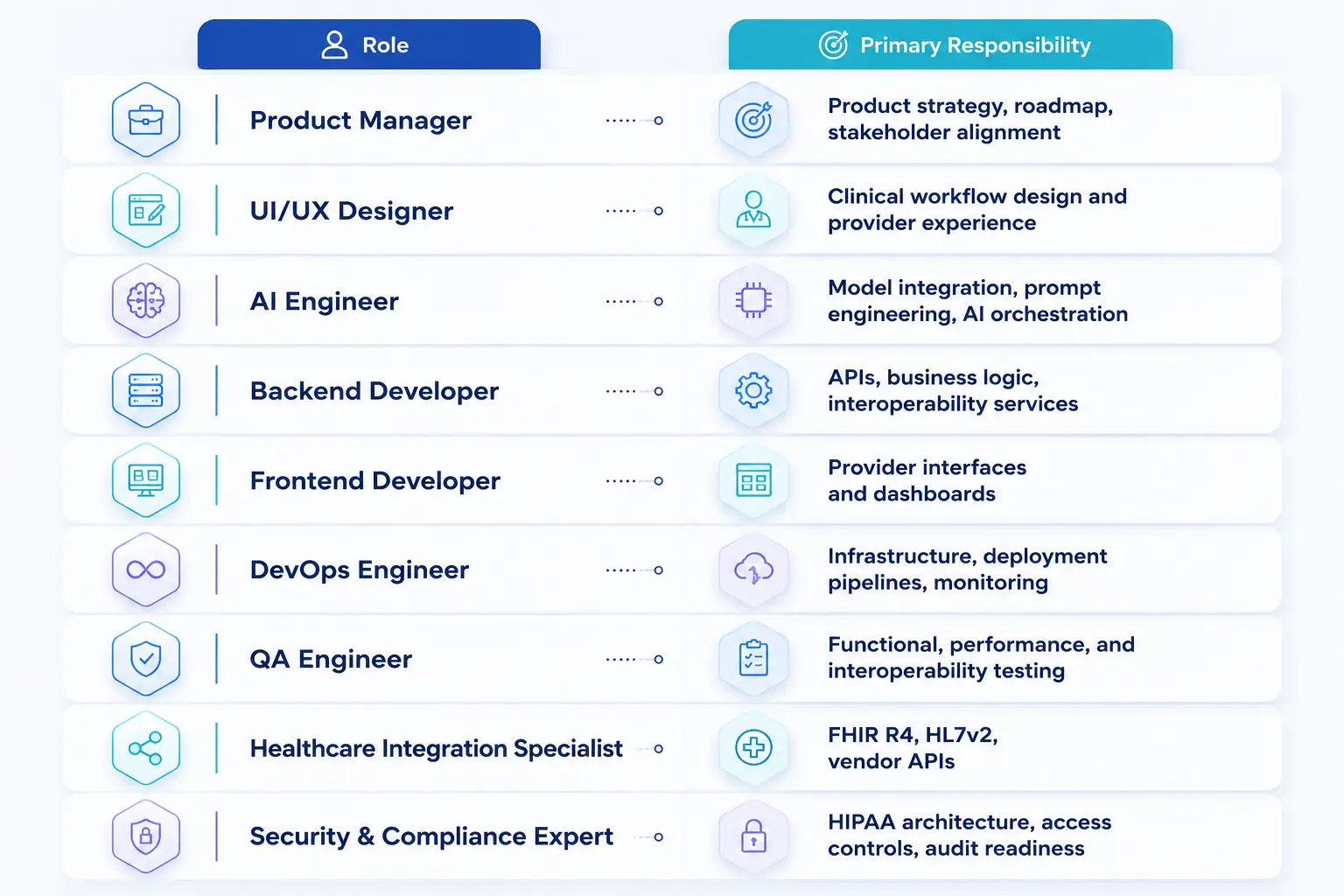
Development cost also varies depending on the composition and geographic location of the delivery team. An AI EHR assistant typically requires collaboration across multiple disciplines, including product management, UI/UX design, AI engineering, backend development, frontend development, DevOps, QA engineering, healthcare interoperability specialists, and compliance experts.
Instead of evaluating hourly rates in isolation, organizations should focus on the overall value delivered by an experienced cross-functional team. Healthcare AI projects often benefit from teams that already understand interoperability standards, regulatory requirements, and healthcare workflows, reducing implementation risk and shortening delivery timelines.
Although experienced healthcare development teams may command higher rates, they often reduce costly rework associated with compliance failures, integration challenges, or clinical workflow redesign. These same technologies are accelerating innovation across digital healthcare, making AI-powered applications a major focus in top healthcare mobile app development trends.
AI EHR Development Cost by Project Phase
The AI in EHR development cost is distributed across multiple project phases rather than concentrated solely in software development. Each stage contributes to building a secure, compliant, and scalable healthcare AI solution.
| Development Phase | Primary Activities | Cost Contribution |
| Discovery & Planning | Requirements gathering, workflow analysis, technical architecture, product roadmap | 10–15% |
| UI/UX Design | Clinical workflow mapping, interface design, provider usability testing | 10–15% |
| AI Development | Model integration, prompt engineering, orchestration, testing | 20–30% |
| EHR Integration | FHIR R4, HL7v2, vendor APIs, interoperability testing | 20–30% |
| Compliance & Security | HIPAA safeguards, access controls, encryption, audit logging | 10–15% |
| QA, Validation & Deployment | Clinical validation, performance testing, production rollout | 10–15% |
This phased investment reflects the reality that successful AI healthcare products require much more than model integration. Clinical workflow design, interoperability, regulatory compliance, and deployment readiness collectively determine the success of an implementation.
Breaking Down EHR Integration Expenses
EHR integration is often one of the most underestimated components of the AI EHR assistant development cost. While AI capabilities usually receive the most attention during planning, the assistant cannot deliver meaningful clinical value unless it exchanges data reliably with existing healthcare systems.
Integration costs vary depending on the EHR vendor, available APIs, interoperability standards, authentication requirements, testing processes, and deployment environment.
Epic, Oracle Health (Cerner), and athenahealth API Access
Most healthcare organizations already rely on enterprise EHR platforms, each with its own integration framework.
Epic
Epic provides extensive interoperability capabilities through FHIR APIs and other integration mechanisms. However, implementation typically requires authentication setup, workflow mapping, sandbox testing, application registration, and production validation before deployment.
Depending on project scope, organizations may also need additional engineering effort for appointment scheduling, clinical documentation, medication management, or patient record synchronization.
Oracle Health (Cerner)
Oracle Health supports modern interoperability standards while maintaining compatibility with legacy healthcare infrastructure.
Development teams often spend considerable time mapping workflows, validating clinical data exchange, handling authentication, and ensuring compatibility across multiple environments before production rollout.
athenahealth
athenahealth offers API-based integrations that simplify access to patient records and clinical workflows for many outpatient providers.
Although implementation may be less complex than some enterprise environments, development still requires API configuration, workflow validation, permissions management, and comprehensive testing.
Regardless of the vendor, organizations should plan for additional engineering effort related to security reviews, production approvals, interoperability testing, and long-term maintenance.
Read More: Healthcare App Development Guide: From Strategy to Deployment
Why a FHIR R4 Abstraction Layer Changes the Math
One of the smartest architectural decisions during AI EHR assistant development is implementing a FHIR R4 abstraction layer. Instead of tightly coupling AI workflows to a specific EHR vendor, the abstraction layer standardizes communication between the assistant and multiple healthcare platforms.
Rather than rewriting business logic for every integration, developers build against a consistent interface while adapting vendor-specific APIs beneath it. This approach offers several long-term advantages:
- Simplifies future EHR integrations
- Reduces maintenance effort
- Improves scalability
- Accelerates onboarding of new provider organizations
- Minimizes vendor-specific engineering work
Although creating the abstraction layer requires additional investment during the initial development phase, it often reduces total ownership costs as deployments expand across multiple healthcare organizations.
Hidden Costs of AI EHR Assistants
Many organizations focus exclusively on development budgets without accounting for the recurring operational expenses required to run an AI EHR assistant in production.
These ongoing costs can significantly influence long-term ROI and should be included during early planning.
Common recurring expenses include:
| Cost Category | Why It Matters |
| AI inference costs | Charges for processing clinical conversations and generating documentation |
| Cloud infrastructure | Hosting applications, databases, storage, networking, and monitoring |
| Security monitoring | Continuous threat detection, vulnerability management, and compliance monitoring |
| Model improvements | Prompt optimization, model upgrades, retraining, and evaluation |
| API maintenance | Vendor updates, version changes, and interoperability improvements |
| Compliance activities | Security audits, documentation updates, penetration testing, and policy reviews |
| Product enhancements | New workflows, specialty support, user-requested features, and performance optimization |
Unlike traditional software, AI-powered healthcare applications continue evolving after deployment. Organizations should therefore evaluate the total cost of ownership rather than focusing solely on initial development expenses.
Should You Build or Buy an AI EHR Assistant?
Healthcare organizations frequently compare custom AI assistants with commercially available ambient documentation platforms. Both approaches solve documentation challenges, but they address different business needs.
| Custom AI EHR Assistant | Licensed Ambient Scribe |
| Tailored clinical workflows | Standardized workflows |
| Deep EHR integration | Limited customization |
| Organization owns product roadmap | Vendor controls feature roadmap |
| Supports multiple AI capabilities | Primarily documentation-focused |
| Greater flexibility | Faster deployment |
| Higher initial investment | Lower upfront cost |
| Better long-term scalability | Subscription-based recurring costs |
Licensed solutions are often appropriate for organizations seeking rapid deployment with minimal customization.
However, a custom AI EHR assistant becomes increasingly valuable when organizations require:
- Multiple clinical workflows
- Proprietary AI capabilities
- Deep EHR integration
- Workflow automation
- Organization-specific governance
- Long-term product ownership
For healthcare startups building commercial products, custom development also creates intellectual property that can become a competitive advantage rather than relying on third-party platforms. Many of today’s top healthcare apps in the USA have differentiated themselves by building proprietary AI capabilities tailored to their users rather than depending solely on third-party documentation solutions.
How to Reduce Cost Without Cutting Compliance
Reducing development costs should never come at the expense of patient safety or regulatory compliance. Instead, organizations should focus on making strategic architectural decisions that maximize long-term value.
One effective approach is to begin with a narrowly scoped pilot rather than attempting to automate every clinical workflow at once. Validating adoption within a single specialty provides valuable clinical feedback while reducing initial investment.
Leveraging existing interoperability standards such as FHIR R4 instead of developing proprietary integrations also helps minimize engineering effort and simplifies future expansion.
Organizations can further optimize costs by prioritizing hosted AI models during early product validation before investing in fine-tuned or self-hosted infrastructure.
Another important consideration is designing reusable integration components that support multiple EHR vendors over time. Although this may increase initial engineering effort, it significantly lowers maintenance costs as deployments scale.
Finally, involving compliance and security experts from the beginning helps prevent expensive redesigns caused by regulatory issues discovered late in development. Defining the right architecture, prioritizing high-impact use cases, and creating a scalable roadmap before development begins also helps reduce implementation risks, improve delivery efficiency, and support long-term product scalability.
AI EHR Development Timeline and Team Structure
Building an AI EHR assistant typically requires collaboration across multiple disciplines throughout the project lifecycle.
A typical delivery team may include:
Project timelines generally align with implementation scope.
| Build Tier | Estimated Timeline |
| Pilot / Single-specialty MVP | 3–4 months |
| Production Build | 5–8 months |
| Multi-site Deployment | 9–12+ months |
These timelines include planning, design, AI implementation, interoperability testing, compliance validation, quality assurance, and production deployment. Organizations looking to accelerate delivery while meeting clinical, security, and regulatory requirements often partner with experts in AI healthcare app development to build scalable, compliant solutions tailored to their healthcare workflows.
Why Choose RipenApps for AI EHR Assistant Development?
Building an AI EHR assistant requires far more than AI expertise. Success depends on understanding clinical workflows, healthcare compliance, secure system architecture, and scalable product engineering.
At RipenApps, we help healthcare startups and enterprises build AI-powered healthcare solutions that integrate seamlessly with existing digital ecosystems while prioritizing security, usability, and long-term scalability. As an experienced AI chatbot development company, our expertise in telemedicine, medication management, and healthcare application development enables us to deliver solutions designed for today’s clinical needs while supporting future AI innovation.
Mednovate Connect
HIPAA-Focused Telehealth & Medication Management Platform
The Challenge
Patients managing multiple prescriptions often struggle with medication adherence, fragmented health records, and limited access to clinical guidance between appointments. Healthcare providers needed a secure digital platform to deliver virtual consultations, personalised medication plans, and continuous medication management while protecting patient data.
What We Built
- Virtual consultations with licensed clinical pharmacists
- Personalised medication plans with adherence tracking
- Automated medication reminders and refill alerts
- Real-time drug interaction and dose-checking tools
- Centralised prescription and health record management
- Secure in-app messaging between patients and providers
Compliance & Security
- HIPAA-focused application architecture
- Encrypted data storage and secure data transmission
- Secure authentication and role-based access controls
- Protected patient-provider communication
Outcome
Through the development of Mednovate Connect, RipenApps helped modernise healthcare delivery with a secure telehealth platform that centralised medication management, enabled remote consultations, and supported future AI-driven capabilities.
Business Impact
- Enabled secure video consultations between patients and healthcare professionals.
- Automated medication reminders and adherence tracking to support ongoing treatment.
- Simplified electronic health record management through a unified digital experience.
- Built with HIPAA-compliant security measures to safeguard sensitive patient information.
Holypills
Medication Adherence & Healthcare Management Platform
The Challenge
Managing medications consistently can be difficult for patients, particularly when handling multiple prescriptions and schedules. The objective was to create a secure, user-friendly healthcare application that simplifies medication management and improves adherence through an intuitive digital experience.
What We Built
- Medication scheduling and reminder management
- Prescription organisation and tracking
- Secure storage of essential health information
- Simple, intuitive user experience for everyday medication management
- Scalable application architecture for future feature expansion
Outcome
RipenApps developed a secure, scalable healthcare application that simplifies medication management while demonstrating our capability to build reliable digital health products with an architecture ready to support future AI-powered features and evolving healthcare workflows.

Final Thoughts
The AI EHR assistant development cost depends on far more than AI implementation alone. Clinical workflow complexity, interoperability requirements, HIPAA compliance, AI infrastructure, validation processes, and long-term operational planning all influence the final investment.
For many healthcare organizations, the smarter approach is not building an entirely new EHR platform but developing an intelligent assistant layer that integrates with existing systems. This strategy reduces implementation complexity while improving clinical documentation, streamlining provider workflows, and enhancing operational efficiency.
By understanding the major cost drivers, planning for ongoing operational expenses, and selecting the right implementation strategy, healthcare leaders can make informed investment decisions that support both immediate clinical needs and long-term digital transformation goals.
As emphasized throughout this guide, the opportunity lies in building an AI assistant on top of existing EHR infrastructure rather than recreating enterprise EHR systems. This focused approach aligns with current buyer intent, delivers faster time to value, and provides a practical path for healthcare organizations looking to adopt AI responsibly. Partnering with AI product development consulting company can further help organizations define the right architecture, prioritize high-impact use cases, and create a scalable roadmap for long-term success.

FAQs
1. How much does it cost to build an AI EHR assistant?
The AI EHR assistant development cost typically ranges from $60,000 to over $500,000, depending on project scope, AI capabilities, EHR integration complexity, HIPAA compliance requirements, and deployment scale. Pilot implementations generally require a lower investment, while multi-site enterprise deployments involve significantly higher costs.
2. How long does it take to build an AI EHR assistant?
Development timelines generally range from 3 to 12+ months. A pilot or single-specialty MVP can often be delivered within three to four months, while production-ready solutions supporting multiple workflows usually require five to eight months. Enterprise deployments involving multiple healthcare sites and EHR systems may take nine to twelve months or longer.
3. What is the biggest cost driver in AI EHR assistant development?
While AI functionality is important, EHR integration, HIPAA compliance, and clinical workflow implementation typically account for a significant portion of the overall project budget. Integration with existing healthcare systems, interoperability testing, security architecture, and clinical validation often require more effort than AI model implementation itself.
4. Is building an AI EHR assistant cheaper than developing a custom EHR?
Yes. Building an AI assistant layer on top of an existing EHR is generally far more cost-effective than developing a complete Electronic Health Record platform. Instead of recreating scheduling, billing, patient records, interoperability, and regulatory infrastructure, organizations enhance their existing systems with AI-powered automation and clinical intelligence.
5. Can an AI EHR assistant integrate with existing EHR platforms?
Yes. AI EHR assistants are designed to work alongside existing healthcare systems using interoperability standards such as FHIR R4, HL7v2, and vendor-specific APIs. The integration approach depends on the organization’s current technology environment and clinical workflow requirements.
6. How can healthcare organizations reduce development costs?
Organizations can reduce costs by starting with a narrowly scoped MVP, prioritizing high-value clinical workflows, leveraging standardized interoperability frameworks, selecting an appropriate AI deployment strategy, and designing reusable integration components. These approaches help optimize investment without compromising compliance or patient safety.
Discuss your project and request for proposal
SHARE
WRITTEN BY

Ishan Gupta
CEO & Founder
Ishan Gupta is a seasoned entrepreneur and CEO with extensive 10+ years of experience in business and mobile app development landscape. He believes that the right digital product allows companies to focus on what they do best, while technology handles the rest. With deep exposure to global markets, he understands what makes an app succeed. His approach translates business needs into clear product strategies, ensuring that every feature contributes to measurable ROI.
View All Articles