

Key Takeaways
- Wireframes validate product structure and information architecture.
- Prototypes validate usability, workflows, and user experience.
- MVPs validate market demand and commercial viability.
- Each stage addresses a different type of business risk.
- Skipping validation steps may save time initially but often increases long-term development costs.
- The right approach depends on business goals, product complexity, funding, and timeline constraints.
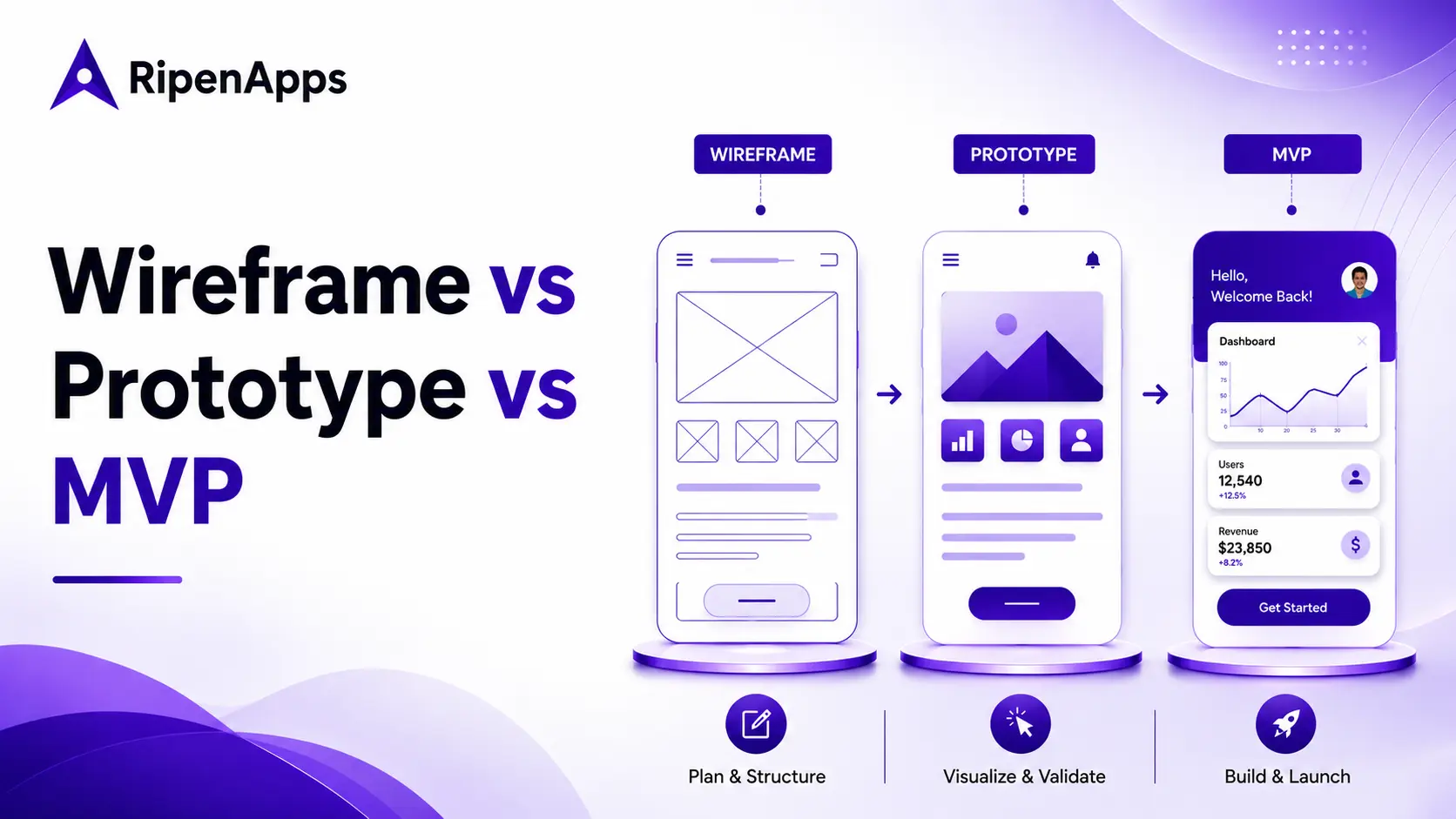
Building the wrong product at the wrong stage can cost startups and enterprises months of lost momentum, wasted development budgets, and missed market opportunities. The difference between a wireframe, prototype, and MVP is straightforward: a wireframe validates structure, a prototype validates usability, and an MVP validates real-world demand.
Despite this distinction, many founders struggle to determine which artifact they actually need. Some invest heavily in development before validating customer needs, while others spend months refining designs without testing market viability. Both approaches introduce unnecessary risk and slow down innovation.
Understanding where wireframes, prototypes, and MVPs fit within the development process is critical for reducing uncertainty and making smarter investment decisions. Each stage plays a unique role in helping organizations validate assumptions before committing significant resources.
As rapid prototyping becomes a core component of modern digital product strategies, businesses that follow a structured validation approach are better positioned to accelerate time-to-market, improve operational efficiency, and achieve sustainable growth. Organizations that leverage expert rapid prototyping services can further reduce development risks, validate ideas faster, and make more informed investment decisions before committing to full-scale product development. Whether you’re a startup founder preparing for launch or an enterprise leader evaluating a new digital initiative, understanding these three stages can dramatically improve your chances of success.
Table of Contents
What is the Difference Between Wireframe vs Prototype vs MVP?
At a high level, the difference between wireframe vs prototype vs MVP comes down to what each stage is designed to validate. While they are often grouped together in product conversations, they serve very different purposes throughout the product lifecycle.
Here is a table for quick comparison:
| Factor | Wireframe | Prototype | MVP |
| Primary Purpose | Validate structure | Validate usability | Validate market demand |
| Fidelity | Low to Medium | Medium to High | Fully Functional |
| User Interaction | None | Simulated | Real |
| Audience | Internal Teams | Stakeholders & Test Users | Actual Customers |
| Development Effort | Low | Moderate | High |
| Timeline | Days | Weeks | Months |
| Investment Level | Low | Medium | High |
The easiest way to understand the relationship between these stages is through what can be called the Validation Ladder.
A wireframe answers the question, “Does the structure make sense?” A prototype answers, “Is the experience usable?” An MVP answers the most important business question of all: “Will customers actually use and pay for this product?”
Each stage requires more investment than the previous one, but it also reduces uncertainty and business risk.
What is a Wireframe?
A wireframe is a low-fidelity visual blueprint that outlines a product’s structure, navigation, content hierarchy, and user flow. It focuses on functionality and layout rather than aesthetics, helping teams align on product requirements before design and development begin.
Wireframes Establish Product Foundations
When people ask, “What is a wireframe?” the simplest answer is that it serves as the architectural plan for a digital product.
Before investing in UI design, development resources, or advanced functionality, product teams need clarity around how users will navigate through the experience. Wireframes provide that clarity. They help teams identify gaps in information architecture, organize content logically, and ensure that core user journeys are mapped correctly from the start.
For startups, this stage often prevents expensive pivots later. For enterprises, it improves stakeholder alignment and reduces miscommunication between business, design, and engineering teams.
This is also why many organizations invest in product discovery services before initiating design and development. A structured discovery phase helps teams define business goals, understand user needs, prioritize features, and establish a clear roadmap before creating wireframes or prototypes.
Low-Fidelity and High-Fidelity Wireframes
Most product teams begin with low-fidelity wireframes consisting of simple sketches, placeholders, and basic layouts. These versions encourage collaboration because they focus discussions on functionality rather than visual preferences.
High-fidelity wireframes add greater detail and structure while still avoiding complete visual design. They often serve as a bridge between product planning and user experience design.
While wireframes are highly effective for validating structure, they cannot accurately predict how users will interact with a product. That limitation is where prototypes become valuable.
Modern Wireframing Tools
Tools such as Figma, Balsamiq, Whimsical, and Lucidchart have made wireframing significantly faster. AI-powered capabilities are also helping teams generate early layouts and user flows automatically.
While modern tools simplify the creation process, effective wireframes require strategic thinking beyond layouts and screens. Professional wireframe design services help businesses translate product requirements into clear user journeys, reducing ambiguity before design and development begin.
However, technology should accelerate thinking, not replace it. Successful wireframes still depend on strong product strategy and a clear understanding of user needs.
What is a Prototype?
A prototype is an interactive representation of a product that simulates real user interactions before full-scale development begins. Unlike a wireframe, a prototype allows stakeholders and users to experience workflows, navigation, and functionality in a realistic environment.
Prototypes Transform Ideas Into Experiences
Understanding what a prototype is requires looking beyond visual design.
A prototype allows users to click buttons, navigate screens, complete tasks, and interact with workflows as if the product already exists. This level of interaction provides valuable insights that static wireframes cannot deliver.
For founders seeking investment, prototypes often serve as compelling demonstration tools. For product teams, they create opportunities to test assumptions before significant engineering investments are made.
Prototypes Validate Usability and Experience
One of the biggest reasons products fail is poor user experience. A product may solve a genuine market problem, but if users struggle to navigate it, adoption rates suffer.
Prototypes help uncover usability challenges early. Teams can observe how users interact with key workflows, identify friction points, and refine experiences before development starts. That said, prototypes have limitations. Positive feedback from usability testing does not necessarily indicate strong market demand. A product can be intuitive and visually appealing yet still fail commercially if it solves the wrong problem.
A structured product prototyping process typically involves creating user flows, designing interactive screens, conducting usability testing, collecting feedback, and iterating on the experience. Following a defined process helps teams reduce uncertainty and make informed decisions before entering development.
The Rise of AI-Powered Prototyping
The rapid prototyping landscape is evolving rapidly. Platforms such as Figma, Framer, Adobe XD, and ProtoPie now integrate AI-assisted capabilities that accelerate design iterations and workflow creation.
While AI tools accelerate design workflows, businesses still require a strategic UI UX design service approach to ensure that interfaces remain intuitive, accessible, and aligned with user expectations. Technology can speed up execution, but user-centered design remains the foundation of successful digital products.
While these tools improve speed and efficiency, successful prototyping still requires human-centered research and validation.
What is an MVP Product?
A minimum viable product is the simplest functional version of a product that delivers core value while enabling businesses to test market demand with minimal investment.
Understanding What Makes an MVP Both Minimum and Viable
Many founders misunderstand what an MVP product is because they focus too heavily on the word “minimum.”
An MVP is not a low-quality product. It is a strategically simplified version of a solution that contains only the essential features required to solve a specific user problem.
The goal is not to build less. The goal is to learn faster. By limiting functionality to core capabilities, businesses can gather real-world feedback without committing extensive resources to features that customers may never use.
MVPs Validate Market Demand
Unlike wireframes and prototypes, MVPs operate in real market conditions.
They provide direct insight into customer behavior, adoption patterns, willingness to pay, retention rates, and product-market fit. These are business-critical metrics that cannot be accurately measured through internal testing alone.
This distinction is why investors and product leaders often prioritize MVP development. It creates evidence rather than assumptions.
One of the best ways for MVP testing is to launch with a narrowly defined feature set and measure real user behavior. Tracking activation rates, retention, customer feedback, and conversion metrics provides valuable insights into whether the product is solving a meaningful problem and creating market value.
What Are Real-World Examples of Wireframes, Prototypes, and MVPs in Action?
The concepts of wireframes, prototypes, and MVPs become much easier to understand when viewed through real product journeys. Nearly every successful digital product, from global technology giants to fast-growing startups, followed a validation-first approach before investing in large-scale development.
While each company took a slightly different path, the underlying principle remained the same: validate assumptions early, reduce risk, and scale only after proving value. These validation stages are especially important in mobile app design, where user expectations around usability, navigation, and performance directly influence adoption and retention. Early wireframing and prototyping help teams identify friction points before development costs increase. The following examples demonstrate how organizations used different stages of the product development process to transform ideas into successful digital products.
Dropbox: Validating Demand Before Building the Product
Dropbox is one of the most popular MVP examples because the company initially validated demand without building a complete product. Instead of investing heavily in development, founder Drew Houston released a simple demonstration video showing how the solution would work.
The video functioned as a prototype-like validation tool and generated significant interest from potential users. This early demand signal gave the team confidence to move forward with MVP development. Dropbox’s approach highlights an important lesson for founders: validating market demand can sometimes be more valuable than building features immediately.
Airbnb: Starting With a Minimal Viable Solution
Airbnb began with an extremely focused minimum viable product. The founders created a simple website that allowed travelers to book temporary accommodation in their apartment during a conference.
The initial product lacked many of the features users associate with Airbnb today. However, it successfully answered the most important business question: would people pay to stay in someone else’s home?
After validating demand, Airbnb gradually expanded its functionality, user experience, and marketplace capabilities. This demonstrates how a minimum viable product can accelerate learning while minimizing risk.
Instagram: Simplifying Before Scaling
Before becoming one of the world’s most influential social platforms, Instagram started as a far more complex application called Burbn. The product included multiple features, but user behavior revealed that photo sharing was the most valuable capability.
The founders simplified the product and launched a streamlined MVP focused exclusively on photo sharing. This strategic reduction allowed them to achieve stronger adoption and clearer product-market fit.
Instagram’s journey reinforces a key MVP principle: focusing on core value often produces better outcomes than launching with excessive functionality.
Examarly: Validating Learning Experiences Before Expansion
Examarly provides a strong vision of how structured validation supports successful product development. Built as an innovative online learning platform, the solution required careful planning of student journeys, content organization, and learning workflows before development began.
The project benefited from early-stage wireframing and prototyping activities that helped validate user experience assumptions before scaling functionality. For educational technology products, where engagement and usability directly impact retention, this validation-first approach reduces development risk while improving user outcomes.
SportsNerve: Building Around User-Centric Validation
SportsNerve was developed as a comprehensive platform serving athletes, coaches, facility managers, and sports organizations. Because the platform addressed multiple user groups, validating workflows and navigation structures early became critical.
By aligning product strategy, user experience design, and functionality before full-scale development, the team was able to create a solution that effectively addressed the needs of a diverse user base. The project highlights how wireframes, prototypes, and MVP thinking work together to reduce uncertainty and improve product-market alignment.
Where Do Wireframes, Prototypes, and MVPs Fit in the Product Development Process?
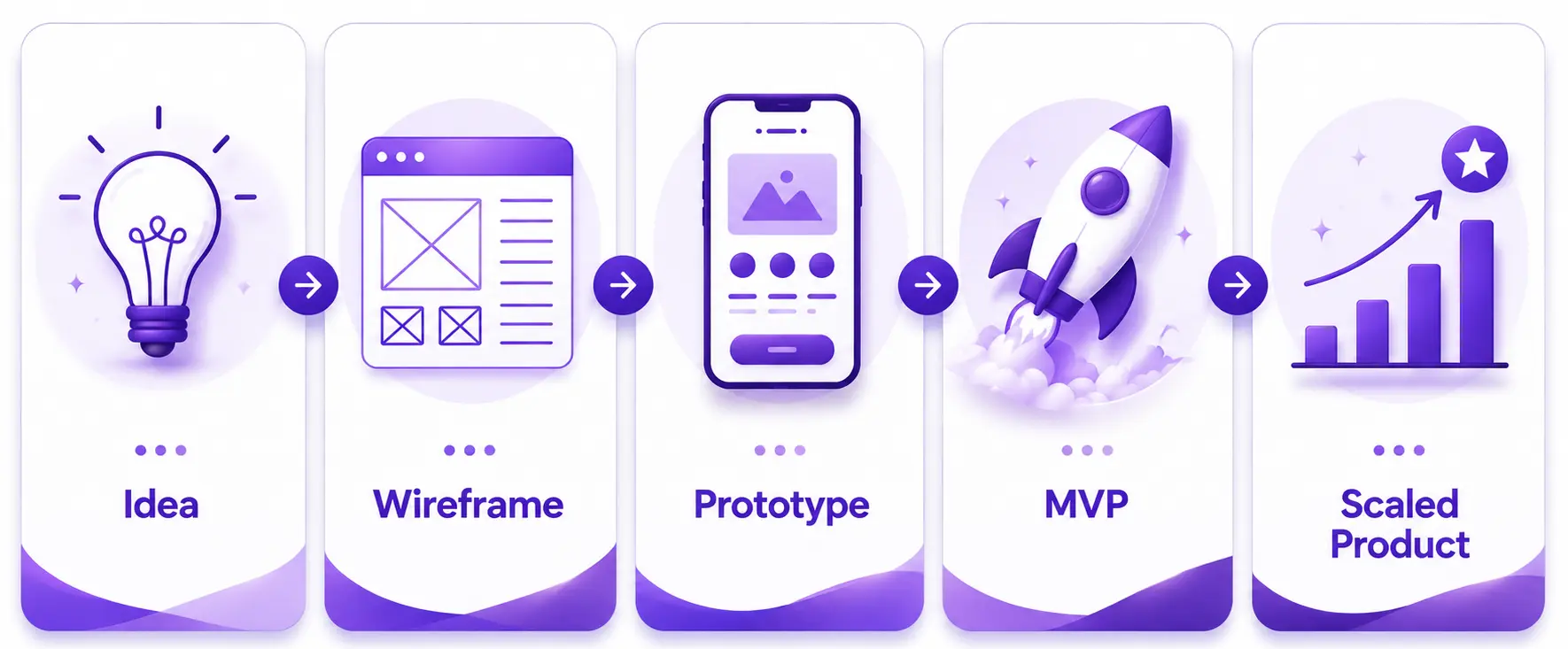
A successful development process follows a sequence designed to reduce uncertainty before major investments occur. Rather than moving directly from an idea to development, high-performing product teams use validation stages that help identify risks early and improve overall project outcomes.
The journey typically begins with idea discovery and market research. Once initial opportunities have been identified, teams move into wireframing to establish product structure and user flows. From there, prototypes are developed to validate usability and user experience assumptions.
Only after these early validations does MVP development begin. The MVP enables organizations to test market demand, gather customer feedback, and evaluate product-market fit.
This structured approach closely aligns with modern rapid prototyping practices. It allows teams to identify issues early, iterate efficiently, and avoid investing heavily in unproven assumptions.
At this stage, organizations typically transition from validation to execution. Partnering with experienced MVP development services providers can help teams translate validated concepts into functional products while maintaining focus on speed, scalability, and customer feedback.
Research from the IBM Systems Sciences Institute has consistently demonstrated that defects become significantly more expensive to fix as development progresses. Early validation remains one of the most effective ways to reduce long-term costs and project risk.
The evidence for working this way is: PwC’s 2025 CEO Survey shows 42% of chief executives doubt their model’s long-term viability without reinvention, and McKinsey’s State of AI 2025 finds that the organizations capturing real value are the ones redesigning workflows end-to-end rather than bolting fixes onto finished products. Early, staged validation is how teams act on both.
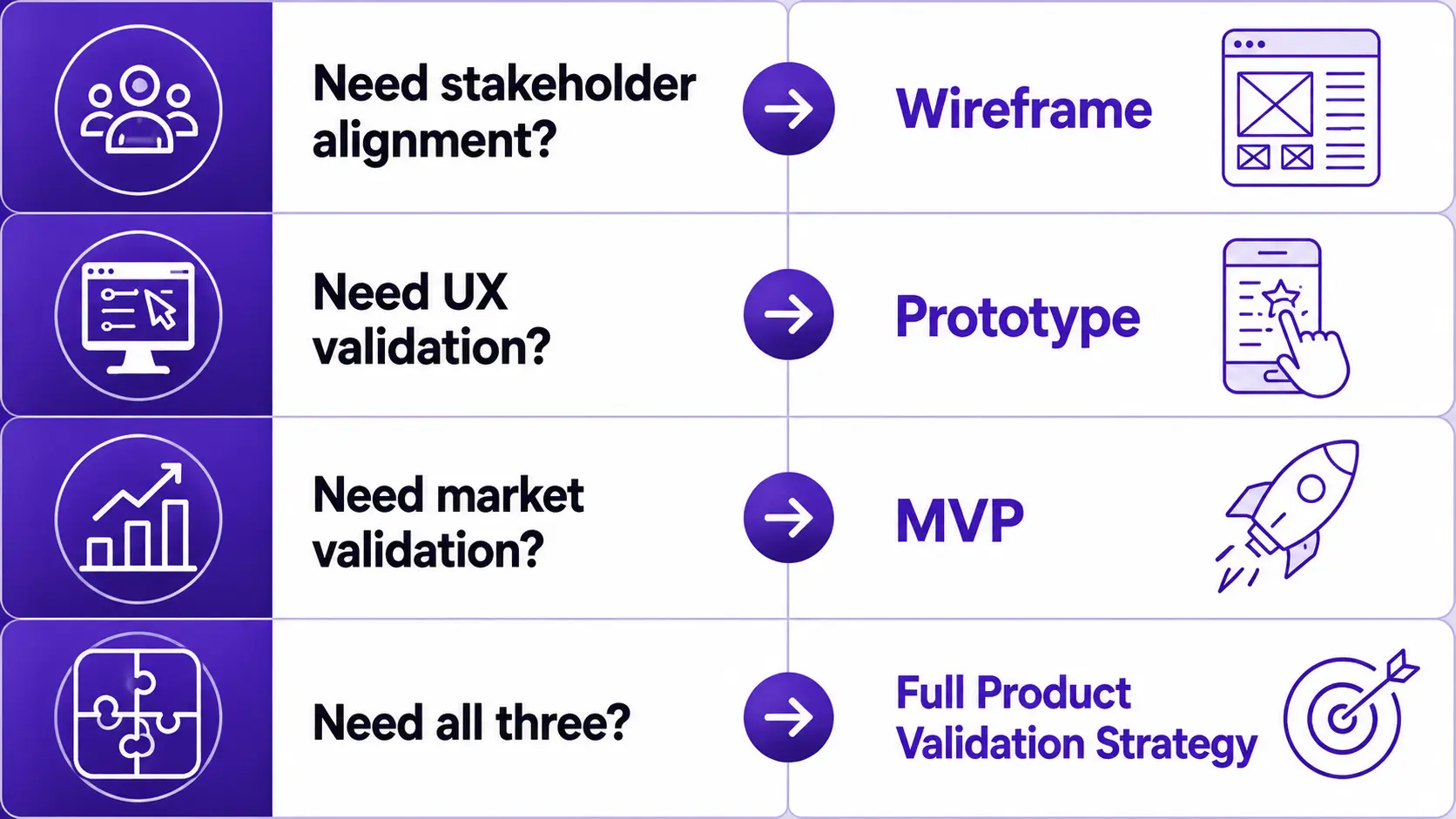
Do You Need All Three? A Build-Decision Framework
One of the most common questions founders ask is whether every product requires a wireframe, prototype, and MVP.
The answer depends on context.
When a Wireframe Is the Right Starting Point
Wireframes provide the greatest value when requirements are unclear, multiple stakeholders are involved, or complex workflows must be mapped before development begins. Enterprise platforms, marketplaces, SaaS products, and workflow-intensive applications often benefit significantly from this stage.
When a Prototype Should Be Prioritized
Prototypes become especially important when user experience is a major differentiator. Products that depend on intuitive navigation, investor presentations, customer demonstrations, or extensive usability testing often require prototype validation before development begins.
Prototypes become even more valuable when combined with UX research consulting. By analyzing user behaviors, expectations, and pain points, businesses can validate assumptions more effectively and make informed product decisions before investing in development. This combination helps teams uncover usability challenges early and create experiences that better align with customer needs.
When an MVP Makes the Most Sense
An MVP-first strategy can be effective when market uncertainty is the primary challenge. Startups operating in rapidly evolving industries often need real customer feedback as quickly as possible. In these situations, launching a focused MVP can generate insights that accelerate future decision-making.
However, skipping earlier validation stages should be approached carefully. While it may appear faster initially, it often introduces hidden costs that emerge later during development or after launch.
What Are the Realistic Costs and Timelines for Wireframes, Prototypes, and MVPs?
Business leaders frequently underestimate the investment required at each stage of product development.
| Stage | Typical Timeline | Estimated Investment |
| Wireframe | 1–2 Weeks | $1,000–$10,000 |
| Prototype | 2–6 Weeks | $5,000–$50,000 |
| MVP | 2–6 Months | $25,000–$250,000+ |
These figures vary based on product complexity, integrations, compliance requirements, AI functionality, and security considerations.
Cost and timeline estimates often depend on the expertise involved throughout the development journey. Many businesses partner with specialized product development services providers to streamline validation, design, engineering, and launch activities under a unified strategy. This approach can improve cross-functional collaboration, reduce execution risks, and accelerate time-to-market without compromising product quality.
While some organizations attempt to reduce costs by skipping validation stages, this strategy often increases long-term expenses. Investing modestly in early validation can prevent much larger losses later.
What Common Mistakes Should Businesses Avoid When Moving Between Stages?
Many product failures occur not because of poor execution but because teams misunderstand the purpose of each validation stage. These mistakes are more costly than many businesses realize. CB Insights found that 43% of failed startups struggled with poor product-market fit, underscoring the risks of relying on assumptions instead of structured validation through wireframes, prototypes, and MVPs. Organizations that skip customer feedback and market testing often discover critical issues only after significant time and capital have already been invested.
One common mistake is over-investing in wireframes. Teams sometimes spend weeks refining layouts that will inevitably change after user feedback is collected. Another frequent issue involves treating prototype feedback as proof of market demand. Users may enjoy an experience without ever becoming paying customers.
Organizations also tend to overload MVPs with unnecessary features. This contradicts the fundamental principle of minimum viable product development and often delays launches significantly.
Finally, many businesses underestimate the importance of product discovery and customer feedback. Even technically sophisticated products can struggle if they are built around assumptions rather than validated user needs.
Final Thoughts
Understanding the relationship between a wireframe, prototype, and MVP is essential for making smarter product investments. Each stage validates a different layer of risk, helping businesses improve decision-making, allocate resources effectively, and reduce costly development mistakes. Organizations that embrace structured validation and invest in rapid prototyping for product development are better positioned to accelerate innovation, achieve faster launches, strengthen user adoption, and build sustainable growth.
For founders, CEOs, CTOs, and product leaders navigating today’s competitive digital landscape, rapid prototyping and MVP development have become strategic business capabilities rather than optional processes. RipenApps helps organizations transform ideas into validated, scalable products through a proven combination of product strategy, design excellence, and technology execution.
FAQs
1. Is a wireframe a prototype?
No. A wireframe focuses on structure, layout, and navigation, while a prototype introduces interaction and usability testing capabilities.
2. Which comes first, a wireframe or a prototype?
In a typical product development process, teams start with product discovery and market research before moving into wireframing, prototyping, and MVP development. This structured approach helps validate product structure, user experience, and market demand at each stage, reducing risk and improving the chances of a successful product launch.
3. What is the difference between a prototype and an MVP?
A prototype validates usability and user experience, while an MVP validates market demand using a functional product released to real customers.
4. How much does it cost to build a prototype versus an MVP?
Prototype costs generally range from $5,000 to $50,000, while MVP development costs can range from $25,000 to more than $250,000 depending on complexity.
5. Can you skip the prototype and go straight to an MVP?
Yes, but doing so increases the likelihood of discovering user experience problems after development investments have already been made.
6. Is a mockup the same as a prototype?
No. A mockup is typically static and visual, whereas a prototype allows users to interact with the product experience.
7. Do I need a prototype before building an MVP?
Not always. However, organizations often validate product ideas using prototypes before committing to development. This reduces risk, uncovers usability challenges, and helps teams make more confident MVP investment decisions.
8. What comes after the MVP?
After an MVP launch, businesses focus on user feedback, feature optimization, retention improvement, scaling strategies, and long-term product growth.
Discuss your project and request for proposal
SHARE
WRITTEN BY

Ishan Gupta
CEO & Founder
Ishan Gupta is a seasoned entrepreneur and CEO with extensive 10+ years of experience in business and mobile app development landscape. He believes that the right digital product allows companies to focus on what they do best, while technology handles the rest. With deep exposure to global markets, he understands what makes an app succeed. His approach translates business needs into clear product strategies, ensuring that every feature contributes to measurable ROI.
View All Articles