


Key Takeaways
- Enterprise application security protects business applications, sensitive data, users, APIs, and connected infrastructure.
- Secure architecture helps organizations reduce vulnerabilities before applications reach development and production environments.
- Strong authentication and access controls limit unauthorized access to critical enterprise systems and information.
- Regular security testing helps identify vulnerabilities before attackers can exploit weaknesses in applications.
- Data encryption protects sensitive business and customer information during storage and transmission.
Enterprise applications have become the backbone of modern organizations, supporting customer relationships, financial operations, employee workflows, supply chains, communication, analytics, and other critical processes. As businesses move more functions to connected digital platforms, these applications handle increasing amounts of sensitive data, making them attractive targets for cybercriminals.
A security vulnerability can expose confidential information, compromise accounts, disrupt operations, or provide attackers with access to connected systems. This makes enterprise application security an essential consideration from planning and architecture through development, testing, deployment, and ongoing maintenance. Organizations must protect not only application code but also databases, APIs, authentication systems, cloud infrastructure, integrations, devices, and access permissions.
Businesses planning a new enterprise application can work with an experienced enterprise application development company to incorporate security requirements from the beginning. A security-focused approach helps organizations reduce vulnerabilities while maintaining scalability, performance, and usability.
This guide explores enterprise application security, including common risks, essential security controls, secure development practices, testing approaches, and considerations for cloud and mobile environments. It also explains how businesses can establish a sustainable security strategy as their applications and digital infrastructure evolve.
Table of Contents
What is Enterprise Application Security?
Enterprise application security refers to the collection of technologies, processes, practices, and policies used to protect enterprise applications from unauthorized access, vulnerabilities, malicious activity, data breaches, and other security threats.
An enterprise application may include a frontend interface, backend services, databases, APIs, authentication systems, cloud infrastructure, third-party integrations, administrative tools, and employee or customer access points. Each component can introduce different security considerations.
For example, a web application may need protection against malicious requests and unauthorized account access. Its backend may require API authentication and authorization. Its database may contain sensitive customer records that need encryption and strict access controls. Meanwhile, administrators may require privileged access that needs additional protection and monitoring.
Enterprise application security therefore takes a broader view of application protection. Instead of focusing on a single vulnerability or security technology, it considers how different components interact and how an attacker could potentially move through the environment after gaining initial access.
It also extends beyond technical controls. Businesses need policies that define who can access information, how vulnerabilities are handled, how security incidents are reported, and who is responsible for maintaining security. The goal is to create multiple layers of protection so that if one control fails, other mechanisms can limit the attacker’s ability to access sensitive systems or information.
Why Enterprise Application Security Matters
The importance of application security has increased as organizations have become more dependent on digital platforms. Enterprise applications frequently contain information that is valuable to both businesses and attackers. A compromised application could expose customer details, financial information, employee records, intellectual property, confidential documents, authentication credentials, or business strategies.
The consequences of a security incident can also extend beyond the immediate application. Enterprise applications are commonly connected to other systems through APIs and integrations. If an attacker compromises one application, they may attempt to use that access to reach connected services.
This interconnected nature makes security a business issue rather than simply a technical concern. Organizations also need to consider the financial consequences of security incidents. Recovering from a breach may require system investigation, data recovery, infrastructure changes, legal assistance, customer communication, and additional security investments.
Reputational consequences can be equally significant. Customers expect businesses to protect the information they provide. A major security incident can reduce confidence in a company’s ability to safeguard sensitive data.
Understanding enterprise security features can help businesses identify the capabilities that modern enterprise applications may need to support secure and reliable operations. However, individual features should be viewed as part of a broader security strategy rather than as standalone solutions.
Enterprise Application Security vs. Traditional Application Security
Enterprise application security shares many principles with general application security, but enterprise environments introduce additional complexity. A small application may have a limited number of users, a relatively simple architecture, and only a few external integrations. An enterprise application may serve thousands of users across multiple departments and locations while connecting to numerous internal and external systems.
Enterprise applications may also need to support different user roles. An employee, administrator, manager, customer, partner, and system integration may each require different levels of access. This means security controls need to account for organizational structure as well as technical requirements.
Enterprise applications also tend to have longer lifecycles. They may be updated continuously, integrated with new systems, migrated between infrastructure environments, or expanded to support new business processes.
As a result, application security needs to be continuous. A security architecture that was appropriate when an application launched may need to be reviewed when the application adds new users, data sources, integrations, or features.
Common Enterprise Application Security Risks
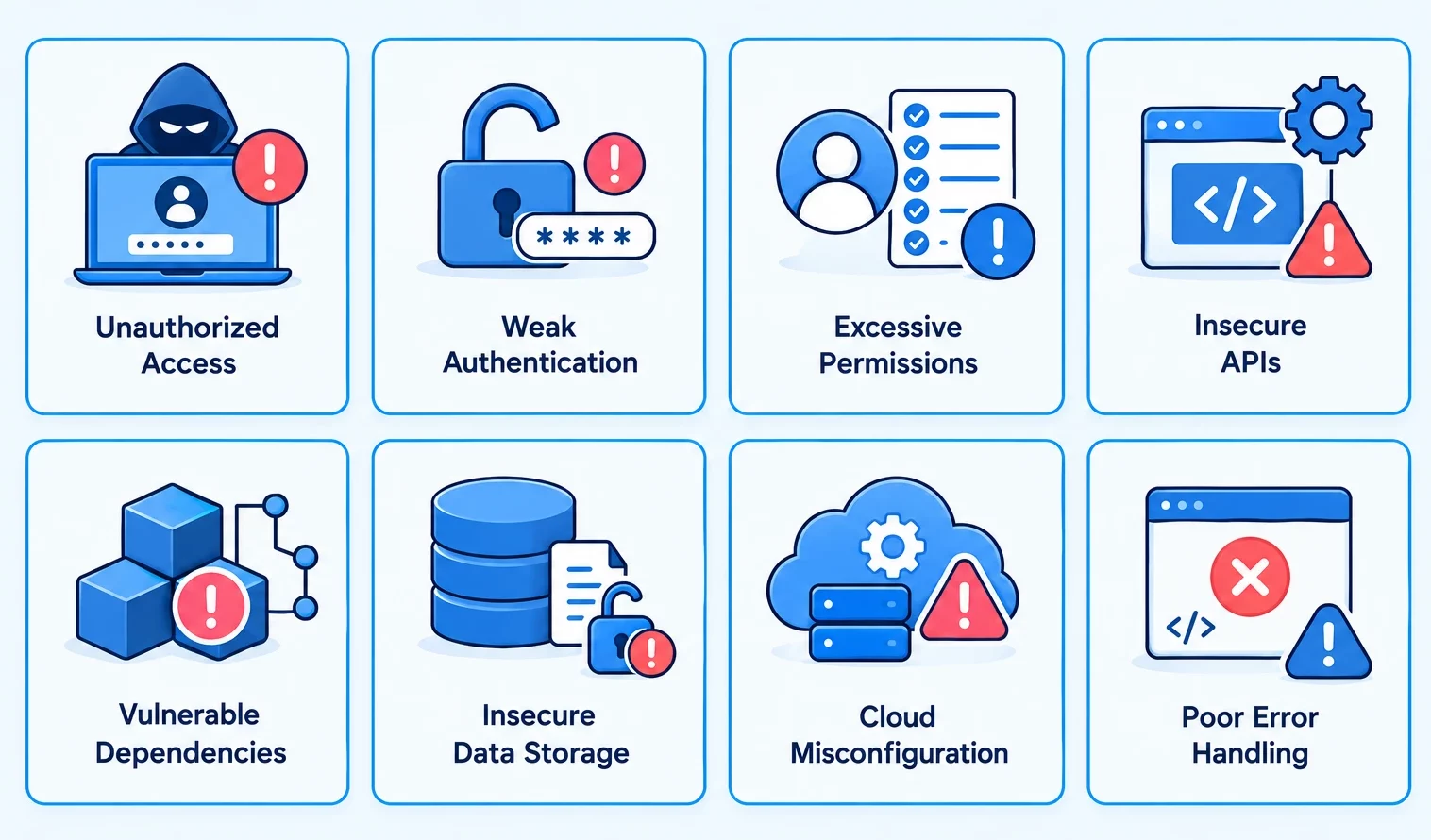
Understanding the most common risks is an important step toward developing an effective security strategy.
1. Unauthorized Access
Unauthorized access occurs when individuals gain access to systems, accounts, or information they should not be able to use. Weak passwords, stolen credentials, inadequate authentication, poor session management, and improperly configured permissions can contribute to this problem.
Businesses should establish strong authentication mechanisms and ensure users receive only the permissions necessary for their responsibilities.
2. Weak Authentication
Authentication is the first major barrier between an application and unauthorized users. If authentication mechanisms are weak, attackers may attempt credential stuffing, brute-force attacks, phishing, or other methods to compromise accounts. Sensitive enterprise applications should use appropriate authentication controls and additional verification mechanisms where necessary.
Multi-factor authentication can provide another layer of protection by requiring users to provide more than one form of verification.
3. Excessive Permissions
Even legitimate accounts can become security risks when they have unnecessary privileges. For example, an employee who only needs to view customer records should not automatically have permission to modify databases, manage users, or access financial systems. The principle of least privilege helps organizations limit access to what users actually need.
4. Insecure APIs
APIs connect enterprise applications with other systems, making them critical components of modern application architecture.
An insecure API can expose sensitive information or allow unauthorized users to perform actions they should not be able to perform. API security should include authentication, authorization, input validation, rate limiting where appropriate, secure communication, monitoring, and proper error handling.
5. Vulnerable Dependencies
Enterprise applications frequently depend on third-party libraries, frameworks, SDKs, and packages.
If a dependency contains a known vulnerability and is not updated or appropriately managed, attackers may exploit it through the application. Organizations should maintain an inventory of dependencies and establish processes for identifying and addressing vulnerable components.
6. Insecure Data Storage
Sensitive data should not be stored without appropriate protection. Applications may store customer records, payment-related information, employee data, authentication information, documents, or other confidential content. Organizations need to determine what data is stored, why it is stored, who can access it, how long it should be retained, and how it should be protected.
7. Cloud Misconfiguration
Cloud environments can provide significant flexibility, but configuration mistakes can expose sensitive systems. Examples include overly permissive access controls, publicly exposed storage, weak identity policies, and improperly configured services. Cloud security therefore needs to be considered as part of the overall application security strategy.
8. Poor Error Handling
Application errors can sometimes reveal information that attackers can use to understand the underlying system. Detailed technical errors, database information, internal paths, or configuration details should not unnecessarily appear in user-facing responses. Secure error handling should provide useful information to legitimate users while minimizing unnecessary technical disclosure.
Application Security Architecture
Security architecture defines how security controls are incorporated into the application’s overall design. A well-designed enterprise app development process should address security requirements during planning and architecture rather than leaving them until the testing stage.
An effective application security architecture can include several layers. The application interface should validate inputs and enforce appropriate session controls. Backend services should authenticate requests and enforce authorization. APIs should limit access according to user and system permissions. Databases should protect sensitive information and restrict access to authorized services.
Network-level controls can also limit unnecessary communication between components. Monitoring and logging can provide visibility into suspicious activity. Security architecture should also consider what happens if one component is compromised. A strong design should prevent an attacker who gains access to one area from automatically gaining unrestricted access to the rest of the environment.
Designing for Defense in Depth
Defense in depth means using multiple security layers instead of relying on one control. For example, an application may use multi-factor authentication, role-based authorization, encrypted communication, database access controls, API security, monitoring, and vulnerability management.
If an attacker manages to bypass one control, the remaining layers can reduce the potential impact. Defense in depth is especially useful in enterprise environments because applications often contain multiple access paths and dependencies.
Secure Application Development
Security should be incorporated throughout the development lifecycle. Developers should understand the application’s security requirements before writing significant amounts of code. They should know which information is sensitive, which users require access, which external systems will be connected, and which security standards need to be followed.
A strong application development security strategy can include secure coding standards, code reviews, automated scanning, dependency management, input validation, authentication controls, secure error handling, and security testing.
Secure Coding Practices
Secure coding involves writing software in ways that reduce the likelihood of exploitable vulnerabilities. Developers should validate and sanitize input, avoid insecure programming patterns, handle authentication carefully, protect sensitive credentials, and use secure libraries and frameworks. Applications should also avoid exposing unnecessary information through logs, errors, URLs, or client-side code.
Secrets Management
API keys, passwords, tokens, certificates, and encryption credentials should be managed securely. Hardcoding secrets directly into source code can create unnecessary exposure, especially when code repositories are accessible to multiple developers or third parties.
Organizations should use appropriate secrets-management mechanisms and restrict access according to role.
Dependency Management
Third-party components can accelerate development, but they also introduce external security risks.
Development teams should maintain visibility into the libraries and packages used by applications and monitor them for known vulnerabilities. When vulnerabilities are discovered, teams should evaluate the affected component and determine whether it should be updated, replaced, isolated, or otherwise mitigated.
Identity and Access Management
Identity and access management is one of the most important areas of enterprise application security. Authentication answers the question, “Who are you?” Authorization answers, “What are you allowed to do?”
Both need to work together. A user may successfully authenticate but still need to be restricted from accessing certain records or performing administrative actions.
Role-Based Access Control
Role-based access control allows organizations to assign permissions according to defined roles. For example, a sales employee might access customer profiles and sales records, while a finance employee may access financial information. An administrator may have broader privileges but should still have controls around highly sensitive operations.
Roles should be reviewed regularly because business responsibilities change.
Data Access Control
Access to sensitive information should be controlled at the appropriate level. Data access control for enterprise applications can help organizations ensure that users and systems only access information necessary for legitimate business purposes. This becomes particularly important when applications contain information belonging to multiple customers, departments, locations, or business units.
Privileged Access
Administrative accounts can have extensive permissions and therefore require stronger controls. Businesses should limit privileged accounts, protect administrator authentication, monitor privileged activity, and regularly review administrative permissions.
Application Data Security
Data is often one of the most valuable assets handled by an enterprise application. Application data security involves protecting information from unauthorized access, alteration, loss, and exposure throughout its lifecycle.
Data security begins by understanding what information an application collects and stores. Businesses should classify information based on sensitivity and determine which data requires stronger protection.
Encryption
Encryption can protect data from unauthorized access if storage systems or communication channels are compromised. Sensitive information should be protected while being transmitted between users, applications, APIs, and backend services. Organizations should also consider encryption for data stored in databases, backups, and other storage systems where appropriate.
Data Minimization
One of the most effective ways to reduce data exposure is to avoid collecting or retaining information that the business does not need. If sensitive information is unnecessary for an application’s operation, storing it creates additional security responsibility without providing corresponding business value.
Secure Backups
Backups are important for business continuity and recovery, particularly in the event of ransomware, system failure, or data corruption. However, backups themselves can become targets if they are not appropriately protected. Organizations should secure backup storage, restrict access, and regularly test recovery procedures.
Application Security Framework
An application security framework provides a structured way to organize security activities throughout an application’s lifecycle. Rather than treating security as a collection of unrelated tasks, organizations can use a framework to define how security requirements are established, vulnerabilities are identified, controls are implemented, and incidents are handled.
A mature framework can cover planning, architecture, secure development, testing, deployment, monitoring, vulnerability management, and incident response. The specific framework an organization adopts should depend on its industry, risk profile, regulatory requirements, application architecture, and business objectives. Frameworks are most effective when they are integrated into everyday development and operational processes rather than maintained only as documentation.
Application Security Testing
Testing is essential because applications can contain vulnerabilities even when development teams follow secure coding practices. Security testing attempts to identify weaknesses before attackers can exploit them. An organization may perform different types of testing depending on the application’s architecture and risk profile.
Vulnerability Assessment
Vulnerability assessments identify known weaknesses within application components, dependencies, infrastructure, or configurations. They can provide development and security teams with a list of potential issues that need to be evaluated and prioritized.
Penetration Testing
Penetration testing involves controlled attempts to identify and exploit vulnerabilities. The purpose is not simply to find problems but to understand how vulnerabilities could potentially be chained together and what impact they might have.
Code Analysis
Static and dynamic analysis can help identify security weaknesses within application code and running environments. Automated tools can improve coverage, although they should complement rather than completely replace human security review.
API Testing
Because APIs are often central to enterprise applications, they should be tested for authentication, authorization, input validation, data exposure, and other potential weaknesses. Organizations that require specialist expertise can consider an enterprise application development partner with experience in building and evaluating complex enterprise systems.
Enterprise Web Application Security Testing
Web applications are exposed to users and potentially malicious traffic through the internet or internal networks. Enterprise web application security testing should evaluate the application’s authentication, authorization, input handling, session management, APIs, business logic, configuration, and other relevant components.
Testing should not be limited to technical vulnerabilities. Business logic vulnerabilities can be equally important. For example, an application may technically authenticate users correctly but still allow a user to perform an action that violates business rules. Security testing should therefore consider how the application is actually used.
Vulnerability Management
Finding vulnerabilities is only useful if organizations have a process for resolving them. A vulnerability management process should establish how security issues are identified, categorized, prioritized, assigned, remediated, and verified.
Not every vulnerability carries the same level of risk. Organizations should consider factors such as exploitability, affected assets, data sensitivity, exposure, and potential business impact. Critical vulnerabilities affecting internet-facing systems may require immediate attention, while lower-risk issues may be addressed during scheduled maintenance. After remediation, teams should verify that the vulnerability has actually been resolved.
Enterprise Mobile Application Security
Enterprise applications increasingly extend beyond desktop and web environments. Employees, customers, partners, and field teams may use mobile applications to access business information and services. This makes enterprise mobile application security an important part of a broader enterprise security strategy.
Mobile applications can introduce risks involving local storage, device compromise, insecure networks, application tampering, authentication, session management, and API communication. Businesses need to consider what information is stored on devices and whether that information remains protected if a device is lost or compromised.
Organizations expanding their enterprise application capabilities across mobile platforms can use mobile app development services to build applications with security requirements incorporated into the development lifecycle.
Secure Mobile Authentication
Mobile applications should use secure authentication mechanisms and manage sessions carefully. Applications should avoid unnecessarily storing credentials locally and should use secure communication channels when exchanging information with backend services.
Secure Local Storage
Mobile devices can be lost, stolen, or compromised. Sensitive business information stored locally should therefore receive appropriate protection. Businesses should carefully determine which information actually needs to remain on the device.
API Protection for Mobile Apps
A mobile application’s backend APIs are often a critical security boundary. Attackers may attempt to reverse engineer applications, manipulate requests, or bypass client-side controls. Security decisions should therefore be enforced on the server rather than relying solely on controls implemented within the mobile interface.

Android Application Security
Android applications can have specific security considerations related to permissions, application components, local storage, third-party libraries, and device environments. Businesses developing Android applications should evaluate how the application handles sensitive information, communicates with backend services, manages permissions, and authenticates users.
Organizations can review Android application security best practices when establishing security controls for Android-based enterprise applications. Testing should also cover different supported Android versions and device configurations where relevant.
As with other mobile applications, Android security should not be considered separately from backend security. A secure application interface cannot compensate for weak APIs, insecure authentication services, or poorly protected databases.
Cross-Platform Mobile Security
Cross-platform development can help businesses deliver applications across multiple mobile environments, but security still needs to be addressed consistently. Organizations should consider how authentication, data storage, APIs, session management, permissions, and application updates operate across supported platforms.
Following mobile app security best practices can help development teams address common security considerations when applications are deployed across different mobile environments. Security controls should remain consistent with the organization’s broader enterprise security policies.
Cloud Application Security
Cloud infrastructure has transformed the way enterprise applications are built and deployed. Organizations can scale resources quickly, use managed services, distribute applications across regions, and integrate a wide range of cloud capabilities. However, moving an application to the cloud does not automatically make it secure.
Cloud environments can introduce risks involving identity management, storage permissions, network configuration, exposed services, credentials, and infrastructure settings. Organizations should follow cloud security best practices when designing, deploying, and maintaining cloud-based applications.
Shared Responsibility
Cloud security typically involves responsibilities shared between the cloud provider and the customer. The provider may secure aspects of the underlying infrastructure, while the organization remains responsible for areas such as application configuration, identity management, access permissions, data, and certain infrastructure settings.
Businesses should understand these responsibilities clearly instead of assuming that cloud deployment transfers all security obligations to the provider.
Cloud Identity Management
Identity is particularly important in cloud environments because administrative and service accounts may have extensive access. Organizations should apply least-privilege principles, protect privileged credentials, use appropriate authentication mechanisms, and monitor account activity.
Cloud Configuration Management
Misconfiguration is a common source of cloud risk. Organizations should establish standards for cloud environments and regularly review configurations to identify unnecessary exposure. Automated monitoring can help identify unexpected changes and configuration problems.
Cybersecurity Solutions for Enterprise Applications
Businesses increasingly use different technologies to strengthen their security posture. Cybersecurity solutions can support different areas of application protection, including threat detection, access management, data protection, monitoring, and vulnerability management. However, technology alone cannot solve every security problem.
A security platform may detect suspicious activity, but organizations still need processes for responding to alerts. Similarly, encryption can protect stored information, but businesses still need access controls to determine who is allowed to use that information. The strongest security strategies combine technology, people, processes, and governance.
Security Measures During Application Development
Security needs to remain part of application development rather than becoming an isolated activity managed only by a security team. Organizations can establish security measures for applications across planning, design, development, testing, deployment, and maintenance.
Security During Planning
Planning should identify sensitive data, user types, integrations, regulatory requirements, and potential threats. Security requirements should be documented alongside functional and technical requirements.
Security During Design
Design teams should consider authentication, authorization, data protection, API security, network communication, and failure scenarios. Threat modeling can help teams identify how an attacker might interact with the proposed system.
Security During Development
Developers should follow secure coding standards and use appropriate tools to identify vulnerabilities. Code reviews can provide another opportunity to catch security issues before they reach production.
Security During Testing
Security testing should validate whether controls work as intended. Testing should include both automated checks and manual assessment where appropriate.
Security After Deployment
Security does not end when an application is released. Organizations need monitoring, logging, vulnerability management, patching, access reviews, and incident response processes throughout the application’s operational life.
Building an Application Security Program
A sustainable security strategy requires an organized program. An application security program defines how an organization manages security across applications and development teams. It can establish responsibilities for developers, security professionals, IT teams, system administrators, and business stakeholders.
A mature program should define security requirements, development standards, testing expectations, vulnerability management procedures, incident response processes, and security monitoring practices.
Establish Security Ownership
Every important security process should have a clear owner. If no one is responsible for reviewing vulnerabilities or monitoring security alerts, issues may remain unresolved. Security ownership should be incorporated into organizational responsibilities rather than relying on informal expectations.
Create Security Policies
Policies provide consistent guidance for development and operations teams. Policies may address password management, access controls, data handling, secure development, vulnerability remediation, third-party integrations, and incident response.
Train Development Teams
Developers need practical security knowledge. Training can help teams recognize common vulnerabilities and understand how to build security into everyday development decisions. Security awareness should not be limited to a single annual session. It should evolve as application technologies and threat patterns change.
Read Also: Enterprise App Development Cost: Budget, Architecture & Business Impact Explained
Application Security Monitoring
Security monitoring provides visibility into what is happening within an application environment. Logs can help organizations identify unusual authentication attempts, unexpected access patterns, suspicious API activity, configuration changes, or other potential indicators of compromise.
Monitoring should be designed around meaningful security events rather than collecting large volumes of data without a clear purpose. Organizations should also determine how alerts will be investigated. A monitoring system that generates large numbers of irrelevant alerts can make it difficult for security teams to identify genuine threats.
Logging and Audit Trails
Audit trails can help organizations understand who performed an action and when it happened. For sensitive enterprise operations, logging can provide valuable information during security investigations.
Logs should themselves be protected because they may contain sensitive operational information. Organizations should determine which events need to be logged, how long logs should be retained, who can access them, and how they are protected from unauthorized modification.
Incident Response
Even strong security controls cannot guarantee that an application will never experience a security incident. Businesses therefore need an incident response process. The process should explain how potential incidents are identified, investigated, contained, resolved, and reviewed.
A well-prepared organization can respond more efficiently because responsibilities and procedures are established before an incident occurs. After an incident, organizations should review what happened and determine whether changes are necessary to prevent similar events.
Third-Party and Supply Chain Security
Enterprise applications frequently depend on external vendors, libraries, APIs, cloud providers, and technology partners. This creates a supply-chain dimension to application security, particularly in solutions built by a logistics app development company that may integrate with payment gateways, mapping services, fleet tracking platforms, and other third-party systems.
Organizations should understand which external components are part of their applications and evaluate the security implications of third-party dependencies. Vendor security assessments may also be appropriate when external providers have access to sensitive systems or information. Third-party access should be limited to what is necessary and reviewed periodically.
Compliance and Enterprise Application Security
Many organizations operate under regulatory or contractual requirements concerning data protection and security. Compliance requirements vary by industry, geography, data type, and business model.
Organizations should identify which requirements apply to their applications and incorporate relevant controls into application design and operations. Compliance should not be viewed as a substitute for security. An application can technically meet a particular compliance requirement while still having other security weaknesses. The stronger approach is to use compliance requirements as part of a broader risk-management strategy.
How Businesses Can Improve Application Security
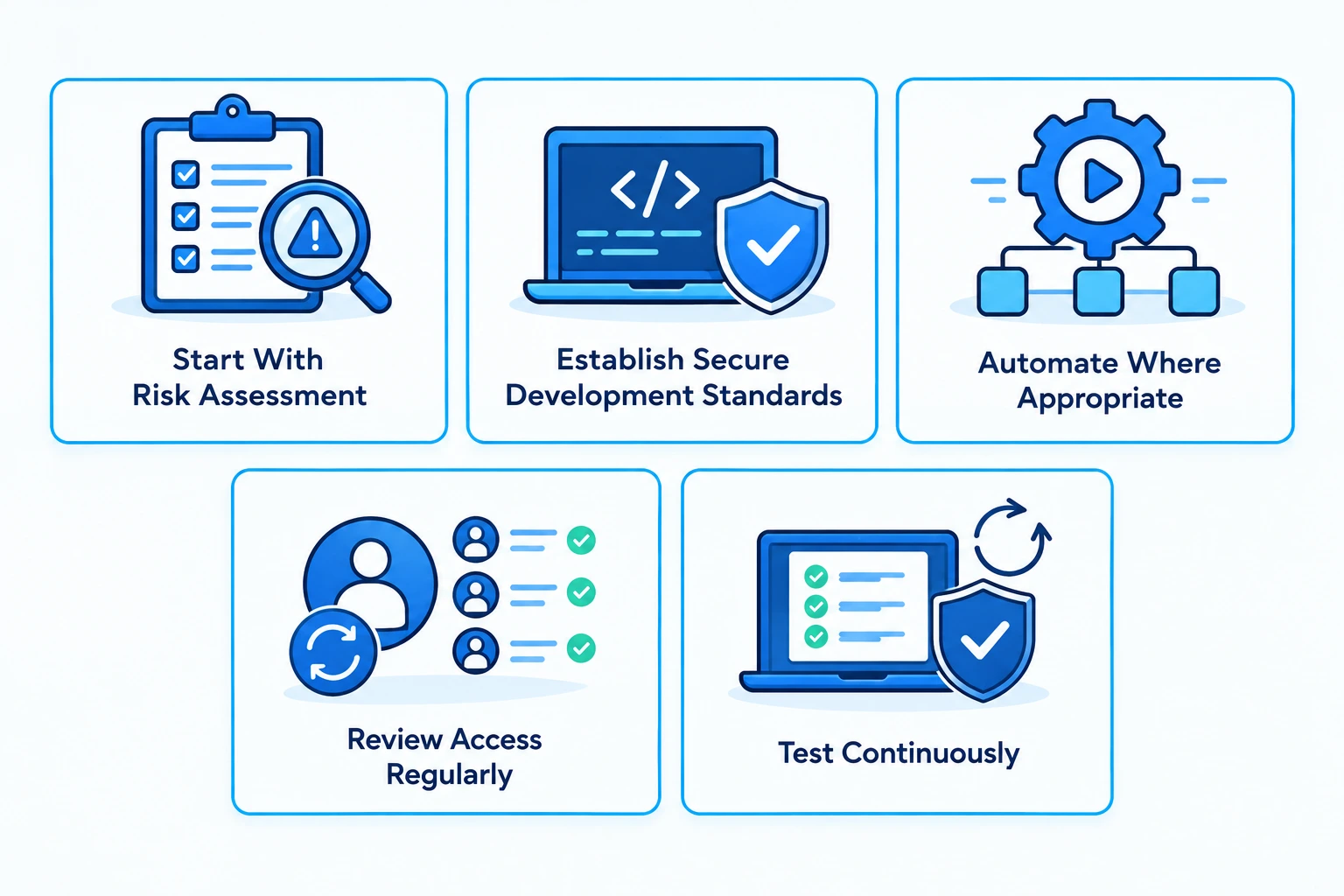
Improving application security is an ongoing process. Businesses do not need to implement every possible security technology simultaneously. A practical approach begins with understanding the organization’s applications, data, users, integrations, and current risks.
From there, businesses can prioritize improvements according to business impact. For example, an organization may first protect highly sensitive systems and internet-facing applications before addressing lower-risk internal applications.
1. Start With Risk Assessment
Risk assessment helps organizations understand where security investments can have the greatest impact. Teams should identify valuable assets, potential threats, vulnerabilities, and consequences. This creates a foundation for prioritizing security activities.
2. Establish Secure Development Standards
Organizations should define secure development practices that developers can consistently follow. These standards can cover coding, authentication, authorization, secrets management, dependency handling, error management, logging, and testing.
3. Automate Where Appropriate
Automation can help teams perform security checks consistently. Automated tools can scan code, identify vulnerable dependencies, evaluate configurations, and monitor certain security events. However, automation should complement human judgment rather than replace it completely.
4. Review Access Regularly
Access permissions should be reviewed as organizations and employee responsibilities change. Inactive accounts should be removed, unnecessary permissions should be revoked, and privileged access should receive additional scrutiny.
5. Test Continuously
Security testing should be repeated throughout the application’s lifecycle. Changes to code, infrastructure, integrations, or configuration can introduce new risks.
Enterprise Application Security and Business Continuity
Security and business continuity are closely connected. A security incident can prevent employees from accessing applications, disrupt customer services, interrupt transactions, or make important data temporarily unavailable.
Organizations should therefore consider security as part of continuity planning. Backup strategies, recovery procedures, redundancy, incident response, and system restoration processes can reduce the impact of disruptive events. The objective is not only to prevent attacks but also to ensure that the business can recover effectively when an incident occurs.
1. Security and Application Scalability
Security controls should be designed with future growth in mind. An application that serves a few hundred users may eventually serve thousands or millions. Security mechanisms need to remain effective as user numbers, transactions, devices, data volumes, and integrations increase.
Scalability should therefore be considered when designing authentication, authorization, monitoring, encryption, API protection, and infrastructure controls. Poorly designed security mechanisms can become performance bottlenecks as applications grow. The solution is not to reduce security but to design controls that can scale with the application’s requirements.
2. Security for Enterprise Integrations
Enterprise applications often need to exchange information with other business systems. Integrations can increase efficiency, but every connection needs to be evaluated from a security perspective.
Organizations should understand what data is exchanged, which system initiates communication, how authentication works, and what happens if an integration becomes unavailable or compromised. API permissions should be limited according to actual requirements. Organizations should also avoid granting third-party services broader access than necessary.
3. Security Culture Within the Organization
Technology cannot provide complete protection if users and teams ignore security practices. Organizations need a security culture in which developers, employees, administrators, and leadership understand their responsibilities. Employees should know how to protect credentials and recognize suspicious requests.
Developers should understand secure coding practices. Administrators should manage permissions carefully. Leadership should recognize that security is an ongoing investment rather than a one-time project. When security becomes part of everyday decision-making, organizations are better positioned to identify and address risks early.
Read Also: Why Enterprise Mobile Apps Are Critical For Business Performance In 2026
Future of Enterprise Application Security
Enterprise application environments will continue to evolve as businesses adopt artificial intelligence, automation, cloud-native architectures, APIs, connected devices, and distributed work environments. These technologies can create new opportunities but also introduce new security considerations.
Artificial intelligence, for example, can create new data-handling requirements and introduce risks related to model access, sensitive information, and third-party AI services. Cloud-native architectures may increase the number of services and APIs that need to be secured.
Remote and distributed work can increase the number of devices and locations from which enterprise applications are accessed. Organizations therefore need security strategies that can adapt to changing technologies rather than relying on static controls.
Continuous assessment, secure development, strong identity management, monitoring, and regular testing will remain important as enterprise application environments become more complex.
A Practical Enterprise Application Security Strategy
Businesses can approach application security as a lifecycle rather than a single implementation task. The process begins with understanding business requirements and identifying sensitive assets.
The next step is designing an architecture that incorporates security controls from the beginning. Development teams then implement secure coding practices and use appropriate tools to identify vulnerabilities. Testing validates the security of the application before and after deployment.
Once the application is live, monitoring, vulnerability management, access reviews, and incident response help maintain its security posture. Finally, organizations should regularly review the entire strategy and make improvements based on new risks, technologies, and business requirements. This lifecycle-based approach helps prevent security from becoming an afterthought.
Final Thoughts
Enterprise application security is essential for businesses that rely on digital applications to manage sensitive information and critical operations. As enterprise environments become increasingly interconnected, organizations must protect application code, identities, APIs, databases, cloud infrastructure, mobile devices, integrations, and business data through secure architecture, development, testing, deployment, and monitoring.
Organizations with specialized workflows or unique technical requirements can leverage custom app development services to build applications around their specific business processes while incorporating appropriate security requirements from the beginning. Clear security ownership, vulnerability management, and incident response processes also help ensure that security remains an ongoing responsibility.
Ultimately, enterprise application security is about more than preventing breaches. By combining strong access controls, data protection, secure development, testing, cloud and mobile security, monitoring, and continuous risk management, businesses can create a trusted digital foundation that protects valuable information while supporting growth and long-term operations.
FAQs
Q1. What is enterprise application security?
Enterprise application security is the practice of protecting business applications, data, users, APIs, and infrastructure from unauthorized access, vulnerabilities, cyberattacks, and data breaches.
Q2. Why is enterprise application security important for businesses?
It helps protect sensitive business information, prevent unauthorized access, reduce operational disruptions, maintain customer trust, and minimize the financial and regulatory impact of security incidents.
Q3. What are the common risks to enterprise applications?
Common risks include weak authentication, unauthorized access, insecure APIs, injection attacks, exposed credentials, insecure data storage, outdated dependencies, and cloud misconfigurations.
Q4. How can businesses secure enterprise applications?
Businesses can improve security through secure architecture, strong authentication, access controls, encryption, secure coding practices, API protection, vulnerability testing, continuous monitoring, and incident response planning.
Q5. What role does security testing play in enterprise applications?
Security testing identifies vulnerabilities before attackers can exploit them. It can include penetration testing, vulnerability assessments, code analysis, API testing, and configuration reviews.
Q6. How can organizations protect data in enterprise applications?
Organizations can protect application data using encryption, access controls, secure key management, data masking, protected backups, and appropriate data-retention policies.
Q7. Is mobile security important for enterprise applications?
Yes. Enterprise mobile applications can provide access to sensitive business information, so organizations should protect authentication, local storage, communication, APIs, sessions, and connected backend systems.
Q8. Should security be added after an enterprise application is developed?
No. Security should be incorporated throughout the application lifecycle, beginning with planning and architecture and continuing through development, testing, deployment, monitoring, and maintenance.

SHARE
WRITTEN BY

Ishan Gupta
CEO & Founder
Ishan Gupta is a seasoned entrepreneur and CEO with extensive 8+ years of experience in business and mobile app development landscape. He believes that the right digital product allows companies to focus on what they do best, while technology handles the rest. With deep exposure to global markets, he understands what makes an app succeed. His approach translates business needs into clear product strategies, ensuring that every feature contributes to measurable ROI.
View All Articles




 India
India USA
USA Australia
 Canada
 UK
UK UAE
UAE