

Key Takeaways
- Enterprise mobile apps are becoming core business infrastructure for organizations aiming to improve operational speed, workforce productivity, and customer engagement in 2026.
- The biggest enterprise app development benefits include workflow automation, real-time decision-making, enhanced security, scalability, and improved ROI.
- AI-powered enterprise mobility solutions are transforming how businesses manage operations, collaborate remotely, and deliver customer experiences.
- Organizations investing in enterprise mobility gain a measurable competitive advantage through faster processes, better data visibility, and stronger digital transformation capabilities.
- Businesses that modernize legacy systems and adopt enterprise-grade mobile solutions are better positioned for scalability, innovation, and long-term growth.
Enterprise mobile apps have evolved from supporting business tools into essential drivers of operational efficiency, workforce productivity, customer engagement, and digital transformation. In 2026, organizations across industries are leveraging enterprise mobility solutions to streamline workflows, connect distributed teams, and enable real-time access to critical business data.
As businesses navigate AI-powered operations, hybrid work environments, and rising customer expectations, the demand for secure, scalable, and intelligent mobile solutions continues to grow. Enterprise mobile applications help bridge the gap between employees, systems, and customers, enabling faster decision-making, improved collaboration, and more agile business processes.
For startups, mid-sized companies, and large enterprises, investing in enterprise mobility is a strategic move toward sustainable growth and long-term competitiveness. By partnering with an experienced enterprise mobile app development company, organizations can build customized solutions that modernize operations, enhance user experiences, and adapt to evolving business needs. In this blog, we’ll explore the key benefits of enterprise apps, the latest enterprise mobility trends, the impact of AI-driven business transformation, and why mobile-first infrastructure is becoming a critical foundation for business success in 2026.
Table of Contents
What are Enterprise Mobile Apps and Why Do Businesses Need Them?
Enterprise mobile apps are secure, scalable applications designed to optimize internal business operations, improve employee productivity, and streamline organizational workflows. Unlike consumer-focused applications, enterprise apps are built to support complex business functions, integrate with enterprise systems, and maintain high levels of security and compliance.
These applications allow employees, managers, and stakeholders to access critical business systems from anywhere through smartphones, tablets, or connected devices. Enterprise mobile apps are commonly integrated with CRM platforms, ERP systems, HR software, analytics tools, customer service platforms, and cloud infrastructure.
How are Enterprise Apps Different from Consumer Apps?
Consumer apps focus primarily on user entertainment, convenience, or e-commerce interactions. Enterprise apps, on the other hand, are designed to solve operational challenges and improve organizational efficiency.
| Consumer Apps | Enterprise Mobile Apps |
| Built for general users | Built for employees and business operations |
| Focus on engagement | Focus on productivity and efficiency |
| Simple integrations | Deep integration with enterprise systems |
| Lower security complexity | Advanced security and compliance |
| Individual usage | Organization-wide workflows |
Enterprise applications prioritize data protection, workflow automation, real-time communication, and cross-department collaboration. This makes them essential for businesses operating in highly competitive and fast-changing markets.
What Types of Enterprise Mobile Apps are Common in 2026?
Understanding the different types of enterprise applications can help businesses identify the right technologies to support their growth and efficiency goals. Several categories of enterprise applications are driving business transformation across industries:
- Sales enablement apps
- ERP and inventory management apps
- HR and employee management platforms
- Field service management applications
- Workflow automation solutions
- Enterprise collaboration apps
- AI-powered analytics dashboards
- Supply chain and logistics platforms
As businesses scale, these applications become critical for maintaining operational consistency and improving decision-making speed.
Why are Enterprise Mobile Apps More Important Than Ever in 2026?
The business environment in 2026 is more digital, data-driven, and mobile-first than ever before. Organizations are expected to operate faster, deliver seamless experiences, and make decisions in real time. Enterprise mobile applications are becoming the backbone of this transformation.
How is Hybrid Work Changing Enterprise Operations?
Hybrid and remote work models have permanently changed how organizations function. Employees now expect secure access to enterprise systems from anywhere. Businesses relying solely on desktop infrastructure or outdated systems struggle to maintain collaboration and productivity.
Enterprise mobility solutions solve this challenge by enabling employees to:
- Access business data remotely
- Collaborate in real time
- Manage workflows on the go
- Communicate securely across teams
- Respond to customer requests faster
This flexibility improves workforce efficiency while supporting modern work expectations.
Why is Real-Time Decision-Making Becoming Critical?
Business leaders can no longer wait hours or days for reports and approvals. Real-time insights are now essential for:
- Sales forecasting
- Operational monitoring
- Inventory tracking
- Customer support
- Financial management
- Supply chain visibility
Enterprise mobile apps provide instant access to live business data, allowing decision-makers to respond quickly to opportunities and challenges.
How is AI Strengthening Enterprise Mobility?
AI integration is one of the most important trends shaping enterprise mobility in 2026. AI-powered enterprise applications are enabling businesses to automate repetitive tasks, predict operational risks, and improve customer experiences.
Examples include:
- AI-driven customer support assistants
- Predictive maintenance alerts
- Intelligent workflow automation
- Personalized sales recommendations
- Smart analytics dashboards
- Voice-enabled enterprise operations
The acceleration of AI adoption continues to reshape enterprise technology priorities. According to McKinsey’s State of AI 2025 report, 88% of organizations now use AI in at least one business function, up from 78% in the previous year. The study also found that 62% of organizations are already experimenting with AI agents, signaling a shift from isolated AI initiatives toward more autonomous and integrated enterprise workflows. This rapid adoption underscores why enterprises are investing heavily in AI-powered mobility ecosystems to enhance operational efficiency, improve workforce productivity, and scale digital transformation initiatives across the organization.
Organizations combining AI with mobility are gaining a major competitive advantage in operational efficiency and scalability.
Why are Businesses Prioritizing Digital Transformation?
Digital transformation is no longer limited to large enterprises. Startups and mid-sized businesses are also investing heavily in scalable technology ecosystems.
Enterprise mobile applications support digital transformation by:
- Reducing manual processes
- Improving workflow visibility
- Enhancing employee productivity
- Accelerating customer response times
- Modernizing legacy systems
- Enabling data-driven decision-making
Companies that delay enterprise mobility adoption often face slower innovation cycles and higher operational inefficiencies. Enterprise mobile app benefits for businesses have increased over time.
What are the Biggest Enterprise App Development Benefits for Businesses?
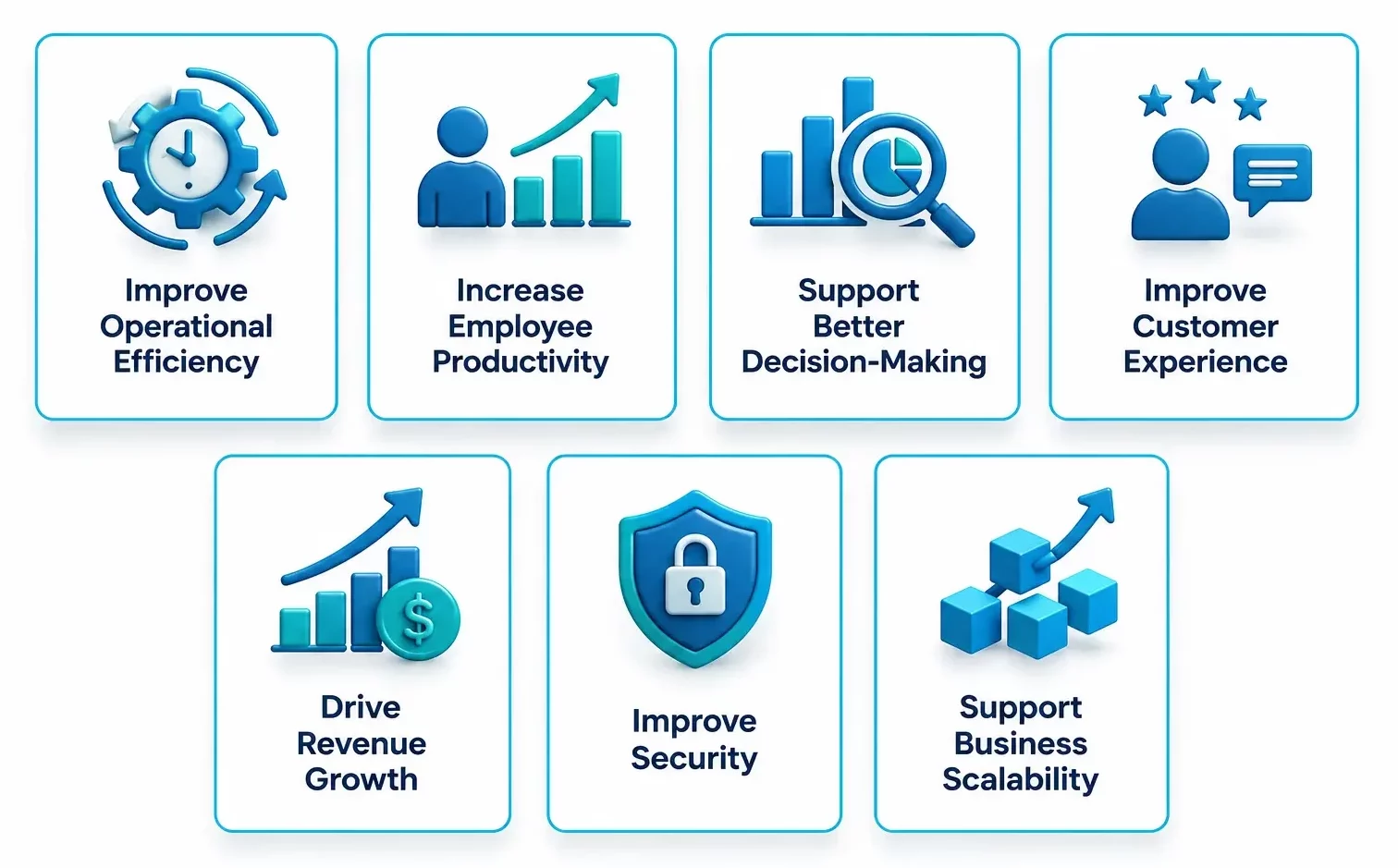
The growing demand for enterprise mobility is driven by measurable business outcomes. Organizations across industries are adopting enterprise apps because they improve productivity, reduce operational bottlenecks, and support long-term scalability.
Organizations looking to maximize these advantages often rely on a comprehensive enterprise app development guide to make informed decisions about scalability, architecture, security, and long-term digital transformation strategies.
How do Enterprise Apps Improve Operational Efficiency?
Operational efficiency is one of the most valuable enterprise app development benefits for modern organizations.
Enterprise mobile applications streamline workflows by automating repetitive tasks, reducing paperwork, and eliminating communication gaps. Teams can access data instantly, complete approvals faster, and manage operations more effectively.
For example, logistics companies using enterprise mobility platforms can monitor shipments in real time, optimize delivery routes, and automate inventory updates. Manufacturing businesses can track production workflows directly from mobile dashboards.
Key operational improvements include:
- Faster approval cycles
- Reduced manual errors
- Improved workflow visibility
- Automated reporting
- Better interdepartmental coordination
- Lower operational costs
These improvements help businesses scale operations without significantly increasing administrative overhead.
How do Enterprise Mobile Apps Increase Employee Productivity?
Workforce productivity is directly connected to accessibility and collaboration. Employees perform better when they can access business systems anytime and anywhere.
Enterprise mobile apps empower employees with:
- Mobile access to enterprise systems
- Instant communication tools
- Task management capabilities
- Remote collaboration features
- Real-time notifications
- Cloud-based document sharing
For field service teams, enterprise mobility eliminates delays caused by manual reporting or disconnected systems. Sales teams can update CRM records instantly while meeting clients. Managers can approve workflows remotely without operational disruptions.
The effectiveness of these solutions often depends on incorporating the right enterprise app features that support seamless communication, workflow automation, and real-time data access across teams.
How do Enterprise Apps Support Better Decision-Making?
Modern businesses rely heavily on data-driven decisions. Enterprise mobile apps provide executives and managers with instant access to analytics, reports, and operational metrics.
Instead of waiting for static reports, leaders can monitor:
- Sales performance
- Employee productivity
- Customer engagement
- Financial metrics
- Operational bottlenecks
- Inventory levels
Real-time business intelligence improves agility and helps organizations respond quickly to market changes.
AI-powered analytics tools integrated into enterprise apps also support predictive decision-making. Businesses can identify risks early, forecast trends accurately, and optimize resource allocation more effectively.
How do Enterprise Mobile Apps Improve Customer Experience?
Customer expectations continue to rise across every industry. Businesses are expected to provide faster responses, personalized experiences, and seamless digital interactions.
Enterprise mobile apps improve customer experiences by enabling:
- Faster customer support
- Real-time order tracking
- Personalized communication
- Better service coordination
- Omnichannel engagement
- Reduced response times
For example, healthcare providers use enterprise mobility solutions to streamline patient communication and appointment management. Retail companies use mobile enterprise platforms to improve inventory visibility and customer service.
Improved customer experiences lead to:
- Higher retention rates
- Increased customer satisfaction
- Better brand reputation
- Higher lifetime customer value
How do Enterprise Apps Drive Revenue Growth?
Many organizations underestimate the direct revenue impact of enterprise mobility.
Enterprise mobile applications accelerate revenue generation by improving sales efficiency, customer engagement, and operational scalability. Businesses can identify opportunities faster, reduce delays, and improve service delivery. While the benefits are substantial, understanding the enterprise app development cost is often an important step in evaluating the potential return on investment and long-term business value.
Revenue-driving advantages include:
- Faster sales cycles
- Improved lead management
- Better customer retention
- Reduced operational waste
- Increased employee efficiency
- Enhanced service quality
Organizations using mobile-first enterprise strategies are often able to scale faster while maintaining operational consistency.
Why is Security a Major Enterprise App Development Benefit?
Cybersecurity and data privacy are top priorities for businesses in 2026. Enterprise mobile apps are designed with advanced security frameworks to protect sensitive organizational data.
Modern enterprise applications commonly include:
- End-to-end encryption
- Biometric authentication
- Role-based access control
- Multi-factor authentication
- Secure cloud integrations
- Compliance monitoring
While the average cost of a data breach declined to USD 4.44 million in 2025, IBM’s latest research found that 97% of organizations experiencing AI-related security incidents lacked proper AI access controls, highlighting a significant governance gap as enterprises accelerate AI adoption. This evolving threat landscape reinforces the need for robust cybersecurity frameworks, secure enterprise mobility solutions, and security-first application development strategies to protect critical business data and operations.
This is especially important for industries such as healthcare, finance, and logistics, where regulatory compliance is critical.
Businesses working with experienced enterprise development teams can also implement scalable security architectures that adapt to evolving cyber threats.
Read Also: Cloud Migration & Data Security Checklist: Types, Risks, & Proven Strategies
How do Enterprise Apps Support Business Scalability?
Scalability is essential for startups and growing enterprises.
Enterprise mobile applications allow businesses to expand operations, onboard teams, and integrate new systems without disrupting workflows. Cloud-native infrastructure and API-first architecture make enterprise apps highly adaptable.
Scalable enterprise systems support:
- Multi-location operations
- Global collaboration
- Cross-platform integration
- Rapid feature deployment
- Business process expansion
- Future technology adoption
This flexibility is one of the biggest advantages of enterprise mobility for organizations planning long-term growth.
Real-World Enterprise Mobile App: Examples Prove the Business Impact
Many globally successful companies have transformed business performance through enterprise mobility, AI-driven operations, workflow automation, and scalable digital ecosystems. These real-world examples demonstrate how enterprise mobile applications directly improve operational efficiency, customer engagement, scalability, and revenue growth.
Real-World Enterprise Mobility Success Examples
- Uber: Uber’s enterprise-grade mobile ecosystem processes millions of ride requests in real time using AI-powered routing, location tracking, and cloud-native infrastructure. Its mobile-first operational model transformed transportation logistics and customer convenience globally.
- Amazon: It uses enterprise mobility extensively across inventory management, warehouse automation, supply chain optimization, and customer fulfillment. Mobile-enabled logistics operations help the company deliver faster customer experiences while managing massive operational scale.
- Salesforce: It revolutionized enterprise productivity by enabling mobile CRM accessibility, real-time sales tracking, AI-powered analytics, and remote workforce collaboration for global enterprises.
- Examarly: It is an AI-enabled eLearning platform developed by RipenApps that helps educational businesses streamline digital learning experiences, improve user engagement, and support scalable online education operations. It demonstrates how enterprise-grade mobility can modernize education workflows and remote accessibility.
- Mednovate Connect: Mednovate Connect is a telemedicine and healthcare mobility platform designed to improve remote healthcare management, patient communication, and digital consultation workflows. The platform highlights how enterprise mobility solutions improve operational efficiency and patient experiences in healthcare ecosystems.
What Are the Advantages of Enterprise Mobility Across Different Industries?
The advantages of enterprise mobility extend across nearly every major industry. Businesses are using mobile enterprise ecosystems to improve efficiency, automate operations, and deliver better customer experiences.
How are Healthcare Organizations Using Enterprise Mobility?
Healthcare providers are adopting enterprise mobile apps to improve patient management, communication, and operational efficiency.
Common healthcare mobility use cases include:
- Electronic health record access
- Telemedicine support
- Appointment scheduling
- Patient communication portals
- Remote monitoring systems
- Staff collaboration tools
Enterprise mobility helps healthcare organizations reduce administrative delays while improving patient outcomes.
How are Retail Businesses Benefiting from Enterprise Apps?
Retail businesses are leveraging enterprise mobile applications to optimize inventory management, customer engagement, and omnichannel experiences.
Retail mobility solutions support:
- Real-time inventory tracking
- Mobile point-of-sale systems
- Personalized customer experiences
- Supply chain visibility
- Store operations management
- Loyalty program integration
Retailers using enterprise mobility platforms are better equipped to meet evolving customer expectations.
How Is Enterprise Mobility Transforming Logistics and Supply Chains?
Logistics companies operate in highly dynamic environments where real-time visibility is critical.
Enterprise mobile apps help logistics providers:
- Track shipments live
- Optimize delivery routes
- Manage fleets efficiently
- Monitor warehouse operations
- Improve communication between teams
- Reduce operational delays
These improvements increase efficiency while lowering transportation and operational costs.
How are Manufacturing Businesses Using Enterprise Apps?
Manufacturers are investing heavily in mobile enterprise platforms to improve production visibility and operational coordination.
Manufacturing enterprise apps enable:
- Predictive maintenance alerts
- Production workflow monitoring
- Quality assurance tracking
- Equipment management
- Workforce coordination
- Real-time analytics
Mobile-first manufacturing operations improve productivity while minimizing downtime.
Why are Financial Institutions Prioritizing Enterprise Mobility?
Financial organizations require secure, compliant, and highly scalable digital ecosystems.
Enterprise mobility solutions support:
- Secure financial transactions
- Fraud monitoring
- Compliance management
- Customer onboarding
- Internal collaboration
- Data-driven reporting
The ability to deliver secure and efficient mobile experiences has become essential in modern banking and financial services.
How do Enterprise Mobile Apps Compare to Traditional Business Systems?
Many organizations still rely on outdated desktop-based infrastructure that limits flexibility and slows operations.
Enterprise mobile apps provide a more scalable, connected, and agile alternative.
| Traditional Systems | Enterprise Mobile Apps |
| Limited remote access | Anywhere accessibility |
| Slow manual workflows | Automated real-time workflows |
| Siloed systems | Integrated ecosystems |
| Delayed reporting | Instant analytics |
| High maintenance costs | Scalable cloud infrastructure |
| Limited collaboration | Real-time communication |
Traditional systems often create operational bottlenecks and reduce organizational agility. Enterprise mobility enables businesses to modernize workflows while improving responsiveness and scalability.
This is why many organizations are investing in legacy app modernization services to replace outdated systems with scalable mobile-first platforms.
How Enterprise Mobility is Transforming Business Performance in 2026
Enterprise mobility is evolving rapidly as businesses adopt new technologies and operational models.
How is AI Changing Enterprise Mobile Applications?
AI-powered enterprise apps are enabling organizations to automate operations, improve customer experiences, and optimize business intelligence.
AI capabilities now include:
- Intelligent workflow automation
- Predictive analytics
- AI-powered customer support
- Smart recommendations
- Automated reporting
- Operational forecasting
Businesses integrating AI into enterprise mobility strategies are improving efficiency while reducing operational complexity. This demonstrates how AI-powered enterprise ecosystems are delivering both operational and security advantages.
Businesses integrating AI into enterprise mobility strategies are improving efficiency while reducing operational complexity.
Why is Cloud-Native Enterprise Infrastructure Important?
Cloud-native architecture allows businesses to scale applications faster and improve operational resilience.
Benefits of cloud-native enterprise mobility include:
- Faster deployment cycles
- Improved scalability
- Better disaster recovery
- Lower infrastructure costs
- Enhanced collaboration
- Seamless updates
Cloud-based enterprise ecosystems are becoming standard across modern organizations. However, enterprises managing hybrid environments must also strengthen cloud security strategies. According to IBM cloud security and breach insights, 40% of data breaches involved information stored across multiple environments, including public cloud, private cloud, and on-premise systems. This reinforces the importance of secure cloud-native enterprise mobility infrastructure in 2026.
Cloud-based enterprise ecosystems are becoming standard across modern organizations.
Why are Businesses Investing in Low-Code Development?
Low-code and no-code platforms are accelerating enterprise application development.
These platforms help businesses:
- Reduce development timelines
- Launch MVPs faster
- Improve workflow automation
- Lower development costs
- Support rapid experimentation
However, enterprises still require scalable custom development strategies for complex operational requirements.
Read Also: Mobile App Development for Enterprises in USA: Proven Strategies to Maximize Engagement and ROI
How can Businesses Know If They Need an Enterprise Mobile App?
Many organizations recognize operational inefficiencies but struggle to identify when enterprise mobility becomes necessary.
Businesses should consider enterprise mobile app adoption if they experience:
- Slow approval processes
- Communication gaps between teams
- Limited remote accessibility
- Operational bottlenecks
- Poor customer response times
- Manual data management
- Difficulty scaling operations
- Outdated legacy systems
- Lack of real-time analytics
If these challenges impact productivity or customer experience, enterprise mobility can provide measurable improvements.
Companies seeking long-term scalability often partner with an app development company to assess operational workflows, identify transformation opportunities, build custom mobility strategies, and provide reliable application maintenance and support services for their growth.
What Best Practices Help Ensure Successful Enterprise App Development?
Successful enterprise mobility initiatives require more than just app development. Businesses must align technology investments with operational goals, scalability requirements, and long-term digital transformation strategies.
Why is Workflow Mapping Important Before Development?
Organizations should analyze existing workflows before building enterprise applications.
Workflow mapping helps identify:
- Operational inefficiencies
- Redundant processes
- Automation opportunities
- User pain points
- Integration requirements
This ensures the final application aligns with real business needs.
Why does User Experience Matter in Enterprise Apps?
Poor user adoption is one of the biggest reasons enterprise software projects fail.
Enterprise apps should prioritize:
- Intuitive navigation
- Fast performance
- Minimal learning curves
- Cross-device compatibility
- Accessibility standards
Well-designed enterprise applications improve employee adoption and operational efficiency.
How Important is Scalability in Enterprise Mobility?
Enterprise systems must support long-term business growth.
Scalable applications allow businesses to:
- Add new users easily
- Expand operations globally
- Integrate additional systems
- Launch new features rapidly
- Adapt to future technologies
Businesses that ignore scalability often face expensive redevelopment costs later.
Why Should Businesses Prioritize Security from Day One?
Enterprise applications manage sensitive organizational and customer data, making security a critical consideration throughout the development lifecycle. Successful enterprise mobile app development strategies prioritize security from the earliest stages to minimize vulnerabilities and ensure long-term reliability.
Security-first development strategies should include:
- Data encryption
- Secure APIs
- Compliance frameworks
- Identity management
- Continuous monitoring
- Threat detection systems
Strong cybersecurity planning reduces operational risks and protects business continuity.
Why are Ongoing Support and Maintenance Essential?
Enterprise mobility is not a one-time investment.
Businesses require continuous maintenance and support services to:
- Improve app performance
- Release security updates
- Fix bugs proactively
- Ensure system compatibility
- Optimize user experience
- Scale features over time
Long-term maintenance ensures enterprise applications remain secure, reliable, and competitive.
Final Thoughts
Enterprise mobile apps have evolved into strategic business assets that directly impact operational efficiency, workforce productivity, customer experience, and long-term scalability. In 2026, businesses that prioritize enterprise mobility are better positioned to innovate faster, adapt to market changes, and maintain a strong competitive advantage in increasingly digital industries.
For organizations looking to accelerate digital transformation, improve operational agility, and unlock the full advantages of enterprise mobility, partnering with the right technology expert is critical. RipenApps helps startups and enterprises build scalable, secure, and future-ready enterprise solutions through custom mobility strategies, enterprise application development, legacy modernization services, and ongoing application maintenance and support designed for long-term business growth.
FAQs
Q1. What are the main enterprise app development benefits?
The biggest enterprise app development benefits include improved operational efficiency, workforce productivity, real-time analytics, customer experience enhancement, workflow automation, and business scalability.
Q2. Why are enterprise mobile apps important in 2026?
Enterprise mobile apps are essential in 2026 because businesses require real-time operations, AI-driven workflows, remote accessibility, and scalable digital infrastructure to remain competitive.
Q3. What industries benefit most from enterprise mobility?
Industries such as healthcare, retail, logistics, manufacturing, and finance gain significant advantages from enterprise mobility through automation, real-time visibility, and operational efficiency.
Q4. How secure are enterprise mobile applications?
Modern enterprise applications use advanced security measures such as encryption, biometric authentication, role-based access controls, and compliance frameworks to protect sensitive data.
Q5. How do enterprise apps improve employee productivity?
Enterprise apps improve productivity by enabling mobile access to business systems, improving collaboration, automating workflows, and reducing operational delays.
SHARE
WRITTEN BY

Ishan Gupta
CEO & Founder
Ishan Gupta is a seasoned entrepreneur and CEO with extensive 10+ years of experience in business and mobile app development landscape. He believes that the right digital product allows companies to focus on what they do best, while technology handles the rest. With deep exposure to global markets, he understands what makes an app succeed. His approach translates business needs into clear product strategies, ensuring that every feature contributes to measurable ROI.
View All Articles