


Key Takeaways
- Enterprise app development challenges go beyond technology and directly impact scalability, operational efficiency, customer experience, security, and long-term business growth.
- Legacy system integration, scalability limitations, security risks, and changing business requirements remain the biggest barriers to successful enterprise digital transformation.
- Modern development approaches such as cloud-native architecture, API-first development, DevSecOps, AI integration, and modular systems help enterprises build scalable and future-ready applications.
- Real-world enterprise leaders like Netflix, Uber, Salesforce, and RipenApps-powered platforms such as eGurukul and Al Muzaini demonstrate how strategic architecture and innovation can overcome complex operational challenges.
- Businesses that invest in a strong enterprise application strategy, user-centric design, and continuous modernization are better positioned to improve ROI, accelerate innovation, and maintain a competitive advantage in rapidly evolving markets.
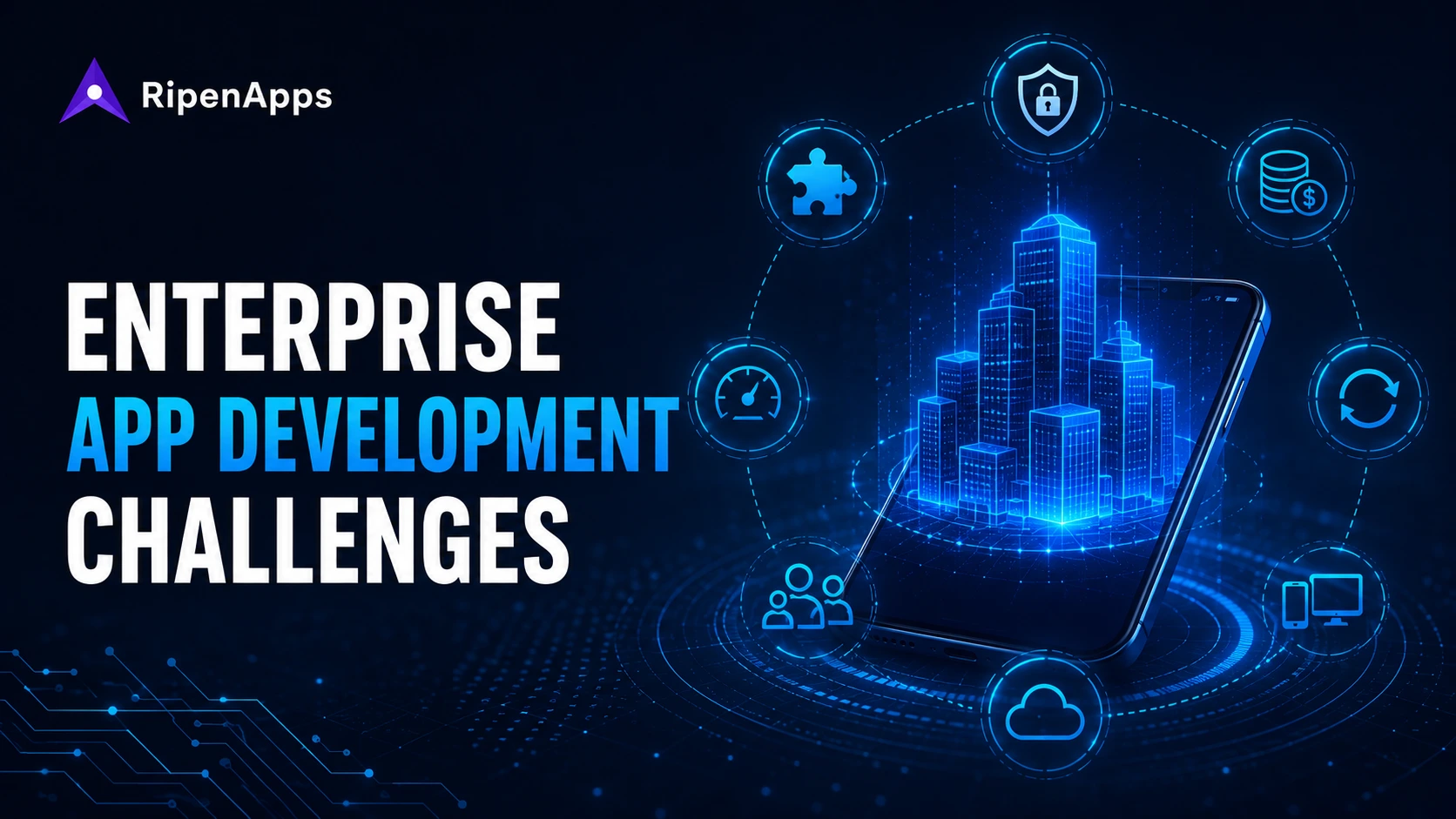
Enterprise application failures rarely happen because of poor ideas. Most enterprise software initiatives fail because organizations underestimate the complexity of scalability, integrations, security, and operational alignment. The biggest challenges in enterprise app development often emerge when businesses try to modernize systems while maintaining speed, compliance, and customer expectations simultaneously. Understanding the challenges in enterprise app development is critical for startups and enterprises aiming for scalable digital transformation.
For startups scaling rapidly and enterprises navigating digital transformation, enterprise applications are no longer just operational tools. They directly impact revenue growth, workforce productivity, customer experience, and competitive advantage. Yet many organizations still struggle with delayed deployments, legacy infrastructure, rising maintenance costs, fragmented workflows, and low user adoption.
As businesses increasingly invest in digital products and intelligent automation, the demand for scalable solutions continues to rise. Whether organizations are partnering with an enterprise app development company or expanding internal engineering capabilities, leaders must address both technical and strategic roadblocks before they become growth bottlenecks.
In today’s hyper-competitive market, enterprise applications must support agility, security, real-time decision-making, and long-term scalability. This blog explores the most critical challenges in enterprise app development, how they affect business growth, and the proven strategies companies can implement to overcome them effectively.
Table of Contents
Why is Enterprise App Development More Complex?
Enterprise software development is fundamentally different from building standard consumer applications. Enterprise systems must support large-scale operations, complex business workflows, multiple user roles, strict compliance requirements, and seamless integrations across departments.
Unlike standalone apps, enterprise platforms often become the operational backbone of the organization. They connect finance, HR, sales, logistics, analytics, customer support, and supply chain operations into one ecosystem. As a result, even small architectural decisions can have enterprise-wide implications.
Another major complexity comes from scale. Enterprise systems process massive volumes of data daily while supporting thousands of concurrent users across different devices and geographic locations. Performance, uptime, and reliability become business-critical priorities rather than technical preferences.
In addition, enterprise leaders often face organizational resistance during modernization initiatives. Teams accustomed to older systems may resist operational changes, slowing digital transformation efforts and reducing ROI.
This combination of technical, operational, and organizational factors explains why developing enterprise applications requires strategic planning, scalable architecture, and long-term governance frameworks.
What Are the Biggest Challenges in Enterprise App Development?
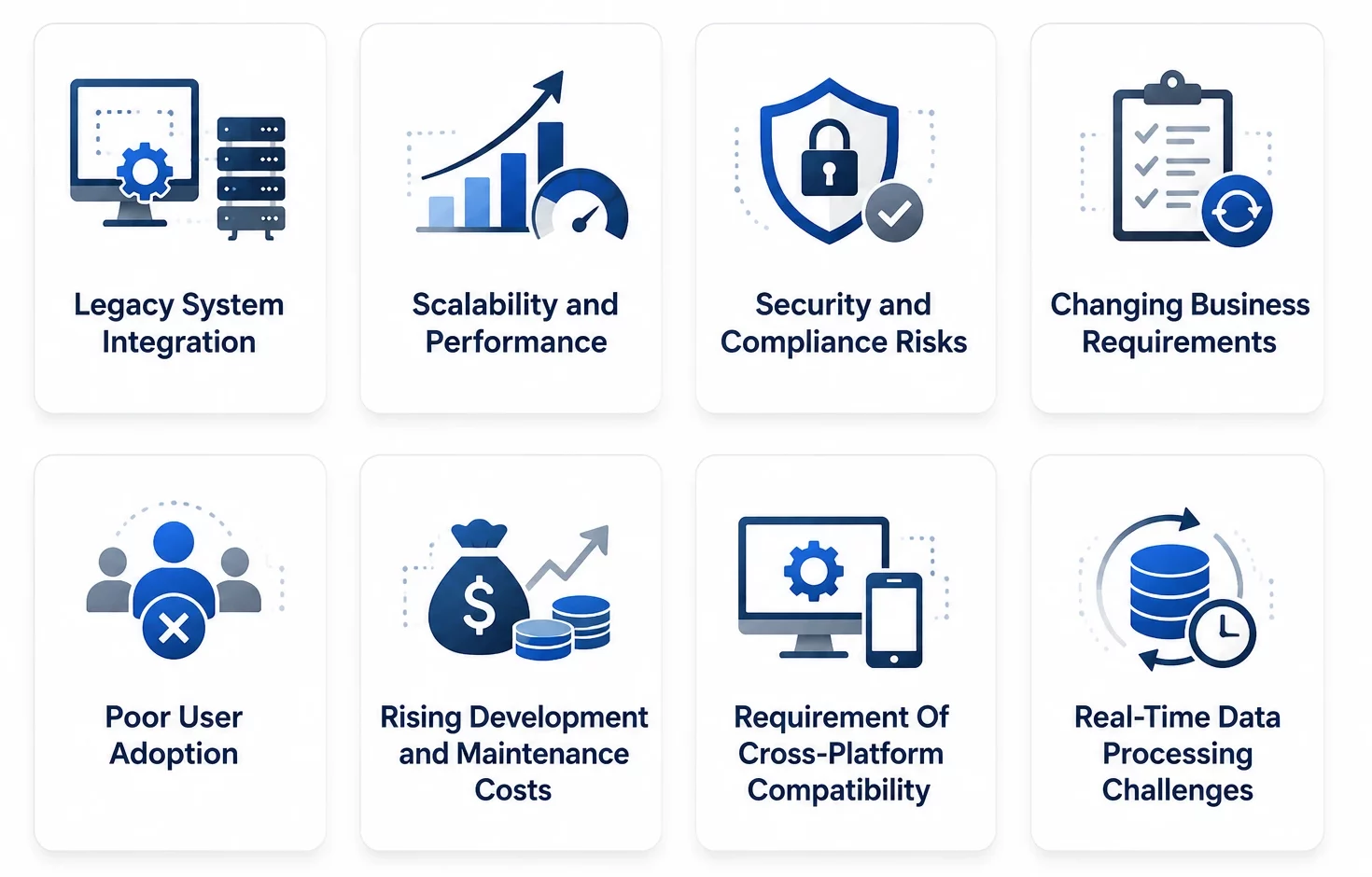
Enterprise software projects face several interconnected challenges that can slow business growth if not addressed proactively. Understanding these issues helps organizations build resilient, future-ready digital ecosystems.
1. Legacy System Integration Creates Operational Bottlenecks
Many enterprises still rely on outdated systems that were never designed for modern cloud-native environments. These legacy platforms often contain valuable business data and critical operational workflows, making replacement difficult and risky.
However, integrating modern applications with aging infrastructure creates serious application challenges, including:
- Data silos
- API incompatibility
- Limited scalability
- Slow data synchronization
- Security vulnerabilities
For example, a logistics company modernizing its supply chain platform may struggle to integrate real-time tracking features with decades-old ERP systems. This disconnect can delay reporting, reduce operational visibility, and create workflow inefficiencies.
Many organizations are now investing in legacy application modernization services to gradually transition from monolithic systems to scalable digital ecosystems without disrupting operations.
2. Scalability and Performance Limit Business Expansion
Scalability is one of the most underestimated enterprise application challenges. Systems that perform well during early deployment often struggle as user demand, transaction volumes, and operational complexity increase.
Common scalability issues include:
| Scalability Problem | Business Impact |
| Slow application performance | Reduced productivity |
| Database bottlenecks | Delayed decision-making |
| Server overload | Downtime and lost revenue |
| Poor infrastructure planning | High operational costs |
| Monolithic architecture | Limited innovation agility |
For high-growth startups and enterprises, performance issues can directly affect customer retention and employee efficiency.
Scalability challenges are often rooted in early architectural decisions, making it important to understand how enterprise app development guide are structured for understanding the process of long-term growth and performance.
3. Security and Compliance Risks Threaten Enterprise Stability
Cybersecurity remains one of the most critical challenges of enterprise application development. Enterprise systems store sensitive financial, operational, and customer data, making them prime targets for cyberattacks.
The most common security risks include:
- Weak authentication systems
- Insecure APIs
- Insufficient access control
- Unencrypted data transfer
- Compliance violations
- Insider threats
According to the IBM Cost of a Data Breach Report 2025, the global average cost of a data breach reached $4.4 million, while organizations extensively using AI and automation saved nearly $1.9 million per breach. The report also found that 97% of organizations experiencing AI-related security incidents lacked proper AI access controls, highlighting the growing importance of AI governance in enterprise ecosystems.
Security must be integrated into the development lifecycle from day one rather than treated as a post-launch requirement.
4. Changing Business Requirements Disrupt Development Timelines
One of the biggest challenges in enterprise app development is managing evolving business expectations during long development cycles.
Enterprise priorities often shift due to:
- Market changes
- Customer demands
- Regulatory updates
- Operational restructuring
- Competitive pressure
As stakeholders introduce new features and workflows mid-project, development teams face scope creep, budget overruns, and delayed releases.
For example, a healthcare startup building a patient management platform may initially prioritize appointment scheduling. Midway through development, new compliance requirements or telehealth integrations may drastically alter the product roadmap.
This approach minimizes waste while improving alignment between technical teams and business leadership.
5. Poor User Adoption Reduces Enterprise ROI
Even the most advanced enterprise software can fail if employees refuse to use it effectively.
Low user adoption often occurs because enterprise platforms become overly complex, unintuitive, or disconnected from actual workflows. Employees may continue relying on spreadsheets, emails, or legacy tools despite new software investments.
Poor adoption typically stems from:
- Complicated interfaces
- Lack of onboarding
- Workflow disruption
- Insufficient training
- Resistance to organizational change
This challenge significantly impacts operational efficiency and reduces digital transformation ROI.
Organizations that focus on usability alongside technical performance achieve higher long-term adoption rates and productivity gains.
6. Rising Development and Maintenance Costs Affect Profitability
Enterprise software development is expensive, especially when organizations lack strategic planning.
Cost overruns usually emerge from:
- Technical debt
- Poor architectural decisions
- Rebuilding features
- Vendor lock-in
- Manual processes
- Maintenance complexity
Many organizations focus heavily on initial development costs while underestimating long-term maintenance expenses. Over time, inefficient systems become difficult to scale, upgrade, or secure.
Companies offering mobile app development services in USA are increasingly helping enterprises optimize development efficiency through agile delivery models and cloud-based infrastructure strategies.
7. Cross-Platform Compatibility Creates Operational Complexity
Modern enterprise users expect seamless experiences across desktops, tablets, smartphones, and remote work environments. Supporting multiple operating systems and device types introduces another layer of technical complexity.
Common issues include:
- UI inconsistencies
- Device fragmentation
- Data synchronization delays
- Security variations across platforms
- Performance inconsistencies
This becomes especially critical for industries such as healthcare, logistics, retail, and field services, where mobile accessibility directly affects operational continuity.
Cross-platform consistency improves user satisfaction while reducing long-term maintenance overhead. Enterprise mobility plays a critical role in extending enterprise systems beyond desktops and enabling real-time access for distributed teams, especially in large-scale organizations operating across the USA market, as explored in enterprise mobile app development for businesses in USA.
8. Real-Time Data Processing Challenges Slow Decision-Making
Modern enterprises rely heavily on real-time analytics and operational visibility. However, processing high-volume enterprise data across distributed systems creates serious performance and synchronization challenges.
Businesses often struggle with:
- Delayed analytics
- Inconsistent reporting
- Data duplication
- Offline synchronization issues
- Latency in distributed environments
For example, an eCommerce enterprise managing inventory across multiple warehouses requires real-time synchronization to avoid overselling or supply chain disruptions.
Real-time capabilities are increasingly becoming a competitive necessity rather than an advanced feature.
What Are the Best Real-World Examples of Enterprise Applications Overcoming Development Challenges?
Successful enterprise app examples show how businesses can overcome scalability, security, integration, and operational challenges through modern architecture and strategic development.
1. Netflix Solved Scalability Challenges With Cloud-Native Architecture
Netflix adopted a cloud-native microservices architecture to support over 325 million paid memberships globally while generating $45.2 billion in annual revenue. The platform processes massive streaming workloads using distributed systems and advanced automation, helping it maintain seamless performance across devices and regions.
2. Uber Managed Real-Time Processing With Distributed Systems
Uber supports more than 200 million monthly active users and handles over 40 million trips daily worldwide. Its enterprise ecosystem uses event-driven architecture and real-time data processing to manage GPS tracking, payments, and ride coordination at a massive scale.
3. Salesforce Simplified Enterprise Integrations Through API-First Development
Salesforce became one of the world’s leading enterprise CRM platforms by enabling scalable cloud-based workflow automation and third-party integrations for businesses globally. The company serves over 150,000 customers worldwide and continues to lead enterprise SaaS innovation through API-first architecture and AI-powered enterprise solutions.
4. eGurukul Improved Large-Scale Learning Operations
RipenApps developed eGurukul to support more than 500,000 medical students through scalable video streaming, real-time assessments, and analytics-driven learning experiences. The platform successfully addressed high user traffic, content delivery optimization, and cross-device accessibility challenges.
5. Al Muzaini Strengthened Fintech Security and Scalability
RipenApps built Al Muzaini to support secure international money transfers and compliance-driven financial operations across global markets. The fintech platform integrates biometric authentication, secure APIs, and real-time transaction processing to improve scalability, compliance, and operational efficiency for enterprise-grade financial services.
How Do Enterprise App Development Challenges Affect Business Growth?
Enterprise software issues rarely remain isolated technical problems. They eventually affect revenue generation, operational agility, customer experience, and innovation capacity.
1. Operational Inefficiency Increases Business Friction
When enterprise systems are fragmented or poorly integrated, teams spend more time managing workflows manually. Employees duplicate tasks, struggle with disconnected tools, and lose visibility across departments.
This operational friction reduces productivity while increasing labor costs.
2. Delayed Innovation Slows Competitive Advantage
Organizations trapped in outdated infrastructure struggle to launch new digital initiatives quickly. Legacy systems limit experimentation, AI adoption, and process automation.
As competitors innovate faster, enterprises relying on rigid architectures lose market responsiveness.
3. Security Risks Damage Brand Reputation
A single data breach can severely impact customer trust and investor confidence. Enterprises operating in regulated industries face additional financial penalties and legal exposure.
Security vulnerabilities directly threaten long-term business stability.
4. Poor Customer Experience Impacts Retention
Enterprise applications increasingly influence customer-facing experiences such as support systems, portals, delivery tracking, and account management.
Performance issues, downtime, or workflow failures negatively affect customer satisfaction and retention.
5. Rising Technology Costs Reduce Profit Margins
Inefficient systems require more maintenance, larger support teams, and frequent rework. Over time, technical debt becomes a major financial burden.
Organizations that fail to modernize strategically often spend more time maintaining outdated systems than building scalable solutions.
However, scalability also introduces new security and governance challenges. IBM’s 2025 cybersecurity research revealed that 1 in 5 organizations experienced breaches linked to shadow AI, while businesses with high levels of unsanctioned AI usage faced an average of $670,000 higher breach costs.
How Can Businesses Solve Enterprise App Development Challenges?
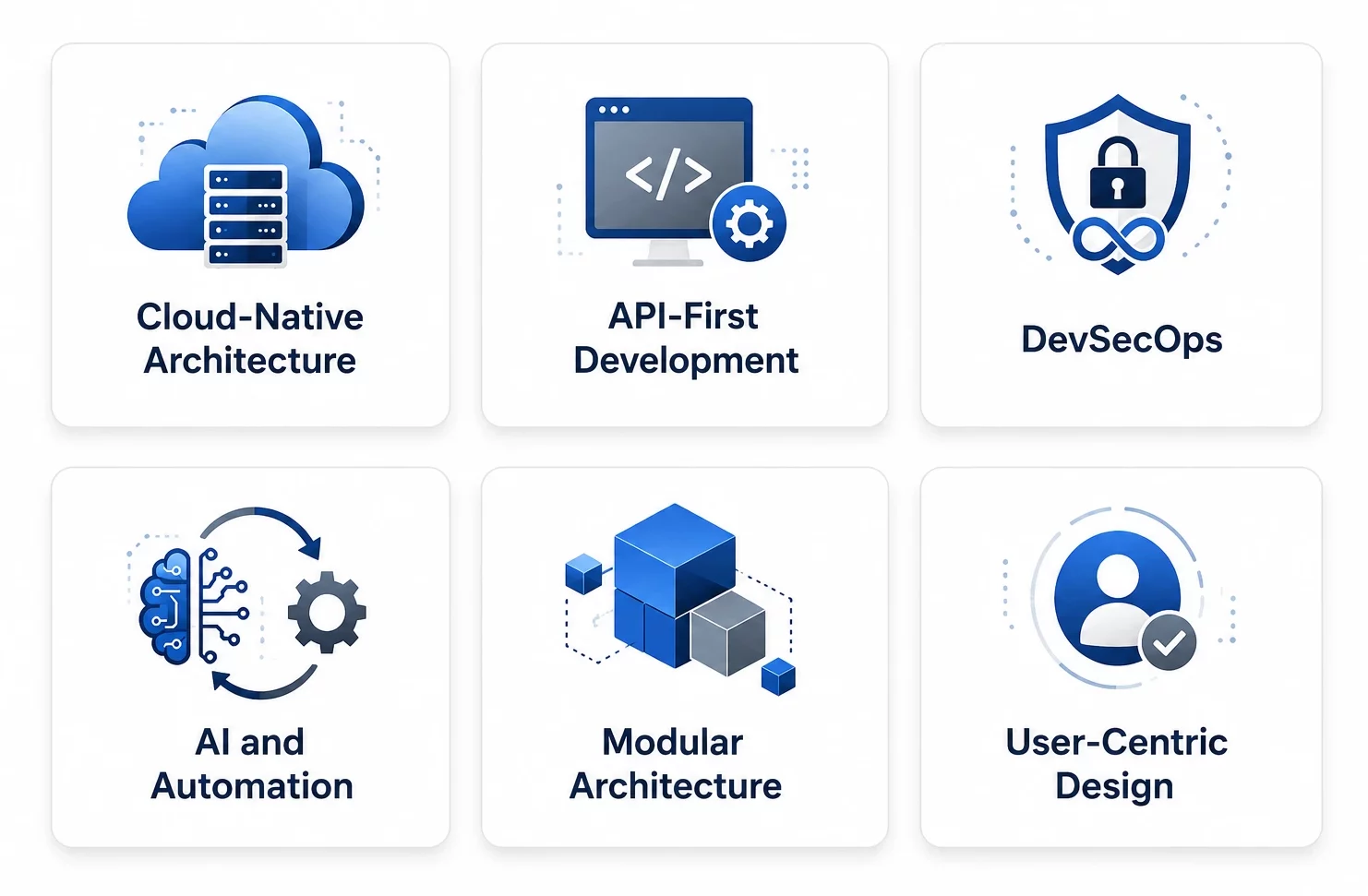
Successful enterprises approach software development strategically rather than treating it as a purely technical initiative.
1. Cloud-Native Architecture Improves Scalability
Cloud-native systems provide the flexibility and elasticity needed for modern enterprise operations. Businesses can scale infrastructure dynamically while reducing operational overhead.
Benefits include:
- Faster deployments
- Better uptime
- Improved disaster recovery
- Cost optimization
- Global accessibility
Cloud-native infrastructure also supports AI workloads, automation, and real-time analytics more efficiently.
2. API-First Development Enables Flexibility
API-first architecture simplifies integrations across enterprise systems, third-party platforms, and future applications.
This approach improves:
- System interoperability
- Development speed
- Scalability
- Digital ecosystem expansion
It also reduces dependence on tightly coupled legacy systems.
3. DevSecOps Strengthens Security and Speed
DevSecOps integrates security directly into development and deployment workflows. Instead of treating security as a final checkpoint, teams continuously monitor vulnerabilities throughout the development lifecycle.
Benefits include:
- Faster releases
- Reduced security risks
- Automated compliance checks
- Improved collaboration
- Lower remediation costs
This approach is becoming essential for enterprises adopting rapid digital transformation strategies.
4. AI and Automation Enhance Operational Efficiency
AI-powered enterprise systems help organizations automate repetitive workflows, improve decision-making, and increase productivity. Enterprises are increasingly integrating intelligent automation-driven systems to streamline workflows and improve operational efficiency across departments.
Key enterprise AI applications include:
- Predictive analytics
- Intelligent process automation
- AI chatbots
- Fraud detection
- Smart workflow management
Enterprises integrating AI strategically gain operational advantages while reducing manual overhead.
5. Modular Architecture Reduces Technical Debt
Monolithic systems become increasingly difficult to scale over time. Modular architecture allows organizations to update or replace components independently without disrupting the entire ecosystem.
This improves:
- Development flexibility
- Scalability
- System resilience
- Maintenance efficiency
Modular systems also accelerate innovation by enabling faster experimentation.
6. User-Centric Design Improves Adoption
Technology adoption improves significantly when enterprise platforms prioritize usability and workflow alignment.
Organizations should involve end users throughout development by conducting:
- UX research
- Workflow testing
- Usability validation
- Role-based personalization
Employee-centric design reduces resistance while improving operational efficiency.
Final Thoughts
Enterprise software challenges are no longer isolated IT concerns. They directly impact operational efficiency, scalability, customer experience, innovation capacity, and long-term business growth. Organizations that proactively address security, scalability, modernization, and adoption challenges position themselves for stronger digital transformation outcomes and sustainable competitive advantage.
As businesses continue navigating complex digital ecosystems, partnering with experienced technology experts becomes increasingly important. RipenApps helps startups and enterprises build scalable, secure, and growth-focused digital products through strategic enterprise mobility solutions, intelligent modernization frameworks, and future-ready application development strategies that drive measurable business impact.
FAQs
Q1. What are the challenges of enterprise application development?
The biggest challenges of enterprise application development include scalability limitations, legacy system integration, security vulnerabilities, compliance requirements, changing business needs, high maintenance costs, and low user adoption. Enterprises also struggle with data synchronization, cross-platform compatibility, and managing complex workflows across multiple departments. Without a scalable development strategy, these challenges can slow operational efficiency, increase technical debt, and impact long-term business growth.
Q2. Why do enterprise software projects fail?
Enterprise software projects often fail because of unclear business goals, poor requirement planning, weak stakeholder communication, and inadequate scalability strategies. Many organizations also underestimate integration complexity, change management, and long-term maintenance needs. When development teams focus only on technical execution without aligning the solution with business outcomes and user expectations, projects face delays, budget overruns, low adoption, and reduced ROI.
Q3. What is the biggest challenge in enterprise app development?
Scalability and system integration are considered the biggest challenges in enterprise app development. Enterprise applications’ features must support growing user demands, complex business operations, real-time data processing, and integrations with existing systems simultaneously. If the architecture is not designed for flexibility and scale from the beginning, businesses may experience performance bottlenecks, operational inefficiencies, and rising infrastructure costs as they grow.
Q4. How can enterprises improve software scalability?
Enterprises can improve software scalability by adopting cloud-native architecture, microservices, API-first development, containerization, and automated infrastructure management. Using technologies like Kubernetes, distributed databases, and auto-scaling cloud environments helps applications handle increasing workloads efficiently. Businesses should also prioritize modular development and continuous performance monitoring to ensure long-term scalability and operational stability.
Q5. Why is security critical for enterprise applications?
Security is critical for enterprise applications because these systems manage sensitive customer, financial, operational, and business data. A single security breach can lead to financial losses, regulatory penalties, operational disruption, and reputational damage. As cyber threats continue to evolve, enterprises must implement strong security frameworks, including encryption, multi-factor authentication, DevSecOps practices, and continuous monitoring to protect critical business assets and maintain compliance.
Q6. What role does enterprise application strategy play in digital transformation?
An effective enterprise application strategy helps businesses align technology investments with long-term growth goals, operational efficiency, scalability, and customer experience improvements. It provides a roadmap for modernization, cloud adoption, process automation, and system integration while reducing technical debt and operational risks. A well-defined strategy also enables organizations to adapt faster to market changes, accelerate innovation, and build sustainable competitive advantages in the digital economy.
Discuss your project and request for proposal
SHARE
WRITTEN BY

Ishan Gupta
CEO & Founder
Ishan Gupta is a seasoned entrepreneur and CEO with extensive 10+ years of experience in business and mobile app development landscape. He believes that the right digital product allows companies to focus on what they do best, while technology handles the rest. With deep exposure to global markets, he understands what makes an app succeed. His approach translates business needs into clear product strategies, ensuring that every feature contributes to measurable ROI.
View All Articles