


Key Takeaways
- Enterprise App Development Cost in the US typically ranges from $50,000 to $500,000+, depending on complexity, integrations, and scalability needs.
- Pricing is never fixed; factors like security, compliance, architecture, and technology stack significantly influence the overall cost.
- Long-term expenses such as cloud scaling, maintenance, and API usage can increase total ownership cost by 20–35% annually.
- Choosing the right pricing model (fixed, time & material, or dedicated team) directly impacts budget control and project flexibility.
- Enterprise apps deliver strong ROI by improving automation, operational efficiency, and enabling data-driven decision-making at scale.
Enterprise App Development Cost in the United States typically ranges between $50,000 and $500,000+, depending on factors such as system complexity, third-party integrations, compliance requirements, scalability needs, and enterprise-grade security infrastructure. For large-scale digital ecosystems involving AI, cloud-native architecture, automation, and advanced data security layers, the investment can grow significantly beyond this range.
Modern enterprises increasingly partner with an app development company to build scalable systems that streamline operations, automate workflows, improve decision-making, and enhance customer experiences. According to IBM’s Cost of a Data Breach Report 2025, the global average cost of a data breach stands at $4.44 million, reinforcing the growing importance of secure and resilient enterprise systems. The report further highlights that organizations leveraging AI-driven security and automation achieve substantial cost savings, while businesses lacking proper AI governance and access controls remain highly vulnerable to evolving cyber threats.
As enterprises accelerate digital transformation initiatives in 2026, enterprise applications are no longer viewed as one-time technology investments. Instead, they have become strategic business assets that drive operational efficiency, scalability, security, and long-term competitive advantage.
This is why choosing the right enterprise app development company plays a critical role in ensuring successful implementation, future scalability, and measurable ROI. In this blog, we will explore the key cost drivers, pricing models, hidden expenses, and real-world factors that shape enterprise app development cost and how businesses can maximize ROI while building scalable, future-ready enterprise solutions.
Table of Contents
What is the Cost of Enterprise App Development and Why Does It Vary?
Enterprise App Development Cost varies significantly because every organization has unique workflows, infrastructure requirements, and scalability goals. Unlike standard applications, enterprise systems are deeply integrated into business operations.
Typical Enterprise App Development Cost in USA
Enterprise app development cost in USA varies based on complexity, features, and scalability requirements. Basic systems are more affordable, while advanced enterprise platforms require higher investment due to integrations, security layers, and performance demands.
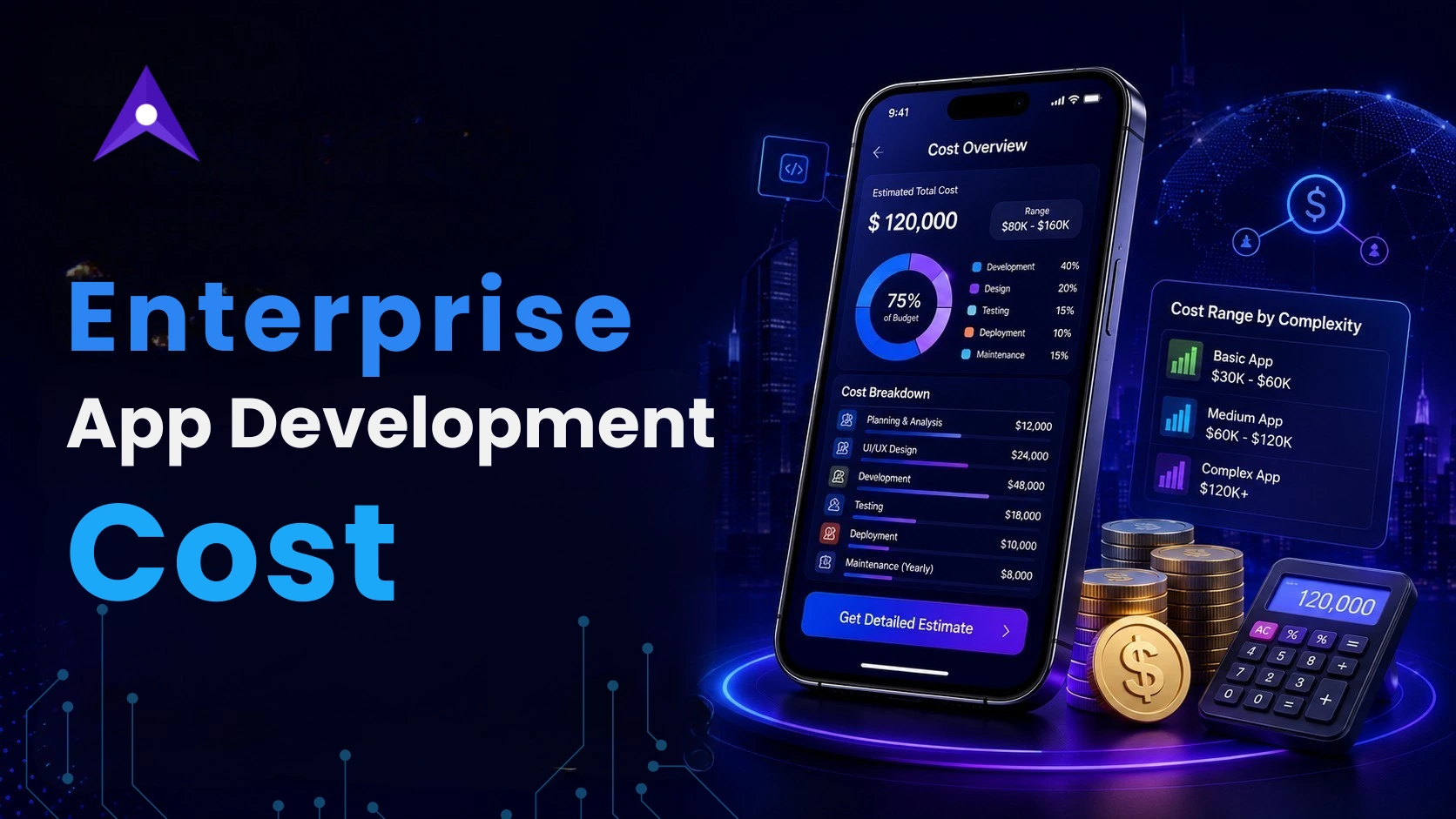
- Basic enterprise apps: $50,000 – $120,000
- Mid-level enterprise systems: $120,000 – $300,000
- Complex enterprise platforms: $300,000 – $500,000+
Highly regulated industries like healthcare, fintech, and logistics often exceed these ranges due to compliance and security requirements.
Why is Enterprise App Pricing not Fixed?
Enterprise app pricing is not fixed because every organization has unique operational structures and technical requirements. The final cost varies based on how complex the system is, how many integrations are needed, and the level of scalability, security, and automation involved in the solution.
Pricing depends on:
- Custom workflows
- Legacy system integration
- Scalability needs
- Compliance requirements
- AI and automation capabilities
Enterprise app pricing varies because every organization has distinct workflows, infrastructure needs, and scalability goals; all of which determine engineering scope, integration depth, and long-term maintenance investment. A deeper breakdown of how these systems are designed and structured can be found in the enterprise app development guide.
What Factors Influence Enterprise App Development Cost the Most?
Cost structure is influenced by technical complexity, architecture decisions, and enterprise-grade requirements.
How does Complexity Impact Enterprise App Development Cost?
Enterprise systems scale in complexity depending on business requirements.
- Simple automation apps = lower cost
- Multi-module enterprise systems = moderate cost
- AI-driven platforms = high cost
Greater complexity directly increases engineering effort and development time.
How does Security Impact the Cost of Enterprise Software Development?
Security is one of the most significant cost drivers in enterprise systems.
According to IBM’s Cost of a Data Breach Report 2025, the average cost of a data breach is $4.4 million, highlighting the financial risks of weak security architecture.
This leads enterprises to invest in:
- Data encryption systems
- Access control frameworks
- Compliance systems (HIPAA, GDPR, SOC 2)
- Monitoring and auditing tools
Security investments increase upfront cost but reduce long-term financial exposure.
How do Technology Choices Affect Enterprise App Pricing?
Technology stack decisions significantly impact cost and scalability.
- Cloud infrastructure improves scalability
- API integrations increase engineering effort
- Microservices architecture adds complexity
Poor architectural decisions often lead to higher long-term redevelopment and maintenance costs.
How is the Enterprise App Development Cost Distributed across Stages?
Understanding cost allocation helps enterprises plan budgets more effectively and avoid unexpected overruns during development. It also provides clarity on how resources are distributed across planning, design, development, testing, and long-term maintenance phases.
| Stage | Cost Share | Business Impact |
| Discovery & Planning | 5–10% | Requirement clarity |
| UI/UX Design | 10–15% | User adoption |
| Development | 40–60% | Core functionality |
| QA Testing | 15–20% | System reliability |
| Maintenance | Ongoing | Long-term scalability |
Why does Maintenance Increase Long-term Cost?
Post-launch maintenance is essential to keep enterprise systems stable, secure, and scalable as business needs evolve. These ongoing efforts ensure continuous performance optimization, compliance updates, and a smooth user experience across all operations.
- Cloud infrastructure scaling
- Security updates and patches
- Feature enhancements and upgrades
- Bug fixes and performance optimization
Proactive application maintenance services keep enterprise systems stable, secure, and cost-efficient well beyond the initial deployment.
How Do Enterprise Project Timelines Impact Development Cost?
Timeline and cost are inseparably linked in enterprise software development. A delayed or poorly scoped project does not simply take longer; it becomes measurably more expensive. Understanding how development phases, deployment complexity, and rollout strategy affect the overall timeline helps enterprises budget more accurately and reduce the risk of cost overruns.
Phase-by-Phase Timeline Breakdown:
| Phase | Typical Duration | Cost Impact if Delayed |
| Discovery & Planning | 2–4 weeks | Scope creep, rework, misaligned architecture |
| UI/UX Design | 3–6 weeks | Late redesigns increase development cycles |
| Core Development | 3–12 months | Highest cost driver; delays compound engineering spend |
| QA & Testing | 4–8 weeks | Deferred testing increases post-launch bug fix cost |
| Deployment & Rollout | 2–6 weeks | Phased rollout reduces risk but extends timeline |
| Post-Launch Stabilization | 4–8 weeks | Unplanned fixes increase maintenance overhead |
Why Rollout Complexity Drives Cost Up
Enterprise platforms are rarely deployed to all users simultaneously. Phased rollouts, departmental pilots, geo-staged deployments, and legacy system cutover planning all add timeline complexity. Each additional rollout phase requires extended QA, environment management, data synchronization overhead, and dedicated support resources, all of which increase total project cost beyond initial estimates.
The Real Cost of Timeline Delays
For every month a project extends beyond its planned timeline, organizations incur compounding costs: continued engineering resource spend, delayed operational value realization, extended infrastructure provisioning, and, in some cases, compliance risk from operating legacy systems beyond their planned decommission date. Enterprises that invest in detailed discovery and phased planning consistently achieve better cost predictability across all deployment stages.
What Pricing Models are Used in Enterprise Software Development?
Enterprise software development uses different pricing models to balance cost predictability, flexibility, and long-term scalability based on project complexity and business needs.
Fixed-price Model
This model offers a clearly defined scope with a fixed budget, making it ideal for projects with well-established requirements and limited expected changes during development.
- Defined scope
- Predictable budget
- Limited flexibility
Time & Material Model
This model allows flexible development where businesses pay based on actual effort and resources used, making it suitable for evolving or long-term enterprise projects.
- Flexible development
- Pay based on effort
- Ideal for evolving requirements
Dedicated Team Model
This model provides a full-time development team working exclusively on the project, offering high control, scalability, and continuous collaboration for enterprise-grade solutions.
- Full-time engineering team
- High control and scalability
- Best for enterprise-scale systems
Custom Enterprise Software vs SaaS Platforms: Which Is More Cost-Effective?
Choosing between building a custom enterprise application, adopting a SaaS platform, or taking a hybrid approach is one of the most consequential decisions in enterprise software strategy. Each path carries distinct implications for total cost of ownership (TCO), scalability, vendor dependency, and long-term business flexibility.
TCO Comparison at a Glance:
| Factor | Custom Build | SaaS Platform | Hybrid |
| Upfront Cost | High ($50K–$500K+) | Low | Moderate |
| Long-Term TCO | Lower over time | High (subscriptions) | Balanced |
| Customization | Full | Limited | Partial |
| Vendor Dependency | None | High | Moderate |
| Scalability | Business-specific | Vendor-limited | High w/ modules |
| Data Ownership | Full | Vendor-controlled | Shared |
| Best For | Complex enterprise workflows | Standardized processes | Enterprises in transition |
For enterprises with complex operational requirements, regulated data environments, or a strong need for competitive differentiation through technology, custom development typically delivers stronger long-term ROI, despite higher initial investment.
What are Real-World Enterprise App Cost Examples by Industry?
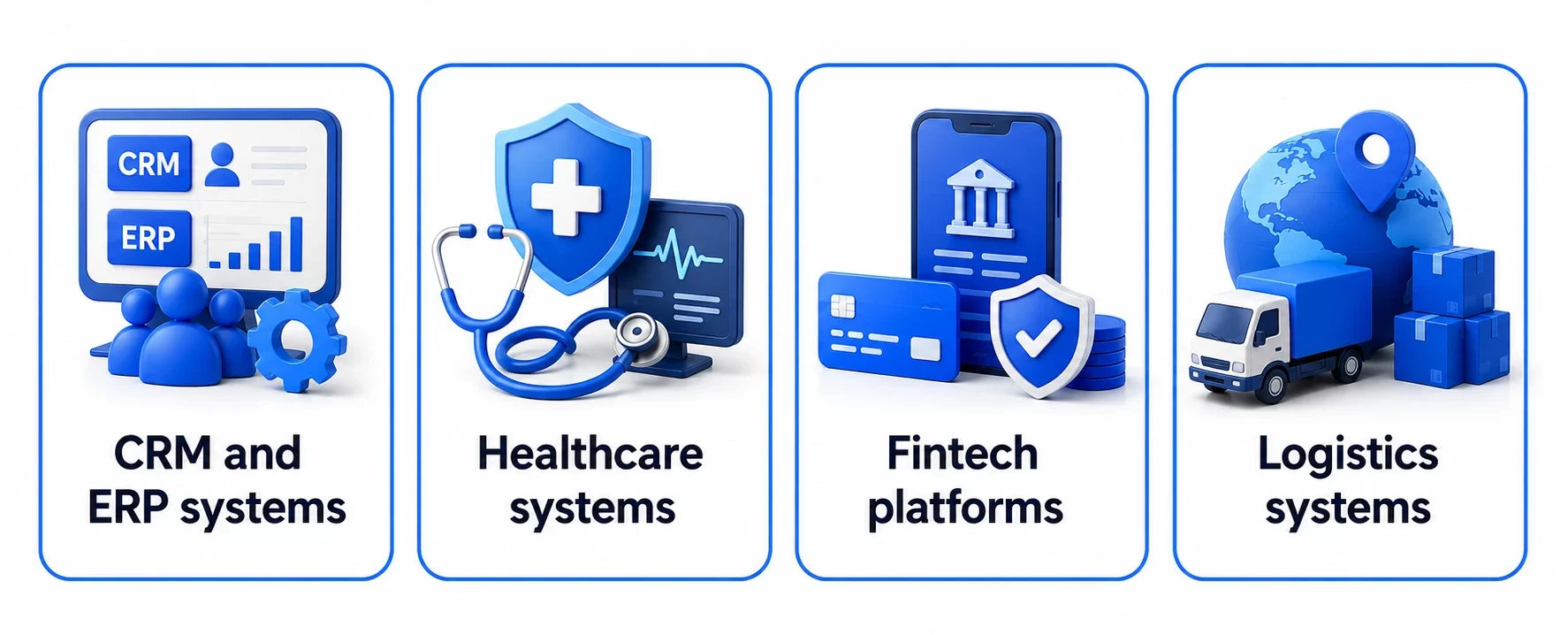
Enterprise app pricing varies significantly across industries due to differences in regulatory requirements, data sensitivity, system complexity, and scalability needs. Each industry demands a unique combination of features and compliance standards, which directly impacts the overall Enterprise App Development Cost.
1. CRM and ERP Systems
Customer Relationship Management (CRM) and Enterprise Resource Planning (ERP) systems are core business platforms used for managing operations, sales, finance, and supply chain functions. CRM applications typically range from $80,000 to $300,000, while ERP systems are more complex and generally cost between $150,000 and $500,000+, depending on customization, integrations, and scale.
2. Healthcare Systems
Healthcare enterprise applications are highly regulated and require strict compliance with standards like HIPAA. Due to advanced security, data protection, and interoperability requirements, these systems typically range from $200,000 to $600,000+, especially when involving patient management, telemedicine, or electronic health records.
3. Fintech Platforms
Fintech and banking applications involve high-level security, fraud detection, real-time processing, and regulatory compliance. As a result, enterprise fintech platforms usually fall in the $250,000 to $1M+ range, particularly for digital banking systems, payment gateways, and trading platforms.
4. Logistics Systems
Logistics and supply chain applications focus on real-time tracking, route optimization, warehouse management, and inventory control. These enterprise systems typically cost between $120,000 and $400,000, depending on integration complexity, automation level, and geographic scale.
Real-World Examples of Enterprise Apps and Their Development Scale
Understanding the Cost of Enterprise App Development becomes easier when we look at real-world enterprise systems. These platforms show how pricing is driven by scale, integrations, security, and performance needs.
1. SAP ERP: Reflects High-end Enterprise App Development Cost
SAP ERP is a global ERP system used for finance, supply chain, HR, and operations.
It represents the highest tier of enterprise app pricing, often ranging from hundreds of thousands to several million dollars.
Key cost drivers:
- Multi-module architecture
- Legacy system integration
- Global scalability
- Strict compliance requirements
2. Salesforce: Shows Scalable Enterprise App Pricing
Salesforce is a cloud CRM platform used for sales, marketing, and customer management. Enterprise implementations typically cost $100,000 to $500,000+, depending on customization.
Key cost drivers:
- Custom workflows
- API integrations
- AI automation features
- Security configurations
3. Microsoft Dynamics 365: Shows Integrated Enterprise Ecosystem Cost
Microsoft Dynamics 365 is an integrated ERP and CRM suite for enterprise transformation. Costs typically range from $120,000 to $600,000+.
Key cost drivers:
- ERP + CRM integration
- Azure cloud infrastructure
- Workflow automation
- Analytics and AI
4. Hungama: Reflects Enterprise-scale Streaming App Cost
Hungama is a large-scale streaming platform for music and video content. Such platforms cost around $300,000 to $1M+ due to high scalability needs.
Key cost drivers:
- Real-time streaming
- CDN-based delivery
- AI recommendations
- Multi-device support
5. Cobone: Reflects the Marketplace App Development Cost
Cobone is a deals and offers marketplace platform. These apps typically cost $150,000 to $400,000+.
Key cost drivers:
- High transaction volume
- Geo-targeting features
- Multi-vendor systems
- Payment integration
What do these Examples Reveal about Enterprise App Development Cost?
Across all examples, enterprise app development cost depends on:
- SAP: maximum complexity and integration scale
- Salesforce: cloud-based customization cost
- Dynamics 365: ecosystem integration cost
- Hungama: real-time streaming scalability cost
- Cobone: transaction-heavy marketplace cost
Overall, pricing is driven by scale, integrations, and architecture complexity, not just industry type.
Hidden Costs Businesses Should Consider in Enterprise App Pricing
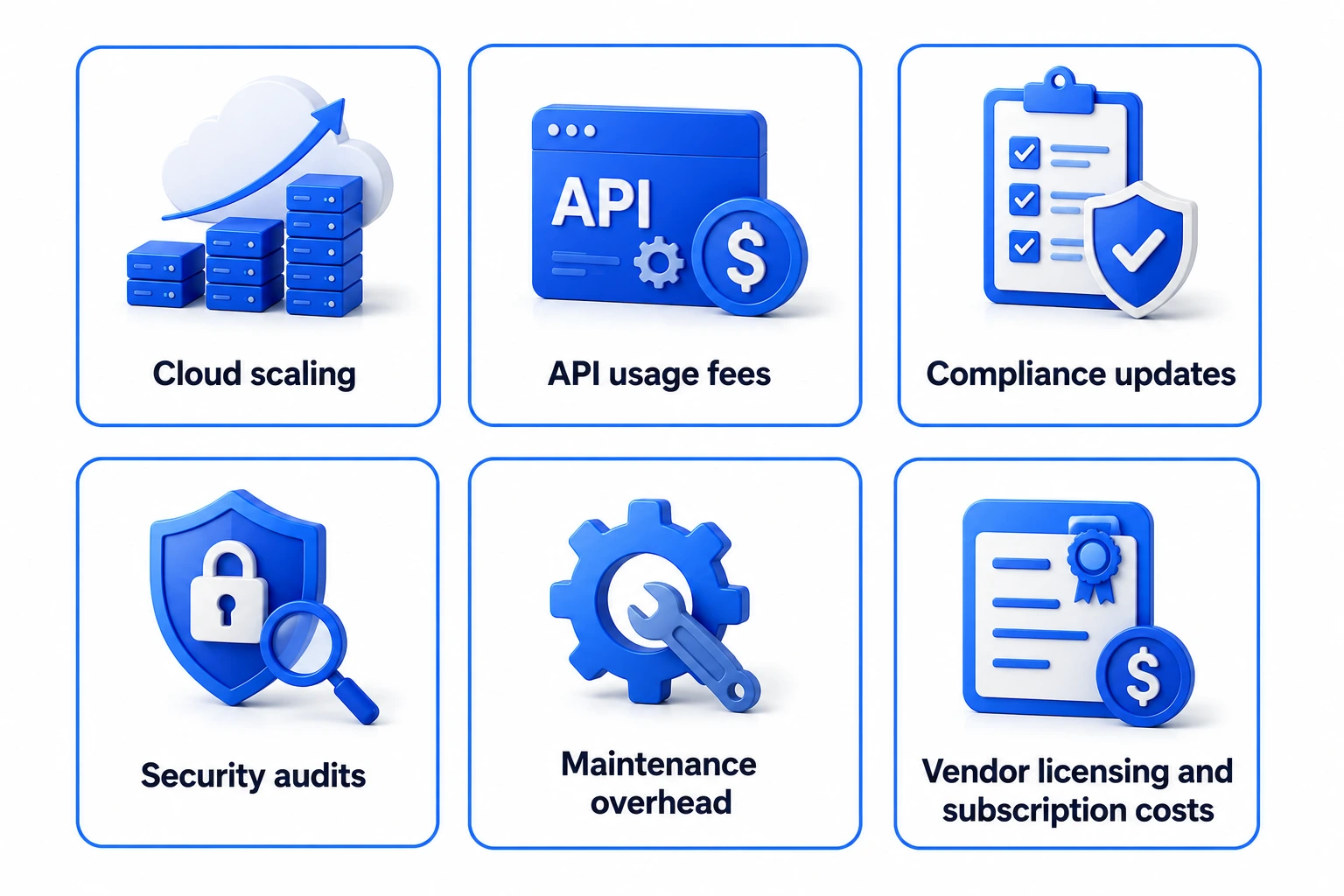
Enterprise app budgets often focus only on development costs, but a significant portion of long-term spending comes from indirect and recurring expenses that are rarely discussed upfront. Understanding these costs is essential for accurate financial planning and avoiding budget overruns after deployment.
1. Infrastructure Scaling & Cloud Vendor Costs
As enterprise user traffic grows, cloud infrastructure costs scale accordingly. Costs related to compute, storage, and data transfer increase with platform usage. Vendor-specific pricing for services like AWS, Azure, or GCP can also introduce unpredictable billing spikes during peak loads, requiring continuous infrastructure cost monitoring and optimization.
2. AI Inference & Model Operation Costs
Enterprises deploying AI-powered features face ongoing inference costs, which accumulate significantly at scale. Running large language models, predictive engines, or recommendation systems in production requires GPU compute, model hosting, and frequent retraining cycles, all of which contribute to a rising operational cost base that is often underestimated in initial project budgets.
3. Observability & Monitoring Infrastructure
Production-grade enterprise systems require robust observability stacks including logging, distributed tracing, and real-time performance monitoring tools. Platforms like Datadog, New Relic, or self-hosted alternatives carry licensing and infrastructure costs that grow proportionally with system complexity and data volume.
4. Data Migration & Legacy System Integration
Migrating data from legacy systems into a new enterprise platform is one of the most underestimated cost drivers. It involves data cleansing, format transformation, validation pipelines, and rollback planning. Poorly scoped migration projects can extend timelines and significantly increase overall development costs.
5. Staff Retraining & Change Management
New enterprise platforms require internal teams to adapt workflows, learn new tools, and update operational processes. Change management programs, internal training sessions, and onboarding documentation represent real costs that are rarely included in initial project estimates but can meaningfully impact total investment.
6. API Consumption & Third-Party Licensing
Many enterprise systems depend on third-party APIs for payments, identity, communications, and analytics. Volume-based API pricing means costs increase directly with platform usage. Combined with SaaS licensing and enterprise software subscriptions, these recurring fees can increase total ownership cost by 20–35% annually.
7. Compliance Audits & Security Assessments
Regulated industries require regular penetration testing, compliance audits, and certification renewals for standards like HIPAA, GDPR, or SOC 2. These are not one-time efforts; they are recurring annual obligations that require both financial investment and dedicated internal resources.
8. Maintenance Debt & Technical Overhead
Over time, enterprise applications accumulate technical debt through deferred refactoring, outdated dependencies, and architectural shortcuts. Without proactive maintenance investment, this debt increases the cost and complexity of future feature development, slows engineering velocity, and raises the risk of system instability.
Collectively, these hidden factors can increase the total cost of ownership by 20–35% annually, making long-term financial planning essential for enterprise applications. To overcome these issues, many businesses take the help of an AI development company to provide the customise solution.
How can Enterprises Optimize their App Development Budget?
Strategic budget optimization in enterprise app development focuses on balancing cost efficiency with long-term scalability and performance. Instead of reducing features blindly, enterprises can lower expenses by making smarter architectural, technology, and development decisions early in the product lifecycle. This ensures faster delivery, controlled scope, and reduced rework costs while still maintaining enterprise-grade quality and future readiness.
How does MVP Reduce the Cost of Enterprise Software Development?
MVP (Minimum Viable Product) development helps organizations control early-stage investment by focusing only on essential functionality. Instead of building a full-scale system upfront, enterprises can validate ideas quickly, reduce financial risk, and iterate based on real user feedback.
It enables businesses to test concepts before full-scale investment, ensuring resources are allocated only to validated features. This approach reduces unnecessary development effort and helps prioritize high-impact functionalities. It also accelerates time-to-market by focusing on core business value instead of extended feature sets.
How does Cloud Transformation Reduce Enterprise Software Costs?
Cloud adoption significantly improves cost efficiency by eliminating heavy upfront infrastructure investments and enabling scalable, usage-based pricing models. It also enhances flexibility, performance, and operational agility for enterprise systems.
According to Deloitte Cloud Transformation Insights, cloud transformation can reduce IT operating costs by up to 30%.
What is the ROI of Enterprise App Development?
Enterprise app development delivers strong long-term ROI by transforming how organizations operate, make decisions, and scale. Instead of being a one-time cost, these applications act as strategic assets that improve efficiency, reduce operational waste, and unlock new revenue opportunities over time.
Why do Enterprise Transformation Projects Fail?
Many enterprise transformation initiatives fail not because of technology limitations, but due to poor execution planning, unclear objectives, and a lack of alignment between business and technical teams.
This highlights that success depends more on strategy, governance, and execution discipline than on investment size alone.
How do Enterprise Apps Improve Business Performance?
Enterprise applications enhance business performance by streamlining core operations and enabling faster, more accurate decision-making across departments. They reduce manual dependency and improve overall organizational productivity.
- Workflow automation improves speed and reduces manual errors across business processes.
- Operational efficiency increases by optimizing resources, reducing redundancy, and improving coordination.
- Data-driven decision-making enables leaders to act on real-time insights rather than assumptions.
- Improved customer experience ensures faster response times, better service delivery, and higher retention rates.
Final Thoughts
Enterprise app development cost is not just a budget line item; it represents a strategic investment in business scalability, operational efficiency, and long-term digital transformation. Organizations that understand the key cost drivers are better positioned to plan effectively, avoid unexpected expenses, and build enterprise systems that deliver sustained value as they grow.
Beyond initial development, the real impact of enterprise applications lies in their ability to streamline operations, enable data-driven decision-making, and support continuous innovation. When approached strategically, these systems become core business assets that drive measurable ROI rather than just technology expenses.
For businesses aiming to scale efficiently and accelerate their digital transformation journey, partnering with a trusted technology provider becomes essential. RipenApps offers expert mobile application development services to help enterprises design and build scalable, future-ready solutions that align technology investments with measurable business outcomes and long-term growth objectives.

FAQs
Q1. How much does enterprise app development cost in USA in 2026?
Enterprise app development cost in USA typically ranges from $50,000 to $500,000+, depending on complexity, integrations, security requirements, and scalability needs. Advanced enterprise systems involving AI, automation, or large-scale infrastructure can exceed this range significantly.
Q2. What factors influence enterprise app development cost the most?
The most important cost drivers include application complexity, third-party integrations, cloud infrastructure, security requirements, compliance standards, and UI/UX design. Among these, security and scalability have the highest impact on the cost of enterprise software development.
Q3. Why is enterprise app development more expensive than regular app development?
Enterprise applications are more expensive because they require deep system integration, advanced security frameworks, high scalability, real-time data processing, and long-term maintenance planning. These factors significantly increase engineering effort and infrastructure requirements.
Q4. How can businesses reduce enterprise app development costs without affecting quality?
Businesses can reduce costs by adopting an MVP approach, prioritizing core features, using cloud-native architecture, and avoiding unnecessary complexity in early stages. Partnering with an experienced app development company also helps optimize architecture and prevent costly rework.
Q5. What is included in enterprise application maintenance costs?
Enterprise maintenance costs include cloud hosting, system monitoring, security updates, bug fixes, API updates, performance optimization, and feature enhancements. These ongoing efforts ensure stability, scalability, and compliance after deployment.
Q6. How long does enterprise app development take on average?
Development timelines typically range from 3 to 18+ months, depending on complexity. Basic enterprise apps take 3–5 months, mid-level systems require 6–9 months, and large-scale enterprise platforms can take 9–18 months or more.
SHARE
WRITTEN BY

Ishan Gupta
CEO & Founder
Ishan Gupta is a seasoned entrepreneur and CEO with extensive 10+ years of experience in business and mobile app development landscape. He believes that the right digital product allows companies to focus on what they do best, while technology handles the rest. With deep exposure to global markets, he understands what makes an app succeed. His approach translates business needs into clear product strategies, ensuring that every feature contributes to measurable ROI.
View All Articles