


Quick Summary
The future of iOS app development is being shaped by artificial intelligence, SwiftUI, spatial computing, cloud-native technologies, and Apple’s privacy-first ecosystem. Businesses that adopt these innovations can build smarter, more secure, and scalable applications while delivering exceptional user experiences and staying competitive in an increasingly digital marketplace.
Key Takeaways
- Apple Intelligence and AI are transforming iOS applications through automation, personalization, predictive insights, and enhanced user experiences.
- SwiftUI, cloud-native architecture, and scalable backend technologies are accelerating development while improving long-term application performance.
- Privacy-first development and advanced security practices are becoming essential for building trusted, compliant, and future-ready iOS applications.
- Emerging technologies like spatial computing, IoT, and augmented reality are creating innovative opportunities across multiple business industries.
- Businesses adopting modern iOS development trends today can achieve stronger customer engagement, sustainable growth, and long-term competitive advantage.
The iOS app ecosystem is entering a new era of innovation driven by artificial intelligence, intelligent automation, spatial computing, cloud-native technologies, and Apple’s expanding ecosystem of connected devices. As Apple continues to enhance its software, hardware, and developer tools, businesses have more opportunities than ever to create high-performing applications that deliver seamless digital experiences. These innovations are not only reshaping user expectations but also redefining how organizations approach mobile product development.
Today, building an iPhone application is no longer just about delivering attractive interfaces or smooth navigation. Businesses must focus on creating secure, scalable, and intelligent applications that can adapt to evolving customer needs while integrating seamlessly with modern technologies. This shift has made staying updated with the latest iOS app development trends a strategic priority for organizations that want to remain competitive in an increasingly digital marketplace.
Emerging technologies such as Apple Intelligence, SwiftUI, Core ML, ARKit, and cloud-based architectures are transforming every stage of application development. These innovations enable developers to build smarter applications that offer personalized user experiences, real-time insights, stronger security, and improved operational efficiency. At the same time, Apple’s commitment to privacy and on-device intelligence is encouraging businesses to rethink how applications process, store, and protect user data.
Whether you’re planning your first iOS application or modernizing an existing product, partnering with an experienced iOS app development company provides access to multidisciplinary teams capable of delivering high-quality applications while reducing recruitment challenges and accelerating project timelines.
In this comprehensive guide, you’ll explore the most influential iOS app development trends 2026, understand the technologies driving these innovations, discover their impact across industries, and learn how businesses can leverage them to build intelligent, secure, and future-ready iOS applications.
Table of Contents
Why Keeping Up with iOS App Development Trends Matters?
Technology evolves rapidly, and the mobile application industry is one of the fastest-changing segments of the digital economy. Every year, Apple introduces new frameworks, APIs, security enhancements, and hardware capabilities that significantly influence how applications are designed and experienced. Businesses that fail to adopt these advancements often struggle to meet rising customer expectations, resulting in lower engagement, declining app performance, and increased development costs.
Keeping pace with the latest trends in ios app development enables organizations to build applications that are faster, more intelligent, and better equipped to support future business growth. Modern applications are expected to deliver personalized experiences, seamless integrations, enterprise-grade security, and consistent performance across multiple Apple devices. Companies that proactively adopt new technologies can respond to changing market demands much faster than competitors relying on outdated development approaches.
Innovation also plays a direct role in customer satisfaction. Users expect applications to understand their preferences, provide relevant recommendations, and deliver frictionless experiences across every interaction. Artificial intelligence, predictive analytics, and automation are helping businesses exceed these expectations while improving customer retention and brand loyalty. As these technologies continue to evolve, the principles covered in a comprehensive guide to iOS app development become increasingly relevant for building future-ready mobile applications.
Modern development practices also improve engineering efficiency. With frameworks like SwiftUI, developers spend less time writing repetitive code and more time building valuable features. Combined with cloud-native infrastructure and AI-assisted development tools, businesses can shorten release cycles, improve collaboration, and launch updates more frequently without compromising quality.
Security has become another defining factor in mobile application success. Apple’s privacy-focused ecosystem encourages developers to build applications that prioritize data protection, secure authentication, and transparent permission management. Businesses that incorporate these capabilities from the beginning are better prepared to comply with evolving regulations while strengthening user trust and protecting sensitive information.
Finally, staying aligned with emerging technologies supports long-term scalability. Successful applications rarely remain static after launch; they continuously evolve through new features, integrations, and growing user bases. Adopting modern development strategies today reduces technical debt, simplifies future upgrades, and creates a stronger foundation for sustainable innovation, making technology investments far more valuable over time.
Factors Driving iOS App Development Trends in 2026
Several technological advancements are converging to shape the future of Apple’s mobile ecosystem. Rather than being driven by a single innovation, the next generation of iOS applications is emerging from the combined influence of artificial intelligence, cloud computing, privacy regulations, immersive technologies, and enterprise digital transformation. Understanding these factors helps businesses make informed technology decisions and build products that remain competitive for years.
1. Apple’s AI Initiatives
Artificial intelligence has become one of Apple’s most significant strategic investments. With Apple Intelligence introducing advanced on-device AI capabilities, developers can build applications that generate smarter recommendations, automate repetitive tasks, summarize information, and provide highly personalized user experiences without relying entirely on cloud processing. This privacy-focused approach represents one of the most significant iOS app development integration trends, allowing businesses to deliver intelligent functionality while maintaining Apple’s strict privacy standards.
2. Swift and SwiftUI Evolution
Swift continues to mature as Apple’s preferred programming language, while SwiftUI has rapidly transformed user interface development through its declarative programming model. Developers can now create responsive interfaces with significantly less code while ensuring consistency across iPhone, iPad, Apple Watch, Mac, and Vision Pro. As these frameworks continue evolving, businesses benefit from faster development cycles, simplified maintenance, and improved application performance.
3. Privacy-First Ecosystem
Privacy remains one of Apple’s strongest competitive advantages. Features such as App Tracking Transparency, Privacy Nutrition Labels, Secure Enclave, and advanced permission management have fundamentally changed how mobile applications collect and process user information. Organizations developing new applications must now prioritize transparent data handling and privacy-by-design principles, making security a core component of product strategy rather than an afterthought.
4. Cloud-Native Development
Cloud-native architectures are transforming how modern iOS applications are deployed and scaled. Businesses increasingly rely on microservices, managed cloud platforms, serverless computing, and containerized infrastructure to deliver highly available applications that can support millions of users. These technologies reduce operational complexity while improving reliability, scalability, and deployment speed, making them an essential foundation for next-generation iOS applications.
5. IoT Expansion
The rapid growth of connected devices continues to create new opportunities for mobile innovation. From healthcare wearables and connected vehicles to industrial sensors and smart home ecosystems, iOS applications are becoming central control hubs for intelligent environments. Apple’s development ecosystem provides secure frameworks that enable businesses to integrate with these devices while maintaining a consistent and intuitive user experience.
6. Wearables and the Apple Ecosystem
Apple has successfully created one of the world’s most interconnected digital ecosystems. Users increasingly expect seamless continuity across iPhone, Apple Watch, Mac, iPad, Apple TV, AirPods, and Vision Pro. This growing ecosystem encourages businesses to design experiences that extend beyond a single device, improving engagement through synchronized data, shared workflows, and uninterrupted user journeys.
7. Spatial Computing
The introduction of Apple Vision Pro has accelerated the adoption of spatial computing across multiple industries. Businesses are beginning to explore immersive three-dimensional experiences for training, collaboration, healthcare, education, retail, and entertainment. As hardware capabilities improve, spatial computing is expected to become one of the most transformative new trends in iOS app development, opening entirely new possibilities for customer engagement.
8. Edge AI
Edge AI allows machine learning models to perform complex tasks directly on users’ devices rather than depending exclusively on cloud infrastructure. Processing information locally reduces latency, improves reliability, enhances privacy, and enables intelligent offline functionality. These benefits are making edge intelligence a key technology for future iOS applications that require real-time decision-making and personalized user experiences.
9. Enterprise Digital Transformation
Organizations across industries continue replacing outdated systems with intelligent mobile solutions that improve productivity, automate workflows, and enable better decision-making. Enterprise mobility initiatives are driving demand for secure, scalable iOS applications capable of integrating with existing business platforms while supporting future technological advancements.
10. Cross-Platform Strategy
Although native iOS development remains the preferred choice for delivering premium Apple experiences, businesses continue evaluating cross-platform frameworks based on project goals, budget, and long-term maintenance requirements. Understanding the strengths and trade-offs between native and cross-platform development helps organizations choose the most suitable technology stack for their products. Comparing Flutter vs Swift is often one of the first steps in determining which approach best supports performance, scalability, and long-term product goals.
Latest iOS App Development Trends Powering the Future of Mobile Apps
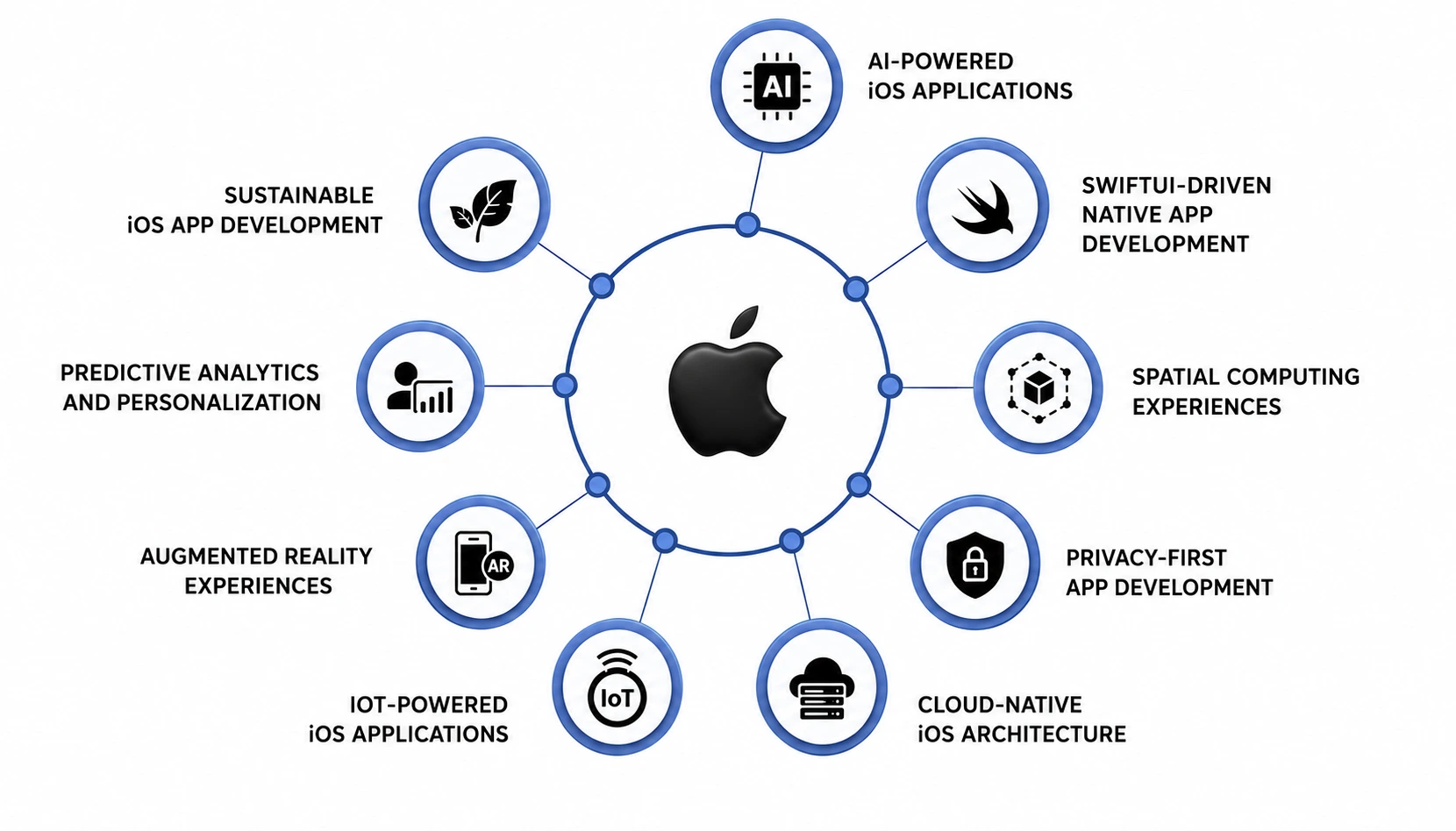
Apple continues to push the boundaries of innovation with every major software and hardware release. From on-device artificial intelligence to spatial computing, the company is redefining how users interact with mobile applications. As customer expectations evolve, businesses must embrace technologies that deliver faster performance, smarter experiences, and stronger security. These innovations are becoming the foundation of the next generation of iPhone applications.
Below are the most impactful iOS app development trends that businesses should watch in 2026.
1. Apple Intelligence Will Transform User Experiences
Artificial intelligence is no longer an experimental technology in the Apple ecosystem. With the introduction of Apple Intelligence, developers can build applications that understand user behavior, automate repetitive tasks, summarize content, generate personalized recommendations, and improve productivity without compromising privacy.
Unlike traditional cloud-based AI models, Apple focuses heavily on on-device processing. This allows applications to deliver intelligent experiences while keeping sensitive user information secure.
Businesses across healthcare, finance, education, retail, and productivity are already exploring ways to integrate AI-powered capabilities into their applications. Features such as intelligent search, writing assistance, predictive suggestions, voice interactions, and contextual automation are expected to become standard across modern iOS apps.
For businesses, this means higher engagement, better personalization, and improved operational efficiency. Organizations investing in AI-enabled applications today are more likely to build products that remain competitive over the next several years.
2. SwiftUI Will Become the Default Framework for Native Development
SwiftUI has evolved rapidly since its introduction and is now becoming Apple’s preferred framework for building native interfaces. Its declarative programming approach simplifies UI development while enabling developers to create consistent experiences across iPhone, iPad, Apple Watch, Mac, Apple TV, and Vision Pro.
Compared to traditional UIKit development, SwiftUI significantly reduces development effort and improves maintainability. Features like live previews, reusable components, adaptive layouts, and seamless animation support allow development teams to build sophisticated applications much faster.
For businesses, adopting SwiftUI offers several long-term benefits. Applications become easier to scale, updates require less development effort, and new features can be introduced more efficiently. This translates into shorter release cycles and lower maintenance costs throughout the application’s lifecycle.
Companies planning long-term investments in the Apple ecosystem should consider SwiftUI an essential part of their development strategy. As iOS technologies continue to evolve, custom iOS development enables businesses to build applications that are easier to maintain, scale, and optimize for future Apple innovations.
3. Spatial Computing Will Create Entirely New App Experiences
The launch of Apple Vision Pro has introduced spatial computing as one of the most disruptive technologies in the Apple ecosystem. Rather than interacting with applications through flat screens alone, users can now engage with immersive digital environments that blend physical and virtual experiences.
This evolution is creating opportunities across numerous industries.
Healthcare providers can visualize complex medical information in three-dimensional environments. Retail companies can enable virtual product demonstrations before purchase. Educational institutions can create immersive learning experiences, while manufacturers can deliver advanced employee training through interactive simulations.
Spatial computing is rapidly becoming one of the most promising iOS app development trends in 2026 because it fundamentally changes how businesses deliver digital experiences. As hardware adoption increases, organizations that invest early in immersive applications will be well positioned to differentiate themselves in competitive markets.
Developers are increasingly using ARKit, RealityKit, and Apple’s spatial design principles to create applications that feel natural within mixed-reality environments. These technologies are expected to become mainstream as Apple’s ecosystem continues expanding.
4. Privacy-First Development Will Become a Business Requirement
Privacy has evolved from a compliance requirement into a competitive advantage.
Apple continues strengthening its privacy ecosystem through features such as App Tracking Transparency, Privacy Nutrition Labels, secure authentication, advanced encryption, and on-device data processing. These initiatives are encouraging businesses to redesign applications around transparency and responsible data management.
Consumers are becoming increasingly aware of how their personal information is collected and used. Organizations that prioritize privacy not only reduce regulatory risks but also strengthen customer trust and long-term loyalty.
Privacy-first development involves minimizing unnecessary data collection, encrypting sensitive information, implementing secure authentication methods, and providing users with greater control over their personal data.
Businesses that embed privacy into every stage of product development are more likely to achieve higher App Store credibility and stronger customer confidence. These principles are central to iOS app security best practices, which focus on protecting user data while maintaining compliance with Apple’s evolving security standards.
5. Cloud-Native Architecture Will Power Scalable Applications
Modern applications are expected to support millions of users while delivering consistent performance across multiple regions and devices. Achieving this level of scalability requires far more than a powerful frontend, it demands a flexible cloud-native backend architecture.
Instead of relying on traditional monolithic infrastructure, organizations are increasingly adopting microservices, serverless computing, containerization, managed databases, and cloud-based APIs.
This shift represents one of the most significant iOS app development integration trends, enabling businesses to build applications that scale automatically according to user demand while reducing operational complexity.
Cloud-native development also simplifies continuous deployment, disaster recovery, monitoring, and performance optimization. As businesses expand globally, these capabilities become essential for maintaining consistent user experiences regardless of traffic volume.
You should partner with experts offering mobile application development services. This is because they can help you select the right technologies, implement scalable architectures, and accelerate time-to-market while ensuring long-term business success.
6. Internet of Things (IoT) Integration Will Expand Across Industries
The rapid adoption of connected devices is changing how businesses deliver digital services, making IoT one of the most influential drivers of innovation in the Apple ecosystem. From smart homes and wearable devices to connected vehicles and industrial equipment, iOS applications are becoming the primary interface for managing intelligent devices. As organizations continue investing in connected ecosystems, seamless device communication will become a competitive differentiator.
Apple’s frameworks, including HomeKit, HealthKit, and Core Bluetooth, enable developers to create secure applications that communicate efficiently with IoT devices. Combined with Apple’s emphasis on privacy and encrypted data exchange, businesses can confidently build solutions that protect user information while delivering real-time connectivity.
Healthcare providers are using connected medical devices to monitor patients remotely, while manufacturing companies rely on IoT-enabled dashboards to track equipment performance and automate maintenance. Retail businesses are also leveraging connected technologies to improve inventory visibility and create personalized shopping experiences.
The growing demand for smart ecosystems is encouraging businesses to invest in scalable applications capable of managing thousands of connected devices simultaneously. Organizations that embrace IoT today will be better positioned to support future innovations across Apple’s expanding ecosystem.
Read Also: IoT App Development: Useful Tips for Building Top-Notch IoT Apps
7. Augmented Reality Will Continue to Redefine Customer Engagement
Augmented Reality has steadily evolved from an emerging technology into a practical business solution. Apple’s continuous investment in ARKit, LiDAR-enabled devices, and Vision Pro is encouraging organizations to develop immersive experiences that improve customer interaction and simplify complex workflows.
Unlike traditional mobile experiences, AR allows users to visualize digital information within their physical surroundings. This capability creates entirely new opportunities for businesses seeking to increase engagement while reducing decision-making friction.
Retail brands now allow customers to preview furniture, fashion accessories, and home décor before making purchases. Real estate companies offer virtual property walkthroughs, while educational institutions create interactive learning environments that improve student engagement. Healthcare organizations are also leveraging AR to enhance surgical planning and medical training.
As hardware capabilities continue improving, immersive experiences will become increasingly accessible across multiple industries. Businesses adopting AR early will be able to differentiate themselves through richer customer experiences and stronger brand engagement.
8. Predictive Analytics Will Drive Hyper-Personalized Experiences
Personalization has become one of the most effective strategies for improving user engagement. However, modern applications are moving beyond simple recommendations by using predictive analytics to anticipate user behavior before decisions are made.
Machine learning models can analyze user interactions, purchase history, browsing patterns, and contextual information to deliver highly relevant experiences. Rather than reacting to user actions, applications proactively recommend products, content, services, and next-best actions.
This represents one of the fastest-growing latest trends in iOS app development, enabling businesses to improve customer retention while increasing conversions.
Streaming platforms personalize entertainment recommendations based on viewing behavior, while eCommerce applications suggest products according to purchasing patterns. Financial institutions provide proactive spending insights, and travel companies recommend destinations based on previous bookings and seasonal preferences.
Predictive analytics also supports operational efficiency by identifying potential issues before they affect users. Businesses can forecast demand, optimize inventory, personalize marketing campaigns, and improve customer support through intelligent automation.
As artificial intelligence becomes more sophisticated, predictive personalization will become an expected feature rather than a competitive advantage.
9. Sustainable and Energy-Efficient App Development Will Gain Importance
Sustainability is becoming an important consideration across every stage of software development. While environmental responsibility has traditionally focused on hardware and cloud infrastructure, businesses are increasingly recognizing that efficient application design also contributes to reducing energy consumption.
Apple continues encouraging developers to optimize applications for battery efficiency, resource utilization, and device performance. Applications that consume less processing power not only improve user satisfaction but also align with Apple’s broader sustainability initiatives.
Efficient coding practices, lightweight application architectures, optimized network requests, and intelligent background processing help reduce device resource consumption without compromising functionality.
Organizations are also adopting cloud infrastructure that prioritizes renewable energy while optimizing backend workloads through serverless computing and intelligent scaling. These efforts contribute to lower operational costs while supporting long-term environmental goals.
As sustainability becomes a larger priority for consumers and enterprises alike, energy-efficient application development will emerge as an important factor influencing purchasing decisions and corporate technology strategies.
Industry-Wise Adoption of iOS App Development Trends
Although every industry benefits from innovation differently, several sectors are leading the adoption of emerging iOS technologies. Organizations are selecting trends based on their customer expectations, operational requirements, compliance obligations, and long-term digital transformation goals.
| Industry | Most Relevant Trends | Primary Business Benefits |
| Healthcare | Apple Intelligence, IoT, Privacy-First Development | Remote patient monitoring, secure healthcare services, predictive diagnostics |
| FinTech | AI, Predictive Analytics, Privacy, Cloud-Native Architecture | Fraud detection, personalized banking, regulatory compliance |
| Retail & eCommerce | AR, AI Personalization, Spatial Computing | Product visualization, higher conversions, personalized shopping |
| Education | Spatial Computing, AI, AR | Interactive learning, virtual classrooms, adaptive education |
| Logistics | IoT, Cloud-Native Development, Predictive Analytics | Fleet monitoring, route optimization, real-time tracking |
| Travel | AI, Cloud Infrastructure, Personalization | Smart itineraries, dynamic pricing, enhanced customer experience |
| Real Estate | Spatial Computing, AR | Virtual property tours, immersive visualization |
| Manufacturing | IoT, Edge AI, Cloud Platforms | Equipment monitoring, predictive maintenance, operational efficiency |
| Media & Entertainment | AI, Apple Intelligence, Spatial Computing | Personalized content, immersive entertainment experiences |
| Social Networking | AI, Predictive Analytics, Cloud-Native Infrastructure | Content recommendations, scalable engagement platforms |
Different industries are adopting these innovations at varying speeds, but one trend remains consistent: organizations investing in intelligent, scalable, and secure iOS applications are better equipped to meet changing customer expectations while accelerating business growth.
Technologies Powering Modern iOS App Development
Behind every innovative iOS application is a technology stack designed to deliver performance, scalability, security, and exceptional user experiences. Apple continues enhancing its developer ecosystem with tools and frameworks that simplify development while enabling businesses to build increasingly sophisticated applications.
Swift remains the foundation of native iOS development because of its performance, safety, and modern syntax. Its continuous evolution enables developers to build reliable applications with fewer errors while improving maintainability.
SwiftUI complements Swift by simplifying interface development through reusable components and declarative programming. This approach allows development teams to build consistent user experiences across Apple’s entire ecosystem while significantly reducing development time.
Apple Intelligence APIs are expected to become one of the most transformative technologies for future applications by enabling intelligent writing assistance, contextual recommendations, automation, and personalized user experiences directly on Apple devices.
Core ML empowers developers to integrate machine learning into mobile applications, enabling features such as image recognition, recommendation engines, language processing, predictive analytics, and intelligent automation without relying entirely on external cloud services.
ARKit and RealityKit continue expanding opportunities for immersive experiences by allowing developers to create realistic augmented reality applications for industries including healthcare, education, retail, manufacturing, and entertainment.
CloudKit provides seamless synchronization across Apple devices while simplifying backend data management. Combined with scalable cloud infrastructure and serverless computing, businesses can build applications capable of supporting global user bases without sacrificing reliability.
Modern applications also rely on GraphQL and REST APIs to connect seamlessly with enterprise systems, third-party services, payment gateways, analytics platforms, and cloud infrastructure. These integrations ensure applications remain flexible as business requirements evolve.
Challenges Businesses Face While Adopting New iOS Development Trends
Adopting emerging technologies offers significant business advantages, but it also introduces new technical, operational, and strategic challenges. As iOS applications become increasingly intelligent and interconnected, organizations must carefully balance innovation with security, scalability, compliance, and long-term maintainability. Understanding these challenges early enables businesses to plan more effectively and reduce development risks.
1. Legacy Application Modernization
Many organizations still rely on outdated applications built using older versions of Objective-C, UIKit, or legacy backend architectures. While these systems continue to support business operations, they often struggle to integrate with modern Apple frameworks, AI capabilities, and cloud-native services.
Modernizing legacy applications requires careful planning to avoid disrupting existing users while introducing new functionality. Businesses must evaluate whether to refactor existing code, rebuild specific modules, or develop entirely new applications based on long-term business objectives.
Organizations planning digital transformation often benefit from legacy application modernization services, which help migrate older systems to modern architectures while preserving business continuity.
2. Managing Development Costs
Emerging technologies such as artificial intelligence, spatial computing, and machine learning introduce additional development complexity. Businesses often underestimate the time, resources, and specialized expertise required to implement these capabilities successfully.
Costs can increase due to advanced feature development, infrastructure upgrades, extended testing cycles, and ongoing optimization. However, strategic technology planning helps organizations prioritize features that deliver the highest business value while maintaining budget efficiency.
Instead of adopting every new technology simultaneously, businesses should focus on innovations that directly align with customer expectations and long-term growth goals.
3. Device Compatibility Across Apple’s Ecosystem
Apple’s ecosystem now includes iPhone, iPad, Apple Watch, Mac, Apple TV, and Vision Pro. Each device offers unique screen sizes, interaction models, and hardware capabilities that influence application behavior.
Developers must ensure applications deliver consistent experiences across multiple devices without compromising usability or performance. Features that work seamlessly on an iPhone may require entirely different interface considerations for Vision Pro or Apple Watch.
Building adaptive interfaces using SwiftUI and responsive design principles helps simplify multi-device compatibility while improving long-term maintainability.
4. Strengthening Security and Privacy
As applications process increasing amounts of personal and financial information, cybersecurity becomes more important than ever. Businesses must protect user data from unauthorized access while complying with evolving privacy regulations.
Secure authentication, encrypted communication, role-based access control, secure API integration, and regular security testing should be incorporated throughout the development lifecycle rather than treated as post-launch activities.
5. Maintaining High Performance
Users expect applications to respond instantly regardless of network conditions or device capabilities. Introducing AI models, cloud integrations, and immersive experiences increases processing requirements, making performance optimization a continuous priority.
Businesses must regularly monitor application performance, optimize API requests, reduce unnecessary background processing, and efficiently manage device resources to maintain smooth user experiences.
Performance optimization becomes especially important as applications grow in complexity and support larger user communities.
6. Finding Skilled Development Talent
Modern iOS development requires expertise across multiple technologies, including Swift, SwiftUI, Core ML, ARKit, cloud infrastructure, backend APIs, cybersecurity, and AI integration. Finding professionals with experience across all these domains remains a challenge for many organizations.
Partnering with an experienced iOS app development company provides access to multidisciplinary teams capable of delivering high-quality applications while reducing recruitment challenges and accelerating project timelines.
7. Managing Complex Integrations
Today’s applications rarely operate independently. They communicate with payment gateways, CRM platforms, ERP systems, cloud storage, analytics platforms, third-party APIs, and AI services.
As the number of integrations increases, maintaining compatibility, reliability, and security becomes more challenging. Poorly designed integrations can negatively impact application performance while increasing maintenance costs.
Scalable API architecture and well-defined integration strategies help organizations simplify future expansion while minimizing technical debt.
8. Keeping Pace with Continuous Updates
Apple introduces annual iOS releases, SDK improvements, security enhancements, and hardware innovations. Businesses must continuously update their applications to maintain compatibility while leveraging newly introduced capabilities.
Ignoring software updates can lead to compatibility issues, declining App Store rankings, and increased security risks. Establishing a structured release management process ensures applications remain optimized for every major platform update.
9. Navigating Compliance Requirements
Industries such as healthcare, finance, insurance, and education operate under strict regulatory frameworks governing data privacy, security, and accessibility. Organizations developing applications for these sectors must ensure compliance throughout the product lifecycle.
Compliance should be integrated into application architecture, data management policies, authentication mechanisms, and auditing processes from the beginning rather than addressed after development.
10. Comprehensive Testing Across Modern Experiences
The growing complexity of iOS applications requires significantly more testing than traditional mobile software. Applications must be validated across multiple devices, operating system versions, network conditions, accessibility settings, and user scenarios.
Automated testing, continuous integration, and performance monitoring help identify issues early while improving release quality and reducing long-term maintenance efforts.
Best Practices for Future-Ready iOS App Development
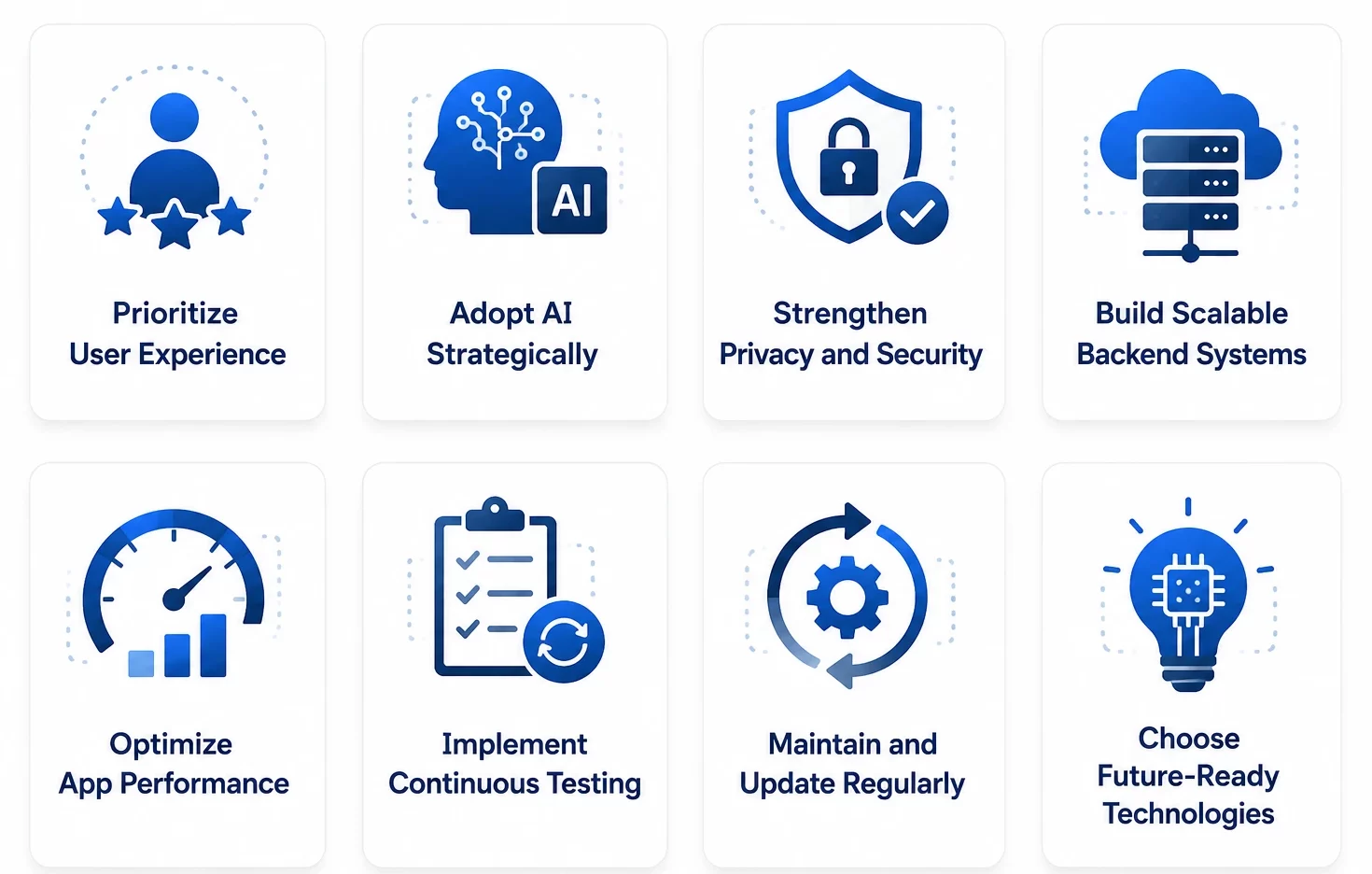
As technology continues evolving, businesses should focus on building applications that remain scalable, secure, and adaptable rather than simply addressing current market demands. Following proven development practices enables organizations to maximize long-term value while reducing future application modernization efforts.
1. Design Around User Experience
Successful iOS applications solve real user problems through intuitive navigation, responsive interfaces, and seamless interactions. Every feature should contribute to improving usability rather than increasing complexity.
Understanding user behavior, collecting continuous feedback, and refining experiences through data-driven improvements help maintain long-term engagement.
2. Integrate Artificial Intelligence Strategically
Artificial intelligence should enhance user experiences rather than complicate them. Businesses should identify opportunities where automation, personalization, predictive analytics, or intelligent recommendations deliver measurable customer value.
Implementing AI with clear business objectives ensures technology investments produce meaningful outcomes.
3. Build Privacy Into the Architecture
Privacy should influence every technical decision throughout the development process. Collecting only essential user information, encrypting sensitive data, and providing transparent permission controls strengthen customer trust while simplifying regulatory compliance.
4. Develop Scalable Backend Infrastructure
Future-ready applications require backend systems capable of supporting growing user bases, increasing data volumes, and expanding feature sets. Cloud-native architectures, scalable databases, microservices, and efficient API management create a strong technical foundation for sustainable growth.
5. Optimize Performance Continuously
Application performance should be monitored before and after launch. Regular optimization of memory usage, network requests, startup time, battery consumption, and rendering performance ensures users continue enjoying fast and reliable experiences as applications evolve.
6. Adopt Continuous Testing and Deployment
Automated testing, continuous integration, and continuous delivery enable organizations to release updates more frequently while maintaining high quality. This approach minimizes deployment risks and accelerates innovation without disrupting users.
7. Plan for Ongoing Maintenance
Launching an application marks the beginning of its lifecycle rather than its completion. Regular feature enhancements, security updates, performance improvements, and compatibility testing help applications remain competitive over time.
Businesses can streamline this process by investing in application maintenance services, ensuring their applications continue performing efficiently as technologies and customer expectations evolve.
8. Future-Proof Your Technology Decisions
Technology choices made during the early stages of development significantly influence long-term scalability and maintenance. Selecting modern frameworks, modular architectures, and flexible cloud infrastructure reduces technical debt while simplifying future expansion.
Organizations interested in understanding how Apple’s ecosystem will continue evolving can gain valuable insights into the technologies expected to shape the next generation of mobile applications.
Conclusion
The future of Apple’s mobile ecosystem will be shaped by artificial intelligence, spatial computing, privacy-first development, cloud-native architectures, and intelligent automation. These innovations are transforming how businesses engage customers, streamline operations, and create digital experiences that deliver lasting value.
Adopting emerging technologies is no longer simply a way to differentiate products, it has become essential for remaining competitive in an increasingly dynamic marketplace. Organizations that embrace innovation early are better positioned to improve customer satisfaction, accelerate digital transformation, and build scalable applications capable of supporting long-term business growth.
While every business has unique objectives, the key to success lies in selecting technologies that align with strategic goals rather than pursuing innovation for its own sake. A thoughtful development approach focused on performance, security, scalability, and user experience creates stronger products and higher long-term returns.
If you’re planning to build a next-generation iOS application or modernize an existing digital product, partnering with an experienced technology team can help transform your vision into a future-ready solution. With deep expertise across native iOS development, AI integration, cloud technologies, application modernization, and long-term product support, RipenApps helps businesses create innovative applications that are ready for the future of Apple’s ecosystem.
FAQs
Q1. What are the latest trends in iOS app development?
Some of the most significant trends include Apple Intelligence integration, SwiftUI adoption, spatial computing, AI-powered personalization, cloud-native development, IoT connectivity, privacy-first architecture, predictive analytics, and immersive AR experiences.
Q2. Which iOS app development trends will dominate 2026?
Artificial intelligence, Apple Intelligence, SwiftUI, Vision Pro applications, predictive analytics, cloud-native infrastructure, and privacy-first development are expected to define the next generation of mobile innovation.
Q3. How is AI transforming iOS app development?
AI enables applications to deliver intelligent recommendations, automate workflows, improve search, personalize user experiences, detect fraud, analyze customer behavior, and support predictive decision-making while improving operational efficiency.
Q4. What is Apple Intelligence in iOS development?
Apple Intelligence is Apple’s AI framework that enables intelligent features such as contextual assistance, writing support, personalized recommendations, and on-device machine learning while prioritizing user privacy and security.
Q5. Why is SwiftUI becoming increasingly popular?
SwiftUI simplifies interface development through declarative programming, reusable components, and cross-device compatibility. Businesses comparing development approaches can refer to Flutter vs Swift to determine which framework best suits their project requirements.
Q6. How important is privacy in iOS app development?
Privacy has become one of the most important factors influencing customer trust and App Store success. Businesses that prioritize secure data handling, transparent privacy policies, and compliance with Apple’s privacy guidelines are more likely to gain user confidence, improve retention, and achieve faster App Store approvals.
Q7. Which industries benefit the most from modern iOS development trends?
Healthcare, finance, retail, logistics, education, manufacturing, travel, media, real estate, and enterprise productivity all benefit significantly from AI, cloud computing, predictive analytics, and immersive technologies. This trend is particularly evident in emerging technology hubs, where iOS app development in Dubai for business growth reflects the increasing demand for secure, high-performance enterprise mobile applications.
Q8. How do I future-proof my iOS application?
Businesses should invest in scalable architecture, modern development frameworks, AI integration, continuous optimization, cloud-native infrastructure, and regular maintenance.
Q9. How much does it cost to build a modern iOS app?
iOS app development costs depend on application complexity, features, integrations, design requirements, security needs, AI capabilities, and infrastructure. On average, a basic iOS app costs between $20,000 and $50,000, a medium-complexity app ranges from $50,000 to $120,000, while enterprise-grade or AI-powered applications can cost anywhere from $120,000 to $300,000+ depending on the project’s scope and customization requirements.
Q10. How do I choose the right iOS app development company?
You should hire an iOS app development partner that has proven experience in native iOS technologies, AI integration, cloud architecture, UI/UX design, security implementation, post-launch support, and enterprise scalability.
Discuss your project and request for proposal
SHARE
WRITTEN BY

Prankur Haldiya
Chief Technical Officer
A tech innovator and engineering leader, Prankur Haldiya drives RipenApps’ product development strategy and oversees cutting-edge solutions in mobility, AI, and cloud ecosystems. He is passionate about building high-performance teams and helping brands launch secure, scalable, and user-centric digital products.
View All Articles