
Key Takeaways
- Healthcare, fintech, retail, logistics, and other service-driven industries use mobile apps to improve accessibility, customer engagement, and operational efficiency.
- Global in-app purchase revenue reached $167 billion in 2025, with non-gaming applications generating more revenue than games for the first time.
- Mobile applications support multiple revenue models, including subscriptions, commissions, transaction fees, advertising, and enterprise software licensing.
- AI, IoT, cloud computing, and augmented reality are expanding mobile app capabilities across traditional and emerging industries.
- Businesses should evaluate customer demand, monetization opportunities, operational requirements, and scalability before investing in industry-specific mobile app development.
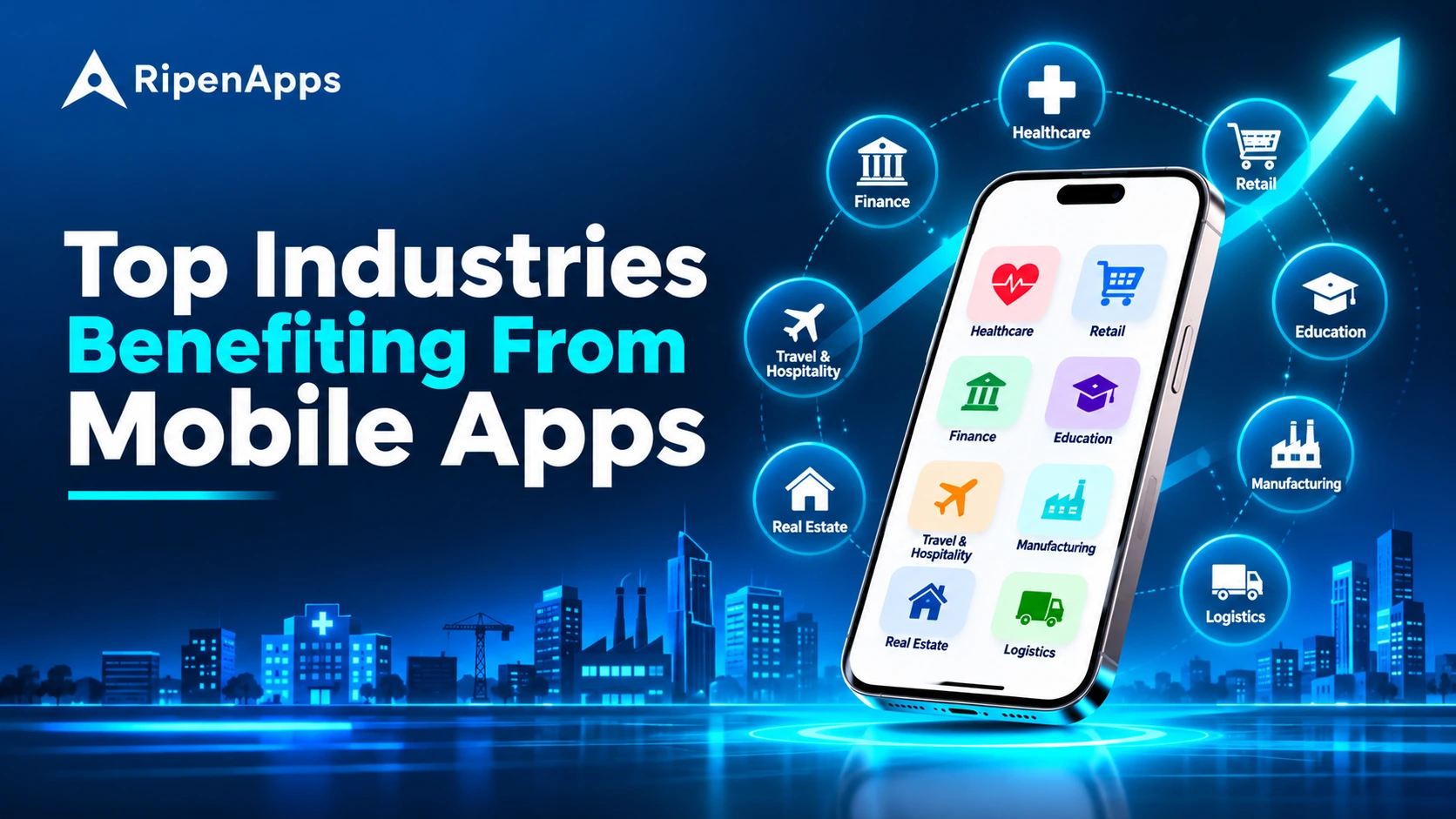
Mobile apps are reshaping how businesses connect with customers, deliver services, and manage operations. In 2026, industries such as healthcare, fintech, retail, food delivery, logistics, education, travel, real estate, fitness, entertainment, manufacturing, and automotive are using mobile applications to improve customer experiences, streamline workflows, and unlock new revenue opportunities.
The market continues to demonstrate this potential. According to Sensor Tower, global mobile app in-app purchase revenue reached $45 billion in Q3 2026, marking 4.4% year-over-year growth. This momentum highlights the growing commercial value of mobile applications as businesses expand their digital services and customer engagement strategies.
However, the opportunities and requirements vary across industries. Partnering with an experienced mobile app development company can help businesses identify relevant use cases, prioritize essential features, and build applications that support operational efficiency and long-term growth.
Table of Contents
Mobile App Market in 2026
Mobile applications have become an established channel for purchasing products, accessing services, managing finances, and interacting with businesses. Their commercial potential is also reflected in the growth of consumer spending and engagement.
According to Sensor Tower’s State of Mobile 2026 report, global in-app purchase revenue reached $167 billion in 2025, increasing 10.6% year over year.
Other findings from the report highlight the market’s continued expansion:
- Global app downloads: Approximately 150 billion downloads across iOS and Google Play in 2025, increasing 0.8% year over year.
- Consumer engagement: Users spent 5.3 trillion hours across mobile applications in 2025, averaging approximately 3.6 hours per user daily.
- Non-gaming app revenue: Approximately $85.6 billion, representing 21% annual growth.
- Gaming app revenue: Approximately $81.8 billion, with 1% annual growth.
- Generative AI revenue: Generative AI applications generated more than $5 billion in in-app purchase revenue in 2025, nearly tripling year over year.
- US consumer spending: Approximately $60 billion, making the United States the largest mobile app consumer spending market.
These figures demonstrate an important shift in the mobile ecosystem. Downloads remain relevant, but revenue generation, user engagement, and long-term retention increasingly determine commercial success.
Why Mobile Apps Matter for Businesses in 2026
Mobile applications give businesses a direct channel to customers while creating opportunities to improve service delivery, strengthen relationships, and introduce additional revenue streams.
1. Better Customer Retention
Mobile applications make it easier for customers to interact with businesses through personalized notifications, loyalty programs, saved preferences, and convenient account access. These features encourage repeat engagement and help companies build stronger customer relationships.
2. Direct Customer Communication
Businesses can communicate product updates, promotional offers, service notifications, and important announcements through push notifications. This creates a direct communication channel without depending entirely on third-party platforms.
3. Actionable Customer Insights
Mobile applications provide information about customer preferences, purchasing patterns, browsing behavior, and feature usage, subject to appropriate consent and privacy requirements. Businesses can analyze these insights to improve products, refine marketing strategies, and make informed decisions.
4. Improved Operational Efficiency
Applications can automate repetitive processes such as appointment scheduling, payment processing, order management, inventory tracking, and customer support. This reduces manual coordination and helps businesses allocate resources more effectively.
5. Personalized Customer Experiences
AI and machine learning enable businesses to analyze user behavior and deliver relevant recommendations, automated assistance, and personalized experiences. These capabilities help companies make their services more responsive to individual customer requirements.
Industries Benefiting From Mobile Apps at a Glance
Different industries use mobile applications to address specific customer and operational challenges. The following comparison highlights their primary use cases, revenue opportunities, and essential features.
| Industry | Top Use Cases | Revenue Model | Must-Have Features |
| Healthcare | Telemedicine, appointment booking, medication management | Consultation fees, subscriptions | Video consultations, patient records, secure messaging |
| Fintech & Banking | Digital banking, money transfers, payments | Transaction fees, premium subscriptions | Biometric authentication, payment integration, fraud monitoring |
| eCommerce & Retail | Online shopping, loyalty programs, order tracking | Product sales, subscriptions, advertising | Product catalog, payment gateway, recommendations |
| On-Demand Food & Grocery Delivery | Food ordering, grocery delivery, restaurant discovery | Commissions, delivery fees, subscriptions | Real-time tracking, digital payments, order management |
| Logistics & Transportation | Shipment tracking, fleet management | Service fees, enterprise subscriptions | GPS tracking, route optimization, dispatch management |
| Education & eLearning | Online courses, exam preparation, virtual classrooms | Subscriptions, course fees | Video lessons, assessments, progress tracking |
| Travel & Hospitality | Hotel booking, travel planning, reservations | Booking commissions, service fees | Booking management, maps, digital payments |
| Real Estate | Property discovery, virtual tours, rental management | Listing fees, subscriptions, commissions | Property search, virtual tours, messaging |
| Fitness & Wellness | Workout tracking, virtual coaching, health monitoring | Memberships, subscriptions | Activity tracking, wearable integration, progress reports |
| Media, Entertainment & Streaming | Video streaming, content discovery, fantasy sports | Subscriptions, advertising, in-app purchases | Content streaming, recommendations, user profiles |
| Manufacturing & Field Services | Equipment monitoring, workforce management, maintenance | Enterprise SaaS, licensing | IoT integration, work orders, inventory tracking |
| Automotive & EV / On-Demand Services | Ride booking, vehicle monitoring, EV charging | Service fees, subscriptions, commissions | GPS navigation, booking, vehicle connectivity |
Top 12 Industries That Benefit From Mobile Apps
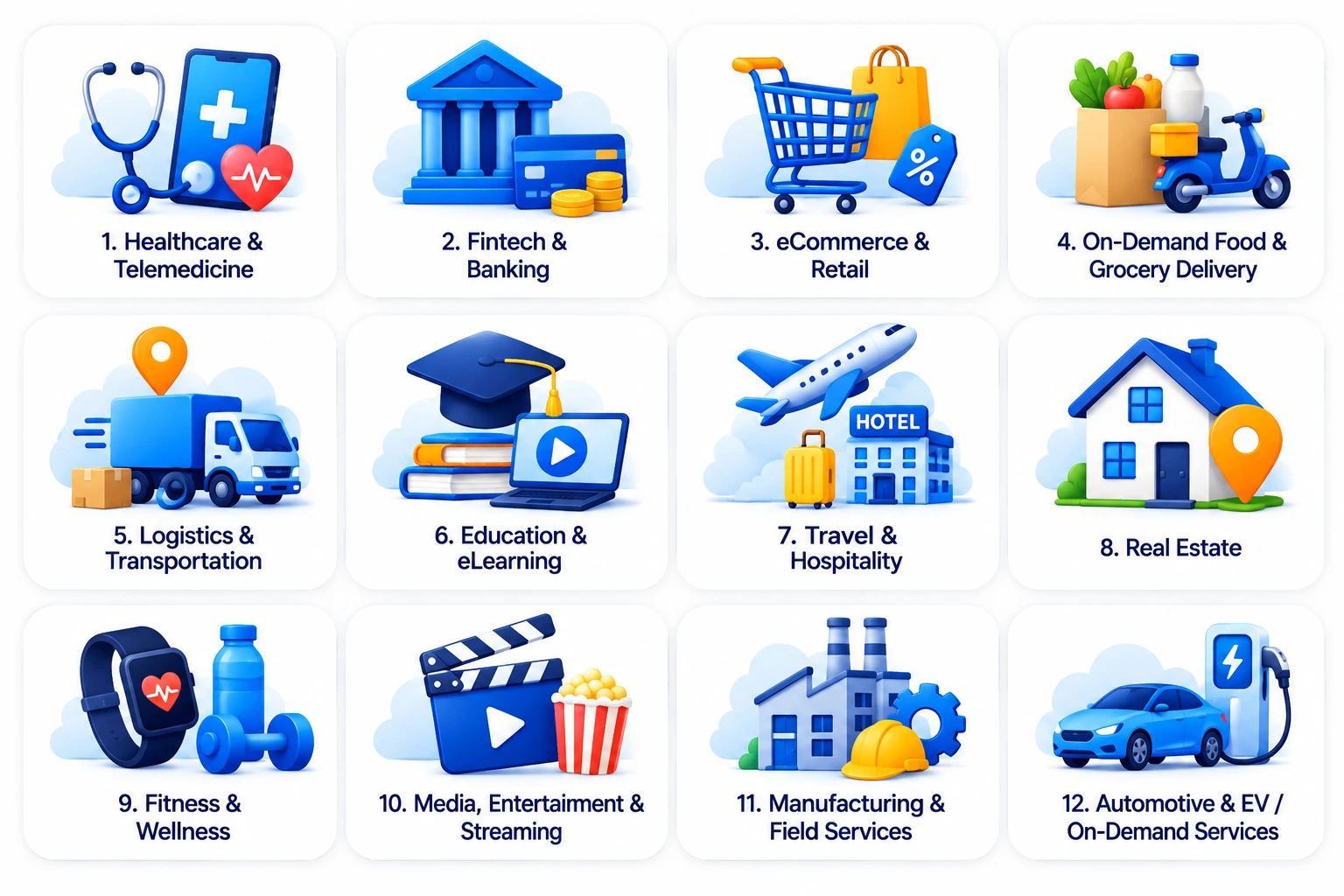
Mobile app adoption is creating opportunities across industries with different customer expectations and operating models. Here are 12 sectors where businesses can use applications to improve service delivery, increase efficiency, and develop new revenue opportunities.
1. Healthcare & Telemedicine
Healthcare is one of the leading industries benefiting from mobile apps because patients increasingly expect convenient access to medical services, health information, and healthcare professionals.
Healthcare applications support several use cases:
- Telemedicine: Patients can consult doctors through video appointments without visiting healthcare facilities.
- Appointment management: Users can find specialists, schedule consultations, and receive appointment reminders.
- Medication management: Applications help patients manage prescriptions, dosage schedules, and medication reminders.
- Remote patient monitoring: Connected devices can transmit health information to healthcare providers for ongoing monitoring.
Healthcare businesses can generate revenue through consultation fees, subscription plans, premium services, and partnerships with healthcare providers. Essential features include secure patient profiles, appointment scheduling, electronic health record integrations, video consultations, payment gateways, and role-based access controls.
Applications such as Practo demonstrate how patients can discover doctors and access healthcare services through mobile platforms.
Mednovate Connect, developed by RipenApps is a telemedicine platform that connects patients with licensed clinical pharmacists for consultations and personalized medication management plans. Developed for both iOS and Android in three months, the application includes real-time drug interaction and dose-checking tools, appointment booking, treatment monitoring, and secure in-app messaging with clinical pharmacists. These features help patients manage medications and communicate with healthcare professionals through a single platform.
Businesses exploring healthcare app development services should prioritize patient data security, regulatory compliance, accessibility, and reliable integrations.
2. Fintech & Banking
Fintech and banking are among the most commercially significant industries using mobile applications. Digital banking, mobile payments, money transfers, and financial management services have changed how customers interact with financial institutions.
Mobile applications support several financial use cases:
- Mobile banking: Customers can check account balances, review transactions, and manage financial activities.
- Digital payments: Applications enable users to transfer money, pay bills, and complete purchases.
- Investment management: Users can monitor portfolios, access market information, and manage investments.
- Money transfers: International remittance applications simplify cross-border transactions and currency conversion.
Fintech applications generate revenue through transaction charges, subscription plans, service fees, and partnerships with financial institutions. Essential features include biometric authentication, multi-factor verification, transaction history, fraud monitoring, payment gateway integration, and secure financial data management.
Examples such as Google Pay and Revolut demonstrate how mobile applications simplify everyday financial activities.
RipenApps’ Al Muzaini project demonstrates its experience in building financial applications for cross-border remittances and currency exchange. Developed for a Kuwait-based exchange house, the platform supports domestic and international money transfers, real-time exchange rates, and Western Union network integration. It also features AI-powered KYC onboarding, three-factor authentication with biometric login, and beneficiary management. The application has recorded 100K+ installs and 1.87K reviews on Google Play.
Businesses investing in fintech app development services should prioritize security, regulatory requirements, transaction reliability, and customer trust.
3. eCommerce & Retail
Retail and eCommerce businesses use mobile applications to create convenient shopping experiences, personalize product discovery, and encourage repeat purchases. Businesses investing in ecommerce app development services can build digital storefronts that simplify shopping, streamline order management, and improve customer engagement.
Mobile applications support several retail activities:
- Online shopping: Customers can browse products, compare prices, and complete purchases.
- Personalized recommendations: AI-powered systems suggest products based on browsing and purchasing behavior.
- Loyalty programs: Businesses reward repeat customers through points, discounts, and exclusive offers.
- Order management: Customers can track deliveries, manage returns, and receive purchase updates.
Retail applications typically generate revenue through product sales, subscriptions, advertising, and sponsored product placements.
Important features include product catalogs, advanced search, shopping carts, secure payment gateways, inventory synchronization, order tracking, and personalized recommendations. Amazon and Walmart demonstrate how mobile platforms support large-scale digital commerce and customer engagement.
Cobone, developed by RipenApps, is a cross-platform retail application. The Middle Eastern daily-deals application was built using React Native and supports location-based discovery and secure transactions.
4. On-Demand Food & Grocery Delivery
Food and grocery delivery applications have transformed how customers order meals, purchase household essentials, and discover nearby restaurants.
Sensor Tower’s State of Mobile 2026 report found that restaurant and food delivery applications recorded 14% year-over-year download growth in 2025. This indicates continued demand for convenient ordering and delivery services.
Businesses can use these applications for several purposes:
- Restaurant ordering: Customers can explore menus, customize meals, and place orders.
- Grocery delivery: Users can purchase groceries and receive deliveries at their preferred locations.
- Quick commerce: Businesses can offer rapid delivery of everyday essentials through localized fulfillment networks.
- Restaurant management: Restaurant owners can manage menus, incoming orders, pricing, and customer interactions.
Common revenue models include restaurant commissions, delivery charges, subscription memberships, advertising, and featured listings. Must-have features include restaurant discovery, product catalogs, real-time order tracking, digital payments, delivery partner management, ratings, and notifications.
Examples such as DoorDash and Instacart demonstrate different approaches to food ordering and grocery delivery.
For businesses exploring food delivery app development, important considerations include delivery logistics, vendor onboarding, payment processing, location services, and customer experience. Businesses planning grocery marketplaces can also explore how to develop a grocery delivery app like Blinkit.
5. Logistics & Transportation
Logistics and transportation businesses operate through complex networks involving vehicles, warehouses, delivery partners, suppliers, and customers. Mobile applications help coordinate these activities and improve visibility across supply chains. A reliable logistics app development company can help businesses build solutions that streamline transportation operations, improve shipment visibility, and support efficient fleet management.
Important use cases include:
- Fleet management: Businesses can monitor vehicles, driver activities, and fleet utilization.
- Shipment tracking: Customers receive updates about shipment locations and delivery status.
- Route optimization: Applications help identify efficient delivery routes and reduce unnecessary travel.
- Warehouse management: Teams can track inventory, manage dispatch activities, and coordinate stock movement.
Logistics applications commonly generate revenue through transaction fees, shipment charges, enterprise subscriptions, and fleet management services. Essential features include GPS integration, real-time tracking, route planning, driver management, shipment notifications, and analytics dashboards. Businesses planning such solutions can explore a logistics app development guide to understand the key considerations involved.
Platforms such as Uber Freight demonstrate how digital platforms connect transportation providers with businesses requiring shipping services.
6. Education & eLearning
Education is another major industry benefiting from mobile applications. Students, educational institutions, coaching providers, and corporate training teams use digital platforms to make learning more accessible and flexible.
Mobile learning applications support educational activities beyond traditional classroom environments. Their capabilities range from recorded lectures and practice assessments to interactive learning and personalized study recommendations. An experienced eLearning app development company can help businesses build platforms that support these learning experiences while meeting different educational and training requirements.
Common education app use cases include:
- Online learning: Students access recorded lectures, live classes, and digital study materials.
- Exam preparation: Applications provide practice tests, mock examinations, and performance assessments.
- Language learning: Interactive lessons and progress tracking help users develop language skills.
- Corporate training: Organizations distribute learning resources and monitor employee development.
Education applications generate revenue through subscriptions, course purchases, freemium plans, advertising, and institutional licensing. Must-have features include video streaming, interactive assessments, downloadable resources, progress tracking, discussion forums, and personalized learning recommendations. Duolingo and Coursera demonstrate how mobile platforms deliver structured learning experiences to global audiences.
RipenApps developed eGurukul, a medical exam preparation platform designed for students preparing for the NEET-PG examination pattern. Available on Android and iOS, the application combines recorded lectures, online tests, daily quizzes, video streaming, and interactive learning features. Its content library includes 1,000+ hours of lectures and 35,000+ syllabus-aligned MCQs. The app has recorded 500K+ installs on Google Play, with a 4.2-star rating from 14.5K reviews.
7. Travel & Hospitality
Travel and hospitality businesses use mobile applications to simplify trip planning, accommodation booking, transportation, and destination discovery. Mobile platforms help travelers access important information throughout their journeys while allowing businesses to manage reservations and customer communication.
Travel applications support several use cases:
- Hotel reservations: Travelers can search for accommodation, compare prices, and manage bookings.
- Flight booking: Users can explore flight options, purchase tickets, and receive travel updates.
- Travel discovery: Applications recommend destinations, attractions, and personalized itineraries.
- Local experiences: Travelers can discover activities, restaurants, and transportation services.
Businesses can generate revenue through booking commissions, service fees, subscriptions, and premium travel services. Essential features include booking management, location-based recommendations, maps, secure payments, itinerary planning, reviews, and real-time notifications.
Examples such as Booking.com demonstrate the commercial potential of mobile-first travel experiences. Businesses exploring travel app development should prioritize seamless reservations, accurate information, personalization, and integration with booking and payment systems. Features such as augmented reality in travel and tourism can further improve destination discovery and visitor experiences.
8. Real Estate
Real estate businesses are increasingly using mobile applications to connect property buyers, sellers, tenants, agents, and property managers. A real estate app development company can help businesses build platforms that simplify property discovery, improve communication, and make property-related transactions more convenient.
Property discovery traditionally involves extensive coordination, multiple site visits, and communication between different stakeholders. Mobile applications simplify these activities by bringing property information and communication tools into one platform.
Real estate applications support several use cases:
- Property discovery: Buyers and tenants search properties using location, price, size, and other filters.
- Virtual property tours: Users explore properties through videos, interactive tours, and AR/VR experiences.
- Rental management: Property owners manage listings, bookings, payments, and tenant communication.
- Agent communication: Applications connect interested buyers with agents for inquiries and property visits.
Common revenue models include listing fees, property commissions, premium subscriptions, and advertising. Must-have features include property listings, advanced search, maps, virtual tours, saved searches, in-app messaging, and payment integration.
Platforms such as Zillow and MagicBricks demonstrate how mobile applications simplify property discovery, real estate transactions, and communication between buyers, sellers, and agents.
RipenApps developed MMH, an AI-powered home design app that connects homeowners with architects, interior designers, and Vastu specialists. This platform enables users to find professionals, book instant consultations, collaborate through real-time chat and calls, and explore AI-generated design inspiration. The solution includes AWS-powered cloud infrastructure, secure UPI, card, and wallet payments, and an AI-based design scoring feature. Delivered in just 3 months, MMH has achieved 10K+ downloads.
9. Fitness & Wellness
Fitness and wellness businesses use mobile applications to deliver personalized workout experiences, monitor physical activities, and maintain customer engagement beyond traditional gym environments. The growth of connected devices, wearable technology, and AI-powered recommendations is expanding the capabilities of fitness applications.
Common fitness app use cases include:
- Workout tracking: Users record exercises, monitor performance, and track fitness goals.
- Personal training: Applications provide customized workout plans and virtual coaching.
- Nutrition management: Users monitor meals, calorie intake, and nutritional information.
- Wellness tracking: Applications help users maintain activity records, routines, and personal wellness goals.
Revenue models include monthly subscriptions, premium memberships, personal coaching fees, and partnerships with fitness providers. Essential features include activity tracking, workout libraries, progress dashboards, wearable integrations, personalized recommendations, and subscription management.
Businesses considering fitness app development should focus on personalization, consistent engagement, accurate activity tracking, and integrations with wearable devices. A fitness tracking app development guide can help businesses understand the essential features, technology requirements, and planning considerations involved in building such applications.
10. Media, Entertainment & Streaming
Media and entertainment companies use mobile applications to distribute digital content, engage audiences, and generate recurring revenue. Businesses working with providers of media and entertainment app development services can build platforms for music streaming, video-on-demand, live sports, and other digital entertainment experiences. These applications make content more accessible while helping businesses reach wider audiences.
Mobile applications support several use cases:
- Video streaming: Users access movies, television programs, and original content.
- Music streaming: Applications provide music libraries, playlists, and personalized recommendations.
- Fantasy sports: Users create teams, participate in competitions, and follow live sporting events.
- Social entertainment: Platforms enable content sharing, community interaction, and creator engagement.
Revenue models include subscriptions, advertising, freemium plans, in-app purchases, and premium content access. Must-have features include media streaming, content recommendations, search, user profiles, watchlists, notifications, and secure subscription management. Examples such as Netflix, Spotify, and YouTube demonstrate how mobile applications have become central to digital entertainment.
RipenApps provided design and development services for Hungama, an entertainment streaming platform available on Android and iOS. The platform brings together a catalog of 30M+ songs and 8,000+ movies and web shows, supported by personalized recommendations and multi-format streaming. It has recorded 50M+ installs and 553K reviews on Google Play, while its iOS listing holds a 4.0-star rating based on 11,474 ratings.
11. Manufacturing & Field Services
Manufacturing and field services businesses are adopting mobile applications to improve workforce coordination, monitor equipment, manage inventory, and streamline operational workflows. These applications connect employees, managers, technicians, and operational systems through a centralized digital platform.
Manufacturing and field service applications support several use cases:
- Equipment monitoring: Connected devices provide information about machinery performance and operating conditions.
- Workforce management: Managers assign tasks, monitor progress, and coordinate field employees.
- Maintenance management: Technicians receive work orders, record equipment issues, and update maintenance histories.
- Inventory tracking: Businesses monitor materials, spare parts, and stock movement across facilities.
Common revenue models include enterprise SaaS subscriptions, software licensing, implementation fees, and customized enterprise solutions. Essential features include role-based dashboards, IoT integration, work order management, offline access, inventory tracking, and reporting.
12. Automotive & EV / On-Demand Services
The automotive industry is expanding beyond traditional vehicle ownership and transportation services. Mobile applications now connect drivers, passengers, vehicle owners, service providers, and electric vehicle charging networks. Businesses can use applications to improve transportation access, simplify vehicle management, and introduce connected services.
Common automotive and on-demand application use cases include:
- Ride booking: Customers book taxis, schedule rides, and track drivers.
- Vehicle management: Owners monitor vehicle information, service schedules, and maintenance requirements.
- EV charging: Drivers locate charging stations, check availability, and manage charging payments.
- On-demand assistance: Users request roadside assistance, emergency transportation, and vehicle-related services.
Revenue opportunities include ride commissions, booking fees, subscriptions, charging service fees, and partnerships.
Must-have features include GPS navigation, real-time tracking, booking management, secure payments, driver profiles, and vehicle connectivity. Examples such as Uber and Tesla demonstrate how mobile applications support transportation and connected vehicle experiences.
How AI Is Changing Mobile Apps Across Industries
Artificial intelligence is changing how businesses design, operate, and monetize mobile applications. Rather than limiting applications to predefined workflows, AI enables more responsive, personalized, and data-driven experiences.
Sensor Tower’s State of Mobile 2026 report highlights the commercial impact of this shift. Generative AI applications contributed an additional $3.5 billion in in-app purchase revenue during 2025.
Here are five ways AI is transforming mobile applications across industries.
- Personalized recommendations: Suggests relevant products, services, and content based on user preferences and behavior.
- Intelligent customer support: Uses AI chatbots and virtual assistants to handle inquiries and provide 24/7 assistance.
- Predictive analytics: Analyzes historical data to forecast demand, identify trends, and support better business decisions.
- Business process automation: Automates repetitive tasks such as document processing, inventory forecasting, and fraud detection.
- Accessible user experiences: Improves usability through voice assistants, intelligent search, automated translation, and conversational interfaces.
Beyond AI, technologies such as IoT, AR/VR, cloud computing, and wearables are expanding mobile app capabilities. Businesses can combine these technologies to build connected experiences that address specific industry requirements.
How Much Does an Industry-Specific App Cost?
The cost to develop an app depends on its complexity, features, technology stack, integrations, security requirements, and development approach.
A basic application with limited functionality generally requires fewer resources than a multi-sided platform involving separate customer, service provider, and administrator interfaces. For initial planning, businesses can consider the following investment ranges.
| App Complexity | Estimated Development Cost | Typical Features |
| Basic MVP | $15,000–$40,000 | User registration, essential functionality, basic dashboard, and limited integrations |
| Mid-Level Application | $40,000–$100,000 | Advanced functionality, payment integration, notifications, analytics, and third-party APIs |
| Complex Application | $100,000–$250,000+ | AI capabilities, real-time processing, multiple user roles, advanced security, and enterprise integrations |
These are indicative planning ranges, not fixed quotations. Actual costs vary according to business requirements and project scope.
Some industries also require specialized integrations that influence the overall budget. For example, healthcare applications may require secure medical record integrations, while logistics platforms may need GPS tracking, route optimization, and fleet management capabilities.
Businesses should also account for ongoing maintenance, infrastructure, third-party services, security updates, and future feature enhancements.

How to Know if Your Industry Needs a Mobile App
Not every business needs a dedicated mobile application. The decision should depend on whether an app can solve meaningful customer problems or improve business performance.
Consider these five criteria before investing in mobile app development.
- Frequent customer interactions: A mobile app improves convenience when customers regularly access services, place orders, or manage accounts.
- Clear monetization opportunities: Supports revenue through subscriptions, transaction fees, commissions, and premium features.
- Operational efficiency needs: Helps automate repetitive tasks and coordinate communication across teams and stakeholders.
- Scalability requirements: Supports growing customer bases, transaction volumes, and operational demands.
- Customer experience priorities: Adds value when convenience, personalization, accessibility, and real-time communication influence purchasing decisions.
The right investment is one that addresses a measurable business requirement rather than simply following a technology trend.
Conclusion
Mobile applications continue to create opportunities across healthcare, fintech, retail, logistics, education, travel, real estate, fitness, entertainment, manufacturing, and automotive services. However, success depends on selecting the right business model, understanding customer needs, and identifying opportunities to deliver measurable value. Custom application development company help businesses address industry-specific requirements, while technologies such as AI, cloud computing, and IoT expand what these applications can achieve.
Before investing in an application, businesses should assess their operational challenges, customer expectations, and long-term growth plans. RipenApps helps businesses turn these requirements into scalable digital products through tailored mobile app development solutions, aligning technology decisions with practical business goals.

FAQs
Q1. Which industries benefit the most from mobile apps?
Healthcare, fintech, retail, food delivery, logistics, education, and travel are among the industries benefiting significantly from mobile applications. These sectors use apps to improve customer access, streamline transactions, automate operations, and deliver personalized services.
Q2. Which app categories make the most money in 2026?
Revenue opportunities vary by market, monetization strategy, and audience. Gaming, social networking, entertainment, finance, and subscription-based applications are commercially significant categories. According to Sensor Tower, non-gaming apps generated approximately $85.6 billion in global in-app purchase revenue in 2025, surpassing games for the first time.
Q3. Does every business need a mobile app?
No. A mobile application makes sense when it addresses a clear customer or operational requirement. Businesses should consider customer interaction frequency, monetization opportunities, operational efficiency, scalability, and the importance of mobile accessibility before investing.
Q4. Which industries are growing fastest on mobile?
Growth varies by app category and geographical market. According to Sensor Tower’s State of Mobile 2026 report, restaurant and food delivery app downloads increased 14% globally in 2025, while credit and lending app downloads grew 18%. Health and fitness applications also recorded 13% year-over-year growth in in-app purchase revenue, reaching $4.5 billion in 2025.
Q5. How much does it cost to build an app for my industry?
Industry-specific mobile app development can start at approximately $15,000 for a basic MVP and exceed $250,000 for complex applications. The final cost depends on functionality, integrations, security, platform requirements, and overall project complexity.
Q6. Native, cross-platform, or PWA: Which is right for my industry?
The right approach depends on your app’s functionality, performance needs, budget, and target platforms.
- Native: Best for advanced performance and deep device integration.
- Cross-platform: Flutter and React Native support multiple platforms through shared code, reducing development effort.
- PWA: Ideal for browser-based access without requiring app installation.
Choose the approach that best supports your business requirements and long-term product goals.
Discuss your project and request for proposal
SHARE
WRITTEN BY

Ishan Gupta
CEO & Founder
Ishan Gupta is a seasoned entrepreneur and CEO with extensive 10+ years of experience in business and mobile app development landscape. He believes that the right digital product allows companies to focus on what they do best, while technology handles the rest. With deep exposure to global markets, he understands what makes an app succeed. His approach translates business needs into clear product strategies, ensuring that every feature contributes to measurable ROI.
View All Articles