

There was a time when health and fitness apps were little more than glorified step counters. Count your calories. Log your jog. Maybe track your water intake if you’re feeling fancy.
That era is over.
In 2026, health & fitness apps have become something else entirely: personal trainers, nutritionists, sleep coaches, mental health allies, and community hubs, all packed into one screen. Users now expect their fitness app to know them better than their doctor and motivate them better than their trainer.
But while users are sweating it out, most business founders are still sweating over revenue.
Because in this saturated, highly personalized market, monetizing a fitness app is not only about throwing in a subscription button or sprinkling ads between yoga flows. It’s about designing value ecosystems where data, habit loops, motivation, and trust align to generate real, sustainable income.
Whether you’re building a meditation platform, an AI-powered workout coach, or a holistic health tracker, 2026 demands smarter monetization strategies that rise above the market noise. And this blog is your blueprint for that shift.
We’ll decode emerging consumer trends and effective app monetization strategies for health & fitness apps that drive revenue. And we’ll also spotlight what the top fitness apps are doing differently to scale with integrity and impact. So if you’re building a health or fitness app that aims to be more than just “another tracker,” you’re in the right place.
Key Takeaways
- The biggest monetization mistake isn’t pricing wrong, but asking users to pay before establishing behavioral dependency.
- Fitness apps are quietly becoming healthcare-adjacent platforms, unlocking premium pricing through clinically relevant features and integrations.
- The real monetization moat is not features or pricing, but how deeply the app embeds itself into daily routines.
- Platforms winning in 2026 treat monetization as experience design, where payment feels like progression instead of interruption.
- The future of revenue lies in owning user journeys end-to-end, not just offering isolated fitness features or content.
Table of Contents
Current Market State of Health & Fitness Apps in 2026
The health & fitness app market is thriving tremendously. It is fueled by a culture shift that no longer views wellness as a luxury but as a non-negotiable. The usage boom isn’t limited to workouts. Meditation, sleep, period tracking, chronic care, men’s health, and hormonal health apps are expanding rapidly.
In fact, in 2025, health and fitness apps made close to $6 billion in revenue, a 17% increase over the prior year and with roughly 80% of that revenue coming from subscriptions alone. The broader online health and fitness industry, spanning connected hardware, virtual classes, and recurring memberships, is on track to hit $28 billion by 2030. This signals that the real competitive advantage lies in building integrated wellness ecosystems rather than standalone apps. Apple Fitness is a textbook example of this, holding around 17% of the fitness app market today. Much of that dominance traces back to Apple Watch and the company’s ability to keep its device users engaged within its own app environment far more effectively than Android counterparts like Samsung and Google.
Gen Z and Millennials are driving this surge. They are willing to try new health and wellness apps if they appeal to a great extent in a real, tangible, emotional way. As far as retention is concerned, that is highest when users see health-related results overlay quickly in real-time through a visual and social tracking.
Rise of Personalized Health: AI, Wearable Integration, and Real-Time Coaching
The year 2026 raises the above trend of making personalized healthcare experience a dominant one, among the existing trends in the fitness app arena. Now, healthcare mobile app development companies are using AI to create high-end features for health & fitness tracking apps.
For instance, learning from sleep cycles, mood logs, glucose levels, or even from vocal tone to trigger intelligent wellness interventions. From vocal tone analysis to glucose tracking, the inputs feeding these systems are growing more sophisticated with every product cycle.
The data stream is further enriched with information from smartwatches, fitness bands, and even smart rings. Many active users in the top fitness apps now expect to see their apps integrated with the wearable independently. And the best apps turn this data into dynamic health journeys that evolve with changes in health.
One of the most significant shifts entering 2026 is the rise of GLP-1 companion programs inside mainstream fitness apps. As medications like Ozempic, Wegovy, and Mounjaro become widely adopted, fitness platforms are stepping in to provide the behavioural layer that medication alone cannot offer.
Platforms like Noom now offer dedicated GLP-1 companion programs with protein tracking and on-demand workouts designed to preserve muscle mass during medication-assisted weight loss. For fitness app founders, this represents an entirely new personalization vertical sitting at the intersection of clinical care and everyday wellness.
Modern-Day Fitness App Users: What They Value and What They Skip
Consumers have a willingness, but only a conditional willingness, when it comes to paying any price in 2026. Consumers are more awake and intelligent than ever. They need value. When it is given, they pay it back in the long run.
The way to make money is through attracting users before charging: this remains the secret. Subscription is still a viable monetization method, but only if the subscribers find daily value and perceive it as such. What has shifted in 2026 is the bar for what counts as daily value. With hundreds of free alternatives available, users are quicker to cancel and slower to upgrade than ever before. Trust is now the currency that monetization runs on.
Users will pay for:
- Hyper-personalized plans (tailored to age, condition, or goal)
- Accountability layers (coaches, group challenges, progress trackers)
- Integrated ecosystems (apps that manage more than one wellness goal)
- AI-driven insights that feel genuinely personal, not just algorithmically generated
- Clinical or semi-clinical features such as GLP-1 companion support, mental health check-ins, or chronic condition tracking
They will surely not pay for generic workout libraries, basic calorie counters, and feature sets that mirror free competitors no longer justify a paywall. Users in 2026 are particularly resistant to paywalls that appear before the app has delivered any meaningful result. The apps losing subscribers fastest are the ones that charge first and prove value second.
Top App Monetization Models for Health & Fitness Apps That Actually Work in 2026
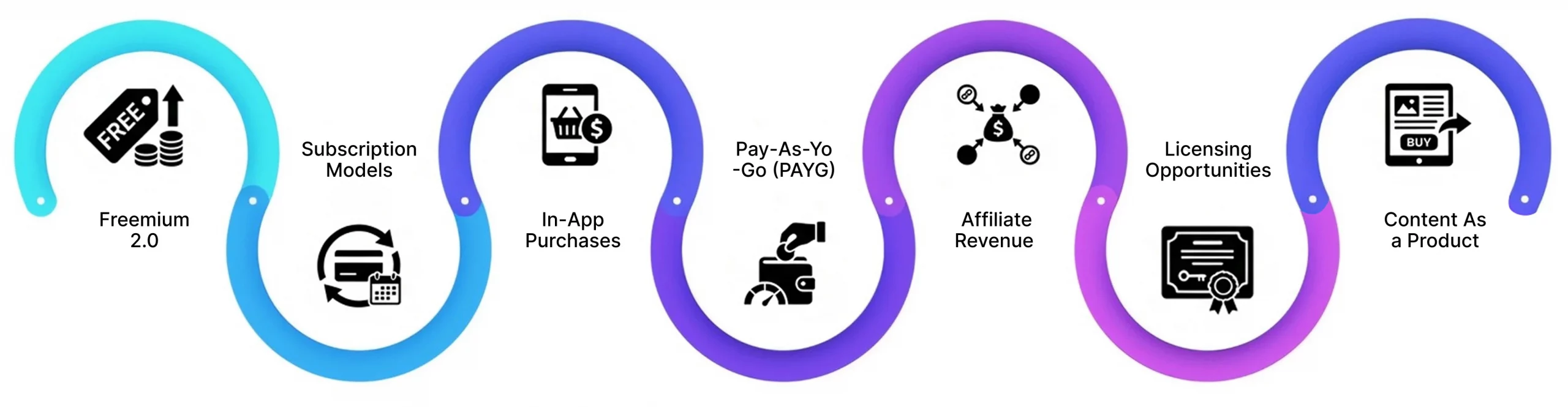
Here’s a closer look at the app monetization strategy top health and wellness platforms are using to earn without feeling like they’re selling.
1. Freemium 2.0: Beyond Basic and Premium
Gone are the days of “basic free” vs “everything behind a paywall.” Freemium in 2025 is about value staging. This app monetization strategy offers just enough transformation in the free version to build trust while guiding users toward premium tiers that feel like a natural next step. Here is what’s working now:
- Smart feature gating: You let the user complete their first 7-day habit, then unlock streak tracking or advanced coaching.
- Community-led upgrades: Peer groups, progress leaderboards, and coach shoutouts drive FOMO-led conversions better than any CTA button.
2. Subscription Models
Yes, subscriptions still work. But only when they feel flexible, fair, and frictionless. Below are the winning app monetization strategies for health & fitness apps that proven to be worked in 2025:
- Hybrid tiers: Mixing weekly, monthly, and even milestone-based unlocks gives users control (and kills churn).
- Pricing psychology: Presenting options as outcomes (“Unlock your personalized sleep score”) instead of cold prices converts better.
- Trial-to-paid flows: The best Proven mobile app monetization strategies use a 7-day success challenge that ends with a prompt—“Want to keep your momentum going?”
3. In-App Purchases & Microtransactions
In-app purchases and microtransactions are among the top fitness app monetization models. These microtransactions scale revenue without forcing commitment. Health & fitness apps in 2025 are embracing modular, pay-as-you-need experiences. However, maintaining a seamless purchase experience often requires application maintenance and support services to ensure payment integrations, feature updates, and transaction flows continue to perform reliably. Therefore, the smart move would be to work with a custom app development company to create a customized architecture that effectively integrates this model into your app.
4. Pay-as-You-Go & On-Demand Coaching
This model plays into one core truth: people want real support, not just data. Users pay for what solves their problem now. And the beauty? You monetize without ever needing a one-size-fits-all tier. You can charge your users for various features under a Pay-as-You-Go model. For instance,
- Live video sessions with nutritionists
- Text-based chats with a fitness expert after completing a milestone
- Audio-guided mental health check-ins powered by AI + human touch
5. Affiliate & Partnership Revenue
If your app helps people sleep better, move more, or eat cleaner, there’s a brand out there that wants in. And users don’t mind, as long as the recommendation is relevant and ethical. This stream is low effort, high trust, and when done right, aligns beautifully with a user’s transformation journey. At present, top apps are recommending smart scales, protein subscriptions, wearables, or meditation aids.
To implement such seamless and personalized recommendation systems, businesses often rely on mobile application development solutions that enable data-driven integrations, partner APIs, and user-behavior-based targeting without disrupting the overall app experience.
6. Licensing & B2B Opportunities
This is the quiet monetization engine that more founders should be paying attention to. This B2B track might not show up in app store revenue, but it unlocks scale and resilience. For many startups, this is the app monetization model that turns survival into long-term success. If your app has a proven model, you can:
- License it to gyms or fitness franchises as white-label wellness tech.
- Offer dashboards to corporate wellness programs.
- Partner with insurance platforms to improve patient engagement.
7. Content as a Product: Monetizing Creator-Driven Wellness
We’re witnessing the rise of the wellness creator economy inside apps. Leading platforms are now onboarding certified fitness coaches, therapists, nutritionists, and even wellness influencers to create premium mini-programs, sold or subscribed to inside the app ecosystem.
It’s sticky. It scales. And it taps into the same “creator economy” driving growth on platforms like Substack, Patreon, and YouTube—just applied to health. If you’re planning long-term growth, creator-driven monetization is a new vertical. This model turns your app into a marketplace:
- Users subscribe to creators they trust
- Creators earn via profit-sharing
- Your app earns as the platform
Read Also : How AI in Healthcare Apps Can Help You Enhance Patient Care?
How to Design a Fitness App Monetization Strategy That Drives Real Revenue
Most fitness apps do not fail because of bad ideas. They fail because of improper alignment of monetization. For your health & fitness app to generate sustainable income, more is needed than simply tacking on a pricing plan. At present, healthcare startups and entrepreneurs are interested in innovative fitness app ideas that bring substantial revenue.
If you are also looking to monetize your fitness platform effectively, you should integrate the monetization strategy into the very core of the product. Being a leading healthcare & fitness app development company, we are aware of how to put it right.
1. Aligning Monetization with App Mission & User Life Cycle
Start here or lose everything. Your monetization model should flow naturally with whatever transformation the app promises, never slowing down or distracting from it.
Therefore, if the goal of your application is to focus on helping busy moms reclaim energy, do not slap them with a $59/year plan right after onboarding. Offer them a 7-day “energy reboot” plan, track their progress, build up trust, and then sell them on a monthly wellness journey to keep that momentum going.
It should be the price linked with the progress so that users feel they are paying for their evolution and not just for unlocking features. The best monetization strategy in health & fitness apps is not aggressive, but empathetic. At the peak emotional moment of the user, an offer that respects this peak moment is provided.
2. Crafting Irresistible Value Propositions
Features Do Not Sell. Outcomes Do. To make an offer convert, step back and work on what the user will become as opposed to what your app will do for them. You are not selling “custom workouts” or “meal tracking.”
Once you discover the value or emotion associated with your app, you want to buttress your pricing toward that. For example, instead of $8.99 per month for unlimited features, say $2.24 a week for your 30-day self-reset. Then it feels like a transformation, not a transaction.
An experienced iOS app development company can also help businesses translate their value proposition into the app experience itself by designing user journeys, onboarding flows, and premium features that reinforce the promised outcome. Successful app monetization approaches in 2026 are emotionally resonant. They connect where users are today with where they want to be, making the decision to pay feel like a meaningful step toward achieving their goals.
3. Using Behavioral Analytics to Time Offers and Upsells
Timing matters most. Instead of asking users to upgrade every Day 3, what if the app waits for them to hit their third milestone, share their very first progress photo, or complete a hard workout streak? That is where behavioral analytics comes in. It helps you find high points of motivation in the user’s journey and puts your upsell there.
Apps powered by an astute data approach are creating micro-moments that trigger personalized nudges, upgrade offers, or invitations to exclusive content only when user signals indicate they are ready. This data-driven personalization is increasingly becoming a key component of legacy app modernization services, enabling businesses to transform older applications into intelligent, user-centric platforms.
In 2026, leading apps are taking this further by using AI to automate this timing entirely, removing the guesswork from when to nudge and when to hold back. Conversion becomes effortless when you offer the right value, at the right time, to the right person.
4. Reducing Friction at the Point of Payment
Most apps lose users not because they refused to pay, but because the payment moment felt complicated or abrupt. The checkout experience is part of the product experience, and in 2026, the best monetization strategies treat it that way.
If a user has to leave their current flow, re-enter card details, or sit through a lengthy plan comparison screen, the moment is already broken. The fix is simpler than most founders expect. Offer one-tap upgrades at the right moment, pre-fill whatever you already know about the user, and present a single clear option rather than three confusing tiers.
The apps converting best right now are not the ones with the most pricing options. They are the ones who made saying yes the path of least resistance. Friction is silent churn. Remove it before it costs you.
5. Building a Retention Loop Before Focusing on Upgrades
Acquisition gets the user in. Retention is what makes monetization sustainable. Yet most fitness apps pour budget into getting new installs while ignoring the experience that happens between Day 1 and Day 30, which is exactly where revenue is won or lost.
Before obsessing over upsell timing or premium pricing, ask a simpler question: Does your free or base experience create a habit? If users are not returning on Day 3, Day 7, and Day 14, no pricing strategy will save your revenue numbers.
Build the loop first. Daily check-ins, streaks, progress snapshots, and small wins that stack up are what bring users back. And users who come back consistently are the ones who eventually upgrade, refer others, and renew without prompting. In 2026, retention is not a growth metric. It is the foundation that every monetization model is built on.
What the Top Earning Fitness Apps Are Doing Differently?
The fitness app market is crowded with competitors, but a few names continue to surge above the rest, not only by downloads but by revenue. Their fitness tracking apps are built with intent, personalization, and precise monetization. Here is a closer look at what these top earners are doing differently, and how you may borrow some of their ideas for monetizing your own fitness apps.
1. Peloton: Subscription as the Entire Business
Peloton is no longer a hardware company. That shift is now official and deliberate. Subscription revenue now accounts for 62% of Peloton’s total income, and the company has made it the central pillar of its long-term recovery strategy. What makes this worth studying is how Peloton earns that subscription loyalty. It runs a two-step funnel: step one is acquisition into an ecosystem, often through hardware or an entry offer.
Step two is subscription retention, where value is realized over months through usage and habit. The product experience, the community, the instructor personalities, and the content library all exist to serve one goal: keeping subscribers from cancelling. For any fitness app founder, this is the clearest possible demonstration that retention architecture and monetization architecture are the same thing.
2. Headspace: Reinventing Mental Wellness at Scale
Headspace’s journey offers some of the most valuable monetization lessons in wellness precisely because it has not been smooth. Rather than relying on a single revenue stream, Headspace built three: a freemium consumer product, a B2B corporate wellness arm partnering with over 2,700 organisations, and a clinical layer following its merger with Ginger.
That diversification kept the platform viable through significant restructuring. Partnerships with organisations like TikTok and the US Navy further expanded its relevance. The core lesson is simple: compassionate design alone does not sustain a business. Multiple revenue layers do.
3. Strava: Community as a Monetization Engine
Strava generated $415 million in revenue in 2025, an 18.5% increase on the prior year, with 180 million registered users and three million new users added every month. What is remarkable about those numbers is that only around 4% of Strava’s total user base is paying subscribers, meaning the platform has built a massively scalable revenue base from a relatively small conversion rate.
The secret is community. Strava turned workout logging into a social experience, complete with leaderboards, kudos, challenges, and sponsored brand activations. Users stay because leaving means losing their athletic identity and social presence on the platform. That stickiness is what makes conversion feel natural rather than forced.
4. MyFitnessPal: Free Utility, Premium Intelligence
One of the most downloaded health apps globally, MyFitnessPal, starts as a simple calorie tracker. But what users really pay for is insight. It’s a powerful example of app monetisation models for health & fitness apps that lean on data unlocks rather than content gating. Users don’t mind paying when it makes their progress smarter, not harder. The premium version unlocks:
- Macro nutrient analysis
- Meal-time recommendations
- Custom goals based on trends
5. WeightWatchers: Reinventing Around a Market Shift
WeightWatchers is one of the most instructive monetization case studies in the fitness space right now, not because it got everything right, but because of how aggressively it pivoted when the market shifted. With the rise of GLP-1 medications reshaping how millions approach weight management, WeightWatchers repositioned itself as the behavioral and nutritional layer that medication alone cannot provide.
It launched a dedicated GLP-1 companion program available even to users who obtained their prescription from an outside doctor, turning a potential threat to its business into a new acquisition channel. The lesson here is that the most durable monetization strategies are not just well-designed at launch. They are built to flex when user needs change.
Final Thoughts
In 2026, the fitness apps winning today aren’t the ones throwing every feature at the screen and hoping something sticks. They’re the ones that solve real human problems, better sleep, stronger bodies, calmer minds, and design business models that reflect that value. So, whether you’re refining your current product or building the next big thing in wellness tech, you should smartly integrate an app monetization model in your health & fitness app.
And the best way would be to consult a highly experienced mobile application development company like RipenApps that specializes in building revenue-generating apps for the health & fitness industry. We have a proven track record of delivering high-grossing fitness platforms that have set new benchmarks in the industry.
FAQs
Q1. What monetization models do fitness apps most commonly use in 2026?
The top fitness apps run a blended monetization model, tiered subscription system (freemium, with paid upgrades), IAPs (meal plans, workout packs), affiliate partnerships (wearables, supplement brands), and sponsored challenges. The point is to spread revenue sources while maximizing the value perceived by the user for each product.
Q2. Can in-app purchases (IAPs) boost fitness app revenue?
Yes, they do. Many fitness apps sell IAPs for consumable content like customized workout plans, meal guides, or test kits. These micro-payments cater to customers who want quick value without long-term commitment and might grossly increase per-user revenue.
Q3. Do any fitness apps earn through advertising or sponsorships?
Yes. Some freemium apps display ads through the app or show sponsored content from workout brands and health companies. The challenge is to make the advertisements so seamless and relevant that they do not hamper the user experience.
Q4. How much revenue can a fitness app generate?
That depends on a lot of things, but the major fitness apps (Fitbit, MyFitnessPal, Sweat) earn somewhere between $50M and $150M annually, through subscriptions, IAPs, affiliate selling, and ads.
Q5. Should I prioritize subscriptions or ingrain AI for higher premium pricing?
Both. Subscription is the baseline model. However, AI, when used for personalization (adaptive workouts, real-time coaching), can contend for premium-tier pricing while helping significantly with conversions.
SHARE
WRITTEN BY

Manish Kumar
Technical Content Writer
Manish is a Senior Technical Content Writer at RipenApps. He has over 7+ years of experience and holds immense tech knowledge. His educational background in science and expertise in the IT domain has made him an expert writer. He has authored various tech blogs and guest posts for leading sites. When he is not writing, he researches on the latest market trends and reads sci-fic novels.
View All Articles