

Key Takeaways
- Mental health app development costs approximately $30,000–$55,000 for a basic wellness app, $60,000–$110,000 for a clinical platform, and $150,000+ for an enterprise-grade solution.
- Safety requirements should shape the product from the beginning, including crisis access, escalation protocols, clinician oversight, and responsible notifications.
- HIPAA does not automatically apply to every mental health app. Requirements depend on the organization’s role, data flows, and relationships with healthcare providers.
- AI can support journaling insights, administrative workflows, and risk identification, but clinical decisions and crisis responses require appropriate safeguards and human oversight.
- Retention depends on accessible design, meaningful progress, appropriate personalization, and trust, not simply the number of features.
Mental health app development costs approximately $30,000–$55,000 for a basic wellness app, $60,000–$110,000 for a clinical platform, $110,000–$150,000 for more complex solutions, and $150,000+ for enterprise-grade or advanced AI platforms.
Defining the app’s purpose, intended users, and level of clinical involvement helps determine its features, regulatory obligations, and investment requirements. The development process also involves selecting the right technology, validating clinical content, and establishing clear protocols for handling sensitive information. Addressing these requirements early helps founders control costs, reduce compliance risks, and build a product that users and healthcare professionals can trust.
In this blog, we’ll explore the key features of mental health apps, the differences between wellness and clinical platforms, and the privacy and compliance requirements businesses must consider. We’ll also cover technology choices, development stages, cost estimates, and monetization models to help you plan your product and evaluate the right healthcare app development company for your business requirements.
Table of Contents
What is a Mental Health App?
A mental health app is a digital platform that helps users monitor emotional well-being, access psychological resources, connect with licensed professionals, or participate in structured mental health programs. Depending on its purpose, it may include mood tracking, guided exercises, virtual therapy, journaling, peer support, or AI-assisted interactions.
Mental health apps range from general wellness products that encourage healthy habits to clinical software designed to support assessment, treatment, or ongoing care. This distinction matters because a product’s intended use can influence its regulatory obligations, safety requirements, and clinical evidence needs.
The Mental Health App Opportunity & the Retention Problem
The need for accessible mental health support creates opportunities for businesses building digital wellness and clinical care products. However, demand alone does not guarantee adoption or sustained engagement.
The World Health Organization (WHO) reported in its 2026 fact sheet that approximately 1.2 billion people worldwide were living with a mental disorder in 2023, with anxiety and depressive disorders among the most common (WHO). In the United States, 20.6% of adults, or approximately 54.6 million people, experienced mental illness during 2025, according to the Substance Abuse and Mental Health Services Administration (SAMHSA).
The commercial challenge is converting initial interest into continued use. A 2026 study published in JMIR mHealth and uHealth examined real-world engagement among 668 users of the Medito meditation app across 30 countries. The study found that fewer than 20% of participants continued using the app beyond 14 days, while only 16.26% were still using it on day 30. Half of the participants spent 16 minutes or less using the app during their first month, highlighting the challenge of sustaining engagement with mental wellness apps.
Clear onboarding, accessible interactions, appropriate personalization, and trustworthy privacy practices can help support sustained engagement without encouraging unnecessary dependency.
Types of Mental Health Apps
Different mental health app categories serve different audiences and involve different levels of clinical and regulatory complexity.
|
App type |
Primary purpose |
Regulatory weight to assess |
|
Self-guided CBT/DBT |
Structured exercises and coping strategies |
Wellness or FDA review, depending on intended use |
|
Teletherapy platforms |
Connect users with licensed therapists |
HIPAA likely in covered-provider workflows; state telehealth rules |
|
Meditation and mindfulness |
Relaxation, attention, and general well-being |
Usually wellness when claims remain within scope |
|
Mood and habit tracking |
Record moods, habits, and personal patterns |
Wellness or additional health-data obligations |
|
Peer support communities |
Enable moderated peer interaction |
Privacy, consumer protection, and moderation obligations |
|
AI-assisted support |
Provide guided interactions or journaling insights |
AI-specific laws; FDA considerations if intended for medical purposes |
|
Crisis and safety tools |
Connect users with crisis resources and support |
Safety, privacy, and clinical governance requirements |
|
Employer mental wellness |
Support workforce well-being |
Privacy, employment considerations, and HIPAA where applicable |
|
Substance-use recovery |
Support recovery programs and care coordination |
42 CFR Part 2 may apply to qualifying records and programs |
A wellness app can face additional requirements because of its claims, clinical functionality, provider relationships, or handling of regulated records.
Wellness App or Medical Device? Choose Your Regulatory Path First
A mental health app’s intended use, features, and marketing claims help determine whether it falls under general wellness guidelines or medical device regulations. Identifying the right regulatory path early helps founders plan compliance, clinical validation, and development requirements.
|
Product pathway |
Typical scope |
What to assess |
|
General wellness |
Meditation, journaling, relaxation, and habit tracking |
Consumer privacy, advertising claims, security, and applicable wellness guidance |
|
Clinical-adjacent |
Therapist communication, appointment management, and care coordination |
HIPAA applicability, business associate agreements (BAAs), provider licensing, and telehealth rules |
|
Medical device or prescription digital therapeutic |
Software intended for diagnosis, prevention, monitoring, or treatment of a condition |
FDA classification, applicable authorization pathway, clinical evidence, and post-market obligations |
The US Food and Drug Administration (FDA) distinguishes certain low-risk general wellness functions from software functions that meet the definition of a medical device. Its January 2026 general wellness guidance provides a starting point for assessing intended use.
Your Marketing Copy Helps Define Your Category
Statements such as “supports relaxation” or “helps users develop healthy habits” differ from claims that software can diagnose depression, treat anxiety disorders, or prevent clinical relapse.
Treatment-related language does not automatically determine FDA status on its own, but it can be evidence of intended medical use. Founders should review product functionality, clinical claims, user-facing copy, and supporting evidence together before launch.
If the product supports licensed providers, assess healthcare privacy and telehealth requirements as well. Read our HIPAA compliance guide for application development.
Must-Have Features of a Mental Health App
A self-guided wellness MVP requires a different feature set from a platform managing therapy appointments, clinical records, and crisis escalation. Prioritize features according to the product’s purpose, audience, and risk profile.
User Features
The user experience should make participation easy without overwhelming people who may already be experiencing emotional distress.
- Clinician-reviewed onboarding: Explain the app’s purpose, limitations, privacy practices, and appropriate use.
- Validated screeners: Instruments such as PHQ-9 and GAD-7 may support screening when used appropriately. Explain their limitations and provide suitable follow-up pathways rather than presenting scores as standalone diagnoses.
- Quick mood check-ins: Short interactions let users record how they feel without completing lengthy questionnaires.
- Private journaling: Offer prompts, free-form writing, and controls for viewing, exporting, or deleting personal entries.
- CBT/DBT modules: Include professionally reviewed exercises aligned with the product’s intended purpose.
- Adaptive reminders: Let users control notification frequency and pause reminders when needed.
- Therapist data sharing: Allow users to export relevant records securely when they choose to share them with a clinician.
Therapist and Clinician Features
Therapist app development requires workflows that support care delivery without adding unnecessary administrative work.
Core features can include:
- Caseload dashboards and patient progress summaries.
- Secure session notes and documentation.
- Protected asynchronous messaging.
- Appointment scheduling and cancellation management.
- Provider verification and state-licensure-aware patient matching.
- Consent controls and access to relevant user-shared information.
A therapist’s authorization to practise in one jurisdiction does not automatically permit practice everywhere. Matching and appointment workflows should account for the locations and licensing rules relevant to the care being delivered. For platforms offering remote consultations, consider telemedicine app development solutions.
Admin and Compliance Features
- Consent and preference management.
- Role-based permissions and audit logs.
- Clinical content review and approval workflows.
- User reporting, community moderation, and escalation queues.
- Data retention, export, and deletion controls.
- Incident management and security monitoring.
Advanced Features
Wearable integrations through Apple HealthKit or Android Health Connect may provide consent-based access to relevant activity, sleep, or other supported health data. AI-assisted tools can summarize journal entries, organize clinician documentation, or identify content that may warrant human review. For further detail, explore AI in mental healthcare.
Sentiment flags and automated triage should not be treated as reliable clinical judgments without appropriate validation. Users must understand when AI is involved, and clinicians should retain control over consequential care decisions. For details, see integrating conversational AI into healthcare apps.
Designing for Safety: Crisis Detection and Escalation
Crisis handling requires defined escalation pathways, clear product limitations, and tested operational procedures. A disclaimer alone is not an adequate safety strategy.
Always-Visible Crisis Access
Users should be able to find crisis resources without navigating through several screens. For a US-facing product, provide clear access to the 988 Suicide & Crisis Lifeline, which supports calling, texting, or chatting with the service.
For users in other countries, provide appropriate local resources and explain the geographical scope of each service. Do not imply that a wellness app itself provides emergency response unless the necessary service and operational arrangements genuinely exist.
Risk Signals and Escalation Tiers
Potential signals may include responses to validated screening tools, explicit statements in user entries, or changes in engagement. These signals should prompt carefully designed responses rather than automatic assumptions about a person’s mental state.
A risk-management plan might distinguish between:
- General support: Offer relevant educational content or coping resources.
- Elevated concern: Present crisis resources and, where an appropriate clinical service exists, route a review to authorized staff.
- Potential immediate danger: Clearly direct the user to emergency or crisis services and follow the documented response protocol.
Qualified clinicians and legal counsel should help establish thresholds, response times, and escalation rules. Automated language analysis can miss context, produce false positives, or fail to recognize indirect expressions of distress.
Safety Plans and Trusted Contacts
Users can create personalized safety plans identifying coping strategies, supportive people, professional resources, and emergency options where appropriate.
Trusted-contact features should be optional and consent-based. Explain what information may be shared, with whom, and under which circumstances. Do not assume that contacting a friend or family member is safe for every user.
Test Crisis Paths Like Payments
Crisis workflows need dedicated testing, including cases where a resource link fails, a notification is not delivered, a user loses connectivity, or a clinician is unavailable.
Teams should verify the experience from risk detection through the intended response. If human escalation is part of the product, define responsibility, coverage hours, response expectations, and fallback procedures before launch.
Notification and UX Ethics
Avoid streak-shaming, guilt-based messages, or notifications that imply users have failed by missing a check-in. A high-risk entry should not trigger routine engagement nudges that may feel inappropriate or distressing.
Give users control over notifications and provide options to pause or reduce them. Product engagement should never take priority over user safety.
Compliance and Data Privacy for Mental Health Apps
Mental health data can include intimate journal entries, screening responses, therapy notes, medication information, and records of substance-use treatment. The applicable rules depend on the product, the organization operating it, the information collected, and the markets served.
When HIPAA Applies and When It Doesn’t
The Health Insurance Portability and Accountability Act (HIPAA) applies to covered entities, such as qualifying healthcare providers, health plans, and healthcare clearinghouses, and to their business associates where the relevant requirements apply.
A consumer wellness app is not automatically subject to HIPAA simply because it collects health-related information. However, a developer providing a platform on behalf of a covered healthcare provider may become a business associate if it creates, receives, maintains, or transmits protected health information for that provider.
When a business associate relationship exists, the required contractual arrangements, including a BAA, must be addressed. HIPAA applicability should be assessed using actual data flows and contractual relationships, not the app’s category alone.
FTC Rules and Enforcement for Non-HIPAA Apps
Apps outside HIPAA are not exempt from all health privacy obligations. The Federal Trade Commission’s Health Breach Notification Rule can apply to qualifying personal health record vendors and related entities, including certain consumer health apps.
The FTC’s updated rule clarified its application to health apps and similar technologies. Covered organizations should assess their breach-notification duties and procedures.
Mental health apps should avoid advertising SDKs and tracking technologies on sensitive screens unless their use has been carefully assessed and is lawful. Consent should not be treated as a blanket justification for sharing sensitive information with advertising platforms.
Substance-Use Records and 42 CFR Part 2
Certain records associated with qualifying substance-use-disorder programs receive additional protection under 42 CFR Part 2. Whether the rule applies depends on the program, records, and circumstances, not merely on whether an app discusses addiction or recovery.
HHS updated Part 2 requirements in 2024, with compliance required by February 16, 2026. Relevant products should assess consent, permitted disclosures, record access, and breach-response requirements.
State Consumer Health Data Laws
Some US states impose health-data privacy obligations beyond HIPAA. Washington’s My Health My Data Act is one example, and other state laws may affect consumer health data, consent, collection, sharing, and deletion.
Founders should map the states where their product is available and assess applicable definitions, exemptions, and obligations. A single nationwide privacy notice may not be sufficient for every business model.
Therapist Licensure and Telehealth Rules
Teletherapy platforms must consider the rules governing the clinician’s practice and the patient’s location. Depending on the jurisdiction and service, requirements may cover professional licensure, consent, records, prescribing, emergency planning, and standards of care.
The platform should verify provider credentials and make location-specific requirements part of its onboarding and appointment workflows.
GDPR and Global Users
International expansion requires a review of the privacy laws applicable to each market. The European Union’s GDPR and the UK’s UK GDPR establish requirements for personal-data processing, while Canada’s PIPEDA and India’s Digital Personal Data Protection framework may apply in relevant circumstances.
Requirements differ across jurisdictions. Determine the legal basis for processing, required notices, user rights, cross-border transfer obligations, and any special protections for health data before expanding.
Security Controls
Security measures should reflect the sensitivity of the information and the risks associated with the product. A baseline may include:
- AES-256 encryption at rest and TLS 1.3 for data in transit, where supported by the selected architecture.
- Role-based access control, least-privilege permissions, and multi-factor authentication for privileged accounts.
- Audit logs, session timeouts, secure credential management, and controlled administrative access.
- Data minimization, retention schedules, deletion workflows, and secure backups.
- Vulnerability assessments, penetration testing, incident-response procedures, and regular security reviews.
- Appropriate vendor reviews and BAAs where required.
Encryption is one layer of protection, not proof of overall compliance. Cloud services, messaging tools, analytics platforms, AI providers, and other third parties must be assessed for their handling of sensitive data.
AI in Mental Health Apps: Benefits, Risks, and New State Laws
The appropriate role of AI depends on the model, data, intended use, and consequences of an incorrect output.
Where AI Helps Safely
Potential applications include organizing journal entries, summarizing clinician documentation for review, routing support requests, and helping users discover relevant educational resources.
Dropout prediction or risk flags may help a care team identify users who could benefit from follow-up, provided the model is appropriately evaluated, and the workflow does not replace clinical judgment.
AI-generated insights should be presented with clear limitations. Sensitive information should not be sent to a model provider until data handling, retention, training use, contractual terms, and any required BAA have been assessed.
State Laws on AI Therapy Chatbots
US state requirements are evolving. Illinois, Nevada, Utah, and other jurisdictions have introduced or considered measures affecting AI systems used in mental or behavioral healthcare.
Nevada’s 2025 Assembly Bill 406 includes restrictions on representations that an AI system can provide professional mental or behavioral healthcare, along with provisions addressing certain uses of AI in care settings. Its scope and application should be reviewed against the product’s actual functionality.
Before launch, review current state statutes, effective dates, exemptions, and the latest legal developments. An AI chatbot disclaimer alone may not resolve every legal obligation.
AI Guardrails Checklist
A responsible implementation should include:
- AI disclosure: Tell users when they are interacting with an AI system.
- Clear scope: Avoid implying that a general-purpose chatbot is a licensed therapist or a substitute for professional care.
- Crisis handoff: Provide an appropriate human or crisis-resource pathway when risk is identified.
- Clinical oversight: Require qualified review for clinical workflows and consequential decisions.
- Evaluation and red-teaming: Test for harmful outputs, bias, missed risk signals, and unsafe responses.
- Privacy controls: Limit sensitive data access, define retention, and review third-party processing.
- Ongoing monitoring: Track failures and revise the system when its performance or risks change.
Designing for Engagement and Retention
Retention should reflect whether users find the product helpful, not whether the app can maximize screen time. A calm interface, short check-ins, readable content, and predictable navigation reduce friction. Progress views can help users recognize patterns without implying that emotional improvement must be linear.
Accessibility should be part of design and testing. Consider readable typography, sufficient contrast, screen-reader support, clear error messages, and alternatives to audio or video content. WCAG provides a useful framework for digital accessibility.
Personalization can make the experience more relevant, but it should remain transparent and user-controlled. Allow people to change reminders, choose preferred activities, and pause participation without losing access to essential information.
Measure meaningful outcomes alongside conventional product metrics. Depending on the app’s purpose, useful measures may include onboarding completion, sustained voluntary use, successful appointment attendance, user-reported usefulness, and safety-workflow performance.
Recommended Tech Stack
The stack should reflect whether the product is a consumer wellness app, a clinician-facing platform, or a regulated clinical product.
|
Layer |
Options to evaluate |
Key consideration |
|
Mobile |
Swift, Kotlin, Flutter, React Native |
Platform needs, accessibility, device integrations, and long-term maintenance |
|
Backend |
Node.js, Python |
Team expertise, integration needs, and workload |
|
Cloud |
AWS, Google Cloud, Microsoft Azure |
Service eligibility, configuration, security controls, and BAA requirements where applicable |
|
Video |
Healthcare-suitable video SDKs |
Privacy, recording controls, access permissions, and vendor terms |
|
Health data |
Apple HealthKit, Android Health Connect |
Explicit permission and data minimization |
|
Analytics |
Privacy-conscious analytics tools |
Avoid unnecessary collection or transmission of sensitive health information |
|
AI |
Suitable model APIs and controlled deployment options |
Data handling, evaluation, access control, and contractual protections |
Cloud-provider eligibility does not make an application automatically HIPAA compliant. The chosen services must be configured appropriately, and required contractual arrangements must be in place.
Native development may suit products requiring deeper platform-specific integration. Flutter or React Native may be suitable when cross-platform delivery and shared code are priorities. Compare the options using actual product requirements rather than declaring one framework universally best. For further comparison, see React Native vs. Flutter.
How to Build a Mental Health App: Step-by-Step
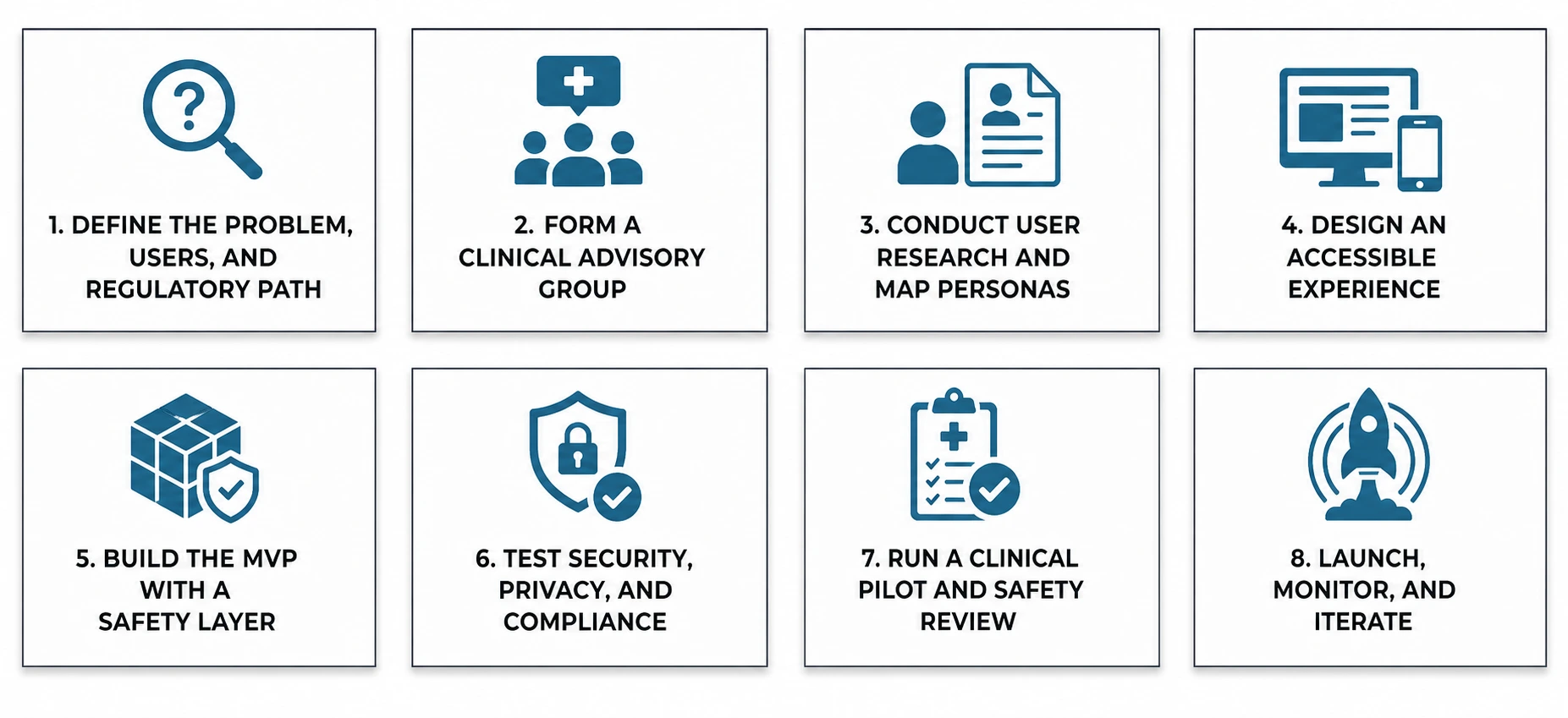
Building a mental health app requires a structured approach that aligns user needs, clinical requirements, privacy safeguards, and business goals. The following steps outline the process, from defining the app’s purpose and features to development, testing, launch, and ongoing improvement.
1. Define the Problem, Users, and Regulatory Path
Identify the audience, the problem the product will solve, and whether it offers wellness support, clinical workflows, or medical functionality. Document intended claims, data collected, and target markets before finalizing features.
2. Form a Clinical Advisory Group
Involve qualified mental health professionals early. They should help review screening flows, clinical content, risk signals, crisis procedures, and product limitations rather than being brought in only for final testing.
3. Conduct User Research and Map Personas
Understand how intended users will access the app, what barriers they face, and which tasks matter most. For clinician-facing products, research provider workflows and operational constraints as well.
4. Design an Accessible Experience
Create user flows, prototypes, and interaction designs that minimize cognitive load. Test onboarding, consent, mood check-ins, privacy settings, and crisis access with representative users.
5. Build the MVP With a Safety Layer
Start with a focused set of core features. For a wellness MVP, this might include onboarding, mood tracking, journaling, reminders, and secure data management. Clinical products may also require provider workflows and additional compliance controls.
Crisis access and appropriate safety procedures should not be postponed merely to reduce the initial feature count.
6. Test Security, Privacy, and Compliance
Review authentication, access permissions, encryption, third-party integrations, data retention, and deletion workflows. Test the complete application and backend rather than relying only on a checklist or vendor claim.
7. Run a Clinical Pilot and Safety Review
Where appropriate, test the product with qualified professionals and a controlled user group. Validate usability, clinical content, escalation procedures, and operational readiness before expanding access.
8. Launch, Monitor, and Iterate
Monitor stability, user feedback, retention, privacy incidents, and safety signals. Establish ownership for incident response, content updates, model evaluation, and ongoing maintenance.
How Much Does Mental Health App Development Cost?
Mental health app development costs depend on the product’s intended use, platform coverage, clinical workflows, security requirements, and third-party integrations.
Cost by App Type
|
App type |
Estimated development cost |
Indicative timeline |
|
Self-guided wellness MVP |
$30,000–$55,000 |
3–4 months |
|
Clinical or therapy platform |
$60,000–$110,000 |
5–7 months |
|
Advanced clinical or integrated platform |
$110,000–$150,000 |
Varies by scope |
|
Enterprise-grade or advanced AI platform |
$150,000+ |
9+ months |
What Drives the Cost?
- Provider marketplace: Therapist verification, availability management, scheduling, video consultations, payments, and jurisdiction-aware matching increase scope.
- Crisis workflows: Risk assessment, resource routing, clinician escalation, safety-plan functionality, and operational testing require specialist input.
- Privacy and compliance: Access controls, auditability, data-retention policies, vendor reviews, and security assessments add work beyond standard app development.
- Clinical content: Validated instruments, professionally reviewed exercises, content licensing, and clinical governance require time and expertise.
- AI capabilities: Model integration, evaluation, safety testing, human review, monitoring, and usage costs affect both initial investment and ongoing expenditure.
- External integrations: Electronic health records, insurance workflows, payment services, wearables, and other systems add integration and maintenance requirements.
Hidden and Ongoing Costs
Businesses should budget for clinical review, content updates, cloud hosting, vendor fees, security assessments, compliance work, support, and continued product development.
A common planning allowance for annual maintenance is approximately 15–20% of the initial development cost. Actual expenditure varies according to service levels, infrastructure, regulatory needs, and the pace of feature development. Clinical operations, specialist legal advice, and major product changes may require separate budgets.
How Long Does It Take?
A focused wellness MVP may take around three to four months, while a therapy platform with provider workflows may require five to seven months. Enterprise-grade products with complex integrations, advanced AI, or additional clinical and regulatory requirements may take nine months or longer. These are indicative planning estimates rather than guaranteed delivery schedules.
How Mental Health Apps Make Money?
Mental health businesses can generate revenue through several models, depending on their audience, clinical scope, and value proposition.
- B2C subscriptions and freemium: Offer basic journaling, tracking, or wellness resources for free, with paid access to additional content or personalization.
- Employer contracts: Sell mental wellness access or agreed services to organizations through business-to-business arrangements.
- B2B2C distribution: Partner with clinics, healthcare providers, or insurers to reach users through established channels.
- Clinical service revenue: Therapy platforms may earn revenue through appointments, provider subscriptions, or service fees, subject to applicable laws and contracts.
- Payer reimbursement: Eligible clinical services may qualify for reimbursement under specific payer rules and billing requirements. Confirm applicable CPT codes, coverage policies, documentation, and provider eligibility rather than assuming an app or digital feature is independently reimbursable.
- Institutional licensing: Offer suitable tools to healthcare organizations or other institutions under enterprise agreements.
Monetization should not depend on selling sensitive mental health information. Advertising or data-sharing models can undermine trust and introduce substantial privacy and legal risks. A sustainable business model aligns revenue with useful services, transparent pricing, and appropriate protection of users’ information.
How to Choose a Mental Health App Development Company?
Choosing a mental health app development company requires evaluating its approach to sensitive health data, clinical collaboration, safety testing, and relevant product experience. Consider these four factors before selecting a development partner.
- Experience with sensitive health data: Ask how the company handles protected health information, supports HIPAA-aligned architecture where applicable, and evaluates third-party SDKs. Advertising and tracking SDKs should not collect sensitive information from private journals, screening forms, or other sensitive screens.
- Willingness to collaborate with clinical advisors: Your development partner should be comfortable working with qualified mental health professionals to review clinical content, user journeys, risk signals, and escalation procedures.
- A documented safety-testing process: Ask how the team tests crisis workflows, including failed resource links, missed notifications, unavailable clinicians, and interrupted connectivity. Safety testing should cover the complete user journey, not just individual screens.
- A shipped product you can evaluate: Request a relevant wellness or healthcare product that you can review through an app store listing, product demonstration, or documented case study. Examine its actual features and privacy controls rather than relying solely on general experience claims.
How RipenApps Builds Mental Health Apps?
RipenApps developed Mind Alcove, a mental wellness app for iOS and Android that combines mood tracking, journaling, and personal reflection with privacy-focused features.
Mind Alcove: Mood Tracking and Journaling
Mind Alcove is a native iOS and Android application focused on personal reflection and emotional well-being. It has features like mood tracking, mood insights, multiple journals, journal prompts, a community, and PIN or biometric locks.
This project by RipenApps demonstrates how mood tracking and journaling can be combined with privacy-focused access controls in a wellness-oriented app.
Conclusion
Building a mental health app requires more than selecting features and choosing a technology stack. Founders must define the app’s purpose, understand its regulatory obligations, protect sensitive user data, and establish clear safety protocols. A well-planned development strategy helps control costs while creating a product that supports user needs and encourages long-term engagement.
RipenApps helps businesses turn healthcare app ideas into secure, scalable digital products. From defining the app’s scope and selecting the right technology to developing features and planning for compliance, our team can help you navigate the development process.

Frequently Asked Questions
Q1. How much does it cost to develop a mental health app?
A basic self-guided wellness app may cost $30,000–$55,000, while a clinical or therapy platform may cost $60,000–$110,000. More complex clinical or integrated platforms may require $110,000–$150,000, while enterprise-grade or advanced AI solutions can cost $150,000 or more. The final estimate depends on features, integrations, security, clinical oversight, and operational requirements.
Q2. How long does mental health app development take?
A focused wellness MVP may take three to four months. A therapy platform may require five to seven months, while an enterprise-grade solution may take nine months or longer. These timelines vary with integrations, testing, clinical review, and regulatory requirements.
Q3. Does a mental health app need to be HIPAA compliant?
Not every mental health app is subject to HIPAA. The requirements depend on whether the organization is a covered entity or business associate and how it handles protected health information. Consumer apps may still be subject to FTC requirements and applicable state privacy laws.
Q4. Does a mental health app need FDA approval?
Not necessarily. General wellness apps may fall outside the FDA’s medical-device requirements when their functions and intended use meet the relevant criteria. Software intended for medical purposes may require a regulatory assessment and, depending on its classification, applicable authorization and clinical evidence.
Q5. Can AI chatbots provide therapy in a mental health app?
AI can support journaling, educational guidance, administrative tasks, and certain structured interactions. However, developers should not represent a general-purpose chatbot as a licensed therapist or assume it can safely replace professional care. Appropriate disclosure, clinical oversight, evaluation, and crisis pathways are essential.
Q6. What features should a mental health app MVP include?
A wellness MVP may include secure onboarding, mood tracking, journaling, basic insights, user-controlled reminders, privacy settings, and clear support resources. A clinical MVP may also require provider verification, appointment scheduling, secure messaging, consent management, and clinical workflows.
Q7. How should a mental health app handle users in crisis?
Provide visible crisis resources, clearly explain the app’s limitations, and implement a documented escalation protocol appropriate to the product. For US users, the 988 Suicide & Crisis Lifeline offers call, text, and chat access. Automated risk signals should be tested and should not replace appropriate human or emergency support.
Q8. How do mental health apps make money?
Common models include consumer subscriptions, freemium plans, employer contracts, institutional licensing, and partnerships with clinics or insurers. Eligible clinical services may also generate payer revenue where coverage and billing rules permit. Selling sensitive health data should not be the basis of the business model.
Discuss your project and request for proposal
SHARE
WRITTEN BY

Ishan Gupta
CEO & Founder
Ishan Gupta is a seasoned entrepreneur and CEO with extensive 10+ years of experience in business and mobile app development landscape. He believes that the right digital product allows companies to focus on what they do best, while technology handles the rest. With deep exposure to global markets, he understands what makes an app succeed. His approach translates business needs into clear product strategies, ensuring that every feature contributes to measurable ROI.
View All Articles