


Key Takeaways
- A complete food delivery platform typically consists of a customer app, restaurant or merchant panel, delivery-partner app, and admin dashboard.
- Dispatch, routing, and real-time tracking are core product capabilities because restaurant preparation, rider availability, traffic, and delivery zones continuously affect order fulfillment.
- Aggregator, full-stack delivery, restaurant-owned delivery, cloud-kitchen, and quick-commerce models require different workflows and technology.
- A focused MVP can typically take 10-14 weeks, while a broader production platform can take approximately 5-8 months.
- Food delivery app development costs can range from approximately $25,000 to $250,000+, depending on scope, integrations, platforms, and operational complexity.
- New entrants do not necessarily need to replicate DoorDash or Uber Eats. A focused geography, customer segment, restaurant category, or delivery workflow can provide a more practical starting point.
Food delivery app development involves much more than building an app where customers browse restaurants and place orders. A production-ready platform connects customers, restaurants, delivery partners, and administrators through coordinated applications, shared backend services, payments, location data, notifications, and dispatch logic.
For a founder or restaurant operator, the important question is not simply how to build a food delivery app. You also need to decide what you are actually building, which business model fits your market, how delivery operations will work, what the initial product should include, and how much time and investment the platform requires.
This guide explains the complete food delivery app development process, from market considerations and four-app architecture to dispatch, business models, technology, cost, timeline, and competitive strategy, helping you make informed decisions before investing in food delivery app development services.
Table of Contents
Food Delivery Market in 2026: Size and Growth
The online food delivery market has evolved beyond restaurant ordering into a broader digital commerce ecosystem spanning prepared meals, grocery delivery, and rapid local fulfillment.
The online food delivery market spans prepared meals, grocery delivery, and other digital ordering and fulfillment models. According to Statista’s global market forecast, worldwide online food delivery revenue is projected to reach $1.51 trillion in 2026, with a compound annual growth rate (CAGR) of 6.24% from 2026 to 2031. Statista also projects global Meal Delivery user penetration of 29.2% in 2026.
In the United States, online food delivery revenue is projected to reach $473.49 billion in 2026, with a 6.83% CAGR through 2031, according to Statista’s US market forecast. The same source projects US Meal Delivery user penetration of 53.9% in 2026.
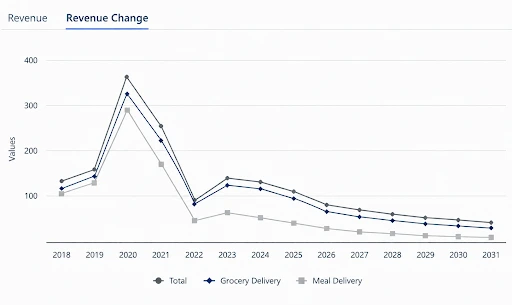
These figures include both meal and grocery delivery, so businesses should not treat the entire market as their addressable opportunity. A restaurant-focused platform should instead define its market by target customers, geography, cuisine, order volume, and delivery model.
U.S. companies do not need to build another broad marketplace to enter this market. A focused platform can compete by solving a specific operational or customer problem, such as direct ordering for restaurant groups, specialized delivery for a niche cuisine, or centralized fulfillment for cloud kitchens. The technology should support that initial use case while leaving room to expand across locations, customers, and delivery categories.
Why Demand for Food Delivery Apps Keeps Growing?
Convenience is now a baseline expectation in digital food ordering. U.S. customers expect restaurant discovery, customization, digital payments, order updates, and real-time delivery tracking in one experience.
For restaurant groups and cloud kitchens, a branded delivery app can reduce reliance on third-party marketplaces while providing greater control over customer relationships, loyalty, promotions, and ordering data. For startups, niche positioning can create differentiation without competing directly with broad marketplace platforms.
The technology must support more than ordering. Restaurant acceptance, preparation time, rider assignment, routing, traffic, ETA updates, and delivery confirmation all need to work together. A scalable architecture gives U.S. businesses the operational foundation to launch focused today and expand into new locations or local-commerce categories later.
What You’re Actually Building: The Four-App Architecture
A food delivery platform is often described as a single mobile application because the customer experience is the most visible component. In practice, a complete platform has four connected applications.
| Application | Primary user | Main responsibility |
| Customer app | Customer | Discover restaurants, order, pay, track, and receive support |
| Restaurant/merchant panel | Restaurant | Manage menus, orders, availability, preparation, and promotions |
| Delivery-partner app | Rider | Accept jobs, navigate, complete pickups, and confirm delivery |
| Admin dashboard | Platform operator | Manage users, merchants, dispatch, payments, service areas, and analytics |
Customer app
The customer application manages the demand side of the marketplace. It needs to make restaurant discovery and ordering straightforward while providing enough information for customers to make a purchase decision.
A typical experience starts with location detection or address selection, followed by restaurant discovery, search, filters, restaurant profiles, menus, item customization, cart management, checkout, payment, and order tracking.
The application also needs to handle the post-purchase experience. Order history, reorder functionality, ratings, support, refunds, notifications, and delivery updates become important once customers place orders regularly. Personalization can be introduced later through recommendations based on order history, cuisine preferences, location, time, and other behavioral signals.
Restaurant or merchant panel
The merchant interface controls the supply side of the platform. Restaurants need to maintain menus, prices, modifiers, operating hours, availability, promotions, and order status. When an order arrives, the merchant should be able to accept it, provide or confirm preparation timing, mark it as ready, and flag unavailable items.
This information is directly connected to dispatch. If the restaurant expects an order to take 25 minutes instead of the normal 15, the delivery system should have that information before assigning or positioning a rider.
For restaurant groups, the architecture may also need multi-location management, centralized menus, branch-level reporting, and role-based permissions.
Restaurant POS Integrations
For US restaurant groups, POS integration can be a core platform requirement rather than an optional enhancement. Integrations with systems such as Toast, Square, and Clover can help synchronize menus, prices, item availability, and incoming orders with existing restaurant workflows, depending on the POS platform and integration capabilities.
The goal is to prevent staff from manually re-entering orders across multiple systems. Before development begins, define which system owns menu data, how incoming orders reach the kitchen, how order status changes are synchronized, and how cancellations or unavailable items are handled.
Multi-location restaurant groups should also evaluate whether the integration supports location-specific menus, permissions, reporting, and operational settings. These requirements can affect integration scope, testing, and overall development cost.
Delivery-partner app
The delivery-partner application turns an accepted order into a physical delivery. The rider needs to see available jobs, receive assignments, navigate to the restaurant, confirm pickup, navigate to the customer, and confirm completion. The application can also manage availability, earnings, delivery history, support, and proof of delivery.
Location handling is particularly important here. The system needs reliable location data during active deliveries while also considering battery consumption, background permissions, network interruptions, and privacy requirements.
Admin dashboard
The admin dashboard connects the operational pieces. Administrators can manage customers, merchants, delivery partners, service areas, orders, commissions, refunds, promotions, payments, support requests, and platform settings from a centralized interface.
A mature platform may separate permissions for operations, finance, customer support, marketing, and system administration. This reduces the risk of giving every employee access to sensitive financial or customer information.
The four applications should not be developed as four isolated products. They should share a common backend and clearly defined APIs so that an order status change, payment event, cancellation, or delivery update propagates to every relevant interface. That shared architecture is what makes an end-to-end food delivery platform work as one system.
This architecture affects development scope directly because each application requires different interfaces, permissions, workflows, integrations, and testing.
Dispatch, Routing and Real-Time Tracking
Dispatch is a critical part of food delivery app development because order status, restaurant preparation, rider availability, traffic, and delivery ETAs change continuously. A simple nearest-rider algorithm cannot account for these variables.
A robust dispatch system evaluates preparation time, rider availability, travel time, active assignments, service zones, traffic, and order priority to select efficient assignments.
Order and preparation synchronization
The restaurant should communicate meaningful order states to the backend, such as accepted, preparing, ready, and completed.
Those states can influence dispatch. Assigning a rider too early can increase idle time at the restaurant. Assigning too late can increase customer delivery time. The platform therefore needs to coordinate restaurant preparation with rider positioning.
ETA calculation
A practical delivery estimate combines several stages:
Estimated delivery time = restaurant preparation time + rider travel to restaurant + restaurant-to-customer travel
The system can recalculate the ETA as actual conditions change. If food is ready earlier than expected, the system can update rider assignment. If traffic increases, the customer-facing ETA can change rather than displaying a static estimate that no longer reflects reality.
Routing and geospatial logic
Maps and routing APIs provide the underlying geographic information, but the delivery platform still needs business rules around that data.
Service areas can be defined by radius, polygon, postal code, neighborhood, or other geographic boundaries. Restaurants can have different delivery zones, while riders may operate within specific areas. Geospatial queries can also help identify nearby riders, restaurants, customers, or active deliveries.
Batching and multi-order delivery
As order volume increases, a platform may allow one delivery partner to handle compatible orders. That introduces another layer of optimization. The system must determine whether two orders can be grouped without creating unacceptable preparation delays or delivery-time increases.
The calculation can consider restaurant proximity, customer destinations, food readiness, rider capacity, and route sequence. Batching should therefore be treated as a deliberate logistics capability rather than a simple add-on feature.
Exceptions and failures
Real delivery systems also need to handle failed payments, restaurant cancellations, unavailable items, rider cancellations, GPS interruptions, customer no-shows, and unexpected preparation delays. The platform should define what happens after each exception before development begins.
This is why dispatch architecture deserves attention during product discovery. It affects the backend, customer experience, rider application, merchant workflows, notifications, and analytics at the same time.
Food Delivery Business Models: Which One to Build
The business model determines your platform’s operational workflows, revenue structure, and technology requirements. AI can support food delivery operations through personalized recommendations, demand forecasting, fraud detection, and smarter delivery planning.
As these capabilities become more common, businesses should consider how AI in the food industry fits into their platform strategy and long-term roadmap.
| Model | Operating structure | Main technology requirements |
| Aggregator | Platform connects customers with multiple restaurants | Marketplace, ordering, payments, merchant management |
| Full-stack delivery | Platform manages marketplace and delivery operations | Marketplace, dispatch, rider management, logistics |
| Restaurant-owned delivery | Restaurant controls ordering and fulfillment | Branded ordering, loyalty, merchant operations, delivery |
| Cloud kitchen | Delivery-focused kitchens prepare food for online demand | Kitchen operations, ordering, inventory, dispatch |
| Quick-commerce hybrid | Platform combines food with faster delivery categories | Multi-category catalog, inventory, fulfillment, dispatch |
Aggregator
An aggregator brings restaurants and customers together through a marketplace. The platform usually manages restaurant discovery, menus, ordering, payments, promotions, reviews, and customer support.
The main challenge is marketplace liquidity. Customers need enough restaurant choice, while restaurants need enough order volume to justify participation.
Full-stack delivery
A full-stack platform also manages delivery operations. This provides greater control over the customer experience because the platform controls more of the order lifecycle.
However, it also adds rider onboarding, availability management, dispatch, incentives, delivery support, service zones, and operational analytics.
Restaurant-owned delivery
Restaurant-owned delivery is particularly relevant for restaurant chains, groups, and cloud kitchens that want a direct relationship with customers.
The platform can prioritize branded ordering, loyalty, customer data, menu management, payments, and delivery operations rather than creating a broad marketplace.
For restaurant delivery app development, this model can be more focused because the platform does not need to solve marketplace discovery across thousands of independent restaurants.
Restaurants do not necessarily need to operate their own delivery fleet to offer delivery through a branded ordering platform. Third-party fulfillment services such as DoorDash Drive and Uber Direct can provide access to delivery networks while restaurants retain their own ordering channels and customer-facing experience.
This model can reduce the need to recruit riders, manage courier availability, and build an in-house delivery operation. However, businesses still need to evaluate delivery coverage, pricing, service-level expectations, order-status updates, cancellation handling, and integration requirements.
The platform architecture should separate order management from delivery fulfillment. This allows a restaurant to manage its own couriers, use a third-party delivery provider, or support both options where operationally appropriate.
Cloud kitchen
Cloud kitchens rely entirely on delivery, making efficient order management and kitchen operations essential. Businesses investing in cloud kitchen app development should consider features such as menu management, inventory tracking, demand forecasting, delivery coordination, and service area management.
For operators running multiple virtual brands, a centralized system can simplify menu updates and performance tracking while sharing kitchen resources and delivery infrastructure.
Quick-commerce hybrid
A quick-commerce hybrid extends the platform into groceries, beverages, convenience products, or other frequently purchased categories. This model requires capabilities beyond restaurant ordering, particularly around inventory, fulfillment, and rapid delivery.
Because these requirements overlap with broader commerce infrastructure, working with an ecommerce app development company can be relevant when the platform expands beyond prepared-food delivery.
However, quick commerce adds inventory accuracy, fulfillment locations, real-time product availability, and tighter dispatch windows to the architecture. Businesses planning a grocery delivery app like Instacart must account for these requirements alongside order management and delivery coordination. For most new businesses, validating the core food-ordering workflow first is more practical than launching multiple commerce categories at once.
Recommended Tech Stack for Food Delivery App Development
Choose the technology stack based on product requirements, expected scale, team expertise, and platform-specific needs.
| Layer | Recommended options |
| Customer & delivery apps | Flutter, React Native, Swift, Kotlin |
| Merchant & admin web | React, Next.js |
| Backend | Node.js, Python, Java |
| Database & caching | PostgreSQL, Redis |
| Maps & routing | Google Maps Platform, Mapbox |
| Payments | Stripe, Adyen, PayPal |
| Cloud infrastructure | AWS, Google Cloud, Azure |
| Notifications | Firebase Cloud Messaging, Apple Push Notification service |
For a food delivery platform, the architecture matters as much as the individual technologies. Core services should have clear boundaries for:
- Orders and payments: Manage transactions, order states, refunds, and payment status.
- Restaurants and dispatch: Coordinate availability, preparation times, rider assignment, and delivery status.
- Users and access: Apply authentication, role-based permissions, and secure API access.
- Monitoring and analytics: Track errors, performance, transactions, and operational events.
The stack should support reliable integrations and scaling as order volume grows. Once live orders depend on the platform, payment failures, dispatch errors, and downtime become business disruptions, not just technical issues.
How to Build a Food Delivery App: Step by Step
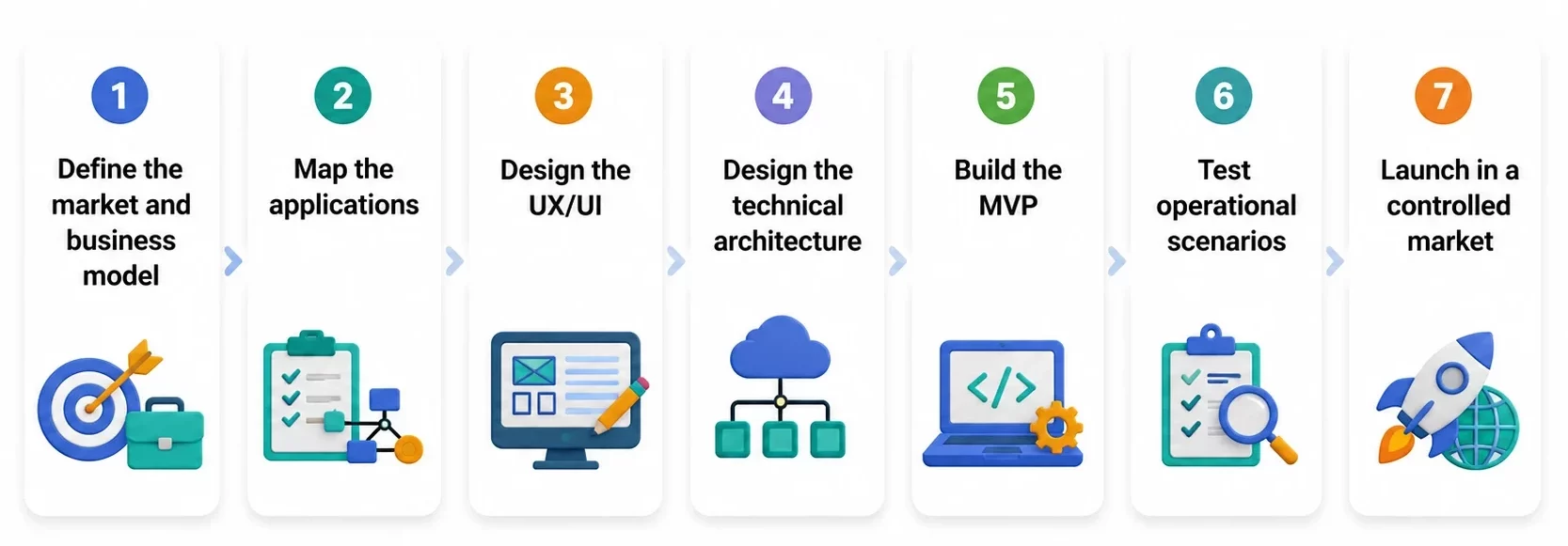
A successful food delivery app requires more than development. The process should align customer needs, business goals, operational workflows, and technical requirements before launch.
1. Define the market and business model
Start with the target geography, customer segment, restaurant category, delivery model, and monetization approach. Exploring best food app ideas can also help identify specific customer needs and market gaps worth addressing.
2. Map the applications
Define the responsibilities of the customer, restaurant, delivery partner, and admin applications before writing a long feature list. The most important workflow is the complete order lifecycle:
Discover – Order – Accept – Prepare – Assign – Pick up – Deliver – Complete
Every role should have a clearly defined responsibility at each stage.
3. Design the UX/UI
Design the customer journey from restaurant discovery through checkout and tracking. At the same time, design the operational interfaces that restaurants and delivery partners will use repeatedly throughout the day.
For example, a rider needs to see the next action immediately while driving, while a restaurant needs to process multiple incoming orders without navigating unnecessary screens. UI UX designing tools can support wireframing, prototyping, collaboration, and design-system development throughout this stage.
4. Design the technical architecture
At this stage, define the backend, database, APIs, authentication, payment workflow, location architecture, notifications, analytics, and dispatch logic. A mobile app architecture guide can help structure these components and clarify how data and services should interact across the platform.
The team should also decide which capabilities require custom development and which can be handled through third-party services.
5. Build the MVP
The MVP should support a complete transaction rather than simply demonstrate the customer interface. That means a customer should be able to place an order, the restaurant should be able to process it, a delivery partner should receive the job, and the customer should receive the order and status updates.
Advanced recommendations, complex batching, predictive analytics, subscriptions, and multi-category commerce can be introduced after the core transaction has been validated. At this stage, MVP development services can help translate the business model into a focused initial product scope, prioritizing the workflows needed to validate demand before broader expansion.
6. Test operational scenarios
Functional testing alone is not enough for a delivery platform. The team should test payment failures, restaurant rejection, unavailable items, rider cancellation, customer cancellation, GPS interruptions, poor connectivity, delayed preparation, changing ETAs, refunds, duplicate orders, and high order volume. The objective is to verify how the system behaves when the expected workflow breaks.
7. Launch in a controlled market
A focused geographic launch can make operational validation easier than attempting a broad rollout immediately. Monitor order conversion, restaurant acceptance, preparation time, rider utilization, delivery duration, cancellation rates, payment failures, customer support requests, and repeat orders.
These metrics can determine which features should be prioritized in the next development cycle.
Cost and Timeline at a Glance
Food delivery app development cost depends on the number of applications, design complexity, integrations, dispatch requirements, platforms, geography, and operational scope.
| Build scope | Estimated cost | Typical timeline |
| Focused MVP | $25,000–$55,000 | 10-14 weeks |
| Growth-stage platform | $55,000–$125,000 | 3-5 months |
| Advanced multi-app platform | $125,000–$250,000+ | 5-8 months |
A focused MVP can stay toward the lower end when it launches in one market with a limited feature set, standard payment integration, basic dispatch, and a manageable number of restaurant and delivery workflows.
Costs increase when the platform adds custom dispatch algorithms, sophisticated routing, multiple payment gateways, restaurant POS integrations, advanced analytics, subscriptions, loyalty programs, multi-region support, or additional commerce categories.
These ranges are intended for early planning rather than as fixed quotations. For a detailed breakdown of development costs and the factors that affect them, see the food delivery app development cost guide.
How a New App Competes with DoorDash and Uber Eats
A new food delivery platform does not need to match the breadth of established marketplaces at launch. Understanding the DoorDash business model can help businesses evaluate how a delivery platform connects customers, restaurants, and delivery partners to generate revenue.
A more practical approach is to target a specific market where the platform can offer distinct value and attract both customers and restaurant partners.
Focus on a defined geography
Delivery is inherently local. A platform with strong restaurant coverage and rider availability in one area can provide a better experience than a platform with a wider geographic footprint but weaker local density.
A neighborhood, city district, university area, office cluster, or other concentrated market can therefore provide a more manageable launch environment.
Choose a specific customer segment
The differentiation can also come from the customer rather than the geography. A platform might focus on premium restaurants, healthy meals, dietary requirements, corporate meals, local independent restaurants, late-night orders, or another defined customer need.
The narrower positioning makes product decisions easier because the platform can optimize the ordering experience around a specific use case.
Rethink restaurant economics
Restaurant partners evaluate more than customer volume. Commission rates, advertising costs, customer ownership, delivery fees, settlements, and operational support can determine whether they stay on a platform. These are also important factors for boosting food delivery app revenue, as healthier restaurant economics can improve retention and create additional revenue opportunities.
A new business can combine commissions with subscriptions, delivery fees, restaurant SaaS charges, advertising, or memberships. Model these economics before development because pricing directly affects payments, reporting, promotions, and administrative workflows.
Build around an underserved workflow
A new platform can also compete by solving a workflow that broad marketplaces do not prioritize.
For example, a restaurant-group platform may emphasize branded ordering and loyalty. A corporate meal platform may need scheduled group orders and business billing. A neighborhood marketplace may prioritize local restaurant discovery.
The objective is not to have more features than established competitors. It is to make the core experience more relevant to a clearly defined market.
Conclusion
Food delivery app development is an orchestration challenge, not simply an app-building exercise. Customers, restaurants, delivery partners, and administrators rely on connected applications supported by backend services for orders, payments, locations, dispatch, notifications, and analytics. Custom app development services can help align this architecture with specific business and operational requirements.
A focused MVP can validate demand and operational viability without replicating every capability of a mature marketplace. As the business grows, it can add loyalty, personalization, advanced dispatch, new commerce categories, or broader geographic coverage. RipenApps can help businesses take this approach from initial product scope through scalable platform development.
FAQs
Q1. How much does it cost to develop a food delivery app?
Food delivery app development can cost approximately $25,000 to $250,000+. A focused MVP typically requires less investment, while a complete multi-application platform with custom dispatch, advanced integrations, analytics, and multiple operational workflows requires a larger budget. The number of applications is an important cost factor. A customer-only prototype is fundamentally different from a production platform that includes customer, restaurant, delivery-partner, and admin applications.
Q2. How long does it take to build a food delivery app?
A focused MVP can take approximately 10-14 weeks, while a broader production platform can take around 5-8 months. The actual timeline depends on the number of applications, design scope, backend architecture, payment and mapping integrations, dispatch requirements, testing, and launch geography.
Q3. What apps are needed for a food delivery platform?
A complete platform generally requires four connected applications: a customer app, restaurant or merchant panel, delivery-partner app, and admin dashboard. These applications share backend services but have different workflows and permissions. The customer needs discovery, ordering, payment, and tracking. Restaurants need menus and order management. Delivery partners need assignments and navigation. Administrators need operational visibility across the entire system.
Q4. What features are essential in a food delivery app?
An MVP should support restaurant discovery, menus, cart management, checkout, payments, restaurant order management, delivery assignment, location tracking, notifications, and administration. Features such as AI recommendations, subscriptions, loyalty programs, automated batching, predictive demand forecasting, and multi-category commerce can be introduced after the core ordering and fulfillment workflow is validated. For a deeper feature breakdown, see the food delivery app features guide.
5. Which business model is suitable for a food delivery app?
The appropriate model depends on the target customers, restaurant relationships, delivery strategy, and operational resources. An aggregator focuses on marketplace discovery and restaurant ordering. A full-stack model also controls delivery. Restaurant-owned delivery focuses on direct ordering and fulfillment, while cloud kitchens and quick-commerce hybrids introduce additional operational requirements.
The business model should be selected before finalizing the architecture because it determines which workflows the platform must support.
6. How can a new food delivery app compete with established platforms?
A new platform can focus on a defined geography, customer segment, restaurant category, or operational problem rather than attempting to match every feature of an established marketplace. Strong local restaurant coverage, a differentiated commission structure, specialized ordering workflows, or a more relevant customer experience can provide the basis for an initial market position.
Discuss your project and request for proposal
SHARE
WRITTEN BY

Ishan Gupta
CEO & Founder
Ishan Gupta is a seasoned entrepreneur and CEO with extensive 10+ years of experience in business and mobile app development landscape. He believes that the right digital product allows companies to focus on what they do best, while technology handles the rest. With deep exposure to global markets, he understands what makes an app succeed. His approach translates business needs into clear product strategies, ensuring that every feature contributes to measurable ROI.
View All Articles