


Quick Summary
Artificial intelligence is reshaping mobile app development by enabling smarter, faster, and more personalized digital experiences. From machine learning and NLP to generative AI and on-device intelligence, businesses are using AI to improve customer engagement, automate operations, strengthen security, and drive long-term growth. This guide explores the key AI technologies, real-world applications, business benefits, and emerging trends shaping mobile apps in 2026.
Key Takeaways
- Machine learning, NLP, computer vision, and generative AI are driving the next generation of intelligent mobile applications.
- On-device AI improves privacy, reduces latency, and enables seamless offline experiences for regulated industries and enterprises.
- AI-powered mobile apps increase engagement, automate workflows, strengthen security, and support data-driven business decisions.
- Emerging trends like agentic AI and multimodal intelligence are redefining how users interact with mobile applications.
- Choosing the right AI development partner helps businesses maximize ROI, scalability, and long-term competitive advantage.
AI technologies in mobile app development are transforming how businesses build, scale, and monetize digital products. From machine learning and natural language processing to generative AI and on-device intelligence, these technologies enable mobile apps to become more personalized, predictive, and efficient.
According to Sensor Tower, AI-powered apps generated billions of downloads globally and continue to reshape user expectations across industries. Businesses are no longer asking whether they should adopt AI. Instead, they are evaluating which AI technologies deliver the greatest business value and competitive advantage. According to McKinsey’s State of AI 2025 report, 64% of organizations say AI is already enabling innovation, demonstrating how rapidly AI has become a strategic growth driver across industries.
For startup founders, understanding the role of AI in app development is essential for making informed investment decisions. Whether launching a new digital product or scaling an existing one, partnering with an experienced AI product development company can help businesses build intelligent solutions that improve customer engagement, automate operations, strengthen security, and unlock new revenue opportunities. This guide explores the most important AI technologies in mobile apps, their real-world applications, business benefits, emerging trends, and how to choose the right AI app development partner for long-term success.
Table of Contents
What Makes a Mobile App “AI-Powered”?
An AI-powered mobile app uses artificial intelligence technologies to learn from data, adapt to user behavior, and make intelligent decisions without relying solely on predefined rules. Unlike traditional apps that follow fixed workflows, AI-enabled applications continuously improve their performance through learning and analysis.
Traditional applications are reactive. They respond only when users initiate actions. AI-powered applications become predictive and proactive by anticipating user needs, recommending actions, and automating decisions.
For example, a traditional e-commerce app displays products based on category selections. An AI-powered e-commerce app recommends products based on browsing history, purchasing behavior, preferences, and contextual signals.
This evolution from rule-based systems to learning-based systems is driven by several specialized AI technologies, each designed to solve different business challenges and deliver specific outcomes.
Businesses looking to use AI in custom app development are increasingly embedding intelligent capabilities directly into core product experiences rather than treating AI as an add-on feature.
What Are the Core AI Technologies Used in Mobile App Development?
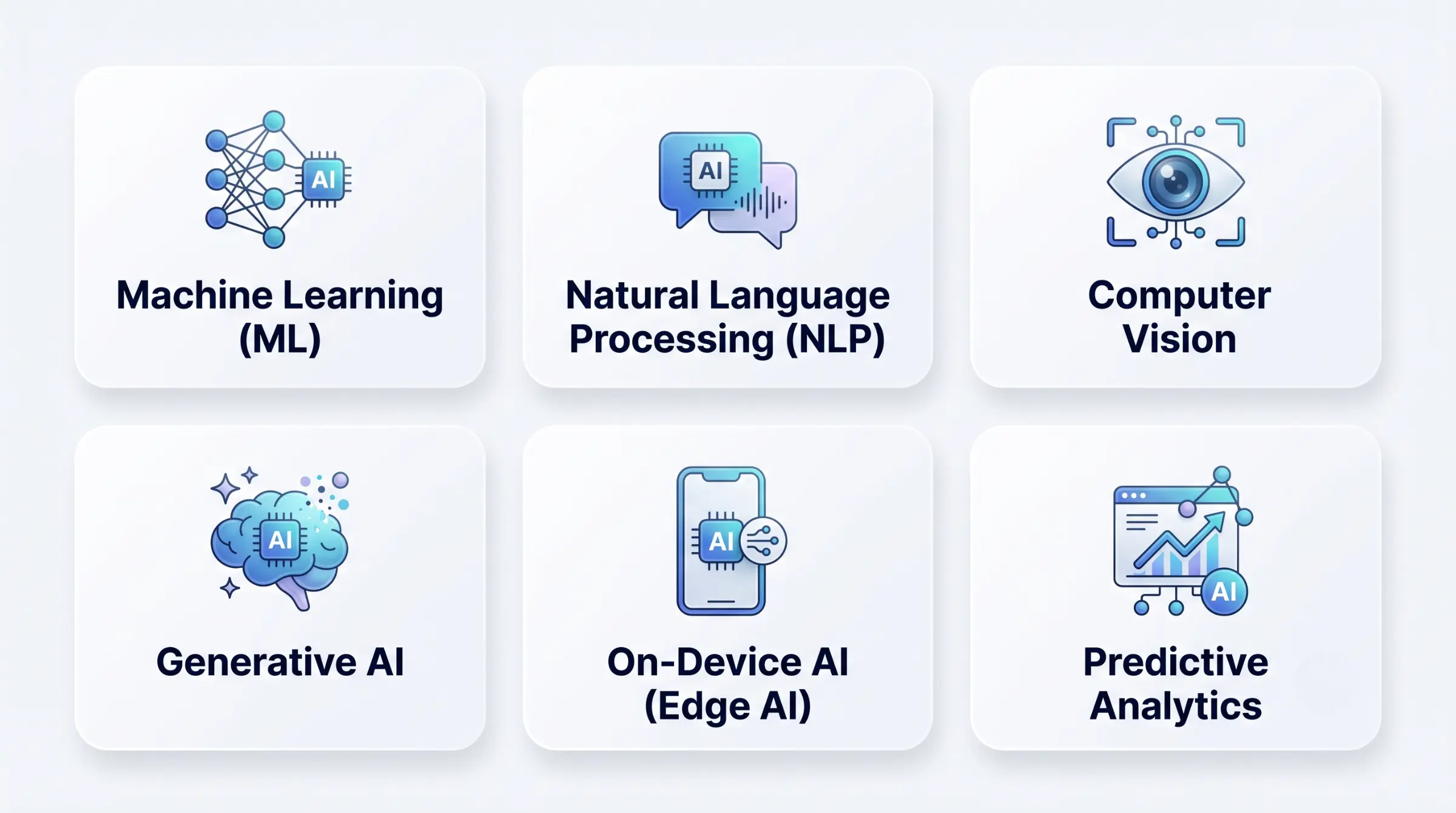
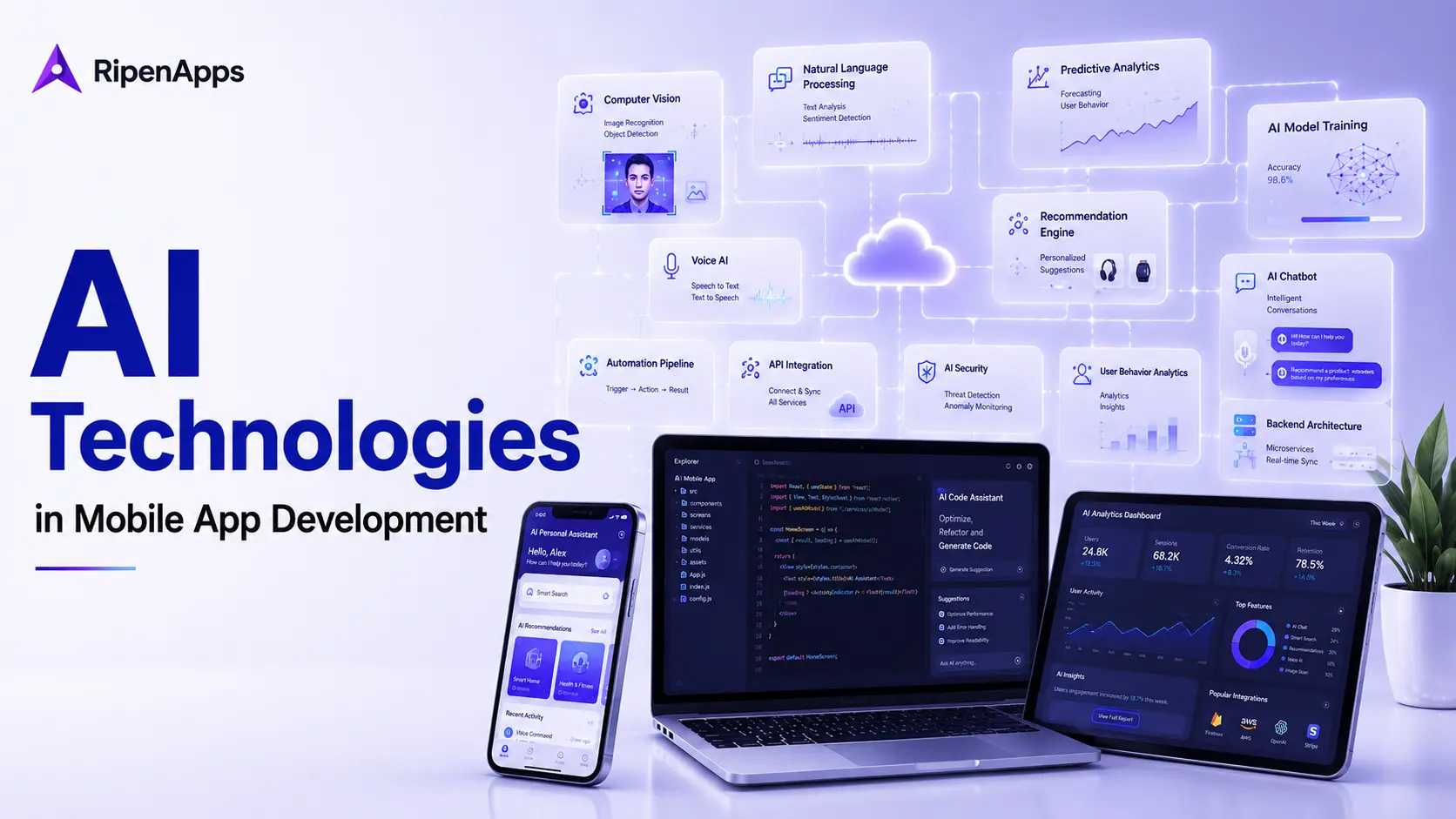
Understanding which technology does what helps business leaders make smarter product decisions. Each AI technology offers unique capabilities that support personalization, automation, intelligence, and growth.
Machine Learning (ML): Personalization and Predictions
Machine learning is one of the most widely adopted technologies in AI mobile app development. It enables applications to identify patterns, analyze large datasets, and make predictions without explicit programming. The growing adoption of machine learning in Android app development is enabling businesses to deliver personalized recommendations, intelligent automation, and real-time predictive experiences.
Machine learning powers many of the experiences users interact with every day. Recommendation engines, personalized content feeds, dynamic pricing systems, fraud detection mechanisms, and churn prediction models all rely on ML algorithms.
Streaming platforms like Netflix and Spotify use machine learning to recommend content based on individual viewing and listening habits. These recommendations increase user engagement and retention by delivering highly relevant experiences.
Popular machine learning tools include:
- TensorFlow Lite
- Apple Core ML
- Google Vertex AI
- PyTorch Mobile
For businesses, machine learning creates measurable value through:
- Improved customer retention
- Increased session duration
- Better conversion rates
- Smarter customer segmentation
- Enhanced revenue optimization
Organizations investing in AI application development services increasingly use machine learning as the foundation for intelligent customer experiences.
Natural Language Processing (NLP): Voice and Conversational Interfaces
Natural Language Processing enables applications to understand, interpret, and generate human language. It serves as the backbone of conversational experiences across modern mobile applications.
As customer expectations for instant support continue to rise, many businesses are investing in AI Chatbot development services to improve customer engagement, automate support operations, and reduce service costs.
NLP powers:
- AI chatbots
- Virtual assistants
- Voice commands
- Smart search
- Sentiment analysis
- Automated responses
Consumers increasingly expect seamless communication with applications. Instead of navigating menus, users can simply speak or type requests naturally.
Banking applications use NLP-powered assistants to answer account-related questions. Customer service apps automate support interactions. Productivity tools leverage smart replies to reduce communication friction.
Leading NLP platforms include:
- OpenAI API
- Google Dialogflow
- Hugging Face Models
- Microsoft Azure AI Language
Advancements in natural language processing in iOS apps are making voice assistants, conversational interfaces, and AI-powered customer interactions more accurate and intuitive.
For businesses, NLP reduces operational costs while improving customer satisfaction. It is also a critical component of modern conversational UI strategies and chatbot development services.
Computer Vision: Image Intelligence in Apps
Computer vision enables mobile applications to analyze and understand visual information from images and videos.
This technology allows apps to recognize faces, identify objects, scan documents, and interpret visual content in real time.
Key applications include:
- Facial recognition authentication
- Visual search
- Medical image analysis
- KYC verification
- OCR document scanning
- Augmented reality experiences
Pinterest’s visual search functionality is a widely recognized example. Users can upload images and receive visually similar product recommendations instantly.
Popular computer vision tools include:
- Google Vision API
- AWS Rekognition
- Apple Vision Framework
- OpenCV
One important strategic consideration is deciding between cloud-based and on-device computer vision. On-device models often process images in under 100 milliseconds, providing faster responses while preserving user privacy.
For businesses, computer vision improves operational efficiency, customer experience, and security while enabling innovative product features.
Generative AI: Content, Code, and Creative Automation
Generative AI is rapidly becoming one of the most influential technologies in mobile application development.
Unlike traditional AI systems that classify or predict, generative AI creates new content, including text, images, audio, video, and code.
The business value of generative AI is becoming increasingly measurable. Deloitte’s State of Generative AI in the Enterprise report found that 74% of organizations say their most advanced generative AI initiative is meeting or exceeding ROI expectations, reinforcing the technology’s growing impact on productivity, automation, and business performance.
Businesses are integrating generative AI into mobile apps for:
- AI writing assistants
- Personalized content generation
- Marketing automation
- Customer support responses
- Product descriptions
- Automated design suggestions
Applications like Grammarly and Jasper AI demonstrate how generative AI can enhance productivity and user engagement.
Common technology providers include:
- OpenAI
- Anthropic Claude
- Google Gemini
- Meta Llama
Sensor Tower reported that generative AI applications generated approximately $1.3 billion in in-app purchase revenue during 2024, highlighting the growing commercial impact of this technology.
For content-driven, SaaS, e-commerce, and productivity applications, generative AI offers significant differentiation opportunities and operational efficiencies.
On-Device AI (Edge AI): Speed, Privacy, and Offline Intelligence
On-device AI, also known as Edge AI, runs machine learning models directly on smartphones and tablets rather than relying on cloud servers. This approach has become a key focus in AI app development, enabling applications to deliver faster responses, enhanced privacy, and intelligent features even without continuous internet connectivity.
This approach delivers several strategic advantages:
- Faster response times
- Reduced latency
- Enhanced privacy
- Offline functionality
- Lower cloud infrastructure costs
Examples include:
- Offline language translation
- Real-time voice recognition
- Wearable health monitoring
- Biometric authentication
- Smart camera enhancements
Popular frameworks include:
- Apple Core ML
- TensorFlow Lite
- Google ML Kit
- ONNX Runtime
On-Device AI vs. Cloud AI
| On-Device AI | Cloud AI |
| Faster processing | Greater computing power |
| Works offline | Requires internet access |
| Enhanced privacy | Easier model updates |
| Lower latency | Supports larger models |
Healthcare, fintech, and regulated industries increasingly prioritize on-device AI because of privacy and compliance requirements.
Predictive Analytics: Anticipating User Needs Before They Arise
Predictive analytics uses historical and real-time data to forecast future user actions and business outcomes.
Rather than reacting to user behavior, predictive systems anticipate needs before they occur.
Examples include:
- Personalized notifications
- Demand forecasting
- Predictive maintenance
- Dynamic content recommendations
- User churn prevention
Ride-sharing platforms use predictive analytics to forecast demand spikes. Fitness apps adjust workout recommendations based on user progress and behavior patterns.
Technology stacks commonly include:
- AWS SageMaker
- Firebase Predictions
- Google Vertex AI
- Custom ML pipelines
As organizations increasingly rely on data-driven decision-making, predictive analytics consulting helps businesses identify growth opportunities, improve forecasting accuracy, and optimize long-term product strategies.
What Are the Key Benefits of Integrating AI Technologies in Mobile Apps?
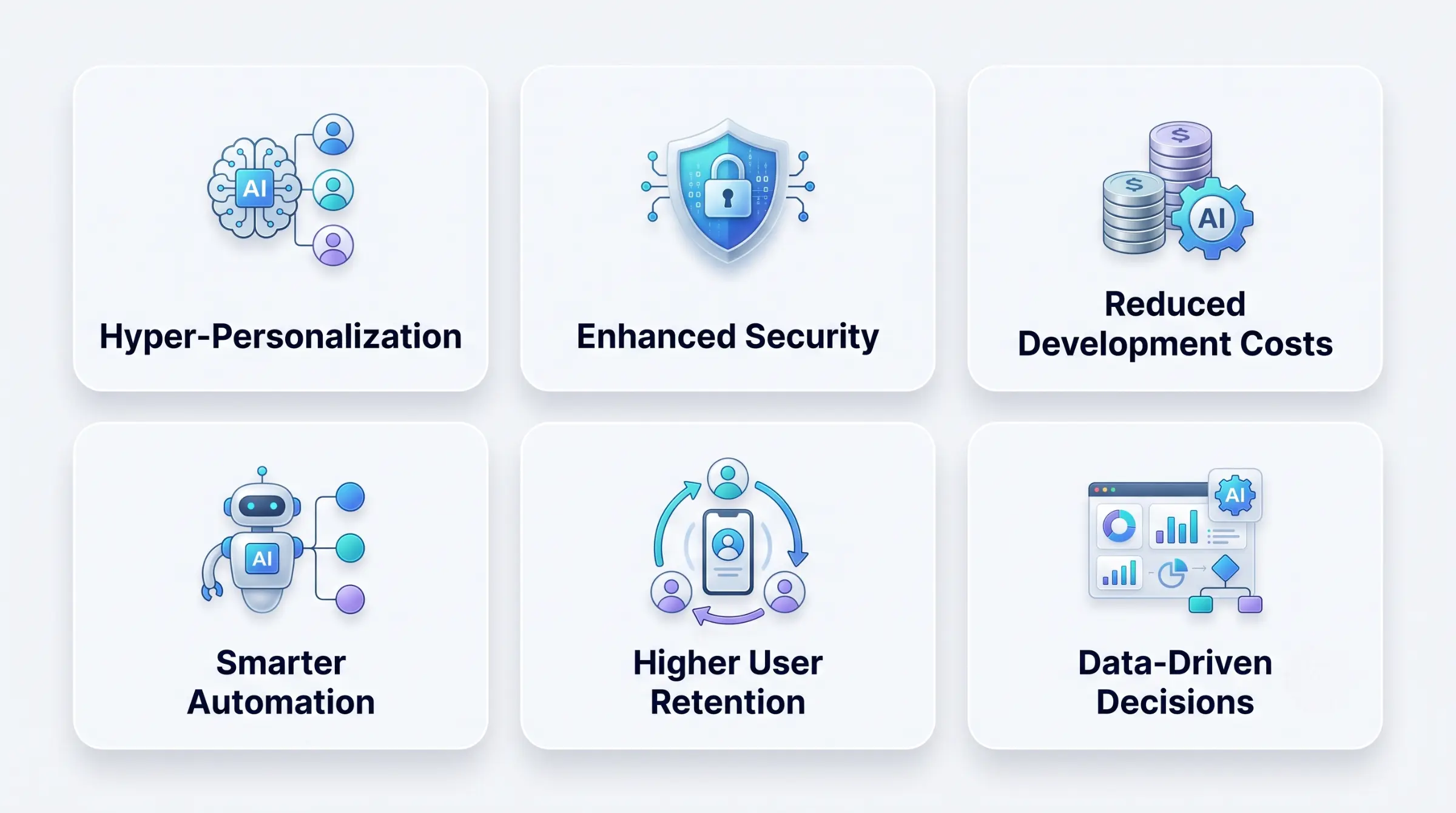
AI adoption is no longer driven solely by innovation. Businesses are investing in AI because it produces measurable returns.
1. Hyper-Personalized User Experiences
AI continuously analyzes behavior and preferences to deliver customized content, recommendations, and experiences that increase customer satisfaction and loyalty.
2. Reduced Development Time and Cost
AI-assisted coding tools, automated testing, and pre-trained APIs accelerate development cycles and reduce engineering effort. Many organizations report significantly faster product delivery timelines.
3. Enhanced Security
Machine learning models identify unusual activity patterns and detect fraud in real time, strengthening application security and reducing risk.
4. Higher Engagement and Retention
AI-powered recommendations and dynamic content experiences encourage users to spend more time within applications and return more frequently.
Modern AI integration features such as personalized recommendations, intelligent search, and predictive notifications help businesses create more engaging and user-centric mobile experiences.
5. Smarter Automation
Businesses can automate repetitive tasks such as customer support, moderation, document processing, and operational workflows, improving efficiency and scalability.
6. Data-Driven Product Decisions
AI transforms raw behavioral data into actionable insights, enabling product leaders to prioritize features, optimize roadmaps, and make strategic decisions based on evidence rather than assumptions.
Organizations seeking the benefits of AI-powered mobile app development increasingly view AI as a core business growth driver rather than an optional enhancement.
Which Real-World Mobile Apps Successfully Leverage AI Technologies?
The impact of AI technologies in mobile app development becomes clearer when viewed through successful real-world applications. Across industries such as fintech, healthcare, productivity, and entertainment, leading brands are using artificial intelligence to deliver personalized experiences, automate workflows, improve security, and create new business value.
ChatGPT: Generative AI for Productivity and Business Automation
ChatGPT is one of the most widely adopted generative AI mobile applications globally. Powered by large language models, it enables content creation, coding assistance, research support, customer service automation, and workflow optimization.
The app demonstrates how Natural Language Processing (NLP) and Generative AI can help businesses improve productivity, reduce operational costs, and accelerate decision-making.
Duolingo: AI-Powered Personalized Learning
Duolingo uses machine learning and generative AI to create adaptive learning experiences. The platform analyzes user performance in real time and adjusts lessons based on learning patterns and proficiency levels.
This showcases how machine learning mobile apps can increase engagement, improve retention, and deliver highly personalized user experiences at scale.
Uber: Predictive Analytics and Intelligent Automation
Uber leverages predictive analytics, machine learning, and AI-driven algorithms to optimize route planning, demand forecasting, dynamic pricing, and driver-passenger matching.
The platform highlights how AI-powered app features can improve operational efficiency, reduce wait times, and support large-scale logistics management.
Al Muzaini: AI-Powered Fintech and Digital Remittance Platform
Al Muzaini demonstrates how artificial intelligence in mobile applications can enhance security, compliance, and customer convenience. The platform utilizes intelligent verification systems, biometric authentication, and automated transaction processing to streamline international remittance services.
It serves as a strong example of AI adoption in fintech environments where trust, security, and regulatory compliance are critical.
Hungama: AI-Driven Content Personalization and Recommendations
Hungama leverages machine learning and predictive analytics to personalize entertainment experiences for millions of users. By analyzing viewing preferences, engagement patterns, and user behavior, the platform delivers highly relevant content recommendations.
This use case illustrates how AI in mobile apps can improve customer engagement, increase session duration, and drive long-term retention.
How Are AI Technologies Being Used Across Industries?
Different industries leverage AI technologies in unique ways to solve specific operational and customer challenges. Today, many organizations are scaling their eCommerce business with AI-powered mobile apps that deliver personalized product recommendations, intelligent search, and automated customer support
| Industry | AI Applications |
| Healthcare | Medical imaging, patient intake chatbots, diagnostics support |
| Fintech | Fraud detection, credit scoring, biometric verification |
| E-commerce | Product recommendations, visual search, content generation |
| Logistics | Predictive maintenance, ETA optimization, voice dispatch systems |
| OTT & Media | Content recommendations, AI subtitles, personalized feeds |
Healthcare organizations use computer vision for medical imaging analysis while NLP streamlines patient communication.
Fintech companies deploy machine learning models to detect fraud and assess risk in real time.
E-commerce businesses combine recommendation engines, generative AI, and visual search technologies to increase conversions and improve customer experiences.
Companies investing in fintech app development and logistics app development increasingly rely on AI to gain competitive advantages through automation and predictive intelligence.
What Emerging AI Trends Are Reshaping Mobile App Development in 2026?
Enterprise leaders are rapidly increasing their AI investments. According to IBM’s 2025 CEO Study, 61% of surveyed CEOs are already adopting AI agents and preparing to scale them across their organizations, highlighting the growing shift toward intelligent and autonomous business systems.
Agentic AI
Agentic AI goes beyond responding to user requests. These systems autonomously execute multi-step tasks on behalf of users.
For example, an AI assistant could research flights, compare prices, complete bookings, and send confirmations without continuous user intervention.
Industry analysts project rapid growth in agentic AI adoption as organizations seek greater automation.
Multimodal AI
Multimodal AI combines text, images, voice, and video processing within a single experience.
Future mobile applications will understand multiple forms of input simultaneously, creating richer and more intuitive interactions.
AI-Generated UI/UX
Generative AI is beginning to influence interface design by dynamically adapting layouts based on user behavior and preferences.
This trend could significantly reduce design iteration cycles while improving personalization.
Cross-Platform AI Experiences
Organizations increasingly seek unified AI experiences across mobile, web, wearable, and IoT ecosystems.
Shared AI infrastructure enables consistency and efficiency across digital touchpoints.
Privacy-First AI Architecture
Growing regulatory requirements such as GDPR and CCPA are accelerating adoption of on-device AI and federated learning models.
Businesses that prioritize privacy-first AI architectures will be better positioned for future compliance requirements and consumer trust expectations.
These emerging technologies are also inspiring entrepreneurs to explore top AI app ideas that address evolving customer needs and create new business opportunities.
Should You Use Pre-Trained APIs or Custom AI Models?
Choosing between pre-trained AI services and custom models depends on business objectives, budget, and competitive differentiation requirements.
| Factor | Pre-Trained APIs | Custom AI Models |
| Cost | Lower | Higher |
| Time to Market | Faster | Longer |
| Customization | Limited | Extensive |
| Maintenance | Lower | Higher |
| Competitive Differentiation | Moderate | High |
Pre-trained solutions such as OpenAI APIs, Google Vision, and Firebase ML Kit are ideal for standard use cases and rapid validation.
Custom AI models become necessary when organizations require:
- Proprietary intelligence
- Industry-specific optimization
- Advanced fraud detection
- Specialized healthcare applications
- Unique competitive advantages
A practical approach is to begin with a pre-trained solution, validate ROI, and then invest in custom models when business value is proven.
Basic AI implementations may start around $20,000, while complex enterprise-grade custom solutions can exceed $200,000 depending on scope and requirements.
Final Thoughts
More than a technology trend, AI in mobile app development is becoming a strategic investment for forward-thinking organizations. Companies that successfully integrate AI capabilities into their mobile ecosystems can enhance customer engagement, optimize business processes, and drive sustainable growth in an increasingly competitive market.
As a trusted AI app development company, RipenApps helps startups, enterprises, and growing businesses identify the right AI technologies, build scalable intelligent applications, and create measurable business impact. Whether you’re planning your first AI initiative or scaling an existing product, our AI mobile app development services can help turn your vision into a future-ready digital solution.

Frequently Asked Questions
1. What AI technologies are most commonly used in mobile app development?
The most common AI technologies include machine learning, natural language processing, computer vision, generative AI, on-device AI, and predictive analytics.
2. What are the biggest benefits of using AI in mobile apps?
Key benefits include personalization, automation, stronger security, faster development cycles, improved user engagement, and data-driven decision-making.
3. What is the difference between on-device AI and cloud AI in mobile apps?
On-device AI runs directly on mobile devices, offering faster performance and enhanced privacy. Cloud AI relies on remote servers and provides greater computational power.
4. How much does it cost to build an AI-powered mobile app?
AI-powered mobile apps typically range from $20,000 for basic AI integrations using pre-trained APIs to over $200,000 for enterprise-grade applications with custom AI models.
5. How can predictive analytics improve mobile app performance?
Predictive analytics helps businesses anticipate user behavior, identify churn risks, personalize experiences, and make data-driven decisions. By leveraging predictive analytics for mobile apps, organizations can improve customer retention, optimize engagement strategies, forecast demand more accurately, and deliver more relevant user experiences that support long-term business growth.
6. What are the main challenges of integrating AI into mobile apps?
Common challenges include data quality issues, model optimization, battery consumption, latency management, privacy compliance, and ongoing model maintenance.
7. What is agentic AI and how does it apply to mobile apps?
Agentic AI enables mobile applications to autonomously perform complex, multi-step tasks on behalf of users rather than simply responding to commands.
Discuss your project and request for proposal
SHARE
WRITTEN BY

Ishan Gupta
CEO & Founder
Ishan Gupta is a seasoned entrepreneur and CEO with extensive 10+ years of experience in business and mobile app development landscape. He believes that the right digital product allows companies to focus on what they do best, while technology handles the rest. With deep exposure to global markets, he understands what makes an app succeed. His approach translates business needs into clear product strategies, ensuring that every feature contributes to measurable ROI.
View All Articles