



Key Takeaways
- MVP testing validates product assumptions early, helping businesses reduce development risks before investing in large-scale feature implementation.
- Collecting real user feedback enables teams to improve usability, prioritize valuable features, and strengthen long-term product-market fit.
- Testing performance, engagement, and customer behavior provides actionable insights that support smarter product decisions and faster iteration cycles.
- Measuring meaningful success metrics ensures every product improvement aligns with business goals, customer expectations, and future scalability requirements.
- A structured MVP testing strategy significantly increases the likelihood of achieving a successful MVP launch with reduced uncertainty.
Launching a new digital product without testing is like setting sail without checking the weather. Even the most innovative ideas can fail if they are built on assumptions rather than real user needs. That is why successful startups focus on validating their ideas early instead of investing significant time and money into developing a fully featured product. Learning how to test your MVP helps businesses identify potential issues, understand customer expectations, and make informed decisions before a large-scale launch.
Many startups struggle not because their ideas lack potential, but because they fail to validate whether customers actually need the solution. Building advanced features before understanding user behavior often results in wasted development efforts, increased costs, and delayed market entry. MVP testing bridges this gap by allowing businesses to gather valuable insights, validate product-market fit, and reduce uncertainty before scaling their product.
An effective MVP testing process goes beyond identifying bugs or technical issues. It focuses on observing how users interact with the product, measuring engagement, collecting meaningful feedback, and evaluating whether the core value proposition solves a real problem. Every interaction provides data that helps refine the product, prioritize future features, and improve the overall customer experience.
Businesses that invest in MVP development services gain a structured approach to building and validating their products from the earliest stages. By combining strategic planning, rapid iterations, and continuous user feedback, experienced product teams help startups launch with greater confidence while minimizing development risks and avoiding unnecessary expenses.
In this comprehensive guide, you will learn what MVP testing involves, why it plays a crucial role in product validation, and how it contributes to a successful MVP launch. You’ll also discover the key principles behind effective MVP validation and understand why testing should be an ongoing process rather than a one-time activity.
Table of Contents
What is MVP Testing?
MVP testing is the process of evaluating a Minimum Viable Product with real users before investing in full-scale product development. Rather than launching a feature-rich application, businesses introduce a simplified version that contains only the essential functionalities required to solve a specific customer problem. The objective is to collect genuine user feedback, validate business assumptions, and determine whether the product delivers meaningful value.
Unlike traditional software testing, which primarily focuses on identifying bugs and ensuring technical quality, MVP testing examines how users interact with the product in real-world scenarios. It answers questions that technical testing alone cannot address. Do users understand the product? Does it solve their problem effectively? Would they continue using it? Are they willing to pay for it? These insights form the foundation of future product decisions.
Organizations that embrace continuous learning often outperform competitors because they adapt faster to changing customer expectations. Instead of spending months developing features that users may never adopt, they iterate quickly based on measurable insights. This agile mindset transforms MVP validation into a strategic advantage rather than simply another development milestone.
Why MVP Testing is Critical Before Launch
Before investing heavily in full-scale product development service, businesses need confidence that their solution solves a real customer problem. This is where MVP testing delivers significant value. By validating assumptions with real users, collecting actionable feedback, and measuring product performance early, organizations can minimize uncertainty, optimize development efforts, and make informed decisions before launch. The following benefits explain why MVP testing is a critical step in building successful digital products.
-
Reduces Business Risk
Launching a product without validating customer demand introduces significant business risk. Development teams may build technically impressive applications, but without confirming that customers genuinely need the solution, even well-designed products can struggle to gain traction. MVP testing reduces this uncertainty by providing real-world evidence before substantial investments are made.
-
Lower MVP Development Costs
Reducing MVP development costs is equally important. Building advanced functionality before confirming customer demand often leads to unnecessary spending. MVP testing helps businesses identify which features truly matter, allowing them to focus development efforts on high-value improvements while avoiding expensive rework later.
-
Builds Investor Confidence
Investor confidence also increases when startups demonstrate validated learning instead of speculative projections. Investors typically look for evidence that customers want the product and that founders understand their market. Usage metrics, customer interviews, retention data, and validated assumptions provide stronger evidence than business plans alone.
-
Improves Customer Satisfaction
Customer satisfaction improves because products evolve according to genuine user needs rather than internal opinions. Continuous feedback enables teams to simplify workflows, eliminate friction, and enhance the overall experience. As a result, businesses launch products that better align with customer expectations from the very beginning.
-
Accelerates Product Iterations
Testing also accelerates product iterations. Instead of waiting for a large release cycle, businesses continuously gather user feedback, implement improvements, and measure results. This iterative approach enables startups to adapt quickly to changing market demands while maintaining development efficiency. In fact, continuous validation is one of the key reasons businesses can build MVPs faster, reducing development risks while bringing market-ready products to users in less time.
Preparing Your MVP for Testing
A well-planned MVP testing process begins long before users interact with your product. Many startups make the mistake of releasing an MVP as soon as the core features are functional, assuming they can gather meaningful insights immediately. However, testing without clear objectives, measurable benchmarks, or the right audience often results in misleading feedback that slows product development instead of accelerating it.
Preparing your MVP properly ensures every user interaction contributes valuable information that helps validate assumptions, improve usability, and guide future product decisions. It transforms MVP testing from a simple feedback exercise into a structured product validation process.
Define Success Metrics
Before inviting users to test your MVP, establish what success looks like. Without predefined metrics, it becomes difficult to determine whether your product is solving the intended problem or simply attracting curiosity.
Your success metrics should align with your business objectives rather than focusing solely on downloads or registrations. For example, if your MVP is a food delivery application, repeat orders and customer retention may be more meaningful than installation numbers. If you are building a SaaS platform, daily active users or feature adoption could provide better insights into product value.
Clear metrics also help product teams prioritize improvements based on measurable outcomes instead of opinions. As your MVP evolves, these benchmarks become valuable indicators of progress and guide future investment decisions.
Identify Your Target Users
Even the most innovative MVP can produce inaccurate results if it is tested with the wrong audience. Product validation depends on gathering feedback from people who genuinely experience the problem your application aims to solve.
Start by creating detailed user personas that include demographic information, professional background, behaviors, motivations, and pain points. These profiles help identify early adopters who are most likely to provide meaningful feedback.
Instead of inviting everyone to participate, focus on users who closely match your ideal customer profile. Their experiences will reveal whether your value proposition resonates with the intended market and whether the product solves real challenges.
Businesses that invest in product discovery services often spend considerable time researching customer behavior before development begins. This early understanding significantly improves the quality of MVP validation because testing focuses on relevant users rather than a broad audience with varying expectations.
Set Testing Objectives
Every MVP testing initiative should answer specific business questions. Without clear objectives, feedback often becomes scattered and difficult to interpret.
Your objectives may include validating customer demand, evaluating onboarding experiences, measuring usability, identifying feature priorities, or understanding pricing expectations. Each objective should support broader business goals and contribute to future product decisions.
Rather than attempting to validate every aspect of the application simultaneously, focus on one or two critical assumptions during each testing cycle. This approach simplifies analysis and allows teams to make targeted improvements before moving on to the next stage.
Prioritize Core Features
A common misconception about MVPs is that they should include as many features as possible to impress users. In reality, unnecessary functionality often distracts users from the product’s primary value proposition and complicates the testing process.
Your MVP should contain only the essential features required to solve the target problem. Every additional feature introduces more variables that make it difficult to understand which aspects of the product influence user behavior.
Businesses comparing POC vs MVP vs Prototype often discover that an MVP differs because it is designed specifically for market validation rather than technical feasibility or design exploration. Keeping the product focused ensures testing remains aligned with customer needs instead of feature experimentation.
Choose the Right Testing Tools
The quality of your insights depends heavily on the tools you use throughout the testing process. Modern analytics platforms provide detailed information about user behavior, helping teams move beyond subjective opinions.
Behavior analytics tools reveal navigation patterns, session duration, feature usage, and drop-off points. Heatmaps identify areas where users experience confusion, while session recordings provide context for specific interactions. Crash reporting tools highlight technical issues that could negatively affect user satisfaction.
Selecting complementary tools enables product teams to combine quantitative data with qualitative feedback, resulting in a more complete understanding of user behavior.
Build a Feedback Collection Process
Feedback should never be collected randomly. Establishing a structured mobile app development process ensures responses remain consistent and actionable throughout the testing period.
Determine how users will submit feedback, whether through in-app surveys, interviews, questionnaires, email follow-ups, or customer support interactions. Encourage participants to explain not only what they liked but also why certain experiences felt confusing or frustrating.
Open-ended conversations frequently reveal opportunities that predefined survey questions overlook. By combining direct interviews with behavioral analytics, businesses gain a balanced perspective on both user opinions and actual product usage.
Prepare Analytics Before Launch
Analytics implementation should be completed before the first user accesses the application. Delaying setup often results in missing valuable behavioral data during the earliest testing stages.
Track important user actions such as registrations, onboarding completion, feature adoption, session duration, conversions, and retention. These insights establish a baseline for measuring future improvements and identifying areas requiring optimization.
Analytics also allow teams to compare assumptions with actual user behavior. Many businesses discover that customers interact with their products differently than expected, leading to valuable improvements in design, functionality, and overall user experience.
9 Proven MVP Testing Strategies for a Successful App Launch
Effective MVP testing combines multiple validation techniques instead of relying on a single source of feedback. Each strategy uncovers different insights about usability, customer behavior, market demand, and technical performance. Together, they provide a comprehensive understanding of how well your product performs in real-world conditions.
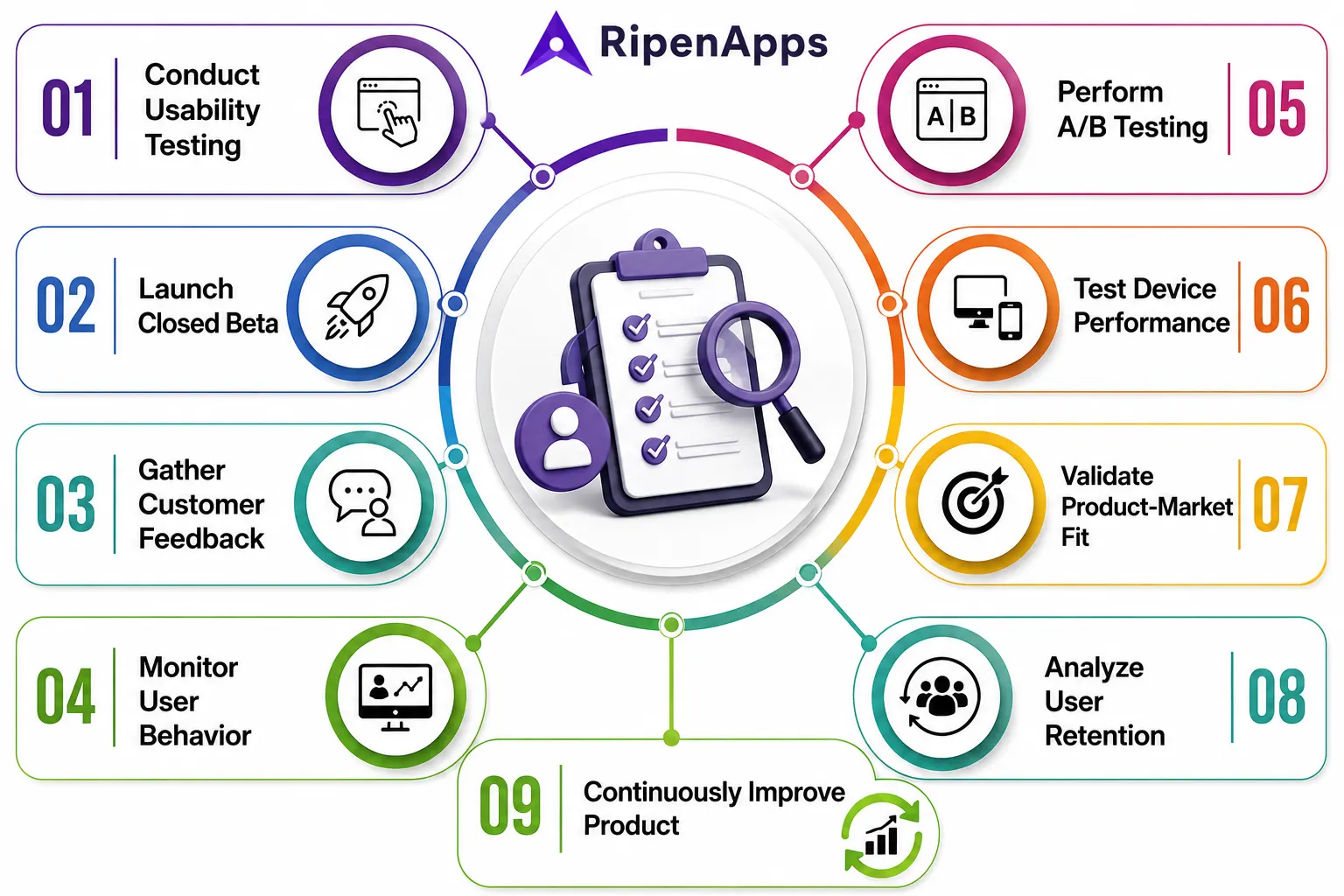
1. Conduct Usability Testing
Usability testing evaluates how easily users can complete essential tasks within your application. Even if the technology functions perfectly, confusing navigation or unintuitive interfaces can discourage adoption.
During usability sessions, participants perform realistic tasks while observers identify areas where they hesitate, become confused, or abandon processes altogether. These observations often uncover friction points that internal teams overlook because they are already familiar with the product.
Testing should focus on critical user journeys such as registration, onboarding, searching, purchasing, or completing primary workflows. Measuring completion rates, task duration, and user satisfaction helps determine whether the interface supports a seamless experience.
One of the most common mistakes during MVP usability testing is providing excessive guidance. Allow users to interact naturally without intervention, as authentic behavior produces the most reliable insights.
Expected outcomes include improved navigation, simplified onboarding, higher task completion rates, and stronger customer satisfaction before launch.
2. Launch a Closed Beta Program
A closed beta introduces your MVP to a carefully selected group of early adopters before making it publicly available. This controlled environment allows businesses to collect detailed feedback while minimizing reputational risks associated with broader releases.
Beta participants often represent your ideal customer segment and are more willing to provide constructive suggestions than general users. Their experiences reveal how the application performs under realistic conditions while highlighting opportunities for refinement.
Maintain regular communication with beta testers throughout the program. Frequent check-ins encourage honest discussions about usability, missing features, performance concerns, and overall product value.
Rather than focusing exclusively on bug reports, evaluate how users incorporate the application into their daily routines. Consistent usage often provides stronger evidence of product-market fit than positive opinions alone.
The insights gathered during closed beta testing frequently determine whether an MVP is ready for public release or requires another iteration cycle.
3. Gather Customer Feedback Through Surveys
User feedback provides valuable context that analytics alone cannot explain. While behavioral data reveals what users do, surveys help uncover the reasons behind their actions.
Effective surveys remain concise and focus on specific experiences instead of broad satisfaction questions. Encourage participants to describe their biggest challenges, favorite features, missing functionality, and overall impressions after using the product.
Combining rating scales with open-ended questions creates a balanced feedback system. Numerical scores simplify trend analysis, while written responses reveal opportunities for product improvement.
Timing also plays a crucial role. Requesting feedback immediately after meaningful interactions generally produces more accurate responses than sending surveys days later.
Businesses reviewing MVP vs Prototype often recognize that MVP surveys generate market validation insights, whereas prototype evaluations primarily assess design concepts before development begins.
Expected outcomes include clearer feature prioritization, improved customer understanding, and stronger alignment between product development and market expectations.
4. Monitor User Behavior with Analytics
Observing actual user behavior often reveals insights that differ significantly from direct customer feedback. Users may claim to enjoy a feature while rarely interacting with it, making behavioral analytics essential for objective decision-making.
Analytics platforms monitor user journeys from registration through long-term engagement. Product teams can identify where users abandon onboarding, which features receive the most attention, and which workflows require optimization.
Monitoring behavioral trends over time also highlights improvements resulting from product updates. Instead of relying on assumptions, businesses can evaluate each iteration using measurable evidence.
Segmentation further enhances analysis by comparing behaviors across user groups based on location, device type, acquisition channel, or subscription plan. These insights help prioritize enhancements that deliver the greatest business impact.
The expected outcome is a deeper understanding of customer behavior, enabling faster iterations supported by reliable data rather than intuition.
5. Perform A/B Testing
A/B testing compares two versions of the same feature to determine which variation produces better user engagement or conversion outcomes. Rather than debating design decisions internally, product teams allow real users to identify the most effective option.
Common elements tested during MVP validation include onboarding screens, pricing pages, call-to-action buttons, layouts, feature placement, and messaging. Small changes frequently generate meaningful improvements in user engagement.
Successful A/B testing requires testing one variable at a time. Simultaneously changing multiple elements makes it difficult to determine which modification influenced user behavior.
Testing should also continue long enough to produce statistically reliable results. Drawing conclusions too early may lead to incorrect product decisions based on temporary trends.
Modern analytics platforms simplify experiment management while automatically measuring conversion rates, retention, and engagement metrics across both versions.
The expected outcome is data-driven optimization that improves customer experience while increasing confidence in future product decisions.
6. Test Performance Across Devices
A seamless user experience depends not only on functionality but also on consistent performance across different devices, operating systems, screen sizes, and network conditions. An MVP that performs flawlessly on one smartphone but crashes or slows down on another can significantly affect user perception and reduce retention.
Modern users access mobile applications using a wide range of devices. Android alone includes thousands of device configurations, while iOS users expect a consistently smooth experience across different iPhone models. Testing your MVP across multiple environments helps identify compatibility issues before they affect a larger audience.
Performance testing should evaluate application speed, loading times, responsiveness, battery consumption, memory usage, and network efficiency. Teams should also simulate real-world conditions such as poor internet connectivity, interrupted sessions, and high server traffic to understand how the application behaves under stress.
Cloud-based testing platforms, device farms, and automated testing frameworks make cross-device testing faster and more reliable. Combining automated testing with manual verification provides comprehensive coverage and ensures that critical user journeys function correctly regardless of device or operating system.
One common mistake is limiting performance testing to high-end smartphones. Since users own devices with varying hardware capabilities, testing should represent your target audience rather than ideal conditions.
The expected outcome is a stable, reliable, and responsive application that delivers a consistent experience across devices, improving user satisfaction and reducing technical issues after launch.
7. Validate Product-Market Fit
One of the primary goals of MVP validation is determining whether the product solves a meaningful problem for a clearly defined audience. This process, known as product-market fit validation, helps businesses understand whether customers genuinely value their solution or simply find it interesting.
Product-market fit cannot be measured through downloads alone. Instead, it becomes evident when users consistently return to the application, recommend it to others, and integrate it into their daily routines.
Customer interviews play a significant role during this stage. Asking users about their biggest challenges, favorite features, and reasons for continued usage provides insights that numerical data cannot capture. Understanding why customers choose to stay or leave helps product teams refine their value proposition before scaling.
Businesses should also analyze customer acquisition channels, retention trends, referral rates, and willingness to pay. These indicators collectively demonstrate whether the product delivers sustainable value within its target market.
Teams that successfully validate product-market fit often scale more confidently because future investments are based on proven customer demand rather than assumptions.
8. Analyze Customer Retention and Engagement Metrics
User acquisition is only the beginning of a successful MVP launch. Long-term growth depends on retaining customers and encouraging continuous engagement with the product.
Retention metrics reveal whether users continue finding value after their initial experience. High download numbers combined with low retention typically indicate unresolved usability issues, weak product-market fit, or insufficient customer value.
Engagement analysis should focus on how frequently users interact with the application, which features receive the highest adoption, and how much time users spend completing important tasks. These insights highlight both strengths and opportunities for improvement.
Businesses should evaluate daily active users, monthly active users, session duration, repeat usage, feature adoption, and customer lifetime value together rather than independently. Looking at multiple metrics provides a more accurate picture of product health than relying on a single indicator.
Comparing engagement trends before and after product updates also helps determine whether new features improve customer satisfaction or unintentionally introduce additional friction.
Organizations reviewing successful MVP examples often discover that sustained user engagement, not initial downloads, served as the strongest indicator of long-term product success.
The expected outcome is a deeper understanding of customer behavior, enabling teams to prioritize improvements that strengthen retention and support sustainable business growth.
9. Continuously Iterate Based on Feedback
Launching an MVP does not represent the end of product development; it marks the beginning of continuous learning. Every testing cycle generates new information that should influence future improvements.
Successful startups treat user feedback as an ongoing resource rather than a one-time activity. Instead of waiting for extensive redesigns, they release incremental improvements, measure user responses, and repeat the validation process regularly.
Iteration should combine multiple sources of information, including analytics, customer interviews, usability testing, support requests, and business metrics. Reviewing these insights together helps distinguish isolated opinions from recurring user needs.
Prioritization remains equally important. Not every suggestion should become a feature. Product teams must evaluate whether requested improvements align with business objectives, customer demand, and long-term product strategy.
Businesses seeking to hire full-stack developers for MVP development often benefit from cross-functional teams capable of implementing rapid improvements without introducing technical debt or delaying future releases.
Continuous iteration creates a culture of learning, allowing products to evolve alongside changing customer expectations while maintaining development efficiency.
The expected outcome is an increasingly refined product with stronger usability, higher customer satisfaction, and greater readiness for large-scale market expansion.

Essential Metrics to Measure During MVP Testing
Collecting feedback without measuring performance leaves product teams with incomplete information. Meaningful metrics transform user behavior into actionable insights, allowing businesses to evaluate whether their MVP is progressing toward its objectives.
Each metric contributes to understanding a different aspect of product performance, from user acquisition to long-term customer loyalty. Together, they provide a comprehensive framework for informed decision-making throughout the MVP testing process.
| Metric | What It Measures | Why It Matters |
| Activation Rate | Percentage of users completing key onboarding actions | Indicates whether users quickly understand the product value |
| User Retention | Percentage of users returning after initial usage | Measures long-term engagement and product usefulness |
| Churn Rate | Percentage of users leaving the product | Identifies customer dissatisfaction and product weaknesses |
| Customer Satisfaction Score (CSAT) | Overall user satisfaction | Reflects customer experience after using the product |
| Net Promoter Score (NPS) | Willingness to recommend the product | Measures customer loyalty and future growth potential |
| Daily Active Users (DAU) | Number of daily users | Shows consistent product engagement |
| Monthly Active Users (MAU) | Number of monthly users | Evaluates broader product adoption |
| Feature Adoption Rate | Usage frequency of individual features | Helps prioritize future product development |
| Session Duration | Average time spent using the application | Indicates engagement and usability quality |
| Conversion Rate | Percentage of users completing target actions | Measures business performance and user motivation |
| Customer Acquisition Cost (CAC) | Cost of acquiring each customer | Assesses marketing efficiency and growth sustainability |
| Customer Lifetime Value (LTV) | Total revenue generated by a customer | Supports long-term business planning and profitability |
Rather than monitoring every available metric, businesses should focus on indicators that directly align with their product goals. Measuring relevant KPIs consistently produces more meaningful insights than tracking numerous unrelated data points.
How AI Is Transforming MVP Testing
Artificial intelligence is redefining how startups and enterprises validate digital products. Traditional MVP testing often relied on manual observation, customer interviews, and basic analytics to understand user behavior. While these methods remain valuable, AI enables businesses to uncover deeper insights, automate repetitive processes, and make faster product decisions based on large volumes of real-time data.
As mobile applications become more intelligent, MVP testing is evolving from reactive analysis to proactive decision-making. AI-powered tools can identify user behavior patterns, predict potential issues, and recommend product improvements long before they become obvious through conventional analysis. This allows product teams to iterate more efficiently while reducing the uncertainty associated with launching new products.
Businesses exploring AI in MVP development are increasingly integrating machine learning models into their testing workflows to improve customer understanding, optimize product performance, and accelerate validation cycles. Rather than replacing human judgment, AI enhances decision-making by providing actionable insights that support data-driven product development.
AI-Powered Analytics
Modern analytics platforms powered by artificial intelligence go beyond tracking user actions. They identify hidden behavioral patterns, group users into meaningful segments, and highlight trends that may otherwise remain unnoticed.
Instead of manually reviewing thousands of user sessions, product teams receive intelligent recommendations based on customer interactions. AI can identify which onboarding steps create the highest drop-off rates, which features contribute most to long-term retention, and which user groups demonstrate the strongest engagement.
These insights help businesses prioritize improvements that deliver measurable business value instead of relying on assumptions or isolated feedback.
Predictive User Behavior
One of AI’s greatest strengths is its ability to predict future outcomes using historical data. During MVP testing, predictive models estimate which users are likely to become loyal customers, discontinue using the application, or require additional engagement.
Understanding these patterns early allows businesses to improve onboarding experiences, personalize communication, and reduce customer churn before the public launch.
For example, if predictive analytics identifies that users abandoning onboarding share similar behavioral characteristics, product teams can redesign that experience to improve activation rates and increase customer retention.
Predictive insights transform MVP testing from simply measuring current performance into anticipating future customer behavior.
Automated Testing
Testing every feature manually becomes increasingly difficult as products grow more complex. AI-powered automation simplifies this process by executing repetitive test scenarios with greater speed and consistency.
Automated testing platforms verify application functionality across multiple devices, operating systems, and user journeys while significantly reducing manual effort. They continuously monitor software quality after every product update, allowing development teams to identify regressions before customers experience them.
Automation also shortens release cycles because testing occurs continuously throughout development rather than only before launch.
Intelligent Bug Detection
Traditional bug reporting often depends on customer complaints or manual quality assurance in mobile app development. AI significantly accelerates this process by identifying unusual application behavior automatically.
Machine learning algorithms monitor crash reports, performance logs, API responses, and system behavior to detect anomalies that indicate potential technical issues. Instead of waiting for repeated failures, teams receive early warnings that enable proactive problem resolution.
This capability becomes particularly valuable during MVP validation, where maintaining a stable user experience directly influences customer satisfaction and product credibility.
AI-Generated Product Insights
Collecting large volumes of feedback is only useful if businesses can interpret the information effectively. AI simplifies this challenge by summarizing customer comments, categorizing recurring issues, identifying feature requests, and detecting overall user sentiment.
Rather than reading every survey response individually, product managers receive organized reports highlighting the most common themes and opportunities for improvement.
This reduces analysis time while ensuring important customer insights are not overlooked.
Personalized Testing Experiences
Every user interacts with an application differently. AI enables businesses to personalize testing experiences based on individual behavior, preferences, and engagement history.
Instead of presenting identical onboarding flows to every participant, intelligent systems can recommend customized tutorials, feature suggestions, or interface adjustments that improve overall usability.
Personalized experiences generate richer feedback because users interact with products that better align with their expectations and usage patterns.
As AI capabilities continue advancing, MVP testing will become increasingly adaptive, allowing businesses to validate products more efficiently while delivering highly personalized customer experiences from the earliest stages of development.
What Happens After MVP Testing?
Completing an MVP testing cycle represents an important milestone, but it is not the finish line. The information collected during validation becomes the foundation for future product decisions, helping businesses determine what to improve, what to remove, and what to build next.
Successful companies treat MVP testing as the beginning of continuous product evolution rather than a final approval process. Every insight contributes to a stronger roadmap, enabling teams to invest resources where they create the greatest customer and business value.
In many cases, businesses use insights gained from MVP testing to refine their concepts through rapid prototyping services before expanding features and moving toward full-scale product development. This iterative approach helps validate improvements, reduce development risks, and build products that better align with customer expectations.
Prioritize Product Improvements
Not every suggestion gathered during MVP testing deserves immediate implementation. Product teams should evaluate each recommendation according to customer demand, business impact, technical complexity, and long-term strategic goals.
Grouping feedback into categories such as critical fixes, usability enhancements, feature requests, and future innovations helps establish a clear development roadmap.
Prioritization ensures resources remain focused on improvements that strengthen product-market fit rather than introducing unnecessary functionality.
Refine the Product Roadmap
The original product roadmap often changes after businesses observe real customer behavior. Features initially considered essential may prove less valuable, while unexpected user needs frequently emerge during testing.
A flexible roadmap allows businesses to respond to validated learning instead of rigid development plans. Continuous refinement keeps the product aligned with changing customer expectations while maintaining development efficiency.
Enhance Core Features
One of the most common outcomes of MVP validation is discovering that existing features require improvement before additional functionality is introduced.
Rather than expanding the application immediately, businesses should strengthen the features customers use most frequently. Improving usability, simplifying workflows, increasing performance, and resolving friction points often generates greater customer satisfaction than launching entirely new capabilities.
Building on validated strengths creates a stronger foundation for future product growth.
Prepare for Product Scaling
Once customer demand has been validated, businesses can begin planning for larger user bases, higher traffic volumes, and increased operational complexity.
Scaling involves much more than infrastructure upgrades. Teams must evaluate application architecture, database performance, security, monitoring systems, and deployment processes to ensure the product remains reliable as adoption increases.
Organizations investing in product engineering services benefit from scalable architectures that support long-term business growth without compromising application performance or user experience.
Optimize Before Public Launch
Before introducing the application to a wider audience, businesses should complete one final optimization phase using the insights collected during MVP testing.
This stage includes improving onboarding experiences, refining interface design, resolving performance issues, strengthening analytics implementation, and enhancing customer support processes.
Launching only after addressing validated improvements significantly increases the likelihood of positive first impressions and stronger customer retention.
Embrace Continuous Improvement
Customer expectations evolve continuously, making product optimization an ongoing responsibility rather than a one-time project.
Regular performance reviews, feature enhancements, usability improvements, and technology upgrades enable businesses to remain competitive while adapting to changing market conditions.
As products mature, organizations often adopt software modernization services to improve scalability, integrate emerging technologies, strengthen security, and maintain long-term business value.
Continuous optimization ensures products remain relevant throughout their lifecycle while supporting sustainable innovation and future growth.

Conclusion
The most successful products are rarely built perfectly on the first attempt. They evolve through continuous learning, rapid experimentation, and data-driven decision-making. Every testing cycle strengthens the product, helping teams prioritize meaningful improvements and allocate resources more effectively.
Partnering with an experienced technology team further accelerates this journey. From product discovery and rapid prototyping to MVP development, testing, optimization, and long-term product scaling, the right expertise enables businesses to launch faster while building products customers genuinely value.
If you’re ready to validate your product idea, reduce development risks, and launch with confidence, RipenApps can help you transform your vision into a market-ready digital product through proven MVP development and testing strategies.
FAQs
1. What is MVP testing?
MVP testing is the process of validating a Minimum Viable Product with real users to determine whether it solves a genuine problem. It helps businesses gather feedback, validate assumptions, and improve the product before a full-scale launch.
2. How do you test an MVP before launch?
Start by defining clear objectives, selecting your target audience, and testing core features. Collect user feedback, analyze behavior with analytics tools, and continuously improve the product based on real insights.
3. What are the best MVP testing strategies?
Some of the most effective MVP testing strategies include usability testing, closed beta testing, customer surveys, A/B testing, performance testing, analytics tracking, and continuous product iteration based on user feedback.
4. What metrics should you track during MVP testing?
Track metrics such as activation rate, user retention, churn rate, feature adoption, session duration, conversion rate, CSAT, NPS, and customer lifetime value. These KPIs help measure user engagement and product success.
5. How long should MVP testing last?
There is no fixed timeline for MVP testing. It should continue until you have enough user feedback and data to validate your assumptions and confidently decide the next product development steps.
6. What tools are best for MVP testing?
Popular MVP testing tools include Firebase Analytics, Mixpanel, Amplitude, Hotjar, UXCam, Google Analytics 4, Instabug, and Firebase Crashlytics for tracking user behavior and product performance.
7. POC vs Prototype vs MVP: What’s the Difference?
POC vs Prototype vs MVP are different stages of product validation. A Proof of Concept (POC) verifies whether an idea is technically feasible. A Prototype demonstrates the product’s design, user flow, and functionality without being a fully working solution. A Minimum Viable Product (MVP) is a functional version with core features that is launched to real users for feedback and market validation. Choosing the right approach depends on your product goals, development stage, and business objectives.
8. What happens after MVP validation?
After validation, businesses prioritize improvements, enhance core features, refine their product roadmap, optimize performance, and prepare the application for a wider market launch.
9. Can AI improve MVP testing?
Yes. AI helps automate testing, analyze user behavior, predict customer trends, detect bugs faster, and generate actionable insights that improve product decisions and accelerate validation.
10. Should startups build an MVP before full product development?
Yes. Building an MVP allows startups to validate market demand, reduce development risks, gather early customer feedback, and make informed decisions before investing in a complete product.

SHARE
WRITTEN BY

Prankur Haldiya
Chief Technical Officer
A tech innovator and engineering leader, Prankur Haldiya drives RipenApps’ product development strategy and oversees cutting-edge solutions in mobility, AI, and cloud ecosystems. He is passionate about building high-performance teams and helping brands launch secure, scalable, and user-centric digital products.
View All Articles





 India
India USA
USA Australia
 Canada
 UK
UK UAE
UAE