

Key Takeaways
- Development cost: A focused MVP may cost $50,000 to $100,000, a mid-tier platform $100,000 to $250,000, and an advanced platform $250,000 to $500,000+.
- Development timeline: A focused MVP may take 3 to 5 months, while a broader platform can require 6 to 9 months or longer.
- Operating model: BaaS and sponsor-bank arrangements can provide infrastructure access, but they do not automatically eliminate the fintech’s compliance obligations.
- Core architecture: A reliable transaction ledger, idempotent payment processing, reconciliation, and dispute handling are essential.
- Payment rails: ACH, RTP, FedNow, and push-to-card support different transfer speeds, eligibility requirements, and settlement arrangements.
- Revenue model: Instant-transfer fees, eligible interchange revenue, merchant services, and premium features offer potential monetization opportunities.
- Launch strategy: Start with one customer segment and a limited payment flow before expanding into additional financial products.
Building a P2P payment app like Cash App typically costs $50,000–$100,000 for a focused MVP and takes 3–5 months, with advanced platforms reaching $250,000–$500,000+. The biggest decisions are the operating model (BaaS/sponsor bank vs. money transmitter license), the payment rails, and the ledger architecture. For US fintech startups, a banking-as-a-service (BaaS) or sponsor-bank partnership can simplify infrastructure access, while independent money transmission may require additional licensing and operational preparation.
Before development begins, founders need to determine how the application will hold, transfer, and reconcile funds. This decision shapes the banking partnerships, payment rails, compliance responsibilities, technical architecture, and overall budget. Businesses exploring fintech app development services should establish these requirements before finalizing their product scope.
This guide covers the operating models, features, compliance requirements, payment infrastructure, technology choices, costs, and timelines involved in building a P2P payment app. It also compares Cash App with other payment platforms to help founders identify the right approach for their business goals.
Table of Contents
What Is a P2P Payment App and How Does Cash App Work?
A P2P payment app lets individuals send, receive, and manage money digitally without exchanging cash or writing checks. Users can connect eligible funding sources, select recipients, initiate transfers, and track transaction statuses through a mobile application.
Cash App launched in 2013 as Square Cash, following Square’s founding in 2009. Developed by Block, Inc., it has expanded beyond person-to-person transfers into a broader financial platform. Block’s Q2 2026 shareholder letter reportedly puts Cash App’s monthly transacting actives at 59 million in June 2026.
How Does a P2P Payment Transaction Work?
A typical transaction follows seven stages:
- User onboarding: The customer creates an account and completes the required identity checks.
- Funding source: The customer links an eligible bank account, debit card, or supported in-app balance.
- Payment initiation: The sender selects a recipient, enters the amount, and confirms the transfer.
- Risk assessment: The system evaluates account status, transaction limits, available funds, and fraud indicators.
- Ledger processing: The application records the transaction and updates the relevant financial records according to its processing state.
- Payment routing: The system sends the transaction through the appropriate bank, processor, or payment network.
- Confirmation: The sender and recipient receive updates reflecting the actual transaction status.
A payment request can be accepted before the underlying funds reach their final destination. The application must distinguish between initiated, pending, completed, returned, and reversed transactions rather than treating every accepted request as settled.
Why Build a P2P Payment App?
A P2P payment product can help fintech startups, credit unions, neobanks, and marketplaces simplify money movement for a specific customer segment. Competing with established applications requires a clear value proposition rather than a feature-for-feature copy.
Potential opportunities include:
- Specialized customer segments: Serve communities, membership organizations, or customer groups with distinct payment needs.
- Embedded payments: Let users pay one another within an existing marketplace or financial application.
- Credit unions and neobanks: Improve digital payment experiences within a broader banking proposition.
- Shared expenses: Simplify bill splitting, group payments, and recurring transfers.
- Business payments: Extend a proven P2P experience into suitable merchant or business workflows.
Commercial viability depends on customer acquisition costs, transaction frequency, processing fees, fraud losses, and customer retention.
Choose Your Operating Model: BaaS Sponsor Bank vs. Money Transmitter License vs. White-Label
The operating model determines which financial activities the business performs, which partners it needs, and which regulatory obligations apply. Changing this model after architecture and integrations are established can require substantial rework.
| Operating model | How it works | Time-to-market considerations | Main trade-off |
| BaaS or sponsor-bank partnership | A bank and specialist providers supply agreed banking or payment capabilities | Often a practical route for an MVP, subject to partner due diligence and approval | Faster access to infrastructure, but fees, contractual limits, and oversight requirements apply |
| Independently licensed money transmitter | The business obtains the licenses and infrastructure required for its activities | Often a longer path because licensing and compliance preparation can precede launch | Greater operational independence, with additional legal and compliance responsibilities |
| White-label platform | A third party supplies much of the existing payment product and infrastructure | Potentially faster for a limited product scope | Less customization and greater vendor dependence |
These models are not mutually exclusive. A white-label vendor may operate through sponsor banks or licensed entities, while a BaaS arrangement may still require the fintech to obtain particular registrations or licenses.
How Should Founders Choose?
For an early-stage US startup, a sponsor-bank or BaaS model can provide access to financial infrastructure without requiring the business to build every capability independently.
Evaluate prospective partners against the following questions:
- Which entity holds customer funds and under what legal arrangement?
- Who performs identity verification, sanctions screening, and transaction monitoring?
- Which states, customer types, funding methods, and payment rails are supported?
- Who handles returns, disputes, complaints, and regulatory reporting?
- What happens if the provider suspends the program or terminates the relationship?
- Can the product migrate to another provider without rebuilding its ledger?
Review the 2023 interagency guidance on third-party relationships (FDIC, Federal Reserve, OCC), and obtain advice from qualified US payments counsel before committing to an operating model.
How to Build a P2P Payment App: 9 Steps
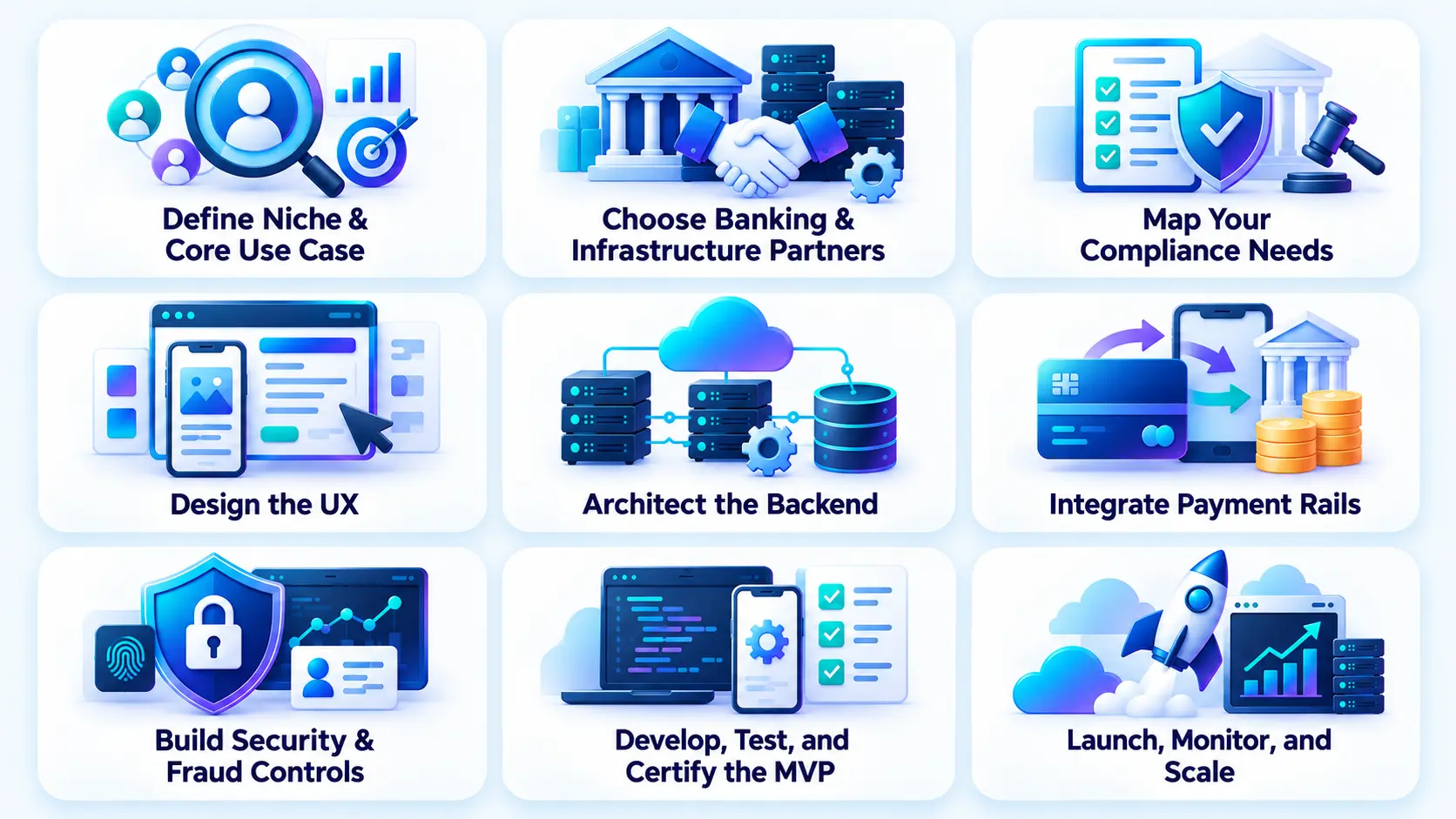
Building a P2P payment app requires coordinated product, financial, regulatory, and technical decisions. These nine steps outline the key decisions from initial planning through launch and scaling.
1. Define Your Niche and Core Use Case
Identify the customers who will use the app, the problem they need solved, and the situations in which they will transfer money.
A credit union might want to simplify transfers between members, while a marketplace might need payments between buyers, sellers, or service providers. Their onboarding requirements, transaction limits, dispute workflows, and integrations can differ significantly.
Define the following before designing the application:
- Primary customer segment and geographic coverage.
- Supported funding and withdrawal methods.
- Typical transaction size and frequency.
- Whether users maintain an in-app balance.
- Expected transfer speed and fee structure.
- Initial fraud risks and customer support requirements.
Keep the first release focused. Adding international remittances, investments, cryptocurrency, lending, and merchant acquiring simultaneously can multiply compliance and infrastructure requirements.
2. Choose Your Banking and Infrastructure Partners
A P2P app may require a sponsor bank, BaaS provider, processor, account-linking service, identity verification provider, and access to payment networks. The exact combination depends on the operating model and product scope.
Common integration categories include:
- Banking and payment infrastructure: Account issuance, balances, money movement, and program support where applicable.
- Bank-account linking: Services such as Plaid can support eligible external account connections and relevant verification workflows.
- Identity verification: Document checks, identity data validation, and risk-based verification.
- Compliance tools: Screening and monitoring capabilities appropriate to the product’s obligations.
- Card and payment processing: Debit-card funding or payouts where supported.
- Notifications and customer support: Transaction alerts, secure communication, and complaint management.
Compare providers on supported use cases, eligibility, transaction limits, pricing, service levels, and responsibility for operational incidents. Review their security controls, audit evidence, incident history, financial stability, and capacity to support expected transaction volumes.
3. Map Your Compliance Requirements
Requirements depend on the activities performed, legal entities involved, states served, and selected banking and payment partners.
| Requirement | What to evaluate |
| FinCEN and MSB obligations | Whether the business qualifies as a money services business and which federal registration and reporting duties apply |
| State money transmitter licensing | Whether the planned activities require licenses in individual states or qualify for an exemption |
| BSA/AML | Applicable risk assessments, monitoring, recordkeeping, and suspicious activity reporting |
| OFAC sanctions | Screening requirements and procedures for handling potential matches |
| Regulation E and EFTA | Consumer disclosures, unauthorized electronic transfers, error resolution, and applicable liability rules |
| Nacha rules | Requirements for applicable ACH participants and service providers |
| PCI DSS | Payment-card data protection requirements relevant to the product’s role and cardholder-data environment |
| GLBA and state privacy laws | Safeguards for financial information, privacy notices, and applicable consumer rights |
FinCEN explains that businesses meeting the money services business definition may have registration and Bank Secrecy Act obligations. State money transmission licensing is a separate question. See FinCEN’s MSB registration guidance and its MSB classification guidance for detailed information.
Reflect applicable obligations in onboarding, transaction limits, disclosures, monitoring, recordkeeping, and customer support. Qualified US legal and compliance professionals should determine the requirements for the proposed model.
4. Design the UX and Build a Clickable Prototype
A payment app should make transfers simple while reducing the risk of mistakes. Users need to recognize the recipient, understand the amount and fees, and know whether a transfer is pending, completed, or failed. The prototype should cover registration, identity verification, bank linking, recipient selection, payment review, confirmation, transaction history, receipts, account recovery, and support requests.
Make the recipient and amount especially prominent on the confirmation screen. Where transfers may be difficult to reverse, explain the consequences before the customer submits the payment. Test the prototype with prospective users to identify confusing steps, accessibility issues, unclear fees, and incorrect assumptions about fund availability.
5. Architect the Backend: Ledger, Idempotency, and Reconciliation
The ledger records the financial effects of transactions and provides the basis for balances, history, reconciliation, and dispute investigations. A production application should not treat a payment as a simple update to a balance field.
- Use a consistent transaction ledger: Represent financial movements with balanced entries, usually through a double-entry accounting model. Record transaction identifiers, amounts, currency, account references, timestamps, and processing states. Corrections and reversals should create explicit records rather than silently overwriting financial history.
- Make payment requests idempotent: Network failures can cause requests to time out, and users may tap a confirmation button repeatedly. Idempotency keys and transaction-state checks help prevent duplicate transfers when the same request is retried.
- Separate authorization from settlement: Model transactions through explicit states such as initiated, submitted, accepted, settled, returned, and reversed. Update the user interface according to confirmed provider events.
- Reconcile internal and external records: Compare the internal ledger with bank statements, payment-network reports, processor records, and provider balances. Investigate missing transactions, duplicates, unexpected returns, and settlement differences.
- Plan dispute handling: Retain the transaction details and evidence needed to investigate errors, trace transfers, respond to complaints, and meet applicable deadlines.
For example, if a $100 transfer is funded through an ACH debit that is later returned, the system needs a defined return and recovery workflow. The ledger should record the relevant financial effects instead of assuming the original transfer remains fully funded.
Together, ledger controls and reconciliation help operations teams identify discrepancies, trace transactions, and resolve financial errors.
6. Integrate Payment Rails: ACH, RTP, FedNow, and Push-to-Card
Payment rails determine how funds move between financial institutions or eligible accounts. Each option has different settlement characteristics, eligibility rules, costs, and operational requirements.
| Payment rail | Typical characteristics | Potential use |
| ACH | Electronic bank transfers processed through the ACH Network; timing depends on the service and processing arrangements | Bank funding and withdrawals |
| RTP | Real-time payments through The Clearing House’s network, available around the clock through participating institutions | Eligible instant account-to-account payments |
| FedNow | Federal Reserve instant-payment service for participating banks and credit unions | Instant transfers supported by participating institutions |
| Push-to-card | Transfers to eligible debit cards through supported card-payment services | Faster payouts where card and provider eligibility permit |
The Federal Reserve’s FedNow overview, The Clearing House’s RTP information, and Nacha’s ACH resources explain the relevant US payment systems and rules.
These rails are not interchangeable. Availability depends on the sender’s and recipient’s financial institutions, account eligibility, provider capabilities, and product requirements. Instant-payment availability does not mean every transfer is risk-free or automatically recoverable.
A startup might launch with ACH and an eligible faster-payout option, then introduce additional rails as demand and operational readiness justify the complexity. The architecture should support reliable account linking, provider-event processing, payment-status tracking, error handling, and reconciliation.
7. Build Security and Fraud Controls
P2P payment applications face account takeover, identity theft, synthetic identities, stolen payment credentials, social engineering, and authorized push-payment scams. In the last category, a legitimate customer may approve a transfer after being deceived.
Security should cover the full transaction lifecycle:
- Multi-factor authentication: Apply appropriate authentication to sign-in, sensitive account changes, and high-risk actions.
- Device and session risk: Identify unusual devices, suspicious session behavior, and account-recovery attempts.
- Behavioral biometrics: Where justified, use behavioral signals to help identify abnormal activity, with appropriate privacy safeguards.
- Transaction monitoring: Evaluate transfer amounts, velocity, account age, recipient patterns, and other risk indicators.
- Adaptive limits: Apply limits based on verification status, transaction risk, and product policy.
- Recipient confirmation: Display the intended recipient clearly and warn users about suspicious payment requests.
- Secure data handling: Encrypt sensitive data, restrict internal access, protect secrets, and maintain audit logs.
- Incident response: Establish procedures for suspected fraud, compromised accounts, outages, and customer notifications.
Fraud controls must balance loss prevention with usability: excessive false positives frustrate legitimate customers, while weak monitoring increases financial and operational risk.
AI can help identify unusual transaction patterns when supported by suitable data and validated against real outcomes. Explore AI fraud detection in fintech apps for additional approaches. AI complements fundamental controls rather than replace authentication, transaction limits, monitoring, and investigation procedures.
8. Develop, Test, and Certify the MVP
Build an MVP around the core payment flow and the controls required to operate it safely. A first release may include registration, identity verification, bank linking, sending and receiving payments, transaction history, notifications, support workflows, and an administrative dashboard. The final scope depends on which capabilities partners provide and which the product must implement itself.
Development should cover mobile applications, backend APIs, account management, transaction processing, ledger integration, payment-rail integrations, audit logging, and monitoring.
Test more than successful payments. Include duplicate requests, delayed provider responses, rejected transfers, partial outages, returned ACH transactions, and mismatched settlement records. Complete the required integration tests, security assessments, and launch-readiness checks before releasing the application.
Treat production approval and partner authorization as explicit project dependencies. A successful sandbox integration does not guarantee launch approval.
9. Launch, Monitor, and Scale
A successful launch depends on operational readiness as much as software quality. Start with a controlled rollout and defined transaction limits rather than unrestricted access immediately. Before launch, confirm that customer support, incident response, fraud escalation, reconciliation, compliance reporting, and provider communications are operational. Document responsibility for investigating failed transfers and resolving complaints.
Monitor transfer success and failure rates, settlement times, fraud losses, onboarding completion, reconciliation exceptions, complaint volumes, and infrastructure availability. Use these indicators to identify bottlenecks and improve the product. Expand transaction limits, payment rails, and customer segments only when risk controls and operational capacity support the change.
Scaling a P2P application means improving financial and operational reliability alongside transaction volume, not simply adding more servers.
Must-Have and Advanced Features of a P2P Payment App
Prioritize features according to customer needs, risk exposure, and implementation costs.
| Feature category | MVP features | Advanced features |
| Account management | Registration, authentication, profile, account recovery | Multi-account management and personalized controls |
| Identity verification | Identity checks and verification status | Risk-based verification and ongoing reviews |
| Payments | Send, receive, request money | Scheduled transfers and group expenses |
| Funding | Eligible bank-account and debit-card linking | Additional funding options and routing rules |
| Transaction management | History, receipts, payment status | Advanced search, exports, and dispute tracking |
| Notifications | Payment confirmations and security alerts | Configurable alerts and personalized insights |
| Fraud prevention | Transaction limits, authentication, basic monitoring | Advanced anomaly detection and risk models |
| Administration | User support, account restrictions, transaction lookup | Advanced case management and risk analytics |
Features That Deserve Particular Attention
- Real-time transaction visibility: Display clear payment statuses so users can distinguish processing transfers from completed, returned, or failed transactions.
- Payment requests: Let users request money from contacts and share payment links where appropriate. Include controls to reduce unwanted requests and payment-request scams.
- Dispute and support workflows: Provide an accessible way to report unauthorized transactions and payment errors. Support teams need transaction records to investigate each case.
- Administrative dashboard: Authorized staff should be able to review transaction states, investigate exceptions, manage account restrictions, and track reconciliation problems through controlled access.
- Advanced fraud analytics: Introduce additional risk signals based on measurable fraud patterns and validated performance. AI should complement fundamental controls.
Lending introduces separate underwriting, funding, and regulatory requirements. See our guide to P2P lending app development for more details.
Tech Stack for a P2P Payment App
The right technology stack depends on integration requirements, performance needs, security architecture, and the team’s experience. Financial infrastructure should be selected for reliability and maintainability rather than novelty.
| Technology layer | Potential choices | Purpose |
| Mobile application | React Native, Flutter, Swift, Kotlin | Cross-platform or native mobile experiences |
| Backend services | Java, Kotlin, TypeScript with Node.js, Python | APIs, business logic, integrations, and transaction workflows |
| Database | PostgreSQL or another suitable relational database | Transactional records and operational metadata |
| Ledger | Dedicated ledger service or a carefully designed double-entry system | Financial entries, balance integrity, and transaction history |
| Messaging | Managed queues or event-streaming platforms | Asynchronous processing and event delivery |
| Cloud infrastructure | AWS, Microsoft Azure, or Google Cloud | Hosting, networking, monitoring, and recovery |
| Security | Managed key services, secrets management, encryption, MFA | Protection of credentials, sensitive data, and privileged access |
| Observability | Centralized logs, metrics, tracing, and risk analytics | Operational visibility, incident detection, and fraud monitoring |
React Native or Flutter can suit startups that want to support iOS and Android with a shared codebase. Native development may be preferable when the product requires specialized platform capabilities or a highly tailored experience.
Financial transactions need explicit state transitions, consistent ledger entries, authorization checks, and durable processing. A relational database can support transactional integrity, while queues help manage asynchronous provider events and notifications.
Cloud services reduce infrastructure management, but they do not automatically make a payment platform secure or compliant. Configure access controls, encryption, backups, recovery procedures, audit logging, and monitoring according to the product’s risk profile. Changing the ledger model or transaction-processing architecture late in development can be more expensive than changing the mobile framework.
How Much Does It Cost to Build an App Like Cash App?
The estimated cost to build a P2P payment app ranges from $50,000 to $500,000+. A focused MVP generally requires a smaller investment than a multi-platform product with multiple payment rails, advanced fraud controls, and extensive operational tooling.
These figures are planning estimates for custom development, not fixed quotations. Actual costs depend on the operating model, partner fees, compliance scope, team composition, and project requirements. Regulatory capital, licensing expenses, and certain legal costs should be budgeted separately where applicable.
Cost by App Complexity
| App type | Estimated development cost | Typical scope |
| Focused P2P MVP | $50,000–$100,000 | Core transfers, onboarding, verification integrations, transaction history, essential administration |
| Mid-tier P2P platform | $100,000–$250,000 | Expanded payment options, stronger fraud controls, reconciliation tooling, richer administration |
| Advanced payment platform | $250,000–$500,000+ | Multiple integrations, complex workflows, advanced risk management, broader operational capabilities |
Actual costs may fall outside these ranges when integrations, compliance, or partner requirements differ.
Established BaaS infrastructure can reduce the need to build financial capabilities in-house. However, integration work, legal support, and partner-specific requirements can still add to the project budget.
An advanced product can become more expensive when it supports multiple jurisdictions, maintains independent licensed operations, or adds international remittances, cards, or investment features.
Cost by Development Phase
The following is an illustrative allocation for a hypothetical $100,000 MVP, not a project quote.
| Development phase | Illustrative allocation | Estimated budget |
| Discovery and requirements | 10% | $10,000 |
| UX research and design | 12% | $12,000 |
| Application and backend development | 38% | $38,000 |
| Financial and third-party integrations | 18% | $18,000 |
| Testing and security validation | 15% | $15,000 |
| Deployment and launch preparation | 7% | $7,000 |
Partner fees, legal work, independent compliance assessments, and regulatory costs may require separate budget lines. Complex financial integrations can also increase the integration and testing budget.
Ongoing Costs After Launch
The initial build is only part of the investment. A P2P payment business must continue funding infrastructure and operations to process transactions safely.
| Expense | What drives the cost |
| Cloud infrastructure | Traffic, storage, availability requirements, and monitoring |
| BaaS and banking fees | Program charges, account fees, and contractual pricing |
| Identity verification | Per-check charges, verification depth, and repeat checks |
| Payment processing | Rail-specific fees, card costs, and transaction volume |
| Fraud and compliance operations | Monitoring tools, investigations, screening, and reporting |
| Maintenance and support | Software updates, incident response, customer service, and provider changes |
| Security and audits | Testing, remediation, assessments, and applicable compliance requirements |
There is no reliable universal monthly operating-cost figure without knowing transaction volume and partner contracts. Estimate recurring costs using expected active users, transfers per user, average transfer value, verification rates, fraud assumptions, and provider pricing. For a more detailed budgeting framework, review fintech app development cost.
How Long Does It Take to Build?
A focused P2P payment MVP may take approximately 3 to 5 months, while a broader platform can require 6 to 9 months or longer. These estimates assume a defined scope and timely access to required infrastructure partners.
Discovery, design, development, integration, and testing may overlap. External dependencies can extend the schedule, particularly when the business requires independent licensing or complex financial integrations.
Financial integrations, risk controls, and operational approvals often have a greater impact on delivery timelines than the number of screens.
How Do P2P Payment Apps Like Cash App Make Money?
The right revenue mix depends on customer behavior, partner agreements, transaction economics, and applicable regulatory requirements.
| Revenue stream | How it works | Business consideration |
| Instant-transfer fees | Users pay for eligible expedited transfers or withdrawals | Fees should reflect service costs and customer expectations |
| Interchange revenue | The business may receive a share of eligible debit-card transaction economics | Depends on card issuance, network rules, and partner agreements |
| Merchant payments | Merchants pay applicable fees for accepting payments or using business features | Requires a clear merchant use case and suitable arrangements |
| Premium features | Customers pay for additional account features or services | Must deliver value beyond the free core experience |
| Business accounts | Businesses pay for payment management and reporting tools | Works best when business users have recurring needs |
| Partner-based products | The platform earns eligible revenue from financial products offered through partners | Requires separate regulatory and contractual analysis |
Not every revenue stream will be available at launch; eligibility depends on partner arrangements, product capabilities, and regulatory requirements. Interchange economics depend on issuing and processing arrangements, while merchant payments introduce additional operational requirements.
Model revenue per active customer alongside payment costs, fraud losses, support, and customer acquisition expenses. High transaction volume does not guarantee profitability if each transfer has unfavorable unit economics.
Building an App Like Venmo vs. Cash App: What Changes?
Cash App and Venmo both support peer-to-peer payments, but their broader product experiences differ. Zelle offers another model centered on transfers through participating financial institutions.
| Builder consideration | Cash App-inspired product | Venmo-inspired product | Zelle-inspired product |
| Core emphasis | P2P payments within a broader financial platform | Socially oriented payments and shared expenses | Bank-integrated person-to-person payments |
| User experience | Simple transfers with opportunities to add financial services | Friend discovery, payment notes, and group expenses | Transfers through participating financial institutions |
| Potential differentiator | Expandable financial product ecosystem | Social interactions and shared payment workflows | Convenience through existing banking relationships |
| Main challenge | Managing the scope and risk of additional financial services | Making social features useful without compromising privacy | Partner and bank participation requirements |
How to Make an App Like Venmo
If your audience values shared expenses and social interactions, prioritize payment requests, group expense tracking, optional payment notes, and contact discovery.
Social features require clear privacy controls. Users should understand which transaction details are visible to other people and be able to control visibility where supported.
How to Make an App Like Cash App
If the goal is a broader financial platform, start with dependable P2P transfers and a clearly defined funding and withdrawal experience. Add debit-card functionality or other financial products only when partner arrangements, customer demand, and compliance requirements support them.
How RipenApps Builds Secure Payment Apps
RipenApps has experience building a cross-border remittance and currency exchange application. Al Muzaini is a Kuwait-based exchange house. As of August 2026, the app had 100K+ Google Play installs. Its capabilities include AI-powered KYC onboarding, three-factor authentication with biometric login, Western Union network integration, and a real-time foreign-exchange engine.
The project demonstrates RipenApps’ experience with financial onboarding, authentication, transfer integrations, and FX workflows.

Conclusion
Building a P2P payment app starts with a clearly defined payment flow, a suitable operating model, and an infrastructure strategy that supports the business’s requirements. For many early-stage fintechs, a focused MVP built on established financial infrastructure offers a practical starting point.
Development may cost $50,000 to $500,000+ and take 3 to 9 months or longer, depending on scope and partner requirements. Define the payment flow, validate the business model, and assess integration and operational risks before committing to a budget. RipenApps helps businesses turn fintech concepts into secure, scalable digital products. With experience building financial applications such as Al Muzaini’s currency exchange and money transfer app, RipenApps can help you evaluate your product requirements, technical priorities, and development roadmap before moving forward.
FAQs
1. How much does it cost to build an app like Cash App?
A custom P2P payment app may cost $50,000 to $100,000 for a focused MVP, $100,000 to $250,000 for a mid-tier platform, or $250,000 to $500,000+ for an advanced product. Banking partnerships, payment integrations, compliance requirements, and security controls influence the final cost.
2. Do I need a money transmitter license to build a P2P payment app?
Possibly. Licensing depends on the activities your business performs, the states served, applicable exemptions, and the structure of your banking or payment partnerships. Federal MSB registration and state money transmitter licensing are separate considerations. Consult qualified US payments counsel before launch.
3. Can I build a P2P payment app without a bank?
You can build the software without owning a bank, but moving customer money generally requires appropriate arrangements with financial institutions and payment providers. A sponsor-bank or BaaS model may provide access to the necessary infrastructure, subject to partner approval and applicable legal requirements.
4. How long does it take to build a P2P payment app?
A focused MVP may take approximately 3 to 5 months, while a broader platform can take 6 to 9 months or longer. Partner onboarding, legal reviews, payment integrations, security testing, and production approvals can extend the schedule beyond core software development.
5. How do P2P payment apps make money?
P2P payment apps may earn revenue from instant-transfer fees, eligible debit-card interchange, merchant payments, premium features, and partner-based financial products. Available options depend on the business model and partner agreements. Profitability also depends on transaction costs, fraud losses, customer acquisition, and retention.
6. What tech stack is used to build a P2P payment app?
A typical stack may use React Native or Flutter for mobile applications, Java or TypeScript for backend services, PostgreSQL for transactional data, and cloud infrastructure for hosting and monitoring. The architecture should also include reliable ledger processing, secure integrations, reconciliation, and appropriate fraud controls.
Discuss your project and request for proposal
SHARE
WRITTEN BY

Ishan Gupta
CEO & Founder
Ishan Gupta is a seasoned entrepreneur and CEO with extensive 10+ years of experience in business and mobile app development landscape. He believes that the right digital product allows companies to focus on what they do best, while technology handles the rest. With deep exposure to global markets, he understands what makes an app succeed. His approach translates business needs into clear product strategies, ensuring that every feature contributes to measurable ROI.
View All Articles