


Quick Summary
A minimum viable product helps startups validate ideas before investing in full-scale development. This blog explores five real-life minimum viable product examples, including Dropbox, Airbnb, Uber, and two RipenApps-built products, highlighting the validation strategy behind each. Learn actionable MVP lessons, common pitfalls, and practical frameworks to build scalable, market-ready products with greater confidence.
Key Takeaways
- Successful MVPs validate one critical business assumption before investing in full-scale product development and long-term scalability efforts.
- The best minimum viable product examples prioritize customer feedback over feature completeness, reducing risks and accelerating product-market fit.
- Different MVP types, including concierge, explainer video, and marketplace models, solve unique validation challenges for startups and enterprises.
- AI tools make MVP development faster, but validating the right customer problem remains the most important success factor today.
- Businesses partnering with experienced MVP development teams can reduce development waste while building products aligned with real market demand.
A minimum viable product example is a real-world demonstration of how successful companies launched with the simplest version of their product to validate demand before scaling. These MVPs were not polished platforms. They were controlled experiments designed to test market need, user behavior, and willingness to pay with minimal investment.
For startup founders, minimum viable product examples are not inspirational stories alone. They are strategic playbooks that reveal how billion-dollar companies reduced risk, validated assumptions, and reached product-market fit faster than competitors. Understanding these examples helps leaders make better investment decisions and avoid building products no one wants.
For businesses evaluating MVP development services, these case studies highlight a critical truth: success comes from validating the right idea before investing in full-scale development. The most successful startups focused on testing real customer demand, refining their products through feedback, and scaling only after proving market fit. In this article, we explore five powerful minimum viable product examples, the strategy behind each one, and the practical lessons modern businesses can apply in 2026.
Table of Contents
What is a minimum viable product, and how does it work in startups?
A minimum viable product is the simplest version of a product that solves a core user problem while enabling real-world validation with early adopters. It is built to learn, not to scale.
In practical terms, an MVP helps startups test assumptions around demand, usability, and pricing before committing significant engineering or design resources. It is a risk-reduction strategy that prioritizes learning speed over feature completeness. Many founders also partner with a startup app development company to build an MVP efficiently while balancing speed, scalability, and long-term product goals.
The concept of ”what is an MVP product” comes from lean startup methodology, where iterative feedback loops are used to refine products based on real user behavior rather than internal assumptions.
MVP vs prototype vs full product in simple terms
A prototype demonstrates how something might work. A minimum viable product tests whether people actually want it. A full product focuses on scalability, performance, and long-term market expansion.
While prototypes stay internal, MVPs enter the market. This distinction is critical for startups aiming to reduce burn rate and accelerate validation cycles.
If you’re still evaluating the right validation approach, understanding the differences between POC vs Prototype vs MVP can help you choose the most effective strategy for your product stage.
Why do successful startups rely on minimum viable product?
Successful startups rely on minimum viable products because they reduce risk by validating customer demand before significant investments in development. According to CB Insights, “no market need” is one of the leading reasons startups fail, making early validation more important than building a feature-rich product. Research from CB Insights shows that a significant percentage of startups fail due to “no market need,” making validation more important than execution perfection.
Minimum viable product examples help leadership teams:
- Reduce early-stage development waste
- Validate real customer demand before scaling
- Identify pricing sensitivity early
- Improve product-market fit accuracy
- Accelerate learning cycles in competitive markets
However, MVPs also come with limitations. Poorly designed MVPs can misrepresent user needs, leading to incorrect conclusions. In some cases, over-simplification hides critical product complexity, especially in enterprise software or regulated industries. For CTOs, the key is balance, building fast while still testing the right assumptions with structured product engineering services and iterative feedback loops.
What is the 5-Signal MVP Framework, and why does it matter?
The 5-Signal MVP Framework helps businesses evaluate what their MVP should actually prove before they build anything. Instead of treating MVPs as “small versions of products,” this framework defines them as validation systems.
Each MVP should validate at least one core signal:
- Demand: Do users want this solution at all?
- Behavior: Do users engage the way we expect?
- Willingness-to-Pay: Will users actually pay for it?
- Retention: Do users come back after first use?
- Scalability: Can the core idea grow efficiently?
This framework matters because most MVP failures happen when companies try to validate everything at once. Strong MVPs isolate one risk and test it clearly.
For example, a startup may use ui ux design services to test usability, while another may focus purely on pricing validation using landing pages or manual workflows. The goal is not perfection. The goal is clarity of learning.
What are real-world minimum viable product examples that have built successful startups?
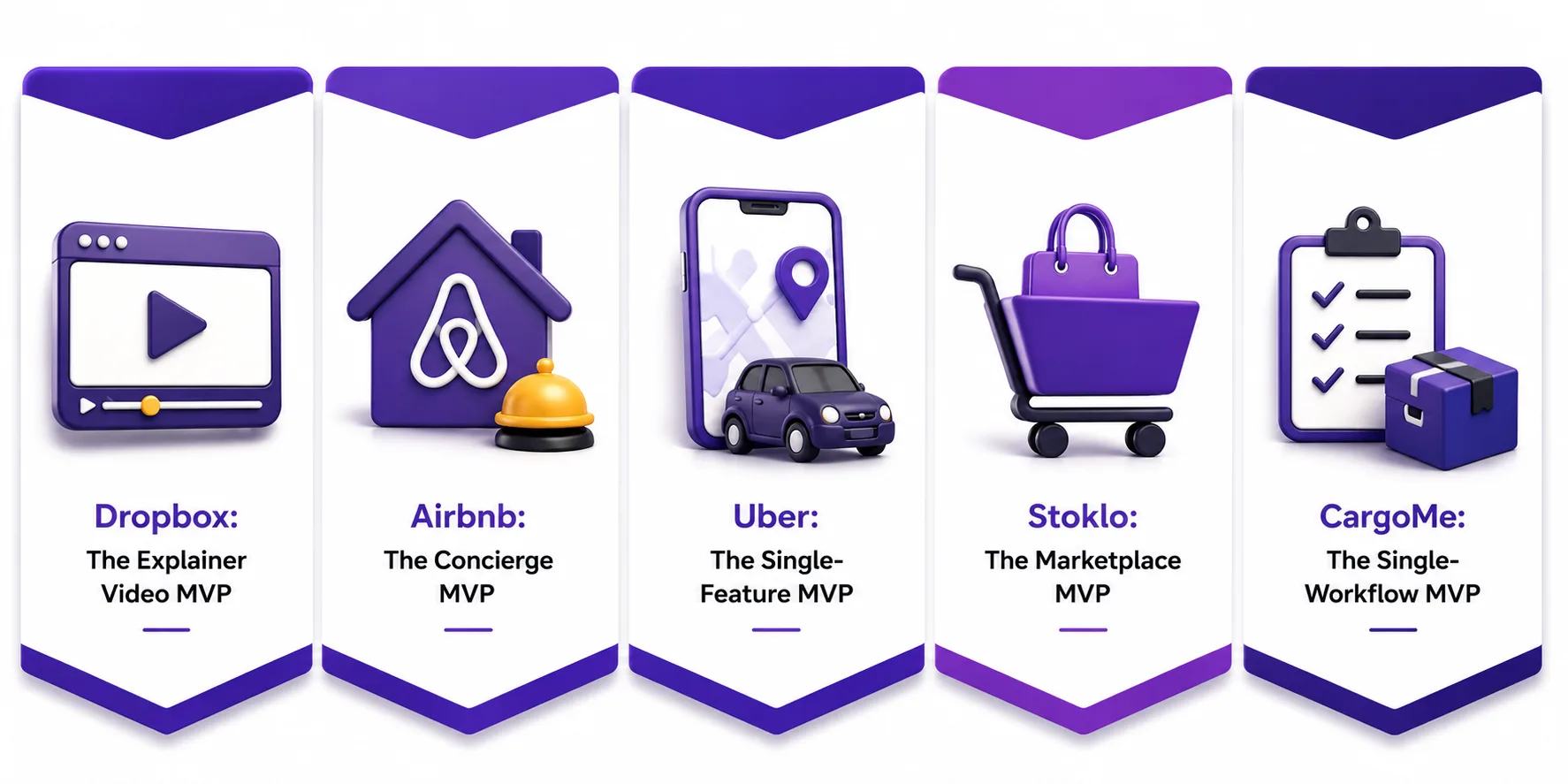
Below are five powerful minimum viable product examples that shaped some of the most successful companies in modern tech history. Each one validates a different signal and uses a different MVP approach.
1. Dropbox: The Explainer Video MVP (Demand Validation)
Dropbox is one of the most cited minimum viable product examples in startup history. Instead of building a full product upfront, the team created a simple explainer video demonstrating how file syncing would work. There was no scalable backend at launch. No full infrastructure. Just a concept video targeted at early adopters.
The result was immediate. The waitlist reportedly jumped from a few thousand users to tens of thousands overnight. This validated a strong market demand before heavy engineering investment.
Key insight:
Dropbox proved that sometimes the best MVP is not software; it is storytelling.
Limitation to note:
This approach works well for digital products but may not validate usability or long-term engagement patterns early enough.
2. Airbnb: The Concierge MVP (Behavior Validation)
Airbnb started as a simple solution to test whether people would rent space in strangers’ homes. The founders listed their own apartment and manually managed guest interactions. Early versions involved basic listings, manual coordination, and even in-person photography for hosts. Nothing was automated.
This helped validate real user behavior rather than assumptions about trust and hospitality markets.
Key insight:
Airbnb proved that users were willing to adopt a completely new travel behavior model.
Limitation to note:
Concierge MVPs are operationally heavy and do not scale, which can delay technical validation if overused.
3. Uber: The Single-Feature MVP (Scalability Validation)
Uber initially launched as UberCab, a simple black car booking service in a single city. The MVP focused on one core action: connecting riders with drivers through a mobile request system.
There were no advanced features, surge pricing systems, or global scaling mechanisms at the start. The goal was to validate whether the core transaction model could scale.
Key insight:
Uber proved that scaling starts with a single reliable core loop, not a full ecosystem.
Limitation to note:
Single-feature MVPs may underestimate complexity when expanding into multi-region operations.
4. CargoMe by RipenApps: The Single-Workflow MVP (Scalability Validation)
CargoMe introduced a focused logistics MVP centered on one essential function: connecting cargo owners with transport providers through a simplified booking process. Instead of building a complete logistics management platform, the team prioritized shipment requests, carrier matching, and order tracking.
This approach allowed CargoMe to validate the platform’s core transaction, gather real customer feedback, and refine the booking experience before investing in advanced logistics capabilities and automation.
Key insight:
CargoMe proved that validating a single high-value workflow is the fastest way to test a logistics business model before scaling operations.
Limitation to note:
A single-workflow MVP validates the core user journey but does not address the operational complexities that arise when expanding into multi-region logistics, fleet management, and advanced supply chain features.
How MVP Development is Evolving in 2026
In 2026, the meaning of a minimum viable product has shifted from “Can we build it?” to “Are we validating the right problem?” AI-powered development tools, low-code platforms, and automation have dramatically reduced the time and cost required to launch an MVP, making development more accessible than ever.
This shift is reflected in the 2025 DORA Report: State of AI-assisted Software Development by Google Cloud, which found that 90% of software professionals now use AI in their development workflows, up 14% year over year, and more than 80% report higher productivity based on a survey of nearly 5,000 professionals. Faster development, however, does not guarantee better products. It simply enables teams to build ideas more quickly.
Startups often rush into development without validating assumptions, leading to wasted iterations despite faster tooling. This is where structured product discovery services and early-stage validation frameworks become critical. The real competitive advantage is no longer speed of building, but accuracy of learning.
What Are the Benefits of Investing in MVP Development for Startups?
Investing in MVP development gives startups a structured way to validate ideas before committing significant time, budget, and engineering resources. Instead of building a feature-rich product based on assumptions, an MVP enables businesses to test their value proposition with real users, gather actionable feedback, and make data-driven decisions. While an MVP doesn’t eliminate all business risks, it significantly improves the chances of building a product that aligns with market demand.
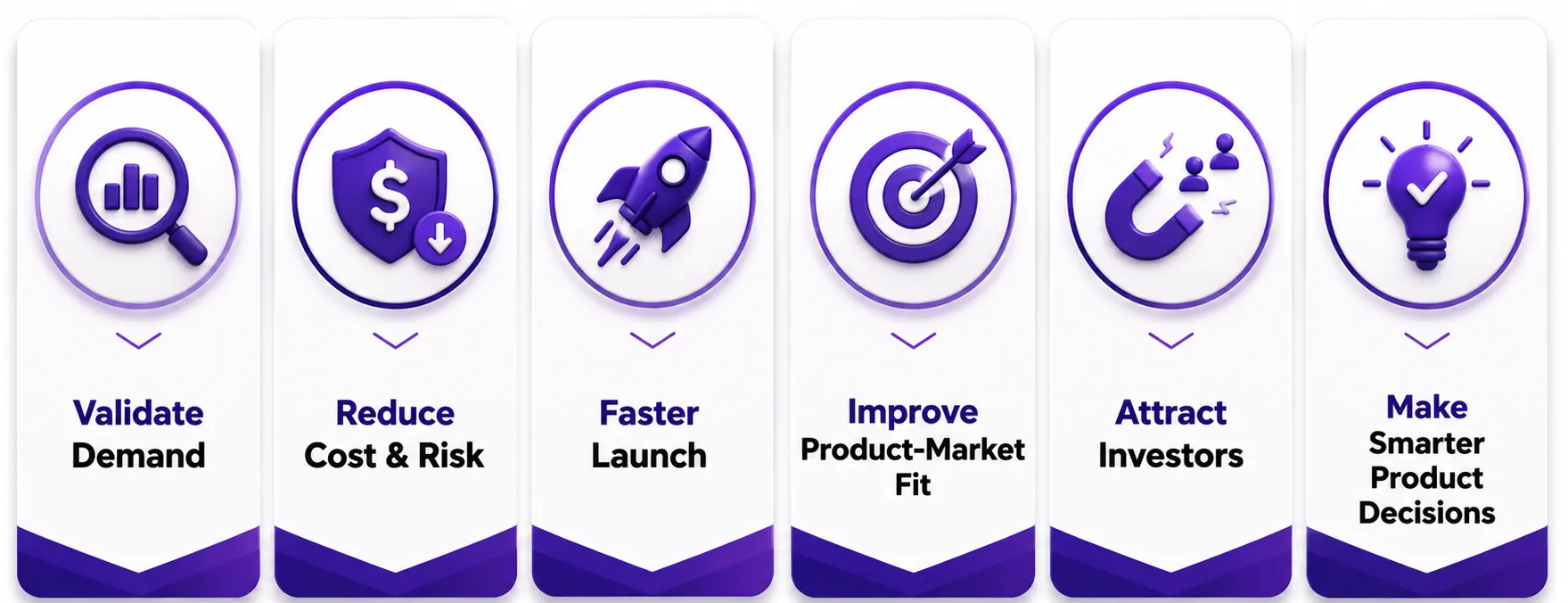
Validate Market Demand Early
An MVP helps startups determine whether customers genuinely need their solution before investing in full-scale development. Early validation reduces the risk of building products with limited market appeal and provides confidence for future investments.
Reduce Development Costs and Risks
Building only the essential features minimizes upfront development costs and prevents unnecessary spending on functionality users may never adopt. However, startups should ensure the MVP still delivers enough value to generate meaningful customer feedback.
Accelerate Time to Market
Launching an MVP enables businesses to enter the market faster, gain a competitive advantage, and begin collecting user insights sooner. Faster launches also create opportunities to refine the product based on real-world usage rather than internal assumptions.
For mobile-first startups, exploring the reasons to choose Flutter for MVP Development can help reduce development time, maintain a single codebase, and accelerate cross-platform launches without compromising user experience.
Improve Product-Market Fit
Early adopters provide valuable feedback on usability, features, and customer expectations. These insights help product teams prioritize future enhancements and improve product-market fit through continuous iteration instead of costly redesigns.
Combining customer feedback with the best ways for MVP testing helps startups validate usability, performance, and market demand before scaling their product.
Attract Investors with Real Validation
A well-executed MVP does more than validate a product idea; it demonstrates traction that investors can evaluate. Instead of relying solely on projections or pitch decks, startups can showcase real user adoption, customer feedback, and early engagement, making investment conversations more credible and data-driven.
This matters even more in today’s funding environment. According to CB Insights’ Venture Trends 2025, global venture funding rebounded to $469 billion in 2025, up 47% year over year, but the number of deals declined by 17% to 29,501. In other words, investors are writing larger checks to fewer startups, placing greater emphasis on demonstrated market validation and measurable traction. AI startups alone attracted 48% of total venture funding, further increasing competition for capital. For founders, an MVP with proven customer demand can be a stronger differentiator than an ambitious product roadmap alone.
Enable Smarter Product Decisions
One of the biggest advantages of MVP development is faster learning. By testing hypotheses with real users, startups can identify what works, eliminate what doesn’t, and make informed product decisions with greater confidence before scaling.
Additionally, AI in MVP development enables teams to analyze user feedback, identify behavioral patterns, and prioritize feature improvements more efficiently. However, AI should complement customer validation rather than replace direct user insights, as real-world feedback remains essential for achieving product-market fit.
What mistakes do companies make when building MVPs?
Many startups misinterpret MVPs as incomplete products rather than learning tools. This leads to over-engineering early versions, which defeats the purpose of rapid validation. Another common mistake is underestimating MVP development cost by adding unnecessary features too early, which increases budgets without improving validation outcomes.
Common mistakes include:
- Building too many features in version one
- Ignoring qualitative user feedback
- Testing multiple assumptions at the same time
- Failing to define success metrics before launch
- Treating MVP as a final product instead of an experiment
These mistakes often lead to slow iteration cycles and unclear product direction, especially in complex digital ecosystems built through software modernization services or enterprise-scale systems.
How can businesses apply MVP lessons to their own product strategy?
If you’re wondering how to build an MVP, the process begins with identifying your riskiest assumption rather than building the maximum number of features. Businesses should start by identifying their riskiest assumption before writing a single line of code.
Once the assumption is defined, teams should choose the simplest validation method available. This could be a landing page test, a manual workflow, or a prototype built using rapid prototyping services.
Finally, success metrics should be clearly defined in advance. Without measurable outcomes, MVPs lose their strategic value. For enterprise teams, combining MVP thinking with product engineering and structured UX validation ensures faster learning cycles and better scalability outcomes.
Conclusion
MVP examples are not just startup stories; they are decision-making frameworks that reduce risk and accelerate learning. From Dropbox’s video validation to Uber’s single-feature launch, each example proves that successful products begin with clarity, not complexity. For modern businesses, Minimum viable product development thinking is no longer optional. It is a core capability that determines how efficiently organizations innovate, validate markets, and scale digital products in competitive environments. Companies that embrace structured experimentation consistently outperform those that rely on assumptions.
RipenApps helps startups and enterprises transform ideas into validated digital products through strategic MVP planning, design, and engineering execution, enabling faster market entry and stronger product-market fit.
FAQs
1. What is a minimum viable product example?
A minimum viable product example is a real-world product launched with only the essential features needed to solve one core problem and validate market demand. Companies like Dropbox, Airbnb, and Zappos used MVPs to test customer interest, gather feedback, and refine their products before investing in full-scale development.
2. How to Build a Minimum Viable Product for a Startup Successfully?
To build a Minimum Viable Product for a startup successfully, begin by identifying the core problem your product solves and the riskiest assumption you need to validate. Develop only the essential features that address this problem, launch the MVP to a targeted group of early users, collect measurable feedback, and iterate based on real user behavior. This lean, data-driven approach minimizes development risk, improves product-market fit, and creates a stronger foundation for scaling.
3. What is the most famous MVP example?
Dropbox is often considered the most famous MVP example because it validated demand with a simple explainer video before building the complete product. The video attracted thousands of early adopters, proving strong market interest while saving significant development time and costs.
4. How much does it cost to build an MVP in 2026?
The cost of building an MVP in 2026 depends on factors such as product complexity, features, technology stack, AI integration, and development location. A simple MVP costs significantly less than a full-scale product because it focuses only on validating the core business idea before further investment.
5. What is the difference between an MVP and a prototype?
A prototype demonstrates how a product will look or function, usually for internal testing or stakeholder feedback. An MVP is a working product released to real users to validate demand, collect market feedback, and measure product-market fit before expanding functionality.
6. What is MVP in a startup, and can a Website or Landing Page Be an MVP?
Yes. If you’re wondering “what is MVP in a startup?”, it refers to the simplest version of a product built to validate a business idea with real users. A landing page or website can serve as an MVP when its primary purpose is to test customer demand, pricing, or user interest before investing in full-scale product development. Companies like Buffer successfully used a simple landing page to collect sign-ups and validate willingness to pay before building the actual product.
Discuss your project and request for proposal
SHARE
WRITTEN BY

Prankur Haldiya
Chief Technical Officer
A tech innovator and engineering leader, Prankur Haldiya drives RipenApps’ product development strategy and oversees cutting-edge solutions in mobility, AI, and cloud ecosystems. He is passionate about building high-performance teams and helping brands launch secure, scalable, and user-centric digital products.
View All Articles