


Quick Summary
LLM app development goes beyond selecting an AI model; it requires the right architecture, cost strategy, governance, and deployment approach. This guide explains how businesses can build secure, scalable, and ROI-driven LLM applications, compare development approaches, estimate costs, and evaluate implementation strategies with real-world examples across multiple industries.
Key Takeaways
- Learn the core architecture required to build secure, scalable, and production-ready LLM applications for real business use cases.
- Understand the complete LLM application development process, from planning and model selection to deployment and ongoing optimization.
- Explore the key cost drivers, infrastructure requirements, and deployment strategies that influence long-term business success with LLM applications.
- Discover best practices for integrating AI agents, RAG, memory, and orchestration into reliable enterprise-grade LLM applications.
- Learn how businesses can reduce development risks, improve ROI, and accelerate AI adoption with the right development strategy and technology partner.
Large Language Model (LLM) app development is the process of building intelligent applications that use advanced AI models to understand, generate, and reason over natural language. For businesses, it goes far beyond adding a chatbot; it enables organizations to automate knowledge work, improve customer experiences, accelerate decision-making, and create entirely new AI-powered products.
As generative AI adoption accelerates, the real competitive advantage no longer comes from experimenting with LLMs. The rapid pace of enterprise AI adoption reflects this shift. According to Gartner, worldwide AI spending is projected to reach approximately $1.5 trillion in 2025, with AI application software spending alone expected to nearly double from $83.7 billion in 2024 to $172 billion in 2025, highlighting how businesses are moving from AI experimentation to large-scale production investments.
However, building successful LLM-powered applications requires much more than selecting the best LLM for app development. Business leaders must evaluate architecture, infrastructure, data readiness, security, compliance, operational costs, and long-term maintenance before approving investments. As AI-powered product development becomes a strategic priority across industries, many organizations partner with providers offering custom app development, AI consulting, cloud engineering, and application modernization to reduce implementation risks while accelerating time to market.
This guide explores the key architectural decisions, cost considerations, ROI frameworks, and implementation strategies behind successful LLM app development. Whether you’re building a customer-facing AI product or modernizing enterprise operations, the insights below will help you make informed technology decisions that support sustainable business growth.
Table of Contents
What Is LLM App Development and Why Is It a Strategic Business Investment?
LLM app development is the process of designing, developing, deploying, and continuously optimizing applications powered by Large Language Models (LLMs). These applications use advanced language intelligence to understand user intent, generate human-like responses, retrieve business knowledge, automate workflows, and support complex decision-making. Unlike traditional software, they combine AI models with enterprise data, business logic, and orchestration frameworks to deliver adaptive and context-aware experiences.
For many organizations, the first interaction with generative AI begins with a proof of concept. A small team connects an API, builds a conversational interface, and demonstrates how an LLM can summarize documents or answer questions. While these prototypes often generate excitement, they rarely reflect the technical and operational requirements of a production environment.
This is why LLM app development should be viewed as a business investment rather than simply an AI initiative. Similar to enterprise software modernization or cloud transformation, success depends on balancing technology choices with long-term business objectives. Decisions made during architecture planning can influence scalability, vendor flexibility, operational efficiency, and total cost of ownership for years after launch.
The rapid evolution of AI in Mobile App Development is enabling businesses to move beyond rule-based features and build intelligent applications capable of understanding context, automating workflows, and delivering personalized user experiences.
LLM Applications Are Different from Traditional AI Systems
Conventional machine learning solutions are designed to solve narrowly defined problems. They classify images, predict customer churn, detect fraudulent transactions, or forecast demand using structured datasets and predefined outputs. Their behavior remains relatively predictable because they are trained for specific tasks.
Large Language Models operate differently. They interpret natural language, reason across multiple sources of information, and generate responses dynamically based on context. This flexibility enables businesses to solve a much broader range of challenges using a single AI platform.
Today, organizations are using LLM applications to automate customer support, assist software developers, streamline legal document reviews, and provide intelligent employee knowledge assistants. These capabilities allow businesses to improve productivity without creating separate AI models for every individual workflow. The gap between an AI demo and a production-ready application is significant. According to McKinsey’s The State of AI 2025 report, more than 80% of organizations report no tangible enterprise-level EBIT impact from generative AI, while only 17% attribute at least 5% of their EBIT to these initiatives. The takeaway is clear: lasting business value comes from scalable implementation, not successful prototypes.
However, this flexibility also increases implementation complexity. Production-grade LLM-powered applications require retrieval systems, prompt orchestration, evaluation frameworks, security controls, and continuous monitoring to maintain quality over time. Without these supporting layers, even the most advanced model can produce inconsistent or unreliable results.
Why Decision-Makers Need to Think Beyond the AI Model
A common misconception is that selecting the most capable language model determines project success. In reality, the model represents only one component of a much larger technology ecosystem. Beyond automation, AI in product development is helping organizations accelerate feature innovation, improve customer experiences, and shorten product release cycles.
Business leaders should instead evaluate how the application will operate after deployment. Questions around enterprise integration, governance, security, compliance, infrastructure costs, and maintenance often have a greater impact on long-term success than the underlying model itself.
For example, an AI-powered customer service assistant must integrate with CRM platforms, authenticate users securely, retrieve accurate product information, and maintain response quality during peak traffic. Likewise, an internal enterprise assistant must respect role-based permissions and prevent confidential information from being exposed to unauthorized users. These operational requirements often determine whether an AI initiative creates measurable business value or becomes an expensive pilot that never scales.
According to McKinsey & Company, generative AI has the potential to add trillions of dollars in annual economic value across industries. Yet many organizations continue to struggle with scaling AI initiatives beyond experimentation due to challenges involving governance, integration, data quality, and organizational readiness.
What Makes LLM App Development a Strategic Investment?
Unlike conventional software projects, LLM app development introduces new cost models, operational risks, and governance responsibilities. AI inference costs fluctuate based on usage, model selection, and token consumption rather than fixed infrastructure alone. Performance must be measured through evaluation frameworks instead of deterministic test cases, while continuous model improvements require ongoing optimization rather than occasional software updates.
These differences change how organizations should evaluate AI investments. Instead of asking, “Which is the best LLM for mobile app development?”, executives should ask broader strategic questions:
- Will this architecture remain scalable over the next three years?
- Can we switch models without rebuilding the application?
- How will operational costs change as adoption grows?
- Does the solution meet our compliance and security requirements?
- How will we measure business outcomes and ROI after deployment?
Answering these questions early reduces technical debt, improves budget predictability, and creates a stronger foundation for long-term AI adoption.
As enterprise adoption continues to accelerate, successful organizations will increasingly differentiate themselves not by using the newest language model, but by building resilient, model-agnostic applications that evolve alongside advances in AI technology. The next step is understanding how modern LLM architectures are designed to achieve exactly that.
What is the Best Architecture for LLM App Development?
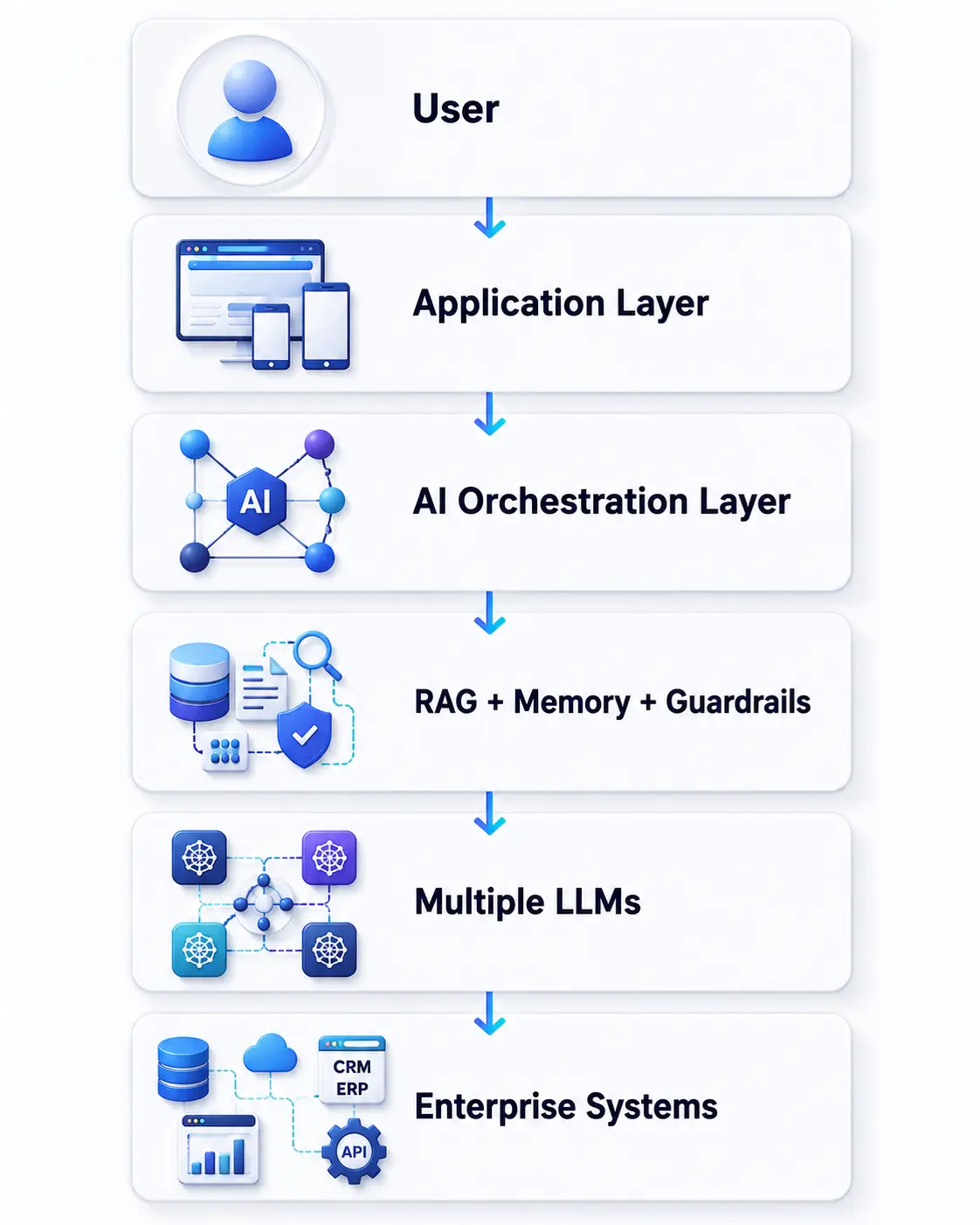
Selecting the right architecture is equally important when integrating modern AI technologies for mobile apps, as it determines scalability, security, and long-term flexibility.
Language models continue to evolve rapidly. A model that delivers the best performance today may no longer be the most cost-effective or capable option a year from now. Building applications that are tightly coupled to a single AI provider makes future upgrades expensive and limits an organization’s ability to adopt newer technologies. A model-agnostic architecture, on the other hand, allows businesses to switch models, optimize costs, and introduce new capabilities without rebuilding the entire application.
This architectural flexibility is becoming increasingly important as enterprises adopt multiple AI models for different business scenarios. For example, a customer support application may use a high-performance model for complex queries while routing routine requests to a smaller, lower-cost model. Such an approach improves operational efficiency without compromising the user experience.
A Three-Layer Architecture Creates Long-Term Flexibility
A scalable architecture forms the foundation of successful AI integration in business, allowing organizations to connect LLMs with enterprise data, existing applications, and critical business workflows. Most enterprise-grade LLM app development platforms follow a layered architecture that separates application logic from AI orchestration and model execution. This modular design simplifies maintenance, improves scalability, and reduces vendor dependency.
| Architecture Layer | Primary Responsibility | Business Value |
| Application Layer | User interface, APIs, authentication, workflows, and integrations | Enables independent product evolution and faster feature releases |
| Orchestration Layer | Prompt management, model routing, memory, retrieval, guardrails, and workflow coordination | Improves reliability while allowing multiple AI models to work together |
| Model Layer | Large Language Models and inference engines | Provides flexibility to replace or combine models without changing the application |
Each layer has a distinct role in delivering production-ready LLM-powered applications.
The Application Layer Connects AI with Business Workflows
The application layer represents everything users interact with, including web and mobile interfaces, dashboards, APIs, authentication systems, and integrations with enterprise platforms such as CRM, ERP, or customer support software.
From a business perspective, this layer determines how AI fits into existing operations. Organizations can continuously improve user experiences, introduce new features, or integrate additional services without modifying the underlying AI infrastructure.
For example, an AI-powered sales assistant may initially generate personalized emails. As business needs evolve, the same application can expand to create proposals, summarize customer meetings, and recommend follow-up actions without requiring a complete architectural redesign.
The Orchestration Layer Determines Application Intelligence
If the language model acts as the brain of an AI application, the orchestration layer serves as its operating system.
This layer coordinates how the application communicates with AI models, retrieves enterprise information, manages conversation history, invokes external tools, and validates responses before they reach users. It also applies business rules that help improve response quality and reduce operational risks.
A well-designed orchestration layer typically manages capabilities such as prompt engineering, retrieval workflows, memory management, model routing, output validation, and guardrails for sensitive information. Building a model-agnostic architecture is becoming increasingly important as the AI ecosystem evolves. Gartner predicts that by 2027, more than 50% of the generative AI models used by enterprises will be domain-specific, up from just 1% in 2024, making architectural flexibility essential for avoiding vendor lock-in and adopting future AI innovations.
Many organizations underestimate the importance of this layer during early development because demonstrations often interact directly with a language model. In production environments, however, orchestration frequently has a greater influence on reliability than the model itself. Without it, applications struggle to maintain consistent quality, especially when handling large volumes of enterprise data or complex workflows.
The Model Layer Should Remain Replaceable
The model layer contains the underlying Large Language Models responsible for reasoning and generating responses. Depending on business requirements, organizations may deploy proprietary foundation models, open-source alternatives, fine-tuned domain-specific models, or hybrid combinations of multiple models.
Keeping this layer independent from application logic allows organizations to evaluate emerging AI technologies without disrupting existing products. As pricing, capabilities, and regulations continue to evolve, businesses can adopt newer models based on performance, security, or cost rather than being locked into a single provider.
This flexibility also supports workload optimization. High-value tasks that require advanced reasoning may justify premium models, while routine interactions can often be handled by smaller, more economical alternatives.
Why Vendor Lock-In Can Increase Long-Term Costs
Speed is often the primary objective during an MVP, which leads many teams to build applications around a single AI provider’s ecosystem. While this approach accelerates initial development, it can create significant technical and financial challenges as applications mature.
Vendor lock-in may limit an organization’s ability to negotiate pricing, adopt new models, or comply with regional data residency requirements. It can also make future migrations costly because business logic becomes deeply integrated with provider-specific APIs.
A model-agnostic architecture minimizes these risks by separating orchestration from model execution. This enables businesses to evaluate new providers, optimize workloads, and maintain greater control over their AI strategy without extensive redevelopment.
Although building this level of flexibility requires additional planning during the early stages, it often reduces technical debt and improves long-term return on investment. A well-designed architecture should also prioritize AI in mobile app security through strong access controls, encryption, and governance mechanisms that protect sensitive enterprise data.
Which LLM Development Approach is Right for Your Business?
There is no universal blueprint for successful LLM app development. The right implementation approach depends on business objectives, data availability, budget, regulatory requirements, and the level of intelligence the application must deliver.
Some organizations can create substantial value through prompt engineering alone, while others require enterprise knowledge retrieval, domain-specific model customization, or autonomous AI agents capable of completing multi-step tasks. Choosing a more advanced approach than necessary often increases development costs without generating proportional business value.
Evaluating these options strategically helps organizations invest in the right level of AI capability instead of pursuing complexity for its own sake.
Four Common Approaches to LLM App Development
| Development Approach | Best Suited For | Relative Investment | Data Requirement | Time to Value |
| Prompt Engineering | MVPs, content generation, internal productivity tools | Low | Minimal | Fast |
| Retrieval-Augmented Generation (RAG) | Enterprise search, customer support, knowledge assistants | Medium | Business documents and knowledge bases | Moderate |
| Fine-Tuning | Industry-specific expertise, specialized language, regulated workflows | High | Large, high-quality datasets | Moderate to Long |
| Agentic or Hybrid Systems | Workflow automation, enterprise operations, AI assistants with decision-making capabilities | Very High | Multiple structured and unstructured data sources | Long |
Rather than viewing these approaches as competing alternatives, organizations should consider them as stages of AI maturity. Many successful LLM applications begin with prompt engineering, evolve into RAG-based systems, and later incorporate specialized models or AI agents as business requirements become more sophisticated.
Prompt Engineering Is the Fastest Path to Validation
Prompt engineering improves model performance through carefully designed instructions instead of modifying the underlying model. It remains one of the most practical approaches for organizations validating product ideas or exploring AI automation. Prompt engineering has also become an effective approach for AI in MVP development, allowing teams to validate ideas quickly before investing in more advanced AI architectures.
The primary advantage is speed. Businesses can launch prototypes within weeks, collect user feedback, and validate market demand before making larger infrastructure investments.
However, prompt engineering has practical limitations. Response quality can vary depending on user inputs, and applications have limited access to proprietary business knowledge unless additional retrieval mechanisms are introduced. As usage expands, organizations often find that prompts alone cannot provide the consistency, accuracy, or governance required for enterprise deployment.
Retrieval-Augmented Generation Delivers Better Business Knowledge
Retrieval-Augmented Generation (RAG) has become one of the most widely adopted architectures for enterprise LLM applications because it allows models to retrieve relevant business information before generating responses. Agentic AI adoption is accelerating, with a 2025 Google Cloud study reporting that 52% of executives are already using AI agents and 39% have deployed more than 10 in production. However, Gartner predicts that over 40% of agentic AI projects will be canceled by 2027, highlighting the need to prioritize business value over AI hype.
Instead of relying solely on the model’s training data, RAG connects AI systems to internal documents, knowledge bases, policies, contracts, product manuals, and other enterprise content. This significantly improves answer accuracy while ensuring information remains current.
For businesses, the biggest advantage is flexibility. New information can be added to the knowledge base without retraining the language model, making it easier to keep AI assistants aligned with evolving business requirements.
Despite these advantages, RAG is not a complete solution. Poor document quality, inconsistent data governance, or ineffective retrieval strategies can still produce inaccurate responses. Organizations should therefore treat data preparation as a business initiative rather than purely a technical task.
Fine-Tuning Is Best Reserved for Specialized Requirements
Fine-tuning modifies a language model using domain-specific datasets so it can perform specialized tasks more effectively. This approach is commonly used in industries such as healthcare, legal services, finance, and scientific research, where terminology, workflows, or regulatory requirements differ significantly from general-purpose language use.
While fine-tuning can improve accuracy for highly specialized applications, it also requires substantial investment in curated training data, model evaluation, and ongoing maintenance. In many cases, organizations discover that a well-designed RAG architecture delivers similar business outcomes with significantly lower cost and operational complexity.
For this reason, fine-tuning should be driven by measurable business needs rather than the assumption that a customized model always performs better. Many of today’s AI chatbot development trends are shifting from simple question-answer systems to intelligent assistants capable of reasoning, planning, and executing multi-step workflows.
Agentic AI Expands Automation Beyond Conversations
The latest generation of LLM-powered applications extends beyond answering questions. Agentic AI systems can plan tasks, interact with multiple software tools, execute workflows, and make context-aware decisions with minimal human intervention.
For example, an AI agent could receive a customer request, retrieve relevant account information, generate a personalized response, schedule a follow-up meeting, update the CRM system, and notify the sales team, all within a single workflow.
These capabilities offer significant productivity gains, but they also introduce greater complexity. Organizations must implement stronger governance, approval workflows, audit trails, and human oversight to ensure AI agents operate safely and align with business policies.
The most successful enterprises adopt agentic systems gradually, beginning with low-risk, repetitive processes before expanding automation into more complex operational areas. This measured approach helps balance innovation with security, compliance, and long-term business resilience.
What Is the Real Cost of LLM App Development?
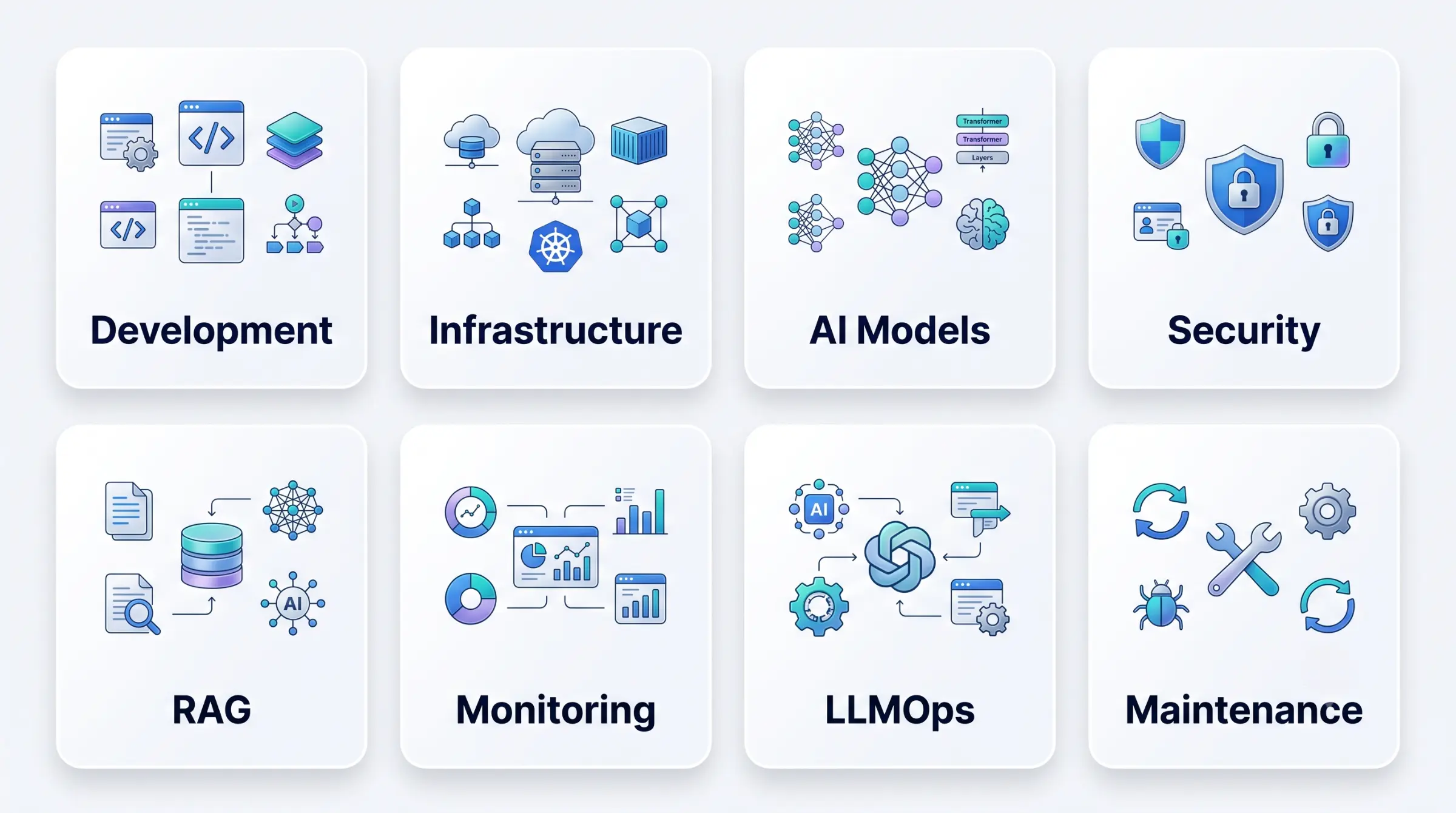
One of the biggest misconceptions about LLM app development is that the primary expense comes from AI model usage. While token pricing receives significant attention, it represents only one part of the total investment. Production-ready LLM-powered applications require infrastructure, security, monitoring, governance, and continuous optimization to operate reliably at scale.
Business leaders should evaluate the overall AI app development cost, including infrastructure, monitoring, security, and maintenance, rather than focusing only on model usage fees.
The actual investment varies depending on application complexity, user volume, deployment model, and compliance requirements. For example, an internal AI assistant built using Retrieval-Augmented Generation (RAG) has significantly different cost drivers than a customer-facing AI platform serving millions of requests every month. Understanding these variables helps organizations make informed architectural decisions instead of reacting to rising operational expenses after deployment.
Understanding the Total Cost of Ownership
Successful LLM app development requires more than integrating a language model into an application. Every production deployment includes multiple technical layers that contribute to long-term operating costs.
| Cost Component | Purpose | Business Impact | Monthly Cost |
| AI Inference | Processing prompts and generating responses | Variable costs increase with application usage | $500–$30,000+ (API-based); enterprise-scale deployments can exceed $100,000/month depending on request volume |
| Data & Retrieval Infrastructure | Stores and retrieves enterprise knowledge (vector databases, embeddings, storage) | Improves response accuracy and reduces hallucinations | $200–$5,000+ depending on data volume and RAG complexity. |
| Security & Guardrails | Protects sensitive information and enforces governance | Supports compliance and risk management | $1,000–$10,000+ including access controls, moderation, audit logging, and compliance tooling. |
| LLMOps & Monitoring | Tracks quality, performance, token usage, and model behavior | Ensures reliability after deployment | $300–$2,000+ for monitoring, observability, evaluation, and prompt management tools. |
| Application Development & Maintenance | Feature enhancements, integrations, testing, and ongoing support | Sustains product growth and business continuity | $5,000–$30,000+ for continuous engineering, AI optimization, and maintenance, depending on team size and release cadence. |
Although AI inference often represents the most visible expense, operational components such as monitoring, evaluation, and infrastructure management become increasingly important as applications scale.
AI Inference Costs Grow with Adoption
Unlike traditional software, where infrastructure costs are relatively predictable, LLM applications typically follow usage-based pricing. Every interaction consumes computational resources based on the selected model, prompt length, response size, and request volume.
During the early stages of adoption, these costs may appear manageable. However, as user engagement increases, monthly inference expenses can rise substantially. Customer support assistants, enterprise search platforms, and AI productivity tools that process thousands of requests daily require continuous monitoring to ensure costs remain aligned with business value.
Organizations should therefore evaluate model selection alongside workload characteristics. Premium models often provide better reasoning capabilities but may not be necessary for every interaction. Routing simpler requests to smaller models while reserving advanced models for complex tasks can significantly improve cost efficiency without compromising user experience.
Retrieval Infrastructure Is Essential for Enterprise AI
Most enterprise LLM-powered applications rely on Retrieval-Augmented Generation (RAG) rather than depending exclusively on a model’s training data. This architecture improves accuracy by retrieving relevant enterprise information before generating responses.
However, retrieval infrastructure introduces additional operational responsibilities. Organizations must maintain document repositories, synchronize knowledge bases, optimize indexing pipelines, and enforce access permissions to ensure users receive accurate and authorized information.
These investments improve response quality, but they also require ongoing maintenance as business knowledge evolves. Poorly managed retrieval systems can reduce application performance regardless of how capable the underlying language model may be.
Security and Governance Should Be Budgeted from the Beginning
As AI systems begin processing customer records, financial information, legal documents, or proprietary intellectual property, security becomes a core architectural requirement rather than an optional enhancement.
Enterprise AI deployments typically include encryption, identity management, audit logging, access controls, prompt filtering, and mechanisms that prevent sensitive information from appearing in generated responses. Organizations operating in regulated industries may also require additional governance frameworks to satisfy compliance obligations.
Although these capabilities increase implementation costs, postponing security investments often proves far more expensive after deployment. Retrofitting governance into an existing AI system can require significant architectural changes and may temporarily disrupt business operations.
Monitoring and Evaluation Continue Long After Deployment
Unlike conventional software, LLM model-powered app development requires continuous evaluation because language models generate probabilistic outputs rather than deterministic results.
Organizations must regularly monitor response quality, latency, hallucination rates, user feedback, and operational costs. Evaluation frameworks also help identify performance regressions after model updates or prompt modifications.
This ongoing discipline, commonly referred to as LLMOps, ensures applications remain reliable as business requirements and AI technologies evolve. While it introduces additional operational investment, it also reduces the risk of declining application quality over time.
Many unexpected implementation costs arise from common AI integration mistakes, such as poor data preparation, inadequate governance, and choosing overly complex architectures too early.
Where Businesses Commonly Underestimate Costs
Many organizations budget for development but overlook the ongoing investment required to operate production AI systems successfully.
Some of the most common planning mistakes include:
- Estimating costs based only on prototype usage rather than production traffic.
- Assuming one language model will suit every workload indefinitely.
- Ignoring evaluation, monitoring, and governance requirements.
- Underestimating the effort required to maintain enterprise knowledge bases.
- Designing applications that are tightly coupled to a single AI provider.
These issues rarely affect demonstrations, but they become increasingly significant as adoption grows. Addressing them during architecture planning helps organizations avoid costly redesigns later.
Practical Strategies for Controlling Long-Term Costs
Cost optimization should be considered during architecture design rather than after deployment. Several proven approaches help businesses maintain predictable operating expenses while preserving application quality.
Caching frequently requested responses reduces repeated inference costs, especially for common customer queries. Intelligent model routing ensures complex reasoning tasks use premium models only when necessary, while routine requests are handled by smaller, more economical alternatives. Optimizing prompts and limiting unnecessary token usage further improves efficiency without affecting user outcomes.
Businesses should also review application usage patterns regularly. Continuous performance monitoring often reveals opportunities to improve response quality and reduce infrastructure costs simultaneously.
Ultimately, the goal is not simply to reduce AI spending but to maximize the business value generated by every dollar invested. Organizations that treat cost optimization as an ongoing operational discipline are better positioned to scale LLM app development sustainably while maintaining strong returns on their AI investments.
Read More : How to Build a ChatGPT-like App in 2026: Complete Development Guide
Should You Build an LLM App In-House or Partner with an AI Development Company?
Once the business case is established, organizations face another critical decision: should the application be developed internally or in collaboration with an experienced technology partner?
There is no universally correct answer. The right approach depends on internal engineering capabilities, project complexity, time-to-market expectations, compliance requirements, and long-term product strategy. While some enterprises possess mature AI teams capable of managing end-to-end development, many organizations find that partnering with specialists reduces implementation risk and accelerates delivery. For early-stage businesses, custom app development for startups provides the flexibility to build AI solutions tailored to specific market needs instead of relying on generic platforms.
The decision should be based on business priorities rather than assumptions about cost alone.
Building Apps In-House
Building AI expertise internally can take significant time and investment. According to Deloitte’s State of AI in the Enterprise study, based on a survey of 3,235 senior leaders across 24 countries, the AI skills gap is the biggest barrier to enterprise AI adoption, making experienced development partners a practical way to accelerate delivery while reducing implementation risk. Organizations with experienced AI engineers, cloud architects, data scientists, and MLOps specialists may prefer building internally. This approach provides complete ownership over product architecture, development processes, and intellectual property.
Internal development is often suitable when AI represents a long-term strategic capability, and the organization expects to build multiple LLM applications over time.
However, building internally also requires significant investment in recruitment, infrastructure, experimentation, governance, and ongoing maintenance. For companies entering the AI space for the first time, assembling the necessary expertise can extend project timelines considerably.
Partnering With an Agency Accelerates Time to Market
Working with an experienced AI Chatbot development service provider enables organizations to access multidisciplinary expertise without building an AI team from scratch.
Experienced partners typically contribute proven architecture patterns, implementation frameworks, cloud engineering expertise, AI security practices, and deployment experience gained across multiple industries. This allows businesses to focus on product strategy while reducing technical uncertainty.
For startups and mid-sized enterprises, partnering can also shorten the learning curve associated with production AI systems, helping teams move from concept to launch more efficiently.
Many organizations also adopt a hybrid strategy. Internal teams retain ownership of product vision and business knowledge, while external specialists support architecture, AI engineering, infrastructure, and deployment. This collaborative model often combines strategic control with faster execution while reducing delivery risks.
How Are Production-Ready LLM Apps Actually Built?
Successful AI initiatives should align with the broader enterprise app development process to ensure seamless integration, governance, and long-term scalability. The most effective teams move through six stages that reduce risk while improving scalability and business alignment.
Each stage addresses a different business and technical challenge, from validating the use case to monitoring performance and costs after deployment.
Stage 1: Problem & Fit
The first step is identifying a business problem that genuinely benefits from an LLM. Not every workflow requires generative AI.
Strong candidates usually involve:
- High volumes of repetitive knowledge work.
- Unstructured documents and conversations.
- Multi-step information retrieval.
- Content generation or summarization.
- Decision support rather than deterministic calculations.
Teams should define a measurable success metric before development begins, such as reducing support handling time, increasing proposal output, or improving employee productivity.
Stage 2: Retrieval & Data Foundation
For enterprise AI, data quality is often more important than model size.
Most production systems use Retrieval-Augmented Generation (RAG) to connect LLMs with internal documents, policies, manuals, contracts, and knowledge bases. This improves accuracy and allows information to be updated without retraining the model.
Key business benefit: RAG helps organizations maintain current, enterprise-specific knowledge while reducing hallucinations.
Stage 3: Orchestration & Workflow Design
Modern LLM applications rarely rely on a single prompt.
Production systems orchestrate multiple steps, including retrieval, reasoning, tool usage, validation, and workflow execution. This is also where AI agents can interact with business systems such as CRMs, ticketing platforms, and internal databases.
Key business benefit: Well-designed orchestration improves reliability, automation depth, and user experience.
Stage 4: Validation & Evaluation
Testing an LLM application is fundamentally different from testing traditional software.
Because outputs are probabilistic, teams need evaluation frameworks that measure quality, accuracy, safety, and consistency across representative business scenarios.
A mature evaluation program typically includes:
- Golden test datasets.
- Regression testing.
- Hallucination checks.
- PII and compliance validation.
- Human review workflows.
Key business benefit: Continuous evaluation helps maintain trust as models and prompts evolve.
Stage 5: Environment & Deployment
Deployment decisions affect privacy, latency, compliance, and cost.
| Deployment Model | Best For |
| Cloud API | Fastest time to market |
| Hybrid | Balance of flexibility and control |
| Self-hosted / On-prem | Strict compliance or data sovereignty |
Many enterprises adopt a hybrid approach, using cloud models for general tasks and private infrastructure for sensitive workloads.
Stage 6: Numbers & Monitoring
After launch, operational monitoring becomes critical.
Teams should track:
- Time-to-first-token.
- Response latency.
- Cost per outcome.
- Acceptance rate.
- Hallucination rate.
- User satisfaction.
Continuous monitoring helps organizations optimize both quality and cost over time.
How Is RipenApps Building Real-World LLM Applications Across Industries?
The true value of LLM app development is realized when AI solves real business challenges rather than functioning as a standalone feature. At RipenApps, we build scalable digital products that lay the foundation for intelligent automation, personalized experiences, and AI-driven decision-making. From retail and education to healthcare and real estate, our portfolio demonstrates how businesses can leverage LLM-powered applications to improve operational efficiency, enhance customer engagement, and unlock new growth opportunities.
Cargome: How RipenApps Is Streamlining Logistics Operations with AI
RipenApps developed Cargome as a digital cargo transportation platform that simplifies freight booking by connecting cargo owners with transporters through a seamless mobile experience. As LLM app development continues to evolve, platforms like Cargome can integrate conversational AI to answer shipment queries, provide real-time delivery updates, summarize transportation details, and assist users with booking and documentation through natural language interactions.
These capabilities can reduce manual coordination, improve customer communication, and accelerate logistics operations while creating a more intuitive shipping experience. As logistics networks become increasingly digital, LLM-powered assistants can also help transporters and cargo owners make faster, more informed decisions throughout the delivery lifecycle.
Servivet: How RipenApps Is Enhancing Veterinary Care with Intelligent AI
RipenApps developed Servivet to digitally connect pet owners with veterinary professionals, making pet healthcare more accessible and convenient. With LLM-powered applications, platforms like Servivet can introduce AI assistants that answer common pet care questions, summarize medical records, guide appointment scheduling, and provide personalized wellness recommendations based on pet history.
These capabilities can improve patient engagement, reduce administrative workload for veterinary clinics, and enhance the overall care experience. Since veterinary healthcare involves sensitive information, AI features should always include appropriate human oversight and data privacy controls. This shift also reflects how AI chatbots are shaping the future of healthcare services by enabling instant assistance, personalized guidance, and round-the-clock customer support without replacing professional expertise.
Sportic: How RipenApps Is Creating Smarter Sports Booking Experiences
RipenApps developed Sportic to simplify sports venue discovery and booking through an intuitive digital platform. As LLM applications become more sophisticated, platforms like Sportic can leverage conversational AI to recommend venues based on user preferences, answer booking-related questions, summarize facility information, and help users discover sports events through natural language interactions.
These capabilities can improve user engagement, simplify booking decisions, and automate customer support while delivering a more personalized sports and fitness experience.
What is the ROI of LLM App Development?
For most business leaders, the key question is not whether AI is impressive; it is whether it generates measurable business value. The ROI of LLM app development depends on how effectively the application reduces costs, increases revenue, improves productivity, or accelerates business processes.
Organizations often see the fastest returns in areas with high volumes of repetitive knowledge work. Customer support, sales operations, document processing, internal knowledge management, and workflow automation are common examples where LLM-powered applications can create measurable efficiency gains within months rather than years.
However, not every AI initiative delivers positive ROI. Many pilots fail because they focus on adoption metrics instead of business outcomes. High usage alone does not guarantee value if the application does not reduce operational effort, improve decision quality, or generate additional revenue. As organizations realize measurable business outcomes, it becomes increasingly evident that AI transforms product development by accelerating innovation and improving operational efficiency.
How to Evaluate ROI Realistically
A practical ROI model should compare the cost of delivering an outcome before and after AI implementation.
| Business Metric | Before AI | After AI |
| Cost per customer inquiry | High | Lower |
| Time to generate a proposal | Hours | Minutes |
| Document review effort | Manual | AI-assisted |
| Employee knowledge search time | Long | Short |
| Customer response time | Slow | Faster |
For example, if a support team handles 100,000 inquiries annually and an AI assistant reduces handling costs by even a few dollars per inquiry, the annual savings can become substantial. Similar gains often appear in sales, legal, HR, and operations workflows.
The most successful organizations define these metrics before development begins. This creates a clear benchmark for measuring business impact after launch.
Why Some LLM Projects Fail to Deliver ROI
In practice, ROI challenges usually stem from business and operational issues rather than model quality.
Common causes include poorly defined use cases, low-quality enterprise data, lack of integration with existing workflows, inadequate user adoption, and missing governance or evaluation frameworks. Organizations that treat AI as a standalone tool instead of embedding it into daily business processes often struggle to achieve meaningful returns.
This is why successful LLM applications typically focus on a small number of high-impact workflows first. Once measurable value is demonstrated, teams can expand AI capabilities across additional business functions.
The Metrics That Matter Most
Executives and finance teams usually care less about model benchmarks and more about operational outcomes.
The most useful KPIs include cost per resolved case, cost per generated document, employee productivity improvements, cycle-time reduction, customer satisfaction, revenue influenced by AI workflows, and overall payback period.
These metrics create a direct connection between AI investment and business performance, making it easier to justify future expansion.
Ultimately, the strongest ROI often comes from combining automation with human expertise. AI handles repetitive analysis, summarization, and content generation, while employees focus on judgment, relationship-building, and strategic decisions. This hybrid model tends to produce more sustainable results than attempting to automate entire business functions from day one.
Final Thoughts
Successful LLM app development is not about chasing the latest AI model. It is about making the right decisions around architecture, data, governance, cost management, and business outcomes. As Generative AI in mobile app development continues to reshape digital products, organizations that adopt a model-agnostic, ROI-driven approach are far more likely to move beyond pilots and build LLM-powered applications that scale sustainably.
For businesses evaluating AI transformation, the biggest opportunity lies in combining intelligent automation with human expertise rather than replacing human judgment entirely. At RipenApps, we help startups and enterprises build secure, scalable, and outcome-focused applications that align with long-term product and growth strategies.

Frequently Asked Questions
1. What is LLM app development for Business?
LLM app development is the process of building applications that use Large Language Models to understand, generate, and reason over natural language while integrating with business data and workflows.
2. How much does it cost to build an LLM application?
Costs vary based on complexity, user volume, data infrastructure, security requirements, and deployment model. The total cost of ownership includes inference, retrieval systems, monitoring, governance, and ongoing maintenance.
3. What is the best LLM for app development?
There is no single best model for every business. The right choice depends on performance requirements, cost, latency, security, and deployment constraints.
4. RAG vs. fine-tuning: which should we choose?
RAG is often the best starting point for enterprise applications because it connects models to current business knowledge. Fine-tuning is typically reserved for highly specialized domains or workflows.
5. What is the most common reason LLM projects fail?
The most common causes are unclear business objectives, poor data quality, lack of evaluation frameworks, and treating AI as a standalone tool rather than integrating it into real business workflows.
SHARE
WRITTEN BY

Ishan Gupta
CEO & Founder
Ishan Gupta is a seasoned entrepreneur and CEO with extensive 8+ years of experience in business and mobile app development landscape. He believes that the right digital product allows companies to focus on what they do best, while technology handles the rest. With deep exposure to global markets, he understands what makes an app succeed. His approach translates business needs into clear product strategies, ensuring that every feature contributes to measurable ROI.
View All Articles



 India
India USA
USA Australia
 Canada
 UK
UK UAE
UAE