


Key Takeaways
- AI is becoming a core layer of mobile app development, not an optional feature.
- Agentic AI, copilots, and intelligent automation are reshaping app experiences.
- AI-powered personalization improves engagement, retention, and user satisfaction.
- Generative AI accelerates content creation, customer support, and in-app assistance.
- AI implementation requires the right data strategy, infrastructure, and governance.
- Security, privacy, explainability, and compliance are critical for responsible AI adoption.
- The choice between AI APIs, open-source models, and custom models impacts cost and scalability.
- Businesses that integrate AI strategically gain a competitive advantage through smarter, more adaptive mobile applications.
Artificial intelligence is no longer an emerging layer in mobile apps. In 2026, AI has become the engine behind how modern applications operate, interact, automate, and evolve. Mobile apps are moving beyond static interfaces and entering an era where applications understand user intent, predict behavior, generate responses, automate decisions, and continuously improve from interactions.
This shift has changed the expectations of users across industries. People no longer want apps that only perform tasks. They expect apps to think intelligently, respond contextually, and deliver experiences tailored to their habits and preferences. From AI-powered shopping assistants and voice-enabled banking platforms to adaptive learning systems and predictive healthcare apps, AI is redefining the mobile ecosystem at every level.
The rise of generative AI, multimodal interfaces, edge AI, and agentic workflows has accelerated this transformation even further. Businesses are now investing aggressively in AI-driven mobile solutions because customer experience has become directly tied to intelligence, speed, and personalization. Companies that fail to adopt AI risk falling behind in engagement, operational efficiency, and digital innovation.
This comprehensive guide explains everything businesses need to know about AI in mobile app development in 2026. It covers core technologies, real-world use cases, development processes, AI tech stacks, future trends, challenges, cost structures, and how to choose the right AI powered mobile app development company. So, here is a complete roadmap for businesses planning to build intelligent mobile experiences.
Table of Contents
What Is AI in Mobile App Development?
AI in mobile app development refers to the integration of artificial intelligence technologies into mobile applications, enabling them to learn from data, understand user behavior, automate tasks, predict outcomes, and deliver personalized experiences. Unlike traditional mobile apps that follow fixed programming logic, AI-powered apps continuously evolve based on user interactions and contextual data.
Modern AI applications rely on technologies such as machine learning, natural language processing, computer vision, predictive analytics, and generative AI to create intelligent user experiences. These technologies help apps move from reactive systems to proactive digital assistants that understand patterns, make recommendations, and automate workflows in real time.
In practical terms, AI changes how users interact with mobile apps. A traditional retail app may simply display products based on categories, while an AI-powered shopping app understands purchase history, browsing behavior, pricing preferences, and intent signals to deliver hyper-personalized recommendations. This intelligence significantly improves user engagement and conversion rates.
As businesses increasingly prioritize personalization and automation, partnering with an AI app development company has become a strategic move for organizations looking to build future-ready digital products.
How AI-Based Apps Differ from Traditional Mobile App Development
Traditional mobile app development follows predefined programming rules. Developers create workflows, conditions, and responses that remain static unless manually updated. The app behaves according to the logic defined during development.
AI-based mobile app development introduces adaptive intelligence. Instead of relying solely on fixed rules, AI systems analyze user behavior, identify data patterns, and improve their responses over time. This creates applications that can evolve with usage and deliver more personalized experiences.
This difference becomes clear when comparing a traditional music streaming app with an AI-powered platform like Spotify. A conventional app may recommend playlists based on manually selected genres, while AI analyzes listening behavior, skipped tracks, preferences, and engagement patterns to generate dynamic recommendations. Businesses exploring innovative AI app ideas can use similar capabilities to create more personalized and engaging user experiences.
AI-powered applications also require a different technical architecture. They often depend on data pipelines, machine learning models, cloud AI infrastructure, vector databases, and continuous model optimization. As a result, AI mobile app development can be considerably more complex than traditional app engineering
AI-Native Apps vs. AI-Integrated Apps
AI-powered mobile applications generally fall into two categories: AI-native apps and AI-integrated apps. Understanding this distinction is important because the development approach, infrastructure requirements, and scalability strategy differ significantly between the two models.
AI-native apps are built around artificial intelligence from the beginning. In these applications, AI is not an added feature but the core functionality of the product itself. Examples include AI writing assistants, AI image generation apps, AI mental health companions, and AI productivity copilots. Without AI, these apps would lose their primary purpose.
AI-integrated apps, on the other hand, are traditional applications enhanced with AI features. Here, AI improves the user experience rather than defining the entire product. Examples include AI-based recommendations in eCommerce apps, smart fraud detection in fintech apps, AI chat support in banking platforms, or personalized workout recommendations in fitness apps.
The rise of generative AI development services has blurred the line between these two categories because many traditional apps are rapidly evolving into AI-first platforms.
Why 2026 Is a Defining Year for AI in Mobile
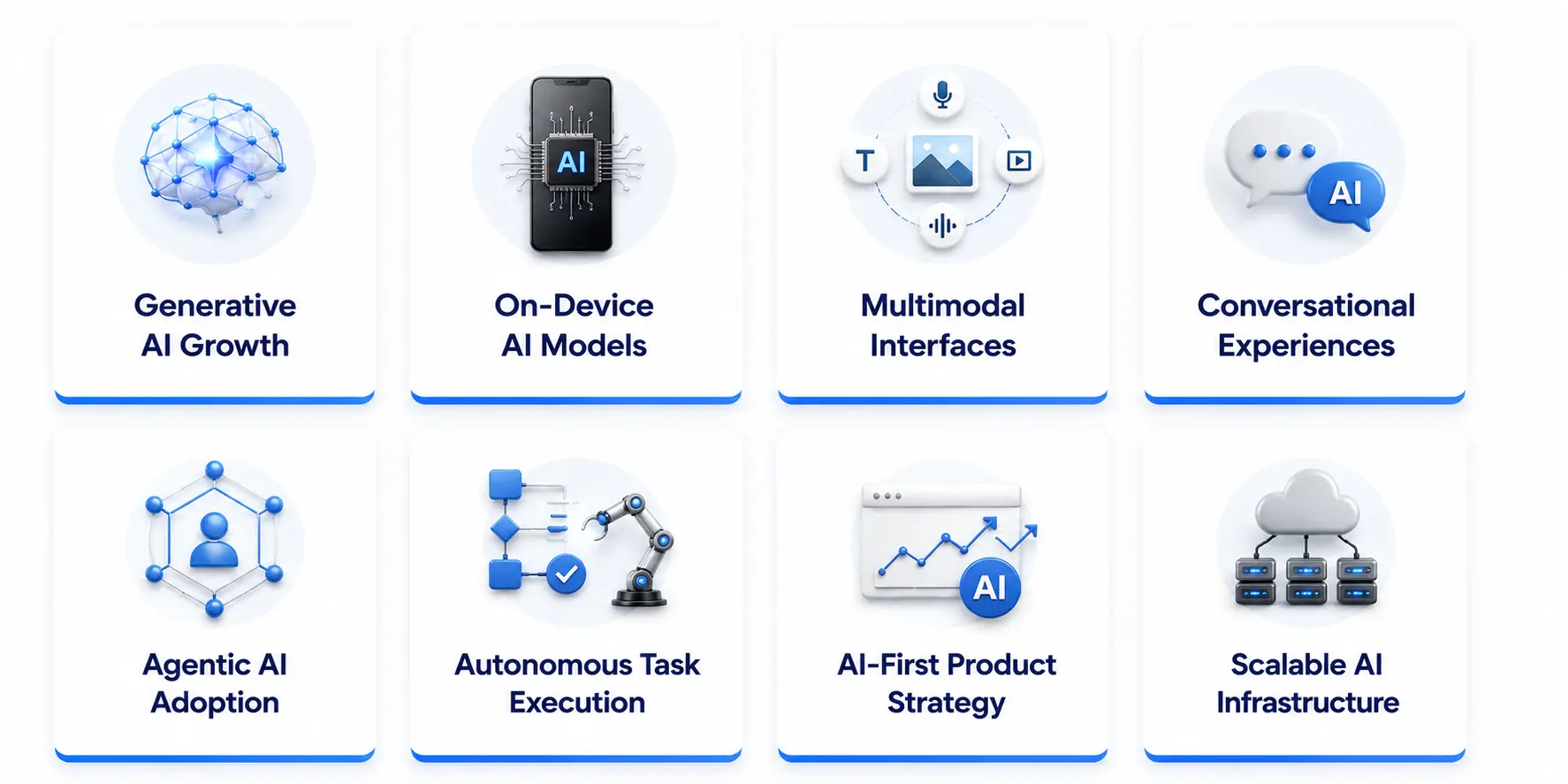
The year 2026 represents a major turning point for AI in mobile app development because multiple technological shifts are converging simultaneously. Generative AI has become mainstream, smaller AI models now run efficiently on smartphones, and multimodal interfaces are replacing traditional navigation systems.
Users now expect AI-powered assistance inside apps. Whether it is conversational commerce, AI-generated recommendations, voice-driven interactions, or autonomous task execution, intelligent experiences are becoming standard across industries. Businesses are no longer adding AI as an optional innovation layer. AI is now central to product strategy.
Another defining shift is the rise of agentic AI. Unlike earlier AI systems that simply responded to prompts, agentic AI can plan tasks, coordinate workflows, and execute multi-step actions autonomously. This changes how users interact with mobile applications completely. Apps are evolving from tools into intelligent digital agents.
Most businesses entering AI mobile app development in 2026 are discovering that AI adoption is no longer the difficult part. Operational scalability is. Building a demo with GPT APIs takes days. Maintaining low-latency AI workflows across millions of mobile interactions is where the real engineering challenge begins. Teams are now spending more effort on inference optimization, observability, and prompt reliability than on model integration itself.
Core AI Technologies Powering Mobile Apps in 2026
Modern AI-powered mobile applications rely on multiple AI technologies working together to create intelligent and adaptive user experiences. Each technology contributes differently depending on the app’s functionality, industry use case, and business objective.
Machine Learning (ML)
Machine learning remains the foundation of most AI-powered mobile applications. ML systems learn from historical and real-time data to identify patterns, predict outcomes, and improve decision-making over time. This technology powers recommendation systems, fraud detection engines, predictive analytics, behavioral segmentation, and dynamic pricing models.
Most users never notice machine learning working in the background, but they experience its impact constantly through smarter recommendations, faster decisions, and more personalized interactions. An eCommerce app, for instance, analyzes browsing behavior and engagement patterns to recommend products aligned with individual preferences. In fintech platforms, ML models continuously evaluate transaction behavior to identify unusual activity and flag potential fraud in real time.
Machine learning has become a critical part of modern mobile application development services because businesses increasingly rely on predictive intelligence to improve customer engagement and operational efficiency.
Natural Language Processing (NLP)
Natural Language Processing enables mobile applications to understand, interpret, and generate human language. NLP powers conversational AI systems such as chatbots, AI assistants, voice interfaces, and smart search functionalities.
In 2026, NLP systems will have become significantly more contextual due to advancements in large language models. Mobile apps can now understand conversational intent more accurately and provide responses that feel natural and human-like.
This technology is transforming industries such as customer support, healthcare, education, and banking, where conversational interactions improve accessibility and reduce friction for users.
Computer Vision
Computer vision enables mobile applications to analyze and interpret visual information such as images and videos. This technology powers facial recognition systems, AR experiences, visual search engines, document scanning, gesture recognition, and AI-based diagnostics.
Retail brands use computer vision for virtual try-on experiences. Healthcare apps use vision AI to support disease detection and diagnostic analysis. Fintech apps rely on computer vision for AI-powered KYC verification processes.
As smartphone hardware continues to improve, computer vision capabilities are becoming faster and more accurate, enabling richer mobile experiences.
Generative AI
Generative AI has become one of the most transformative technologies in mobile app development. Unlike traditional AI systems that classify or predict information, generative AI creates entirely new content such as text, images, audio, code, and videos.
Businesses are rapidly adopting generative AI consulting services to integrate AI-driven creativity and automation into mobile applications.
Many organizations also invest in application modernization services to upgrade legacy systems, enabling them to support generative AI capabilities and modern AI-powered user experiences. AI-generated content is now being used in customer support, marketing automation, content creation, education, commerce, and productivity tools.
The real value of generative AI appears when apps begin adapting outputs dynamically according to individual user behavior. In retail applications, AI shopping assistants generate highly personalized product suggestions based on browsing patterns and purchase intent. In education platforms, AI systems create customized quizzes, summaries, and study material aligned with a learner’s progress, performance gaps, and engagement level.
Agentic AI — The Biggest Shift in Mobile UX
Agentic AI represents the next evolution of intelligent mobile experiences. Instead of simply responding to user prompts, agentic AI systems can plan tasks, execute workflows, coordinate tools, and operate autonomously.
This technology is fundamentally changing mobile UX design. As expert UI/UX design services evolve to support AI-driven interactions, users no longer need to manually navigate through multiple steps to complete tasks. Instead, they can delegate goals to AI agents that handle workflows independently.
One of the biggest shifts happening in mobile UX is the transition from assistive AI to execution-driven AI. Instead of simply suggesting actions, modern AI systems are beginning to complete workflows independently. A travel app may compare flights, optimize itineraries, reserve hotels, and coordinate bookings with minimal user involvement. This reduces decision fatigue significantly while creating faster and more seamless user experiences.
Predictive Analytics
Predictive analytics uses historical and real-time data to forecast future outcomes and user behavior. Mobile apps use predictive systems to improve engagement, prevent churn, optimize pricing, forecast demand, and personalize recommendations.
Predictive intelligence helps businesses make proactive decisions instead of reactive ones. This capability is especially valuable in industries such as fintech, healthcare, logistics, and eCommerce, where data-driven forecasting directly impacts operational efficiency and customer satisfaction.
On-Device AI (Edge AI) vs. Cloud AI vs. Hybrid AI
AI processing architecture has evolved significantly in recent years. Businesses now choose between on-device AI, cloud AI, or hybrid AI models depending on performance requirements and privacy considerations.
On-device AI processes data directly on smartphones. This improves speed, reduces latency, supports offline functionality, and enhances privacy because user data does not need to leave the device. However, device hardware limitations restrict model size and complexity.
Cloud AI processes data on remote servers with significantly higher computational power. This supports large-scale AI models and advanced processing capabilities but introduces latency and internet dependency.
Hybrid AI combines both approaches by handling lightweight AI tasks on-device while using cloud infrastructure for advanced processing. This architecture is becoming the standard model for modern AI-powered mobile applications in 2026.
Key Features of an AI-Powered Mobile App in 2026
AI-powered mobile applications in 2026 are designed to do far more than perform basic digital functions. Modern users expect apps to understand behavior, predict intent, automate actions, and deliver deeply personalized experiences in real time. This has transformed AI from a supporting feature into the core intelligence layer behind mobile products.
Businesses are now integrating advanced AI capabilities directly into customer journeys to improve engagement, retention, operational efficiency, and user satisfaction. Whether it is a healthcare app offering predictive health insights or a retail app delivering hyper-personalized recommendations, intelligent features are now shaping how mobile experiences are built and scaled.
Below are the most important features defining successful AI-powered mobile apps in 2026.
Predictive Analytics Engine
Predictive analytics allows mobile apps to anticipate user actions and business outcomes using behavioral and historical data. Instead of reacting after users take action, AI systems analyze engagement patterns continuously and forecast future behavior proactively.
For instance, an eCommerce app can predict which products users are likely to purchase next, while a fitness app can identify users at risk of dropping engagement and trigger personalized recommendations automatically. Fintech platforms use predictive intelligence for fraud prevention, spending analysis, and financial forecasting. These use cases increasingly rely on professional predictive analytics services to transform large volumes of data into actionable business insights.
This capability helps businesses create more proactive customer experiences, improving retention, engagement, and operational efficiency.
Natural Language & Multimodal Interface
Modern AI apps are shifting from traditional menu-driven navigation to conversational and multimodal interactions. Users increasingly prefer communicating naturally through voice, text, images, and contextual prompts rather than manually navigating through multiple screens.
Natural language processing enables apps to understand conversational intent and respond intelligently in real time. Multimodal AI further improves interaction by combining multiple inputs simultaneously. This allows users to upload an image, speak a query, and receive contextual recommendations instantly.
This feature is becoming essential in industries such as retail, banking, healthcare, and education, where frictionless interaction directly impacts user experience.
Computer Vision Capabilities
Computer vision enables mobile applications to interpret and analyze visual information such as images, objects, faces, gestures, and documents. As smartphone hardware continues to evolve, computer vision is becoming a major driver of immersive mobile experiences.
Retail brands use computer vision for virtual try-ons and visual product search. Healthcare apps use it for diagnostic assistance and medical image analysis. Fintech apps rely on computer vision for identity verification and AI-based KYC processes.
The combination of AI and visual intelligence is helping businesses create faster, smarter, and more interactive user experiences.
Smart Personalization Layer
Personalization in 2026 goes far beyond product recommendations. AI-powered mobile apps now personalize entire user journeys dynamically according to behavior, preferences, engagement history, and contextual signals.
Modern AI systems personalize:
- Content feeds
- Notification timing
- Product suggestions
- Learning pathways
- UI layouts
- Promotional offers
A learning app may automatically adjust lesson difficulty based on student performance, while a streaming platform reorganizes recommendations according to viewing habits and engagement patterns.
This level of intelligent personalization improves customer satisfaction and significantly increases long-term retention.
Generative AI Integration
Generative AI has become one of the most impactful features in modern mobile applications because users now expect apps to create intelligent outputs dynamically instead of only displaying information.
AI-powered apps can now generate:
- Personalized content
- AI summaries
- Product descriptions
- Study materials
- Customer responses
- Images and creative assets
- Conversational replies
AI productivity apps generate meeting summaries automatically, while AI education apps create personalized quizzes according to user progress.
Generative AI is also becoming a foundational component of AI-powered digital product development, enabling businesses to build more adaptive, personalized, and automation-driven user experiences.
Businesses are increasingly working with a generative AI development company to integrate intelligent content creation and automation directly into mobile experiences.
Agentic Task Automation
Agentic AI is transforming mobile apps from passive tools into autonomous digital assistants capable of planning and executing workflows independently.
The biggest difference between traditional AI assistants and agentic AI systems is execution capability. Earlier AI systems mostly responded to prompts or generated suggestions, while modern agentic systems are designed to handle complete multi-step workflows autonomously. A travel assistant, for instance, may analyze destinations, compare flights, optimize schedules, reserve hotels, and manage bookings with very limited user input.
This feature significantly reduces manual effort and improves productivity. Businesses are increasingly adopting agentic AI because autonomous workflow execution improves convenience and creates more intelligent user experiences.
On-Device AI Processing
On-device AI processing enables mobile apps to perform AI tasks directly on smartphones instead of relying entirely on cloud servers. This improves speed, reduces latency, strengthens privacy, and supports offline functionality.
On-device AI is especially important for applications handling sensitive data such as healthcare, fintech, and enterprise communication apps. Features like facial recognition, voice processing, and behavioral authentication often operate locally to improve security and performance.
As lightweight AI models continue to evolve, on-device processing is becoming a standard feature in AI-powered mobile ecosystems.
Intelligent Security & Behavioral Biometrics
AI-powered security systems are becoming essential because cyber threats and digital fraud continue to increase across mobile ecosystems.
Behavioral biometrics use AI to analyze unique interaction patterns, such as:
- Typing speed
- Swipe behavior
- Device handling patterns
- Navigation habits
- Usage anomalies
These systems continuously monitor activity and detect suspicious behavior in real time without disrupting user experience. As cybersecurity in fintech app development becomes a growing priority, behavioral AI is playing an important role in strengthening fraud prevention and identity verification frameworks. Fintech and enterprise applications are increasingly using behavioral AI to improve security without adding friction to the user experience.
This creates a more secure and seamless authentication experience for users.
Contextual & Behavior-Triggered Push Notifications
Traditional push notifications often fail because they are generic and poorly timed. AI-powered notification systems solve this problem by analyzing user behavior, contextual signals, engagement timing, and interaction history before sending alerts.
AI-driven notification systems are becoming significantly more behavior-aware than traditional push strategies. Instead of sending generic alerts, modern mobile apps analyze engagement timing, browsing habits, and interaction patterns to deliver contextual communication. An eCommerce platform, for instance, may identify the exact stage where purchase intent is highest and trigger personalized recommendations accordingly. Fitness apps use similar behavioral signals to send reminders based on inactivity trends, workout consistency, or engagement drops.
AI-driven notifications improve engagement rates, conversions, and customer retention while reducing notification fatigue. As competition for user attention increases, intelligent communication systems are becoming critical for mobile app success.
How AI Is Being Used in Mobile Apps Across Different Industries in 2026
AI adoption in mobile applications is expanding rapidly across industries because businesses are realizing that intelligent automation and personalization directly improve customer experience and operational efficiency.
From healthcare and finance to retail and logistics, AI is reshaping how businesses interact with users, process data, and deliver services.
Here’s how different industries are leveraging AI-powered mobile applications in 2026.
Healthcare & Fitness Apps
Healthcare is one of the fastest-growing sectors for AI-powered mobile innovation. AI is helping healthcare providers improve diagnostics, patient monitoring, treatment recommendations, and overall healthcare accessibility.
Modern healthcare apps use AI for:
- Symptom analysis
- Predictive diagnostics
- Virtual health assistants
- Personalized treatment suggestions
- Medication reminders
- Patient risk assessment
The growing adoption of conversational AI in healthcare apps is also improving patient engagement by enabling symptom-based guidance, appointment support, medication assistance, and personalized health interactions through intelligent virtual assistants.
Fitness apps are also becoming increasingly intelligent. Instead of offering generic workout plans, AI-powered fitness applications adapt routines according to user goals, activity history, physical performance, and health metrics.
Modern fitness applications are increasingly shifting from static workout tracking toward adaptive wellness intelligence. AI systems continuously evaluate workout consistency, recovery cycles, calorie expenditure, sleep behavior, and movement patterns to generate personalized fitness recommendations in real time. This allows apps to adjust training intensity, recovery suggestions, and wellness guidance according to individual user performance instead of relying on fixed routines.
This level of personalization improves engagement while helping users achieve better health outcomes.
Fintech & Banking Apps
AI has become deeply integrated into fintech and banking applications because financial services rely heavily on data analysis, risk management, and real-time decision-making.
Modern fintech apps use AI for fraud detection, predictive financial analysis, credit scoring, intelligent automation, and personalized financial planning.
AI-powered banking systems can now:
- Detect suspicious transactions instantly
- Predict spending behavior
- Offer smart investment suggestions
- Automate expense categorization
- Improve customer support through conversational AI
Behavioral biometrics and intelligent authentication systems are also strengthening security frameworks in banking apps.
As digital banking competition grows, AI-driven personalization is becoming a major differentiator for customer experience.
E-Commerce & Retail Apps
Retail and eCommerce apps have experienced a massive transformation through AI integration. Modern consumers expect highly personalized shopping experiences, and AI enables businesses to deliver that at scale.
AI-powered retail apps now offer:
- Personalized product recommendations
- Visual search functionality
- AI-powered shopping assistants
- Dynamic pricing optimization
- Inventory forecasting
- Smart checkout systems
One of the biggest reasons AI is transforming retail apps is its ability to reduce decision friction during shopping journeys. Visual AI search, for instance, allows users to upload a product image and instantly discover visually similar items within the platform. At the same time, recommendation engines continuously analyze browsing activity, purchase history, and engagement behavior to surface highly relevant product suggestions tailored to individual preferences.
Businesses investing in AI-powered commerce platforms are seeing higher conversion rates, stronger customer retention, and improved average order value because personalization directly impacts purchasing behavior.
Education & E-Learning Apps
AI is transforming education and e-learning mobile applications by making learning experiences more adaptive, personalized, and interactive. Traditional online learning platforms often followed a one-size-fits-all approach, but AI-powered systems now adjust content dynamically according to each learner’s performance, engagement level, strengths, and weaknesses.
Modern AI-powered education apps use intelligent systems for:
- Personalized learning paths
- AI tutoring assistants
- Automated assessments
- Performance tracking
- Real-time feedback
- AI-generated quizzes and study material
Language learning apps like Duolingo use AI to analyze how quickly users learn concepts and then modify lesson difficulty accordingly. Similarly, AI tutoring apps provide contextual explanations, personalized recommendations, and interactive conversational learning experiences.
Generative AI is also improving content accessibility by creating summaries, flashcards, voice explanations, and multilingual learning assistance instantly. This helps students learn faster while reducing dependency on manual instruction.
As digital learning adoption continues to rise globally, AI-powered e-learning apps are becoming essential for delivering scalable and personalized education experiences.
On-Demand & Logistics Apps
AI has become a core operational layer for on-demand and logistics mobile applications because these industries depend heavily on real-time decision-making, route optimization, and predictive intelligence.
Modern logistics and delivery apps use AI for:
- Route optimization
- Delivery time prediction
- Demand forecasting
- Driver allocation
- Fleet management
- Dynamic pricing
- Warehouse automation
Food delivery and ride-hailing apps analyze traffic conditions, weather data, driver availability, and customer demand patterns in real time to optimize operations automatically. This improves delivery speed, reduces fuel costs, and increases operational efficiency.
AI also helps logistics businesses predict demand surges and optimize inventory movement across supply chains. Predictive analytics enables companies to allocate resources more efficiently while minimizing delays and operational bottlenecks.
As customer expectations for faster deliveries continue to increase, AI-powered logistics systems are becoming critical for maintaining scalability and service quality.
Travel & Hospitality Apps
The travel and hospitality industry is rapidly adopting AI-powered mobile applications to deliver more personalized, efficient, and seamless customer experiences. Travelers now expect apps to provide intelligent recommendations, automated planning assistance, and contextual support throughout their journey.
AI-powered travel apps use intelligent systems for:
- Personalized trip recommendations
- AI itinerary generation
- Dynamic pricing optimization
- Smart booking assistance
- Real-time language translation
- Virtual travel assistants
Mostly, travel platforms analyze browsing behavior, travel history, seasonal preferences, and budget patterns to recommend destinations and accommodation options tailored to individual users.
Hotels and hospitality businesses are also integrating conversational AI into customer service workflows. AI-powered assistants handle bookings, answer queries, provide local recommendations, and automate guest support operations efficiently.
Generative AI is further improving travel experiences by creating customized travel itineraries, destination guides, and activity suggestions instantly according to user interests and schedules.
As competition increases across travel platforms, AI-driven personalization is becoming a major differentiator for customer engagement and loyalty.
Social Media & Entertainment Apps
AI has become the driving force behind user engagement in social media and entertainment mobile applications, shaping the Future of AI in Social Media through personalized feeds, intelligent content recommendations, automated moderation, and user retention optimization.
Social media and entertainment apps use AI for:
- Personalized content recommendations
- AI-generated media
- Smart editing tools
- Content moderation
- Voice and image filters
- Audience behavior analysis
- Engagement prediction
Platforms like Spotify, YouTube, Instagram, and TikTok depend heavily on AI recommendation engines to keep users engaged by continuously analyzing viewing habits, interaction patterns, and content preferences.
Generative AI is also changing how users create and consume content. AI-powered editing tools now generate captions, enhance images, create music, and automate video production directly within mobile applications.
AI moderation systems are equally important because social platforms must manage harmful content, spam, misinformation, and policy violations at scale.
As content consumption continues to grow rapidly, AI is becoming the backbone of personalized entertainment and digital engagement ecosystems.
How to Build an AI-Powered Mobile App in 2026: A Complete Step-by-Step Process
Building an AI-powered mobile app in 2026 requires more than integrating an AI API into an existing application. Businesses now need a clear strategy that combines AI architecture, scalable infrastructure, intelligent workflows, data pipelines, and long-term optimization planning.
Unlike traditional app development, AI app development is iterative. The system continuously learns, improves, and evolves based on user interactions and real-time data. This makes planning and execution significantly more important.
Below is the complete step-by-step process businesses should follow while building AI-powered mobile applications.
Step 1 — Define Your AI Use Case (Problem-First Thinking)
The success of an AI mobile app starts with identifying a clear business problem. Many companies fail because they add AI only for trend adoption instead of solving an actual user challenge.
Businesses should first identify where AI creates measurable value. This could include automation, personalization, predictive recommendations, fraud detection, conversational support, or intelligent search experiences.
A retail app may use AI to improve personalized recommendations, while a healthcare app may focus on predictive patient monitoring. The objective should always be tied to user experience improvement or operational efficiency.
A problem-first strategy helps businesses avoid unnecessary AI complexity and keeps development aligned with business outcomes.
Step 2 — Assess Your AI Readiness (Data, Team, Infrastructure)
AI systems rely heavily on high-quality data and scalable infrastructure. Before development begins, businesses must evaluate whether they are prepared technically and operationally for AI implementation.
This assessment includes:
- Data availability and cleanliness
- Infrastructure scalability
- Security and compliance readiness
- AI engineering expertise
- Cloud architecture capabilities
Poor data quality is one of the biggest reasons AI systems underperform. Even advanced models fail when trained on inconsistent or incomplete datasets.
Businesses working with an AI app development company often begin with an AI readiness audit to identify gaps before development starts.
Step 3 — Choose Your AI Integration Approach (API / Fine-Tuned / Custom)
Businesses generally choose between three AI integration approaches depending on complexity, scalability, and budget.
API-Based AI Integration
This is the fastest and most cost-effective approach. Businesses integrate third-party AI services such as OpenAI, Claude, or Gemini APIs directly into mobile applications. The growing demand for expert AI chatbot development services has further accelerated the adoption of API-based AI integration due to its speed, flexibility, and lower implementation effort.
This model is ideal for:
- MVP development
- AI chatbots
- AI content generation
- Rapid prototyping
Fine-Tuned AI Models
Fine-tuning involves customizing existing AI models using proprietary business data. This improves contextual understanding and domain-specific accuracy.
This approach works well for:
- Healthcare apps
- Enterprise AI systems
- Personalized recommendation engines
- Industry-specific workflows
Custom AI Models
Custom AI development involves building models from scratch for highly specialized use cases.
This approach is best suited for:
- Large enterprises
- Proprietary AI products
- Advanced automation systems
- AI-native platforms
The right integration strategy depends on business goals, available resources, and long-term scalability requirements.
Step 4 — Select Your AI Tech Stack
Choosing the right AI tech stack is critical because it directly affects performance, scalability, and future expansion.
A typical AI mobile app stack includes:
- Frontend framework
- Backend infrastructure
- AI orchestration layer
- Vector databases
- Cloud services
- ML frameworks
- Monitoring systems
For frontend development, businesses often choose between React Native, Flutter, or native development depending on performance requirements. Backend systems may include Node.js, Python, or cloud-native serverless infrastructure.
Selecting the wrong stack early can create major scalability issues later, especially for AI-heavy applications handling large data volumes and real-time processing.
Step 5 — Build Your Data Pipeline
Data pipelines are one of the most important yet overlooked parts of AI app development. AI systems continuously depend on structured and real-time data to improve performance and maintain accuracy.
A strong data pipeline handles:
- Data collection
- Data cleaning
- Data labeling
- Data transformation
- Real-time processing
- Secure storage
Recommendation systems require continuous behavioral data to improve personalization. Similarly, AI fraud detection systems need real-time transaction analysis to identify suspicious patterns instantly.
Without a scalable data infrastructure, AI systems struggle to deliver consistent results.
Step 6 — Develop & Test Your AI MVP
AI MVP development focuses on validating the core intelligence layer before scaling the product further. Businesses should prioritize solving one high-impact problem first instead of building too many AI features initially.
During this stage, teams test:
- AI response quality
- User engagement
- Workflow efficiency
- Accuracy levels
- Latency performance
- User adoption
AI testing is more complex than traditional software testing because developers must also evaluate hallucinations, bias, prediction accuracy, and model reliability.
This validation-first approach is a core principle of MVP development services, helping businesses gather real-world feedback before expanding functionality.
Step 7 — Deploy, Monitor & Retrain
AI deployment is not a one-time launch process. AI systems require continuous monitoring and retraining because user behavior, market conditions, and data patterns evolve.
Post-launch AI operations typically include:
- Performance monitoring
- Model retraining
- Drift detection
- Usage analytics
- Accuracy optimization
- Infrastructure scaling
For instance, recommendation engines may lose effectiveness if models are not retrained regularly with updated user behavior data.
Continuous AI optimization is essential for maintaining long-term product performance and user satisfaction.
Step 8 — Scale Responsibly with Compliance
As AI adoption increases globally, regulatory compliance and ethical AI practices are becoming critical business priorities.
Businesses must address:
- Data privacy regulations
- GDPR compliance
- EU AI Act requirements
- Explainability standards
- AI transparency
- Bias mitigation
Responsible AI development directly impacts customer trust, legal safety, and long-term scalability.
Companies that prioritize compliance and transparency early are better positioned for sustainable AI adoption in global markets.
Choosing the Right AI Tech Stack for Mobile App Development
The AI tech stack plays a major role in determining how scalable, secure, and intelligent a mobile application becomes. In 2026, businesses will no longer choose technologies only for frontend or backend performance. They also need systems capable of supporting real-time AI inference, multimodal interactions, vector search, and intelligent orchestration.
Choosing the right stack early helps businesses avoid infrastructure bottlenecks and long-term technical limitations.
Frontend Development Frameworks (React Native, Flutter, Native)
Frontend frameworks determine how efficiently AI experiences are delivered across platforms.
React Native
React Native remains a popular choice because it enables faster cross-platform development with a shared codebase. It works well for businesses looking to launch AI-powered MVPs quickly while maintaining development efficiency. Many startups and enterprises also choose this framework when they need to develop a React Native app that can scale across both iOS and Android platforms.
Flutter
Flutter is increasingly preferred for AI-heavy applications because of its high-performance rendering and flexible UI capabilities. It supports visually rich experiences and smooth animations, making it ideal for modern AI-driven mobile interfaces.
Native Development
Native iOS and Android development offers maximum performance and better hardware-level AI optimization. Businesses building advanced computer vision apps, AR experiences, or real-time AI systems often choose native frameworks for improved speed and responsiveness.
The right framework depends on business goals, scalability expectations, and AI complexity.
On-Device AI & ML Frameworks (TensorFlow Lite, Core ML, ML Kit, PyTorch Mobile)
On-device AI frameworks allow mobile applications to process AI tasks directly on smartphones instead of relying entirely on cloud servers.
TensorFlow Lite is widely used for lightweight ML deployment on mobile devices. Core ML supports optimized AI processing for iOS applications, while Google ML Kit simplifies AI integration for Android apps through features like text recognition and face detection.
PyTorch Mobile is commonly used for advanced AI experimentation and flexible custom model deployment.
These frameworks are essential for businesses focusing on low latency, offline functionality, and privacy-focused AI experiences.
Cloud AI & API Services (OpenAI, Anthropic Claude, Google Gemini, AWS Bedrock)
Cloud AI platforms have accelerated AI adoption because businesses can integrate advanced intelligence without building models entirely from scratch.
OpenAI powers conversational AI, AI copilots, and content generation systems. Claude is increasingly used for enterprise AI workflows and long-context reasoning. Google Gemini supports multimodal AI interactions, while AWS Bedrock enables scalable enterprise-grade AI deployments.
Cloud AI integration significantly reduces development complexity and speeds up product launches for businesses adopting AI capabilities rapidly.
Agentic AI Frameworks (LangGraph, AutoGen, CrewAI)
Agentic AI frameworks are becoming important because modern AI systems increasingly operate autonomously rather than responding only to prompts.
Agentic AI frameworks are becoming important because modern AI systems increasingly operate autonomously rather than responding only to prompts.
These frameworks are driving the next generation of AI-powered mobile experiences focused on intelligent workflow execution.
Database Architecture for AI Apps (Relational + Vector DBs)
AI-powered applications require more advanced database architectures compared to traditional mobile apps.
Relational databases such as PostgreSQL continue to manage structured transactional data. However, AI applications now also depend heavily on vector databases such as Pinecone, Weaviate, and Chroma for semantic search and contextual AI retrieval.
Vector databases are especially important for:
- AI search systems
- Recommendation engines
- Retrieval-augmented generation (RAG)
- Personalized AI experiences
Modern AI app architecture often combines relational and vector databases for better scalability and contextual intelligence.
AI Development & Testing Tools (Copilot, Cursor, Testim, Weights & Biases)
AI-assisted development tools are improving productivity significantly across mobile engineering teams.
GitHub Copilot and Cursor help developers accelerate coding workflows through AI-assisted suggestions and automation. Testim supports AI-powered testing automation, while Weights & Biases helps teams monitor experiments, track AI performance, and optimize models efficiently.
These tools reduce development time while improving testing accuracy and deployment efficiency for AI-powered mobile applications.
Benefits of Integrating AI in Mobile App Development
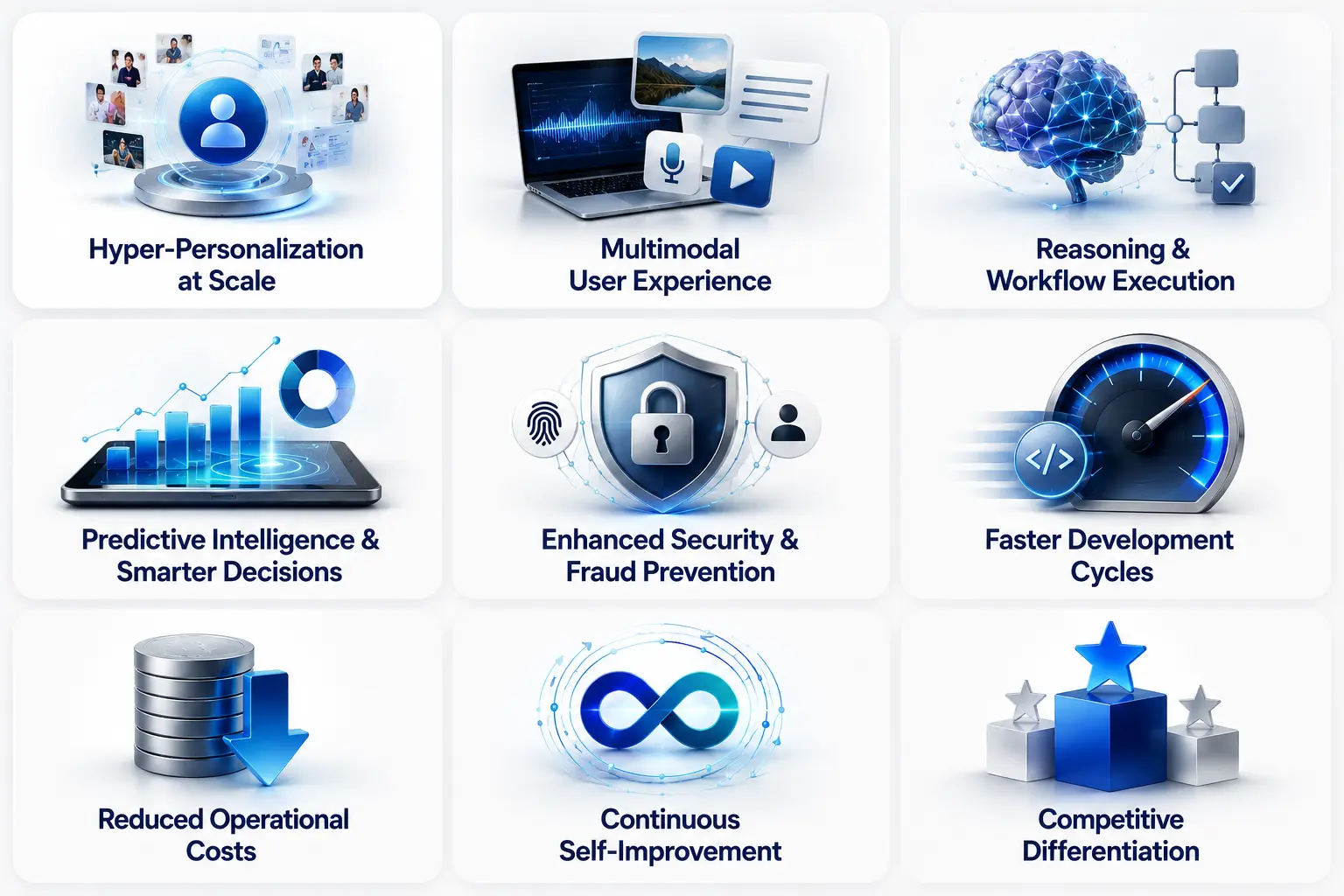
AI integration in mobile applications is no longer limited to innovation-focused businesses. In 2026, organizations across industries are adopting AI because intelligent mobile experiences directly influence customer satisfaction, operational efficiency, engagement, and revenue growth.
Unlike traditional applications that rely on static workflows, AI-powered apps continuously improve based on usage patterns and behavioral data. This creates products that become smarter over time and deliver stronger business outcomes.
Below are the major benefits businesses gain by integrating AI into mobile app development.
Hyper-Personalization at Scale
Personalization has become one of the strongest drivers of customer retention, and AI enables businesses to deliver individualized experiences at scale. Instead of treating users as broad customer segments, AI systems analyze behavior, preferences, interaction history, and contextual signals to create highly personalized journeys.
Popular streaming platforms personalize recommendations according to viewing habits, while eCommerce apps recommend products based on browsing history, pricing sensitivity, and purchasing intent.
AI-powered personalization improves:
- User engagement
- Customer satisfaction
- Session duration
- Conversion rates
- Long-term retention
As digital competition increases, businesses that deliver personalized experiences are more likely to retain customers and improve lifetime value.
Conversational & Multimodal User Experience
Users increasingly expect natural and frictionless interactions while using mobile applications. AI enables apps to move beyond traditional navigation and support conversational experiences through voice, text, images, and contextual inputs.
A banking app may allow users to ask financial questions conversationally instead of manually navigating dashboards. Similarly, a retail app may let customers upload product images and search visually.
This conversational and multimodal experience reduces friction and improves accessibility, making mobile apps easier and faster to use.
Businesses investing in mobile application development services are increasingly prioritizing conversational UX because intuitive interactions improve user engagement significantly.
Automated Reasoning & Workflow Execution
AI-powered systems are increasingly capable of automating repetitive workflows and executing intelligent decisions without constant user involvement.
Modern AI-powered fintech platforms now categorize expenses automatically, analyze spending behavior, and surface personalized savings insights in real time. Similarly, healthcare applications continuously monitor health metrics and proactively recommend preventive actions based on user data and behavioral patterns.
Agentic AI systems further improve automation by planning and completing multi-step workflows independently. This reduces manual effort for users while increasing operational efficiency for businesses.
Automation also improves scalability because businesses can handle larger workloads without proportional increases in staffing or resources.
Predictive Intelligence & Smarter Decisions
Predictive analytics enables businesses to move from reactive decision-making to proactive planning. AI systems analyze behavioral trends, historical data, and contextual signals to predict future outcomes with greater accuracy.
Predictive AI systems are already helping businesses anticipate operational and customer behavior patterns before problems emerge. Retail platforms use predictive models to forecast product demand and optimize inventory planning, while logistics apps analyze real-time data to prepare for delivery surges and route disruptions. In fintech ecosystems, AI continuously evaluates transaction behavior to identify potential fraud risks before payments are processed.
Predictive intelligence helps businesses:
- Improve planning accuracy
- Reduce operational risks
- Increase customer retention
- Optimize marketing performance
- Improve customer experiences
This makes AI one of the strongest drivers of data-informed business growth.
Enhanced Security & Fraud Prevention
Security has become a major concern in mobile ecosystems, especially in industries handling sensitive user information such as fintech, healthcare, and enterprise applications.
AI strengthens security systems by continuously analyzing user behavior and identifying anomalies in real time. Behavioral biometrics, device intelligence, and fraud detection models allow apps to detect suspicious activity without interrupting the user experience.
Some AI-powered systems can detect unusual login patterns, suspicious transactions, or abnormal navigation behavior instantly.
This improves security while reducing false positives and customer friction.
Faster Development Cycles (Developer Productivity)
AI is also improving how mobile apps are built. Development teams now use AI-assisted coding, testing, debugging, and automation tools to accelerate engineering workflows and improve productivity.
Modern AI development tools help teams:
- Generate code suggestions
- Automate repetitive development tasks
- Improve testing efficiency
- Detect bugs faster
- Accelerate documentation
Businesses working with an app development company increasingly expect AI-assisted engineering processes because faster development cycles reduce time-to-market significantly.
This becomes especially valuable in competitive markets where product speed influences success.
Reduced Operational & Support Costs
AI reduces operational costs by automating customer support, internal workflows, analytics, and repetitive business operations.
Businesses are increasingly using conversational AI systems to automate customer support interactions and reduce operational workload at scale. Recommendation engines simultaneously personalize user experiences without requiring manual configuration, while predictive AI models help businesses optimize inventory planning, demand forecasting, and resource allocation more efficiently.
This operational efficiency helps businesses scale faster while controlling expenses.
Organizations increasingly adopt AI because automation reduces dependency on manual processes and improves overall resource utilization.
Continuous Self-Improvement with Usage Data
Unlike traditional software systems that remain static until manually updated, AI-powered apps improve continuously through real-world usage data.
As users interact with an app, AI models learn behavioral patterns and optimize outputs over time. Recommendation systems become more accurate, personalization improves, and automation workflows become smarter.
This continuous learning capability gives businesses a long-term competitive advantage because products improve naturally instead of remaining fixed.
AI-powered mobile applications effectively become smarter after launch, improving user experience progressively.
Measurable Competitive Differentiation
AI is increasingly becoming a competitive requirement rather than an optional innovation layer. Businesses adopting intelligent mobile experiences are creating stronger market differentiation through automation, personalization, and operational efficiency.
AI-powered mobile apps help businesses:
- Deliver smarter customer experiences
- Improve engagement
- Reduce response times
- Automate workflows
- Increase customer satisfaction
- Improve retention and revenue
In highly competitive industries, these advantages directly influence customer preference and business growth.
Companies investing in AI-powered mobile solutions today are positioning themselves more effectively for long-term market leadership.
Challenges of Building AI-Powered Mobile Apps
Despite its advantages, AI app development introduces technical, operational, and strategic challenges that businesses must address carefully. AI systems are more complex than traditional software because they depend on data quality, model performance, infrastructure scalability, compliance requirements, and continuous optimization.
Understanding these challenges early helps businesses avoid common AI integration mistakes and improve implementation success.
Data Quality, Availability & Labeling
AI systems are only as effective as the data used to train and optimize them. Poor-quality, incomplete, or inconsistent data directly impacts AI accuracy and decision-making quality.
Many businesses underestimate the effort required for:
- Data collection
- Data cleaning
- Data labeling
- Data organization
- Real-time processing
For example, recommendation systems fail when user behavior data is inaccurate, while fraud detection models struggle without properly labeled datasets.
Building a reliable data infrastructure is one of the most important steps for successful AI adoption.
Privacy, Compliance & the EU AI Act
AI adoption is growing alongside regulatory requirements around privacy, transparency, and ethical data use.
Businesses building AI-powered apps must address compliance obligations such as:
- GDPR requirements
- Data consent management
- Explainability standards
- Responsible AI governance
- EU AI Act compliance
Industries such as healthcare and fintech operate under significantly stricter compliance requirements because they handle highly sensitive user and financial data. As AI adoption grows, businesses are increasingly required to address explainability, consent management, data governance, and regulatory transparency from the early development stage itself.
Ignoring these compliance layers creates legal exposure, operational risk, and long-term trust issues that become difficult to reverse later.
Model Drift & Long-Term Maintenance
AI systems require continuous optimization after launch because user behavior and real-world conditions evolve.
Model drift becomes a serious issue when AI systems continue learning from outdated or shifting behavioral patterns. Consumer behavior, fraud techniques, engagement habits, and market conditions evolve constantly, causing prediction accuracy to decline gradually over time. This is especially noticeable in recommendation engines, fraud detection systems, and predictive analytics models, where even small behavioral shifts can significantly impact AI performance if retraining pipelines are not maintained consistently.
Businesses must continuously:
- Monitor AI performance
- Retrain models
- Update datasets
- Improve prediction accuracy
- Evaluate real-world outcomes
Unlike traditional apps, AI systems require long-term maintenance to remain effective.
Device Fragmentation & Performance Variability
Mobile ecosystems remain highly fragmented, creating technical challenges for AI implementation.
AI-powered apps must function efficiently across:
- Different smartphone hardware
- Multiple operating systems
- Battery limitations
- GPU variations
- Processing capabilities
An AI feature performing smoothly on a flagship smartphone may struggle on lower-end devices.
Businesses must optimize AI systems carefully to maintain a consistent user experience across device categories.
Talent Gap in ML + Mobile Development
AI mobile app development requires expertise across multiple disciplines, including machine learning, mobile engineering, cloud systems, data pipelines, MLOps, and cybersecurity.
Finding professionals with expertise across both AI and mobile development remains difficult.
Businesses often struggle with:
- Hiring AI engineers
- Managing specialized development teams
- Scaling AI infrastructure
- Maintaining AI performance
This skills gap increases development complexity and often slows AI adoption.
Partnering with experienced AI development teams helps businesses reduce technical risks and improve execution speed.
Managing Cost Overruns & Scope Creep
AI projects frequently exceed planned budgets because businesses underestimate implementation complexity.
Unexpected costs often emerge through:
- Infrastructure scaling
- Model retraining
- API consumption fees
- Data preparation
- AI testing
- Monitoring systems
Many companies also expand project scope mid-development after realizing additional AI possibilities.
Starting with an AI MVP and scaling gradually helps businesses manage investment more effectively.
Building User Trust & AI Transparency
Users are becoming more aware of how AI systems collect data, make decisions, and influence digital experiences.
Businesses increasingly need to explain:
- How AI works
- Why recommendations appear
- How user data is processed
- How privacy is protected
Transparent AI systems improve trust and encourage adoption, especially in industries handling sensitive information.
Building explainable and ethical AI experiences is becoming a major differentiator for businesses investing in intelligent mobile products.
How Much Does AI in Mobile App Development Cost in 2026?
The cost of AI in mobile app development varies significantly depending on the complexity of the application, the level of AI integration, infrastructure requirements, scalability goals, and the type of AI models being used. In 2026, businesses are no longer building simple mobile apps with static features. AI-powered applications require intelligent architectures, data pipelines, model optimization, cloud infrastructure, and continuous monitoring systems.
Because of this, AI app development costs are generally higher than traditional mobile development projects. However, the long-term business value often outweighs the initial investment because AI improves automation, customer retention, personalization, and operational efficiency.
Businesses planning to invest in AI mobile solutions must understand the major cost factors before starting development.
Key Factors That Influence AI App Development Cost
Several technical and business factors influence the total development cost of an AI-powered mobile application.
AI Integration Complexity
The complexity of AI implementation directly impacts project cost. A basic AI chatbot integrated through third-party APIs costs significantly less than a fully autonomous agentic AI platform built with custom workflows and proprietary intelligence layers.
For example:
- AI-powered recommendations → Lower complexity
- Conversational AI assistant → Medium complexity
- Autonomous AI agents → High complexity
The more advanced the AI workflows become, the higher the development and infrastructure investment required.
Type of AI Model
AI integration cost is heavily influenced by the type of AI model and implementation approach selected. API-based integrations using platforms like OpenAI or Claude are generally more affordable because businesses do not need to build models from scratch. Fine-tuned AI systems cost more because they require domain-specific training and optimization. Custom AI models involve the highest investment because they require dedicated AI engineering, model training, infrastructure management, and continuous optimization.
Businesses often start with API-based AI systems before gradually scaling toward custom AI architectures.
Data Infrastructure Requirements
AI systems depend heavily on structured data pipelines and scalable infrastructure.
Costs increase when applications require:
- Real-time data processing
- Vector databases
- AI orchestration layers
- Cloud GPU infrastructure
- Continuous model retraining
- Large-scale analytics systems
Infrastructure requirements increase significantly when AI systems process sensitive or real-time data continuously at scale. Healthcare applications handling live patient monitoring, diagnostics, or wearable device data require far more robust infrastructure, security layers, and low-latency processing capabilities compared to lightweight AI tools such as content assistants or basic recommendation systems.
Platform Scope
Development cost also depends on whether businesses are building for:
- Android only
- iOS only
- Cross-platform ecosystems
Cross-platform frameworks such as React Native and Flutter reduce development time, while native development often increases cost due to separate engineering workflows for Android and iOS.
However, native development is sometimes necessary for AI-heavy apps requiring deep hardware optimization and advanced on-device AI processing.
Security & Compliance Requirements
Industries such as healthcare, fintech, and enterprise SaaS face stricter compliance obligations, which increase overall development costs.
Additional investment may be required for:
- Data encryption
- Regulatory compliance
- AI explainability systems
- Security audits
- Fraud detection frameworks
- Privacy-focused AI architecture
Compliance-focused AI development is becoming increasingly important due to growing global regulations around data protection and responsible AI.
AI App Development Cost Breakdown by Integration Level
The following table provides a general estimate of AI mobile app development costs in 2026 based on integration complexity.
| AI Integration Level | Estimated Cost Range |
| Basic AI Features | $20,000 – $50,000 |
| AI-Enhanced Mobile App | $50,000 – $120,000 |
| Generative AI Mobile App | $100,000 – $250,000 |
| Enterprise AI Platform | $250,000 – $1M+ |
| Agentic AI Ecosystem | $500,000 – Multi-million |
These estimates vary depending on business requirements, development region, AI architecture complexity, and scalability expectations.
Hidden Costs Businesses Often Miss
One of the biggest mistakes businesses make is underestimating long-term AI operational expenses. AI development is not limited to the initial launch phase. AI systems require continuous optimization, monitoring, and infrastructure scaling after deployment.
Common hidden costs include:
- AI model retraining
- API usage fees
- Cloud GPU infrastructure
- Data labeling and preparation
- AI testing and monitoring
- Security updates
- Compliance management
- Prompt optimization
- Performance tuning
For example, businesses using generative AI APIs may face rising operational costs as user activity increases and AI queries scale over time. Understanding these hidden expenses early helps businesses create more realistic AI investment strategies.
How to Start Small and Scale AI Investment Over Time
Businesses do not need to build highly advanced AI systems immediately. In fact, the most successful AI products often begin with a focused MVP approach that validates a single high-impact use case before scaling further.
A phased AI strategy for digital products generally includes:
- Launching a targeted AI MVP
- Measuring user engagement
- Validating ROI
- Expanding AI capabilities gradually
- Optimizing infrastructure over time
For example, a retail app may begin with AI-powered recommendations before later adding conversational shopping assistants and predictive personalization systems.
This approach reduces financial risk while helping businesses understand how users interact with AI features in real-world environments.
Businesses working with a recognized AI app development company often adopt this phased strategy because it balances innovation with long-term scalability.
Real-World Examples of AI in Mobile App Development
Several global platforms demonstrate how AI transforms mobile applications into intelligent and highly engaging digital ecosystems. These companies use AI not only for automation but also for personalization, predictive intelligence, operational optimization, and user retention.
Their success shows how AI has become central to modern mobile product strategy.
Spotify — Hyper-Personalized Music Discovery
Spotify is one of the strongest examples of AI-powered personalization in mobile app development. The platform uses machine learning algorithms to analyze listening habits, skipped tracks, playlist interactions, mood preferences, and engagement history continuously.
Features like Discover Weekly and Daily Mix rely heavily on predictive intelligence to deliver personalized music recommendations unique to each user.
Spotify’s AI systems improve user engagement because the platform continuously adapts according to listening behavior instead of offering static recommendations.
This personalization-driven strategy has become one of Spotify’s biggest competitive advantages in the streaming industry.
Amazon — End-to-End AI Shopping Experience
Amazon integrates AI across nearly every stage of the customer journey. Its mobile platform uses intelligent systems for product recommendations, personalized search results, inventory forecasting, fraud detection, voice commerce, and dynamic pricing optimization.
AI recommendation engines analyze customer browsing behavior, purchase history, and engagement patterns to deliver highly targeted shopping experiences.
Amazon also uses predictive analytics extensively for logistics optimization and demand forecasting, helping improve operational efficiency at a massive scale.
Its AI-first commerce ecosystem demonstrates how intelligent automation directly impacts revenue growth and customer retention.
Google Assistant — Contextual Multimodal AI
Google Assistant represents one of the most advanced examples of multimodal AI in mobile ecosystems. The platform combines voice recognition, contextual understanding, predictive intelligence, and conversational AI to create seamless digital interactions.
Users can interact naturally through voice commands, contextual prompts, images, and smart device integrations.
Google Assistant also demonstrates how AI systems are evolving from simple assistants into proactive digital agents capable of understanding context, anticipating needs, and automating workflows.
Its ecosystem highlights the growing importance of conversational and multimodal experiences in modern mobile app development.
Duolingo — Adaptive AI-Powered Learning
Duolingo uses AI extensively to personalize education experiences according to user learning patterns and engagement behavior.
The platform continuously analyzes:
- Learning speed
- Mistake frequency
- Retention patterns
- Lesson completion behavior
Based on this analysis, the app dynamically adjusts lesson difficulty and content recommendations for each learner individually.
AI-powered personalization has helped Duolingo improve user engagement and create more effective learning experiences at scale.
Its success demonstrates how AI can transform education apps from static content platforms into adaptive learning ecosystems.
Uber — Real-Time AI in Logistics & Dynamic Pricing
Uber relies heavily on real-time AI systems to optimize logistics operations and improve platform efficiency.
Its AI infrastructure powers:
- Route optimization
- Driver allocation
- Dynamic pricing
- ETA prediction
- Demand forecasting
- Fraud detection
Uber’s pricing infrastructure continuously evaluates live demand patterns, traffic congestion, driver availability, weather conditions, and nearby events to adjust fares dynamically in real time. What makes these AI systems valuable is not only prediction accuracy but the ability to handle massive operational complexity across millions of simultaneous transactions and location updates.
This demonstrates how AI evolves from a feature layer into the core operational intelligence powering large-scale mobile ecosystems.
AI Mobile Apps Built by RipenApps: Case Studies from Our Portfolio
Real-world implementation matters significantly in AI mobile app development because businesses today are not only looking for innovative ideas. They want measurable outcomes, scalable architectures, and intelligent user experiences that solve actual business challenges.
At RipenApps, the focus has been on building mobile solutions that combine AI-driven intelligence, personalization, predictive systems, and automation with scalable product engineering.
Below are some relevant case studies from the RipenApps portfolio that demonstrate how intelligent mobile experiences are transforming different industries.
Motion Learning — AI-Driven Personalized Education Experience
Motion Learning is an edtech platform developed to support students preparing for competitive examinations such as JEE, NEET, CUET, and Olympiads. The platform required a scalable and highly personalized learning ecosystem capable of handling large user engagement while improving learning outcomes.
The primary challenge was creating an intelligent education experience that adapts according to student performance and engagement behavior. Traditional learning systems often fail because all students receive the same learning flow regardless of their strengths or weaknesses.
To solve this, the platform was designed with AI-driven personalization capabilities that help optimize learning journeys dynamically. The system analyzes user progress, engagement patterns, assessment performance, and learning consistency to improve content delivery and student recommendations.
Key intelligent capabilities included:
- Personalized learning recommendations
- Adaptive content delivery
- Performance tracking and analytics
- Smart assessment workflows
- Student engagement optimization
The platform achieved significant user growth with:
- 500K+ downloads
- 100K+ daily active users
This case study demonstrates how AI-powered personalization can improve scalability and engagement in modern e-learning ecosystems.
Cashbook — AI-Enhanced Social Networking Experience
Cashbook was developed as a next-generation social networking platform focused on intelligent digital interaction and engagement.
The challenge was building a platform capable of managing large-scale user interactions while maintaining personalized content experiences and smooth engagement workflows. Modern social platforms depend heavily on behavioral intelligence because static feeds no longer sustain long-term retention.
The platform architecture focused on intelligent content distribution, scalable user engagement systems, and personalized interaction experiences designed to improve user activity and retention.
The solution included:
- Intelligent user interaction systems
- Personalized content experiences
- Real-time engagement workflows
- Scalable social architecture
- User behavior-driven content delivery
This project highlights how AI-inspired personalization and behavioral intelligence are becoming central to social media app ecosystems where engagement directly influences growth and retention.
EmmyWellness — Intelligent Wellness & Health Management Platform
EmmyWellness was developed to simplify wellness management and improve digital healthcare experiences through intelligent mobile workflows.
The healthcare industry increasingly depends on AI-powered systems because users expect personalized wellness experiences rather than generic health tracking solutions. The challenge was creating a mobile platform capable of supporting health engagement, wellness tracking, and user-centric digital healthcare experiences efficiently.
The platform focused on:
- Personalized wellness journeys
- Smart health tracking
- User engagement optimization
- Digital wellness management
- Scalable healthcare experience design
The solution was designed to improve usability, accessibility, and long-term engagement while supporting scalable digital wellness management for users.
This project reflects how AI-powered mobile healthcare platforms are evolving toward predictive, personalized, and behavior-driven wellness ecosystems.
Mednovate Connect — AI-Enabled Telemedicine Experience
Mednovate Connect is a telemedicine application developed to simplify digital healthcare consultation and medication management workflows.
Healthcare applications today require intelligent automation because users expect faster consultations, personalized communication, and seamless digital healthcare experiences. The challenge was building a scalable telemedicine ecosystem that supports healthcare accessibility while simplifying remote interaction workflows.
The platform was designed with features supporting:
- Smart telehealth workflows
- Digital consultation management
- Remote patient engagement
- Medication management systems
- Secure healthcare communication
The application architecture focused heavily on usability, workflow efficiency, and scalable healthcare operations while maintaining secure patient interactions.
This case study demonstrates how AI-integrated healthcare apps are improving patient accessibility and operational efficiency in digital healthcare ecosystems.
Future of AI in Mobile App Development
AI in mobile app development is evolving far beyond automation and personalization. In 2026 and beyond, mobile applications are expected to become autonomous, context-aware, multimodal, and deeply integrated into users’ daily workflows. The next phase of AI innovation will focus on reducing friction between human intent and digital execution.
Instead of manually operating apps, users will increasingly rely on intelligent systems capable of understanding goals, predicting needs, and completing workflows independently. This transformation will redefine how businesses design mobile products, user experiences, and digital ecosystems.
Below are the major trends shaping the future of AI-powered mobile applications.
Agentic AI Becomes the Default UX Pattern
Agentic AI is expected to become one of the biggest shifts in mobile user experience over the next few years. Traditional mobile apps required users to manually navigate screens, complete actions, and guide workflows step by step. Agentic AI changes this completely by enabling apps to act autonomously on behalf of users.
Instead of simply responding to prompts, agentic systems can:
- Plan tasks
- Coordinate workflows
- Make contextual decisions
- Execute multi-step actions
- Learn from user behavior
An AI travel assistant may automatically compare flights, optimize itineraries, reserve hotels, and manage scheduling without requiring continuous user input.
This shift will fundamentally transform app design because users will increasingly delegate goals to AI agents instead of manually operating applications themselves. However, businesses should also recognize that AI agent software development costs typically increase with the level of autonomy, workflow orchestration, and decision-making capabilities built into the system.
Businesses investing early in agentic AI ecosystems are likely to gain major competitive advantages in customer convenience and productivity.
Spatial Computing + AI (Apple Vision Pro, Android XR)
The convergence of spatial computing and AI is expected to reshape how users interact with digital experiences. Devices such as Apple Vision Pro and emerging Android XR ecosystems are introducing immersive computing environments where AI plays a central operational role.
AI-powered spatial computing will enable:
- Intelligent AR interfaces
- Context-aware virtual environments
- Gesture-driven interactions
- AI-guided navigation
- Immersive commerce experiences
- Spatial collaboration systems
Retail brands are already experimenting with AI-enhanced augmented reality experiences that allow users to visualize products directly within real-world environments before making purchase decisions.
In healthcare, immersive AI-powered visualization systems are improving medical training, diagnostics, and simulation-based learning experiences. As spatial computing hardware becomes more accessible, these AI-driven immersive interfaces are expected to expand far beyond experimental use cases and become a larger part of mainstream mobile ecosystems.
Smaller, More Powerful On-Device Models
One of the biggest advancements in AI infrastructure is the development of smaller and more efficient AI models capable of running directly on smartphones.
Earlier AI systems relied heavily on cloud processing due to large computational requirements. In 2026, lightweight AI models are becoming increasingly capable of performing advanced tasks locally on mobile devices.
This shift improves:
- Response speed
- Offline functionality
- User privacy
- Real-time processing
- Battery optimization
For example, modern smartphones can now handle on-device voice recognition, image processing, AI summarization, and predictive personalization without relying entirely on cloud servers. As smartphone hardware becomes more AI-optimized, edge AI will play a major role in reducing latency and strengthening privacy-focused mobile experiences.
Multimodal AI as the Standard Interface
The future of mobile UX will move beyond traditional touch-based interactions. Multimodal AI is expected to become the standard interface model for modern mobile applications.
Users will increasingly interact through combinations of:
- Voice
- Images
- Video
- Text
- Gestures
- Contextual inputs
For example, users may upload an image, speak a query, and receive contextual recommendations instantly through a single interaction flow.
This creates more natural and intuitive experiences compared to conventional app navigation. Industries such as healthcare, retail, education, entertainment, and fintech are already adopting multimodal systems to reduce friction and improve accessibility.
As large multimodal AI models continue to evolve, user expectations around conversational and contextual interaction will increase rapidly.
Responsible AI & Regulatory Compliance
As AI adoption accelerates globally, businesses are facing increasing pressure to build transparent, ethical, and compliant AI systems.
Governments and regulatory bodies are introducing stricter AI regulations focused on:
- Data privacy
- Explainability
- Bias mitigation
- Transparency
- Responsible AI governance
The EU AI Act is one of the most significant regulatory developments influencing AI product development worldwide.
In the future, businesses will need to ensure that AI systems clearly explain:
- How decisions are made
- How user data is processed
- Why recommendations appear
- How AI models are trained
Responsible AI practices will become essential not only for compliance but also for building customer trust and long-term brand credibility.
Companies ignoring ethical AI frameworks may face legal, operational, and reputational risks as regulations continue to evolve.
AI-Personalized Super Apps
The rise of AI-powered super apps is expected to redefine mobile ecosystems by combining multiple services into unified intelligent platforms.
Instead of using separate applications for shopping, payments, communication, travel, and productivity, users will increasingly rely on centralized AI-driven ecosystems that personalize services dynamically.
AI-powered super apps may integrate:
- Commerce
- Banking
- Messaging
- Productivity
- Healthcare
- Travel services
- Entertainment
AI orchestration systems will connect these services intelligently according to user behavior, preferences, schedules, and contextual needs.
This level of integration will create highly personalized digital ecosystems where AI acts as the operational intelligence layer behind every interaction.
This level of integration will create highly personalized digital ecosystems where AI acts as the operational intelligence layer behind every interaction.
Read Also: AI Chatbot Development Trends Shaping 2026: Key Insights for Modern Businesses
How to Choose the Right AI Mobile App Development Company
Choosing the right mobile app development company is one of the most important decisions for businesses planning to build intelligent digital products. AI app development is significantly more complex than traditional software development because it combines mobile engineering, machine learning, cloud infrastructure, data systems, and AI governance.
A strong development partner should not only build the application but also help businesses define AI strategy, scalability planning, infrastructure optimization, and long-term product evolution.
Businesses should evaluate technical expertise, industry experience, AI capabilities, and scalability approaches carefully before selecting a development partner.
What to Look for in an AI Development Partner
Businesses should first evaluate whether the development company has real experience building AI-powered mobile solutions instead of only offering generic software development services.
An ideal AI development partner should have expertise in:
- AI architecture design
- Machine learning integration
- Generative AI systems
- Agentic AI workflows
- Cloud infrastructure
- Mobile engineering
- Data pipeline management
- AI security and compliance
It is also important to evaluate the company’s portfolio, scalability approach, and industry-specific experience.
Businesses should review whether the company has experience building:
- AI healthcare apps
- AI fintech platforms
- AI commerce systems
- Conversational AI applications
- Predictive analytics solutions
A reliable AI app development company should also focus heavily on business outcomes instead of only technical implementation. The goal should be to improve operational efficiency, customer engagement, automation, and scalability through intelligent product development.
Transparent communication, long-term support capabilities, and agile development practices are equally important while selecting an AI technology partner.
Why RipenApps for AI Mobile App Development
RipenApps helps businesses build scalable AI-powered mobile applications designed for long-term innovation, automation, and customer engagement. As a mobile app development company focused on intelligent digital transformation, RipenApps combines advanced AI capabilities with user-centric mobile experiences.
Our AI mobile app development expertise includes:
- Generative AI integration
- AI-native mobile app development
- Conversational AI systems
- Predictive analytics integration
- AI-powered personalization
- Intelligent workflow automation
- Cross-platform AI app development
- Enterprise AI scalability
At RipenApps, the development approach focuses on solving real business problems through scalable AI architectures rather than adding AI as a superficial feature layer.
The team works closely with businesses to identify high-impact AI opportunities, validate product strategies, optimize infrastructure, and build future-ready mobile ecosystems aligned with growth objectives.
Whether businesses want to build AI copilots, AI commerce platforms, intelligent healthcare apps, or AI-powered enterprise systems, RipenApps focuses on delivering measurable business value through scalable and intelligent mobile solutions.
Wrapping Up
AI is fundamentally changing how mobile applications are built, operated, and experienced. What began as simple automation and recommendation engines has evolved into intelligent systems capable of personalization, prediction, content generation, autonomous decision-making, and real-time user assistance. Businesses that approach AI strategically are creating mobile experiences that improve engagement, streamline operations, reduce costs, and deliver greater value to users. The real opportunity in 2026 is not simply adding AI features, but embedding intelligence throughout the entire product experience.
As AI capabilities continue to mature, successful mobile apps will be defined by how effectively they combine technology, data, user experience, and business outcomes. At RipenApps, we help businesses transform AI concepts into scalable, market-ready mobile products through strategic consulting, AI integration, custom app development, and long-term product innovation. From AI-powered customer experiences and predictive analytics to agentic workflows and intelligent automation, our team builds future-ready applications that help businesses stay competitive in an increasingly AI-driven digital landscape.
FAQs
1. What is AI in mobile app development?
AI in mobile app development refers to integrating artificial intelligence technologies into mobile applications to enable features such as automation, personalization, predictive analytics, conversational interfaces, and intelligent decision-making. AI helps apps learn from user behavior and improve experiences dynamically over time.
2. How much does AI integration in a mobile app cost?
AI integration costs vary depending on app complexity, AI model type, infrastructure requirements, and scalability goals. Basic AI features may cost around $20,000–$50,000, while advanced AI-powered enterprise platforms and agentic AI systems may exceed several hundred thousand dollars.
3. What are the most popular AI tools for mobile app development in 2026?
Some of the most popular AI tools and frameworks in 2026 include:
- OpenAI
- Claude
- Google Gemini
- TensorFlow Lite
- Core ML
- PyTorch Mobile
- LangGraph
- CrewAI
- ML Kit
- AWS Bedrock
These tools support conversational AI, predictive analytics, on-device AI, agentic workflows, and generative AI integration.
4. What is the difference between on-device AI and cloud AI?
On-device AI processes AI tasks directly on smartphones, improving speed, offline functionality, and privacy. Cloud AI processes data on remote servers with larger computational power and supports more advanced AI models.
Many modern mobile apps use hybrid AI architectures that combine both approaches for better performance and scalability.
5. What is agentic AI in mobile apps?
Agentic AI refers to autonomous AI systems capable of planning, reasoning, and executing workflows independently instead of only responding to prompts.
Travel platforms are increasingly using agentic AI to automate tasks such as booking management, itinerary optimization, and schedule coordination with minimal user involvement.
6. Which industries benefit most from AI mobile apps?
AI-powered mobile apps are transforming multiple industries, including:
- Healthcare
- Fintech
- Retail & eCommerce
- Education
- Logistics
- Travel & hospitality
- Social media
- Entertainment
- Enterprise productivity
These industries benefit from automation, personalization, predictive analytics, and intelligent customer experiences.
7. How long does it take to build an AI-powered mobile app?
Development timelines vary depending on app complexity and AI integration depth.
Typical timelines include:
- Basic AI integrations: 2–4 months
- Mid-level AI apps: 4–8 months
- Enterprise AI platforms: 9–18 months or more
Factors such as custom AI models, compliance requirements, and infrastructure complexity also influence development duration.
8. What are the main challenges of AI in mobile app development?
Major AI development challenges include:
- Data quality and labeling
- AI compliance and privacy regulations
- Infrastructure scaling
- Model drift and maintenance
- Device fragmentation
- AI talent shortages
- Cost management
- User trust and explainability
Businesses must address these challenges carefully for successful long-term AI adoption.
9. Can I add AI to an existing mobile app?
Yes, businesses can integrate AI into existing mobile applications through APIs, predictive systems, recommendation engines, conversational AI, automation workflows, and generative AI features.
Many companies begin with limited AI integrations before gradually scaling toward more advanced intelligent systems.
10. How do I measure the ROI of AI in a mobile app?
AI ROI can be measured using key business metrics such as:
- User engagement growth
- Customer retention improvement
- Operational cost reduction
- Revenue growth
- Automation efficiency
- Customer satisfaction
- Conversion rate improvement
Businesses should define measurable KPIs before implementing AI to evaluate long-term business impact accurately.
Discuss your project and request for proposal
SHARE
WRITTEN BY

Prankur Haldiya
Chief Technical Officer
A tech innovator and engineering leader, Prankur Haldiya drives RipenApps’ product development strategy and oversees cutting-edge solutions in mobility, AI, and cloud ecosystems. He is passionate about building high-performance teams and helping brands launch secure, scalable, and user-centric digital products.
View All Articles