

Key Takeaways
- Successful startups validate customer demand through rapid prototypes before investing heavily in product development and infrastructure.
- The most effective rapid prototyping examples focus on testing one critical assumption using the lowest-cost validation method.
- Techniques like Wizard of Oz, concierge testing, and smoke tests help reduce risk and accelerate learning.
- Rapid prototyping for startups improves product-market fit by collecting real user feedback before full-scale development begins.
- Founders who prioritize validation over perfection often achieve faster market entry, better resource allocation, and stronger growth.
The most successful startups rarely begin with a fully developed product. Instead, they validate assumptions through rapid prototyping before committing significant time, budget, and engineering resources. From Airbnb and Dropbox to Uber and Groupon, some of today’s most valuable companies started with simple prototypes that tested demand before scaling.
For startup founders and product leaders, studying real rapid prototyping examples provides a practical roadmap for reducing risk, accelerating validation, and improving product-market fit. In an environment where development costs continue to rise, and customer expectations evolve rapidly, the ability to test ideas quickly has become a strategic advantage.
Modern product teams increasingly leverage rapid prototyping services, and UX validation frameworks, to transform concepts into testable experiences before full-scale development. Whether you’re building a SaaS platform, AI product, mobile application, or enterprise software solution, rapid prototyping helps identify market opportunities while minimizing costly mistakes.
This article explores nine real examples of rapid prototyping, the specific techniques each company used, the outcomes they achieved, and the lessons business leaders can apply to their own product development strategies.
Table of Contents
What Counts as a Rapid Prototyping Example? (Prototype vs. MVP vs. POC)
A rapid prototype is an early representation of a product used to test assumptions, validate user needs, and gather feedback before full development. Unlike a complete product, a prototype focuses on learning rather than scaling.
Understanding what is rapid prototyping helps founders and product teams decide how early ideas should be shaped before investing in development.
One of the biggest misconceptions in startup ecosystems is treating prototypes, MVPs, and proofs of concept as interchangeable. While related, each serves a different business objective.
| Approach | Purpose | What It Tests | Development Effort |
| Prototype | User experience and concept validation | Usability and desirability | Low |
| MVP | Market validation | Product-market fit | Medium |
| Proof of Concept (POC) | Technical feasibility | Technology viability | Medium to High |
Why the Prototype-vs-MVP Line Matters for Your Budget
Many startup prototyping examples demonstrate that founders often overspend by building MVPs before validating core assumptions. A prototype can uncover critical usability issues in days, while an MVP may require months of engineering investment.
For early-stage ventures, this distinction can significantly impact runway, investor confidence, and go-to-market speed. The goal is not to build faster; it’s to learn faster.
One of the biggest misconceptions in startup ecosystems is treating prototypes, MVPs, and proofs of concept as interchangeable. While related, each serves a different business objective, often supported by structured product development services that help teams choose the right approach for validation.
What are the Rapid Prototyping Techniques?
Different products require different validation methods. The most effective teams choose the lowest-cost experiment capable of testing their riskiest assumption.
Iteration is the differentiator, not polish. In Figma’s 2025 AI Report, a survey of 2,500 designers and developers, 60% of teams that successfully shipped AI products said they “explored multiple design or technical approaches,” compared with just 39% of teams that failed. Modern tooling is compressing the build-test-learn loop even further: 78% of designers and developers in the same Figma report say AI now improves their efficiency.
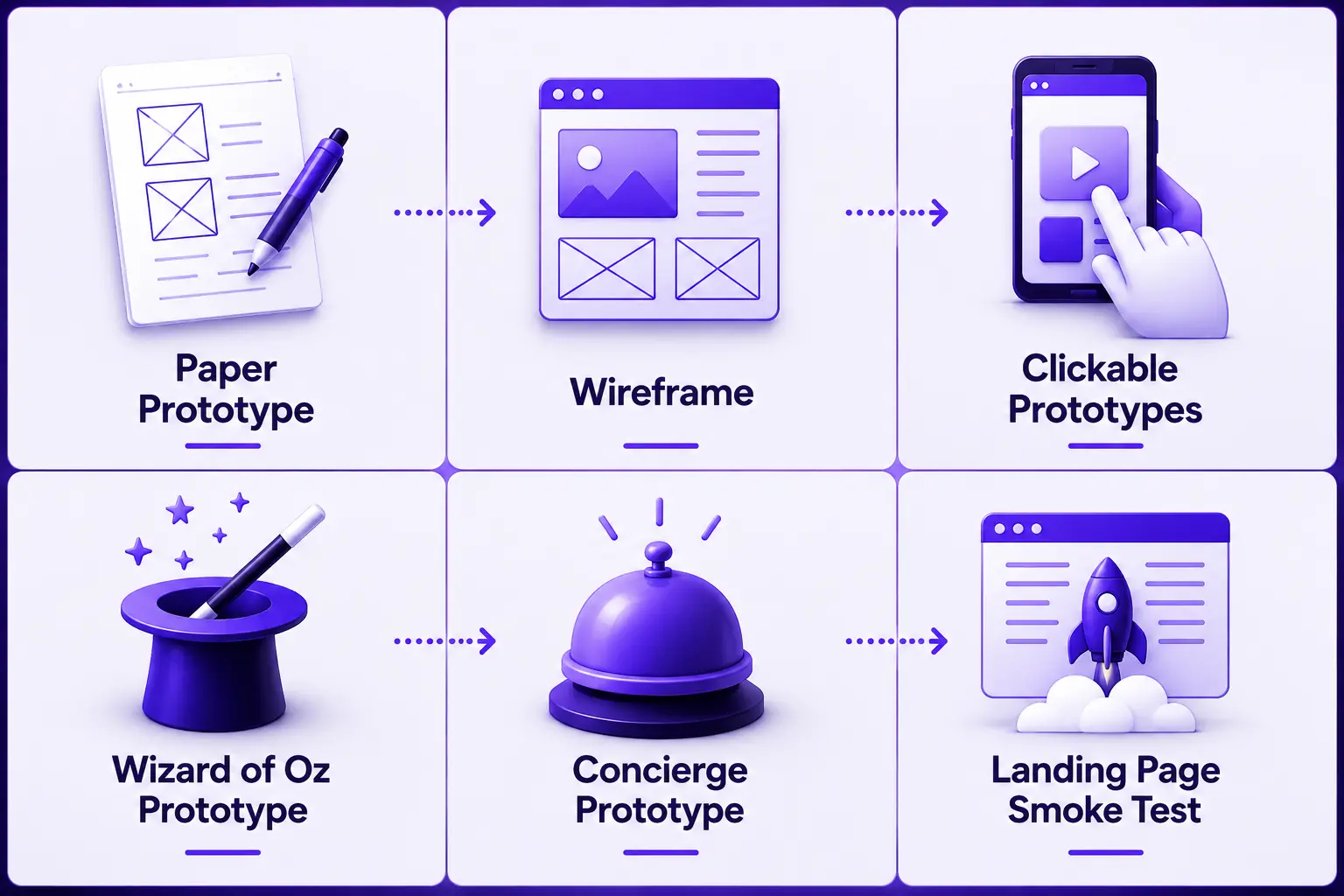
Paper Prototypes
Paper prototypes are simple sketches or hand-drawn screens used to visualize product ideas before investing in design or development. They help teams validate user flows, navigation patterns, and core functionality at minimal cost.
Wireframes
Wireframes are low-fidelity visual layouts that outline a product’s structure, content hierarchy, and user journey. They allow teams to evaluate usability and information architecture before moving into detailed design.
Clickable Prototypes
Clickable prototypes simulate real product interactions without requiring actual development. Created using tools like Figma, Adobe XD, or ProtoPie, they help stakeholders and users experience workflows before a product is built.
Wizard of Oz Prototypes
A Wizard of Oz prototype appears fully automated to users, while humans manually perform the underlying tasks behind the scenes. This technique helps validate demand and user behavior before investing in automation or complex technologies.
Concierge Prototypes
In a concierge prototype, founders manually deliver the service instead of relying on software or automation. This approach provides direct customer insights while validating the business model with minimal development effort.
Landing Page Smoke Tests
Landing page smoke tests use simple marketing pages to gauge customer interest before development begins. By tracking sign-ups, clicks, or pricing interactions, businesses can validate demand and willingness to pay before building the product.
While these approaches accelerate learning, they also have limitations. Feedback collected from prototypes can sometimes differ from actual purchase behavior. Teams must combine prototype insights with real customer validation before making major investment decisions.
Different products require different validation methods. The most effective teams choose the lowest-cost experiment capable of testing their riskiest assumption, often guided by early product discovery workshop sessions that align teams on what to test first.
What are the Best Real Rapid Prototyping Examples From Startups?
The most successful startups don’t build first; they validate first. These real rapid prototyping examples show how companies like Airbnb, Dropbox, Uber, and others tested ideas, reduced risk, and gained market insights before investing heavily in full-scale product development.
In many cases, early validation was later supported by mvp development services for startups, helping teams transition from prototype to scalable product once demand was proven.
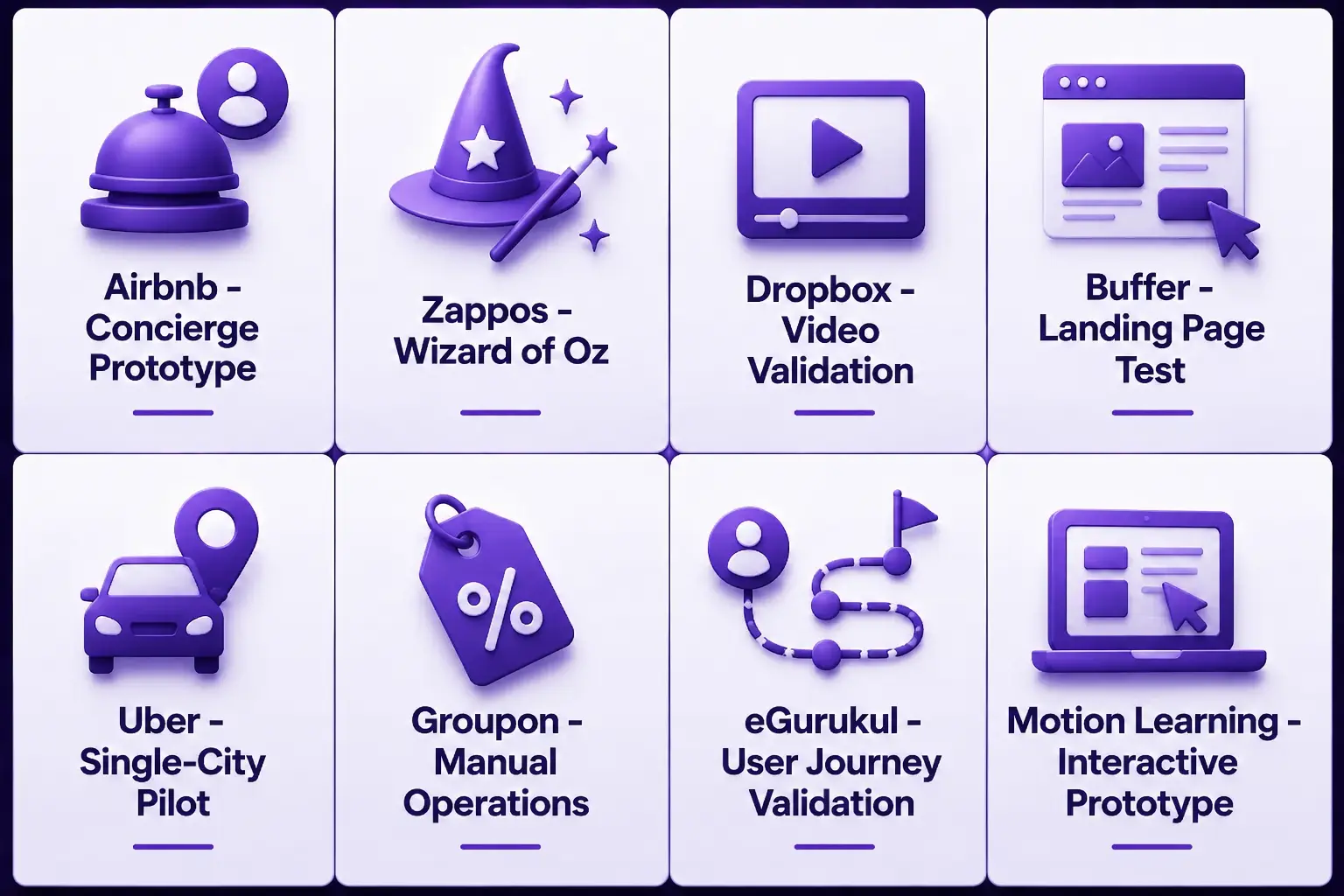
Airbnb: Concierge Prototype That Validated Market Demand
Technique: Concierge Prototype
When Airbnb’s founders struggled to pay their rent in San Francisco, they looked for a simple way to generate extra income. Instead of building a sophisticated hospitality marketplace, they created a basic website and offered air mattresses in their apartment to conference attendees who couldn’t find hotel rooms.
By manually managing bookings and guest interactions, the founders tested the business concept without investing heavily in technology or operations.
What They Tested
- Whether travelers would pay to stay in someone’s home
- Trust in peer-to-peer accommodations
- Demand for alternative lodging options
Outcome: The experiment validated a completely new hospitality model. More importantly, it proved that customers were willing to book accommodations from individual hosts, laying the foundation for Airbnb’s future growth.
Key Lesson: Validate customer demand before investing in large-scale platform development.
Zappos: Wizard of Oz Prototype That Proved Online Shoe Demand
Technique: Wizard of Oz Prototype
Before launching a full-scale eCommerce operation, Zappos founder Nick Swinmurn wanted to determine whether customers would actually buy shoes online.
Rather than investing in inventory, warehouses, and logistics, he photographed shoes from local retail stores and listed them on a simple website. Whenever someone placed an order, he manually purchased the shoes and shipped them to the customer.
What They Tested
- Consumer willingness to buy footwear online
- Customer trust in eCommerce transactions
- Demand without inventory ownership
Outcome: The experiment validated market demand while avoiding high operational costs and inventory risks.
Key Lesson: You can test customer behavior without building the complete business infrastructure first.
Dropbox: Video Prototype That Validated User Interest
Technique: Explainer Video MVP
Dropbox is often featured among rapid prototyping examples, although its famous validation experiment is more accurately categorized as an MVP-style smoke test.
Founder Drew Houston created a short demonstration video showing how Dropbox would solve file synchronization challenges. The product was not fully developed, but the video clearly communicated its value proposition.
What They Tested
- Whether users experienced the problem strongly enough to seek a solution
- Interest in cloud-based file synchronization
- Product messaging effectiveness
Outcome: The demonstration generated significant interest and dramatically increased beta signups, providing strong evidence of market demand.
Key Lesson: Sometimes demonstrating the value of a product is enough to validate demand before building it.
Buffer: Landing Page Prototype That Validated Pricing Demand
Technique: Landing Page Smoke Test
Buffer’s founder wanted to determine whether users would pay for a social media scheduling solution before investing in product development.
The company launched a simple landing page explaining the service and pricing plans. Users could click subscription options even though the platform had not yet been built.
What They Tested
- Customer interest in the solution
- Willingness to pay
- Pricing model viability
Outcome: The landing page generated enough interest to validate both demand and pricing assumptions before development began.
Key Lesson: Testing willingness to pay can be more valuable than testing product features in the early stages.
Uber: Single-City Prototype That Validated Ride-Hailing Demand
Technique: Limited Geographic Pilot
Uber’s first version was intentionally simple. The founders launched in a single market with limited functionality and focused on validating the core ride-hailing concept.
By restricting the launch scope, the company could test operational challenges and customer adoption without the complexity of scaling across multiple cities.
What They Tested
- Demand for app-based transportation
- Rider convenience preferences
- Operational feasibility
Outcome: The pilot demonstrated strong customer demand and revealed a scalable business opportunity.
Key Lesson: Validate your business model in a controlled market before expanding.
Groupon: Manual Operations Prototype That Validated Group Buying
Technique: Concierge MVP
Before building automated systems, Groupon relied on a simple website and manually distributed discount coupons to customers.
This approach allowed the company to validate the group-buying concept while avoiding unnecessary engineering costs.
What They Tested
- Consumer interest in daily deals
- Merchant participation
- Viability of group purchasing incentives
Outcome: The concept gained traction quickly, proving there was strong demand for local deal discovery.
Key Lesson: Manual execution often provides faster validation than building complex software upfront.
eGurukul 2.0: User Journey Prototype That Optimized Learning Experiences
Technique: User Journey Prototyping and UX Validation
Before scaling eGurukul into a large digital learning platform, extensive user research, wireframing, and workflow validation helped refine the student experience.
The team focused on understanding how medical aspirants accessed content, navigated learning modules, and engaged with educational resources across devices.
What They Tested
- Learning workflows
- Content accessibility
- Student engagement patterns
- Mobile-first user experiences
Outcome: The platform evolved into one of India’s leading medical education ecosystems, surpassing 2.5 million downloads and serving millions of learners.
Key Lesson: Validating user journeys early helps reduce redesign costs and improves long-term product adoption.
Motion Learning: Interactive Prototype That Validated Scalability
Technique: Interactive Product Prototyping
Motion Learning required a scalable education platform capable of supporting large numbers of students preparing for competitive examinations.
Through iterative prototyping, usability testing, and product refinement, the platform validated both user engagement and infrastructure requirements before scaling.
What They Tested
- Learning engagement patterns
- Content delivery architecture
- User retention mechanisms
- Platform performance at scale
Outcome: The solution achieved more than 500,000 downloads and over 100,000 daily active users, demonstrating strong adoption and engagement.
Key Lesson: Successful prototypes should validate scalability requirements alongside user experience, helping avoid common rapid prototyping mistakes like scaling too early without validation.
What Do These Rapid Prototyping Success Stories Teach Founders?
Across all these rapid prototyping examples, a consistent pattern emerges.
The startups that succeeded did not attempt to validate everything at once. Instead, they isolated one critical assumption and designed the cheapest possible experiment to test it.
This principle can be summarized as the Cheapest-Test-First Framework:
- Identify the riskiest assumption.
- Choose the lowest-fidelity validation method.
- Launch quickly.
- Gather feedback from real users.
- Decide whether to build, pivot, or stop.
Companies that follow this framework often reduce product risk, accelerate time-to-market, and improve resource allocation. The startups that succeeded did not attempt to validate everything at once. Instead, they isolated one critical assumption and designed the cheapest possible experiment to test it, often refined through insights from ux research consulting to better understand user behavior and decision-making.

Final Thoughts
Rapid prototyping is not about creating perfect products. It is about creating fast learning cycles. The most successful startup prototyping examples show that founders who validate assumptions early consistently outperform those who rely on intuition alone. While rapid prototyping can accelerate innovation, it should always be combined with customer research, business validation, and long-term product strategy.
Whether you’re developing a SaaS platform, mobile application, AI solution, or enterprise software product, investing in rapid prototyping for product development can significantly reduce development risk and improve product-market fit. At RipenApps, we help startups and enterprises transform ideas into validated digital products through strategic product discovery, UX research, prototype development, and scalable MVP development services that accelerate innovation while minimizing uncertainty.
FAQs
1. What is an example of rapid prototyping?
One of the most well-known rapid prototyping examples is Airbnb’s early concierge-style experiment. Instead of building a sophisticated booking platform, the founders created a simple website and rented out air mattresses in their apartment to validate whether travelers would pay for alternative accommodations. This low-cost test helped prove market demand before significant development investment.
2. What’s the difference between a prototype and an MVP?
A prototype is used to test ideas, user flows, and product concepts before development. An MVP (Minimum Viable Product) is a functional version of a product launched to validate market demand with real users. While prototypes focus on learning and feedback, MVPs focus on product-market fit and business viability. Startups often use prototypes before building MVPs, which helps build MVPs faster by reducing unnecessary features early in the process.
3. Which famous companies used rapid prototyping to succeed?
Several globally recognized companies leveraged rapid prototyping in startups to validate their ideas. Airbnb used a concierge prototype, Zappos adopted a Wizard of Oz approach, Dropbox tested demand through an explainer video, Buffer launched a landing-page smoke test, Uber started with a limited city pilot, and Groupon manually processed deals before building automation. These rapid prototyping success stories demonstrate how early validation can accelerate growth.
4. What is a Wizard of Oz prototype (with an example)?
A Wizard of Oz prototype is a testing method where users believe a product is automated, but humans perform the underlying tasks manually. Zappos is a classic example. Founder Nick Swinmurn listed shoes online without maintaining inventory.
When customers placed orders, he manually purchased and shipped the products. This approach is often part of a structured rapid prototyping process used to test feasibility before investing in automation.
5. How long does it take to build a rapid prototype?
The timeline depends on complexity, business goals, and prototype fidelity. Simple paper prototypes or wireframes can be created within a few days, while interactive digital product prototyping examples may take one to three weeks.
More advanced software prototyping examples involving user testing and iterative improvements can take several weeks. The objective is to learn quickly rather than build a complete product.
6. What tools are used for rapid prototyping?
Popular rapid prototyping tools include Figma, Adobe XD, Sketch, InVision, Axure RP, Balsamiq, and ProtoPie. These platforms help teams create wireframes, interactive interfaces, and clickable prototypes efficiently. These are widely considered the best prototyping tools because they support collaboration, fast iteration, and usability testing across design teams.
7. Why is rapid prototyping important for startups?
Rapid prototyping for startups helps validate ideas before committing significant resources to development. It reduces business risk, improves product-market fit, accelerates customer feedback collection, and shortens time-to-market.
By testing assumptions early, startups can avoid building products that fail to solve real customer problems, ultimately improving ROI and investor confidence.
8. Can rapid prototyping help attract investors?
Yes. Investors often prefer startups that demonstrate validated demand rather than relying solely on assumptions. Prototype development examples provide tangible evidence of customer interest, usability insights, and market potential.
A well-tested prototype can strengthen fundraising conversations by showing that key risks have already been addressed through structured validation.
9. What industries benefit the most from rapid prototyping?
Rapid prototyping is widely used across fintech, healthcare, education, eCommerce, SaaS, logistics, AI, and on-demand services. Each industry uses different validation methods depending on regulatory requirements, customer behavior, and technical complexity.
Digital product prototyping examples are particularly common in software and mobile application development, where user experience significantly impacts adoption and retention.
Discuss your project and request for proposal
SHARE
WRITTEN BY

Ishan Gupta
CEO & Founder
Ishan Gupta is a seasoned entrepreneur and CEO with extensive 10+ years of experience in business and mobile app development landscape. He believes that the right digital product allows companies to focus on what they do best, while technology handles the rest. With deep exposure to global markets, he understands what makes an app succeed. His approach translates business needs into clear product strategies, ensuring that every feature contributes to measurable ROI.
View All Articles