

Key Takeaways
- Development budget: Custom OTT app development typically costs $50,000–$300,000+.
- MVP timeline: A focused streaming MVP can take approximately 8–12 weeks.
- Full-platform timeline: A broader OTT platform may require 6–12 months or longer.
- Major cost drivers: Platform coverage, streaming infrastructure, DRM, monetization, integrations, and content workflows.
- Recurring expenses: CDN delivery, encoding, storage, licensing, content protection, maintenance, and applicable distribution fees.
- Budgeting strategy: Start with essential viewing and monetization capabilities, then expand according to audience demand and business priorities.
Building an over-the-top (OTT) platform involves more than adding video playback to an app. Businesses must plan for content management, video delivery, subscription workflows, digital rights management (DRM), device compatibility, and the infrastructure required to deliver reliable playback.
For US-based founders and product leaders, OTT app development cost typically ranges from $50,000 to $300,000+ for a custom platform in 2026. The final investment depends on the product’s scope, supported devices, streaming architecture, monetization model, content protection requirements, and expected audience.
A focused minimum viable product (MVP) can establish the core viewing experience before the business expands into smart TVs, advanced recommendations, or live streaming. However, development costs must be separated from recurring infrastructure bills, content licensing, distribution fees, and maintenance. Companies planning a custom streaming product can also explore media and entertainment app development services to evaluate their requirements before committing to a build.
This guide breaks down OTT platform development costs, explains ongoing expenses after launch, and outlines realistic timelines for bringing a streaming product to market.
Table of Contents
How Much Does OTT App Development Cost?
Custom OTT app development costs approximately $50,000–$300,000+, depending on the platform’s functionality, device coverage, streaming infrastructure, security requirements, and integration complexity. A focused MVP requires a narrower scope than an enterprise-grade streaming service supporting multiple devices, advanced personalization, and high-volume delivery.
These figures are planning estimates for custom development, not fixed agency quotations. They should be validated against the business’s requirements, technical architecture, and delivery expectations before a budget is approved.
The initial development investment is only one part of the financial commitment. A business must separately account for video delivery, content acquisition, storage, DRM services, maintenance, and other operating expenses.
For example, a streaming startup with an existing content library and a single primary distribution platform has different requirements from a media company launching across mobile, web, and connected TVs. Both need reliable playback, but their integration, testing, and infrastructure requirements can differ substantially.
Businesses evaluating the project should first define their audience, content strategy, monetization model, and launch platforms. The OTT app development guide provides broader context on product planning, architecture, and functionality.
OTT Platform Development Cost by Tier
The most useful way to approach the development budget is to divide the project into three stages: a focused MVP, a multi-device product, and an enterprise-grade platform. The overall planning range remains $50,000–$300,000+.
| Development tier | Suggested development cost | Indicative timeline | Typical scope |
| MVP / single-platform | $50,000–$80,000 | 8–12 weeks | Core playback, accounts, content catalog, and essential monetization |
| Mid-range, multi-device | $80,000–$180,000 | Approximately 3–5 months, depending on scope | Mobile and web experiences, subscriptions, analytics, and stronger content controls |
| Enterprise-grade OTT platform | $180,000–$300,000+ | 6–12 months or longer | Multi-device distribution, advanced DRM, live streaming, personalization, and scalable infrastructure |
MVP / Single-Platform OTT App
An OTT MVP focuses on the minimum capabilities required to validate the viewing experience and business model. It typically prioritizes one primary platform and a clearly defined audience rather than attempting to support every device at launch.
Core functionality may include:
- User registration, login, and profile management.
- A searchable content catalog with categories and metadata.
- Video playback with adaptive streaming support.
- Basic watch history and continue-watching functionality.
- A subscription or payment workflow appropriate to the product.
- Content administration and publishing controls.
- Basic analytics, monitoring, and access permissions.
The development scope can increase when the product requires offline downloads, complex subscription rules, advanced DRM, multiple profiles, or specialized content workflows.
The objective is not to create a disposable prototype. The underlying architecture should support planned expansion without forcing the business to rebuild essential services after initial validation. For businesses evaluating a lean first release, the MVP development cost guide offers additional context on prioritizing features and planning the initial investment.
Mid-Range Multi-Device OTT Platform
A multi-device product expands distribution while introducing additional integration and testing requirements. It may support Android and iOS applications alongside a web experience, with synchronized profiles, subscription management, and improved content discovery.
Typical capabilities include:
- Multiple application interfaces and device-specific navigation.
- Subscription management and entitlement controls.
- Improved search and recommendation features.
- User profiles and synchronized viewing progress.
- Analytics for content engagement and retention.
- Push notifications and lifecycle communication.
- More advanced security and administrative permissions.
Supporting several devices does not automatically require entirely separate implementations. Shared components can reduce duplication, but they do not eliminate platform-specific development or testing.
Businesses should select platforms according to audience demand, distribution strategy, and commercial priorities. Supporting additional devices should create measurable value rather than add maintenance obligations without a clear business case.
Enterprise-Grade OTT Platform
An enterprise-grade streaming product may need advanced architecture to deliver content reliably across multiple platforms and regions. The scope can include:
- Mobile, web, smart TV, and connected TV applications.
- Live streaming alongside video-on-demand content.
- Multi-DRM integration and advanced entitlement management.
- High-availability services and multi-CDN delivery strategies.
- Sophisticated search, personalization, and audience analytics.
- Advertising technology, subscription billing, or hybrid monetization.
- Automated content ingestion, encoding, and publishing workflows.
- Security monitoring, performance testing, and production observability.
Regional content restrictions, accessibility requirements, external content-provider integrations, and contractual security obligations can further expand the scope. The Netflix app development guide provides a related reference for understanding the breadth of a mature streaming product. Its requirements should not be treated as a default specification for every OTT business.
Cost Breakdown by Component
A reliable estimate separates product planning, application development, backend services, streaming integration, and quality assurance. This helps businesses understand what a proposal includes and identify work that may have been excluded from an initial quotation.
The table below identifies the principal development components.
| Component | What the development work covers | Main cost variables | Estimated cost range |
| Discovery and product planning | Requirements, user journeys, architecture, and delivery planning | Product complexity, stakeholder alignment, and existing systems | $3,000–$10,000 |
| UI/UX design | Navigation, content discovery, player interfaces, and design systems | Number of platforms, user journeys, and design requirements | $5,000–$15,000 |
| Frontend development | Application interfaces, playback integration, and account workflows | Device coverage, native capabilities, and interface complexity | $10,000–$40,000 |
| Backend and APIs | Authentication, content metadata, user profiles, and business logic | Data relationships, integrations, and scalability requirements | $10,000–$35,000 |
| Video streaming integration | Playback services, adaptive delivery, and streaming workflows | Streaming provider, protocols, and live versus on-demand delivery | $5,000–$20,000 |
| Content management system | Catalog administration, metadata, publishing, and permissions | Library size, editorial workflows, and automation | $4,000–$15,000 |
| Subscription and payment integration | Plans, billing workflows, renewals, and entitlements | Monetization model, platforms, and payment integrations | $3,000–$12,000 |
| DRM and content security | Protected playback, access controls, and licensing workflows | Device compatibility, security requirements, and provider contracts | $3,000–$15,000 |
| Search and recommendations | Content discovery, search, ranking, and personalization | Data availability, recommendation complexity, and integrations | $3,000–$15,000 |
| QA and device testing | Functional, playback, security, and performance testing | Number of devices, test scenarios, and release requirements | $5,000–$18,000 |
| Deployment and monitoring | Production configuration, logging, alerts, and release preparation | Availability requirements, environments, and monitoring depth | $2,000–$10,000 |
The development estimate should also distinguish one-time engineering expenses from third-party subscriptions and recurring usage charges. A vendor’s monthly price is not a substitute for the cost of designing, integrating, testing, and maintaining the relevant functionality.
What Drives OTT Application Development Cost Up?
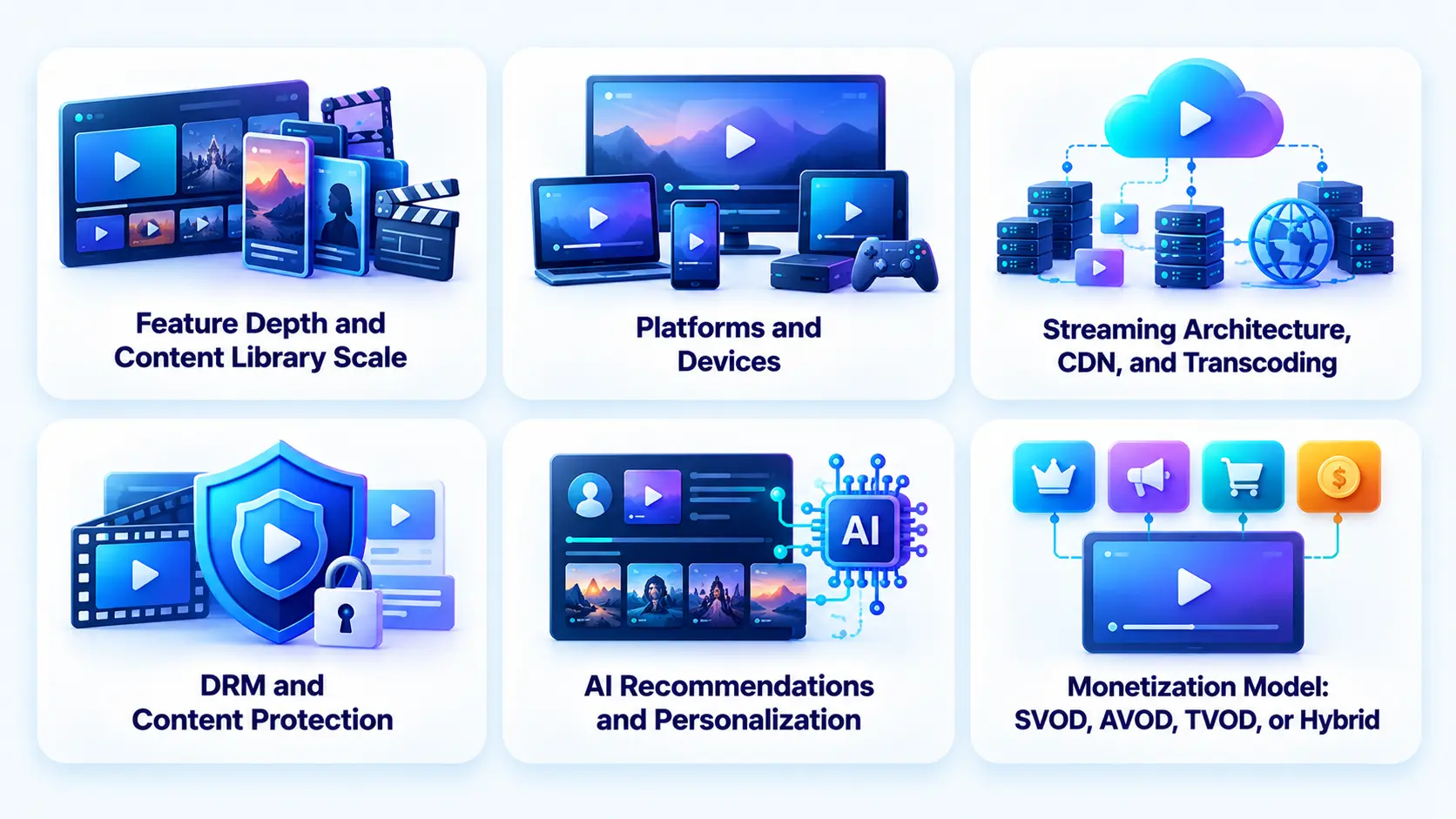
The largest cost differences usually come from product scope and architecture rather than screen count alone. A streaming service with a limited catalog and predictable viewing demand has different requirements from one distributing premium live events across several device categories.
1. Feature Depth and Content Library Scale
A basic catalog with categories, search, and playback requires less engineering than a platform with multiple profiles, personalized home screens, offline downloads, or interactive viewing features.
Content scale also affects the administrative side of the product. A small library may be managed through straightforward publishing workflows, while a large catalog may require bulk ingestion, richer metadata, localization, rights tracking, and automated quality checks.
Businesses should prioritize features according to their contribution to customer acquisition, retention, and monetization. Capabilities that do not support an immediate product objective can often be deferred.
2. Platforms and Devices
Supporting Android, iOS, web, and connected TV platforms such as Android TV, Google TV, Apple tvOS, Samsung Tizen, LG webOS, and Amazon Fire TV expands development and quality assurance requirements. Each platform has different navigation patterns, playback capabilities, operating-system versions, hardware constraints, and app distribution requirements. Supporting additional platforms can increase development costs, testing effort, and ongoing maintenance.
A shared architecture can reduce duplication, but it does not eliminate platform-specific implementation or testing. Businesses should choose platforms based on audience demand rather than attempting to support every device in the first release.
3. Streaming Architecture, CDN, and Transcoding
Streaming architecture directly affects playback reliability, quality, and recurring infrastructure expenses. Video content often needs to be processed into suitable formats and quality levels before delivery. Adaptive bitrate streaming allows playback quality to adjust to network conditions, while content delivery networks (CDNs) distribute video closer to viewers.
The implementation may use HTTP Live Streaming (HLS), MPEG-DASH, or other protocols suited to the required devices and delivery model. Live streaming adds ingestion, processing, latency management, and monitoring requirements.
4. DRM and Content Protection
Digital rights management helps enforce access rules for licensed or premium video content. Depending on the supported devices, a platform may need Widevine, FairPlay, PlayReady, or a multi-DRM solution.
Google’s Widevine Cloud License Service is scheduled to cease operations on April 13, 2027. OTT businesses using this service should plan a migration before the deadline. Budget for the replacement license-server setup or third-party DRM integration, device compatibility testing, and ongoing operating or licensing costs. Confirm the migration requirements with the chosen DRM provider.
5. AI Recommendations and Personalization
Recommendation systems help viewers discover relevant titles and can support engagement. A simple implementation may use categories and popularity, while a more advanced system could incorporate viewing history, behavioral signals, contextual ranking, and machine-learning models.
The budget depends on data availability, model complexity, integration requirements, and ongoing evaluation. AI capabilities may also introduce additional infrastructure and monitoring expenses.
A startup does not necessarily need a custom recommendation model at launch. A simpler discovery experience may be sufficient until the platform gathers enough reliable user behavior to justify more sophisticated personalization. Businesses considering this expansion can explore AI in OTT apps.
6. Monetization Model: SVOD, AVOD, TVOD, or Hybrid
The monetization model influences both application development and the services required after launch.
- Subscription video on demand (SVOD): Requires subscription plans, renewals, cancellations, entitlement checks, and billing management.
- Advertising video on demand (AVOD): Adds ad-serving integrations, placement rules, reporting, and potentially more complex video delivery workflows.
- Transactional video on demand (TVOD): Requires rental or purchase workflows, content access windows, and transaction-specific entitlements.
- Hybrid monetization: Combines multiple approaches, increasing the number of billing, access, and reporting scenarios to test.
A hybrid model can serve different audience segments, but it should be implemented only when the expected business value justifies the added complexity. The OTT business models guide explores these monetization approaches in greater detail.
The Recurring Costs You Should Know
The initial development budget is only one part of the financial commitment. Once the platform goes live, businesses must pay for video delivery, processing, storage, content rights, security services, and product maintenance.
These expenses vary with viewing hours, video quality, audience geography, library size, and commercial agreements. A platform with substantial viewing activity can incur high recurring costs even when the application requires few changes.
| Recurring expense | How it is charged | What affects the bill |
| CDN and video delivery | Data transfer, delivery minutes, or contracted usage | Viewing hours, bitrate, audience geography, and traffic patterns |
| Video encoding and transcoding | Processing minutes, output formats, or usage units | Upload volume, resolutions, codecs, and live-stream workflows |
| Video and application storage | Stored data or stored video minutes | Library size, renditions, retention, and backups |
| DRM and content protection | Provider-specific licensing or usage terms | License volume, supported devices, and contract terms |
| Cloud hosting and databases | Compute, storage, requests, and other service usage | Concurrent users, API traffic, and availability requirements |
| Monitoring and analytics | Event volume, retention, or subscription plans | Observability depth, data retention, and reporting requirements |
| Maintenance and updates | Internal team capacity or an external maintenance agreement | Release frequency, supported devices, defects, and feature changes |
These categories may overlap depending on the provider. A managed video service might bundle several capabilities, while a custom architecture may require separate vendors and bills.
CDN Bandwidth at Scale
CDN (Content Delivery Network) expenses grow as viewers consume more video. The amount of data delivered depends on playback duration, bitrate, resolution, and the delivery architecture.
AWS CloudFront offers both usage-based services and flat-rate plans with defined allowances and included capabilities. Its official pricing-plan documentation explains how plan selection affects delivery and associated services.
For budgeting, estimate monthly viewing hours, average delivered bitrate, and regional distribution. Model normal traffic, peak events, and growth scenarios rather than relying on a single monthly figure.
For example, Amazon CloudFront’s published Premium flat-rate plan includes 50 TB of monthly data transfer and 500 million requests for $1,000 per month. A streaming business can use this as an initial reference when estimating delivery costs, but it must check the plan’s included capabilities, usage allowances, and overage policies against its expected traffic. Actual costs depend on the selected plan and delivery requirements. See Amazon CloudFront’s official pricing plans for current usage allowances, plan features, and pricing.
DRM Licensing
Content protection costs depend on the selected technology and provider contract. Some services charge by license volume or usage, while others use different commercial arrangements.
Widevine’s cloud license service, for example, has no access or transaction fees according to Google’s documentation. That does not mean the entire multi-DRM implementation is free. Integration, license proxy development, operational monitoring, and other DRM providers may introduce additional expenses.
Before choosing a provider, confirm the supported devices, license workflow, contractual obligations, and any applicable usage charges.
Transcoding and Storage
Uploaded videos commonly need to be processed into multiple renditions so viewers can stream at suitable quality levels. Larger libraries, higher resolutions, and additional processing workflows can increase encoding and storage costs.
Storage also depends on how long the platform retains source files and generated versions. A library containing thousands of long-form videos has a different storage profile from a service publishing short clips.
Managed video platforms can simplify these workflows, but businesses should confirm which services are included in their chosen plan. Bitmovin, for example, publishes usage-based pricing for encoding, player impressions, and observability. Its pricing page provides a basis for estimating those specific services, not the full operating cost of a streaming business.
Content Licensing
Content rights can become one of the largest expenses in a streaming business. The amount depends on the titles, territories, exclusivity, contract duration, distribution rights, and negotiated commercial terms.
There is no reliable universal monthly allowance for content licensing. Some businesses own their libraries, while others pay minimum guarantees, revenue shares, per-title fees, or other negotiated amounts. Content acquisition should therefore be modeled separately from software development. Geographic availability and entitlement rules must also reflect the rights granted under each agreement.
Apple App Store Fees
Apple’s commission depends on the transaction, subscription duration, developer program, and region. The standard commission is generally 30% on qualifying paid apps and in-app purchases. Eligible developers in the App Store Small Business Program can qualify for a 15% rate, and qualifying auto-renewable subscriptions generally move to a 15% commission after the first year. Regional terms may differ, including Apple’s updated EU terms effective October 1, 2026. Review Apple’s Small Business Program before estimating net revenue.
Google Play Store Fees
For eligible US transactions under Google Play’s updated fee framework, auto-renewing subscriptions carry a 10% service fee. Other transactions generally carry a 20% service fee for new installs and 25% for existing installs. A separate 5% billing fee applies to qualifying purchases made through Google Play Billing. Eligible developers and programs may qualify for different rates, including reduced fees on the first $1 million in annual earnings. Confirm the applicable rates in Google Play’s official service-fee guidance before forecasting revenue.
Maintenance and OS Updates
Maintenance includes security patches, dependency upgrades, compatibility updates, monitoring, performance improvements, and changes required to support evolving devices and operating systems.
The cost depends on the application portfolio, release frequency, and reliability requirements. A service available across mobile, web, and connected TVs generally needs a broader testing and maintenance plan than a single-platform MVP.
Reserve funds for ongoing maintenance from launch rather than treating it as an optional expense after the first release.
How Long Does It Take to Build an OTT Platform?
A focused OTT MVP can take approximately 8–12 weeks, while a full-scale platform may require 6-12 months or longer. Timelines depend on the feature set, integrations, content readiness, team availability, and the number of supported devices.
Some development activities run in parallel, so the durations below represent indicative stage estimates rather than a cumulative project timeline.
| Development stage | Indicative duration | Main activities |
| Discovery and planning | 1–2 weeks | Requirements, audience definition, architecture, and launch scope |
| UX and UI design | 2–3 weeks | Navigation, playback, content discovery, and account workflows |
| Backend and architecture | 3–6 weeks | APIs, user management, content services, and business logic |
| Frontend development | 3–5 weeks | Application interfaces and integration with playback and account services |
| QA and release preparation | 2–3 weeks | Functional, playback, security, performance, and device testing |
The schedule assumes that content, branding, third-party accounts, and necessary business decisions are available when required. Delays in licensing, payment approvals, DRM configuration, or device-specific development can extend delivery.
Why Enterprise Projects Take Longer
Enterprise platforms often require more integration and validation than a focused MVP. Smart TV distribution, multi-DRM protection, live streaming, advanced recommendations, regional access restrictions, and high-availability infrastructure can add substantial work.
RipenApps’ documented Hungama engagement provides a project-specific reference: the build took seven months. This is not a standard estimate for every OTT product, but it demonstrates that a mature entertainment platform can require a longer delivery cycle than a tightly scoped MVP.
Businesses should agree on the initial release scope and measurable acceptance criteria before development begins. This makes it easier to distinguish essential launch requirements from enhancements that can be delivered in later phases.
Custom OTT App Development vs. White-Label Platforms
A custom OTT platform gives the business greater control over product functionality, architecture, branding, and long-term development. A white-label platform provides a prebuilt foundation that can be configured for a particular brand and use case.
Neither approach is automatically cheaper over the product’s lifetime. The right choice depends on the amount of differentiation required and how much control the business wants over its technology.
| Consideration | Custom development | White-label platform |
| Initial investment | Depends on engineering scope and integrations | Depends on vendor plans and customization |
| Launch speed | Depends on scope and delivery complexity | Often faster when requirements match existing capabilities |
| Product control | Greater control over architecture and features | Limited by vendor capabilities and contract |
| Customization | Supports specialized workflows | Depends on configuration and extensions |
| Infrastructure | Can be designed around business requirements | Often managed or constrained by the provider |
| Vendor dependency | Depends on selected technology and maintenance model | Can be significant |
| Ongoing expenses | Infrastructure, maintenance, and third-party services | Subscription, usage fees, add-ons, and customization |
| Best suited for | Differentiated products with specific requirements | Businesses prioritizing speed and standard functionality |
When Custom Development Makes Sense
Custom development is worth evaluating when the platform needs specialized monetization, proprietary content workflows, complex entitlements, integrations with existing business systems, or distinctive user experiences.
It can also be appropriate when the business wants greater control over its technology roadmap and has a clear plan for maintaining the product. The trade-off is a larger initial engineering commitment and responsibility for architecture, quality assurance, updates, and ongoing operations.
When White-Label Development Makes Sense
A white-label solution may be a better fit when the business wants to validate demand quickly, and its requirements align with an established platform’s capabilities.
Before committing, review subscription terms, transaction fees, content portability, API access, supported devices, security controls, data ownership, and exit provisions. A low initial fee may become less attractive if usage charges increase or essential features require expensive upgrades.
Compare the total cost over several years rather than choosing solely on launch price. Include migration expenses if the product eventually outgrows the vendor’s capabilities.
How to Reduce OTT App Development Cost
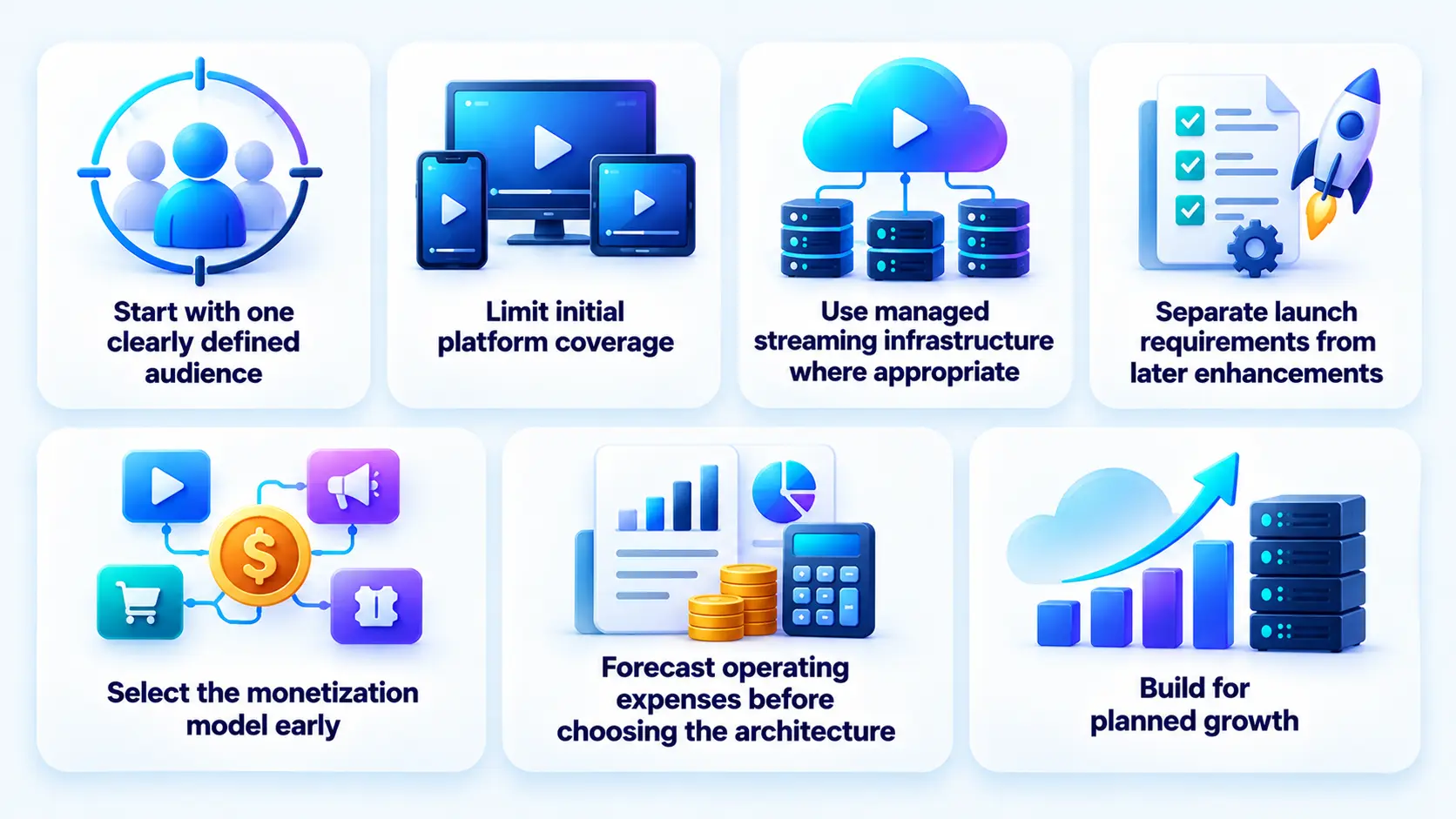
Reducing cost does not mean compromising the core viewing experience or weakening content protection. It means concentrating investment on capabilities that support immediate business objectives while keeping future expansion practical.
- Start with one clearly defined audience: A niche streaming service can focus on the content categories, discovery workflows, and subscription options its audience actually needs. This reduces the risk of building features without evidence of demand.
- Limit initial platform coverage: Launch on the devices most relevant to the target audience. Expand to additional platforms when user demand and business performance justify the extra development and maintenance work.
- Use managed streaming infrastructure where appropriate: Building every part of a video pipeline from scratch can introduce unnecessary complexity. Compare managed video services with self-managed infrastructure based on usage, security, customization, and projected costs.
- Separate launch requirements from later enhancements: Prioritize reliable playback, content discovery, user accounts, and the required monetization workflow. Defer advanced personalization or complex interactive features when they are not essential to the initial business case.
- Select the monetization model early: Subscription, advertising, rental, and hybrid models require different integrations and testing. Making the decision early reduces rework across billing, entitlements, reporting, and user experience.
- Forecast operating expenses before choosing the architecture: Estimate viewing hours, video quality, content storage, and expected traffic. A solution with a low initial setup cost may become expensive at scale if its usage pricing does not match the product’s consumption pattern.
- Build for planned growth, not hypothetical scale: Choose an architecture that supports the next stage of the business without paying for unnecessary infrastructure on day one. The objective is to preserve a practical path to expansion while keeping the initial system manageable.
What a Platform at Scale Actually Looks Like: Hungama
RipenApps developed the Hungama Entertainment app for Android and iOS over seven months. The platform brings together a catalog of 30M+ songs and 8,000+ movies and web shows, supported by personalized recommendations and multi-format streaming.
Hungama has 50M+ installs and 553K reviews on Google Play, alongside a 4.0-star rating from 11,474 ratings on the Apple App Store.
It illustrates the planning required to support a large entertainment catalog, personalized content discovery, and multi-format streaming. These requirements can influence architecture, integration complexity, and the overall cost of developing an OTT platform.

Final Thoughts
OTT app development cost depends on the product a business intends to operate, not just the application it wants to launch. A custom platform may require $50,000–$300,000+ in initial development investment, with additional expenses for video delivery, content rights, security, storage, and maintenance. Businesses using AI integration services for personalized recommendations or content discovery should also budget for added development and infrastructure requirements.
A focused MVP can establish the core viewing experience in approximately 8–12 weeks, while a broader platform may need 6-12 months or longer. The strongest budgets account for both development and ongoing operations before selecting the technology stack or expanding device coverage. Businesses planning a new streaming product should define their launch requirements, model recurring expenses, and identify which capabilities can be introduced later. RipenApps works with businesses on media and entertainment products, helping them evaluate application scope and development requirements before committing to a build.
Frequently Asked Questions
1. How much does it cost to develop an OTT app?
Custom OTT app development typically costs $50,000–$300,000+. A single-platform MVP may cost $50,000–$80,000, a mid-range multi-device platform $80,000–$180,000, and an enterprise-grade platform $180,000–$300,000+. The final cost depends on platform coverage, streaming infrastructure, DRM, monetization, integrations, and content workflows.
2. How long does it take to build an OTT platform?
A focused OTT MVP generally takes 8–12 weeks, while a full-scale platform may take 6-12 months or longer. Timelines depend on feature complexity, integrations, content readiness, and testing requirements. RipenApps’ documented Hungama engagement took seven months, illustrating the timeline of a specific entertainment project.
3. What is the difference between custom OTT development and a white-label solution?
Custom development provides greater control over architecture, functionality, integrations, and the product roadmap, but requires engineering investment. White-label solutions can accelerate launch when existing capabilities meet the requirements. Businesses should compare licensing, usage fees, customization limits, and long-term vendor dependency before deciding.
4. What are the highest ongoing costs of an OTT platform?
Ongoing OTT operating costs can range from a few hundred dollars to $10,000+ per month, depending on usage and platform complexity. Major expenses include CDN delivery, transcoding, storage, cloud hosting, DRM, content licensing, and maintenance. High-traffic platforms or services with premium content may spend considerably more.
5. Can a startup launch an OTT platform with a limited budget?
Yes. A startup can begin with a focused MVP that supports its core audience, essential playback, content discovery, and a suitable monetization workflow. Limiting initial device coverage and using managed streaming services where appropriate can help control engineering costs. The business must still budget for content rights, infrastructure, and operations.
6. Is custom OTT app development worth the investment?
Custom OTT development can be worthwhile when a business needs differentiated features, specialized monetization, control over its architecture, or integrations that a standard platform cannot provide. The decision should account for audience demand, expected revenue, content acquisition, operating costs, and the resources required to maintain the product after launch.
Discuss your project and request for proposal
SHARE
WRITTEN BY

Ishan Gupta
CEO & Founder
Ishan Gupta is a seasoned entrepreneur and CEO with extensive 10+ years of experience in business and mobile app development landscape. He believes that the right digital product allows companies to focus on what they do best, while technology handles the rest. With deep exposure to global markets, he understands what makes an app succeed. His approach translates business needs into clear product strategies, ensuring that every feature contributes to measurable ROI.
View All Articles