


Key Takeaways
- Instacart’s asset-light model enables scalable grocery delivery by leveraging retailer partnerships rather than owning inventory or operating traditional warehouses.
- Diversified revenue streams across customers, retailers, brands, advertising, and technology services can reduce reliance on a single source of income.
- Human-assisted shopping combined with AI-powered optimization creates a hybrid model that supports personalization, product discovery, and operational efficiency.
- Real-time inventory visibility, accurate substitutions, and flexible delivery options play an important role in building user trust, retention, and repeat orders.
- A successful grocery delivery platform needs more than an ordering app; it requires coordinated customer, shopper, retailer, logistics, payment, and administrative systems working together.
The grocery shopping experience has evolved significantly in 2026. Customers now expect more than online product catalogs and basic delivery options. They want fast discovery, accurate product availability, secure payments, real-time tracking, personalized recommendations, and convenient reordering. For businesses, this creates an opportunity to build digital grocery platforms that combine ecommerce, logistics, retailer partnerships, and intelligent technology.
Building an app like Instacart today involves much more than creating a mobile storefront. A successful platform needs to connect customers, retailers, shoppers, administrators, inventory systems, payment providers, and delivery operations through a coordinated digital ecosystem. Instacart provides a useful reference because its platform demonstrates how grocery commerce can expand beyond online ordering and delivery. Its ecosystem increasingly combines marketplace operations with advertising, enterprise technology, artificial intelligence, and connected-store capabilities.
Whether you are planning a focused startup MVP or a larger multi-retailer platform, working with an experienced food delivery app development company can help translate the business model into scalable technology while adapting the product to specific market and customer requirements. This guide explains how to build a grocery delivery app like Instacart in 2026, covering its business model, architecture, development process, features, AI opportunities, inventory management, technology stack, cost, timeline, challenges, and emerging trends.
Table of Contents
What is Instacart?
Instacart is a grocery commerce platform that connects consumers with retailers and shoppers through digital ordering and fulfillment. Customers can discover products, add items to their carts, select delivery options, complete payments, and receive their purchases without visiting the store. Behind this simple experience, however, multiple technology systems coordinate inventory, orders, shoppers, payments, communication, and delivery operations.
The customer journey may appear straightforward: search for products, add them to a cart, select a delivery option, pay, track the order, and receive the groceries. However, each step requires coordination between different parts of the platform. Product availability needs to be accurate, orders need to reach the appropriate retailer, shoppers need assignments, and customers need timely updates when fulfillment conditions change.
Instacart’s evolution also demonstrates how grocery technology is becoming broader than traditional marketplace delivery. Its 2026 business includes enterprise ecommerce solutions, advertising capabilities, artificial intelligence initiatives, and connected-store technologies. This development shows why businesses should think beyond a conventional ordering application when planning a modern grocery delivery platform. (Instacart 2026 financial results)
How Does the Platform Work?
A typical Instacart-style platform brings together three primary participants: customers, retailers, and shoppers. Customers place orders through the application, retailers provide products and inventory information, and shoppers pick and deliver the selected items. The platform acts as the technology layer connecting these participants while managing payments, order status, communication, delivery coordination, and other operational requirements.
When a customer places an order, the system first needs to identify an appropriate store and confirm product availability. The order can then move into the fulfillment process, where a shopper receives the assignment and begins picking products. If something is unavailable, the platform can support substitutions or customer communication before the order proceeds toward delivery.
The final stage involves coordinating the delivery from the store to the customer. Location information, delivery status, navigation, estimated arrival times, and notifications can all contribute to a smoother experience. This process illustrates why a grocery delivery platform requires real-time communication between applications and backend systems rather than relying on a traditional ecommerce architecture alone.
How Instacart Stays Competitive in the Grocery Delivery Industry
On-demand grocery delivery has become one of the most competitive sectors in the digital commerce industry. As consumers increasingly rely on smartphones and mobile apps for convenient grocery shopping and delivery, the market continues to expand. However, entering a crowded market does not guarantee success. Instacart has remained competitive by combining retailer partnerships, customer convenience, technology, and continuous product innovation.
The grocery delivery market is becoming increasingly competitive as consumers expect faster fulfillment, accurate product availability, flexible delivery options, and more personalised shopping experiences. This creates opportunities for businesses to build differentiated platforms rather than simply replicating existing delivery models.
However, Instacart has built a strong position in the US by combining technology with an asset-light marketplace model. Its approach offers a useful example for businesses looking to develop similar grocery marketplace concepts while adapting the model to specific markets, retailer relationships, and customer needs.
The reasons? A blend of timing, innovation, strategic partnerships, and a deep understanding of customer behaviour. Let us understand how the Instacart business model continues to compete despite fierce competition in the grocery and ecommerce market.
1. Solving a Real Pain Point
Instacart tapped into a universal truth: grocery shopping isn’t always convenient. Long lines, crowded stores, limited time, and forgotten items are common challenges. By offering an alternative that lets users order groceries remotely while maintaining control over their selections, Instacart’s business model addresses a real-world problem and delivers convenience at scale.
2. Strategic Partnerships
Unlike businesses that build their own inventory or warehouses, Instacart has historically relied heavily on partnerships with grocery retailers. This approach allows the platform to expand its selection and geographic reach without operating traditional retail inventory itself.
Retailers benefit too, as partnerships can extend their digital reach without requiring them to build an entire grocery delivery ecosystem independently. This creates value for both sides and strengthens the marketplace by connecting retailers, shoppers, and consumers through a shared platform.
3. Exceptional User Experience
Instacart’s app focuses on making grocery shopping convenient and intuitive. Features such as product discovery, shopping lists, order tracking, shopper communication, and personalised recommendations help simplify the customer journey. Its mobile app design approach also demonstrates why usability is important for high-frequency commerce applications.
The ability to reorder previous purchases, manage grocery lists, discover relevant products, and receive updates throughout the order can reduce friction. These small but impactful details contribute to a smoother experience and can encourage customers to return to the platform.
4. Flexibility and Speed
In the on-demand economy, convenience remains a major competitive factor. Instacart supports different fulfillment options and delivery windows, allowing customers to choose services according to their needs. Its marketplace architecture also enables the platform to coordinate orders across participating retailers and shoppers rather than relying on a single fulfillment model. Businesses partnering with an experienced on-demand app development company can build similar flexible platforms with scalable marketplace architecture and seamless order management.
The broader competitive landscape has also pushed grocery platforms toward faster fulfillment, better delivery-slot management, and more efficient logistics. Businesses entering this space therefore need to balance delivery speed with operational efficiency instead of treating speed alone as the primary differentiator.
5. Customer-Centric Approach
The Instacart business model does not focus only on logistics and technology. Customer experience remains an important part of the platform, with features that support shopper communication, order instructions, substitutions, and updates during fulfillment. These interactions can create greater transparency and trust, particularly when customers are ordering products they cannot physically inspect themselves.
This customer-centric approach becomes even more important as grocery platforms introduce AI and automation. Technology can improve recommendations and operational efficiency, but customers still need accurate information, clear communication, and reliable support when something changes during an order.
6. Innovative Features
Instacart continues to expand its technology capabilities to respond to changing customer and retailer expectations. In 2026, AI has become a more visible part of the platform through conversational shopping assistance, AI-powered cart creation, personalised product discovery, and inventory-aware recommendations. Its broader technology ecosystem also includes advertising, retailer technology, and smart-store solutions.
The company is also expanding beyond conventional grocery delivery through initiatives such as AI-powered shopping assistants and Caper smart carts. These developments show how grocery platforms can evolve from simple ordering applications into broader digital commerce ecosystems.
For businesses planning a similar platform, the lesson is not to copy every Instacart feature. Instead, the goal should be to identify a specific customer problem, establish strong retailer and fulfillment operations, and continuously introduce technology that improves convenience, personalization, and efficiency.
Why Build a Grocery Delivery Platform in 2026?
The growing expectation for convenient digital shopping has created opportunities for retailers, grocery startups, and technology businesses. A well-designed platform can help businesses reach customers beyond physical stores, encourage repeat purchases, introduce loyalty programs, personalize promotions, and offer delivery or pickup options. It can also provide retailers with digital tools for managing products, inventory, orders, and customer relationships.
Another important opportunity is connecting digital and physical shopping experiences. Customers may discover products through an application, visit a store, order for delivery later, or collect an online purchase through pickup. An effective platform can connect these experiences through shared customer profiles, inventory, loyalty programs, promotions, and order information. This is where an omnichannel commerce strategy becomes particularly relevant.
For businesses, grocery delivery can also become more than a transaction channel. The platform can create opportunities for retailer partnerships, subscriptions, advertising, analytics, personalized recommendations, and enterprise technology services. This broader approach allows businesses to build recurring revenue while creating additional value for customers and participating retailers instead of depending entirely on delivery charges.
Grocery Delivery Market Opportunity in 2026
The grocery delivery market continues to expand as consumers prioritize convenience, digital ordering, flexible fulfillment, and faster access to everyday essentials. According to Mordor Intelligence, the global online grocery delivery market is estimated at $0.91 trillion in 2026 and is projected to reach $2.43 trillion by 2031, representing a 21.68% CAGR.
The opportunity is not limited to traditional scheduled grocery delivery. Quick commerce, same-day fulfillment, omnichannel retail, personalized shopping, and AI-powered inventory management are creating new ways for businesses to compete. Mordor Intelligence expects quick commerce app development to be one of the faster-growing delivery models, while Asia-Pacific is projected to record the strongest regional growth through 2031.
For businesses planning a grocery delivery platform, this growth creates opportunities beyond simply connecting customers with nearby stores. Platforms can build value through retailer partnerships, subscriptions, advertising, personalized recommendations, commerce analytics, and technology services. The strongest opportunities are likely to come from combining reliable fulfillment with accurate inventory, intelligent shopping experiences, and scalable marketplace infrastructure.
India also presents a particularly strong opportunity. NIQ reported in August 2026 that quick-commerce adoption had reached 82% among surveyed Indian consumers, compared with a global average of 48%. Its findings also indicate that grocery shopping in India is expanding beyond small top-up purchases toward larger baskets and more frequent online missions.
This changing behavior means new grocery platforms do not necessarily need to compete only on delivery speed. Businesses can differentiate through broader product selection, local retailer partnerships, personalized experiences, reliable substitutions, competitive pricing, and efficient fulfillment. For startups and established retailers alike, the opportunity is to identify an underserved customer segment and build a grocery experience around its specific needs.
How Does the Business Model Work?
Before development begins, businesses should determine exactly how their grocery platform will generate revenue. A single revenue stream may not be enough to support the operational costs associated with technology, customer acquisition, delivery, support, and retailer relationships. Depending on the target market, a platform can combine transaction-related revenue with subscriptions, retailer partnerships, advertising, enterprise services, and other commerce-related opportunities.
Delivery and Service Fees
Delivery and service fees can provide a direct revenue stream from completed customer orders. Pricing can vary according to factors such as delivery distance, order size, delivery speed, location, and operational costs. Rather than copying another platform’s current pricing structure, businesses should develop a model that matches their own market, delivery network, retailer agreements, and customer expectations.
Subscription Revenue
Membership programs can encourage customers to place orders more frequently while creating predictable recurring revenue. A grocery platform might provide benefits such as reduced delivery charges, free delivery above a minimum order value, exclusive promotions, loyalty benefits, or priority delivery options. The exact membership structure should be based on customer ordering behavior and the economics of the delivery operation.
Retailer Partnerships
Retailers can participate by listing products and accepting customer orders through the platform. Depending on the business structure, revenue may come from retailer partnerships, transaction arrangements, technology fees, or other commercial agreements. This model can be especially useful for platforms that want to aggregate multiple stores while providing retailers with digital sales channels and operational technology.
Advertising Revenue
Advertising has become increasingly important within digital grocery commerce because brands want to influence customers close to the point of purchase. A platform can potentially offer sponsored products, search advertising, personalized promotions, display placements, shoppable content, and other advertising formats. Instacart’s continued development of its advertising ecosystem demonstrates how grocery marketplaces can evolve into broader retail media platforms.
Businesses can also explore different monetization approaches beyond grocery transactions. For example, understanding mobile app monetization strategies can help founders evaluate subscriptions, advertising, commissions, premium functionality, and other revenue models before finalizing their product architecture.
Enterprise Technology
A grocery technology company can also monetize its infrastructure by providing retailers with ecommerce, artificial intelligence, analytics, fulfillment, or connected-store capabilities. This approach shifts the business beyond a consumer marketplace and creates additional B2B opportunities. Instacart’s continued investment in enterprise technology illustrates how grocery platforms can expand by becoming technology providers for retailers rather than remaining solely customer-facing marketplaces.
Retailer Technology
Another opportunity is developing white-label technology that allows individual retailers to operate their own digital grocery experiences. Instead of every store depending entirely on a shared marketplace, retailers can use dedicated technology for product catalogs, ordering, inventory, payments, delivery, loyalty, and customer engagement. This model can provide greater flexibility while creating recurring technology revenue for the platform provider.
Analytics and Commerce Intelligence
Data generated through customer purchases, product searches, inventory activity, promotions, and orders can help improve business decisions. Instead of treating customer data simply as a monetization source, businesses can use first-party commerce information to improve demand forecasting, inventory planning, recommendations, advertising performance, customer segmentation, and promotional strategies. This creates measurable value for both the platform and participating retailers.
What Does an Instacart-Like Platform Include?
A complete grocery platform is not a single application. It normally consists of several connected products designed for different participants in the ecosystem. The customer application handles shopping and ordering, the shopper application supports fulfillment, the retailer portal manages store operations, and the administrative system controls the broader platform. A backend infrastructure connects these experiences and manages their underlying business logic.
Customer Application
The customer application is the primary shopping interface. Users should be able to discover stores, search products, check availability, manage their carts, select delivery slots, make payments, track orders, communicate about substitutions, and reorder frequently purchased items. The experience should minimize unnecessary steps while providing enough information for customers to make confident purchasing decisions.
Shopper Application
The shopper application supports the people responsible for picking and delivering customer orders. It can provide order assignments, store navigation, picking lists, barcode scanning, substitution workflows, customer communication, delivery navigation, proof of delivery, earnings information, and availability management. A well-designed shopper experience can improve fulfillment accuracy while reducing the time required to complete each order.
Retailer Portal
Retailers need dedicated tools for managing their participation in the marketplace. A retailer portal can provide product management, inventory information, order management, pricing, promotions, store information, delivery zones, and performance analytics. Connecting these functions with existing retailer systems can reduce manual work while helping stores maintain more accurate product and operational information.
Admin Dashboard
The administrative dashboard provides centralized control over the platform. Administrators may need to manage customers, retailers, shoppers, orders, payments, promotions, disputes, delivery operations, analytics, and system settings. As the platform expands into multiple markets, the dashboard becomes increasingly important for monitoring performance and managing different stores, delivery zones, users, and operational rules.
Backend Infrastructure
The backend connects every application and operational system. It manages user accounts, products, inventory, orders, payments, subscriptions, delivery assignments, notifications, analytics, and third-party integrations. Because grocery platforms can experience sudden increases in order volume, the backend should be designed for scalability, reliability, security, and real-time communication from the earliest stages of development.
Businesses requiring a platform tailored to specific grocery workflows can consider custom app development services. A custom approach can provide greater control over marketplace functionality, integrations, user experiences, and future expansion compared with adapting a generic application to complex grocery operations.
Why is the Platform a Three-Sided Marketplace?
A grocery delivery platform can be understood as a three-sided marketplace connecting customers, retailers, and shoppers. Each participant has different requirements, but all three depend on the same underlying technology. Customers need convenient shopping, retailers need sales and operational tools, and shoppers need efficient fulfillment workflows. The platform succeeds when these experiences work together without creating friction between participants.
For example, when a customer purchases an item, the system may need to check inventory, confirm the appropriate retailer, process payment, assign a shopper, manage product picking, handle substitutions, update the customer, and coordinate delivery. Each action can trigger another workflow. This interconnected structure makes grocery delivery significantly more complex than a conventional online store.
Businesses planning a marketplace-based grocery model can also explore RipenApps’ multi-vendor ecommerce marketplace development guide. The concepts around vendor management, product catalogs, orders, payments, and marketplace operations are particularly relevant when multiple grocery retailers participate in one digital platform.
How to Build a Grocery Delivery App Like Instacart
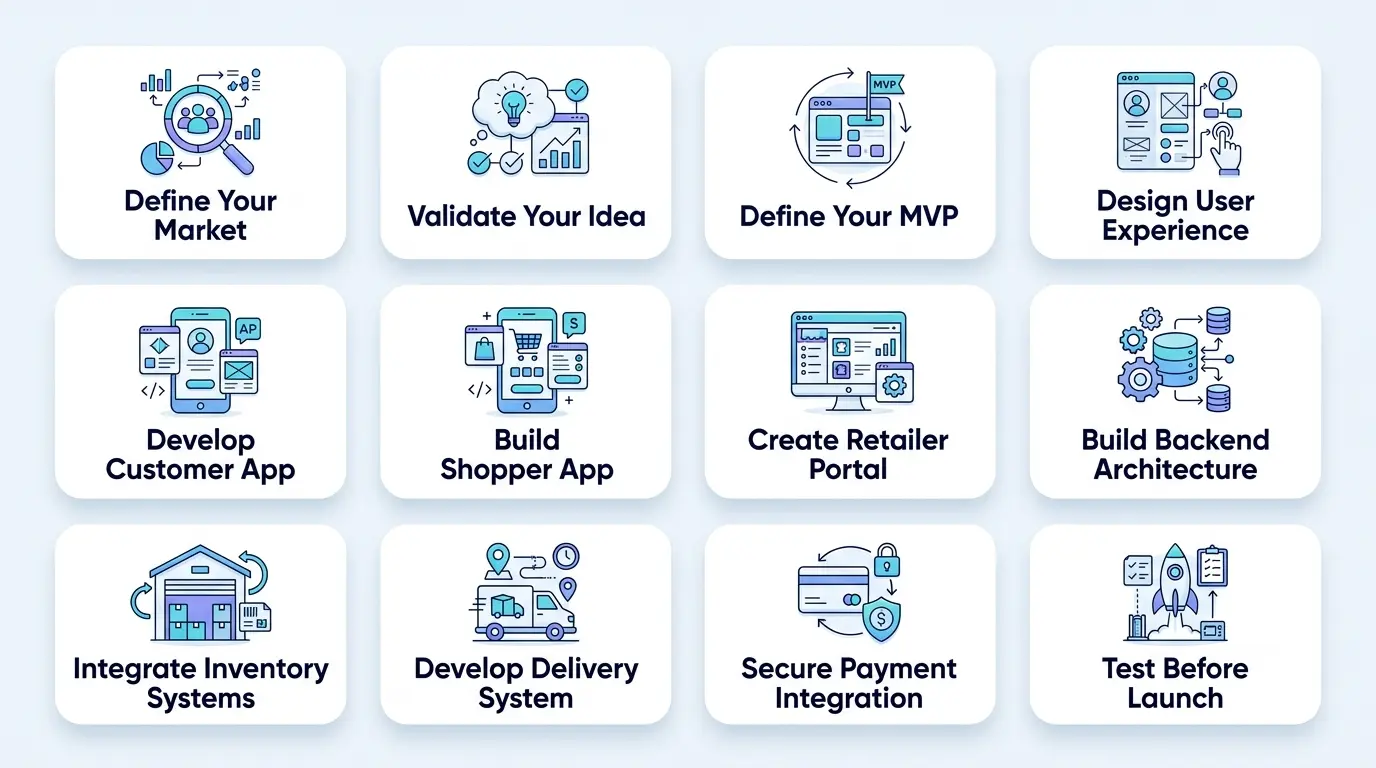
Once the business model and platform structure are defined, the next step is translating the concept into a practical development roadmap. The objective should not be to replicate every feature offered by an established platform. Instead, businesses should identify the core customer and operational problems they need to solve, build the essential functionality first, and then introduce advanced capabilities as the platform gains users and transaction data.
1. Define Your Market and Niche
Before development begins, determine exactly which customers and retailers the platform will serve. You could focus on general grocery delivery, organic products, specialty foods, local supermarkets, ethnic groceries, fresh produce, or same-day delivery. A clearly defined market makes it easier to establish the right product features, pricing model, delivery strategy, retailer partnerships, and customer acquisition approach.
2. Validate the Business Idea
Market validation helps determine whether customers and retailers are willing to use the proposed platform before significant development investment begins. Research competitors, identify customer frustrations, evaluate delivery expectations, and speak with potential retail partners. This process can reveal opportunities to differentiate through convenience, pricing, selection, personalization, faster delivery, better inventory accuracy, or a specialized grocery category.
3. Define the MVP
The first release should focus on the features required to prove the business model. A grocery delivery MVP does not need sophisticated artificial intelligence, complex loyalty systems, or extensive retailer integrations on day one. Starting with essential ordering, payment, inventory, delivery, and administrative functionality allows businesses to collect real-world feedback and use it to determine which capabilities should be developed next.
Businesses can work with an MVP development company to define a practical first release and prioritize features according to business objectives. A phased approach can reduce unnecessary development while creating a foundation that can later support more sophisticated grocery commerce capabilities.
4. Design the User Experience
The customer experience should make grocery shopping feel simple from product discovery through delivery. Search, categories, filters, product information, cart management, checkout, delivery slots, and order tracking should work together without unnecessary friction. At the same time, the shopper and retailer experiences need to be designed around their own workflows because their requirements are different from those of customers.
For a platform involving multiple applications, consistency is equally important. Navigation, notifications, statuses, and important actions should feel connected across the customer, shopper, retailer, and administrative experiences. Professional UI/UX design services can help businesses map these journeys before development begins.
5. Develop the Customer App
The customer application should provide the complete digital shopping journey. Users should be able to create accounts, select locations, discover stores, browse categories, search products, view availability, add items to carts, choose delivery slots, make payments, track orders, and manage substitutions. Reordering and personalized recommendations can further reduce the effort involved in recurring grocery purchases.
Location is particularly important because product availability, store selection, delivery zones, delivery times, and pricing may vary according to the customer’s area. The application should therefore use location information intelligently while giving customers enough control to select their preferred store or delivery option.
6. Build the Shopper App
The shopper application is responsible for connecting digital orders with physical fulfillment. Once an order is assigned, the shopper needs clear information about the store, products, quantities, customer preferences, substitutions, and delivery instructions. Features such as picking lists, barcode scanning, navigation, customer communication, and proof of delivery can help reduce mistakes and improve fulfillment efficiency.
The shopper interface should also account for real-world conditions. Shoppers may have limited connectivity inside stores, need to move quickly between aisles, or encounter products that are unavailable. Designing the application around these practical situations can make the fulfillment process more reliable and reduce unnecessary customer communication.
7. Create the Retailer Portal
Retailers require a dedicated environment for managing products, inventory, orders, prices, promotions, stores, and operational information. The portal should make it easy for participating businesses to update their product catalog and monitor incoming orders without creating additional administrative complexity. Depending on the business model, retailers may also need analytics showing sales, order volume, product performance, and customer behavior.
For a multi-store marketplace, the retailer portal becomes especially important because every participating business may have different product catalogs, inventory systems, pricing rules, and fulfillment processes. A flexible architecture allows the platform to support these differences while maintaining a consistent customer experience across the marketplace.
8. Build the Backend
The backend acts as the central layer connecting customers, shoppers, retailers, administrators, and external services. It needs to manage authentication, product catalogs, inventory, orders, payments, delivery assignments, notifications, promotions, subscriptions, and analytics. APIs allow the different applications and external systems to exchange information while keeping the overall platform organized and scalable.
Backend architecture should also account for real-time operations. When an order status changes, inventory is updated, a shopper accepts an assignment, or a delivery location changes, the relevant information may need to reach other parts of the platform immediately. This makes reliable real-time communication an important part of grocery platform architecture.
9. Integrate Inventory and POS Systems
Inventory synchronization is one of the most challenging parts of grocery commerce because product availability can change continuously. A customer may select an item that becomes unavailable moments later, while different stores may maintain different stock levels. The platform therefore needs mechanisms for synchronizing products, prices, inventory, variants, promotions, and store-specific availability.
POS and retailer APIs can help connect the grocery platform with existing store systems. The exact integration approach will depend on each retailer’s technology environment. A scalable architecture should therefore support multiple integration patterns instead of assuming that every store will provide information in the same format.
10. Develop the Delivery System
The delivery layer connects completed orders with shoppers and customers. It can manage order assignment, delivery zones, navigation, estimated arrival times, route planning, status updates, and proof of delivery. As order volumes grow, automated dispatch and route optimization become increasingly important because inefficient assignments can increase delivery costs and negatively affect customer satisfaction.
Businesses that want to understand the broader technology behind delivery platforms can explore on-demand pickup and delivery app development. Many of the underlying concepts around dispatch, location tracking, order management, and last-mile coordination are directly relevant to grocery delivery.
11. Add Secure Payments
The payment system should support the methods preferred by customers in the target market while handling the complexities of grocery ordering. These can include cards, digital wallets, UPI, store credits, promotional balances, or subscription billing. The architecture should also account for refunds, partial refunds, discounts, failed payments, and order adjustments caused by unavailable or substituted products.
Payment security should be considered throughout the development process rather than added immediately before launch. Businesses should use established payment providers where appropriate and design the platform around secure authentication, encrypted communication, appropriate access controls, and compliance requirements relevant to their target markets.
12. Test Before Launch
Testing a grocery delivery platform requires more than checking whether buttons and screens work correctly. Teams should test the complete order journey across customer, retailer, shopper, and administrative systems. Important scenarios include inventory changes, substitutions, failed payments, refunds, delivery updates, poor connectivity, simultaneous orders, and peak traffic conditions.
Performance and security testing are equally important because a platform may handle sensitive customer and payment information while processing large numbers of simultaneous transactions. Testing these conditions before launch can help identify technical weaknesses before they affect real customers or retailers.
Essential Features of the Customer App
A customer-facing grocery application should prioritize convenience, accuracy, and speed. Customers should be able to find products quickly, understand whether items are available, complete purchases without unnecessary steps, and remain informed after checkout. The feature set should support both occasional purchases and recurring grocery routines.
Key features can include:
- Registration and login
- Location detection
- Store selection
- Product categories
- Search and filters
- Product details
- Real-time availability
- Shopping cart
- Delivery-slot selection
- Multiple payment options
- Order tracking
- Substitution preferences
- Push notifications
- Order history
- Reordering
- Reviews and ratings
- Loyalty and rewards
- Personalized recommendations
These features should not be treated as isolated components. For example, accurate product availability affects search, cart management, substitutions, checkout, and customer satisfaction. Designing the entire journey as one connected experience is more important than simply increasing the number of features.
Features for the Shopper App
The shopper application should make physical fulfillment as efficient as possible. After receiving an order, shoppers need to understand exactly what products to pick, where to find them, what to do when something is unavailable, and how to complete the delivery. Every unnecessary step can increase fulfillment time and affect the customer experience.
Useful capabilities include:
- Order assignment
- Order acceptance
- Store information
- Picking lists
- Barcode scanning
- Product availability updates
- Substitution workflows
- Customer chat
- Store navigation
- Delivery navigation
- Delivery instructions
- Proof of delivery
- Earnings information
- Availability scheduling
The application can also use intelligent recommendations to help shoppers choose suitable substitutes when customers have enabled substitution preferences. Over time, these workflows can become increasingly automated as the platform collects operational data.
Features for Retailers and Administrators
Retailer and administrative tools provide the operational foundation of the marketplace. Retailers need control over their products and orders, while administrators need visibility across the entire platform. The system should make it possible to monitor performance, resolve issues, manage participants, and adjust business rules without depending on developers for routine operational tasks.
Important functionality can include:
- Product management
- Inventory management
- Order management
- Pricing
- Promotions
- Store management
- Shopper management
- Delivery zones
- Customer management
- Refund management
- Analytics
- Revenue reporting
- User permissions
- Platform configuration
As the marketplace grows, role-based access can help ensure that customers, shoppers, retailers, and internal teams see only the information and controls relevant to their responsibilities.
AI Features for Grocery Delivery
Artificial intelligence is becoming a more practical part of grocery commerce in 2026. Instacart’s AI shopping assistant demonstrates how conversational requests can be transformed into personalized grocery recommendations and carts using product and inventory information. This creates an opportunity for new grocery platforms to make shopping more intuitive rather than relying entirely on traditional keyword-based search. (Instacart AI Assistant)
An AI-powered grocery application can use intelligence across several stages of the customer and retailer journey. Potential applications include conversational search, shopping-list generation, recipe-to-cart functionality, personalized recommendations, demand forecasting, smart substitutions, delivery prediction, customer support automation, fraud detection, personalized promotions, and retailer analytics.
Conversational Shopping
Traditional grocery search requires customers to know exactly what they want to type. Conversational shopping allows them to describe their needs naturally, such as asking for ingredients for a family dinner or affordable snacks for a weekend gathering. AI can interpret the request and translate it into relevant products, categories, recommendations, or a complete shopping list.
Personalized Recommendations
Recommendation engines can analyze previous purchases, preferences, product interactions, seasonal patterns, and other relevant signals to suggest products. Personalization can make recurring grocery shopping faster by surfacing commonly purchased items, complementary products, relevant promotions, or alternatives that better match a customer’s preferences.
Smart Substitutions
Out-of-stock products are a common challenge in grocery fulfillment. AI can help identify alternative products based on factors such as brand preference, product category, size, price, dietary requirements, and previous customer behavior. Customers can still retain control by approving, rejecting, or defining their substitution preferences.
Demand Forecasting
Retailers can use machine learning to predict future demand by analyzing historical orders, seasonal patterns, promotions, weather-related factors, and other relevant information. Better forecasting can help retailers prepare inventory more effectively and potentially reduce stockouts, excess inventory, and fulfillment problems.
Businesses planning to integrate intelligent capabilities into their products can also explore AI-powered product development services, particularly when AI needs to become part of the product architecture rather than functioning as a standalone feature.
Real-Time Inventory Management
Inventory accuracy is one of the most important factors in grocery delivery. Unlike many other ecommerce categories, grocery stock can change rapidly throughout the day. A product that appears available when an order is placed may no longer be on the shelf when a shopper arrives, creating the need for substitutions, refunds, or alternative products.
A grocery platform should therefore connect customer-facing product information with retailer systems and shopper workflows. The architecture may need to synchronize SKU information, prices, inventory levels, product variants, promotions, store-specific availability, and substitution preferences. Reliable synchronization can reduce failed orders and create a more predictable shopping experience.
Managing Product Availability
The platform should distinguish between products that exist in the catalog and products that are currently available at a particular store. Store-level availability is especially important for marketplaces serving multiple retailers because the same product may be available in one location but unavailable in another.
Handling Substitutions
Substitution management should be designed before launch rather than treated as an exception. Customers can specify whether they want automatic alternatives, approval before replacement, or refunds when products are unavailable. Shoppers can then follow these preferences while the system records the outcome for future personalization.
Connecting Retailer Systems
Different retailers may use different POS and inventory technologies, making integration one of the more complex parts of grocery platform development. An API-driven architecture can provide a consistent connection between external systems and the marketplace while allowing individual retailer integrations to evolve independently.
For businesses building complex digital commerce systems, ecommerce app development services can help bring together inventory, orders, payments, integrations, customer experiences, and scalable backend infrastructure.
Technology Considerations
There is no single technology stack that is appropriate for every grocery delivery platform. The right choices depend on the expected user base, geographic coverage, number of retailers, required integrations, development resources, performance requirements, and long-term roadmap. Technology decisions should therefore follow product and architecture requirements rather than being selected simply because a framework is popular.
A possible stack may include Swift for iOS, Kotlin for Android, Flutter or React Native for cross-platform applications, and technologies such as Node.js, Python, or Java for backend development. Databases such as PostgreSQL or MongoDB can be selected according to the data model, while AWS, Azure, or Google Cloud can provide scalable infrastructure.
The platform may also require mapping services, payment gateways, push notifications, analytics tools, real-time communication, and AI or machine-learning services. The important consideration is how these technologies work together. APIs, monitoring, security, caching, load balancing, and scalable infrastructure should be planned as part of the architecture from the beginning.
Building for Scalability
A grocery platform may start with a single store or city and eventually expand across multiple locations. The architecture should therefore avoid unnecessary dependencies that make future expansion difficult. Modular services, well-designed APIs, scalable databases, cloud infrastructure, monitoring, and efficient data management can make it easier to support additional stores, customers, products, and delivery operations.
Scalability also applies to business operations. Adding another retailer should not require rebuilding the entire platform. Similarly, launching in another geographic area should ideally involve configuration and integration work rather than fundamental architectural changes. Designing for this flexibility early can reduce technical debt as the business grows.
How Much Does it Cost to Build a Grocery Delivery App?
The cost to build a grocery delivery app depends on the platform’s scope, number of applications, integrations, technology choices, and level of automation. A focused MVP can require a significantly smaller investment than a full marketplace supporting customers, shoppers, retailers, payments, real-time inventory, logistics, analytics, and AI. For broader app-development benchmarks, see the mobile app development cost guide.
For planning purposes, a grocery delivery MVP may start around $30,000, while a sophisticated multi-sided platform can exceed $200,000. These figures are planning ranges rather than fixed quotations. The final grocery delivery app development cost depends on whether you need separate mobile applications, retailer integrations, advanced delivery optimization, AI capabilities, custom dashboards, third-party APIs, and scalable cloud infrastructure.
What Factors Affect Development Cost?
The first major factor is platform scope. Building only a customer-facing application is considerably different from developing a complete ecosystem with customer, shopper, retailer, and administrative interfaces. Each additional interface requires design, development, testing, authentication, data management, and maintenance. A multi-vendor model therefore requires more resources than a simple single-store ordering application.
Integrations can also substantially influence the budget. Grocery platforms commonly connect with payment gateways, maps, POS systems, inventory databases, notification services, analytics tools, and delivery systems. Real-time synchronization becomes particularly important when product availability and pricing change frequently. The more external systems the platform must communicate with, the more engineering and testing are required before launch.
AI introduces another cost variable. Basic recommendation logic can be relatively straightforward, while conversational shopping assistants, demand forecasting, intelligent substitutions, personalized promotions, and predictive delivery systems require more sophisticated data pipelines and machine-learning capabilities. If AI is central to the product strategy, businesses should plan for additional development, infrastructure, model integration, monitoring, and ongoing optimization.
How Long Does it Take to Build a Grocery Delivery App?
Development time depends on the same factors that influence cost. A focused MVP (Minimum Viable Product) can generally be delivered faster because it limits the initial feature set and integrations. A market-ready MVP may take approximately 12–16 weeks, while a complex platform with extensive third-party integrations can require six months or longer. The development timeline should therefore be based on scope rather than an arbitrary launch date.
A practical approach is to launch the smallest version capable of validating demand. The first release can focus on registration, product discovery, cart management, checkout, order tracking, retailer management, shopper workflows, and basic administration. Once customers and partners begin generating real usage data, advanced capabilities such as AI recommendations, predictive inventory, and automated optimization can be introduced incrementally.
Key Grocery Delivery Trends to Watch in 2026
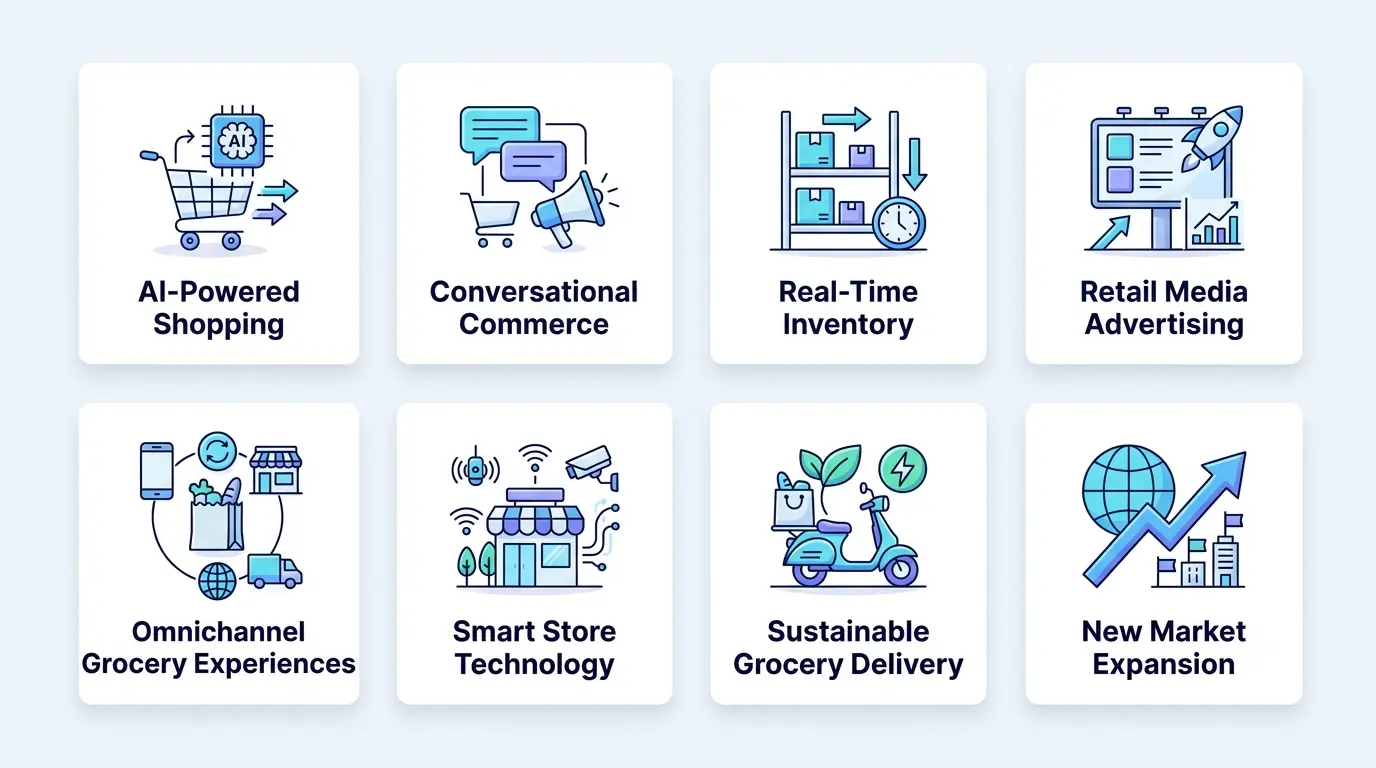
The grocery delivery industry is evolving beyond basic online ordering and doorstep delivery. In 2026, businesses are focusing on AI-powered shopping, real-time inventory intelligence, omnichannel experiences, retail media, and connected store technology. These developments are changing how customers discover products, how retailers manage orders, and how grocery platforms create value across the wider commerce ecosystem.
AI-Powered Shopping Assistants
AI is moving grocery applications beyond conventional search and filtering. Instacart has expanded its AI shopping assistant, allowing customers to use conversational requests and generate grocery carts based on their needs. The system can work with live local inventory and customer preferences, showing how AI can become part of the shopping journey rather than simply an optional chatbot. Businesses exploring similar capabilities can consider AI-powered product development services.
Conversational Commerce
Customers increasingly expect to describe what they want naturally instead of navigating multiple categories and filters. A shopper could ask for ingredients for a family dinner, products for a weekend gathering, or healthier alternatives within a specific budget. The application can then translate that intent into relevant products, creating a faster path from discovery to checkout and making grocery shopping more personalized.
Real-Time Inventory Intelligence
Inventory accuracy is becoming a competitive advantage. Grocery platforms need to know not only which products a retailer normally carries, but also what is available at a particular location. Connecting POS systems, retailer APIs, product catalogs, and inventory databases can help reduce cancellations and improve substitution decisions. This also creates a stronger foundation for personalization and automated fulfillment. RipenApps’ ecommerce app development solutions include inventory management, integrations, and scalable ecommerce architecture.
Retail Media and In-App Advertising
Advertising is becoming an increasingly important part of grocery commerce. Retailers and brands can use grocery platforms to promote relevant products, offers, sponsored placements, and personalized promotions. For the platform operator, this creates another revenue stream beyond delivery and service fees while giving retailers a way to reach customers closer to the purchase decision. As grocery platforms collect more first-party commerce insights, relevant advertising can become more targeted and useful.
Omnichannel Grocery Experiences
The boundary between online and offline grocery shopping continues to disappear. Customers may discover products online, purchase through an application, collect an order from a store, or receive a home delivery. Businesses planning new platforms should therefore consider how digital ordering can connect with physical retail operations, loyalty programs, promotions, and in-store experiences.
A strong omnichannel approach can connect the physical store, website, mobile app, delivery, pickup, loyalty, and personalized offers into a more consistent customer journey.
Smart Store Technology
Grocery technology is also moving into physical stores. Instacart’s Caper smart carts, for example, combine shopping assistance with features such as real-time spending visibility, loyalty benefits, personalized coupons, and advertising. This demonstrates how grocery platforms can expand beyond delivery into connected retail experiences, creating opportunities for businesses that combine marketplace, ecommerce, logistics, and in-store technology.
Sustainable Grocery Delivery
Sustainability is becoming an important consideration as grocery delivery volumes increase. Businesses can explore more efficient delivery routes, order batching, reusable or recyclable packaging, and electric or low-emission delivery options to reduce the environmental impact of fulfillment. Sustainable practices can also improve operational efficiency when they are incorporated into route planning, packaging decisions, and delivery management rather than treated as separate initiatives.
Expansion into New Markets
As grocery delivery platforms mature, expansion into new cities and regions can create additional growth opportunities. However, successful expansion requires more than extending delivery coverage. Businesses need to consider local retailer partnerships, customer preferences, product availability, pricing, regulations, payment methods, and delivery infrastructure. A scalable architecture allows the platform to adapt these components for different markets without rebuilding the entire technology foundation.
Challenges in Grocery Delivery App Development
Managing Real-Time Product Availability
A grocery application cannot rely on static product catalogs. Products may sell out between the moment an order is placed and the moment a shopper reaches the store. The platform must therefore synchronize inventory information and communicate availability accurately. Strong inventory architecture can reduce failed orders while also enabling smarter substitution recommendations when the preferred product is unavailable.
Coordinating Multiple Stakeholders
Unlike a basic ecommerce application, grocery delivery involves several operational participants. Customers place orders, retailers provide products, shoppers collect items, delivery operations handle fulfillment, and administrators oversee the ecosystem. Each participant needs different workflows and permissions. Designing these interactions carefully is essential because delays or errors in one part of the system can affect the entire customer experience.
Handling Delivery Optimization
Delivery efficiency directly affects customer satisfaction and operating margins. The platform needs to consider shopper availability, store location, order volume, delivery windows, traffic conditions, and geographic clustering. Route optimization and dynamic delivery-slot management can improve utilization as order volume grows. These capabilities become especially important when expanding from one market into multiple cities or regions.
Protecting Payments and Customer Data
Grocery applications process sensitive information including customer profiles, addresses, payment details, order histories, and sometimes loyalty information. Security therefore needs to be incorporated throughout the architecture rather than added after development. Secure authentication, encrypted communication, appropriate payment integrations, access controls, monitoring, and regular testing help create a safer foundation for long-term platform growth.
Conclusion
Learning how to build a grocery delivery app like Instacart requires looking beyond customer ordering and delivery tracking. A competitive platform combines marketplace architecture, retailer integrations, real-time inventory, shopper operations, payments, logistics, analytics, and increasingly AI-powered experiences. Businesses should begin with a focused MVP, validate demand, and expand capabilities according to customer behavior and operational requirements.
The most sustainable approach is to build an architecture that can evolve as the marketplace grows. Start with the workflows that create immediate value, establish reliable inventory and fulfillment processes, and then introduce advanced capabilities such as conversational shopping, personalization, predictive analytics, smart substitutions, and automated logistics. With the right development strategy, a grocery platform can become more than a delivery app; it can become a connected grocery commerce ecosystem.

FAQs
1. How much does it cost to build a grocery delivery app like Instacart?
A grocery delivery application can range from approximately $30,000 for a focused MVP to $200,000+ for a sophisticated multi-sided platform. The actual investment depends on applications, features, integrations, AI capabilities, infrastructure, design requirements, and development complexity. Businesses should define their MVP first and then estimate the cost of advanced capabilities planned for later releases.
2. How long does it take to build a grocery delivery app?
A focused market-ready MVP can take around 12–16 weeks, while a larger platform with multiple applications, retailer integrations, logistics capabilities, and advanced automation may take six months or more. The timeline depends primarily on scope, technical complexity, integrations, testing requirements, and the number of platforms being developed.
3. What are the essential features of a grocery delivery app?
Essential customer features include registration, product discovery, search, categories, cart management, checkout, payments, order tracking, notifications, and support. The wider platform also needs shopper workflows, retailer management, inventory synchronization, order orchestration, delivery management, and administrative controls. Advanced products can later add AI recommendations, smart substitutions, predictive analytics, and conversational shopping.
4. How does a grocery delivery app make money?
A grocery delivery platform can generate revenue through delivery and service fees, memberships, retailer partnerships, advertising, enterprise technology, retailer technology, and commerce analytics. The strongest models often combine several revenue streams rather than relying exclusively on customer delivery charges. The right mix depends on market structure, customer behavior, retailer relationships, and operational economics.
5. How does Instacart use AI?
Instacart has expanded AI into the grocery-shopping experience through conversational shopping assistance, cart generation, personalized recommendations, and inventory-aware product discovery. Its broader technology strategy also includes AI applications across retail and fulfillment. This illustrates how AI can support both customer-facing experiences and operational decision-making in modern grocery commerce.
6. What technology is needed to build a grocery delivery platform?
A typical platform requires mobile applications, backend APIs, databases, cloud infrastructure, payment integrations, maps and location services, notification systems, inventory or POS integrations, analytics, and administrative dashboards. Depending on the product scope, businesses may also require AI services, route optimization, real-time synchronization, recommendation engines, and retailer-specific integrations.
7. Should a grocery delivery startup build an MVP first?
Yes. An MVP allows a business to validate its marketplace concept before investing heavily in advanced functionality. The initial release can focus on ordering, payments, retailer operations, shopper workflows, and delivery. Once the platform generates real usage data, the business can prioritize AI, personalization, automation, and additional integrations based on demonstrated customer and operational needs.
8. Can I build a grocery delivery app for a specific city or region?
Yes. A grocery delivery platform can be designed around a specific city, region, or local market before expanding to additional locations. Starting locally can simplify retailer onboarding, delivery operations, inventory integration, and customer acquisition. Once the core model is validated, the platform can be scaled with additional stores, delivery zones, payment options, and localized features.
Discuss your project and request for proposal
SHARE
WRITTEN BY

Ishan Gupta
CEO & Founder
Ishan Gupta is a seasoned entrepreneur and CEO with extensive 10+ years of experience in business and mobile app development landscape. He believes that the right digital product allows companies to focus on what they do best, while technology handles the rest. With deep exposure to global markets, he understands what makes an app succeed. His approach translates business needs into clear product strategies, ensuring that every feature contributes to measurable ROI.
View All Articles