


Key Takeaways
- AI-powered insights and predictive analytics can turn expense tracking into proactive financial management.
- Receipt automation, voice logging, and subscription tracking reduce repetitive financial-management tasks.
- Budgeting, project tracking, approvals, and reporting support broader business expense-management requirements.
- Security, privacy, compliance, and reliable integrations are essential for building trust in fintech products.
- Future-ready expense products combine automation, personalization, AI, and seamless financial-data connectivity.
Expense tracker app features should help businesses capture expenses, manage budgets, automate workflows, analyze spending, and protect sensitive financial data. These requirements matter most for founders, product managers, CTOs, and financial-services businesses planning secure expense management products.
Modern expense tracking products have moved beyond basic transaction logging and spreadsheet replacement. Successful products combine intuitive interfaces, intelligent automation, budgeting controls, integrations, reporting, security, and personalized financial insights.
For businesses planning an expense management product, feature selection should begin with user workflows and business requirements. A well-planned fintech app development approach can help teams build an architecture that supports individual users, freelancers, teams, project-based organizations, and financial-services products without creating unnecessary complexity.
Table of Contents
Why Do You Need to Develop an Expense Tracking App?
Expense tracking apps help businesses organize transactions, receipts, budgets, approvals, reporting, and financial records through one connected experience.
Businesses often struggle with fragmented spreadsheets, paper receipts, disconnected payment accounts, and manual reporting processes. An expense tracking product can centralize these workflows while reducing repetitive administrative work.
The need becomes stronger when organizations manage multiple employees, projects, cards, currencies, spending categories, or approval workflows. A well-planned product can give teams better visibility while supporting faster and more consistent financial decisions.
- Businesses can replace fragmented spreadsheets with centralized expense records and searchable digital transaction histories.
- Automated receipt capture can extract transaction details and reduce repetitive manual entry for employees and finance teams.
- Expense categorization can organize transactions according to predefined business rules, spending categories, projects, or accounting requirements.
- Automated workflows can flag unusual transactions and route expenses for review before reimbursement or accounting processing.
- Predictive analysis can identify spending patterns, forecast potential budget pressure, and provide decision-support information based on historical data.
- Connected banking and payment integrations can create a unified financial view across supported accounts, cards, and payment methods.
For businesses entering fintech, expense management can also become part of a broader financial-services ecosystem. Fintech software development can help teams understand the wider product and technology landscape.
The strongest products therefore begin with clear requirements rather than simply adding every available feature. Each capability should solve a defined user problem, support a measurable workflow, or improve financial visibility.
Key Features Every Expense Tracking App Should Include
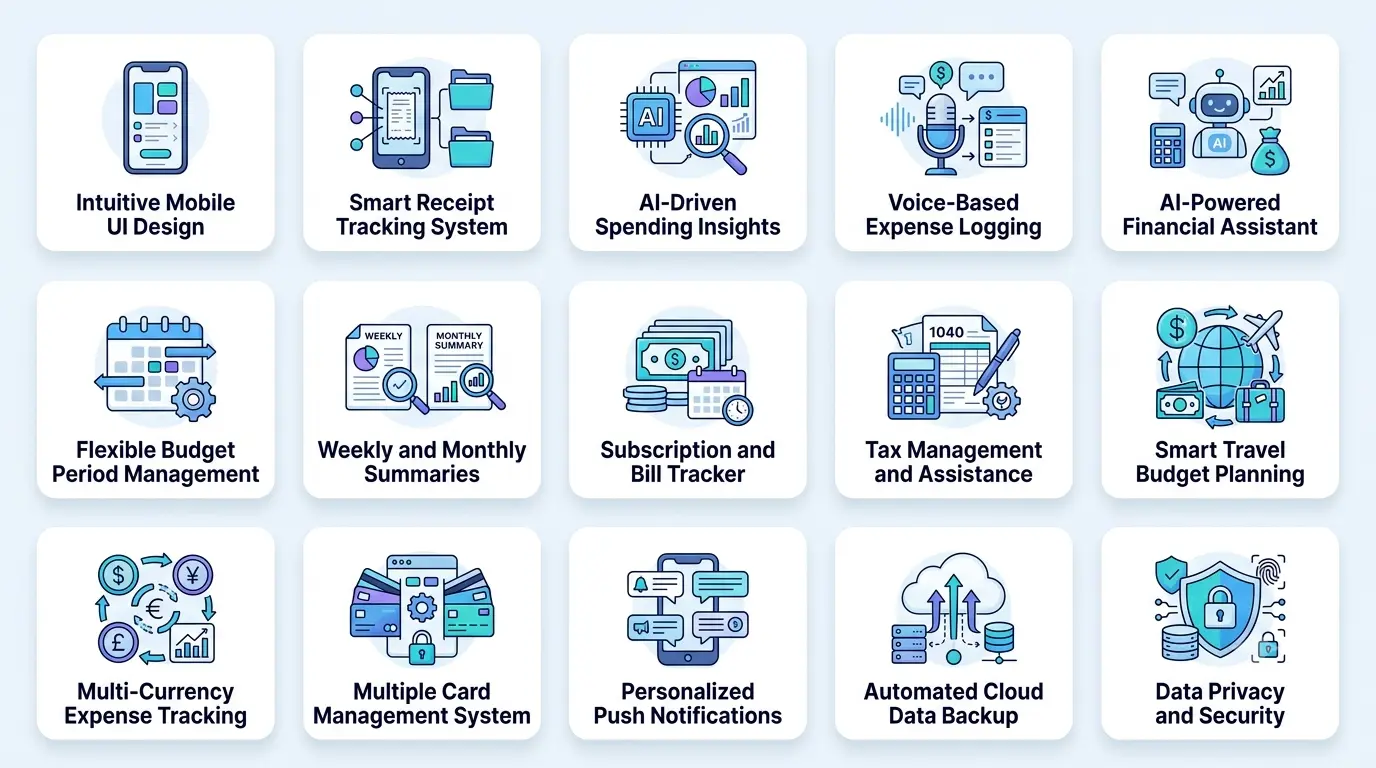
Expense tracker app features should cover the complete expense lifecycle, from transaction capture through categorization, analysis, budgeting, reporting, and security. Identifying the top mobile features early can help product teams prioritize capabilities that improve usability while addressing core financial-management needs
The following fifteen features provide a practical foundation for products targeting freelancers, businesses, project teams, and financial-services organizations. The final selection should depend on the product’s audience, workflows, integrations, compliance requirements, and operating markets.
1. Intuitive Mobile UI Design
An intuitive interface makes expense capture, review, approval, and reporting easier for users with different financial-management responsibilities. A business-focused interface should reduce unnecessary navigation and surface important information quickly. Users should understand their spending position without searching through multiple screens.
A useful dashboard can show recent expenses, budget progress, pending approvals, upcoming bills, spending categories, and important alerts. This approach keeps critical information accessible from the first interaction.
Accessibility should also influence the interface from the beginning. Support for readable typography, appropriate contrast, screen readers, touch targets, and logical navigation can improve usability across different user groups.
Responsive layouts are equally important when the product supports multiple device types. The requirements for an expense tracker web app should therefore align with mobile workflows and shared backend capabilities. For design guidance, businesses can also review this detailed resource on mobile app design.
2. Smart Receipt Tracking System
Receipt tracking reduces manual data entry by allowing users to capture receipts and extract relevant transaction information automatically. OCR can identify fields such as merchant names, dates, totals, taxes, and purchased items. Machine-learning models can then help categorize transactions using historical patterns and predefined rules.
The system should allow users to review extracted information before final submission. This verification step is important because OCR performance can vary according to receipt quality, layout, language, and image conditions.
Duplicate detection can prevent the same receipt from being submitted multiple times. The system can also connect receipts with transactions, invoices, reimbursement requests, or project records.
Secure cloud storage can preserve digital receipt records while making them searchable when users need supporting documentation. Retention rules should follow the product’s business and regulatory requirements. Receipt automation can also complement fraud detection by helping identify duplicate, inconsistent, or suspicious expense records.
3. AI-Driven Spending Insights
AI-driven spending insights help transform historical transaction data into useful financial intelligence for users and business teams. Instead of displaying static charts, the system can identify spending patterns, unusual changes, recurring expenses, and potential budget pressure.
For example, the application could identify that a department has exceeded its normal travel spending during the current period. AI is becoming increasingly central to finance operations. Deloitte found that 87% of North American CFOs expect AI to be extremely or very important to their finance departments’ operations in 2026. It could then highlight the variance and provide supporting transaction information. Predictive models can also estimate future spending based on historical behavior and available transaction data. These predictions should be presented as decision-support information rather than guaranteed outcomes.
Businesses can use predictive analytics for mobile apps to understand how predictive capabilities can support intelligent product experiences. AI insights should remain explainable wherever financial decisions are involved. Users should understand which transactions, patterns, or thresholds contributed to an insight.
4. Voice-Based Expense Logging
Voice-based expense logging allows users to record transactions without completing multiple manual input steps. A user could say, “I spent $50 on groceries today,” and the application could identify the amount, category, date, and transaction description.
Natural language processing can convert spoken commands into structured expense records. The system should still provide a confirmation step before saving information permanently. Voice logging can benefit employees who submit expenses frequently or users who need faster transaction capture. It can also improve accessibility for people who find manual data entry difficult.
Multilingual support may become important for products operating across different regions. However, language support should be prioritized according to the target market rather than added without clear demand. Voice capabilities should therefore be designed as part of the overall expense workflow instead of functioning as an isolated AI feature.
5. AI-Powered Financial Assistant
An AI-powered financial assistant can provide conversational access to transaction data, budgets, spending patterns, and financial-management information. Users could ask questions such as, “How much did our marketing team spend this month?” The assistant could retrieve relevant information and summarize the result using connected financial data.
PwC’s 2026 AI Performance Study found that leading companies are twice as likely to redesign workflows to incorporate AI rather than simply adding AI tools, reinforcing the importance of embedding AI into core expense-management workflows.
For business products, the assistant can also help explain budget variances, identify recurring expenses, summarize reports, and surface transactions requiring attention. The system should apply strict access controls before displaying financial information. A user should only receive information permitted by their account role and organizational permissions.
AI responses should also distinguish between factual transaction information and generated recommendations. This separation helps users understand what the system knows versus what it suggests. A financial assistant can become valuable when it reduces information-search time while maintaining appropriate security, privacy, and auditability.
6. Flexible Budget Period Management
Flexible budget periods allow users to create financial plans according to their actual income and spending cycles. Monthly budgets may work well for salaried employees, while weekly or project-based budgets may better suit freelancers, contractors, teams, and businesses.
Users should be able to define a start date, end date, spending categories, limits, and applicable accounts. The system can then calculate remaining budget automatically throughout the selected period. Flexible periods also support businesses managing seasonal projects or departments with different financial cycles. This makes budgeting more closely aligned with operational reality.
Budget periods should connect with alerts and reporting features. Users should quickly see whether current spending remains within planned limits. The underlying architecture should also support consistent functionality across supported mobile and web platforms without duplicating core financial logic.
7. Weekly and Monthly Summaries
Weekly and monthly summaries provide users with a structured view of their spending activity over defined periods. A weekly summary can highlight total expenses, category-level spending, major transactions, budget progress, and changes from the previous period.
Monthly summaries can provide deeper analysis by comparing actual spending with planned budgets. Business users can also review department, project, employee, or account-level information.
Visual reporting should make important differences easy to identify. Charts, comparisons, trend indicators, and concise explanations can help users understand financial patterns without reading large transaction lists.
The system should allow users to export or share reports when required. Business reporting may also require filters based on dates, categories, projects, departments, or payment methods. Clear summaries therefore support both everyday financial monitoring and periodic management reviews.
8. Subscription and Bill Tracker
Subscription and bill tracking helps users identify recurring financial commitments, monitor upcoming payments, and avoid unexpected charges. The system can detect recurring transactions from connected bank accounts or cards and organize them by merchant, amount, billing frequency, renewal date, and expense category.
Users should receive timely reminders before expected payments so they have an opportunity to review, modify, or cancel unnecessary subscriptions. For example, the app could notify a user several days before a recurring streaming, software, insurance, or utility payment is due. This gives users better visibility into fixed and recurring expenses.
For businesses, the same functionality can help manage SaaS subscriptions, software licenses, service contracts, utilities, insurance premiums, and other recurring operational costs. Finance teams can monitor renewal dates, identify unused services, and understand how recurring commitments affect departmental or project budgets. When estimating the overall fintech app development cost, teams should also account for the integrations and automation required to support reliable recurring-payment tracking.
The feature becomes more valuable when connected with budgeting, reporting, and spending alerts. Users can see how much of their available budget is already committed to recurring expenses and identify subscriptions that may be contributing to unnecessary spending.
Recurring-transaction detection should also remain transparent and editable. Merchants may change billing amounts, payment dates, or transaction descriptions, so users should be able to confirm, correct, pause, or remove detected recurring payments. This reduces incorrect classifications and keeps the financial record under the user’s control.
9. Tax Management and Assistance
Tax management can help freelancers, businesses, and other eligible users organize expenses that may require tax-related review. The application can support tax categories, deductible-expense tagging, transaction notes, receipt storage, and financial report exports.
Users should be able to configure tax-related rules according to their applicable jurisdiction and business requirements. The product should avoid presenting generic tax calculations as professional tax advice. Tax reports can become more valuable when they connect transaction records with receipts and supporting documentation. This creates a more complete audit trail for financial review.
Deadline reminders can also help users monitor important tax-related dates. However, the application should source deadline information from appropriate jurisdiction-specific data. For businesses, tax functionality should integrate with accounting workflows wherever practical. This reduces duplicate data entry and improves consistency between expense records and financial systems.
10. Smart Travel Budget Planning
Travel budgeting helps users estimate, organize, and monitor expenses before and during business or personal trips. Users can create a travel budget by defining destinations, dates, transportation, accommodation, meals, activities, and other expected expenses. During the trip, actual expenses can be compared against planned amounts. This makes it easier to identify overspending before the total budget becomes difficult to control.
Businesses can extend this functionality to employee travel by adding approval limits, project codes, expense policies, and reimbursement workflows. AI-supported estimates can provide planning assistance when sufficient historical or destination-level data exists. These estimates should remain clearly identified as estimates rather than guaranteed costs. Travel budgeting therefore works best when connected with multi-currency support, receipt tracking, reporting, and policy management. Businesses planning broader travel-related functionality can also refer to a travel app development guide to understand the key product and technology considerations.
11. Multi-Currency Expense Tracking
Multi-currency expense tracking is essential for users and businesses that manage transactions across different countries and currencies. The system should allow users to record expenses in the original transaction currency while displaying the converted amount in a preferred reporting currency. This ensures that international expenses remain accurate and easy to understand.
The application should provide transparent exchange-rate handling by recording the exchange rate, source, timestamp, and conversion method used for each transaction. This is particularly important when users reconcile expenses later or when exchange rates change between the transaction date and reporting date. For example, a business employee could pay for a hotel in EUR while the company’s reporting currency remains USD.
Multi-currency support is valuable for international employees, remote teams, travelers, freelancers, and businesses operating across multiple markets. It should also support multiple reporting currencies where organizations need to consolidate expenses across regional operations.
The system should account for currency-specific decimal rules, rounding, refunds, reversals, exchange-rate differences, and transaction reconciliation. These details become especially important when expense data is transferred to accounting or financial systems.
Because exchange-rate providers, banking integrations, and regional financial requirements can change, ongoing monitoring and maintenance are also important after launch. A well-designed architecture should allow exchange-rate sources and integration components to be updated without altering historical transaction records or compromising financial accuracy.
12. Multiple Card Management System
Multiple card management allows users to connect and monitor several payment cards or financial accounts within one product. Users can view transactions by card, category, account, employee, or spending period. This gives them a clearer understanding of where money is being spent.
Business products can also assign cards to employees, teams, departments, or projects. Spending limits can then be configured according to organizational policies.
Transaction synchronization should include appropriate reconciliation controls. Users need to distinguish pending transactions, completed transactions, refunds, reversals, and duplicate records.
Strong authentication should protect account access and sensitive payment information. Sensitive card details should also be handled according to applicable payment-security requirements. The feature becomes significantly more useful when combined with budgeting, alerts, reporting, receipt matching, and expense approval workflows.
13. Personalized Push Notifications
Personalized notifications can encourage consistent expense logging and provide timely information about budgets, bills, approvals, and unusual spending. Users should be able to control notification types and preferences. Excessive alerts can create notification fatigue and cause users to disable important communications.
Notifications can be triggered by meaningful events such as approaching budget limits, pending approvals, recurring payments, missing receipts, or unusual transactions. Business users may also need role-specific notifications. For example, employees may receive submission reminders while managers receive approval notifications.
AI can help prioritize notifications according to user behavior and financial context. However, financial alerts should remain predictable and understandable. A strong notification system should therefore focus on relevance, timing, user control, and actionable information rather than simply increasing message frequency.
14. Automated Cloud Data Backup
Automated cloud backup protects expense records against device loss, accidental deletion, system failures, and other data-loss events. The application should synchronize relevant records securely while maintaining appropriate access controls and encryption.
Backup architecture should define retention periods, recovery procedures, synchronization rules, and failure-handling mechanisms. Users should also understand whether their information is synchronized automatically or requires manual action. Clear status indicators can reduce uncertainty around data availability.
For business products, administrators may need additional controls for retention, account recovery, audit trails, and organizational data management. A reliable backup system should also support recovery testing. Backups are valuable only when organizations can restore required information accurately when needed.
15. Data Privacy and Security
Data privacy and security are foundational expense tracker app features because these products handle sensitive financial, transactional, and potentially personally identifiable information. Security architecture should include strong authentication, authorization, encryption, secure API communication, session controls, logging, monitoring, and appropriate access management.
Biometric authentication can provide an additional login layer on supported devices. Multi-factor authentication can further protect accounts against compromised credentials. Financial products should also apply data minimization principles. Collecting only necessary information reduces exposure and simplifies privacy management.
For US-market products, relevant requirements may include PCI DSS, SOC 2 controls, GLBA obligations where applicable, and state privacy laws such as CCPA/CPRA. GDPR may apply when the product processes personal data belonging to individuals in relevant European jurisdictions.
HIPAA Compliance should only be considered when the product actually handles protected health information under HIPAA. HIPAA is not a general compliance framework for expense tracking applications. Security should also extend across APIs, third-party integrations, cloud infrastructure, databases, mobile applications, and administrative interfaces.
Al Muzaini: Fintech-Grade Security and Integration Proof
Al Muzaini project, developed by RipenApps, demonstrates relevant fintech-grade capabilities for financial applications. The product achieved 100K+ downloads, 50K+ active users, a 4.1-star rating, and the #1 FinTech app position in Kuwait.
The solution included three-factor authentication with biometric login, AI-powered KYC, Western Union integration, and real-time exchange rates. These verified capabilities demonstrate experience with secure authentication, financial integrations, identity workflows, and real-time financial data.
The project should be viewed as proof of fintech engineering capability rather than as an expense tracking application case study.
Project Expense Tracking: Requirements for Business Apps
Project expense tracking connects financial transactions with specific projects, teams, cost centers, budgets, and accounting workflows. It helps businesses understand where project money goes, who spends it, and whether actual costs remain within approved limits. These requirements apply to both web and mobile products, with consistent data, permission models, and financial workflows across platforms.
Project-based organizations need more than simple personal expense logging. They require controls that connect every transaction with an operational context. A strong project expense tracking app should answer questions about project spending, approval status, remaining budgets, employee expenses, and financial variance. Working with an experienced mobile application development company can help businesses design these workflows consistently across mobile platforms while maintaining scalable backend capabilities.
Creators and freelancers can also use a creator expense tracker app to separate business expenses from personal spending, track project costs, and organize receipts.
Project and Cost-Center Tracking
Every project expense should connect with a project, cost center, department, client, or another organizational identifier. Users should select the appropriate project when submitting expenses. The system can then automatically associate transactions with the relevant financial records.
Administrators should be able to create project-level spending rules and assign employees to approved projects. Cost-center tracking provides another layer of financial visibility. Businesses can compare spending across departments, locations, teams, or operational units.
The data model should support multiple organizational structures without forcing businesses into a single hierarchy.
Expense Approval Workflows
Approval workflows help businesses control expenses before reimbursement, accounting submission, or payment processing. A workflow can route expenses according to amount, department, project, employee role, or expense category.
For example, smaller employee expenses could require manager approval, while higher-value project expenses could require additional financial review. The system should provide clear statuses such as draft, submitted, approved, rejected, and returned for correction.
Approval history should remain available for auditing and internal review. Users should also receive notifications when action is required.
Employee and Team Expense Management
Business expense products should support multiple users with role-based permissions and clearly defined responsibilities. Employees may submit expenses, managers may review them, and finance teams may reconcile approved transactions.
Administrators should be able to configure policies according to departments, locations, projects, or employee groups. Team-level dashboards can show spending trends and outstanding submissions without exposing information beyond a user’s authorization level.
The system should also support employee reimbursement workflows where required. Reimbursement status should remain connected with the original expense record.
Project Budget vs. Actual Reporting
Budget-versus-actual reporting helps businesses determine whether projects remain financially controlled. The system should compare approved budgets against actual expenses throughout the project lifecycle.
Reports can show total budget, current spending, remaining funds, committed expenses, and variance. Managers can use these insights to identify cost pressure before project completion.
Filters by project, category, employee, department, date, and cost center can make reports more useful for operational decisions. Visual indicators should explain significant variances rather than relying only on numerical tables.
Receipt, Invoice, and Accounting Integrations
Project expense systems should connect receipts, invoices, transactions, and accounting records wherever practical. Users can upload supporting documents and associate them with the relevant project expense.
Accounting integrations can reduce duplicate data entry and help maintain consistency between expense records and financial systems. Integration architecture should include authentication, synchronization rules, error handling, duplicate prevention, and reconciliation processes. The product should also maintain a clear source of truth for financial records.
Budgeting App Requirements: What to Plan Before Development
Budgeting app requirements should cover budget creation, category management, spending controls, alerts, reporting, integrations, and security. A successful budgeting product should help users plan spending, monitor actual performance, identify variances, and adjust financial decisions without unnecessary manual work.
Before development, product teams should define the budgeting model and the users who will manage it. A business budgeting product may require departments, projects, cost centers, approval rules, recurring budgets, and role-based permissions. A consumer-oriented financial product may require simpler categories, flexible periods, savings goals, and personalized recommendations.
Budget Creation and Category Management
Users should be able to create budgets based on defined periods, accounts, projects, departments, or financial goals. Category management should allow administrators to define standard categories while supporting custom classifications when required.
The system should prevent overlapping or confusing categories that make reporting difficult. Budget categories should connect directly with transaction categorization. This creates a consistent relationship between planned spending and actual spending. Businesses can also use category hierarchies for broader reporting. For example, travel can contain transportation, accommodation, meals, and other related categories.
Spending Limits and Alerts
Spending limits help users control expenses before budgets are exhausted. The system should allow limits to be defined for categories, projects, teams, accounts, or individual users. Alerts can trigger when spending reaches configured thresholds. For example, a business could receive notifications when a department reaches 80% of its approved monthly budget.
The system should support multiple thresholds when appropriate. Early warnings and critical-limit alerts can serve different decision-making needs. Alerts should remain actionable. A notification should explain what happened and provide a relevant next step.
Recurring and Flexible Budgets
Budgeting systems should support recurring budgets for expenses that follow predictable financial cycles. Users may create weekly, monthly, quarterly, annual, or custom budget periods based on their income patterns, business operations, or project timelines.
Flexible budgets are especially useful when spending requirements change from one period to another. Users should be able to increase, reduce, reallocate, or adjust planned spending without losing the original budget history. For example, a business may move part of its marketing budget to software expenses when operational priorities change.
The system should maintain historical versions of budgets so users can compare original plans with revised allocations and actual spending. This creates better visibility into how financial plans evolve over time and helps businesses evaluate whether budget adjustments are producing the desired results.
Reporting and Financial Insights
Budget reporting should help users understand the relationship between planned spending and actual financial activity. Reports should show total expenditure, remaining budget, category-level variance, spending trends, and changes across previous periods.
Business users may also need reporting by department, project, employee, cost center, account, location, or expense category. These filters allow finance teams and managers to identify where spending is increasing and which areas require attention.
AI-assisted insights can make reports more actionable by highlighting significant variances, unusual spending patterns, or categories approaching their limits. For example, the system could flag that a department has used 85% of its monthly budget while the period is only halfway complete.
However, financial insights should remain explainable. Users should be able to trace important insights back to the underlying transactions and rules or patterns that generated them. Reports should also support exports in formats compatible with the organization’s accounting, finance, and operational workflows.
Banking, Payment, and Accounting Integrations
Budgeting systems become more useful when actual transaction data flows into them automatically. Banking integrations can import eligible transactions and reduce manual entry.
Payment integrations can provide additional transaction information where supported by the relevant provider. Accounting integrations can synchronize approved expense records with financial systems. Integration architecture should include secure authentication, permission management, synchronization controls, error handling, and reconciliation.
Teams planning broader financial connectivity can use fintech software development as a broader reference for financial-product architecture.
Security, Privacy, and Compliance Requirements
Budgeting products process financial information, so security and privacy requirements should be defined before development begins. Authentication should support strong credentials and additional verification methods where appropriate.
Authorization should restrict financial information according to user roles, organizations, projects, and permissions. Data should be protected during transmission and storage using appropriate security controls.
US-market products should assess applicable requirements such as PCI DSS, SOC 2, GLBA, and CCPA/CPRA. GDPR may apply when the product processes personal data covered by European privacy requirements. The exact compliance scope depends on the product’s data, integrations, users, business model, and operating markets.
Budgeting Requirements Checklist
A budgeting requirements checklist helps product teams define the core controls and workflows before development begins. It ensures the budgeting system supports clear ownership, spending limits, financial reporting, integrations, security, and applicable compliance requirements.
- Define budget ownership: Identify who creates, approves, modifies, and monitors budgets.
- Define budget periods: Support monthly, quarterly, project-based, or custom financial cycles.
- Define categories: Create consistent classifications for meaningful financial reporting.
- Set spending thresholds: Establish warning and critical limits for controlled spending.
- Connect actual transactions: Synchronize relevant financial data with planned budgets.
- Define reporting requirements: Identify the dimensions managers need for financial analysis.
- Establish approval rules: Control budget changes and high-value spending.
- Plan integration requirements: Identify banking, payment, accounting, and other required connections.
- Define security controls: Establish authentication, authorization, encryption, logging, and monitoring requirements.
- Map compliance obligations: Assess regulations and contractual requirements for every target market.
Compact Budgeting Requirements Table
This table summarizes the core budgeting requirements businesses should define before developing an expense or budgeting application. It connects each requirement with its business purpose and the functionality needed to support it.
| Requirement | Purpose | Example functionality |
| Budget creation | Establish planned spending | Monthly, quarterly, project budgets |
| Category management | Organize financial activity | Travel, payroll, software, marketing |
| Spending limits | Control expenditure | Category and project thresholds |
| Alerts | Prevent unexpected overspending | 80% and 100% budget notifications |
| Recurring budgets | Manage repeated financial cycles | Monthly operating budgets |
| Flexible budgets | Support changing financial patterns | Custom start and end dates |
| Reporting | Compare financial performance | Budget-versus-actual reports |
| Banking integration | Import transactions | Account synchronization |
| Accounting integration | Reduce duplicate entry | Approved expense synchronization |
| Security controls | Protect financial information | MFA, encryption, authorization |
| Compliance controls | Meet applicable obligations | Audit logs, retention, privacy controls |

Future of Expense Tracking Apps
Expense tracking apps are evolving from basic transaction-recording tools into intelligent financial-management platforms. Future products will combine AI, automation, real-time financial connectivity, predictive analytics, and personalized experiences to help users make better financial decisions with less manual effort.
For businesses, this evolution also means that competitive expense products will need more than a long feature list. They will need reliable data, secure integrations, transparent AI, strong financial controls, and workflows designed around specific user and business requirements.
1. AI-Driven Financial Assistance
AI-powered financial assistants are expected to become a more natural interface for accessing financial information, making AI in fintech increasingly useful for personalized and data-driven financial experiences. Instead of manually navigating dashboards and reports, users can ask questions about transactions, budgets, spending trends, and financial performance using natural language.
For example, a finance manager could ask, “Which projects exceeded their travel budget this month?” The assistant could analyze authorized transaction and budget data, identify relevant projects, and provide a concise summary. Users could also ask follow-up questions to explore specific categories, employees, or periods.
For business applications, these assistants will need strict role-based access controls. The AI should only retrieve information that the requesting user is authorized to view. Auditability, data governance, response accuracy, and clear separation between transaction facts and AI-generated recommendations will also become increasingly important.
2. Automation in Financial Management
Automation will continue to reduce repetitive activities across the expense-management lifecycle. Receipt processing, transaction categorization, recurring-expense detection, report generation, reimbursement workflows, and approval routing can all be partially or fully automated.
Rule-based automation remains valuable for predictable financial processes. For example, an expense above a defined threshold can automatically be routed to a manager for approval. AI can complement these rules by handling less structured tasks such as interpreting receipt information or identifying unusual spending patterns.
The strongest expense products will combine deterministic rules with AI rather than replacing established financial controls with AI alone. Exception handling will also become critical. When confidence is low or transaction data conflicts with business rules, the system should request human review instead of automatically making a potentially incorrect decision.
3. Deep Banking & Fintech Integrations
Expense tracking products will increasingly depend on connected financial systems to provide timely and accurate transaction information. Banking, payment, accounting, payroll, card, and financial-data integrations can bring multiple financial workflows into a single platform.
For example, a business could connect corporate cards, bank accounts, accounting software, and payroll systems so that eligible transactions flow into the expense platform automatically. This reduces manual data entry and creates a more complete view of organizational spending.
Open banking can further expand financial connectivity in markets where the relevant infrastructure and regulations support it. However, every integration introduces additional security, authentication, permission, synchronization, and data-governance requirements. Future-ready products will therefore need integration architectures that are scalable, monitored, and resilient rather than simply adding more connections.
4. Hyper-Personalized User Experience
Personalization will make expense-management interfaces more relevant to different users, roles, and financial workflows. A freelancer may prioritize project expenses and tax-related records, while a finance manager may need department budgets, approval queues, and financial variance reports.
Expense platforms can personalize dashboards, notifications, reports, recommendations, and workflows based on user roles, preferences, historical activity, and business requirements. For example, employees could see pending submissions and remaining allowances, while finance teams could see reconciliation issues and outstanding approvals.
However, personalization should remain transparent and controlled. Financial products handle sensitive information, so businesses should clearly define how user data is used to personalize experiences. Users should also retain appropriate control over preferences and notification settings.
5. Predictive & Proactive Insights
Predictive analytics will shift expense tracking from reporting what has already happened to helping users anticipate what may happen next. Applications can analyze historical transactions, current spending patterns, recurring commitments, and budget information to identify potential financial pressure.
For example, the system could detect that a department is spending significantly faster than its normal pattern and estimate that its monthly budget may be exceeded. It could then highlight the contributing categories and suggest that the finance team review the spending.
Predictive insights should be presented as estimates rather than guaranteed outcomes. Users should be able to understand the data or patterns behind important predictions. The most valuable systems will connect forecasts with practical actions, such as adjusting a budget, reviewing recurring expenses, or investigating an unusual transaction.
6. Reduced Manual Effort & Frictionless Usage
Future expense products will focus heavily on removing unnecessary manual steps. Automated receipt capture, transaction synchronization, intelligent categorization, voice input, recurring-expense detection, automatic report generation, and workflow automation can make expense management faster and easier.
For example, an employee could capture a receipt immediately after a business purchase, allow the system to extract the transaction details, and submit the expense with minimal additional input. Finance teams could then receive structured information without manually entering every transaction.
However, frictionless usage should not mean removing human oversight from every financial workflow. Expense management still requires review, accountability, and control. The most effective products will automate routine tasks while allowing users to intervene when information is uncertain, unusual, or financially significant.
7. Competitive Edge Through Innovation
Innovation will increasingly depend on how effectively expense products combine emerging technologies with dependable financial workflows. Simply adding AI, voice commands, or automation will not guarantee product success. Businesses still need intuitive experiences, accurate financial data, reliable integrations, strong security, reporting capabilities, and appropriate compliance controls.
A differentiated product may focus on a specific underserved workflow rather than attempting to serve every possible user. For example, a platform could specialize in project-based expense management, freelancer finances, corporate card controls, or cross-border expense management.
The strongest expense tracking products will therefore use innovation to solve measurable user and business problems. By combining useful technology with reliable financial controls, businesses can create products that provide lasting value instead of adding features that increase complexity without improving the user experience.
Final Words
The right expense tracker app features should create a connected financial-management experience rather than a simple transaction-recording tool. A strong product should make expense capture easier while supporting budgets, project tracking, reporting, integrations, security, and financial insights. For businesses planning AI-driven capabilities, partnering with an experienced AI application development company can also help integrate intelligent automation without compromising security or scalability. Requirements should ultimately be defined around real workflows, user roles, financial controls, and compliance obligations before development begins.
The strongest roadmap usually starts with essential workflows and expands through validated user needs. This approach can reduce unnecessary complexity while creating a scalable foundation for future capabilities. Businesses planning a fintech expense product can evaluate requirements, integrations, security architecture, and product scope before moving into development.
FAQs
Q1: What features should a business expense tracking app include?
A business expense tracking app should include receipt capture, expense categorization, project tracking, approval workflows, budgeting, reporting, integrations, security, and role-based access. Larger products may also require multi-currency support, accounting synchronization, recurring-expense tracking, reimbursement workflows, audit trails, and configurable policies for different departments or projects.
Q2: Is my financial data secure in an expense tracking app?
Security depends on the product architecture, implementation, integrations, and operational controls. A business product should use strong authentication, authorization, encryption, secure APIs, monitoring, audit logs, and controlled data access. Teams should also assess applicable requirements such as PCI DSS, SOC 2, GLBA, CCPA/CPRA, and GDPR.
Q3: Can I use an expense tracking app across multiple devices?
Yes, a properly designed expense tracking product can support mobile and web access through synchronized backend services. The architecture should maintain consistent transaction data, permissions, budgets, and reporting across supported devices. Offline capabilities may also be considered when users need to capture expenses without reliable connectivity.
Q4: Do expense tracking apps support multiple bank accounts and payment methods?
Yes, business-focused products can support multiple financial accounts, cards, and payment methods through secure integrations. The architecture should define authentication, synchronization, transaction matching, duplicate handling, reconciliation, and permission requirements. Supported integrations will depend on providers, markets, financial institutions, and the product’s technical architecture.
Q5: How do expense tracking apps help users save money?
Expense tracking products can help users identify spending patterns, monitor budgets, detect recurring expenses, and receive timely alerts. Business products can additionally identify project or departmental overspending. Predictive analytics can highlight potential budget pressure, while reporting helps teams understand where financial resources are being used.
Q6: Are expense tracking apps suitable for freelancers and businesses?
Yes, expense tracking products can support both freelancers and businesses when their requirements are addressed separately. Freelancers may need project tracking, tax categorization, receipts, and client expenses. Businesses may require approvals, employee management, cost centers, reimbursement workflows, accounting integrations, policies, audit trails, and role-based access.
Discuss your project and request for proposal
SHARE
WRITTEN BY

Ishan Gupta
CEO & Founder
Ishan Gupta is a seasoned entrepreneur and CEO with extensive 10+ years of experience in business and mobile app development landscape. He believes that the right digital product allows companies to focus on what they do best, while technology handles the rest. With deep exposure to global markets, he understands what makes an app succeed. His approach translates business needs into clear product strategies, ensuring that every feature contributes to measurable ROI.
View All Articles