


Key Takeaways
- Most healthcare modernization projects fall between $25,000 and $300,000. Full rebuilds and large-scale microservices transformations run higher.
- Modernization is often more cost-effective than rebuilding because it preserves existing business logic while improving performance and user experience.
- Cloud migration, architecture upgrades, API modernization, and microservices adoption are common approaches for transforming legacy healthcare applications into scalable, future-ready platforms.
- HIPAA compliance, secure data handling, HL7/FHIR interoperability, and robust access controls should be integrated throughout the modernization process to reduce security and regulatory risks.
- A phased modernization strategy helps founders, CEOs, and CTOs minimize operational disruption, control investment costs, and maximize long-term ROI from existing healthcare products.
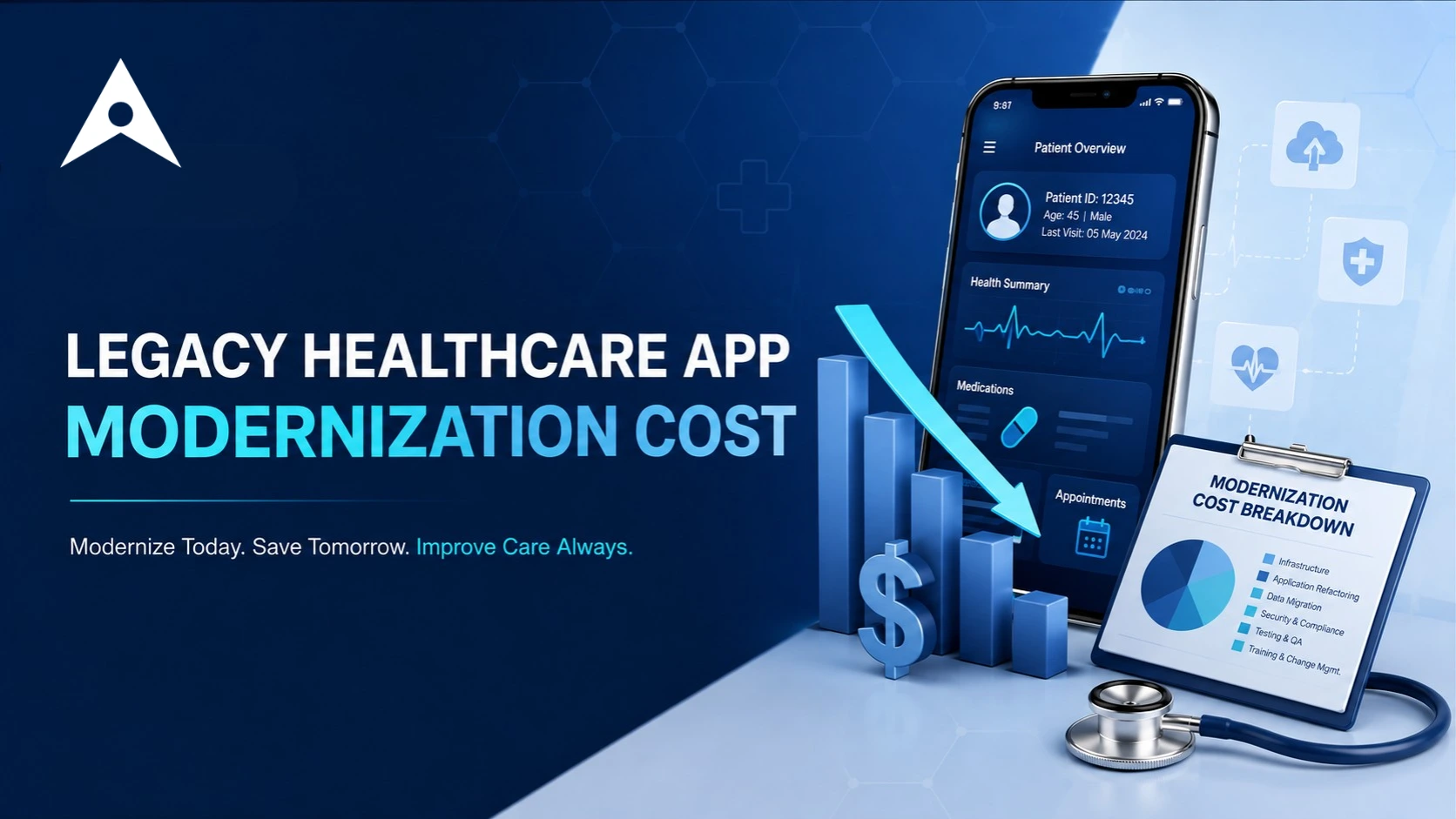
Legacy healthcare applications eventually become expensive to maintain as infrastructure ages, compliance requirements evolve, and user expectations increase. Healthcare app modernization typically costs between $25,000 and $300,000+, depending on the modernization scope, technical complexity, cloud migration strategy, and regulatory requirements.
Healthcare applications have become essential for delivering digital care, improving patient engagement, and streamlining healthcare services. However, many healthtech companies still rely on legacy applications that struggle to meet modern user expectations, security requirements, and evolving compliance standards. As technology advances, these outdated systems become increasingly expensive to maintain and harder to scale.
Instead of replacing an entire application, many businesses choose modernization to extend the value of their existing digital products. Investing in product modernization services improves performance, strengthens security, enhances user experience, and enables seamless integration with cloud platforms and modern healthcare technologies.
The overall budget depends on factors such as application complexity, modernization goals, compliance requirements, cloud adoption, and integration needs. By evaluating these factors early, founders can choose the most cost-effective modernization strategy while reducing business risks.
Table of Contents
What Is Healthcare App Modernization?
Healthcare app modernization is the process of upgrading an existing healthcare application, its architecture, infrastructure, security, and user interfaces, without rebuilding it from scratch. Instead of replacing the entire product, businesses modernize key components to meet evolving business needs and healthcare regulations.
Modernization typically includes migrating to the cloud, updating the application architecture, redesigning outdated interfaces, strengthening security, and integrating modern APIs. These improvements help healthcare applications deliver better performance and long-term business value.
Healthcare software modernization can apply to several types of digital products, including:
| Application Type | Modernization Focus |
| Legacy Healthcare Applications | Upgrade outdated technology stacks, improve maintainability, and enhance performance. |
| Healthcare SaaS Platforms | Improve cloud infrastructure and subscription management. |
| Mobile Healthcare Apps | Refresh user experience, optimize performance, strengthen mobile security, and support modern operating systems. |
| Telemedicine Platforms | Improve video communication, appointment management, interoperability, and real-time data exchange. |
| Patient Engagement Applications | Modernize patient portals, messaging, notifications, and personalized healthcare experiences. |
Why Businesses Modernize Legacy Healthcare Apps
Many healthcare companies launched their applications years ago using technologies that successfully supported their initial growth. However, as user expectations, compliance standards, and digital healthcare services evolve, legacy applications often become barriers to innovation instead of supporting long-term business expansion.
1. Aging Technology Stack
Many legacy healthcare applications rely on outdated programming languages, unsupported frameworks, or aging infrastructure. These technologies increase maintenance costs and make it difficult to adopt new features or integrate modern healthcare services.
Modernizing the technology stack improves development efficiency, enhances system reliability, and reduces long-term operational risks.
2. Slow Application Performance
Delays in appointment scheduling, record retrieval, or clinician dashboards directly affect operational efficiency and patient experience. Slow-loading dashboards, delayed appointment scheduling, or sluggish data synchronization can frustrate users and reduce customer retention.
Modernization improves application speed by optimizing infrastructure, upgrading databases, and introducing cloud-native technologies that deliver better responsiveness under growing workloads.
3. Security Vulnerabilities
Healthcare applications store highly sensitive patient information, making them attractive targets for cyberattacks. Legacy software often lacks modern security controls, exposing businesses to data breaches and regulatory penalties.
A modernization initiative strengthens application security through advanced encryption, secure authentication, continuous monitoring, and proactive vulnerability management.
4. Poor User Experience
Healthcare users expect intuitive, responsive, and mobile-friendly digital experiences. Outdated interfaces often increase user frustration and reduce engagement across patient, provider, and administrative workflows.
Refreshing the user experience improves accessibility, simplifies navigation, and encourages higher adoption among healthcare professionals and patients.
5. Scalability Limitations
Business growth often exposes the limitations of legacy applications. Increasing user traffic, expanding service offerings, or entering new markets can overwhelm outdated architectures.
Modern applications use scalable cloud infrastructure and flexible architectures that support business growth without requiring costly infrastructure replacements.
6. Compliance Updates
Healthcare regulations continue evolving to improve data privacy and patient protection. Legacy applications may struggle to meet current compliance requirements without significant architectural improvements.
Modernization helps businesses implement stronger governance, improve audit readiness, and maintain compliance with healthcare data protection standards.
7. Cloud Migration Needs
Many older healthcare platforms operate on expensive on-premises infrastructure that limits flexibility and increases operational costs. Maintaining physical servers also slows innovation and business expansion.
Migrating to cloud infrastructure improves availability, strengthens disaster recovery, and removes the capital cost of refreshing physical servers.
Where Modernization Budget Usually Goes
Understanding the following variables is essential when estimating the cost to modernize a healthcare app and selecting the most suitable modernization strategy.
| Modernization Priority | Typical Business Trigger | Expected Outcome |
| Infrastructure | Rising hosting costs | Lower operating expenses |
| Security | Compliance gaps | Reduced risk exposure |
| UX | Declining engagement | Higher retention |
| Architecture | Slow releases | Faster delivery cycles |
Healthcare App Modernization Cost in 2026
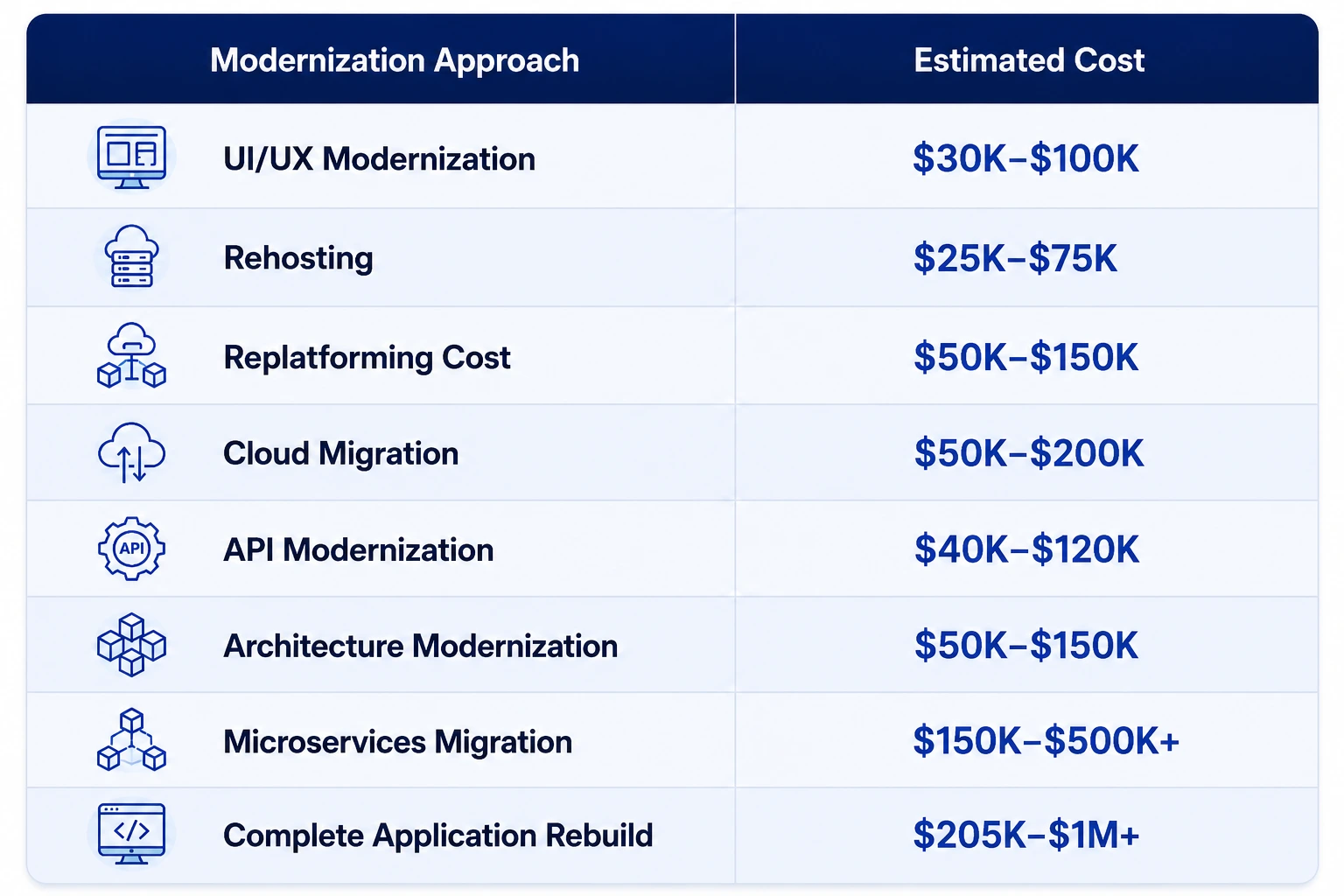
The healthcare app modernization cost varies depending on your application’s current architecture, technical debt, compliance requirements, modernization scope, and business objectives. Some companies only refresh the user interface, while others migrate to cloud-native infrastructure or completely rebuild critical application components.
The table below provides estimated investment ranges for common healthcare app modernization initiatives.
What Factors Affect Healthcare App Modernization Costs?
Every healthcare application has unique technical and business requirements. Understanding the following cost drivers helps founders and CTOs estimate realistic budgets while avoiding unexpected expenses.
1. Existing Codebase Quality
The quality of your existing application significantly influences modernization costs. Well-structured and documented code requires fewer modifications than outdated systems with accumulated technical debt.
Applications containing obsolete frameworks, duplicate code, or unsupported technologies typically require additional engineering effort before modernization can begin.
2. Platform Complexity
Applications supporting multiple user roles, extensive workflows, or advanced healthcare features naturally require larger modernization investments.
For example, a telemedicine platform offering video consultations, e-prescriptions, appointment scheduling, and patient messaging requires considerably more effort than a basic wellness application.
3. Data Migration
In practice, historical patient records usually require multiple migration rehearsals before production cutover to validate record integrity and minimize clinical disruption.
Data migration costs increase when businesses consolidate multiple databases or migrate information across different cloud environments.
4. Third-Party Integrations
Most healthcare platforms depend on external services to deliver seamless digital experiences. These integrations often require updates during modernization projects.
Common integration examples include:
- Electronic payment gateways
- Video consultation platforms
- CRM systems
- Notification services
- Analytics platforms
- Identity management solutions
- Healthcare interoperability APIs
The greater the number of integrations, the higher the modernization effort and overall project cost.
5. HIPAA Compliance Requirements
HIPAA compliance is a key consideration during healthcare app modernization, as applications handling protected health information (PHI) must meet strict security standards. Modernization typically includes implementing end-to-end encryption, multi-factor authentication, role-based access controls, secure audit logging, continuous security monitoring, infrastructure hardening, and proper compliance documentation. HHS has proposed major HIPAA Security Rule updates that would make encryption and MFA mandatory. These measures help protect sensitive healthcare data while reducing legal, financial, and operational risks.
HIPAA Compliance Checklist for Healthcare App Modernization
- Encrypt PHI at rest and in transit.
- Implement role-based access control (RBAC) and MFA.
- Enable audit logs and continuous monitoring.
- Secure APIs and third-party integrations.
- Perform regular risk assessments and security testing.
- Maintain data backup and disaster recovery plans.
- Ensure cloud infrastructure meets HIPAA requirements.
- Sign Business Associate Agreements (BAAs) with applicable vendors.
6. Cloud Infrastructure
Migrating applications to cloud platforms introduces infrastructure costs that vary according to storage requirements, computing resources, network traffic, and disaster recovery strategies.
Although cloud adoption requires upfront investment, it often lowers long-term operational expenses while improving application availability.
7. Team Expertise
Healthcare modernization projects require specialists with expertise in cloud technologies, application architecture, cybersecurity, healthcare interoperability, and compliance standards.
Experienced modernization partners typically deliver faster implementations, reduce technical risks, and minimize costly rework throughout the project lifecycle.
8. Cost Drivers Summary
| Cost Driver | Usually Increases Cost By | Why |
| Large PHI databases | High | Migration validation |
| Legacy frameworks | High | Refactoring effort |
| Multiple integrations | Medium | Compatibility testing |
| Cloud migration | Medium | Infrastructure redesign |
| HIPAA controls | High | Security implementation |
Types of Healthcare Apps Businesses Modernize
Most healthcare platforms require modernization after several years of feature additions, infrastructure changes, and evolving compliance requirements.
Although modernization strategies vary across products, several healthcare applications commonly require upgrades to improve security and user experience.
1. Telemedicine Apps
Telemedicine platforms experienced rapid adoption in recent years, but many were developed quickly to meet growing market demand. As user expectations increase, these platforms often require modernization to deliver better reliability and seamless virtual care experiences.
Businesses typically modernize telemedicine applications to:
- Improve video consultation quality and stability.
- Reduce appointment scheduling delays.
- Enhance mobile performance across devices.
- Strengthen patient data security.
- Support higher concurrent user traffic.
- Integrate modern communication APIs.
Modernization enables telemedicine platforms to scale efficiently while maintaining secure and uninterrupted virtual healthcare services. If you’re planning to build or upgrade a virtual care platform, our Telemedicine app development cost guide breaks down development timelines, features, and investment estimates.
2. Patient Engagement Apps
Patient engagement applications help users schedule appointments, access health records, receive reminders, and communicate with healthcare providers. As these platforms evolve, businesses must continuously improve usability and performance.
Common modernization initiatives focus on improving both functionality and user experience. These include redesigning patient portals, simplifying appointment booking workflows, improving accessibility for diverse users, enhancing notification systems, increasing application responsiveness, and enabling more personalized healthcare experiences.
These improvements encourage higher patient engagement while strengthening long-term customer retention.
3. Health & Wellness Apps
Health and wellness apps require continuous modernization to meet evolving user expectations across fitness tracking, nutrition, mental wellness, and preventive care.
Businesses upgrade these platforms to improve real-time activity tracking, wearable integrations, AI-driven recommendations, user interfaces, performance, cloud synchronization, and overall user experience while enabling faster feature innovation.
4. Chronic Care Management Apps
Applications supporting chronic disease management require high reliability because users depend on them for ongoing health monitoring and care coordination.
Healthcare companies modernize these platforms to:
- Improve medication reminder systems.
- Enable continuous health tracking.
- Enhance remote patient communication.
- Strengthen secure data sharing.
- Improve reporting dashboards.
- Support scalable long-term patient management.
These upgrades help businesses provide more consistent healthcare experiences while improving operational efficiency.
5. Mobile Healthcare Apps
Mobile healthcare applications often require modernization as operating systems, mobile devices, and customer expectations continue evolving. Older applications may experience compatibility issues, slower performance, or declining user engagement.
Typical modernization goals include:
- Updating mobile frameworks.
- Improving application speed.
- Enhancing offline functionality.
- Strengthening authentication methods.
- Supporting the latest Android and iOS versions.
- Delivering consistent cross-device experiences.
Modern mobile applications improve customer satisfaction while reducing maintenance challenges over time.
6. Healthcare SaaS Platforms
Healthcare SaaS platforms serve clinics, healthcare providers, insurers, and digital health businesses through subscription-based software products. As customer bases grow, these platforms must support increasing workloads without compromising performance.
Modernization efforts commonly focus on migrating to scalable cloud infrastructure, modernizing application architecture, improving multi-tenant performance, enhancing API capabilities, strengthening platform security, and increasing deployment flexibility to support long-term operational efficiency.
These improvements allow healthcare SaaS businesses to onboard more customers while maintaining reliable platform performance.
If you’re planning to build a new healthcare product instead of modernizing an existing one, refer to a comprehensive healthcare app development guide; it covers development processes, costs, features, and technology considerations.
Healthcare App Modernization Approaches
Healthcare businesses have different modernization goals based on their application’s condition, growth plans, and available budget. Some only need infrastructure upgrades, while others require architectural transformation to support future innovation.
Selecting the right modernization approach helps businesses reduce risks, control costs, and maximize long-term value from their existing healthcare applications.
| Modernization Approach | What It Involves | Best For | Cost Impact |
| Rehosting | Move the application to the cloud without architectural changes. | Quick infrastructure upgrades | Low |
| Replatforming | Upgrade the platform with limited code and database changes. | Better performance without major redevelopment | Medium |
| Cloud Migration | Move applications and workloads to cloud infrastructure. | Scalability and operational efficiency | Medium |
| API Modernization | Replace legacy APIs with modern, secure APIs. | Better interoperability | Medium |
| Microservices Transformation | Break monolithic applications into independent services. | Rapidly growing healthcare platforms | High |
| Complete Application Rebuild | Redevelop the application using modern technologies. | Applications that have reached end of life | Very High |
Which Modernization Approach Should You Choose?
The right modernization strategy depends on both technical and business priorities rather than technology alone.
| Business Situation | Recommended Approach |
| Stable application with outdated infrastructure | Rehosting |
| Good application requiring platform improvements | Replatforming |
| Growing customer base requiring scalability | Cloud Migration |
| Multiple external integrations causing limitations | API Modernization |
| Rapidly scaling SaaS platform | Microservices Transformation |
| Legacy platform nearing end of life | Complete Application Rebuild |
The most successful healthcare companies rarely rely on a single modernization strategy. Instead, they combine multiple approaches in phased initiatives, reducing implementation risks while achieving faster business outcomes and stronger returns on investment.
Modernization ROI: Is Healthcare App Modernization Worth the Investment?
Modernizing a legacy healthcare app requires an upfront investment, but it can generate long-term returns by reducing technical debt, improving engineering efficiency, and extending the product’s lifespan. For healthcare product companies, modernization often costs significantly less than rebuilding an application while enabling continuous innovation and business growth.
1. Reduce Technical Debt
Legacy applications consume valuable engineering resources that could otherwise be invested in innovation. According to Deloitte’s 2026 Global Technology Leadership Study, technical debt accounts for 21%–40% of an organization’s IT spending. By modernizing outdated architectures and technologies, healthcare businesses can lower maintenance costs, improve development efficiency, and redirect resources toward new product capabilities.
2. Accelerate Product Innovation
Modern application architectures and cloud-native development practices enable faster feature delivery and shorter release cycles. Deloitte’s system dynamics model estimates that infrastructure modernization can reduce technical debt by 18% over five years, helping organizations spend less time maintaining legacy systems and more time delivering customer value.
3. Extend Product Lifespan
Modernization allows healthcare businesses to preserve valuable business logic while replacing outdated technologies, avoiding the higher cost and disruption of a complete rebuild. By upgrading applications incrementally, organizations can continue meeting evolving user expectations and compliance requirements while maximizing the return on their existing technology investment.
Step-by-Step Healthcare App Modernization Process
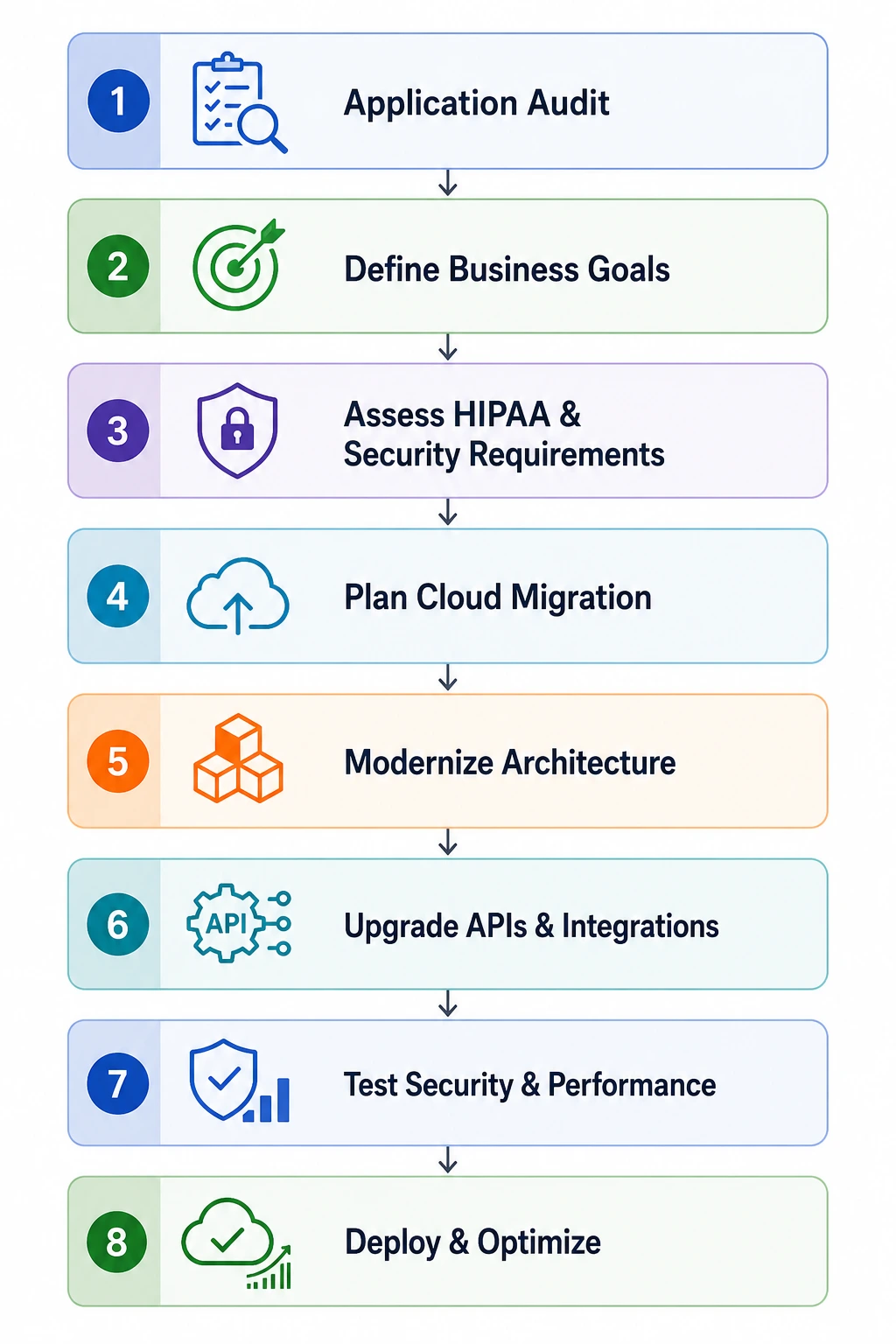
Healthcare app modernization is a strategic business initiative rather than a standalone technology upgrade. Following a structured process helps businesses reduce risks, control costs, and maintain uninterrupted services throughout the modernization journey.
The following roadmap outlines the key stages followed by successful healthcare product companies.
| Modernization Stage | Primary Objective | Business Outcome |
| Audit the Existing Application | Evaluate technical health and business value. | Clear modernization priorities and realistic budget planning. |
| Define Modernization Goals | Align modernization with business objectives. | Better investment decisions and measurable outcomes. |
| Assess Compliance Requirements | Identify security and regulatory gaps. | Reduced compliance risks and stronger data protection. |
| Plan Cloud Migration | Design scalable infrastructure. | Improved availability, performance, and operational efficiency. |
| Modernize Architecture | Upgrade application components and workflows. | Better maintainability and flexibility. |
| Upgrade APIs and Integrations | Improve interoperability with external systems. | Faster data exchange and seamless platform connectivity. |
| Test Security and Performance | Validate reliability before launch. | Higher application stability and user confidence. |
| Deploy and Continuously Optimize | Monitor performance and improve continuously. | Long-term business growth and product evolution. |
1. Audit the Existing Application
Every modernization project should begin with a comprehensive assessment of the existing healthcare application to identify technical limitations, business risks, and improvement opportunities. The audit typically evaluates the technology stack, application performance, infrastructure, security, code quality, database architecture, third-party integrations, and maintenance costs. These insights help determine whether selective modernization or a complete rebuild offers greater long-term value.
2. Define Modernization Goals
Modernization should be driven by clear business objectives rather than technology upgrades alone. Organizations typically focus on improving user experience, reducing infrastructure costs, accelerating product releases, strengthening security, supporting business growth, and improving operational efficiency. Well-defined goals help prioritize investments and measure project success.
3. Assess Compliance Requirements
Healthcare applications handling sensitive data must comply with strict security and privacy standards. This stage evaluates data protection policies, authentication methods, access controls, audit logging, encryption practices, and security monitoring. Addressing compliance requirements early helps reduce risks and avoid costly changes later in the project.
4. Plan Cloud Migration
A well-planned cloud migration improves flexibility and long-term performance while minimizing operational disruptions. McKinsey estimated cloud technologies could generate $100–170 billion in value for healthcare in 2030. Planning typically includes selecting the right infrastructure, defining a database migration strategy, preparing backup and disaster recovery plans, prioritizing workloads, mitigating downtime, and allocating resources effectively.
Before migrating sensitive healthcare workloads, use a cloud migration data security checklist to validate encryption, access controls, backup strategies, and compliance requirements throughout the migration process.
5. Modernize Architecture
Modernizing the application architecture improves flexibility for future growth. This may involve refactoring application components, adopting microservices, updating legacy frameworks, optimizing database architecture and backend services, and modernizing frontend technologies to support continuous innovation.
6. Upgrade APIs and Integrations
Modern APIs improve interoperability and enable seamless communication with external services. According to the latest available data published in 2025, 70% of U.S. hospitals enabled patient access through HL7 FHIR APIs, highlighting the growing importance of API modernization for healthcare interoperability.
Modernization often includes upgrading integrations with payment gateways, communication platforms, analytics tools, identity management systems, cloud services, and healthcare interoperability standards to accelerate innovation.
7. Test Security and Performance
Comprehensive testing ensures the modernized application performs reliably while maintaining security and compliance. This includes functional, performance, security, load, compatibility, and user acceptance testing to identify issues before deployment and ensure business continuity.
8. Deploy and Continuously Optimize
Modernization extends beyond deployment through continuous monitoring and optimization. Ongoing activities such as performance monitoring, security updates, infrastructure optimization, customer feedback analysis, feature enhancements, and cost optimization help keep the application secure, efficient, and aligned with evolving business needs. A phased modernization approach also reduces implementation risks and maximizes long-term return on investment.
Technologies Used in Modern Healthcare Applications
Modern healthcare applications require technologies that support security, interoperability, and continuous innovation. During modernization, businesses replace outdated technologies with flexible solutions that improve performance while preparing applications for future growth. Organizations often partner with providers offering application modernization services to evaluate existing systems and implement technologies that align with their business and compliance requirements.
The right technology stack depends on business objectives, application complexity, compliance requirements, and long-term product strategy rather than simply following the latest technology trends.
1. Cloud Computing
Cloud computing provides scalable and reliable infrastructure that improves application availability, reduces maintenance costs, and supports business growth. It also creates a flexible foundation for future modernization initiatives.
2. Containers & Kubernetes
Containers and Kubernetes simplify application deployment, automate scaling, and improve operational efficiency. They help healthcare businesses deliver reliable applications with minimal downtime.
3. APIs
Organizations migrating from legacy HL7 interfaces to modern FHIR APIs often modernize API gateways and authentication layers together to avoid introducing new interoperability bottlenecks.
4. AI & Analytics
AI and analytics help healthcare businesses generate actionable insights, automate workflows, personalize user experiences, and improve operational decision-making.
5. Mobile Technologies
Modern mobile technologies improve application performance, responsiveness, and cross-platform compatibility, delivering better user experiences across Android and iOS devices.
6. Microservices
Microservices divide large applications into independent services, making them easier to scale, maintain, and update while supporting continuous innovation.
7. DevOps
DevOps automates development, testing, and deployment to accelerate software delivery, improve reliability, and reduce operational risks.
To stay ahead of evolving technologies, explore the top application modernization trends shaping cloud-native architectures, AI adoption, automation, and healthcare software modernization.
Compliance Considerations
Healthcare applications handle sensitive patient information, making compliance an essential part of every modernization initiative. Businesses should strengthen security while ensuring their applications meet evolving regulatory and interoperability requirements.
HIPAA
HIPAA establishes standards for protecting protected health information (PHI). During modernization, businesses should implement security controls that safeguard patient data throughout its lifecycle.
Key focus areas include:
- Secure PHI storage and transmission
- Risk assessments
- Data backup and recovery
- Employee access controls
For a deeper understanding of healthcare security and regulatory best practices, refer to the HIPAA Compliance Guide.
HL7
HL7 enables healthcare systems to exchange clinical and administrative information efficiently. Modernizing applications with HL7 support improves communication between connected healthcare platforms.
Business benefits include:
- Faster data exchange
- Better system interoperability
- Reduced manual data entry
- Improved operational efficiency
FHIR
FHIR is the modern interoperability standard for healthcare applications. It uses APIs to simplify secure data sharing across digital health platforms.
Businesses adopt FHIR to:
- Improve integration speed
- Enable real-time data exchange
- Support connected healthcare ecosystems
- Enhance user experiences
Data Encryption
Encryption protects sensitive healthcare information both during transmission and while stored in databases. Strong encryption reduces security risks and supports regulatory compliance.
Essential encryption practices include:
- Encrypting data at rest
- Encrypting data in transit
- Secure key management
- Regular encryption reviews
Access Control
Not every employee requires access to every healthcare record. Role-based access control limits data exposure and reduces insider security risks.
Modern applications should support:
- Role-based permissions
- Multi-factor authentication
- Session management
- User activity monitoring
Audit Logging
Audit logs create a detailed record of user activities across the application. They improve visibility while supporting security investigations and compliance reporting.
Effective audit logging should capture:
- User logins
- Data access events
- Record modifications
- Administrative actions
- Security incidents
Healthcare compliance should be integrated throughout the modernization process rather than treated as a final deployment checklist. Building security and compliance into every modernization phase helps reduce business risks while strengthening customer trust.
Benefits of Modernizing Legacy Healthcare Apps
Modernization helps healthcare businesses improve operational efficiency while preparing their products for long-term growth. Beyond technology upgrades, it delivers measurable business value across customer experience and operational performance.
For a broader understanding of modernization strategies beyond healthcare applications, explore the legacy application modernization guide to learn how businesses approach legacy transformation projects.
1. Better User Experience
Modern interfaces improve usability, accessibility, and application responsiveness, leading to higher customer satisfaction and engagement.
2. Improved Scalability
Cloud-native architectures enable healthcare applications to support growing user demand without compromising performance or reliability.
3. Stronger Security
Modern security controls reduce vulnerabilities, protect sensitive healthcare data, and improve regulatory readiness.
4. Faster Releases and Easier Maintenance
Modern architectures simplify application maintenance while enabling faster feature releases, helping businesses innovate more efficiently and reduce technical debt.
5. Lower Operational Costs
Modern infrastructure optimizes resource utilization, reducing long-term maintenance, infrastructure, and operational expenses.
6. Better Interoperability
Modern APIs and standardized integrations improve communication with third-party healthcare platforms, creating more connected digital healthcare ecosystems.
Modernization helps healthcare businesses innovate faster, operate more efficiently, and maximize the long-term value of their existing digital products.
Common Challenges
Healthcare app modernization delivers significant business value, but organizations often face technical and operational obstacles during implementation. Identifying these challenges early helps reduce risks and keeps modernization projects on schedule.
1. Legacy Code
Poorly documented or outdated code increases modernization complexity. A comprehensive technical assessment helps identify components that require refactoring or replacement.
2. Data Migration
Migrating healthcare data requires careful planning to maintain data integrity and business continuity. Testing and validation significantly reduce migration risks.
3. Third-Party Integrations
Legacy integrations may not support modern architectures or APIs. Updating them ensures seamless communication across connected healthcare platforms.
4. Compliance
Meeting healthcare compliance requirements while modernizing applications can be challenging. Embedding security and compliance throughout the project minimizes future risks.
5. Downtime
Unexpected downtime can affect customer trust and business operations. Phased deployments and comprehensive testing help minimize service interruptions.
6. User Adoption
Even technically successful modernization projects can fail if users struggle with new workflows. Clear onboarding and intuitive user experiences encourage faster adoption.
Why Choose RipenApps to Modernize a Legacy Healthcare App?
Modernizing a legacy healthcare application requires deep expertise in healthcare products, compliance, and scalable architectures. At RipenApps, we help healthcare businesses transform aging applications into secure, cloud-native, and future-ready digital products while preserving critical business functionality. Our experience extends across telemedicine, patient engagement, and digital health platforms, enabling us to modernize application architecture, improve performance, strengthen security, and simplify integrations.
Our experience in digital healthcare includes solutions such as Mednovate Connect, a telemedicine platform featuring secure virtual consultations, medication management, EHR integration, and HIPAA-aligned security practices. Working on healthcare products like these has strengthened our understanding of modern healthcare application architectures, compliance requirements, and user-centric experiences. Combined with our end-to-end modernization approach, from application assessment and cloud migration to deployment and continuous optimization, we help healthcare businesses reduce technical debt and prepare their applications for future growth.
Conclusion
The healthcare app modernization cost depends on factors such as application complexity, modernization scope, cloud migration requirements, compliance needs, integrations, and technical debt. Legacy healthcare applications often become barriers to innovation as technology, customer expectations, and compliance requirements continue evolving. Modernization enables businesses to reduce technical debt, shorten release cycles, strengthen healthcare data protection, and support higher patient volumes without redesigning the entire platform.
Evaluating these factors early helps founders choose the most cost-effective modernization strategy while reducing implementation risks. Whether you’re planning a targeted upgrade or a complete application transformation, partnering with an experienced healthcare app development company like RipenApps can help maximize long-term value and prepare your application for future growth.
Frequently Asked Questions
Q1. How much does it cost to modernize a healthcare app?
Healthcare app modernization typically costs between $25,000 and $300,000+, depending on the modernization scope, application complexity, cloud migration requirements, integrations, and compliance needs.
Q2. How long does healthcare app modernization take?
Most projects take 2 to 12 months. Timelines vary based on application size, modernization approach, data migration, and architectural complexity.
Q3. Should you modernize or rebuild a healthcare application?
Modernization is often the better choice when the application’s core architecture remains valuable. A rebuild becomes appropriate when technical debt or architectural limitations prevent future growth.
Q4. What factors affect healthcare app modernization costs?
Key factors include codebase quality, application complexity, data migration, third-party integrations, cloud infrastructure, compliance requirements, and the chosen modernization approach.
Q5. How do you modernize a HIPAA-compliant healthcare application?
The process includes assessing security gaps, implementing encryption, strengthening access controls, maintaining audit logs, upgrading infrastructure, and validating compliance throughout the modernization lifecycle.
Discuss your project and request for proposal
SHARE
WRITTEN BY

Ishan Gupta
CEO & Founder
Ishan Gupta is a seasoned entrepreneur and CEO with extensive 10+ years of experience in business and mobile app development landscape. He believes that the right digital product allows companies to focus on what they do best, while technology handles the rest. With deep exposure to global markets, he understands what makes an app succeed. His approach translates business needs into clear product strategies, ensuring that every feature contributes to measurable ROI.
View All Articles