


Key Takeaways
- Cloud-based warehouse management systems improve inventory visibility, scalability, and operational efficiency while reducing long-term infrastructure and maintenance costs.
- Custom warehouse management system development typically costs between $50,000 and $350,000+, depending on business complexity and integrations.
- Cloud-native architecture enables businesses to scale warehouse operations, integrate enterprise systems, and support future growth with greater flexibility.
- Advanced technologies such as AI, IoT, RFID, and robotics significantly enhance warehouse productivity, inventory accuracy, and operational decision-making.
- Custom cloud-based WMS solutions deliver stronger long-term ROI by eliminating recurring licensing costs and improving warehouse performance.
Managing warehouses today is far more complex than simply storing inventory. Businesses must handle increasing order volumes, real-time inventory visibility, multi-channel fulfillment, supplier coordination, and customer expectations for faster deliveries. As operations scale, traditional warehouse systems often struggle to keep pace, leading to inventory inaccuracies, delayed shipments, and higher operational costs.
This is why many logistics providers, eCommerce businesses, distributors, and manufacturers are moving toward cloud-native warehouse management systems. Unlike traditional on-premise software, cloud-based platforms offer greater scalability, faster deployment, seamless integrations, and lower infrastructure maintenance, making them a preferred choice for businesses planning long-term growth.
However, choosing the right approach is not always straightforward. Organizations often face critical questions such as whether they should buy an existing solution or build a custom platform, how much warehouse management system development actually costs, which features should be included initially, whether cloud deployment delivers better ROI than traditional software, and how cloud consulting services can help design a secure, scalable, and future-ready warehouse infrastructure.
If you’re evaluating a custom cloud-based warehouse management system, this guide answers those questions. You’ll learn the estimated development cost, essential features, cloud architecture considerations, development process, and how to determine whether building a custom solution is the right investment for your business.
Table of Contents
What is a Cloud-Based Warehouse Management System?
A cloud based warehouse management system is software that helps businesses manage inventory, warehouse operations, order fulfillment, receiving, picking, packing, shipping, and stock movement through cloud infrastructure rather than on-premise servers. Because the application is hosted in the cloud, users can securely access warehouse data from any location while benefiting from automatic updates, scalability, and easier integration with other business systems.
Unlike legacy warehouse software that requires significant infrastructure investments and ongoing server maintenance, cloud-based solutions operate on modern cloud environments, allowing businesses to scale operations without replacing hardware or rebuilding infrastructure. As organizations continue to digitize warehouse operations, cloud-based WMS platforms have become an essential part of the broader role of technology in supply chain and logistics, enabling businesses to improve inventory visibility, streamline fulfillment, and build more resilient supply chains.
A modern cloud WMS typically integrates with:
- Enterprise Resource Planning (ERP) systems
- Transportation Management Systems (TMS)
- eCommerce platforms
- Accounting software
- Inventory management solutions
- CRM platforms
- Barcode and RFID devices
By centralizing warehouse operations within a cloud environment, businesses gain real-time inventory visibility, faster order processing, improved workforce productivity, and better operational decision-making.
Cloud-Based vs. On-Premise WMS: Which Deployment Model Wins?
Choosing between cloud and on-premise deployment is one of the first strategic decisions businesses make when planning a warehouse management system. While both approaches can support warehouse operations, they differ significantly in terms of infrastructure, scalability, implementation costs, maintenance, and long-term flexibility.
| Factor | Cloud-Based WMS | On-Premise WMS |
| Initial Investment | Lower infrastructure cost | High upfront hardware investment |
| Deployment Time | Faster implementation | Longer deployment cycle |
| Scalability | Scale resources on demand | Limited by physical infrastructure |
| Maintenance | Managed through cloud updates | Internal IT team responsible |
| Accessibility | Accessible from anywhere | Usually restricted to internal networks |
| Software Updates | Automatic | Manual implementation |
| Disaster Recovery | Cloud backup and redundancy | Business-managed backup systems |
| Integration | Easier API integrations | Often requires custom connectors |
| Long-Term Flexibility | High | Moderate |
The growing preference for cloud deployment is reflected in global enterprise technology spending. According to Gartner, worldwide end-user spending on public cloud services is projected to reach $723.4 billion in 2025, reflecting continued enterprise investment in scalable cloud infrastructure, AI-ready platforms, and application modernization.
For growing organizations, cloud deployment often provides greater flexibility because computing resources, storage, and processing capacity can expand as warehouse operations grow. Businesses can also introduce new fulfillment centers, integrate additional software, and support seasonal demand without major infrastructure investments.
On-premise systems may still suit organizations with strict internal infrastructure requirements or highly customized legacy environments. However, businesses planning digital transformation generally benefit from cloud-native architecture due to its scalability, operational agility, and reduced maintenance burden.
Build vs. Buy: When Custom WMS Development Makes Sense
Many businesses initially adopt off-the-shelf warehouse management software because it offers faster deployment and lower initial costs. However, as operations expand, standardized platforms often become difficult to customize for unique workflows, integrations, and operational requirements.
Buying an existing WMS may be suitable when:
- Warehouse processes are relatively standardized.
- Operational complexity remains limited.
- Internal customization requirements are minimal.
- Growth expectations are moderate.
Custom warehouse management system development becomes more practical when businesses require:
- Complex warehouse workflows
- Multiple warehouse locations
- ERP, TMS, and eCommerce integrations
- Custom inventory allocation logic
- Industry-specific compliance requirements
- Advanced automation capabilities
- AI-driven forecasting and optimization
- Long-term ownership of software
A custom WMS also eliminates recurring per-user licensing limitations that often become expensive as warehouse operations scale. Instead of adapting business processes to match software limitations, organizations can build workflows around their operational requirements.
Businesses operating as third-party logistics providers (3PLs), manufacturers, distributors, or enterprise eCommerce companies often find that custom development provides greater flexibility, stronger competitive differentiation, and better long-term return on investment than extending generic warehouse software.
How Much Does It Cost to Build a Cloud-Based Warehouse Management System?
Building a cloud based warehouse management system typically costs between $50,000 and $350,000+, depending on feature complexity, cloud architecture, integrations, automation capabilities, deployment model, and scalability requirements. Most mid-market businesses complete development within 4 to 10 months, while enterprise-grade platforms generally require longer implementation timelines due to broader operational requirements and complex system integrations.
The overall investment depends not only on software functionality but also on cloud infrastructure design, integration with existing enterprise systems, security requirements, warehouse automation technologies, and future scalability planning.
Cost by Complexity Tier
| Development Tier | Deployment | Estimated Cost | Timeline | Suitable For |
| Basic MVP | Cloud | $50K–90K | 4–5 months | Small warehouses |
| Mid-Market | Cloud | $90K–180K | 5–8 months | Growing distributors |
| Enterprise | Cloud | $180K–350K+ | 8–12+ months | 3PLs & enterprises |
| Enterprise | On-Premise | $300K–700K+ (typically 1.5–2× the equivalent cloud implementation due to infrastructure, licensing, deployment, and ongoing maintenance costs) | 10–14+ months | Organizations requiring on-site infrastructure |
The basic tier generally focuses on inventory management, order processing, barcode support, warehouse dashboards, and essential reporting. Mid-market solutions expand functionality through ERP integration, multi-warehouse management, role-based access, shipping integrations, analytics, and cloud scalability.
Enterprise implementations include advanced automation, IoT connectivity, RFID support, robotics integration, AI-powered forecasting, extensive reporting, microservices architecture, and complex enterprise integrations.
How Cloud Deployment Changes the Cost Equation
Cloud deployment changes the economics of warehouse management system development by reducing the need for significant upfront infrastructure investment. Instead of purchasing and maintaining physical servers, businesses consume cloud resources based on actual usage.
In addition to application development costs, businesses should also budget for cloud infrastructure, third-party integrations, testing, and post-launch optimization. Cloud hosting typically ranges from $500–$3,000 per month depending on warehouse size and transaction volume, while ERP, TMS, or logistics integrations can add approximately $10K–40K to the implementation cost. Advanced capabilities such as AI-powered forecasting, RFID integration, warehouse robotics, or IoT connectivity may further increase the project investment by $20K–80K, depending on implementation complexity and operational requirements.
Cloud infrastructure costs generally include:
- Compute resources
- Storage
- Networking
- Database services
- Monitoring
- Backup and disaster recovery
- Auto-scaling services
- Security management
Although cloud environments introduce recurring operational expenses, they typically reduce maintenance overhead, improve system availability, accelerate deployment, and support business growth without major infrastructure upgrades.
For rapidly growing warehouse operations, cloud deployment often delivers a lower total cost of ownership compared with expanding on-premise infrastructure over several years.
Cost Drivers That Impact Development Cost
Several technical and operational factors influence the final investment required for warehouse management software development.
The number of warehouse locations directly affects architecture complexity, synchronization requirements, and inventory management logic. Multi-location inventory visibility requires additional engineering compared with single-site operations.
Integration requirements significantly impact development effort. Connecting ERP platforms, transportation management systems, accounting software, eCommerce platforms, payment systems, barcode scanners, RFID devices, and third-party logistics providers increases both implementation time and overall project cost.
Cloud infrastructure design also plays an important role. Highly available architectures with auto-scaling, disaster recovery, containerized deployments, monitoring systems, and security controls require additional engineering investment while improving long-term scalability and reliability.
Advanced capabilities such as artificial intelligence, robotics integration, predictive inventory planning, warehouse automation, and IoT connectivity further increase development complexity but provide substantial operational advantages as warehouse operations mature.
Must-Have Warehouse Management System Features
The success of a cloud based warehouse management system depends largely on its ability to support daily warehouse operations while remaining flexible enough to scale with future business growth. Rather than trying to build every possible capability in the first release, businesses should prioritize features based on operational impact. Core warehouse functions should be included in the initial version, while advanced automation capabilities can be introduced as operations mature.
Essential Warehouse Management Features
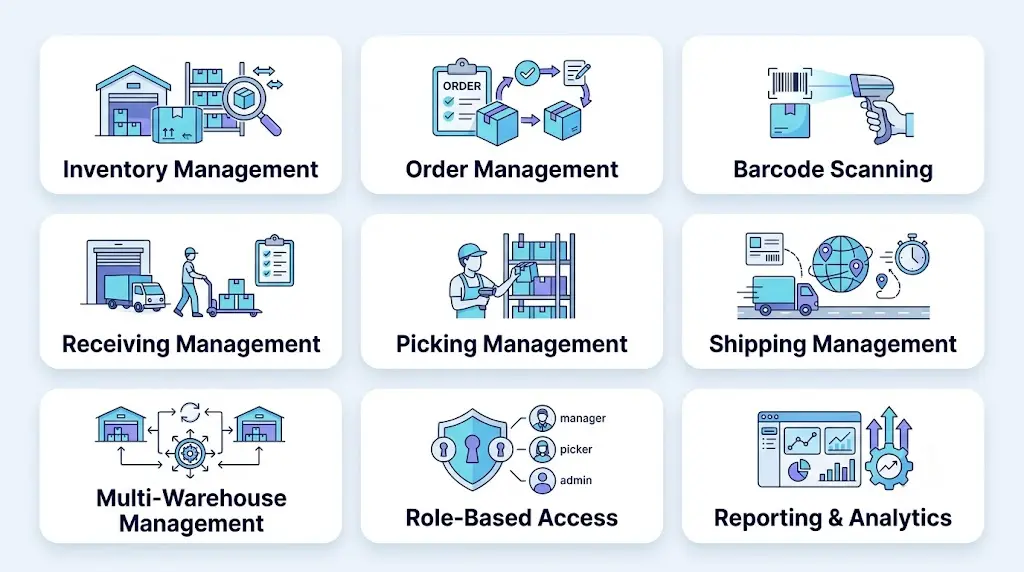
A minimum viable warehouse management system should focus on improving inventory visibility, order accuracy, warehouse productivity, and operational efficiency. These foundational capabilities create the operational backbone of the platform while supporting future feature expansion.
Inventory Management
Real-time inventory tracking forms the foundation of every warehouse management system. The platform should provide accurate stock visibility across warehouse locations, maintain inventory records, monitor stock movements, and reduce discrepancies caused by manual updates.
Order Management
Order management enables warehouses to receive, process, prioritize, and fulfill customer orders efficiently. The system should automate order allocation, monitor fulfillment status, and ensure faster processing with fewer manual interventions.
Barcode Scanning
Barcode integration significantly improves warehouse accuracy by reducing manual data entry. Warehouse staff can scan products during receiving, picking, packing, and shipping, ensuring inventory records remain synchronized in real time.
Receiving and Putaway Management
The receiving module should record inbound shipments, verify purchase orders, assign storage locations, and guide warehouse personnel through optimized putaway workflows. Efficient receiving minimizes storage delays and improves inventory accuracy from the beginning of the warehouse process.
Picking and Packing Management
An effective WMS should generate optimized picking routes, group orders intelligently, reduce travel time inside warehouses, and streamline packing workflows before shipment.
Shipping Management
Shipping capabilities should integrate with logistics providers to generate shipping labels, track deliveries, calculate freight costs, and provide shipment visibility throughout the delivery lifecycle.
Multi-Warehouse Management
Businesses operating multiple distribution centers require centralized inventory visibility while maintaining independent warehouse operations. A cloud-based platform allows inventory synchronization across facilities without creating operational silos.
Role-Based Access Control
Warehouse supervisors, administrators, inventory managers, and operators require different system permissions. Role-based access improves security while ensuring employees only access information relevant to their responsibilities. For organizations migrating from legacy warehouse systems, following a cloud migration and data security checklist also helps protect sensitive operational data, maintain compliance, and minimize risks during the transition to a cloud-based environment.
Reporting and Analytics
Operational dashboards provide visibility into inventory levels, warehouse productivity, order fulfillment rates, stock turnover, and operational bottlenecks, enabling managers to make faster business decisions.
Advanced Features
Once the operational foundation is established, businesses can expand their warehouse management system with advanced technologies that improve efficiency, automation, and decision-making.
Artificial Intelligence
Artificial intelligence enables predictive inventory planning, demand forecasting, intelligent replenishment recommendations, anomaly detection, and warehouse workload optimization. AI helps businesses reduce stock shortages, minimize excess inventory, and improve operational planning through data-driven insights.
RFID Integration
Unlike traditional barcode scanning, RFID technology allows inventory to be identified automatically without direct line-of-sight scanning. This accelerates inventory counting, improves stock visibility, and reduces manual warehouse operations.
IoT Device Integration
Connecting IoT sensors with warehouse operations enables businesses to monitor environmental conditions, equipment performance, storage temperatures, and asset movement in real time. For organizations handling sensitive products, continuous monitoring improves operational reliability while reducing losses.
As IoT in logistics and supply chain management continues to transform warehouse operations, connected devices are enabling greater visibility, predictive monitoring, and smarter inventory management across the supply chain.
Robotics Integration
Modern warehouses increasingly utilize autonomous mobile robots and automated picking systems to improve fulfillment speed and warehouse productivity. A cloud-native WMS should support integration with warehouse robotics through standardized APIs and automation workflows.
Predictive Maintenance
Monitoring warehouse equipment through connected devices allows businesses to identify maintenance requirements before equipment failures disrupt warehouse operations, reducing downtime and maintenance costs.
Advanced Business Intelligence
Enterprise reporting extends beyond operational dashboards by delivering predictive analytics, warehouse performance forecasting, labor utilization insights, and executive-level business intelligence for strategic planning.
How to Build a Cloud-Based Warehouse Management System: Step-by-Step Development Process
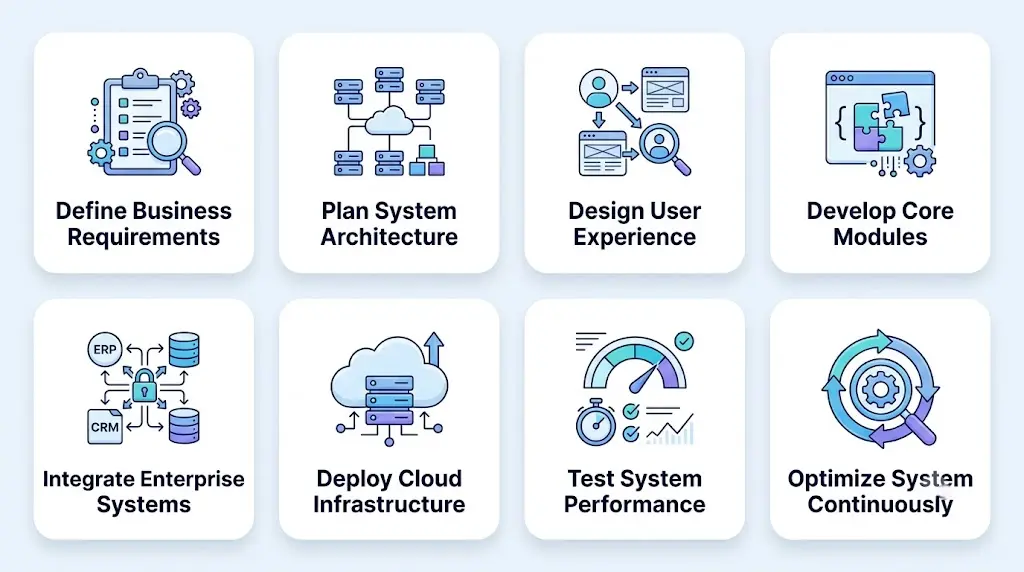
Developing a cloud based warehouse management system requires more than implementing warehouse functionality. Businesses must carefully design operational workflows, select an appropriate cloud architecture, integrate enterprise systems, and ensure long-term scalability. A structured development approach reduces implementation risks while supporting future business growth.
Step 1: Define Business Requirements
The development process begins by identifying warehouse workflows, operational challenges, inventory processes, fulfillment requirements, integration needs, reporting expectations, and future scalability goals. Clear business requirements establish the foundation for technical architecture and feature prioritization.
Step 2: Plan Product Architecture
Once requirements are finalized, architects define the system architecture, database design, cloud infrastructure, user roles, API strategy, security framework, and deployment model. At this stage, businesses also determine whether a modular or microservices architecture best supports future expansion.
Step 3: Design the User Experience
Warehouse employees interact with the platform throughout daily operations. User interface design should prioritize operational efficiency through simplified navigation, optimized workflows, mobile responsiveness, barcode support, and role-specific dashboards that minimize training requirements.
Step 4: Develop Core Warehouse Modules
Development begins with the essential operational modules, including inventory management, receiving, putaway, picking, packing, shipping, order management, warehouse dashboards, and reporting. Building these foundational capabilities first allows businesses to validate workflows before expanding functionality.
Step 5: Integrate Enterprise Systems
A modern WMS rarely operates independently. Integration with ERP platforms, Transportation Management Systems (TMS), accounting software, eCommerce platforms, payment gateways, and third-party logistics providers enables seamless data synchronization across business operations.
Step 6: Deploy Cloud Infrastructure
Cloud deployment involves configuring application hosting, databases, networking, storage, security controls, monitoring systems, backup strategies, disaster recovery, and auto-scaling policies. Proper infrastructure planning ensures consistent system availability while supporting future operational growth.
Step 7: Test and Optimize
Comprehensive testing validates warehouse workflows, integrations, system performance, security, scalability, user experience, and cloud cost optimization before production deployment. Performance optimization ensures the application continues operating efficiently as transaction volumes increase while keeping cloud infrastructure costs under control.
Step 8: Launch and Continuously Improve
Following deployment, businesses should monitor operational performance, gather user feedback, introduce advanced automation capabilities, and continuously optimize warehouse workflows based on evolving business requirements.
Cloud Architecture & Tech Stack for a Modern WMS
A modern cloud based warehouse management system requires an architecture that supports high transaction volumes, real-time inventory updates, multiple warehouse locations, and seamless integrations across the supply chain. As businesses grow, the platform should be capable of handling increasing workloads without compromising performance or availability.
Cloud-native architecture enables organizations to scale infrastructure on demand while maintaining operational continuity. Instead of relying on a single application server, modern WMS platforms typically use modular services that can be deployed, updated, and scaled independently. This approach improves system resilience while reducing downtime during future enhancements.
According to Gartner, the worldwide enterprise application software market is projected to grow 14.4% in constant currency in 2026, driven by continued demand for advanced, agile, and AI-enabled business applications. This increasing investment reflects why organizations are modernizing mission-critical systems, including warehouse management, with scalable cloud-native architectures.
| Component | Purpose |
| ERP Integration | Synchronizes inventory, procurement, finance, and purchasing data |
| Transportation Management System (TMS) | Coordinates shipping, carrier management, and delivery tracking |
| eCommerce Platforms | Synchronizes online orders, product inventory, and fulfillment status |
| Inventory Management System | Maintains real-time stock visibility across warehouse locations |
| Payment & Accounting Systems | Supports invoicing, reconciliation, and financial reporting |
| Barcode & RFID Devices | Enables accurate inventory tracking and warehouse automation |
Modern cloud infrastructure also incorporates:
- Microservices architecture for independent service deployment
- API-first integrations with types of enterprise applications
- Auto-scaling infrastructure to support seasonal demand
- Cloud databases for high availability
- Role-based security controls
- Backup and disaster recovery
- Continuous monitoring and logging
- Containerized deployment for simplified maintenance
This architecture allows businesses to introduce new warehouses, onboard additional users, expand integrations, and support growing transaction volumes without rebuilding the platform.

WMS ROI: Payback Timeline vs. Off-the-Shelf Licensing
While purchasing a SaaS warehouse management platform may appear less expensive initially, recurring subscription fees, user licensing costs, customization limitations, and integration expenses often increase the total cost of ownership as businesses expand.
A custom cloud-based warehouse management system requires a higher upfront investment but provides greater flexibility, ownership, and scalability over the long term.
| Evaluation Factor | Off-the-Shelf SaaS WMS | Custom Cloud WMS |
| Initial Investment | Lower | Higher |
| Monthly Licensing | Ongoing subscription | No recurring licensing fees |
| Customization | Limited | Fully customized |
| Integration Flexibility | Platform dependent | Built around business requirements |
| Scalability | Based on pricing plans | Scales with cloud infrastructure |
| Ownership | Vendor controlled | Business owned |
| Long-Term Cost | Continues increasing | Lower total ownership over time |
While the exact payback period varies depending on warehouse size, order volume, and implementation scope, businesses operating multiple warehouses or managing high transaction volumes often begin realizing measurable operational savings within the first 6–12 months after deployment. As recurring SaaS licensing fees, per-user charges, and customization costs continue to increase, a custom cloud-based warehouse management system can deliver a lower total cost of ownership and stronger long-term return on investment.
According to McKinsey’s Supply Chain 4.0 research, organizations adopting digital supply chain technologies can reduce operational costs by up to 30%, improve service levels, and optimize inventory performance. These measurable improvements demonstrate how digital warehouse operations can generate financial value beyond software ownership alone.
A custom cloud-based warehouse management system improves ROI by increasing inventory accuracy, accelerating order fulfillment, reducing manual labor, improving warehouse productivity, optimizing inventory utilization, minimizing operational bottlenecks, and eliminating recurring software licensing costs. As warehouse operations continue to scale, these cumulative efficiency gains often outweigh the higher upfront investment, making a custom cloud-native WMS a more cost-effective long-term solution than relying on subscription-based warehouse software.
How RipenApps Builds Warehouse & Inventory Systems
At RipenApps, we build scalable digital platforms that solve operational challenges across logistics, inventory management, and enterprise commerce. Our development approach focuses on creating cloud-native applications that support long-term business growth while integrating seamlessly with existing enterprise ecosystems.
Our experience includes developing inventory-driven platforms such as Stoklo, a B2B pharmacy ordering marketplace that required robust inventory management capabilities, supplier coordination, and efficient order processing. The platform contributed to 45% business growth while supporting 10,000+ active users, demonstrating how scalable digital infrastructure can improve operational performance.
Whether businesses require warehouse management software development, inventory automation, cloud migration, or enterprise system integration, our teams design solutions around business workflows rather than forcing operations to adapt to standardized software limitations.
If you’re evaluating a custom warehouse management solution, our experts can help assess your operational requirements, define the right cloud architecture, and build a scalable platform that supports future growth.
Final Thoughts
As warehouse operations become increasingly connected, data-driven, and customer-focused, businesses require software that can scale alongside operational growth. A cloud based warehouse management system provides the flexibility, scalability, and integration capabilities needed to support modern supply chain operations while reducing infrastructure complexity and improving long-term efficiency.
Although development costs vary based on business requirements, investing in a custom cloud-native platform enables organizations to build warehouse workflows around their operations rather than adapting to the limitations of off-the-shelf software. From real-time inventory management and enterprise integrations to AI-powered automation and cloud scalability, the right solution delivers long-term operational and financial value.
If your organization is planning to build a future-ready warehouse management platform, partnering with an experienced logistics app development company with expertise in cloud-native enterprise solutions can help you design a scalable system that supports both current operations and future growth.
FAQs
1. What is a cloud-based warehouse management system?
A cloud based warehouse management system is warehouse software hosted on cloud infrastructure that enables businesses to manage inventory, order fulfillment, warehouse operations, and logistics through a secure, scalable, internet-based platform.
2. How much does a warehouse management system cost?
Custom warehouse management system development typically costs between $50,000 and $350,000+, depending on business requirements, integrations, feature complexity, cloud infrastructure, and deployment scope.
3. How long does it take to build a warehouse management system?
A basic warehouse management system generally requires 4–5 months, while mid-market solutions take 5–8 months. Enterprise-grade cloud WMS platforms with advanced integrations and automation may require 8–12 months or longer.
4. What features should a warehouse management system include?
Essential features include inventory management, barcode scanning, order management, receiving, picking, packing, shipping, reporting, user access control, and multi-warehouse support. Advanced capabilities may include AI, RFID, IoT integration, robotics, and predictive analytics.
5. Should businesses build or buy a warehouse management system?
Businesses with standardized operations and limited customization requirements may benefit from purchasing an existing solution. Organizations requiring unique workflows, enterprise integrations, multi-warehouse operations, and long-term scalability often achieve better value through custom warehouse management software development.
6. Is a cloud-based warehouse management system suitable for small businesses?
Yes. A cloud based warehouse management system is suitable for businesses of all sizes because it offers flexible infrastructure, lower upfront hardware costs, and the ability to scale as warehouse operations grow. Small businesses can start with essential features and expand the platform as their operational requirements evolve.
7. How do you implement a warehouse management system?
Warehouse management system implementation typically involves analyzing business requirements, designing warehouse workflows, configuring the platform, integrating ERP and other enterprise systems, migrating inventory data, testing the solution, training warehouse staff, and deploying the system in a production environment.
8. What does a warehouse management system do?
A warehouse management system helps businesses manage inventory, receiving, putaway, picking, packing, shipping, order fulfillment, and warehouse operations from a centralized platform. It improves inventory accuracy, warehouse productivity, operational visibility, and overall supply chain efficiency.
Discuss your project and request for proposal
SHARE
WRITTEN BY

Ishan Gupta
CEO & Founder
Ishan Gupta is a seasoned entrepreneur and CEO with extensive 10+ years of experience in business and mobile app development landscape. He believes that the right digital product allows companies to focus on what they do best, while technology handles the rest. With deep exposure to global markets, he understands what makes an app succeed. His approach translates business needs into clear product strategies, ensuring that every feature contributes to measurable ROI.
View All Articles