

Key Takeaways
- MVP development helps startups validate ideas faster while reducing unnecessary product development costs and market risks.
- Rapid prototyping improves product usability, accelerates feedback cycles, and simplifies early-stage design validation processes.
- Agile MVP methodologies enable startups to launch faster through continuous iteration, testing, and feature prioritization strategies.
- Successful startups like Airbnb, Uber, and Dropbox scaled rapidly by validating simple MVP concepts before expansion.
- Choosing the right prototyping tools improves collaboration, accelerates workflows, and supports long-term product scalability goals.
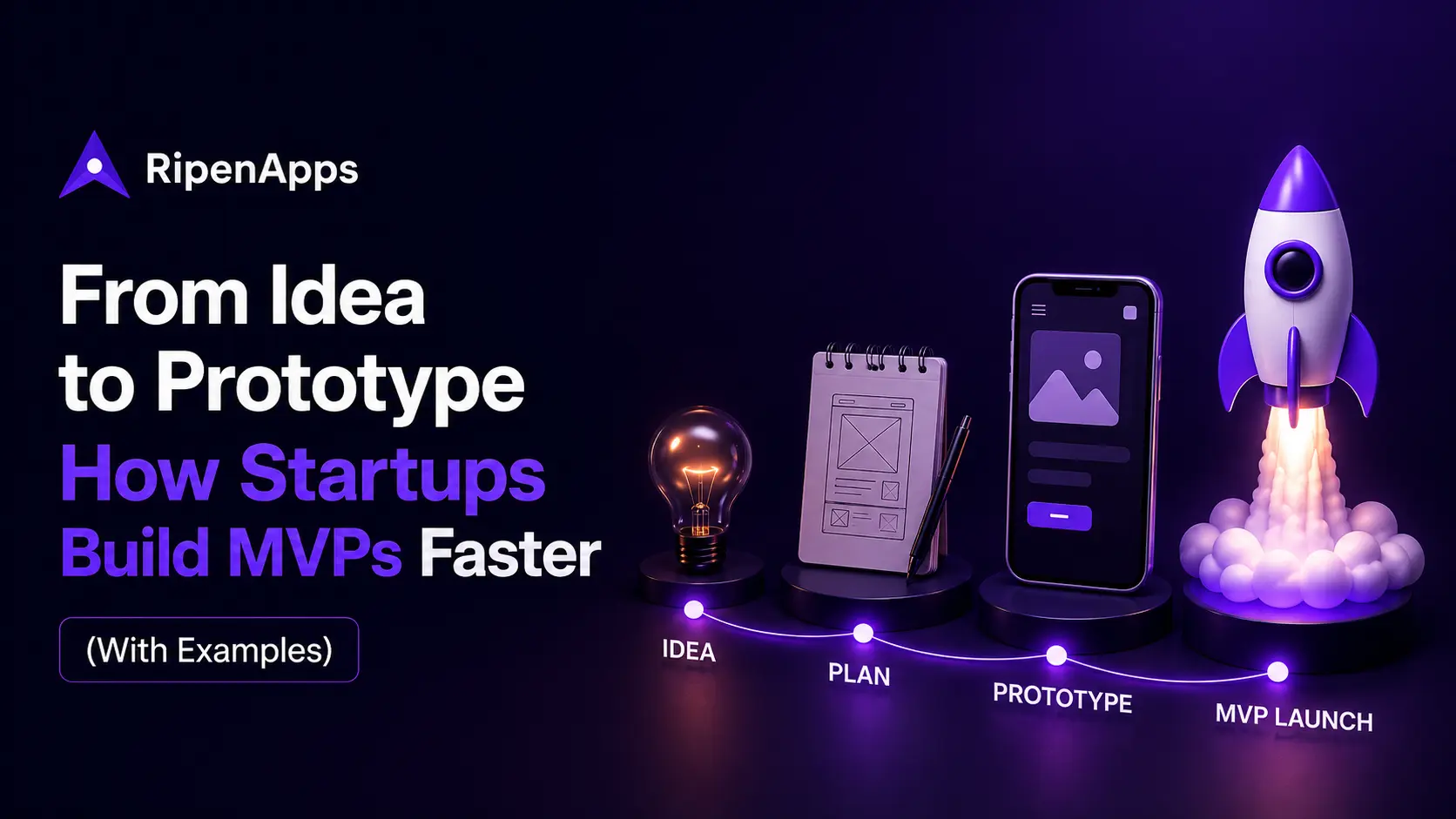
Launching a startup product today is no longer about spending years building a fully polished platform before entering the market. Modern startups succeed by validating ideas early, minimizing development risks, and launching lean products that solve real customer problems quickly. This is where the concept of the MVP, minimum viable product, becomes essential.
From SaaS platforms and fintech applications to healthcare solutions and AI-driven apps, successful startups rely on a streamlined MVP development process to build MVPs faster and transform ideas into scalable digital products. Instead of investing heavily in unnecessary features, founders focus on creating a product MVP that delivers core value, collects real user feedback, and evolves through continuous iteration.
Whether you are building a new startup app, validating a SaaS concept, or launching an innovative digital platform, understanding how startups accelerate prototype creation and MVP delivery can significantly improve your chances of market success. This is why many founders partner with expert providers to leverage top rapid prototyping services to reduce uncertainty before development begins.
In this blog, we will explore what a minimum viable product is, how startups move from idea to prototype efficiently, the key stages involved in minimum viable product development, real-world examples of MVP success stories, and practical strategies for building MVPs faster without compromising quality.
Table of Contents
What is a Minimum Viable Product (MVP)?
Before diving into the development process, it is important to define the minimum viable product clearly. A minimum viable product MVP is the earliest version of a digital product that includes only the essential features required to solve a specific user problem and validate market demand. Instead of developing a feature-heavy application, startups focus on launching quickly with a simplified version that enables learning and iteration.
In simple words, what is MVP minimum viable product? It is a strategic product version designed to test assumptions, gather user feedback, and minimize business risk. The concept became highly popular in startup ecosystems because it allows businesses to:
- Validate product-market fit early
- Reduce unnecessary development costs
- Accelerate product launch timelines
- Improve investor confidence
- Collect actionable user insights
- Optimize future product scaling
Today, MVP in product development has become one of the most important startup methodologies for digital businesses worldwide.
Why Startups Prioritize MVP Development
Many startups fail because they spend too much time building products customers never actually need. A well-executed MVP product development strategy helps businesses avoid this costly mistake.
Instead of building everything at once, startups focus on solving one core problem exceptionally well. A step-by-step MVP process makes it easier to start with the most important features, test the product with early users, learn from their feedback, and refine the idea before investing heavily in full-scale development.
Key Benefits of Minimum Viable Product Development
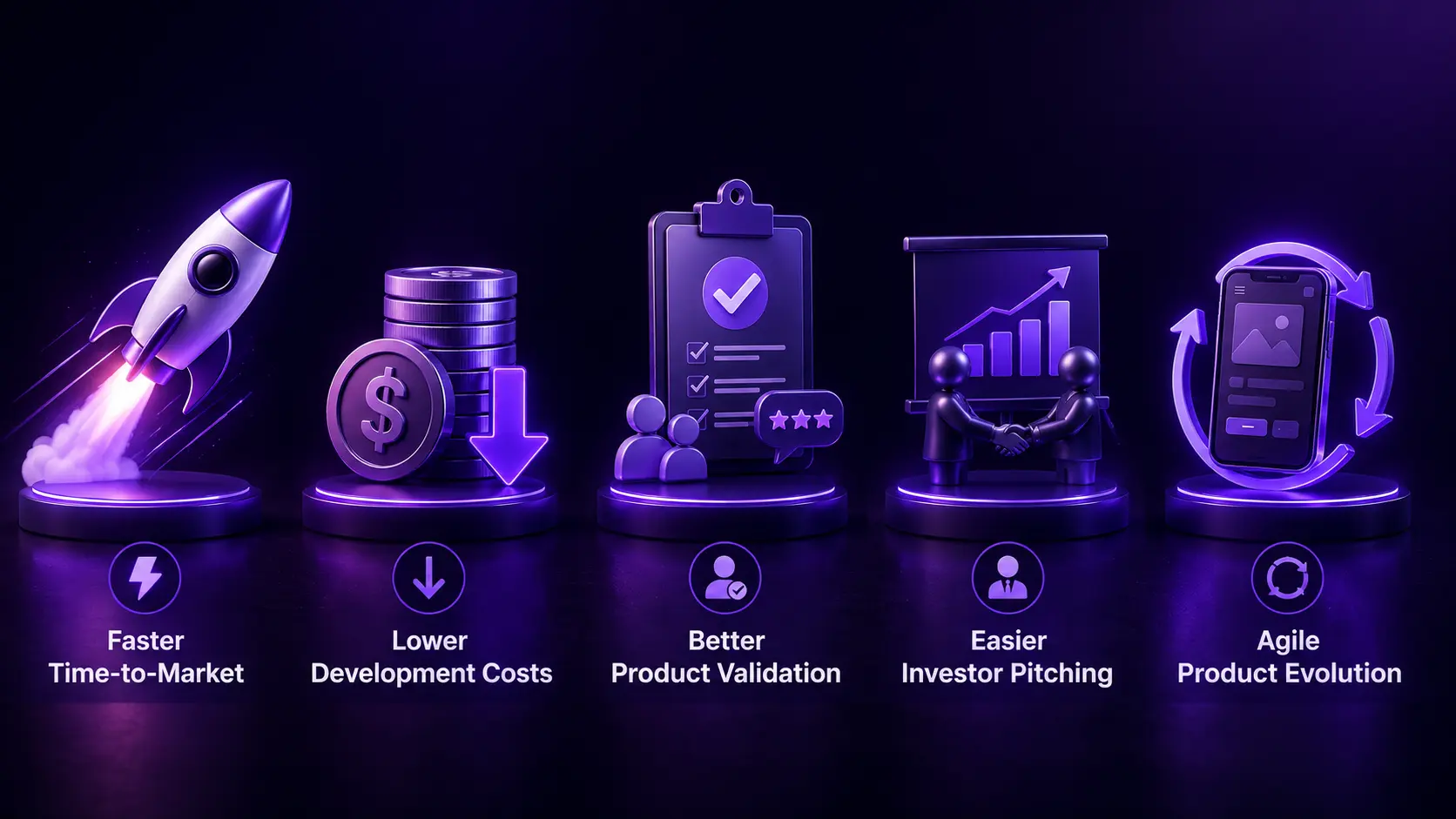
1. Faster Time-to-Market
Startups operate in highly competitive environments where speed matters. Launching quickly enables founders to gain traction before competitors dominate the market. This is one reason why businesses increasingly invest in product prototyping services to validate concepts faster and reduce development delays.
Faster prototyping and validation also help startups improve product-market fit while minimizing unnecessary development costs and operational risks.
2. Lower Development Costs
One of the biggest benefits of minimum viable product development is cost efficiency. Businesses only invest in core features initially, reducing financial risks significantly.
If you want deeper insights into budgeting, you can also estimate development budgets and project timelines more effectively by understanding the key factors involved in MVP development cost and scalable product planning.
3. Better Product Validation
Real users provide real feedback. Startups can quickly identify whether their product idea has genuine demand or requires adjustments before scaling. Early feedback also helps businesses improve usability, prioritize essential features, and eliminate unnecessary functionalities before full-scale development begins.
This validation process significantly reduces business risks while increasing the chances of building a product that aligns with actual market needs.
4. Easier Investor Pitching
Investors are more likely to fund startups with validated prototypes and active user engagement compared to theoretical business ideas. Functional prototypes demonstrate market potential, product vision, and execution capability more effectively during investor presentations and funding discussions.
Early traction, usability testing, and customer validation also increase investor confidence by reducing uncertainty around product viability and market demand.
5. Agile Product Evolution
Modern startups rely heavily on agile development MVP methodologies that support continuous iteration, rapid releases, and feature optimization. Agile workflows help teams respond quickly to user feedback, changing market demands, and evolving business priorities throughout the product development cycle.
This iterative approach improves collaboration between teams while accelerating product improvements and reducing overall time-to-market.
Understanding the MVP Development Process
A successful MVP development process involves several strategic stages that help startups transition from an idea into a functional product efficiently.
1. Idea Validation
Every startup begins with an idea, but not every idea solves a meaningful problem. The first step is validating whether the target audience actually needs the product.
Startups usually conduct:
- Competitor analysis
- User interviews
- Market research
- Pain-point identification
- Demand analysis
This stage is critical within the SaaS creation framework stages: ideation, validation MVP launch, growth, because poor validation often leads to failed product launches.
2. Product Discovery
After validation comes product discovery, where businesses define product goals, target audiences, user journeys, and core functionalities.
This stage helps eliminate feature overload while ensuring the MVP remains customer-focused.
Professional product designing services & consultation often play a crucial role here by improving user experience planning and product clarity.
3. Rapid Prototyping
Prototypes visually represent the product before development begins. They help startups test workflows, UI/UX design, and user interactions.
Modern startups increasingly adopt rapid prototyping for product development to accelerate validation cycles and improve collaboration between designers, developers, and stakeholders.
Similarly, understanding the role of prototyping in product development helps businesses reduce usability issues before coding begins.
4. MVP Development
Once prototypes are approved, the actual minimum viable product development begins.
During this stage, developers focus exclusively on essential features required for the initial launch.
This is the stage where startups usually partner with experienced companies that provide top-notch MVP app development services to accelerate execution while maintaining scalability.
5. MVP Testing
Testing is essential before public release. Startups analyze performance, usability, bugs, and customer interactions to improve product quality.
To strengthen product validation, businesses can adopt advanced MVP testing strategies that improve product-market fit and reduce launch failures.
6. MVP Launch
After testing, startups release the product to early adopters and gather real-world feedback.
A successful MVP launch focuses on learning rather than perfection.
7. Product Scaling
Once market validation is achieved, businesses begin expanding features, infrastructure, and user acquisition efforts.
This is where advanced product engineering services become essential for supporting growth, scalability, and long-term product performance.
How Startups Build MVPs Faster
Speed is one of the most important competitive advantages for startups. However, faster development does not mean sacrificing product quality.
Here are the proven strategies startups use for building MVPs faster:
1. Focus on Core Features Only
One of the biggest mistakes startups make is trying to build too many features initially.
Successful startups identify:
- The primary customer problem
- The minimum feature set required
- The fastest path to validation
By limiting scope, teams reduce development complexity and shorten release timelines.
This lean approach is central to minimum viable product agile methodologies.
2. Use Agile Development Methodologies
Agile workflows enable startups to divide development into smaller sprint cycles.
Instead of waiting months for a complete product, teams release iterative improvements continuously.
Benefits of agile development mvp strategies include:
- Faster development cycles
- Continuous feedback implementation
- Reduced rework
- Improved collaboration
- Flexible feature prioritization
3. Prioritize Rapid Prototyping
Rapid prototyping allows startups to validate concepts visually before investing in full-scale development.
Interactive prototypes help founders:
- Test user experiences
- Gather stakeholder feedback
- Detect usability issues
- Improve product clarity
- Reduce costly revisions
This is why startups increasingly prioritize product prototyping services during early product development phases.
4. Leverage Cross-Platform Technologies
Modern frameworks like Flutter and React Native help startups reduce development timelines by building apps for multiple platforms simultaneously.
This significantly accelerates product delivery while lowering costs.
Businesses looking for efficient cross-platform strategies can streamline product launches by building MVPs faster using Flutter app development frameworks.
5. Work With Experienced Startup Development Teams
Building MVPs internally can be expensive and time-consuming, especially for early-stage startups.
Partnering with the best app developers for startups helps businesses:
- Access specialized expertise
- Reduce hiring costs
- Accelerate development
- Improve scalability planning
- Optimize product architecture
An experienced startup-focused development team understands how to prioritize speed without compromising product quality.
6. Automate Testing and Deployment
Automation tools reduce repetitive development tasks and accelerate release cycles.
Startups commonly automate:
- Quality assurance testing
- Bug tracking
- CI/CD pipelines
- Code reviews
- Performance monitoring
This improves product stability while reducing manual workloads.
Real-World MVP Examples That Changed Industries
Some of the world’s most successful companies started with simple MVPs focused on solving one clear problem.
Let’s explore a few real-world MVP examples:
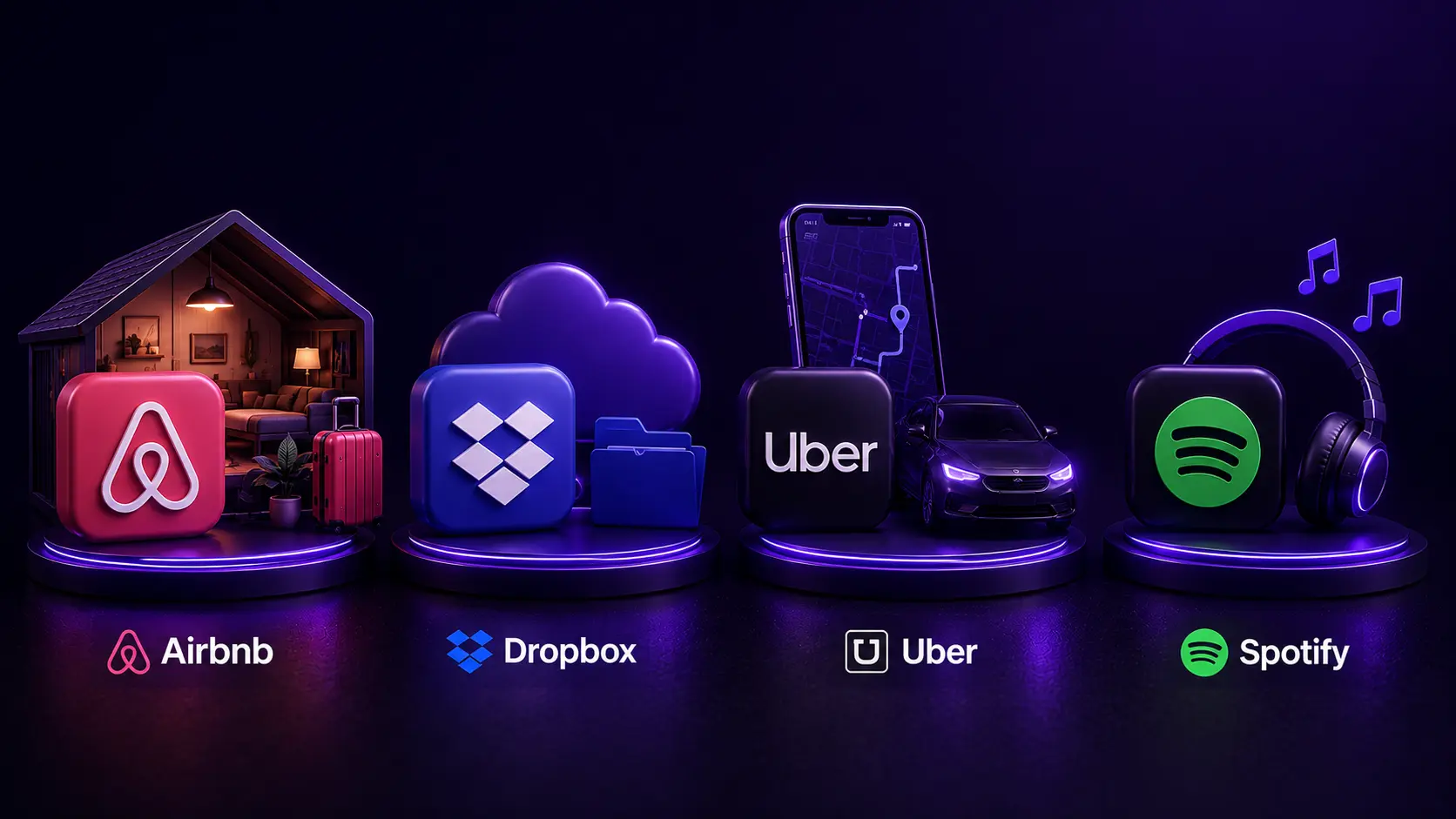
1. Airbnb
Airbnb began as a basic website offering temporary accommodation for conference attendees. Instead of building a massive travel platform initially, the founders validated demand using a simple booking concept. This early MVP approach helped them understand customer behavior, identify market demand, and refine their business model with minimal investment. By focusing only on core functionality in the beginning, Airbnb was able to gather valuable user feedback and improve the platform iteratively.
Today, Airbnb has evolved into a global hospitality giant serving millions of users across multiple countries. Its success demonstrates how validating a simple idea through an MVP can help startups scale into industry-leading businesses with strong product-market fit and sustainable growth.
2. Dropbox
Dropbox used an explainer video as its MVP instead of building the complete product initially. The founders created a simple demonstration video showcasing how the platform would allow users to store, sync, and access files seamlessly across devices. This strategy helped the company validate customer interest and measure market demand before investing heavily in development resources.
The explainer video quickly attracted thousands of signups and generated strong user interest, proving that the problem Dropbox aimed to solve was highly relevant. This early validation helped the company secure investor confidence, refine product priorities, and build a scalable cloud storage platform based on real customer expectations and feedback.
3. Uber
Uber initially launched as a simple app connecting users with black car services in San Francisco. Instead of creating a large-scale transportation ecosystem from the beginning, the company focused on solving one core problem: making transportation more convenient and accessible for users in a specific market.
After validating customer demand through its localized MVP approach, Uber gradually expanded into additional cities and introduced new ride categories and services. By starting with a focused solution and scaling strategically, Uber transformed from a small transportation startup into one of the world’s leading global mobility platforms.
4. Spotify
Spotify started with a simple MVP focused on one core objective: providing instant music streaming without requiring users to download songs. Instead of launching with a massive feature set, the company concentrated on delivering a fast, reliable listening experience and securing licensing agreements with record labels. This focused approach allowed Spotify to validate whether users were willing to switch from downloaded music to on-demand streaming.
As user adoption grew, Spotify expanded its platform with personalized recommendations, curated playlists, podcasts, and subscription plans. By validating its core value proposition early and continuously improving the product based on user behavior, Spotify transformed the music industry and became one of the world’s leading audio streaming platforms.
For additional inspiration, businesses can analyze real-world MVP examples from successful startups to understand scalable product strategies and faster market validation approaches.
Prototype vs MVP: Understanding the Difference
Many startups confuse prototypes and MVPs, but both serve different purposes.
Prototype
A prototype is a visual or interactive representation of the product concept used for internal testing and design validation.
Purpose:
- Validate usability
- Demonstrate workflows
- Improve UI/UX design
MVP
An MVP is a working product released to actual users for market validation.
Purpose:
- Validate customer demand
- Collect real-world feedback
- Generate early traction
Businesses seeking deeper clarity can better understand product validation strategies through the POC vs Prototype vs MVP approach used in modern startup development.
Common MVP Development Mistakes Startups Should Avoid
Even promising startup ideas can fail if MVP execution is poor.
1. Building Too Many Features
Feature overload increases complexity, development costs, and launch delays. Startups should focus only on core functionalities during initial releases. Many founders attempt to satisfy every potential user need in the first version, which often results in a bloated product. A lean MVP should validate a single core value proposition before expanding functionality.
2. Ignoring User Feedback
Customer feedback is the foundation of successful product evolution. Ignoring user insights often leads to poor product-market fit. Early adopters provide valuable information about what works and what needs improvement. Consistently collecting and acting on feedback helps startups build products that align with real market demands.
3. Poor Market Validation
Skipping validation increases the risk of building products nobody wants. Conducting market research, customer interviews, and competitor analysis before development can significantly reduce business risk. Validation ensures that the MVP addresses a genuine problem faced by a target audience.
4. Choosing the Wrong Technology Stack
Scalability challenges often emerge when startups prioritize speed over technical architecture. This is why working with a top digital product development company becomes crucial for long-term product success. The right technology stack supports future growth, integrations, and performance requirements. Making informed technical decisions early can prevent costly redevelopment efforts later.
5. Weak UI/UX Design
Even strong ideas can fail because of poor user experiences. Intuitive interfaces improve user engagement, retention, and product adoption. Users form opinions about a product within seconds of using it. A clean, user-friendly design reduces friction and encourages users to continue interacting with the product.
The Role of Product Design in Faster MVP Development
Strong product design significantly impacts development speed and product success.
Well-structured design systems help startups:
- Reduce revisions
- Improve user flows
- Simplify development
- Increase usability
- Accelerate validation
Modern product designING strategies combine business goals, customer psychology, and user behavior insights to create intuitive digital experiences.
Startups that prioritize design early often reduce development rework and improve launch efficiency.
How AI and No-Code Tools Are Accelerating MVP Development
Emerging technologies are transforming how startups build MVPs.
AI-Powered Development
AI tools assist startups with:
- Code generation
- User analytics
- Automated testing
- Predictive insights
- Personalized experiences
This improves efficiency while reducing manual workloads.
No-Code and Low-Code Platforms
No-code solutions allow startups to build basic MVPs without extensive engineering resources.
These platforms are particularly useful for:
- Market validation
- Internal tools
- Early-stage prototypes
- Workflow automation
However, scalable products often require custom development for long-term growth.
SaaS MVP Development: A Strategic Growth Framework
SaaS startups frequently adopt lean MVP strategies to accelerate product-market validation.
The typical SaaS creation framework stages ideation validation mvp launch growth include:
Ideation
Identifying a scalable market opportunity.
Validation
Testing market demand through surveys, interviews, and competitor research.
MVP Creation
Building a functional product with core features.
Product Launch
Introducing the MVP to early adopters.
Growth Optimization
Scaling infrastructure, expanding features, and improving retention.
This framework minimizes risk while improving startup scalability.
Why MVPs Are Essential for Digital Transformation
MVPs are no longer limited to startups alone.
Large enterprises also adopt minimum viable product development approaches to:
- Test digital transformation initiatives
- Validate new business models
- Accelerate innovation
- Improve customer-centric development
- Reduce operational risks
Businesses across industries now rely heavily on mvp in product development to remain agile in competitive markets.
How RipenApps Helps Startups Build MVPs Faster
Modern startups require more than just development support. They need strategic technology partners who understand validation, scalability, and rapid execution.
RipenApps helps startups accelerate product innovation through:
- Product discovery workshops
- UX/UI strategy consulting
- Rapid prototyping
- Agile MVP development
- Scalable product engineering
- Post-launch optimization
By combining user-focused design with agile engineering, startups can move from idea validation to market launch more efficiently.
Whether you are building a SaaS platform, mobile app, healthcare solution, fintech product, or AI-driven platform, working with experienced startup specialists significantly improves execution speed and scalability.
Future Trends in MVP Development
The future of minimum viable product development will continue evolving with emerging technologies and changing user expectations.
Key trends include:
1. AI-Driven Product Validation
AI-powered analytics will help startups predict customer behavior and optimize MVP strategies faster. By analyzing user interactions, market trends, and behavioral patterns, AI can identify potential product-market fit opportunities early. This enables startups to make informed decisions and reduce the risks associated with product launches.
2. Hyper-Personalized User Experiences
Data-driven personalization will improve customer engagement and retention. Modern MVPs will leverage machine learning algorithms to deliver tailored content, recommendations, and user journeys based on individual preferences. This personalized approach can significantly enhance user satisfaction and long-term loyalty.
3. Faster Cross-Platform Development
Advanced frameworks will further reduce development timelines across multiple devices. Technologies such as Flutter, React Native, and low-code platforms will continue streamlining development processes while maintaining consistent user experiences. This allows startups to reach broader audiences with fewer resources and faster releases.
4. Cloud-Native Product Architectures
Scalable cloud infrastructures will improve flexibility, security, and product performance. Cloud-native MVPs can quickly adapt to changing user demands, support rapid feature deployment, and ensure high availability. They also provide startups with cost-effective scalability as their customer base grows.
5. Continuous Product Experimentation
Businesses will increasingly adopt iterative release models driven by real-time customer feedback. Instead of relying on large, infrequent updates, companies will continuously test new features, gather insights, and optimize experiences. This approach accelerates innovation while ensuring product decisions remain aligned with user needs and market expectations.
Conclusion
Building successful digital products today requires speed, validation, and strategic execution. Instead of investing heavily in untested ideas, startups now rely on MVP-focused methodologies to validate concepts, reduce risks, and accelerate growth. From idea validation and rapid prototyping for product development to agile development and scalable product engineering, every stage of the MVP journey plays a critical role in long-term startup success.
Understanding what a minimum viable product is, adopting lean development principles, and focusing on customer feedback enable startups to launch smarter and grow faster in highly competitive markets.
Most importantly, startups that prioritize user-centric design, rapid iteration, and agile execution gain a significant competitive advantage in today’s digital economy. Whether you are at the ideation stage or preparing for product launch, a well-planned MVP strategy can transform innovative ideas into scalable digital businesses.

FAQs
1. What is minimum viable product in startup development?
A minimum viable product MVP is the simplest version of a product built with essential features to validate market demand and gather user feedback before full-scale development.
Businesses can also estimate development budgets and project timelines more effectively by understanding the key factors involved in MVP app development cost and scalable product planning.
2. Why do startups build an MVP before full product development?
Startups build an MVP before full-scale product development to validate business ideas with minimal investment and reduced market risk. An MVP helps businesses test core features, collect real user feedback, identify market demand, and improve product direction before investing heavily in advanced development.
3. How long does the MVP development process usually take?
The timeline depends on product complexity, features, and technology stack. However, most startups aim to complete the mvp development process within a few weeks to a few months.
4. What is the difference between a prototype and MVP?
A prototype is used for design validation and internal testing, while an MVP is a functional product released to users for market validation.
5. Why is rapid prototyping important in MVP development?
Rapid prototyping helps startups test user experiences, validate workflows, and identify usability issues before development begins. Businesses interested in accelerating validation can also explore rapid prototyping for product development strategies.
6. What are the best MVP testing strategies for startups?
Effective MVP testing includes usability testing, beta launches, customer interviews, A/B testing, analytics tracking, and continuous feedback collection. You can also learn advanced MVP testing strategies to improve product validation.
7. How can startups build MVPs faster?
Startups can accelerate development by focusing on core features, using agile methodologies, leveraging cross-platform frameworks, automating workflows, and partnering with experienced development teams.
Businesses can accelerate product launches and improve scalability by building MVPs faster using modern frameworks and agile app development strategies.
8. What are some successful real-world MVP examples?
Popular real-world MVP examples include Airbnb, Dropbox, Uber, and Instagram. These companies started with simple product versions focused on solving one core problem before scaling globally.
Discuss your project and request for proposal
SHARE
WRITTEN BY

Ishan Gupta
CEO & Founder
Ishan Gupta is a seasoned entrepreneur and CEO with extensive 10+ years of experience in business and mobile app development landscape. He believes that the right digital product allows companies to focus on what they do best, while technology handles the rest. With deep exposure to global markets, he understands what makes an app succeed. His approach translates business needs into clear product strategies, ensuring that every feature contributes to measurable ROI.
View All Articles