
Quick Summary
IoT in logistics and supply chain uses GPS trackers, RFID tags, and sensors to enable real-time shipment tracking, cold chain monitoring, predictive maintenance, warehouse automation, and route optimization. These applications help businesses reduce cargo losses, delivery delays, vehicle downtime, and inventory discrepancies. IoT implementation costs range from $25,000 to $500,000+, depending on device requirements, integrations, and system complexity.
The Internet of Things (IoT) in logistics and supply chain management connects vehicles, shipments, warehouses, and equipment to improve visibility and operational efficiency. GPS trackers, RFID tags, and environmental sensors collect real-time data that helps businesses monitor cargo conditions, track deliveries, manage inventory, and identify potential disruptions.
When integrated with transportation management systems (TMS), warehouse management systems (WMS), and mobile applications, IoT enables faster responses to delays, equipment issues, and inventory discrepancies. However, successful implementation requires careful planning around connectivity, system integration, data security, and development costs.
Understanding the key use cases, benefits, and implementation challenges helps decision-makers identify the right opportunities and estimate the investment required. A logistics app development company can help businesses turn these requirements into connected applications that support their operational goals.
Table of Contents
What Is IoT in Logistics and Supply Chain Management?
The Internet of Things (IoT) is a network of physical devices equipped with sensors, software, and connectivity that collect and exchange data. In logistics, these devices monitor vehicles, shipments, containers, equipment, and warehouse conditions throughout the movement of goods.
For example, a temperature sensor inside a refrigerated truck can detect a deviation from the required range and notify an operations manager. A GPS tracker can report a shipment’s location, while an RFID reader can automatically record inventory moving through a warehouse.
Integrated with logistics management systems, this data helps businesses detect delays, reduce manual tracking, protect product quality, and make informed operational decisions.
Logistics vs. Supply Chain Management
Logistics and supply chain management are closely related, but they operate at different levels.
| Aspect | Logistics | Supply chain management |
| Primary focus | Moving, storing, and delivering goods | Coordinating the complete flow of products, information, and resources |
| Scope | Transportation, warehousing, order fulfillment, and delivery | Sourcing, procurement, production, inventory, logistics, and distribution |
| IoT applications | Vehicle tracking, delivery monitoring, and warehouse automation | Supplier visibility, production monitoring, inventory coordination, and end-to-end traceability |
| Business objective | Improve delivery speed, reliability, and operating efficiency | Improve coordination, resilience, cost control, and overall supply chain performance |
IoT supports both functions. Logistics teams use it to monitor individual shipments and transportation activities, while supply chain leaders combine data across suppliers, warehouses, carriers, and distribution networks. Understanding the role of technology in supply chain and logistics helps businesses identify where connected systems can improve coordination and visibility.
How Does IoT Work in Logistics?
An IoT-enabled logistics system collects data from physical assets, transfers it through a communication network, processes it on an edge device or cloud platform, and presents relevant information through operational software.
The system typically includes six components.
- Sensors: Measure variables such as temperature, humidity, vibration, fuel consumption, acceleration, door openings, and equipment status.
- RFID and Bluetooth Low Energy (BLE) tags: Identify products, pallets, vehicles, or reusable containers. RFID readers capture tag information, while BLE gateways detect nearby compatible devices.
- Gateways: Collect information from nearby sensors and tags, translate protocols where necessary, and forward data to edge or cloud systems.
- Connectivity: Cellular networks support mobile assets, LPWAN technologies such as LoRaWAN and NB-IoT support suitable low-power applications, and satellite connectivity helps reach remote areas and maritime routes.
- Cloud and edge computing: Edge devices can process urgent events locally, while cloud platforms store historical data, run analytics, and coordinate information across locations.
- WMS, TMS, and application layer: Warehouse management systems (WMS), transportation management systems (TMS), enterprise software, and mobile applications turn raw readings into alerts, dashboards, workflows, and decisions.
Unlike the device-level functions discussed above, cloud infrastructure helps logistics businesses consolidate data from multiple locations, analyze operational trends, and coordinate workflows across warehouses and fleets. A cloud app development company can help translate these requirements into a platform that supports centralized reporting, exception management, and better resource allocation as operations expand.
IoT in Logistics: System Architecture
A typical IoT logistics system follows this data flow:
Sensors and tags – Gateways and onboard devices – Cellular, LPWAN, or satellite networks – Edge and cloud processing – WMS, TMS, APIs, and databases – Web and mobile applications – Alerts and operational decisions
For example, a shipment tracker records a location update and sends it through a cellular network. The cloud platform associates that reading with the shipment, compares its position with the planned route, and updates the estimated arrival time. If the vehicle stops unexpectedly or deviates from its route, the system can notify the relevant operations team.
Not every deployment requires every component. A warehouse using fixed RFID readers may not need GPS, while a refrigerated container crossing an ocean may require satellite connectivity and specialized environmental sensors.
Architecture choices should reflect asset types, data frequency, network coverage, operating conditions, and integration requirements. The logistics app development guide explains the application-layer considerations in more detail.
Use Cases of IoT in Logistics and Supply Chain
IoT enables logistics businesses to improve visibility, automate routine operations, and make data-driven decisions across transportation, warehousing, and delivery. The following use cases show how connected devices address operational challenges and improve supply chain efficiency.
Shipment Tracking
IoT shipment tracking combines GPS devices, connected sensors, RFID, and location data to provide visibility into the movement of goods.
Instead of relying exclusively on manual updates at dispatch, warehouse arrival, and delivery, businesses can receive location reports throughout a shipment’s journey. Operations teams can compare actual progress with planned milestones and identify shipments that may arrive late.
Typical applications include:
- Tracking vehicles, pallets, containers, and high-value goods.
- Monitoring shipment handoffs between carriers and distribution centers.
- Updating estimated arrival times based on recent location data.
- Sending alerts when a shipment stops unexpectedly or leaves a defined geofence.
- Sharing shipment status with customers and business partners.
The level of visibility depends on the tracking technology. GPS provides location information, while RFID generally identifies tagged items when they pass a reader. Combining these technologies can improve tracking across warehouses, vehicles, and transfer points.
Cold Chain Monitoring
Cold chain logistics requires products to remain within specified environmental conditions during storage and transportation. This is particularly important for pharmaceuticals, vaccines, fresh food, seafood, and other temperature-sensitive goods.
IoT sensors can monitor temperature, humidity, door openings, and refrigeration equipment status. The system can compare readings with product-specific thresholds and notify staff when conditions move outside acceptable limits.
For example, if a refrigerated vehicle experiences a temperature excursion, the system can alert the operations team before the shipment reaches its destination. Staff can investigate the refrigeration unit, assess the exposure period, and follow the appropriate product-handling procedure.
A useful cold chain solution should maintain timestamped records, preserve historical readings, and support audit reports. Where regulations or product specifications require calibrated equipment and validated monitoring, those requirements must be addressed separately from the software implementation.
Fleet Telematics and Predictive Maintenance
Fleet telematics collects vehicle information such as location, engine diagnostics, fuel consumption, mileage, speed, braking behavior, and operating hours.
Connected vehicle devices can transmit this information to fleet management software, helping managers understand how vehicles are used and identify operational issues. Maintenance teams can monitor diagnostic codes, engine temperatures, battery health, and other indicators to prioritize inspections.
Predictive maintenance uses historical and real-time data to estimate when a component may require attention. For example, abnormal vibration or rising operating temperatures could indicate a developing mechanical problem.
However, sensor readings alone do not guarantee accurate predictions. Useful models require reliable historical data, appropriate thresholds, and validation against actual maintenance outcomes. A fleet management system can combine telematics data with maintenance schedules, diagnostic alerts, and vehicle service records.
Warehouse and Inventory Automation
IoT can reduce manual inventory checks by connecting RFID readers, barcode systems, smart shelves, environmental sensors, and warehouse equipment.
RFID readers at receiving and dispatch points can record tagged inventory movements automatically. Connected storage systems can monitor environmental conditions, while sensors on conveyors and material-handling equipment can report operational status.
These capabilities help warehouse managers:
- Improve inventory visibility and item traceability.
- Identify discrepancies between recorded and physical stock.
- Reduce manual scanning at selected checkpoints.
- Monitor equipment utilization and potential downtime.
- Improve coordination between receiving, picking, packing, and dispatch.
IoT works best when integrated with a warehouse management system rather than operating as an isolated tracking layer. Inventory events should update the relevant records, trigger exceptions, and support reconciliation. Businesses evaluating this approach can learn more about a cloud-based warehouse management system.
Route Optimization
IoT data can improve route planning by providing information about vehicle location, traffic conditions, road restrictions, fuel consumption, and delivery progress.
A route optimization system can combine these signals with delivery windows, vehicle capacity, driver availability, and order priorities to recommend practical routes. When conditions change, dispatchers can reassess assignments and redirect vehicles where appropriate.
For example, a vehicle running behind schedule may trigger a revised delivery sequence. A fleet manager can also compare planned and actual travel times to identify recurring delays or inefficient routes. IoT provides operational data, but route optimization usually requires mapping services, scheduling logic, and optimization algorithms. The quality of recommendations depends on accurate inputs and realistic operating constraints.
Last-Mile Delivery
Last-mile delivery involves moving an order from a local distribution point to its final recipient. It often accounts for significant operational complexity because of traffic, failed delivery attempts, narrow time windows, and changing customer availability.
IoT-enabled delivery applications can combine driver location, vehicle telemetry, geofencing, and proof-of-delivery workflows to improve coordination.
Useful capabilities include real-time delivery status, arrival notifications, route deviation alerts, electronic proof of delivery, and location-based delivery confirmation. Connected lockers and access-control devices can also support selected unattended delivery models.
These features help businesses identify exceptions earlier and communicate more accurate delivery updates. They do not eliminate failed deliveries, but they give dispatchers and customers better information to respond to them.
Benefits of IoT in Logistics and Supply Chain Management
IoT’s business value depends on its measurable impact, not the number of connected devices. Businesses should evaluate improvements in operating costs, service quality, productivity, and risk.
| Benefit | Operational outcome | Suggested KPI |
| Better shipment visibility | Earlier identification of delays and exceptions | On-time delivery rate; exception detection time |
| Lower transportation costs | Reduced unnecessary mileage, idling, and inefficient vehicle use | Cost per delivery; fuel consumed per kilometer |
| Improved inventory accuracy | Fewer discrepancies between system records and physical stock | Inventory accuracy; stock variance |
| Reduced cargo losses | Faster response to theft, tampering, and temperature excursions | Loss rate; spoilage rate; claims per shipment |
| Higher fleet availability | Maintenance based on equipment condition and usage | Unplanned downtime; vehicle availability |
| Faster warehouse operations | Less manual tracking and improved equipment coordination | Order cycle time; labor hours per order |
| Better customer experience | More reliable status updates and arrival estimates | Delivery success rate; customer complaints |
| Improved sustainability reporting | More consistent measurement of fuel use and emissions | Fuel per shipment; emissions per ton-kilometer |
Results vary by operating model, baseline performance, implementation quality, and adoption. Establish baseline measurements before deployment, then compare performance over a representative period to determine whether the system delivers a meaningful improvement.
IoT in Transportation
IoT in transportation focuses on monitoring vehicles, cargo, infrastructure, and movement across road, rail, air, and maritime networks.
Road transport applications include GPS tracking, vehicle diagnostics, driver behavior monitoring, and fleet maintenance. Rail operators can use connected sensors to monitor equipment condition and cargo movement. Maritime logistics uses container tracking, vessel connectivity, and refrigerated cargo monitoring, while aviation logistics can use connected devices to improve the visibility of high-value and time-sensitive freight.
The main difference between transportation IoT and broader supply chain IoT is scope. Transportation applications emphasize movement, fleet performance, and transit conditions. Supply chain applications connect those insights with procurement, inventory, warehouse operations, and order fulfillment.
Integrating transportation data with inventory and customer applications gives businesses end-to-end shipment visibility.
Real-World Examples of IoT in Logistics
Large logistics and e-commerce businesses demonstrate how connected data, sensors, and automation can improve specific operational processes. The examples below distinguish publicly documented capabilities from broader assumptions about their technology stacks.
UPS: Route Optimization and Connected Driver Tools
UPS uses its ORION routing system to optimize the order of delivery and pickup stops. Its UPSNav tool provides drivers with turn-by-turn directions to delivery locations, including loading docks and receiving areas that standard mapping tools may not identify accurately.
UPS has explained that ORION and UPSNav help reduce unnecessary driving, fuel consumption, and associated emissions. The example demonstrates how operational data, routing software, and driver-facing devices can work together to improve delivery efficiency.
Amazon: Sensor-Enabled Warehouse Robotics
Amazon uses robotics and sensor-based systems to support inventory handling and fulfillment. Its Vulcan robot uses touch-related sensing and machine learning to pick and stow items, while its Proteus autonomous mobile robot uses sensors to navigate warehouse environments.
These systems illustrate how connected physical equipment can interact with warehouse software to support material movement and order fulfillment. They also show that effective automation requires coordinated hardware, software, safety processes, and human oversight.
DHL: IoT as Part of Connected Logistics
DHL’s Logistics Trend Radar examines technologies and business trends shaping logistics operations. Its research covers IoT alongside areas such as artificial intelligence, robotics, digital infrastructure, and sustainability.
DHL’s public research highlights the importance of combining technology with operational processes and workforce capabilities. For businesses planning an IoT initiative, this is a useful reminder that connected devices create value when they support clear operational decisions rather than simply increasing data collection.
These examples represent different applications rather than interchangeable solutions. A fleet operator may prioritize telematics and route optimization, while a cold chain provider may need environmental sensors, audit trails, and temperature alerts. The most appropriate investment depends on the operational problem being addressed.
Challenges of IoT in Logistics and How to Solve Them
IoT adoption can introduce technical and operational challenges if devices, connectivity, security, and existing systems are not planned together. Businesses should address these issues during architecture design rather than waiting until deployment.
| Challenge | Business impact | Recommended solution |
| Device and data security | Unauthorized access, exposed shipment information, or compromised connected equipment | Use device identity, encryption, secure authentication, access controls, firmware updates, and network segmentation |
| Legacy system integration | Duplicate records, delayed updates, and disconnected workflows | Integrate through APIs and middleware, map existing data structures, and migrate in phases |
| Connectivity gaps | Missing location updates or delayed sensor alerts in remote areas | Select connectivity according to coverage and power requirements; use local buffering, store-and-forward synchronization, and satellite links where appropriate |
| Data overload | Excessive alerts, high processing costs, and difficulty identifying important events | Filter readings at the edge, define event thresholds, aggregate routine data, and prioritize actionable alerts |
| Implementation and maintenance costs | Budget overruns, device replacement expenses, and uncertain returns | Start with a limited pilot, calculate total cost of ownership, and expand only after validating operational results |
Securing Connected Devices
IoT security must cover the complete device lifecycle, from procurement and installation to updates and retirement. Businesses should change default credentials, restrict administrative access, validate device identities, and monitor unusual network activity.
They should also establish procedures for patching devices, managing certificates, revoking compromised devices, and responding to incidents. These controls are especially important when connected equipment can influence physical operations or expose sensitive shipment information. The IoT security challenges and solutions guide provides additional context for assessing these risks.
IoT Implementation Roadmap for Logistics Businesses
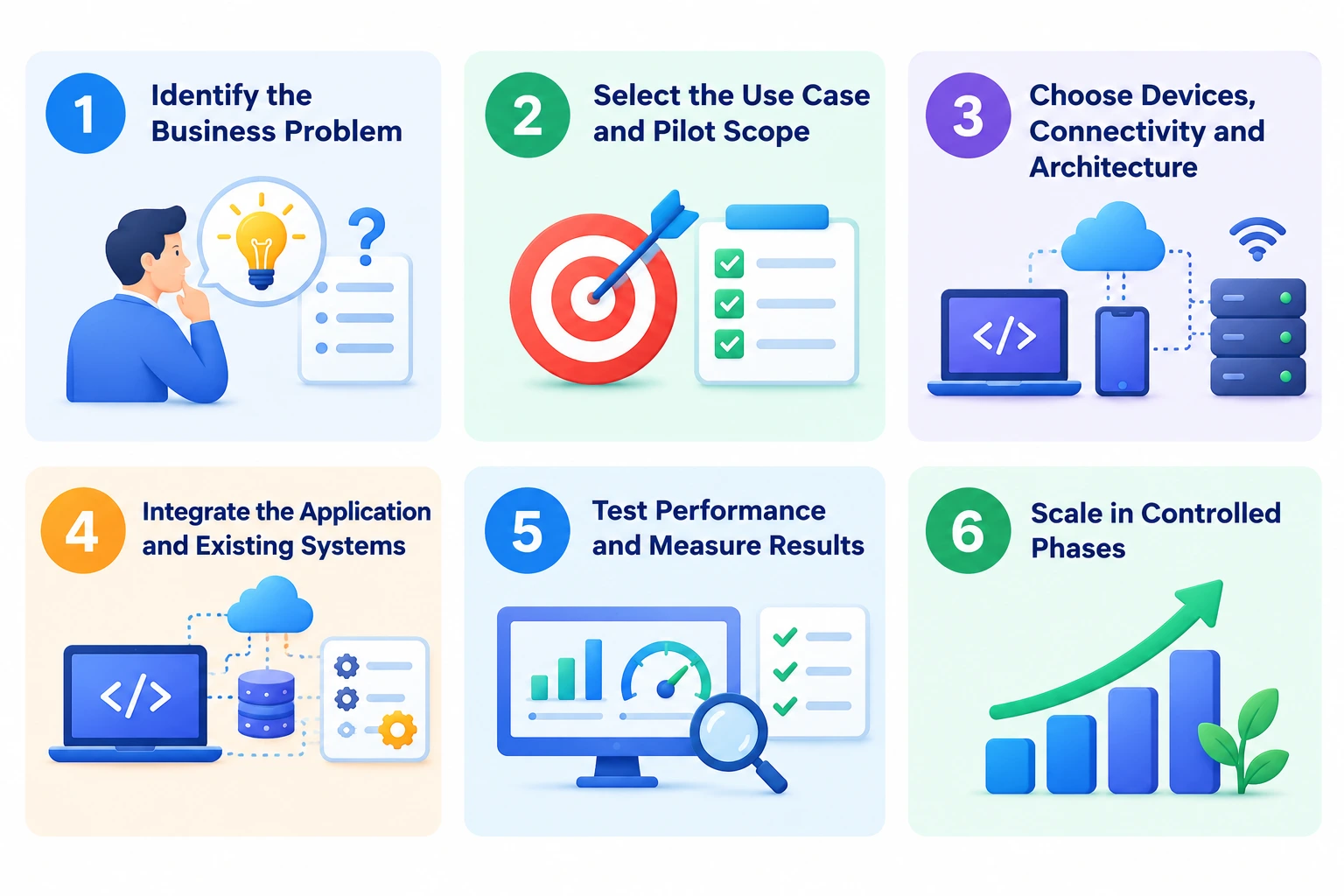
A phased rollout helps businesses validate operational value before committing to a large deployment.
Step 1: Identify the Business Problem
Start with a measurable problem, such as frequent delivery delays, limited shipment visibility, cold chain incidents, inaccurate inventory, or unplanned vehicle downtime.
Document the current process, identify where information is missing, and establish baseline KPIs. For example, a fleet operator might measure fuel consumption per kilometer and unplanned maintenance hours before introducing telematics.
Step 2: Select the Use Case and Pilot Scope
Choose one operational area with a clear business owner and measurable outcomes. A pilot might cover 20 vehicles, one warehouse, or a selected group of refrigerated shipments.
The sample should reflect real operating conditions, including different routes, working hours, connectivity limitations, and relevant equipment types. Avoid expanding the scope before confirming that the initial use case works reliably.
Step 3: Choose Devices, Connectivity, and Architecture
Select sensors, tracking devices, gateways, and connectivity based on the required data and environment. Consider battery life, installation requirements, environmental resistance, update frequency, coverage, and device replacement costs.
Define how data will move into the cloud platform, which events require immediate action, and which information can be processed periodically.
Security and integration requirements should be included in the initial design. The guide to building secure, reliable IoT apps can help inform these decisions.
Step 4: Integrate the Application and Existing Systems
Connect IoT data with the systems employees already use, including WMS, TMS, ERP, fleet management software, and customer portals. The application should show relevant information, highlight exceptions, and support actions such as assigning an investigation or notifying a customer.
Integrations should also handle duplicate events, delayed messages, and temporary connectivity loss without corrupting operational records. For mobile access, businesses can evaluate React Native for IoT apps when shared iOS and Android development is appropriate for their requirements.
Step 5: Test Performance and Measure Results
Run the pilot across a representative operating period. Test sensor accuracy, connectivity, alert delivery, battery life, integration reliability, and user adoption.
Compare the results with the baseline KPIs. A tracking pilot, for example, should measure how often locations are updated successfully, how quickly exceptions are detected, and whether dispatchers can respond more effectively.
Include the total cost of devices, connectivity, software, installation, training, and support when assessing the results.
Step 6: Scale in Controlled Phases
Expand only after the pilot meets agreed performance, security, and financial targets. Roll out by vehicle group, warehouse, region, or shipment category. Standardize device provisioning, monitoring, maintenance, and employee training before increasing deployment volume.
Review KPIs regularly and refine alert thresholds, integrations, and workflows as operating conditions change.
IoT in Logistics: Implementation Cost
The cost of implementing IoT in logistics depends on the devices being deployed, the application capabilities required, connectivity infrastructure, and integration with existing business systems. Businesses may integrate IoT devices into an existing logistics application or implement a new platform that connects shipment tracking, fleet telematics, warehouse operations, and sensor data.
A basic GPS tracking integration requires less investment than an enterprise-wide implementation involving cold chain monitoring, predictive maintenance, warehouse automation, and multiple system integrations. The overall budget should account for both software integration and the hardware and infrastructure needed to support connected operations.
Main Cost Drivers
- Hardware and installation: GPS trackers, environmental sensors, RFID readers, gateways, vehicle interfaces, installation labor, and replacement devices.
- Connectivity: Cellular data plans, LPWAN infrastructure, satellite services, SIM management, and network coverage.
- IoT platform and cloud infrastructure: Device management, data ingestion, storage, event processing, dashboards, analytics, monitoring, and cloud data transfer charges.
- Application development and integration: Mobile apps, web dashboards, alerts, shipment workflows, reporting, APIs, and integrations with WMS, TMS, and ERP systems.
- Security and compliance: Device authentication, encryption, access controls, device provisioning, security monitoring, and applicable compliance requirements.
- Ongoing operations: Cloud usage, connectivity subscriptions, device maintenance, software updates, technical support, and future enhancements.
Estimated IoT Implementation Cost for Logistics
| Implementation scope | Estimated cost | Typical scope |
| Basic IoT tracking integration | $25,000–$50,000 | GPS device integration, shipment location tracking, basic dashboard, alerts, and limited user roles |
| Mid-level IoT-enabled logistics platform | $50,000–$120,000 | Multiple device types, mobile applications, tracking dashboards, analytics, and selected WMS/TMS integrations |
| Advanced fleet or cold chain implementation | $120,000–$250,000 | Vehicle telematics, environmental monitoring, automated workflows, advanced reporting, and predictive analytics |
| Enterprise-wide IoT implementation | $250,000–$500,000+ | Multiple operational modules, extensive integrations, large device fleets, advanced security, and scalable data infrastructure |
These figures are only planning estimates, not fixed industry rates. Actual costs depend on the project scope, development location, team composition, device protocols, third-party licensing, and required service levels. Hardware-heavy implementations may require additional budgets for sensors, gateways, installation, and connectivity, while recurring cloud and maintenance expenses should be estimated separately where they are not included.
Businesses evaluating a broader logistics platform can also review the cost to build a logistics app like Uber Freight to understand the investment involved in developing logistics software.
How RipenApps Builds IoT-Enabled Logistics Apps
IoT devices generate valuable logistics data, but businesses need the right application to turn that data into actionable insights. RipenApps builds logistics applications that connect tracking systems, operational workflows, and real-time alerts to help businesses improve shipment visibility, streamline dispatch, and make informed decisions.
CargoMe
Our work on CargoMe, a cargo transportation platform connecting cargo owners with transporters in Tanzania, shows the core pieces in production:
- Live GPS tracking that gives cargo owners real-time shipment visibility and ETAs
- AI-based matching that connects loads with the nearest available transporters
- Dynamic pricing that calculates fares automatically and transparently
- Scalable cloud infrastructure built to handle growing transport demand
Delivered in four months, the platform has supported more than 50,000 successful deliveries.
CargoMe provides app-based GPS tracking. Additional IoT devices could extend this capability by monitoring cargo temperature, door status, and vehicle telemetry, provided the required hardware and integrations are implemented. Device data flows into the tracking, alerting, and dispatch workflows the platform already runs.
For any IoT logistics build, we start with the operating model rather than the hardware. That means defining which events matter, how devices and connectivity fit the routes, which systems (TMS, WMS, ERP) need the data, and which security controls and KPIs will prove the investment worked.
MVLoad
On MVLoad, a logistics aggregator platform, we integrated multiple carrier APIs into a single system and built a GPS-enabled module that delivers minute-by-minute shipment updates across providers, running on cloud-based microservices.
Bringing tracking data from many independent sources into one reliable, real-time view is the same integration challenge IoT logistics solutions face when combining data from different trackers, sensors, and telematics systems.
Future of IoT in Logistics and Supply Chain
Emerging technologies are expanding how logistics businesses use IoT data to improve visibility, automate operations, and anticipate disruptions.
- AI-Powered Analytics: AI analyzes IoT data to predict maintenance needs, anticipate shipment delays, forecast demand, and optimize delivery routes. Explore IoT in modern AI applications for more details.
- Satellite IoT: Satellite connectivity extends shipment and asset monitoring to remote highways, maritime routes, and areas with limited cellular coverage.
- Digital Twins: IoT-powered digital models help businesses simulate warehouse operations, monitor asset performance, and identify bottlenecks before making operational changes.
- 5G and Edge Computing: These technologies support low-latency data processing, connected equipment, and faster responses to time-sensitive events where network coverage and infrastructure permit.
Conclusion:
IoT is helping logistics and supply chain businesses improve shipment visibility, automate warehouse operations, monitor fleet performance, and reduce operational risks. Partnering with an experienced IoT app development company can help businesses identify the right use cases, integrate connected devices with existing systems, and measure results against clear business objectives. A phased implementation allows businesses to validate performance and ROI before scaling.
RipenApps helps businesses build logistics applications tailored to their operational requirements, from real-time tracking and fleet management to connected workflows and data-driven insights. A well-designed logistics platform can turn connected-device data into actionable alerts, better dispatch decisions, and more reliable shipment monitoring.
Frequently Asked Questions
1. What is IoT in logistics and supply chain management?
IoT in logistics and supply chain management uses connected devices and sensors to collect information about shipments, vehicles, inventory, equipment, and cargo conditions. The data helps businesses improve tracking, automate selected workflows, identify exceptions, and make better operational decisions.
2. What are the most common use cases of IoT in logistics?
Common use cases of IoT implementation in logistics include shipment tracking, cold chain monitoring, fleet telematics, predictive maintenance, warehouse automation, route optimization, and last-mile delivery. The right applications depend on a business’s operational needs and priorities.
3. How does IoT improve supply chain visibility?
IoT provides location, condition, and equipment data from connected assets. When integrated with WMS, TMS, and other business systems, it helps teams monitor shipment progress, identify delays, detect environmental deviations, and coordinate responses across operational partners.
4. What are the challenges of implementing IoT in logistics?
Major challenges include device security, legacy system integration, inconsistent connectivity, large volumes of sensor data, hardware maintenance, and implementation costs. A phased pilot, secure architecture, reliable integrations, and clear performance metrics can help businesses manage these risks.
5. How much does it cost to implement IoT in logistics?
Software development costs for implementing IoT in logistics typically range from $25,000 to $500,000+, depending on application complexity, device integration, security requirements, and third-party system integrations. Hardware, devices, installation, and connectivity are additional costs and should be budgeted separately.
6. How can businesses calculate ROI from IoT in logistics?
Businesses can estimate ROI by measuring savings from fuel efficiency, reduced downtime, fewer losses, improved inventory accuracy, and lower manual processing costs. They should subtract ongoing operating expenses and compare the net benefit with the initial investment.
7. What is the difference between GPS tracking and IoT tracking?
GPS tracking identifies an asset’s geographic location using satellite positioning. IoT tracking is a broader concept that can combine GPS with sensors, RFID, connectivity, and software to monitor location, temperature, vibration, door openings, and other conditions. GPS can be one component of an IoT solution.
8. What is the future of IoT in logistics?
Emerging applications include AI-powered predictive analytics, satellite IoT, digital twins, and 5G-enabled operations. These technologies may improve forecasting, remote visibility, simulation, and automation, but adoption should depend on practical operating needs and a demonstrable business case.
Discuss your project and request for proposal
SHARE
WRITTEN BY

Ishan Gupta
CEO & Founder
Ishan Gupta is a seasoned entrepreneur and CEO with extensive 10+ years of experience in business and mobile app development landscape. He believes that the right digital product allows companies to focus on what they do best, while technology handles the rest. With deep exposure to global markets, he understands what makes an app succeed. His approach translates business needs into clear product strategies, ensuring that every feature contributes to measurable ROI.
View All Articles