

Quick Summary
Choosing the right rapid prototyping company can significantly impact the success of your startup product. The best partners help validate ideas, reduce development risks, improve product decisions, and create a clear path toward MVP development. This guide explains what to look for in a prototyping company, common selection mistakes to avoid, and how strong validation practices lead to better product outcomes. Whether you are building a new startup product or refining an existing concept, selecting the right partner can save time, budget, and future development effort.
Key Takeaways
- Rapid prototyping reduces product risk by validating ideas before development begins.
- User research and testing help uncover real customer needs and usability gaps.
- The right prototyping partner contributes to strategy, validation, and product planning.
- Low-fidelity and high-fidelity prototypes support different stages of product validation.
- Early validation helps prevent costly development mistakes and unnecessary features.
- Strong prototyping processes create a smoother path toward MVP development.
- Startup-focused prototyping companies are better equipped to handle evolving product requirements.
- Validation-driven decisions improve product-market fit and long-term product success.
Every successful startup begins with an idea, but turning that idea into a successful product requires much more than enthusiasm and execution speed. Many founders rush into development assuming they understand their users, only to discover later that the product solves the wrong problem, lacks critical functionality, or fails to gain traction in the market. These mistakes often lead to wasted budgets, delayed launches, and expensive pivots.
As a result, rapid prototyping has become a critical stage in modern product development. Instead of spending months building a complete product, startups create prototypes to test assumptions, validate concepts, and gather user feedback before making major investments in development. The process reduces uncertainty and helps founders make decisions based on evidence rather than assumptions.
However, more importantly, the effectiveness of prototyping depends heavily on the partner guiding the process. A prototype is not simply a collection of screens or visual designs. It is a validation tool that helps startups understand whether they are solving the right problem in the right way. The wrong partner can create attractive designs that generate little learning, while the right partner can uncover insights that shape the entire product strategy.
Choosing the best rapid prototyping company is, therefore, one of the most important decisions during the early stages of startup growth. This guide explains how to evaluate prototyping partners, what capabilities matter most, and how to find a company that helps transform ideas into validated product opportunities.
Table of Contents
Why Rapid Prototyping Matters More Than Ever for Startups
Building a product without validation has become increasingly risky in today’s competitive startup ecosystem. Customer expectations evolve quickly, market conditions change rapidly, and development costs continue to rise.
This is why rapid prototyping has become a core part of modern startup strategy. It allows founders to test ideas, gather feedback, and make informed decisions before investing heavily in development.
Startups Need Validation Before Development
Most startup failures are not caused by poor technology. They occur because businesses build products without validating whether customers actually need them. Development consumes significant resources, and building before validating often increases both risk and cost.
Consequently, rapid prototyping allows startups to test concepts quickly and gather meaningful feedback before development begins. This creates a safer and more efficient path toward product-market fit while reducing the likelihood of expensive rework later.
Prototyping Reduces Product Risk
One of the biggest benefits of rapid prototyping is risk reduction. Instead of investing heavily in assumptions, startups gain evidence about user behavior, expectations, and adoption barriers.
Businesses that understand what is rapid prototyping recognize that the objective is not simply creating visuals. The objective is to learn what works before committing substantial development resources.
Faster Learning Creates Competitive Advantage
Markets evolve quickly, and startups rarely have the luxury of extended decision-making cycles. The faster a team learns, the faster it can improve products and respond to market opportunities.
This is one reason why rapid prototyping for product development has become a standard practice among modern startups. It shortens feedback loops and accelerates product decision-making.
Better Investor Confidence
Investors increasingly expect evidence that a product solves a real problem. A validated prototype demonstrates market understanding and shows that founders are making informed decisions based on user feedback.
Prototypes often become valuable assets during fundraising because they help communicate product vision more effectively than presentations alone.
Improved Product-Market Fit
Products succeed when they solve meaningful user problems. Prototyping helps teams identify those problems early and refine solutions before development begins.
This improves product-market fit and increases the chances of building something users genuinely want.
What Does a Rapid Prototyping Firm Actually Do?
Many founders assume a prototyping company is responsible only for creating wireframes or design mockups. In reality, the best prototyping partners play a much broader role in product development. They help startups validate ideas, identify risks, understand users, and create a structured path from concept to development. Understanding their responsibilities helps founders evaluate potential partners more effectively.
Product Discovery and Research
A strong prototyping engagement begins long before design work starts. Experienced teams invest time understanding business goals, target users, competitive landscapes, and market opportunities.
Many companies begin with product discovery services to ensure that prototyping efforts focus on the most critical assumptions and opportunities.
User-Centered Validation
Great prototypes are built around users rather than internal opinions. Leading prototyping firms conduct research to understand behaviors, pain points, and expectations before proposing solutions.
This user-first approach improves validation quality and helps startups avoid costly product decisions.
Prototype Design and Testing
The creation of a prototype is only one part of the process. Effective partners also test prototypes with users and collect actionable feedback that informs future decisions.
The focus remains on learning rather than presentation.
Iteration and Refinement
The first version of a prototype rarely answers every question. Strong prototyping companies embrace iteration and continuously refine concepts based on feedback and testing results.
This process helps startups improve confidence in product direction before development begins.
Development Readiness Planning
The best firms think beyond validation. They help founders understand how prototype findings will influence future development, architecture decisions, and product roadmaps.
Companies offering professional product development services provide stronger continuity between validation and execution. Thus, helping startups move from a validated concept to a scalable product with greater confidence.
Key Qualities to Look for in a Prototyping Company
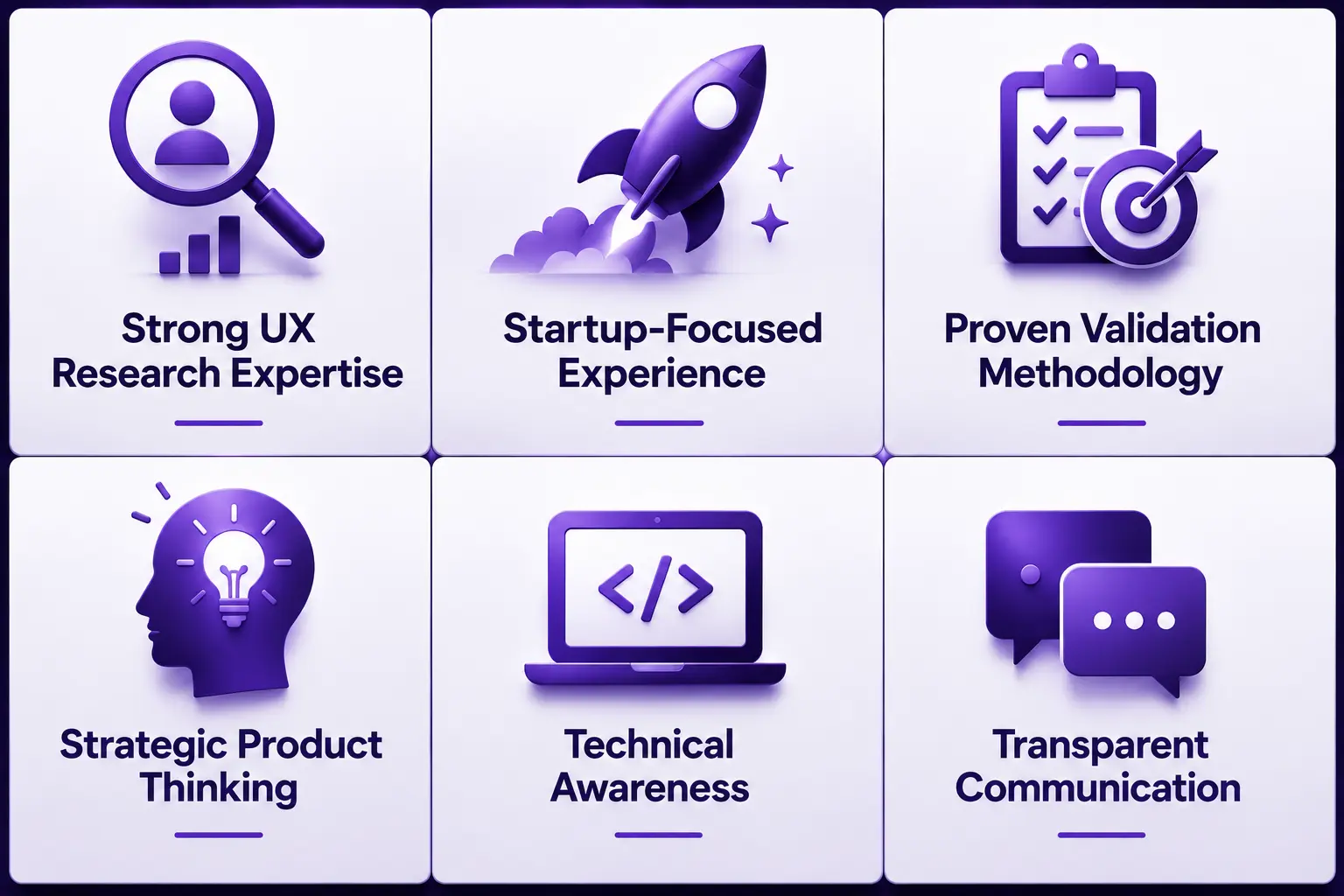
Not every prototyping company delivers the same level of value. Some focus primarily on visual design, while others provide strategic guidance throughout the validation journey. The difference often determines whether a startup gains meaningful insights or simply receives a collection of screens. Evaluating specific capabilities can help founders identify partners that contribute to long-term product success.
1. Strong UX Research Expertise
Effective prototyping starts with understanding users. This makes UX research one of the most important capabilities to evaluate when selecting a partner.
Research helps identify behavioral patterns, unmet needs, and usability challenges that influence product adoption. Without these insights, prototypes often validate assumptions rather than real user needs.
2. Startup-Focused Experience
Startups operate under unique constraints. Budgets are limited, timelines are aggressive, and product ideas continue evolving throughout the validation process.
A company with startup experience understands these realities and adapts its approach accordingly. An experienced startup product development company can often identify risks and opportunities that less specialized firms may overlook.
3. Proven Validation Methodology
Every prototyping company claims to validate ideas, but the best partners can clearly explain how they do it. Ask about testing frameworks, user interviews, success metrics, and iteration processes that support the best prototyping methods for validating your product idea.
A structured approach to product validation creates more reliable outcomes and reduces uncertainty before development begins.
4. Strategic Product Thinking
Prototyping should support business goals rather than focus solely on design deliverables. The strongest partners understand product strategy, user experience, and market positioning.
Instead, they ask why a feature exists before discussing how it should look.
5. Technical Awareness
Even during validation, technical feasibility matters. A prototype that cannot realistically be built creates false confidence and often leads to expensive changes later.
Companies offering software prototyping services understand how the best prototyping tools support realistic validation while ensuring the final product can be developed efficiently and scaled successfully.
6. Transparent Communication & Collaboration
Rapid prototyping is an iterative process that requires continuous feedback and quick decision-making. A reliable partner keeps stakeholders informed through regular updates, collaborative workshops, and clearly defined milestones.
Open communication helps startups validate ideas faster, resolve challenges early, and ensure the final prototype stays aligned with both user needs and business objectives.
Questions Every Founder Should Ask Before Hiring a Prototyping Partner
Choosing a prototyping company should never be based solely on portfolio quality or pricing. Founders need to understand how a company approaches research, validation, testing, and future development planning. Asking the right questions early helps uncover strengths, identify potential gaps, and reduce the risk of selecting the wrong partner.
How Do You Approach Validation?
The answer to this question reveals whether a company views prototyping as a strategic process or simply a design activity. A reliable startup app development company should be able to explain how validation fits into the broader product development journey.
Look for discussions around testing, user feedback, iteration, and measurable outcomes.
What Research Methods Do You Use?
Research directly influences validation quality. Ask how the company gathers insights and translates findings into product decisions.
Businesses offering ux research consulting often have more mature methodologies for collecting and analyzing user feedback.
How Do You Measure Success?
Success should not be measured by the number of screens delivered. It should be measured by how effectively assumptions are validated.
Strong companies define validation goals before creating prototypes.
Can You Share Startup Case Studies?
Past work often reveals how a company approaches product challenges. Ask for examples involving startups rather than only enterprise projects.
This helps determine whether the team understands the realities of early-stage product development.
What Happens After Prototyping?
Validation is only the beginning of the product journey. Understanding how a company supports future development helps ensure continuity and long-term success.
Understanding Low-Fidelity vs High-Fidelity Prototypes
One of the most common sources of confusion for startups is determining what type of prototype they actually need. Different stages of validation require different levels of detail and functionality. Understanding the distinction between low-fidelity and high-fidelity prototypes helps founders allocate resources more effectively and choose the right approach for their product goal.
What Is a Low-Fidelity Prototype?
A low fidelity prototype focuses on workflows, user journeys, and structural concepts. These prototypes are intentionally simple and designed for quick validation.
Their primary purpose is testing ideas rather than presenting polished experiences.
Benefits of Low-Fidelity Prototyping
Low-fidelity prototypes are inexpensive to create, easy to modify, and ideal for early-stage experimentation.
They allow startups to gather feedback quickly without investing heavily in design.
What Is a High-Fidelity Prototype?
A high fidelity prototype closely resembles the final product experience. It includes detailed interfaces, realistic interactions, branding, and visual design elements.
These prototypes are commonly used for investor presentations, advanced usability testing, and stakeholder reviews.
When Should Startups Use High-Fidelity Prototypes?
High-fidelity prototypes become valuable when product concepts are more mature, and teams need realistic user feedback.
They are particularly useful before transitioning into development.
Choosing the Right Fidelity Level
The best prototyping partners understand when each approach is appropriate. They select the right fidelity level based on validation objectives rather than visual preferences.
Red Flags That Signal the Wrong Prototyping Company
A poor prototyping partner can create delays, increase costs, and lead startups toward incorrect product decisions. While many agencies promise rapid delivery and attractive designs, not all of them prioritize validation and strategic learning. Recognizing common warning signs early can help founders avoid costly mistakes and select a partner that genuinely supports product success.
They Prioritize Design Over Learning
A prototype should generate insights, not simply look impressive. If a company focuses primarily on visual aesthetics, it may be overlooking validation objectives.
The goal should always be to reduce uncertainty.
They Skip Discovery Activities
Companies that begin designing immediately often lack the strategic depth needed for effective validation.
A structured product discovery workshop helps establish the foundation for meaningful prototyping outcomes.
They cannot Explain Their Validation Process.
Experienced partners should clearly explain how they test assumptions, collect feedback, and measure success.
Vague answers often indicate weak methodologies.
They Lack Startup Experience
Startup validation differs significantly from enterprise product design. Without startup experience, companies may struggle to balance speed, flexibility, and budget constraints.
They Treat Prototyping as a One-Time Deliverable
Great prototyping involves testing, iteration, and continuous refinement. Companies focused solely on delivery often miss opportunities to improve product decisions.
How the Best Prototyping Companies Help Build Better MVPs
Prototyping and MVP development are closely connected stages within the product journey. Insights gathered during validation often determine which features should be included in the first product release. By validating ideas early, startups can build MVPs faster with greater confidence, focusing only on features that address real user needs.
The best prototyping companies support this transition by turning validated concepts into market-ready product strategies.
Validation Before Development
A prototype validates assumptions. An MVP validates market demand. Understanding this distinction is critical for startup success.
Insights gathered during prototyping help determine which features should be included in the first product release.
Smoother Transition Into MVP Development
Businesses that validate ideas before development often experience faster and more efficient delivery cycles.
This is why many founders partner with an MVP development company after completing validation activities.
Better Feature Prioritization
Validation helps identify which features matter most to users. This reduces scope creep and ensures development resources are allocated effectively.
Reduced Development Waste
Building unnecessary functionality increases both cost and complexity. Prototyping helps eliminate low-value features before development begins.
Stronger Launch Readiness
Validated assumptions create greater confidence during launch planning and improve the likelihood of product adoption.
Many startups leverage MVP development services for startups to transform validated concepts into market-ready products.
Common Mistakes Founders Make While Choosing a Prototyping Company
Many startup founders evaluate prototyping partners based on incomplete criteria. They may focus heavily on design quality, cost, or turnaround time while overlooking research capabilities and validation expertise. These decisions often lead to poor outcomes that could have been avoided with a more structured evaluation process. Understanding these mistakes can help startups make smarter partner selection decisions.
1. Selecting Based on Cost Alone
Budget considerations are important, but choosing the cheapest provider often leads to poor validation outcomes and expensive development mistakes later.
2. Focusing Only on Portfolio Design
A visually attractive portfolio does not guarantee strong validation expertise.
Founders should evaluate research capabilities, testing methodologies, and strategic thinking alongside design quality.
3. Ignoring Discovery and Research
Skipping discovery activities creates blind spots that often surface later during development.
4. Expecting Immediate Certainty
Prototyping reduces uncertainty, but it does not eliminate it. Validation is an iterative process that requires continuous learning.
5. Overlooking Long-Term Product Goals
The best prototyping companies think beyond immediate deliverables and help startups prepare for future growth.
Many of these challenges are discussed in common rapid prototyping mistakes, which continue to affect startup success rates across industries.
Conclusion
Choosing the best rapid prototyping company is not about finding a vendor that creates attractive screens. It is about finding a strategic partner that helps validate ideas, reduce uncertainty, and improve product decisions before development begins. The strongest partners combine research, validation, product thinking, and technical awareness to help startups build products users actually want.
Ultimately, whether you are validating a new concept, preparing for fundraising, or planning future development, investing in rapid prototyping for product development helps startups make informed decisions early in the product journey.
This approach reduces uncertainty before committing to full-scale development and creates a stronger foundation for long-term success. By combining structured validation with user-centered insights, businesses can reduce risk, strengthen product-market fit, and build a solid foundation for long-term growth. A reliable product prototyping company does more than create prototypes. It helps transform ideas into validated business opportunities.

FAQs
1. What does a rapid prototyping company do?
A rapid prototyping company helps businesses transform product ideas into testable prototypes that can be evaluated before development begins. Their role often includes user research, prototype design, validation testing, and product strategy recommendations.
2. Why is rapid prototyping important for startups?
Rapid prototyping for startups is essential because it allows founders to validate assumptions before investing heavily in development. It helps identify usability issues, gather user feedback, and reduce the risk of building products that fail to meet market needs.
3. How do I choose the best rapid prototyping company?
Look for a company with experience in product validation, UX research, startup products, and MVP planning. The best partners focus on solving business problems and validating ideas rather than simply delivering designs.
4. What is the difference between a low-fidelity and a high-fidelity prototype?
A low-fidelity prototype focuses on structure, workflows, and core functionality, making it ideal for early validation. A high-fidelity prototype closely resembles the final product and is typically used for advanced testing, stakeholder reviews, and investor presentations.
5. How long does the rapid prototyping process take?
The rapid prototyping process typically takes between one and six weeks, depending on the product’s complexity, research requirements, testing scope, and the number of iterations needed to validate key assumptions before development begins.
6. Can rapid prototyping help with MVP development?
Yes. Prototyping helps identify which features should be prioritized in an MVP and validates product assumptions before development starts. This often reduces development costs and improves product-market fit.
7. What questions should I ask before hiring a prototyping company?
You should ask about their validation process, user research approach, testing methodology, startup experience, case studies, and how they support the transition from prototype to development.
8. What are the most common mistakes when choosing a prototyping partner?
Common mistakes include selecting based on cost alone, focusing only on visual design quality, skipping research evaluation, ignoring validation capabilities, and choosing a partner without startup-specific experience.
Discuss your project and request for proposal
SHARE
WRITTEN BY

Prankur Haldiya
Chief Technical Officer
A tech innovator and engineering leader, Prankur Haldiya drives RipenApps’ product development strategy and oversees cutting-edge solutions in mobility, AI, and cloud ecosystems. He is passionate about building high-performance teams and helping brands launch secure, scalable, and user-centric digital products.
View All Articles