


Key Takeaways
- AI Case Studies show the greatest business impact when AI solves customer problems, improves experiences, and reduces friction.
- AI-powered personalization and recommendation engines remain leading AI use cases for increasing engagement, retention, and loyalty.
- Predictive analytics AI implementation examples help businesses identify churn risks, optimize resources, and improve revenue growth.
- AI assistants, intelligent onboarding, and conversational experiences accelerate product adoption, engagement, and long-term customer retention.
- Successful AI business use cases align artificial intelligence investments with measurable outcomes, growth objectives, and scalability.
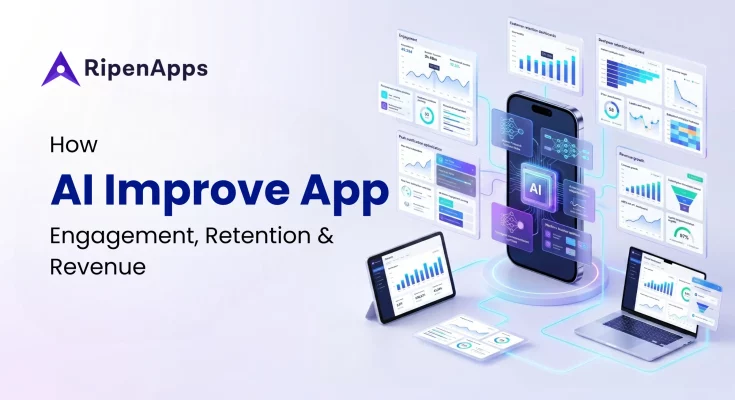
AI features increase growth and retention when they solve real user problems, remove friction, and deliver personalized experiences at scale. The most successful AI Case Studies show that organizations achieve measurable business outcomes when artificial intelligence becomes part of the product experience rather than a standalone technology initiative.
Across industries, business leaders are under increasing pressure to improve customer retention, accelerate digital transformation, and unlock new revenue opportunities. While AI adoption continues to grow, many startups and enterprises still struggle to identify which AI features create the greatest impact on growth, engagement, and long-term customer value. According to McKinsey’s The State of AI: Agents, Innovation, and Transformation (2025) report, 88% of organizations now use AI in at least one business function, up from 78% the previous year, highlighting how AI has rapidly become a mainstream business capability rather than an emerging technology.
The strongest artificial intelligence success stories reveal a consistent pattern. Companies that align AI investments with user behavior, product strategy, and business objectives consistently outperform competitors. Whether it’s personalized recommendations, predictive analytics, intelligent onboarding, or conversational experiences, organizations are using AI to create more engaging digital products.
Businesses investing in AI chatbot development are increasingly leveraging intelligent interactions to improve customer experiences while creating scalable engagement channels. This article explores real-world AI case studies, examines why certain implementations succeeded, and highlights practical lessons startup founders can apply to their own digital products.
Table of Contents
Why do Some AI Features Drive Growth While Others Fail?
Many organizations assume that adding AI to a product automatically leads to better outcomes. In reality, success depends less on the technology itself and more on how effectively the AI feature integration addresses user needs and business objectives.
The most successful AI business use cases share three important characteristics:
- Solve a clearly defined customer problem.
- Naturally fit into existing workflows.
- Deliver measurable business value.
On the other hand, AI initiatives often fail when businesses prioritize innovation for its own sake instead of focusing on user outcomes.
For example, recommendation engines succeed because they reduce decision fatigue. Predictive analytics works because it helps users make faster and more informed decisions. Intelligent onboarding improves activation because it simplifies complex experiences.
This distinction explains why some AI implementation examples become industry-leading growth drivers while others struggle to gain adoption.
For business leaders evaluating AI opportunities, the key question should not be, “What can AI do?” Instead, it should be, “Which customer problems can AI solve more effectively than existing solutions?”
Which AI Features in Apps Have Proven to Increase Growth and Retention?
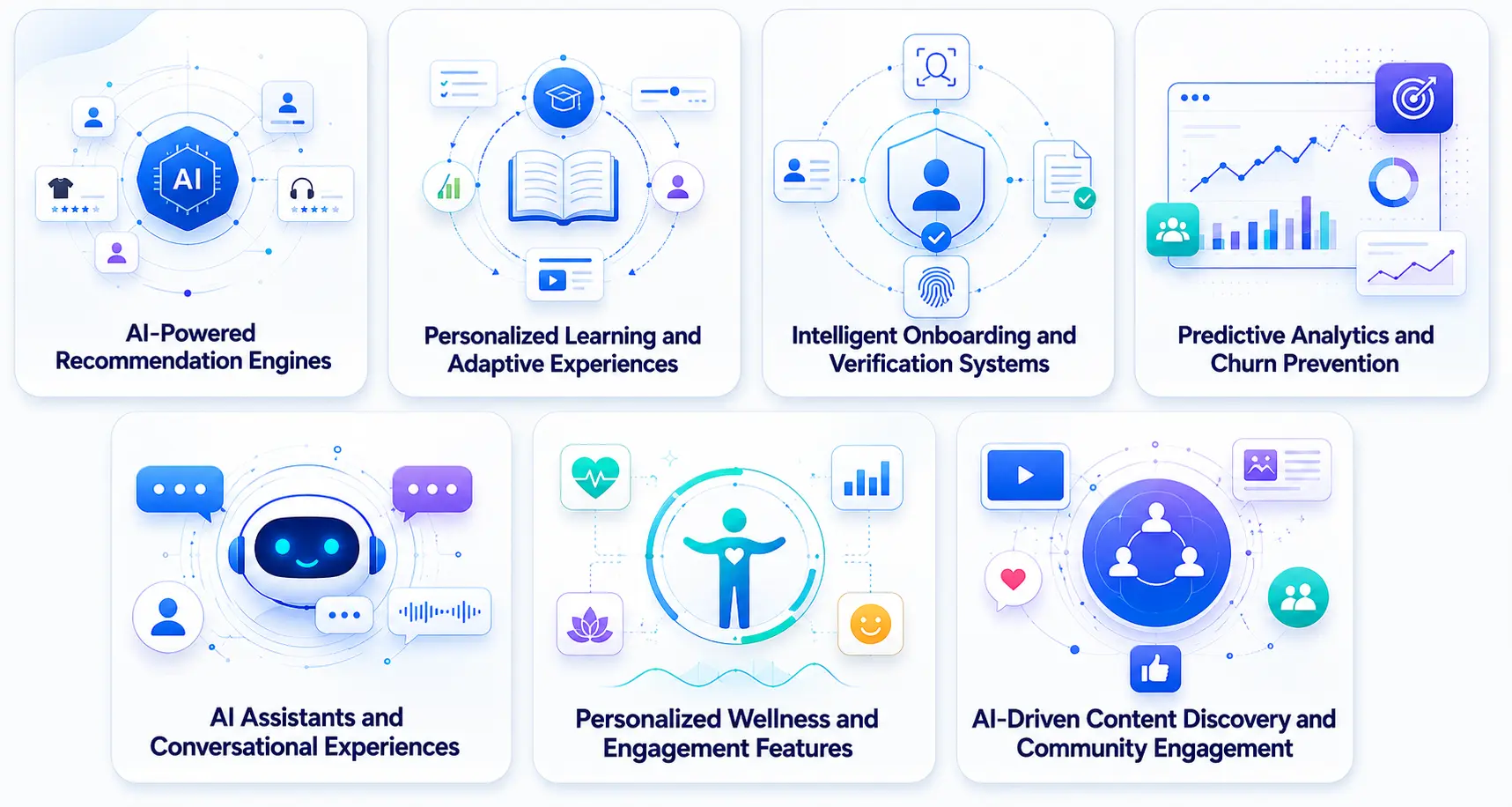
Not all AI capabilities generate the same business impact. The most successful digital products focus on AI features that improve user engagement, accelerate activation, personalize experiences, and reduce customer churn. From recommendation engines and predictive analytics to intelligent onboarding and AI assistants, these features have consistently delivered measurable growth outcomes across industries. The following real-world examples show how specific AI features have helped apps increase retention, engagement, and long-term customer value.
1. AI-Powered Recommendation Engines
Recommendation engines analyze user behavior, preferences, and interactions to deliver highly relevant content, products, or services. By reducing decision fatigue and improving content discovery, these AI features increase engagement, session duration, and long-term customer retention.
2. Personalized Learning and Adaptive Experiences
Adaptive learning systems use AI to tailor content, recommendations, and user journeys based on individual progress and behavior. This personalized approach improves user engagement, accelerates goal achievement, and encourages continued platform usage.
3. Intelligent Onboarding and Verification Systems
AI-powered onboarding features streamline user journeys by providing personalized guidance, automating verification processes, and reducing friction during account setup. These capabilities help improve activation rates, minimize drop-offs, and enhance the overall user experience.
4. Predictive Analytics and Churn Prevention
Predictive analytics leverages historical and real-time data to identify user behaviors, engagement patterns, and potential churn risks. This enables businesses to take proactive actions that improve retention, optimize customer experiences, and increase lifetime value.
5. AI Assistants and Conversational Experiences
AI assistants help users complete tasks, find information, and receive personalized support through natural interactions. By providing instant assistance and contextual recommendations, these features improve engagement, satisfaction, and product adoption.
6. Personalized Wellness and Engagement Features
AI-driven wellness and engagement features analyze user preferences, behaviors, and goals to deliver customized experiences. This personalization encourages consistent participation, strengthens user relationships, and improves retention outcomes.
7. AI-Driven Content Discovery and Community Engagement
Content discovery systems use AI to surface the most relevant discussions, resources, and recommendations based on user interests and activity. These features foster deeper engagement, increase participation, and create more active digital communities.
How Are AI Personalization Features Increasing User Retention?
Personalization has become one of the most powerful AI use cases in business because it directly influences engagement, satisfaction, and loyalty.
Modern users expect products to understand their preferences and deliver relevant experiences. Generic interactions no longer create sustainable competitive advantages.
1. Netflix Built Retention Through Recommendation Intelligence
Netflix remains one of the most widely recognized artificial intelligence case study examples.
Its recommendation engine continuously analyzes viewing behavior, preferences, watch history, and engagement patterns to deliver highly personalized content suggestions.
The business impact has been substantial:
- Increased viewing time
- Improved customer satisfaction
- Reduced churn
- Stronger subscriber retention
Netflix demonstrates how AI-powered personalization can become a core driver of business growth.
2. Spotify Increased Engagement Through Personalized Discovery
Spotify transformed music consumption by helping users discover relevant content through AI-driven recommendations.
Features like Discover Weekly and personalized playlists analyze listening behavior to deliver tailored experiences.
Business outcomes include:
- Higher engagement levels
- Increased listening time
- Stronger customer loyalty
- Improved retention rates
Spotify remains one of the most referenced AI success stories because personalization is embedded directly into the customer journey.
3. Why Personalization Continues to Dominate AI Growth Strategies
The success of Netflix and Spotify highlights a broader trend.
Organizations that leverage behavioral data to create personalized experiences consistently outperform competitors that rely on generic user journeys.
For business leaders, personalization represents one of the most proven business use cases for AI because it delivers value to both users and organizations simultaneously.
How is RipenApps Helping Businesses Increase Growth and Retention Through AI-Powered Digital Products?
While companies like Netflix, Spotify, and Amazon often dominate discussions around AI innovation, many startups and enterprises are achieving significant outcomes through targeted AI implementations. RipenApps has partnered with businesses across multiple industries to build intelligent digital products that improve engagement, streamline operations, strengthen personalization, and increase customer retention.
The following AI Case Studies demonstrate how strategic AI adoption can generate measurable business value across education, entertainment, fintech, wellness, and community-driven platforms.
1. eGurukul: Enhanced Student Retention Through Personalized Learning Experiences
Educational platforms frequently struggle with learner engagement and course completion. Through personalized content delivery and adaptive learning experiences, eGurukul created a more engaging educational ecosystem that helps students discover relevant learning materials based on their progress and preferences.
Business Outcomes:
- Improved student engagement
- Better learning continuity
- Increased content consumption
- Higher platform retention
AI Feature Highlight: Personalized learning recommendations and adaptive content experiences.
2. Hungama: Improved Content Consumption Through AI-Powered Recommendations
For entertainment platforms, content discovery directly impacts engagement. Hungama enhanced user experiences by leveraging intelligent recommendation capabilities that help users discover relevant music and entertainment content more efficiently.
Business Outcomes:
- Increased session duration
- Higher repeat engagement
- Better content discoverability
- Improved customer retention
AI Feature Highlight: Recommendation engine and personalized content delivery.
3. Al Muzaini: Accelerated Customer Onboarding With Intelligent Verification Workflows
Financial applications must balance compliance requirements with seamless customer experiences. Al Muzaini optimized user onboarding through intelligent verification workflows that streamline customer acquisition while maintaining security standards.
Business Outcomes:
- Faster onboarding completion
- Reduced abandonment rates
- Improved customer experience
- Greater operational efficiency
AI Feature Highlight: AI-assisted onboarding and intelligent verification systems.
4. Examarly: Increased User Activation Through Adaptive Learning Experiences
User activation remains a major challenge for educational products. Examarly focused on helping learners quickly identify relevant educational resources and personalized learning paths.
Business Outcomes:
- Faster activation rates
- Better feature adoption
- Increased engagement
- Improved long-term retention
AI Feature Highlight: Personalized educational recommendations and learner engagement optimization.
5. EmmyWellness: Strengthened User Engagement Through Personalized Wellness Journeys
Sustained engagement is critical for wellness platforms. EmmyWellness leveraged personalized user experiences to encourage continuous participation throughout users’ wellness journeys.
Business Outcomes:
- Increased platform activity
- Better engagement metrics
- Improved retention performance
- Enhanced customer loyalty
AI Feature Highlight: Personalized wellness recommendations and behavioral engagement experiences.
6. Conveyr: Improved Community Engagement Through Intelligent Content Experiences
Community-driven platforms depend heavily on participation and content relevance. Conveyr improved engagement by delivering more relevant content experiences that encourage interaction and strengthen community involvement.
Business Outcomes:
- Increased community participation
- Higher engagement rates
- Longer session durations
- Improved user retention
AI Feature Highlight: AI-driven content relevance and engagement optimization.
Strategic Takeaway for Business Leaders
Across industries, the most successful AI business case examples share a common characteristic: they solve meaningful customer problems while creating measurable business outcomes. Whether through onboarding optimization, recommendation engines, personalized experiences, or intelligent engagement features, these implementations demonstrate that AI delivers the greatest value when aligned with user needs and business objectives.
While successful AI implementations may look different across industries, they are typically guided by a clear strategic vision. An effective AI strategy for digital product initiatives helps organizations identify high-impact use cases, prioritize investments, align AI capabilities with business goals, and create a roadmap for sustainable growth. This strategic approach enables businesses to move beyond experimentation and achieve measurable outcomes from AI adoption.
How Can AI Onboarding Features Improve Product Activation?
User onboarding often determines whether customers become long-term users or abandon a product after their first interaction.
AI-powered onboarding experiences help businesses shorten time-to-value and improve activation rates.
1. Intelligent Product Guidance Accelerates Adoption
Traditional onboarding experiences follow static pathways.
AI-powered onboarding adapts to user behavior, goals, and preferences.
Instead of presenting every feature at once, intelligent systems prioritize the most relevant actions for each user.
Benefits include:
- Faster user activation
- Reduced learning curves
- Better feature adoption
- Improved retention
2. Contextual Recommendations Improve User Success
AI can identify user intent during onboarding and recommend relevant resources, workflows, or next steps.
This approach helps users reach meaningful outcomes faster.
Organizations implementing contextual onboarding often see improvements in:
- Product engagement
- User confidence
- Feature utilization
- Customer satisfaction
3. Adaptive Onboarding Creates Long-Term Value
One of the most important lessons from the modern AI case study is that onboarding should not end after account creation.
The most successful products continuously guide users toward new features and opportunities based on their evolving behavior.
This creates an ongoing value loop that strengthens customer relationships and reduces churn.
How Are Predictive AI Features Reducing Customer Churn?
Customer acquisition costs continue to rise across industries. As a result, retaining existing customers has become a strategic priority for business leaders. Predictive analytics helps organizations proactively identify risks before they impact revenue.
1. Churn Prediction Models Enable Proactive Retention
AI algorithms can analyze:
- Product usage trends
- Login frequency
- Customer support interactions
- Behavioral patterns
- Engagement metrics
By identifying customers at risk of leaving, businesses can intervene before churn occurs.
Common retention actions include:
- Personalized outreach
- Product recommendations
- Educational resources
- Loyalty incentives
This represents one of the strongest AI optimization business case examples because preventing churn is often more cost-effective than acquiring new customers.
2. Predictive Lead Scoring Improves Revenue Efficiency
Predictive analytics is not limited to customer retention.
Many B2B organizations use AI to prioritize sales opportunities and improve pipeline performance.
By evaluating intent signals and behavioral data, AI helps sales teams focus on prospects most likely to convert.
Benefits include:
- Higher conversion rates
- Reduced sales cycles
- Better resource allocation
- Increased revenue efficiency
3. Predictive Intelligence Creates Competitive Advantages
Organizations that leverage predictive analytics gain deeper visibility into customer behavior.
This allows leaders to make more informed decisions while improving both customer experiences and operational performance.
These applied AI case studies demonstrate why predictive analytics continues to be one of the most valuable artificial intelligence business use cases.
How Are AI Assistants and AI Agents Increasing Engagement?
AI assistants are rapidly becoming central to digital product experiences.
Unlike traditional automation tools, AI assistants interact dynamically with users and adapt based on context.
1. AI Writing Assistants Increased Daily Product Usage
Platforms like Grammarly and Notion AI have transformed productivity workflows.
Rather than requiring users to switch between multiple tools, AI functionality is embedded directly within existing experiences.
Business outcomes include:
- Higher product engagement
- Increased daily usage
- Better customer retention
- Stronger subscription growth
These generative AI success stories highlight the value of integrating AI directly into user workflows.
2. Customer Support AI Agents Improved Service Scalability
Many enterprises investing in AI agent software development are creating intelligent support ecosystems that improve both customer satisfaction and efficiency.
Modern organizations increasingly rely on AI assistants to handle:
- Customer inquiries
- Technical support
- Product recommendations
- Account management tasks
This enables businesses to deliver faster responses while reducing operational costs.
The shift toward AI-powered assistance is accelerating. According to McKinsey’s The State of AI (2025) report, 62% of organizations are already experimenting with AI agents, demonstrating growing enterprise confidence in autonomous and workflow-driven AI capabilities.
3. Embedded AI Creates Sustainable Engagement
The most effective AI assistants are not standalone features.
They become part of everyday workflows, helping users complete tasks faster and achieve better outcomes.
Organizations that successfully integrate conversational experiences often pair them with Generative AI Integrations to deliver more personalized and context-aware interactions.
The growing adoption of AI assistants reflects several top AI trends 2026, including agentic AI, hyper-personalization, autonomous workflows, and context-aware digital experiences. As these technologies mature, businesses will increasingly leverage AI to deliver proactive support, streamline operations, and create more engaging customer journeys.
How Do AI Recommendation Engines Improve Retention?
An AI recommendation engine is a system that analyzes user behavior, preferences, and interactions to deliver personalized suggestions. By helping users discover relevant content, products, or services faster, recommendation engines increase engagement, improve customer satisfaction, and strengthen long-term retention.
Recommendation engines remain one of the most successful examples of AI solutions because they reduce friction and improve decision-making.
1. E-Commerce Recommendation Systems Increase Revenue
Amazon helped popularize AI-powered recommendations by delivering highly relevant product suggestions.
Its recommendation engine analyzes:
- Purchase history
- Browsing behavior
- Product interactions
- Similar customer patterns
The result is improved customer experiences and increased revenue generation.
Amazon remains one of the most frequently cited AI in e-commerce case study examples.
2. Streaming Platforms Use Recommendations to Increase Consumption
Content-heavy platforms face a common challenge: helping users find relevant content quickly.
Recommendation engines solve this challenge by surfacing personalized suggestions based on user behavior and interests.
This reduces decision fatigue and encourages continued engagement.
3. Social Platforms Leverage AI for Content Discovery
Social media platforms increasingly rely on recommendation algorithms to determine what content users see.
By continuously learning from interactions, these systems deliver highly relevant experiences that keep users engaged for longer periods.
For organizations evaluating what AI should be used for, recommendation engines remain one of the most practical and impactful applications.
What Can Product Teams Learn From These AI Case Studies?
Despite operating in different industries, successful AI implementations follow remarkably similar principles. As AI capabilities become more deeply integrated into digital ecosystems, organizations are increasingly incorporating AI in web development to deliver personalized user experiences, automate workflows, improve search functionality, and enhance overall application performance. These capabilities enable businesses to create more intelligent and responsive digital products while supporting long-term scalability.
1. Successful AI Features Solve Specific Problems
The most effective AI initiatives address real customer pain points rather than implementing technology for novelty.
Before investing in AI, organizations should clearly define:
- The problem being solved
- The desired business outcome
- The user value being created
2. Data Quality Determines AI Success
Even the most advanced AI models depend on accurate, consistent, and reliable data. Poor data quality can lead to inaccurate insights and ineffective outcomes. Organizations should establish strong data foundations and governance practices to improve AI performance, support better decision-making, and maximize ROI.
3. AI Should Support Existing Workflows
AI delivers the best results when it enhances existing user experiences rather than disrupting them. By seamlessly integrating into familiar workflows, businesses can drive higher adoption, improve user satisfaction, and accelerate time-to-value.
Businesses evaluating AI in product development initiatives should focus on solving high-impact customer problems before pursuing advanced AI capabilities.
4. Business Outcomes Must Guide Decision-Making
Successful AI initiatives are driven by clear business goals, not technology alone. Organizations should focus on measurable outcomes such as increased retention, higher engagement, improved efficiency, and revenue growth to ensure AI investments deliver tangible value.
Enterprise results increasingly validate this approach. Deloitte’s State of Generative AI report found that nearly three-quarters (74%) of organizations report that their most advanced generative AI initiative is meeting or exceeding ROI expectations, reinforcing the importance of aligning AI investments with measurable business outcomes.
Successful organizations measure AI performance through metrics such as:
| Metric | Business Impact |
| Activation Rate | Faster Product Adoption |
| Retention Rate | Lower Customer Churn |
| Engagement Time | Increased Product Usage |
| Revenue Per User | Improved Profitability |
| Customer Satisfaction | Greater Loyalty |
Companies investing in backend API development often create the technical foundation necessary to support scalable AI experiences while maintaining performance and security.
5. Which AI Features should Businesses Build First?
One of the most common questions executives ask is: What to use AI for when launching or scaling a digital product?
The answer depends on business maturity, customer needs, and available data.
| Business Stage | Recommended AI Feature |
| Startup | Smart Search and Recommendations |
| Growth Stage | Personalization Engines |
| Scaling Business | Predictive Analytics |
| Enterprise | AI Agents and Automation |
| Mature Platforms | Autonomous Workflows |
Organizations beginning their AI journey should prioritize features that deliver immediate customer value.
These often include:
- Recommendation systems
- Intelligent onboarding
- Predictive analytics
- Conversational interfaces
- Workflow automation
Similarly, many organizations researching AI in mobile app development examples discover that personalization and recommendation features typically generate faster ROI than more complex autonomous systems.
Final Thoughts
The most successful AI Case Studies demonstrate that artificial intelligence creates business value when it solves meaningful customer problems and becomes deeply integrated into the product experience. Whether through personalization, recommendation engines, predictive analytics, onboarding optimization, or AI-powered assistants, organizations that align AI initiatives with business goals consistently achieve stronger engagement, retention, and growth outcomes. As AI adoption accelerates, leaders who focus on customer value rather than technology alone will be best positioned to build sustainable competitive advantages.
For startups, enterprises, and product leaders exploring AI opportunities, success begins with a clear strategy and the right implementation partner. From Chatbot Development and generative AI integrations to intelligent automation and scalable digital products, RipenApps helps organizations transform innovative ideas into high-impact AI solutions that drive measurable business growth, operational efficiency, and long-term customer retention.
Frequently Asked Questions
1. What are AI case studies?
AI case studies are real-world examples that demonstrate how businesses use artificial intelligence to solve challenges, improve efficiency, increase revenue, and enhance customer experiences.
2. How does AI improve user retention?
AI improves retention through personalization, predictive analytics, intelligent recommendations, proactive customer support, and automated engagement strategies.
3. Which AI features generate the highest growth?
Personalization engines, recommendation systems, predictive analytics, AI assistants, and onboarding optimization consistently deliver strong business outcomes.
4. What is the business case for AI?
The business case for AI includes improved operational efficiency, lower costs, increased customer retention, stronger engagement, and higher revenue growth. The lessons form the basis of many successful case study AI implementations across industries. Understanding AI app development cost is equally important because implementation complexity, data requirements, and scalability goals can significantly influence project investment levels.
5. Are generative AI solutions delivering measurable ROI?
Yes. Many generative AI case studies demonstrate measurable improvements in productivity, content creation, customer support, and user engagement.
6. How do organizations measure AI success?
Businesses typically measure AI performance through activation rates, retention rates, customer satisfaction, engagement levels, operational efficiency, and revenue impact.

SHARE
WRITTEN BY

Ishan Gupta
CEO & Founder
Ishan Gupta is a seasoned entrepreneur and CEO with extensive 8+ years of experience in business and mobile app development landscape. He believes that the right digital product allows companies to focus on what they do best, while technology handles the rest. With deep exposure to global markets, he understands what makes an app succeed. His approach translates business needs into clear product strategies, ensuring that every feature contributes to measurable ROI.
View All Articles




 India
India USA
USA Australia
 Canada
 UK
UK UAE
UAE