


Key Takeaways
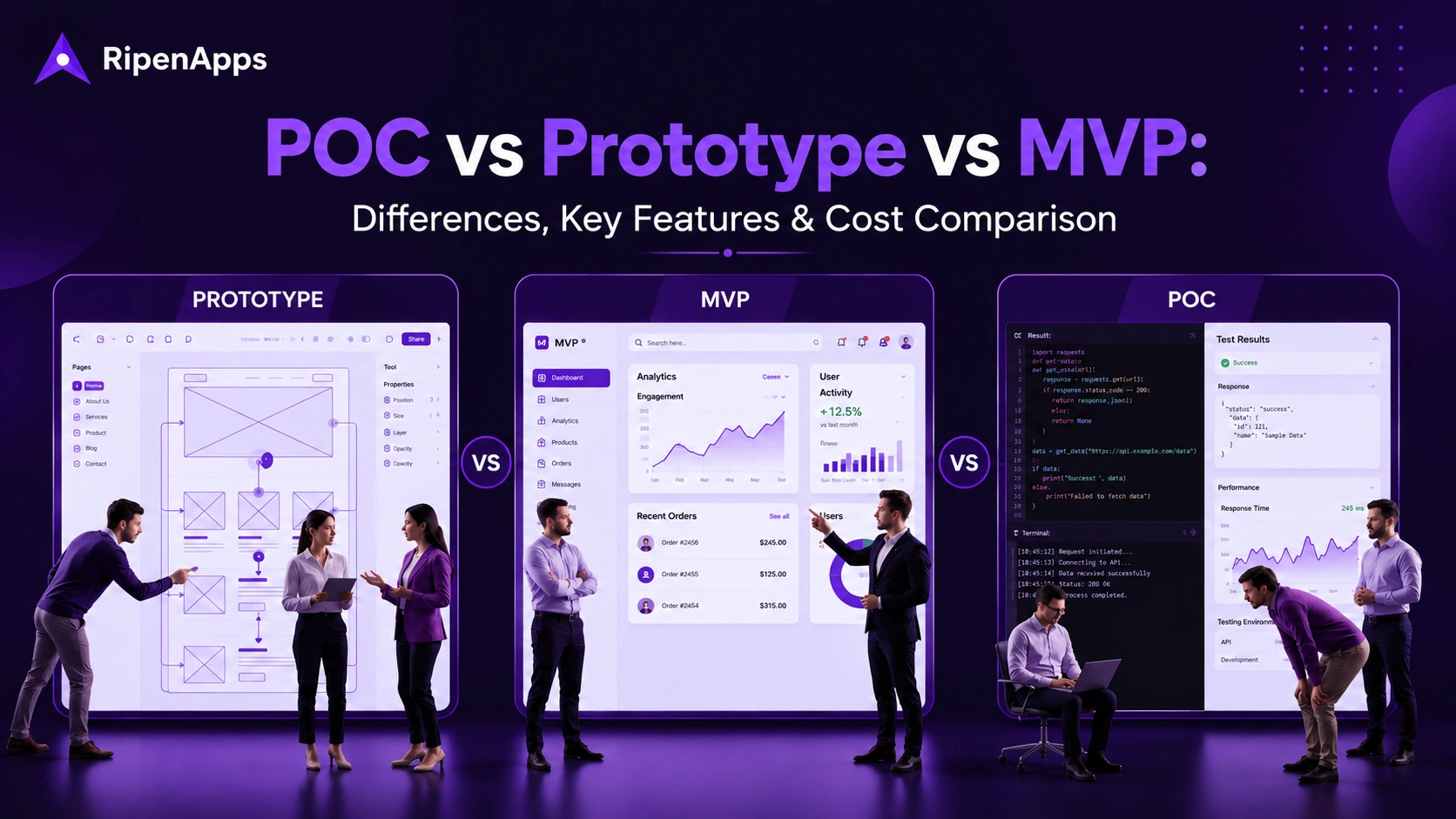
- A POC validates whether an idea is technically feasible before investing in full-scale product development.
- A prototype focuses on testing user experience, workflows, and interface design before coding begins.
- An MVP is the first functional version of a product launched to real users for market validation.
- Each validation stage addresses different business challenges and helps reduce specific types of risks.
- Choosing the appropriate validation strategy improves development efficiency, saves costs, and accelerates time-to-market.
- Startups, enterprises, and technology companies should select a validation approach based on business goals, technical complexity, and customer needs.
Every successful digital product starts with an idea, but not every idea is ready for full-scale development. Whether you are launching a startup, developing enterprise software, building an AI-powered application, or creating a SaaS platform, validating your concept before investing significant time and resources is one of the smartest business decisions you can make. Product validation helps organizations minimize uncertainty, identify potential challenges early, and ensure they are solving the right problem for the right audience.
Despite the importance of early validation, many businesses often confuse a Proof of Concept (POC), Prototype, and Minimum Viable Product (MVP). While these terms are frequently used interchangeably, they represent three distinct stages of product development with different objectives, audiences, and outcomes. Understanding the role of each approach is essential because selecting the wrong validation strategy can lead to unnecessary development costs, delayed product launches, poor user adoption, and increased technical risks.
Many organizations partner with an experienced MVP development company during the early planning phase to evaluate product ideas, define validation goals, and determine whether a POC, prototype, or MVP is the most appropriate starting point. This strategic approach helps businesses avoid costly mistakes and ensures development efforts remain aligned with both technical feasibility and market demand.
In this comprehensive guide, you’ll gain a clear understanding of poc vs prototype vs mvp, explore their individual purposes, compare their features and business value, and learn how to choose the right validation approach based on your product goals, technology requirements, budget, and long-term growth strategy.
Table of Contents
What is a Proof of Concept (POC)?
A Proof of Concept (POC) is the earliest stage of product validation, used to determine whether an idea can be built with the chosen technology. Instead of creating a customer-ready product, a POC focuses on validating technical feasibility, identifying risks, and resolving engineering challenges before significant development begins. It is commonly used for AI, Machine Learning, Blockchain, IoT, and other emerging technologies.
A successful POC reduces technical uncertainty and helps businesses make informed investment decisions before moving forward. Understanding proof of concept vs prototype is simple: a POC validates whether the technology works, while a prototype focuses on the user experience.
What is a Prototype?
A Prototype is an interactive model of a product that helps businesses test its design, navigation, and user experience before development. Using wireframes and clickable screens, teams can gather feedback from stakeholders and potential users without building the actual software.
By validating usability early, businesses can refine the product experience and reduce costly design changes later. When comparing prototype vs POC, the key difference is that a prototype validates user interaction, while a POC validates technical feasibility.
What is an MVP?
When comparing MVP vs Prototype, a Minimum Viable Product (MVP) is the first functional version of a product released with only the essential features needed to solve a core customer problem. Unlike a POC or Prototype, an MVP validates market demand by collecting real user feedback and measuring customer adoption.
Many businesses prioritize essential features and launch faster with a lean product. This highlights the difference between POC vs MVP and Prototype vs MVP: a POC validates technology, a Prototype validates usability, and an MVP validates business viability in the real market.
POC vs Prototype vs MVP: Understanding the Key Differences
Although businesses often use these terms interchangeably, a Proof of Concept (POC), Prototype, and Minimum Viable Product (MVP) serve completely different purposes within the product development lifecycle. Understanding these differences helps organizations make informed investment decisions, reduce project risks, and choose the right validation strategy at the right stage.
Businesses partnering with experienced software product development services providers can also identify the most effective validation approach, reducing uncertainty before committing to full-scale development.
| Comparison Factor | Proof of Concept (POC) | Prototype | Minimum Viable Product (MVP) |
| Primary Objective | Validate technical feasibility | Validate product design and user experience | Validate market demand and business viability |
| Development Stage | Earliest validation stage | Design validation stage | Initial product launch stage |
| Target Audience | Internal stakeholders, technical teams, investors | Designers, stakeholders, potential users | Real customers and early adopters |
| Core Features | Limited technical functionality | Interactive screens and workflows | Essential working features |
| User Interface | Usually minimal or absent | High-fidelity or low-fidelity design | Fully functional user interface |
| Coding Effort | Limited development focused on technology | Minimal coding or no backend development | Complete development of core product functionality |
| Time Required | One to four weeks | Two to six weeks | Two to six months depending on complexity |
| Estimated Cost | Lowest among the three | Moderate investment | Highest initial investment |
| User Testing | Internal technical validation | Usability testing with target users | Real-world customer feedback |
| Investment Readiness | Demonstrates technical viability | Helps secure stakeholder approval | Demonstrates business potential and traction |
| Risk Reduction | Reduces technical risks | Reduces design and usability risks | Reduces market and business risks |
| Business Value | Confirms feasibility before investment | Improves product experience before development | Generates customer insights, revenue, and product-market fit |
The comparison clearly shows that each validation stage serves a different business objective. Selecting the wrong approach may increase costs, delay product launches, or result in building features that customers do not actually need.
POC vs Prototype: What’s the Difference?
The discussion around proof of concept vs prototype often creates confusion because both represent early stages of product validation. However, they solve entirely different business problems.
A POC is primarily a technical exercise. Its purpose is to determine whether developers can successfully implement the underlying technology stack required for the product. User interface design, branding, navigation, and customer experience are not priorities during this stage.
A prototype, on the other hand, focuses on product usability. It helps designers and stakeholders visualize the application, improve customer journeys, and validate interaction flows before software development begins.
Prototype vs MVP: Understanding the Transition
Many startups assume that a prototype is simply an early version of an MVP. While they appear similar visually, they differ significantly in functionality and business purpose.
A prototype demonstrates how a product should work. It allows stakeholders and users to experience navigation, workflows, and interface design without requiring a complete backend or production-ready infrastructure.
An MVP, however, is a real product built for actual customers. Users can register accounts, perform essential actions, make transactions, and generate meaningful business data.
For example, an online learning platform may create a prototype that showcases course browsing, student dashboards, and lesson navigation. Once usability has been validated, the company develops an MVP where students can enroll in courses, watch lessons, complete quizzes, and make payments.
The transition from prototype vs MVP represents the shift from validating assumptions to validating market demand. For businesses interested in the complete product development journey, the MVP development guide explains how a product development company takes ideas from validation to scalable digital products through structured planning and iterative development.
POC vs MVP: Technical Validation vs Market Validation
Another common comparison is poc vs mvp. Although both reduce risks, they address completely different uncertainties.
A POC focuses on answering technical questions. Development teams verify algorithms, cloud architecture, API integrations, infrastructure, or engineering challenges before investing in customer-facing functionality.
An MVP focuses on business validation. Instead of testing whether technology works, businesses measure customer adoption, engagement, retention, revenue, and product-market fit. For example, a fintech company developing a blockchain payment platform may first create a POC to verify transaction speed, encryption, and scalability. Once technical confidence has been established, the organization builds an MVP that allows users to send payments, monitor transactions, and provide feedback on the overall experience.
When Should You Build a POC?
Not every product idea requires a Proof of Concept (POC), but when technical uncertainty is high, developing one can save businesses significant time, money, and effort. A POC is most valuable when organizations need to validate whether a proposed solution can actually be built before investing in product design or software development.
Instead of focusing on customer experience or visual design, a POC answers technical questions that could determine the success or failure of the entire project. By validating assumptions early, businesses can identify implementation challenges, assess technology choices, and reduce engineering risks before larger investments are made.
For startups, a POC can help secure investor confidence by demonstrating that an innovative idea is technically feasible. For enterprises, it supports strategic decision-making by confirming whether emerging technologies can integrate with existing systems and deliver the expected business outcomes.
1. Testing Technical Feasibility
Technical feasibility is the primary reason organizations invest in a Proof of Concept. Every innovative product relies on assumptions about technology, infrastructure, integrations, or performance. If these assumptions prove incorrect after development begins, businesses may face costly delays or even project failure.
A POC validates whether critical technologies can perform as expected under realistic conditions. Development teams can evaluate system architecture, API compatibility, database performance, cloud infrastructure, security requirements, and scalability before committing to full-scale development.
2. Building Products with Emerging Technologies
The need for a POC increases when products rely on innovative or relatively untested technologies. Unlike conventional applications, these solutions often involve technical complexity that cannot be fully predicted during the planning phase.
A Proof of Concept helps engineering teams explore implementation approaches, identify limitations, and validate whether selected technologies can support the intended business objectives.
3. AI-Powered Products
Artificial Intelligence projects almost always involve technical uncertainty because model accuracy depends on data quality, training methods, algorithms, computational resources, and integration capabilities.
Before building a customer-facing application, businesses often create a POC to answer questions such as whether the AI model can generate reliable predictions, process information within acceptable response times, or maintain consistent performance across different user scenarios.
4. Blockchain Applications
Blockchain projects require careful technical validation due to their unique architecture, consensus mechanisms, transaction speeds, and security requirements.
A Proof of Concept enables organizations to determine whether blockchain technology is the appropriate solution for the intended business problem while validating transaction processing, smart contracts, network scalability, and interoperability with existing systems.
5. Internet of Things (IoT) Solutions
IoT applications combine hardware, software, cloud infrastructure, sensors, and communication protocols, making technical validation particularly important.
A POC helps businesses evaluate device connectivity, data synchronization, network reliability, latency, and hardware compatibility before designing customer-facing dashboards or mobile applications.
6. Healthcare Technology
Healthcare software involves strict regulatory requirements, sensitive patient information, and mission-critical functionality. Technical failures can have significant consequences, making early validation especially valuable.
Healthcare organizations often build POCs to verify interoperability with electronic health record systems, medical device integration, AI-assisted diagnostics, telemedicine infrastructure, or secure data exchange.
7. Enterprise Software
Enterprise platforms frequently integrate with multiple legacy systems, cloud environments, third-party APIs, authentication services, and internal databases. A Proof of Concept enables organizations to determine whether these integrations can function reliably before initiating large-scale implementation projects.
For example, a multinational company introducing an enterprise workflow automation platform may use a POC to verify integration with existing ERP, CRM, and HR systems. Successfully validating these connections reduces implementation risks and improves deployment planning.
8. Investor Validation
Beyond technical feasibility, a POC also plays an important role in attracting investment for innovative products. Investors are often interested in understanding whether an ambitious idea can realistically be developed using available technology. While they may appreciate market opportunities and business models, technical uncertainty can discourage funding decisions.
A successful Proof of Concept demonstrates that the product’s core innovation is achievable. It provides tangible evidence that the engineering challenges have been addressed, increasing investor confidence and supporting discussions around product roadmaps, funding requirements, and commercialization strategies.
When Should You Build a Prototype?
Once technical feasibility has been validated or when technology risks are relatively low, the next step is often creating a prototype. Unlike a Proof of Concept, which focuses on engineering validation, a prototype helps businesses evaluate how users interact with the product before development begins.
Many businesses adopt rapid prototyping services to quickly transform ideas into clickable interfaces, gather early feedback, and refine designs through multiple iterations before moving into development.
Validating User Interface and User Experience
User experience has become one of the strongest competitive differentiators in digital products. Customers expect applications to be intuitive, visually appealing, and easy to navigate. A prototype enables businesses to test these expectations before investing in software engineering.
Interactive screens allow users to complete realistic tasks, providing valuable insights into navigation patterns, usability challenges, accessibility issues, and overall satisfaction. Designers can then improve layouts, simplify workflows, and optimize interactions based on actual feedback rather than assumptions.
Improving User Journeys
Every successful digital product guides users toward specific goals, whether placing an order, booking a service, completing a payment, or managing business operations. A prototype allows businesses to evaluate these journeys step by step.
Teams can observe how users move through onboarding, search features, dashboards, checkout processes, and profile management while identifying friction points that could negatively affect engagement or conversions.
Presenting Ideas to Customers
Many organizations use prototypes to validate product ideas with potential customers before development begins. Unlike written concepts or static presentations, interactive prototypes help users visualize the final experience. This makes feedback more meaningful because participants can interact with realistic workflows instead of imagining how the application might function.
Customer insights gathered during prototype testing often influence feature prioritization, navigation structures, and design decisions that improve the final product.
Securing Stakeholder Approval
Internal stakeholders frequently require a clear understanding of how a product will function before approving development budgets. A prototype serves as a communication tool that aligns executives, investors, designers, developers, and business teams around a shared product vision.
Rather than reviewing lengthy documentation, stakeholders can experience the application firsthand, making discussions more productive and reducing misunderstandings during implementation.
Supporting Product Discovery
Prototype development is closely connected to product discovery because both focus on validating assumptions before development begins. During the discovery phase, businesses define customer problems, identify market opportunities, prioritize features, and establish product goals. Using the best prototyping tools, teams can quickly transform these findings into interactive experiences that stakeholders can evaluate, test, and refine before development starts.
Organizations that combine product discovery with rapid prototyping typically enter development with greater confidence, clearer requirements, and fewer costly revisions.
Strengthening Investor Pitches
Investors often find it easier to understand a product when they can interact with it rather than simply viewing business plans or presentations. A well-designed prototype demonstrates product vision, customer workflows, and business potential while making startup pitches more engaging and persuasive.
Although a prototype does not validate market demand like an MVP, it helps communicate the value proposition in a compelling way, increasing stakeholder confidence before development begins.
Driving Better Product Design
Design is rarely perfect on the first attempt. Prototypes encourage continuous improvement by allowing businesses to experiment with multiple layouts, interaction models, navigation patterns, and visual concepts.
Each testing cycle generates insights that contribute to a more intuitive and user-friendly product. By refining designs before development, organizations reduce technical rework, improve development efficiency, and ultimately deliver higher-quality digital experiences.
When Should You Build an MVP?
Once a product idea has been validated technically or through design, the next logical step is often building a Minimum Viable Product (MVP). An MVP is appropriate when a business is ready to test its solution in the real market, collect feedback from actual users, and validate whether the product delivers genuine value.
Unlike a Proof of Concept or Prototype, an MVP is not limited to internal testing or stakeholder presentations. It is a functional product with core features that customers can use in real-world scenarios. The primary objective is to learn from actual market behavior while minimizing development costs and accelerating time-to-market.
Validating Market Demand
One of the biggest reasons to build an MVP is to determine whether there is genuine demand for the product. Market research and customer interviews provide valuable insights, but they cannot fully predict how people will behave when a product becomes available.
An MVP allows businesses to observe real customer actions rather than relying on assumptions. User registrations, feature adoption, subscription rates, purchase behavior, and customer retention provide measurable evidence of whether the product solves an important problem.
Reaching Early Adopters
Every successful product begins with a small group of early users who are willing to try innovative solutions and provide constructive feedback.
Launching an MVP enables businesses to engage these early adopters and learn how customers actually use the product. Their experiences often reveal usability issues, feature gaps, unexpected use cases, and improvement opportunities that would have been difficult to identify during planning.
Launching Faster
Many businesses delay product launches while attempting to include every planned feature. This approach often increases development costs, extends timelines, and creates unnecessary complexity.
An MVP encourages businesses to focus on solving one core customer problem exceptionally well instead of building dozens of secondary features.
Generating Revenue Earlier
Unlike a prototype, an MVP is capable of generating revenue from real customers. Whether the business model relies on subscriptions, transaction fees, product sales, advertising, or enterprise licensing, an MVP enables organizations to begin testing revenue models while simultaneously validating customer demand.
Early revenue not only supports business sustainability but also provides valuable evidence when approaching investors or planning future funding rounds.
Collecting Meaningful Customer Feedback
Customer feedback collected after launch is significantly more valuable than assumptions made during planning. Real users interact with products in unpredictable ways. They may discover new use cases, request additional functionality, or identify obstacles that internal teams never anticipated.
Post-launch validation is most effective when businesses combine customer feedback with proven MVP testing practices. The best ways for MVP testing can help teams validate ideas more efficiently and prioritize the right improvements.
Supporting Iterative Development
An MVP is not the final product. Instead, it represents the beginning of an ongoing improvement process. After launch, businesses continuously analyze customer behavior, prioritize enhancements, remove unnecessary functionality, and introduce new features based on measurable demand.
This iterative approach enables organizations to adapt quickly to changing customer expectations while reducing the risk of building features that deliver little business value. Continuous improvement also helps products remain competitive as market conditions evolve.
Achieving Product-Market Fit
Perhaps the most important objective of an MVP is achieving product-market fit. Product-market fit occurs when a product consistently satisfies customer needs, retains users, generates demand, and supports sustainable business growth.
Reaching this milestone requires continuous experimentation, customer learning, and data-driven decision-making rather than assumptions made during initial planning. An MVP provides the foundation for this learning process by exposing the product to real customers under real market conditions.
POC vs Prototype vs MVP Cost Comparison
Cost is one of the most important factors businesses consider when deciding whether to build a Proof of Concept (POC), Prototype, or Minimum Viable Product (MVP). While all three approaches help reduce development risks, they differ significantly in terms of investment because each serves a different business purpose and requires a different level of effort.
Factors That Affect Development Cost
Several variables influence the cost of building a POC, prototype, or MVP. Understanding these factors allows businesses to estimate budgets more accurately and choose an approach that aligns with their product goals.
Product Complexity
Complexity is one of the biggest cost drivers.
A simple appointment booking application requires significantly less effort than an AI-powered healthcare platform or enterprise ERP solution. As business logic, workflows, integrations, and technical requirements become more sophisticated, development costs naturally increase.
For example, a basic prototype for an eCommerce application may take only a few weeks, while an enterprise-grade prototype involving multiple dashboards and user roles requires considerably more design work.
Similarly, an MVP for a marketplace platform will cost more than an MVP for a simple productivity application because of additional features such as payment processing, messaging, notifications, and user management.
Technology Stack
The technologies selected for the product also influence the overall budget.
Applications powered by Artificial Intelligence, Machine Learning, Blockchain, IoT, augmented reality, or cloud-native infrastructure require specialized expertise and longer development timelines.
If the project involves advanced algorithms, real-time processing, or custom infrastructure, both POC and MVP costs may increase substantially compared to conventional web or mobile applications.
Feature Scope
The number and complexity of features directly impact development effort.
A POC usually validates only one technical capability, making it the least feature-intensive option.
A prototype includes multiple user screens and interaction flows but generally avoids backend implementation.
An MVP includes complete functionality for essential features, requiring frontend development, backend services, databases, APIs, authentication, analytics, testing, and deployment.
Businesses often increase costs unnecessarily by attempting to include every planned feature in the first release. Prioritizing only essential functionality allows teams to launch faster while maintaining budget efficiency.
Development Team
The experience and composition of the development team also affect pricing.
A typical product validation team may include product strategists, business analysts, UI/UX designers, software architects, frontend developers, backend developers, quality assurance engineers, DevOps specialists, and project managers.
Projects involving specialized technologies such as AI or blockchain may additionally require data scientists or domain experts.
Although experienced teams generally command higher rates, they often reduce long-term costs by minimizing technical debt and preventing expensive redevelopment.
Development Timeline
Project duration has a direct relationship with cost.
POCs are usually completed within a few weeks because their scope is intentionally limited.
Prototypes require additional time for design exploration, usability testing, and stakeholder feedback.
MVPs typically take several months to develop because they include production-ready software architecture and customer-facing functionality.
Businesses that require accelerated delivery may increase development costs by allocating larger teams or extending working hours.
Third-Party Integrations
Many digital products depend on external services such as payment gateways, mapping platforms, communication APIs, authentication providers, analytics tools, CRM platforms, ERP systems, or cloud infrastructure.
The number and complexity of these integrations can significantly influence both development effort and ongoing maintenance costs.
Enterprise software projects often involve multiple legacy system integrations, making MVP development considerably more expensive than standalone consumer applications.
AI Implementation
Artificial Intelligence introduces additional development considerations beyond traditional software engineering.
Training machine learning models, preparing datasets, validating predictions, optimizing inference speed, and deploying AI infrastructure require specialized expertise and computational resources.
Businesses building AI-powered products frequently begin with a POC to validate model performance before investing in a full MVP.
This phased approach reduces financial risk while ensuring the underlying technology performs as expected.
POC vs Prototype vs MVP Cost Comparison Table
The following estimates represent typical development ranges. Actual MVP development costs vary depending on product complexity, technology choices, geographic location of the development team, project scope, and business requirements.
| Factor | Proof of Concept (POC) | Prototype | Minimum Viable Product (MVP) |
| Primary Objective | Validate technical feasibility | Validate design and usability | Validate market demand |
| Development Duration | 1–4 weeks | 2–6 weeks | 2–6 months |
| Team Size | 2–4 specialists | 2–5 designers and product experts | 5–10+ cross-functional professionals |
| Feature Scope | Single technical capability | Interactive user journeys | Core production-ready functionality |
| Estimated Cost | $5,000–$20,000 | $10,000–$40,000 | $30,000–$150,000+ |
Which Approach is Right for Your Business?
There is no universal answer to whether a business should build a Proof of Concept, Prototype, or MVP. The right approach depends on several factors, including your product idea, technical complexity, target audience, business objectives, available budget, and desired timeline.
Some products require technical validation before anything else, while others benefit more from testing user experience or entering the market quickly. Understanding your primary objective is the key to selecting the right validation strategy.
If your biggest uncertainty is whether the technology can work, begin with a POC. If your concern is whether users will understand and enjoy the product, invest in a prototype. If you are ready to validate customer demand and generate real business insights, developing an MVP is the logical next step.
The following recommendations can help different types of businesses determine the most appropriate approach.
Startup Founders
For startups building relatively straightforward mobile or web applications using established technologies, it is often possible to move directly from product planning to prototype development and then launch an MVP.
Studying successful examples of MVP development for startups can provide valuable insights into how leading startups validated their ideas, attracted early users, and achieved product-market fit without building unnecessary features.
Enterprises
Large organizations often face challenges that differ from startups. Enterprise applications usually involve legacy system integration, security requirements, regulatory compliance, and multiple stakeholder approvals.
Once technical confidence has been established, enterprises frequently build prototypes to gather executive feedback, improve user workflows, and align departments before initiating full-scale development. An MVP is then used to launch pilot programs, validate operational improvements, and collect employee or customer feedback before organization-wide deployment.
SaaS Companies
Software-as-a-Service businesses compete in fast-moving markets where customer expectations evolve quickly. For most SaaS products, a prototype is valuable for refining onboarding experiences, dashboards, subscription flows, and account management before development begins.
Once usability has been validated, launching an MVP allows businesses to measure user engagement, feature adoption, customer retention, and recurring revenue while continuously improving the platform. Rapid customer feedback plays a critical role in achieving sustainable growth within competitive SaaS markets.
AI Startups
Artificial Intelligence products often involve significant technical uncertainty. Before investing in interface design or customer acquisition, AI startups should validate whether machine learning models deliver acceptable accuracy, speed, and reliability through a Proof of Concept.
Once technical feasibility has been confirmed, prototypes help users understand AI-generated outputs and improve overall product usability. Finally, an MVP introduces the AI solution to real customers, allowing businesses to measure adoption, trust, and long-term business value.
Healthcare Businesses
Healthcare technology requires careful validation because products often involve patient safety, regulatory compliance, and sensitive medical information. Organizations frequently begin with a POC to validate clinical algorithms, interoperability with electronic health record systems, and secure data exchange.
After technical validation, prototypes enable healthcare professionals to evaluate workflows, accessibility, and usability before software development begins. An MVP is then introduced in controlled clinical environments to gather operational feedback while minimizing implementation risks.
FinTech Companies
Financial technology platforms must prioritize security, compliance, transaction reliability, and customer trust. A Proof of Concept helps validate payment processing, encryption, fraud detection, or blockchain infrastructure before development proceeds.
Prototypes refine customer journeys such as onboarding, transfers, investment management, or payment experiences. An MVP enables financial institutions and startups to launch secure products, measure customer adoption, and refine services based on market feedback.
eCommerce Businesses
Customer experience directly influences revenue in eCommerce applications. Businesses generally benefit from investing in prototypes before development because navigation, search functionality, checkout flows, and product discovery significantly impact conversion rates.
Once the shopping experience has been optimized, an MVP allows businesses to launch quickly, test customer behavior, validate pricing strategies, and expand features through continuous improvements.
Marketplace Platforms
Marketplaces introduce the additional challenge of balancing supply and demand between different user groups. A prototype helps validate workflows for buyers, sellers, vendors, or service providers before development begins.
The MVP should focus only on essential marketplace functionality such as registration, listings, messaging, search, and payments. More advanced features like AI recommendations, loyalty programs, or dynamic pricing can be introduced after customer behavior has been analyzed.
Enterprise Software
Enterprise software often involves multiple user roles, complex permissions, reporting systems, and workflow automation. Businesses should prioritize technical validation when integrating with existing enterprise systems, followed by usability testing through prototypes.
Launching an MVP for a limited group of departments or business units enables organizations to gather operational feedback before wider implementation.
Common Mistakes Businesses Make
Even experienced organizations sometimes choose the wrong validation strategy, leading to unnecessary expenses, delayed launches, and lower customer adoption. Understanding these common mistakes helps businesses make smarter product decisions while maximizing return on investment.
Building an MVP Too Early
One of the most common mistakes is developing an MVP before validating critical assumptions. Businesses often become excited about their ideas and immediately begin software development without confirming technical feasibility or testing user experience.
If the underlying technology proves unreliable or customers struggle to use the product, significant redevelopment may become necessary. Validating assumptions early through a POC or prototype can prevent these costly setbacks.
Confusing a POC with an MVP
Another common misunderstanding is treating a successful Proof of Concept as a market-ready product. A POC validates technology, not customer demand.
Even if an AI model performs exceptionally well or a blockchain solution functions correctly, there is no guarantee customers will use or purchase the final product. Businesses must still validate usability and market demand before assuming commercial success.
Overbuilding the First Version
Many businesses mistakenly believe that adding more features increases the likelihood of success. In reality, excessive functionality often increases development costs, delays launches, complicates user experiences, and makes products more difficult to maintain.
An effective MVP focuses on solving one core problem exceptionally well before introducing secondary functionality. How startups build MVPs faster demonstrates how lean development practices help teams shorten development cycles while maintaining product quality.
Underestimating the Budget
Poor budgeting is another frequent challenge. Some businesses allocate funds only for initial development while overlooking design revisions, usability testing, infrastructure, maintenance, analytics, and future iterations.
Product validation should be viewed as an ongoing investment rather than a one-time activity. Planning for continuous improvement helps businesses maintain product quality while adapting to changing customer expectations.
Future Trends in Product Validation
The product validation landscape continues to evolve as emerging technologies accelerate innovation and reduce development timelines. Businesses are increasingly adopting AI-powered tools, automation platforms, and data-driven methodologies to validate ideas more efficiently than ever before.
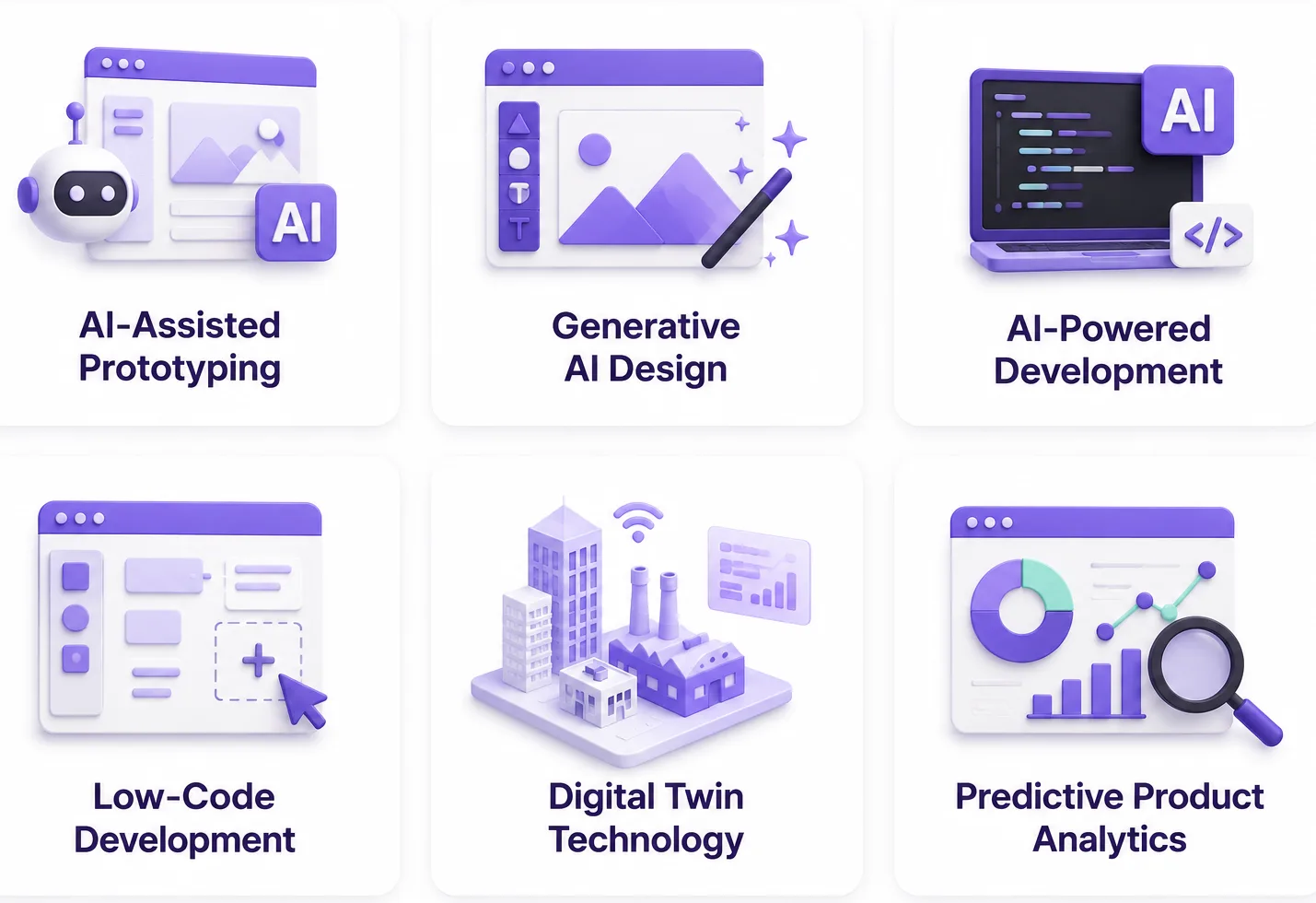
AI-Assisted Prototyping
Artificial Intelligence is transforming how designers create prototypes by generating layouts, recommending interface improvements, and automating repetitive design tasks. This allows product teams to create interactive prototypes much faster while exploring multiple design variations before selecting the most effective user experience.
Generative AI for Product Design
Generative AI enables businesses to transform product ideas into wireframes, interface concepts, user flows, and design systems within minutes. Rather than replacing designers, these tools accelerate early-stage ideation and free design teams to focus on creativity, usability, and strategic decision-making.
AI-Powered MVP Development
AI-powered MVP development is also reshaping software engineering by assisting with code generation, testing, debugging, documentation, and quality assurance. These capabilities enable businesses to reduce development timelines while improving overall productivity.
Low-Code and No-Code Development
Low-code platforms are enabling businesses to validate ideas much faster than traditional development approaches. Startups and enterprises increasingly use these platforms to build internal tools, pilot applications, and early MVPs while reducing engineering effort and accelerating experimentation.
Digital Twins
Digital twins are becoming increasingly valuable for validating products in manufacturing, healthcare, logistics, and industrial automation. By simulating real-world environments digitally, businesses can evaluate product performance before deploying solutions in live operational settings.
Product Analytics
Modern predictive analytics platforms provide deeper insights into customer behavior than ever before. Instead of relying solely on interviews or surveys, businesses can monitor engagement, retention, feature usage, and customer journeys in real time, allowing product teams to make faster and more informed decisions.

Conclusion
Understanding the differences between POC vs Prototype vs MVP helps businesses make informed product development decisions while reducing unnecessary risks and costs. Each stage serves a distinct purpose: POC validates technical feasibility, a Prototype refines the user experience and design, and an MVP tests market demand with real users. Rather than choosing one over another, successful businesses use these approaches strategically throughout the product development lifecycle to validate ideas, gather feedback, and optimize investments.
As digital products become more sophisticated with AI, automation, and evolving customer expectations, structured validation is more important than ever. Companies that test assumptions early, iterate based on user insights, and scale with confidence are far more likely to achieve long-term success and faster product-market fit.
Whether you’re building a new startup product or modernizing an existing solution, RipenApps provides end-to-end expertise from product discovery and prototyping to AI-powered MVP development, product scaling, and ongoing innovation, helping you transform ideas into successful, market-ready digital products.
FAQs
1. What is the difference between POC, Prototype, and MVP?
A Proof of Concept validates whether a product idea is technically feasible. A Prototype focuses on testing user experience, interface design, and workflows. An MVP is the first functional version of the product released to real users for market validation and customer feedback.
2. Is a POC necessary before building an MVP?
Not always. A POC is recommended when your product involves technical uncertainty, such as AI, Blockchain, IoT, or complex enterprise systems. If your idea uses proven technologies, you may move directly to a prototype or MVP depending on your business objectives.
3. Can a prototype become an MVP?
A prototype can serve as the design foundation for an MVP, but it cannot become an MVP on its own. A prototype primarily demonstrates user interactions, whereas an MVP includes production-ready functionality that customers can actually use.
4. How much does a prototype cost?
Prototype costs depend on design complexity, the number of screens, user flows, and interactive elements. On average:
- Basic clickable prototype: $2,000–$8,000
- Medium-complexity prototype: $8,000–$20,000
- Enterprise-grade or highly interactive prototype: $20,000–$50,000+
The final cost varies based on design fidelity, revisions, animations, and user testing requirements.
5. What is the cost of MVP development?
The cost of MVP development varies based on factors such as the number of features, technology stack, platform selection, third-party integrations, UI/UX complexity, and the location of the development team. On average, a basic MVP with essential features typically costs between $15,000 and $40,000, while a mid-level MVP ranges from $40,000 to $100,000.
For complex or enterprise-grade MVPs that include advanced functionalities such as AI, real-time communication, or extensive integrations, costs generally start at $100,000 and can exceed $300,000. Choosing cross-platform development can help reduce overall expenses, whereas custom features and higher scalability requirements may increase the budget.
6. Which comes first: Prototype or MVP?
In most product development journeys, a prototype comes before an MVP. The prototype validates usability and interface design, while the MVP validates customer demand with a working product. However, products involving emerging technologies may begin with a POC before prototype development.
7. What is a Proof of Concept used for?
A Proof of Concept is used to validate technical feasibility before investing in full-scale product development. It is particularly valuable for Artificial Intelligence, Machine Learning, Blockchain, healthcare technology, enterprise software, and IoT solutions where engineering risks are relatively high.
8. Which approach is best for startups?
The best approach depends on the startup’s product idea. Technology-driven startups often benefit from beginning with a POC, while many digital startups move directly from prototyping to MVP development.
9. How long does it take to build an MVP?
The timeline depends on feature scope, technical complexity, integrations, and team size. Most MVPs are completed within a few months, although larger enterprise applications may require additional time.
10. How do I choose the right product development approach?
Start by identifying your biggest uncertainty. If you need to validate technology, build a POC. If your priority is testing user experience, create a prototype. If you’re ready to validate market demand, launch an MVP.
SHARE
WRITTEN BY

Prankur Haldiya
Chief Technical Officer
A tech innovator and engineering leader, Prankur Haldiya drives RipenApps’ product development strategy and oversees cutting-edge solutions in mobility, AI, and cloud ecosystems. He is passionate about building high-performance teams and helping brands launch secure, scalable, and user-centric digital products.
View All Articles


 India
India USA
USA Australia
 Canada
 UK
UK UAE
UAE