


Key Takeaways
- Custom fleet software can provide greater control over workflows, integrations, data, and scalability than standard SaaS.
- Core features include GPS tracking, route optimization, maintenance, driver management, fuel tracking, compliance, and reporting.
- Modern platforms can extend capabilities through AI-powered maintenance, telematics, IoT integrations, and EV fleet support.
- A scalable architecture separates web and mobile applications, backend services, real-time processing, and telematics data.
- Fleet management software development can cost $80,000–$300,000+, depending on features, integrations, complexity, and scale.
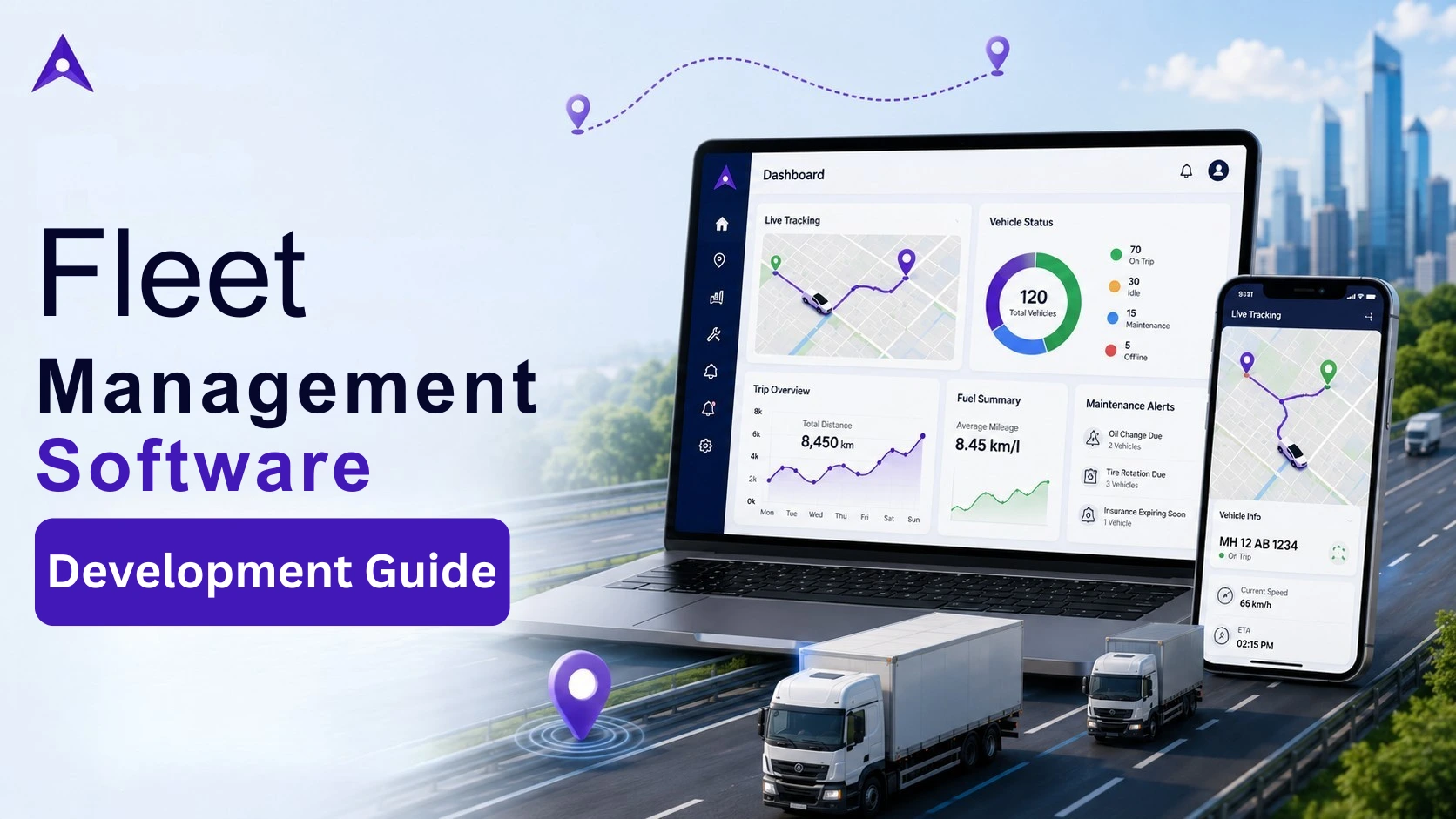
Managing a growing fleet requires more than tracking vehicles on a map. Dispatchers need real-time visibility, drivers need reliable mobile workflows, and managers need actionable operational data. Off-the-shelf fleet platforms can cover standard requirements, but specialized workflows, complex integrations, and per-vehicle pricing can create limitations as operations scale.
Custom fleet management software gives businesses greater control over workflows, integrations, data, and future scalability. It can connect GPS tracking, route optimization, driver management, maintenance, telematics, compliance, and analytics in one platform.
Building these capabilities requires the right architecture, integrations, and software development services to support operational requirements and long-term scalability. This guide explains how fleet management software is developed, which features and technologies matter, what the development process involves, and how much a custom fleet platform can cost.
Table of Contents
What Is Fleet Management Software Development?
Fleet management software development involves building a digital platform that helps businesses manage vehicles, drivers, routes, maintenance, fuel, compliance, tracking, and operational reporting. A modern fleet platform typically combines a web dashboard, driver mobile application, backend services, databases, mapping services, and telematics integrations.
These components work together to turn vehicle and operational data into actionable information for dispatchers, fleet managers, drivers, maintenance teams, and business leaders. Custom development allows companies to adapt these capabilities around their workflows instead of changing operations around predefined SaaS functionality.
Why Companies Build Custom Fleet Software Instead of Buying SaaS?
Businesses are continuing to increase technology investment as software becomes more central to operational efficiency. SaaS can be appropriate when workflows are standardized and fast deployment matters most. Custom development becomes more attractive when operations require specialized workflows, integrations, data ownership, or long-term flexibility.
The decision should therefore consider more than the initial development cost. Companies should compare subscription expenses, customization limitations, integration requirements, operational complexity, scalability, and long-term ownership before selecting an approach.
Fleet operations often overlap with dispatch, shipment management, delivery workflows, and third-party logistics systems. Businesses evaluating these broader requirements can also explore this logistics app development guide for a wider view of logistics platform development.
Where off-the-shelf tools hit their limits
Generic fleet platforms are designed to support common operational requirements across many businesses. That makes them convenient, but standardization can become restrictive when a company has unique workflows or technology requirements.
Common limitations include:
- Fixed workflows that cannot fully match internal processes.
- Limited integration options for proprietary business systems.
- Per-vehicle or per-user pricing that increases with fleet growth.
- Restricted control over data architecture and storage.
- Limited customization for specialized reports and analytics.
- Dependence on the vendor’s product roadmap.
- Difficulties integrating proprietary telematics or hardware.
- Workarounds for specialized dispatch, billing, or compliance workflows.
Custom software removes many of these constraints by making the business requirements part of the product architecture. However, custom development also introduces responsibility for development, infrastructure, security, maintenance, and future enhancements.
The goal is therefore not to prove that custom software is always better. The goal is to determine whether customization creates enough operational or commercial value to justify the additional investment.
Custom vs. SaaS comparison
A quick comparison of custom fleet software and SaaS across cost, flexibility, integrations, scalability, and ownership.
| Decision factor | Custom Fleet Software | Fleet Management SaaS |
| Initial investment | Higher | Lower |
| Time to launch | Longer | Faster |
| Workflow flexibility | Very high | Usually limited |
| Integrations | Built around business requirements | Depends on available integrations |
| User experience | Fully customizable | Vendor-defined with configuration |
| Data control | Greater control | Vendor-dependent |
| Pricing at fleet scale | Development and infrastructure costs | Often subscription or usage-based |
| Product roadmap | Business-controlled | Vendor-controlled |
| Specialized functionality | Easier to build | May require workarounds |
| Scalability | Architecture-controlled | Depends on vendor capabilities |
| Maintenance | Business responsibility | Vendor responsibility |
| Best suited for | Complex or differentiated operations | Standard fleet workflows |
SaaS is often the better option when a business has standard requirements and wants to launch quickly. Custom development becomes more compelling when software needs to support proprietary processes, multiple systems, specialized analytics, or a differentiated operating model.
A company should also compare the five-year total cost of ownership, rather than comparing subscription fees with development costs alone.
Core Features of Fleet Management Software
Fleet management software typically includes GPS tracking, route optimization, vehicle maintenance, driver management, fuel tracking, compliance, reporting, alerts, and mobile applications.
The required feature set depends on fleet size, vehicle types, operating model, geographic coverage, and business workflows.
| Feature module | Core capabilities | Primary users |
| Vehicle tracking | GPS location, trip history, geofencing | Fleet managers, dispatchers |
| Route management | Planning, optimization, ETA tracking | Dispatchers, drivers |
| Maintenance | Service schedules, inspections, repair history | Maintenance teams |
| Driver management | Profiles, assignments, behavior monitoring | Fleet managers |
| Fuel management | Consumption, transactions, efficiency | Operations, finance |
| Compliance | ELD, HOS, inspections, reports | Compliance teams |
| Analytics | KPIs, dashboards, operational reports | Managers, executives |
| Driver mobile app | Tasks, navigation, status updates | Drivers |
| Alerts | Exceptions, delays, maintenance notifications | Operations teams |
GPS tracking & real-time vehicle visibility
GPS tracking gives fleet managers real-time visibility into vehicle locations and movement. A tracking module can display vehicle location, speed, trip status, driver assignment, route progress, and estimated arrival time.
Geofencing can trigger events when vehicles enter or leave predefined locations. These events can support arrival notifications, unauthorized movement alerts, customer updates, and operational reports. Geofences can also support workflow automation, such as marking a delivery stop as arrived or notifying a dispatcher when a vehicle leaves a service area.
The business value extends beyond seeing vehicles on a map. Dispatchers can identify delayed vehicles, reassign nearby resources, investigate route deviations, and provide more accurate arrival information. Managers can also compare planned routes with actual movement to identify recurring delays or inefficient operating patterns.
The system should handle temporary connectivity loss. Mobile applications and supported telematics devices can cache relevant events locally and synchronize them when connectivity is restored. Location data should also be processed at an appropriate frequency so the platform balances real-time visibility with device battery use, network traffic, and infrastructure costs.
Route planning & optimization
Route management helps dispatchers assign vehicles and drivers according to operational requirements. Basic routing can calculate routes between multiple destinations. Advanced optimization can consider traffic, vehicle capacity, delivery priorities, driver availability, service windows, and historical travel patterns.
For commercial fleets, routing should also account for vehicle-specific restrictions. These can include truck dimensions, weight limits, road restrictions, bridge clearances, and hazardous-material requirements where applicable. The platform can recalculate routes when conditions change. For example, a road closure or delayed delivery can trigger route adjustments and send updated instructions to the driver application.
Advanced optimization should not focus only on distance. A useful routing engine balances travel time, fuel consumption, vehicle restrictions, service commitments, driver availability, and operational priorities. For delivery operations, the system can also prioritize stops according to promised delivery windows and business rules instead of treating every destination equally.
Route optimization becomes especially valuable when dispatchers manage many vehicles or changing schedules. The platform can provide recommended assignments while allowing authorized users to override automated decisions when operational conditions require manual intervention.
Maintenance scheduling & vehicle health
Fleet maintenance has become a growing cost consideration for U.S. trucking operations. ATRI reported that fleet repair and maintenance costs increased 8.6% in 2025, making it the second-largest cost increase among the report’s major operating-cost categories.
The same analysis found that toll costs increased 13.2% and tire costs rose 6.4%, further highlighting the need for better visibility into vehicle operating expenses.
Fleet management software can help operators track service schedules, inspections, repair history, mileage, and maintenance costs in one system. This gives maintenance teams better visibility into upcoming requirements and helps managers identify recurring expenses across vehicles.
A maintenance module can also connect scheduled servicing with mileage, engine hours, diagnostic information, and vehicle utilization. Managers can see which vehicles are approaching service thresholds, while maintenance teams can assign work, record completed repairs, and maintain a history for each vehicle. This creates a shared operational record instead of relying on spreadsheets or disconnected maintenance systems.
Driver management & behavior monitoring
Driver management brings profiles, assignments, schedules, performance, and operational records into one system. A fleet platform can maintain driver credentials, assigned vehicles, trip histories, schedules, and performance metrics.
Driver behavior monitoring can track events such as speeding, harsh braking, rapid acceleration, excessive idling, and route deviations. These insights should support coaching and operational improvement rather than simply generating alerts.
The driver application can provide assigned jobs, navigation, delivery instructions, communication, vehicle inspections, and status updates. The mobile experience should remain simple because drivers need to complete tasks while working in the field. Offline capabilities can also help when drivers operate in areas with unreliable connectivity.
Fuel management
Fuel can represent a significant operating expense for commercial fleets. Fleet software can record fuel transactions and compare consumption across vehicles, drivers, routes, and time periods. Fuel-card integrations can reduce manual data entry and improve transaction visibility.
Telematics data can provide additional context by connecting fuel consumption with mileage, idle time, vehicle utilization, and driving behavior. Managers can then identify abnormal consumption patterns and investigate potential causes.
Fuel analytics becomes more valuable when combined with route optimization and driver-performance data. This allows businesses to measure fuel efficiency as an operational KPI rather than treating fuel records as isolated financial transactions. The platform can also surface vehicles with unusual consumption so operations teams can investigate maintenance issues, excessive idling, inefficient routes, or other causes.
Compliance & reporting (ELD, FMCSA)
U.S. fleet software may need to support operational workflows affected by federal and state transportation requirements. Electronic logging devices are particularly important for applicable commercial drivers required to maintain records of duty status.
FMCSA states that applicable drivers must use compliant ELDs and that the ELD rule includes requirements covering technical specifications, certification, registration, and supporting documentation. A fleet platform can integrate with compliant ELD providers to receive relevant operational data.
The platform should not assume that fleet-management functionality itself satisfies ELD requirements. FMCSA distinguishes ELD requirements from broader fleet-management functionality.
Compliance-related functionality can include:
- Hours-of-service information.
- ELD data integration.
- Driver qualification records.
- Inspection records.
- Maintenance documentation.
- Compliance alerts.
- Exception management.
- Audit-ready reporting.
FMCSA also requires motor carriers to systematically inspect, repair, and maintain commercial motor vehicles under their control. Because requirements can vary by operation and change over time, compliance requirements should be validated against current regulations during product discovery.
Advanced Features That Set Modern Fleet Platforms Apart
Advanced capabilities can extend a fleet platform beyond basic tracking and administration. These features are not mandatory for every fleet. They become valuable when vehicle connectivity, operational scale, predictive analytics, or electrification creates a strong business case for additional capabilities.
AI-powered predictive maintenance
Predictive maintenance uses historical and real-time vehicle data to identify patterns associated with potential failures. Models can consider diagnostic codes, mileage, engine hours, maintenance history, driving behavior, and other available signals.
Instead of waiting for a vehicle breakdown, the system can identify potential maintenance requirements earlier. The platform can prioritize alerts according to probability, severity, vehicle importance, and operational impact.
This can help maintenance teams schedule service around operating requirements and reduce unexpected downtime. AI recommendations should also remain explainable enough for maintenance teams to understand why an alert was generated.
Telematics & IoT integration
Telematics connects vehicles with software through GPS, onboard systems, sensors, and communication networks.
Connected devices can provide information such as:
- Vehicle location.
- Engine diagnostics.
- Fuel consumption.
- Mileage.
- Engine hours.
- Driver behavior.
- Vehicle utilization.
- Temperature.
- Battery information.
- Sensor events.
This can make it easier to add or replace telematics providers without changing the core fleet application. It also allows high-frequency telemetry processing to operate independently from ordinary business transactions. Telematics is one part of the broader connected-operations ecosystem. For a deeper look at how connected devices support transportation and supply-chain operations, explore IoT in logistics and supply chain management.
EV fleet support
Electric vehicles are becoming increasingly relevant to commercial fleet planning. Electric trucks accounted for 9% of global truck sales in 2025, while electric heavy freight truck sales nearly tripled year over year, rising from 84,000 to a record 230,000 units, according to the IEA’s Global EV Outlook 2026.
The broader transition is also reflected in fleet growth. The IEA projects that the global electric vehicle fleet, excluding two- and three-wheelers, could grow more than sixfold by 2035 to around 510 million vehicles.
For fleet management platforms, this shift creates new requirements around battery state of charge, charging sessions, energy consumption, charging locations, estimated range, and charging costs.
Route planning may also need to account for vehicle range and charging availability. As electric fleets expand, software can combine vehicle availability, battery levels, charging capacity, delivery requirements, and route constraints to support more practical dispatch decisions.
Fleet Management Software Tech Stack
A fleet platform requires an architecture capable of supporting applications, APIs, real-time events, location data, external integrations, analytics, and security.
The technology stack should be selected according to fleet size, expected data volume, integrations, performance requirements, and development capabilities.
| Architecture Layer | Common Technologies | Purpose |
| Web application | React, Angular, TypeScript | Fleet dashboards and administration |
| Mobile application | React Native, Flutter, native Android/iOS | Driver workflows |
| Backend | Node.js, Java, .NET, Python | Business logic and APIs |
| API layer | REST, GraphQL, WebSockets | Application communication |
| Database | PostgreSQL, MySQL, MongoDB | Operational data |
| Real-time processing | WebSockets, Kafka, Redis | Events and live updates |
| Maps | Google Maps, Mapbox, HERE | Mapping and routing |
| Telematics | GPS, ELD, OBD-II, CAN bus APIs | Vehicle data |
| Cloud | AWS, Azure, Google Cloud | Infrastructure |
| Analytics | Data warehouse, BI, ML services | Reporting and predictions |
| Security | OAuth 2.0, encryption, RBAC | Access and protection |
The final technology choices should follow architecture requirements rather than technology trends. The stack should be evaluated against expected vehicle count, telemetry frequency, concurrent users, offline requirements, integration complexity, reporting needs, security requirements, and the team’s ability to maintain the platform. For example, a smaller fleet may work well with a modular backend, while higher event volumes may justify separate real-time processing and telemetry services. Fleet software is also part of a wider shift toward technology-enabled supply chains, where connected systems improve visibility, coordination, and operational decision-making. Learn more about technology in supply chain management.
Application layer (web dashboard + driver mobile app)
The application layer provides interfaces for fleet managers, dispatchers, administrators, maintenance teams, and drivers. The web dashboard can provide live maps, vehicle status, driver assignments, alerts, reports, maintenance schedules, and operational KPIs.
The driver mobile application should focus on field workflows. Typical functions include job assignments, navigation, trip status, proof of delivery, communication, inspections, and incident reporting.
The application should consume processed information through secure APIs rather than processing high-volume telemetry directly. This separation helps keep user interfaces responsive while backend services process operational data.
Backend & real-time data processing
The backend manages authentication, permissions, business rules, integrations, notifications, data processing, and operational workflows. A modular architecture can work well for smaller platforms.
As data volume and operational complexity increase, selected services may require independent scaling. For example, telemetry ingestion can receive thousands of events while administrative workflows generate fewer requests.
Separating these workloads prevents high-frequency vehicle data from affecting ordinary application transactions. WebSockets can deliver live vehicle updates to dashboards without continuous page refreshes.
Message brokers can process large event streams and distribute telemetry events across services. Caching can improve response times for frequently accessed information such as vehicle status and operational dashboards. The database architecture should also separate high-volume telemetry data from ordinary business transactions when scale requires it.
When to use modular architecture vs. microservices
The architecture should match the fleet’s current scale and expected growth. A modular backend can be sufficient for smaller fleets with moderate telemetry volumes and a limited number of integrations. It keeps development and deployment simpler while allowing business modules such as vehicles, drivers, maintenance, routing, and reporting to remain logically separated.
Microservices become more useful when different parts of the platform have significantly different scaling or deployment requirements. For example, telemetry ingestion may need to process a high volume of vehicle events, while maintenance or administrative services may handle fewer requests. Separating these workloads allows individual services to scale independently and reduces the risk of high-frequency telemetry affecting core business operations.
The decision should not be based on fleet size alone. Expected event volume, integration complexity, team capabilities, deployment requirements, and long-term product plans should determine whether a modular or distributed architecture is appropriate.
IoT / Telematics Layer (OBD-II, CAN bus, GPS ingestion)
The telematics layer connects physical vehicles with the software platform. Depending on the use case, data can come from GPS devices, ELDs, OBD-II interfaces, CAN bus systems, sensors, mobile devices, or third-party telematics providers.
OBD-II can provide diagnostic information from compatible vehicles. CAN bus data can expose deeper vehicle-system information when supported by the vehicle and hardware.
Not every vehicle or device exposes identical data. Device compatibility, data formats, transmission frequency, connectivity, and provider APIs should therefore be validated before implementation.
A typical data flow is:
Vehicle or device – Telematics provider – Data ingestion – Processing – Storage – Fleet application
This architecture separates hardware integrations from business-facing applications. It also makes future provider changes easier because the ingestion layer can normalize different data formats into a common internal model.
Fleet Management Software Development Process: 7 Steps
Fleet management app development typically involves both a web platform for managers and a mobile application for drivers. A structured approach reduces unnecessary development and helps validate the most valuable workflows before large-scale investment. Following a custom software development guide can also help businesses define requirements, choose the right technology, and plan development around specific fleet operations.
- Define fleet requirements and business workflows: Document fleet size, vehicle types, users, routes, dispatch rules, maintenance workflows, compliance requirements, and existing systems. This stage should identify who uses the platform, what decisions they make, which systems already hold operational data, and where manual work creates delays or errors. Mapping the current workflow gives the development team a practical baseline for defining the product scope.
- Prioritize the MVP feature set: Select the workflows that provide immediate value, such as vehicle management, GPS tracking, driver management, routing, maintenance, and reporting. The MVP should solve a clearly defined operational problem rather than attempt to reproduce every capability of a mature fleet platform. Advanced analytics, predictive maintenance, complex optimization, and additional integrations can be phased in after the core workflows are validated.
- Design user journeys and system architecture: Map dispatcher, driver, manager, maintenance, and administrator workflows before finalizing application architecture. This includes defining web and mobile responsibilities, user roles, API boundaries, data models, real-time requirements, and the way telematics data will move through the platform. Architecture decisions should account for expected fleet size and event volume so the system does not need major structural changes as usage grows.
- Build integration and backend foundations: Develop APIs, databases, authentication, business services, mapping integrations, and telematics ingestion capabilities. External systems such as GPS, ELD, fuel-card, mapping, ERP, or dispatch providers may expose different data formats and update frequencies. An integration layer can normalize these inputs before they reach business-facing services, making the platform easier to maintain when providers or requirements change.
- Develop web and mobile applications: Build the fleet dashboard and driver application around validated workflows and role-specific requirements. Managers and dispatchers may need live maps, assignments, alerts, reports, and operational KPIs, while drivers need fast access to jobs, navigation, inspections, status updates, and communication. Mobile workflows should also account for offline conditions, device permissions, synchronization, and practical field usage.
- Test real-world fleet scenarios: Test location accuracy, connectivity failures, high event volumes, route changes, device compatibility, security, permissions, and compliance workflows. Testing should use realistic operating conditions rather than only standard functional cases. Teams should also validate telemetry frequency, synchronization after connectivity loss, concurrent users, API failures, and behavior during traffic or route changes.
- Launch, monitor, and continuously optimize: Release incrementally, monitor performance and adoption, resolve issues, and prioritize improvements using operational data. A pilot with a limited vehicle group can expose workflow, connectivity, hardware, and adoption problems before a wider rollout. After launch, product teams can use usage patterns, operational KPIs, support issues, and fleet-manager feedback to decide which features and integrations should be developed next.
What should a fleet management MVP include?
A practical MVP should focus on workflows that solve immediate operational problems. For a mid-market fleet, the initial release can include:
- Vehicle management.
- GPS tracking.
- Driver management.
- Route planning.
- Basic maintenance scheduling.
- Driver mobile application.
- Alerts.
- Basic reporting.
- Core third-party integrations.
Advanced features can follow after the MVP demonstrates adoption and operational value. These can include predictive maintenance, advanced telematics, AI route optimization, EV management, advanced analytics, and additional integrations.
A phased approach allows businesses to validate the product before committing to the full platform scope. A pilot with a limited number of vehicles can also reveal issues with connectivity, device compatibility, driver adoption, and operational workflows.
How Much Does Fleet Management Software Development Cost?
Fleet management software development can cost approximately $80,000 to $300,000+, depending on functionality, integrations, real-time processing, architecture, and customization.
| Scope | Estimated cost | Timeline |
| Fleet MVP | $80K–$120K | 3–5 months |
| Mid-complexity platform | $120K–$200K | 5–8 months |
| Advanced custom platform | $200K–$300K+ | 8–12+ months |
Custom fleet management software typically costs $80,000–$300,000+, while hardware-heavy enterprise telematics implementations can exceed these ranges and fall outside the scope of a typical mid-market fleet software build. These are planning ranges rather than fixed project quotations. The final estimate depends on the number of applications, users, vehicles, integrations, data volume, compliance requirements, analytics capabilities, and infrastructure expectations.
What drives fleet management software development cost?
| Cost factor | Lower complexity | Higher complexity |
| GPS tracking | Standard mapping API | Multiple telematics providers |
| Mobile application | Basic driver workflows | Offline and advanced workflows |
| Routing | Standard routing API | Custom optimization |
| Integrations | Few APIs | Multiple business and vehicle systems |
| Analytics | Standard dashboards | Predictive analytics |
| Compliance | Basic reporting | Advanced ELD and compliance workflows |
| Architecture | Modular application | Distributed or microservices architecture |
| Data volume | Limited fleet | High-frequency telemetry |
| User roles | Few roles | Complex permissions and organizations |
For example, integrating one standard mapping API is considerably different from building a multi-provider telematics ingestion platform. Similarly, basic route calculation is less complex than optimization involving vehicle capacity, time windows, driver availability, traffic, and operational constraints.
The development estimate should therefore be based on functional scope and technical complexity, not screen count alone. A phased development model can reduce upfront investment. The business can launch the highest-value workflows first, measure operational outcomes, and then expand the platform based on validated requirements.
What does each development cost range typically include?
A fleet management MVP in the $80,000–$120,000 range typically focuses on essential workflows such as vehicle management, GPS tracking, driver management, basic routing, maintenance scheduling, alerts, reporting, and a driver mobile application. The number of integrations and the level of real-time processing are usually limited.
A $120,000–$200,000 platform can support more complex operational requirements. This may include advanced routing, offline mobile workflows, multiple third-party integrations, richer dashboards, role-based permissions, expanded reporting, and more sophisticated backend processing.
An advanced platform costing $200,000–$300,000+ may involve high-volume telematics ingestion, multiple vehicle or data providers, advanced route optimization, predictive analytics, complex compliance workflows, distributed architecture, and extensive integration requirements.
These ranges should be treated as planning benchmarks rather than fixed prices. A platform with fewer screens can still cost more when it requires complex real-time processing, hardware integrations, advanced optimization, or high data volumes.
Common Challenges (and How to Avoid Them)
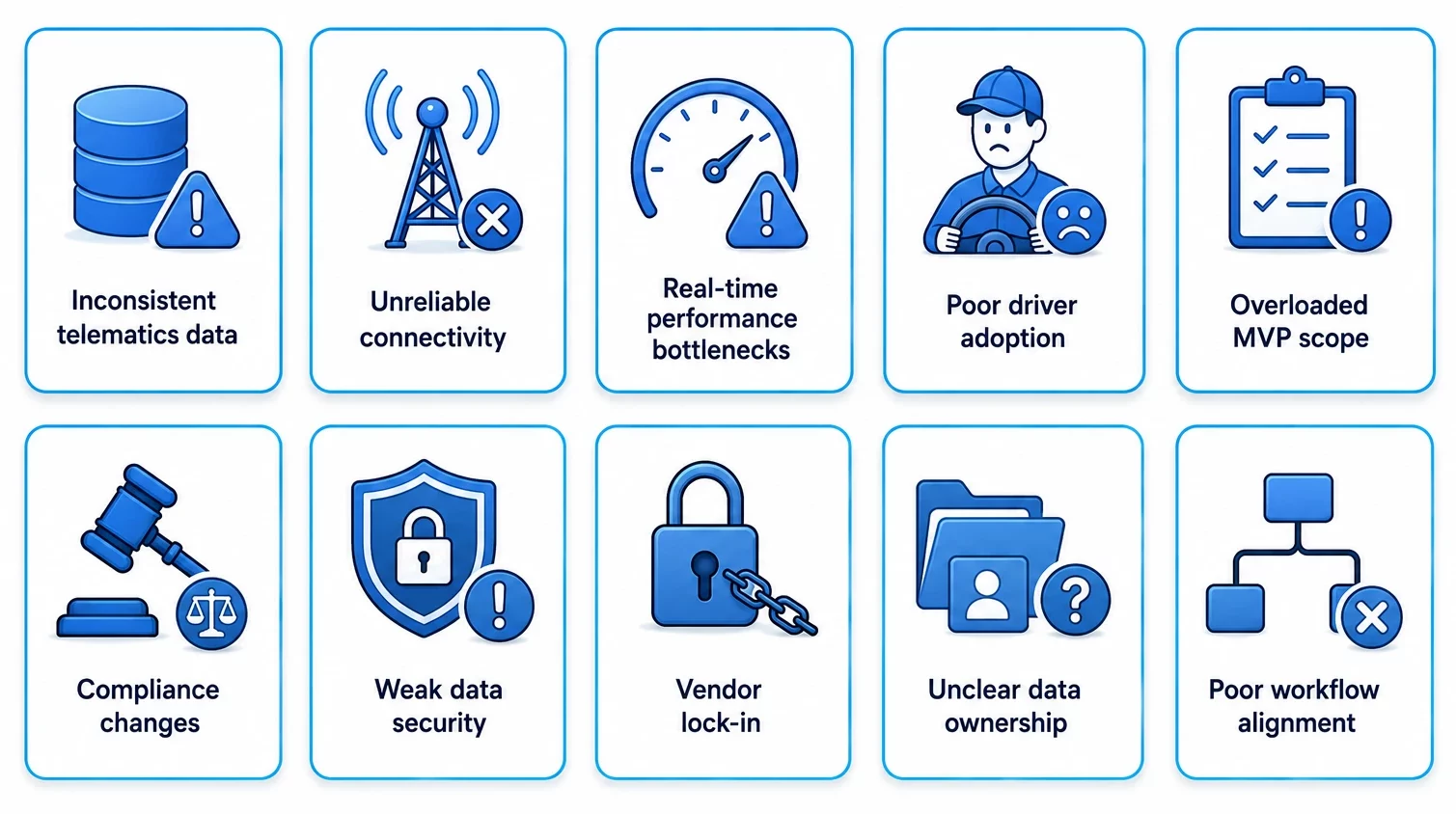
Fleet platforms combine physical vehicles, mobile users, cloud systems, external APIs, and operational data. This combination creates technical and operational challenges that should be addressed during discovery and architecture planning.
- Inconsistent telematics data: Different providers can expose different formats, fields, frequencies, and device capabilities. Use a normalized data model and isolated integration layer.
- Unreliable connectivity: Drivers and vehicles can operate in areas with poor network coverage. Support local caching, queued events, retries, and synchronization.
- Real-time performance bottlenecks: Large fleets can generate high volumes of location and telemetry events. Use event-driven processing, queues, caching, and appropriate storage strategies.
- Poor driver adoption: Complicated mobile workflows can create resistance. Keep the driver application task-focused, fast, and simple.
- Overloaded MVP scope: Building every advanced capability simultaneously increases cost and delays validation. Prioritize workflows with measurable operational value.
- Compliance changes: Transportation requirements can change and may vary by operation. Keep compliance logic configurable and validate requirements against current regulations.
- Weak data security: Fleet platforms contain operational, employee, location, and business information. Apply encryption, role-based access, audit logging, secure APIs, and least-privilege access.
- Vendor lock-in: Heavy dependence on one telematics or mapping provider can create migration challenges. Use integration abstraction layers and maintain access to business-critical data.
- Unclear data ownership: Businesses should establish data ownership, retention, export, and vendor responsibilities before signing integration agreements.
- Poor workflow alignment: A technically sophisticated platform can still fail when it does not reflect how dispatchers, drivers, and managers actually operate.
Operational discovery should therefore happen before development begins. For businesses modernizing an existing fleet platform, software modernization services can help address outdated architecture, legacy integrations, and scalability limitations while preserving critical operational workflows.
How RipenApps Approaches Fleet & Logistics Software Development
Fleet software requires experience across application development, logistics workflows, real-time data, integrations, and scalable backend architecture.
A successful fleet platform also needs to connect operational requirements with the right application architecture, integrations, and technology choices.
MVLoad demonstrates RipenApps’ experience with real-time logistics tracking, multi-provider API integration, and scalable cloud architecture.
MVLoad: Real-Time Logistics Platform Development
MVLoad is a custom logistics platform developed to streamline shipping operations across India and beyond. The platform provides instant price comparisons, shipment bookings, and real-time tracking. The platform now supports 50K+ active users, 1M+ shipments, 400+ active transport partners, and a 30% reduction in costs, highlighting its ability to handle growing logistics operations.
The project involved integrating multiple logistics APIs, enabling real-time price comparisons, supporting shipment bookings, and providing GPS-enabled tracking. The platform was also designed using a cloud-based microservices architecture to support performance during peak loads. The case study states that the system was designed to handle thousands of shipment requests simultaneously.
MVLoad is not a dedicated fleet-management platform. Its relevance to fleet software development comes from the underlying logistics capabilities it demonstrates, including real-time tracking, third-party integrations, operational workflows, and scalable backend architecture.
A dedicated fleet platform may require additional capabilities such as ELD integration, driver compliance, vehicle maintenance, fuel management, telematics ingestion, and fleet-specific analytics. This experience gives RipenApps relevant exposure to the integration and scalability challenges involved in building connected logistics platforms.
Conclusion
For fleet operators, the decision to build custom software should come down to operational complexity, integration requirements, and long-term scalability. Standard SaaS can work well for common fleet workflows, but businesses with specialized processes may need greater control over their systems and data.
A practical approach is to start with the workflows that create the most operational value, then expand the platform as requirements grow. RipenApps, as a reliable logistics app development company, can help translate complex fleet workflows into practical software solutions while keeping architecture, integrations, and future growth in consideration. The goal is not to build every possible fleet feature at once. It is to create a reliable platform that solves current operational challenges while providing the flexibility to support future fleet growth.
FAQs
Q1. What is fleet management software development?
Fleet management software development involves building software that manages vehicles, drivers, routes, maintenance, fuel, tracking, compliance, and operational reporting.
Q2. How much does fleet management software development cost?
Custom fleet management software typically costs around $80,000 to $300,000+, depending on features, integrations, architecture, real-time requirements, and development complexity.
Q3. How long does it take to build fleet management software?
A basic fleet MVP can take approximately three to five months, while advanced platforms may require eight to twelve months or longer.
Q4. What features should fleet management software have?
Core features include GPS tracking, route management, vehicle maintenance, driver management, fuel tracking, compliance, reporting, alerts, and driver mobile applications.
Q5. Should I build custom fleet management software or use SaaS?
Custom development is more suitable when workflows, integrations, data ownership, or scalability requirements exceed what standard SaaS platforms can provide.
Q6. How does ELD integration work with fleet management software?
Fleet platforms can integrate with compliant ELD providers to receive relevant hours-of-service and operational information through supported integration mechanisms.
Q7. Can fleet management software track vehicles in real time?
Yes. GPS and telematics integrations can provide location updates, route progress, vehicle status, geofencing events, and other operational information.
Q8. What technology is used to build fleet management software?
Typical stacks include React or Angular for web applications, React Native or Flutter for mobile applications, backend frameworks such as Node.js or Java, cloud infrastructure, databases, mapping APIs, and telematics integrations.
Discuss your project and request for proposal
SHARE
WRITTEN BY

Prankur Haldiya
Chief Technical Officer
A tech innovator and engineering leader, Prankur Haldiya drives RipenApps’ product development strategy and oversees cutting-edge solutions in mobility, AI, and cloud ecosystems. He is passionate about building high-performance teams and helping brands launch secure, scalable, and user-centric digital products.
View All Articles