



Key Takeaways
- FinTech SaaS requires multi-tenant architecture to securely separate customer data, users, permissions, configurations, and financial workflows.
- Compliance should shape product design early, covering KYC/AML, PCI DSS, SOC 2, GDPR/CCPA, and applicable licensing requirements.
- Features vary by financial business model, with lending, payments, wealth management, banking, insurtech, and regtech requiring different workflows.
- FinTech SaaS development costs vary significantly, depending on integrations, security, compliance, architecture, features, and overall product complexity.
- Custom development provides greater control, while white-label solutions can offer faster market entry with more limited flexibility.
Building a FinTech SaaS application requires more than combining financial features with a subscription model. A successful platform must support secure multi-tenancy, reliable financial workflows, third-party integrations, recurring billing, strong access controls, and regulatory requirements that vary by product and market.
For US-based FinTech founders and product leaders, the challenge is usually not deciding whether SaaS is attractive. It is determining what the platform needs, how much it will cost, how its architecture should work, and which compliance obligations must be addressed before launch.
This guide explains how to build a FinTech SaaS platform, from business models and must-have features to architecture, compliance, development cost, technology choices, and the decision between custom development and white-label FinTech solutions. For businesses evaluating a development partner, FinTech product development services can provide support across product strategy, architecture, development, integrations, and scaling.
Table of Contents
What is a FinTech SaaS Application?
A FinTech SaaS application is a cloud-based financial technology platform delivered to multiple business customers through subscription, usage-based, transaction-based, or hybrid pricing.
Unlike a conventional financial application built for one organisation or a consumer audience, a FinTech SaaS platform must support multiple tenants while keeping each customer’s users, data, configurations, permissions, and workflows logically isolated.
For example, a lending SaaS platform could allow several lenders to manage borrowers through the same core product while maintaining separate loan products, underwriting rules, dashboards, users, and reporting environments.
The commercial opportunity is also broader than a conventional app. McKinsey reported in 2026 that global FinTech generated approximately $650 billion in revenue in 2025, while highlighting scalability, profitability, and regulatory maturity as defining priorities for the next phase of FinTech growth. (McKinsey & Company)
For a business building a B2B or B2B2C financial product, SaaS can therefore provide a scalable delivery model, but only when the underlying architecture is designed for financial workloads from the beginning.
FinTech SaaS vs. Traditional FinTech Apps: What Changes When You Go SaaS?
| Area | Traditional FinTech App | FinTech SaaS Platform |
| Primary users | Consumers or one organisation | Multiple organisations and their users |
| Architecture | Application-focused | Multi-tenant |
| Revenue model | Transactions, fees or commissions | Subscription, usage, transaction or hybrid |
| Data structure | User-centric | Tenant, organisation, user and financial data |
| Access control | User roles | Tenant and role-level permissions |
| Billing | Usually transaction-oriented | Recurring subscription and usage billing |
| Administration | Basic administration | Tenant provisioning, billing, configuration and monitoring |
| Scalability | User growth | Tenant, user, transaction and workload growth |
| Customisation | Product-level | Tenant-level configuration |
| Security | Application security | Application plus tenant isolation and platform security |
The defining difference is multi-tenancy. A FinTech SaaS platform must allow multiple customers to use the same product without allowing their data or permissions to cross organisational boundaries.
This also changes the economics of development. Architecture decisions made early affect infrastructure costs, compliance scope, customer onboarding, maintenance, and the ability to introduce new financial products later.
FinTech SaaS Business Models: Lending, Payments, Wealth & More
A FinTech SaaS product can support different financial workflows depending on its target customers. The underlying SaaS model remains similar, but each vertical introduces different integrations, data requirements, workflows, and regulatory considerations.
Lending Software Development
Lending platforms use SaaS architecture to deliver configurable loan workflows for lenders, financial institutions, brokers, and alternative-credit providers. Core capabilities include borrower onboarding, KYC and AML checks, loan origination, credit scoring, underwriting, disbursement, repayment management, and collections. Lender and admin dashboards provide visibility into applications, loan status, portfolio performance, repayment activity, and risk indicators.
Credit bureau integrations enable credit assessment, while payment integrations handle disbursements and repayments. Multi-tenant platforms also support different eligibility rules, loan products, rates, approval workflows, and collection strategies for individual lenders.
For businesses investing in lending software development, configurable financial workflows and strict tenant isolation are essential. This allows multiple lenders to operate on the same core platform while keeping customer-specific financial data and business rules separated.
Payments
Payments SaaS development can provide transaction processing, merchant management, payment orchestration, reconciliation, reporting, and API access. Platforms can serve multiple businesses through configurable payment workflows and subscription plans.
Wealth Management
Wealth SaaS platforms handle portfolio management, client onboarding, investment dashboards, financial reporting, advisor-client communication, and portfolio analytics for financial organisations.
Banking-as-a-Service
Banking-as-a-Service platforms expose financial capabilities through APIs, enabling businesses to embed accounts, payments, cards, lending, and other banking services into their products.
Insurtech
Insurtech SaaS platforms manage policy administration, underwriting workflows, claims processing, customer management, and integrations with insurers and third-party data providers.
Regtech
Regtech platforms automate compliance workflows such as identity verification, transaction monitoring, reporting, risk assessment, and regulatory documentation.
Expense Management
Expense-management SaaS platforms combine corporate expenses, approvals, reimbursements, card transactions, policy controls, accounting integrations, and financial reporting.
Must-Have Features of a FinTech SaaS Platform
The feature set of a FinTech SaaS platform needs to satisfy both financial workflows and SaaS operating requirements. The core product should combine financial functionality with multi-tenant management, secure access, integrations, and operational controls.
Core Features
- Onboarding and KYC: Customer registration should include identity verification, document collection, customer due diligence, and risk-based checks where applicable.
- Payments and transactions: Payment initiation, transfers, refunds, transaction tracking, reconciliation, and transaction notifications form the core transaction layer for applicable FinTech products.
- Dashboards: Financial dashboards should surface balances, applications, transactions, portfolios, expenses, risk indicators, and other product-specific metrics.
- Reporting: Reporting tools should provide operational and financial visibility to customers, administrators, and internal teams.
- Notifications: Email, SMS, push, or in-app notifications should communicate verification requests, payment events, approvals, failures, and compliance actions.
SaaS-Specific Features
- Multi-tenancy: Tenant isolation should be built into the data model, authentication layer, authorisation system, APIs, and infrastructure from the beginning.
- Subscription billing: Subscription management should cover plans, recurring payments, invoices, upgrades, downgrades, usage-based charges, and failed-payment handling.
- Role-based access: Tenant administrators, managers, finance users, analysts, and other roles should have access levels aligned with their responsibilities.
- APIs: APIs should connect the platform with banking systems, payment providers, accounting tools, CRMs, credit bureaus, and other business systems.
- Tenant administration: Administrators should be able to create organisations, configure settings, manage users, monitor usage, and manage subscriptions.
Security and Trust Features
Security should be treated as a core product requirement. Important controls include encryption in transit and at rest, multi-factor authentication, secure secrets management, least-privilege access, audit logs, session controls, vulnerability testing, monitoring, backups, and disaster recovery.
For B2B customers, uptime commitments and service-level agreements are important purchasing criteria. Auditability is especially valuable because financial customers need evidence of who accessed data, changed configurations, approved transactions, or performed administrative actions.
The Compliance Stack: Regulations Your FinTech SaaS Must Meet
FinTech regulatory compliance depends on the product’s financial activities, customer type, data processed, payment flows, and target jurisdictions. There is no single compliance checklist that applies to every FinTech SaaS application.
| Requirement | Relevant Products | Key Considerations |
| KYC/AML | Lending, payments, money movement | Identity verification, customer due diligence, risk assessment, monitoring |
| PCI DSS | Applicable card-data environments | Protection of cardholder data and security controls |
| SOC 2 | B2B SaaS | Security, availability, confidentiality and related controls |
| GDPR | Products processing covered EU personal data | Lawful processing, data rights, governance and safeguards |
| CCPA/CPRA | Covered businesses handling California residents’ data | Consumer rights, disclosures, correction and deletion processes |
| State money-transmitter licensing | Applicable money-movement businesses | State licensing, capital, bonding and related requirements |
KYC and AML
For applicable financial institutions, customer identification and risk-based verification are core parts of the compliance framework. FFIEC guidance describes procedures for verifying customer identity and maintaining appropriate customer identification programs. AML controls can also include transaction monitoring and AI fraud detection mechanisms to identify suspicious activity and potential financial crime.
Businesses that qualify as money services businesses may also have FinCEN obligations. FinCEN identifies money transmitters as a category of MSB and outlines applicable BSA requirements.
PCI DSS
Where applicable, PCI DSS governs security requirements for environments handling payment card data. PCI Security Standards Council’s document library identifies PCI DSS v4.0.1 as the current version. The actual validation requirements depend on the payment environment and applicable scope.
SOC 2
SOC 2 is particularly relevant for FinTech SaaS providers selling to enterprise customers that require evidence of security and operational controls. The required control environment should be planned during architecture and development rather than treated as a final-stage audit exercise.
GDPR and CCPA/CPRA
Privacy requirements depend on the people whose data is processed and the organisation’s activities. A FinTech SaaS product should therefore define data collection, retention, access, deletion, consent, disclosure, and processing responsibilities during product planning.
State Money-Transmitter Licensing
US money movement can involve state-specific licensing obligations. The Conference of State Bank Supervisors reported in 2026 that 31 states had enacted the Money Transmission Modernization Act in full or in part, illustrating the importance of jurisdiction-specific analysis.
Compliance requirements should be validated with qualified legal and compliance professionals before launch. Software architecture should support those requirements, but it should not be presented as a substitute for legal advice. For a deeper security-specific discussion, see the FinTech app security guide.
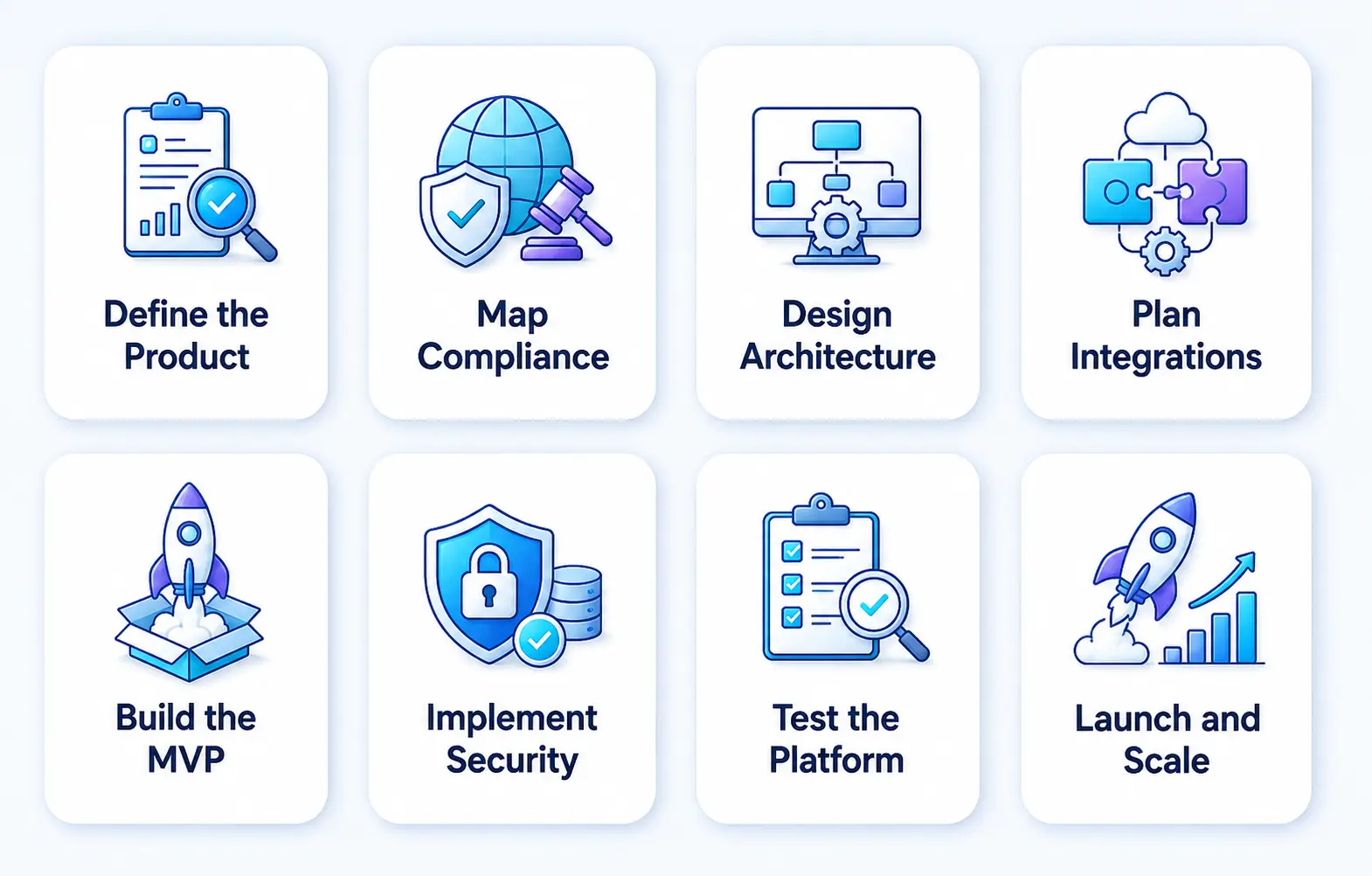
How to Build a FinTech SaaS Application in 8 Steps
1. Define the FinTech SaaS Product and Target Users
Start with the financial problem rather than the technology. Define whether the platform serves lenders, merchants, financial advisors, businesses, banks, insurers, or another customer group. Document the core workflows, target users, revenue model, target markets, initial integrations, and MVP boundaries.
2. Map Regulatory and Compliance Requirements
Identify the financial activities the platform will perform and the jurisdictions it will serve. Map KYC, AML, PCI DSS, privacy, security, licensing, reporting, and data-handling requirements to individual workflows. Also determine which responsibilities belong to your platform and which are handled by banking, payment, identity, or compliance partners.
3. Design the Multi-Tenant Architecture
Define how tenant data and configurations will be isolated. Common approaches include shared databases with tenant-level isolation, separate schemas, and database-per-tenant architectures. Select the model based on security requirements, compliance expectations, expected scale, and operational complexity. Design tenant-aware authentication, authorisation, APIs, storage, logging, billing, and monitoring from the beginning.
4. Plan Core FinTech Workflows and Integrations
Map every important financial workflow before implementation. Depending on the product, integrations may include payment gateways, banking APIs, KYC providers, AML systems, credit bureaus, accounting platforms, card networks, and notification services. For complex B2B platforms, enterprise application development services can help businesses architect these integrations around scalability, security, and reliability. APIs should include authentication, rate limiting, versioning, monitoring, error handling, and appropriate retry strategies.
5. Build the MVP
The MVP (Minimum Viable Product) should validate the highest-value financial workflow instead of attempting to reproduce an entire financial ecosystem. For example, a lending MVP could focus on borrower onboarding, KYC, loan applications, underwriting, approval, disbursement, and repayment tracking before adding advanced analytics or secondary integrations.
6. Implement Security and Compliance Controls
Implement security controls alongside product functionality. Use encryption, MFA, least-privilege access, secure API authentication, audit logging, secrets management, monitoring, vulnerability testing, backup strategies, and incident-response processes.
7. Test Transactions, Permissions, Integrations, and Reliability
FinTech testing must cover more than user interfaces. Test successful and failed transactions, duplicate requests, reversals, permission boundaries, tenant isolation, API failures, incomplete data, interrupted workflows, reconciliation, and recovery scenarios. Load testing should also simulate multiple tenants generating concurrent workloads.
8. Launch, Monitor, and Scale
After launch, monitor application performance, transaction failures, API latency, infrastructure consumption, security events, tenant activity, and subscription metrics. Use these signals to identify performance bottlenecks, integration failures, suspicious activity, and infrastructure requirements before they become customer-facing problems.
FinTech SaaS Development Cost: What to Budget
The cost of building a FinTech SaaS application depends on product complexity, number of integrations, compliance scope, security requirements, architecture, development team, and post-launch support. For initial budgeting, these ranges provide a practical starting point:
| Product Scope | Estimated Development Cost | Indicative Timeline |
| SaaS MVP | $80,000–$150,000 | 4–6 months |
| Production-ready platform | $150,000–$300,000 | 6–10 months |
| Advanced FinTech SaaS | $300,000–$600,000+ | 10–15+ months |
These are planning ranges, not fixed quotations. The biggest cost drivers are product discovery, UI/UX, backend architecture, multi-tenant infrastructure, financial integrations, KYC/AML providers, payment systems, security engineering, compliance preparation, QA, cloud infrastructure, and ongoing maintenance.
A platform with basic dashboards and limited integrations can remain closer to the lower range. A lending or payments platform with multiple financial integrations, advanced permissions, complex tenant configurations, transaction processing, compliance controls, and enterprise security requirements can move significantly higher.
Unlike , FinTech app development costs are influenced by mobile platforms, app features, third-party integrations, security requirements, and device compatibility. A mobile FinTech product may also require native capabilities, app-store compliance, and additional testing across devices and operating systems. As a result, the development scope and overall investment can differ significantly from a multi-tenant SaaS platform.
Build vs. White-Label FinTech: Which Route Fits You?
The choice between custom development and white-label FinTech comes down to the level of control, differentiation, flexibility, and ownership your business requires.
| Decision Factor | Custom Build | White-Label |
| Time to market | Longer | Faster |
| Differentiation | High | Limited by provider |
| Custom workflows | High flexibility | Provider-dependent |
| Architecture control | High | Limited |
| Integration flexibility | High | API/provider-dependent |
| Product ownership | Strong | Contract-dependent |
| Upfront investment | Higher | Usually lower |
| Long-term flexibility | High | Depends on provider |
Choose white-label when speed to market is the priority and the provider already covers your required financial workflows. Choose custom app development comapny when your product requires proprietary business logic, differentiated user experiences, unique integrations, configurable financial workflows, or long-term platform ownership.
Before choosing white-label, evaluate provider security, data ownership, API limitations, compliance responsibilities, service-level commitments, pricing changes, and exit options.
Technology Stack for a FinTech SaaS Platform
The right technology stack is a critical part of FinTech software development, as it should align with product requirements, transaction volume, security needs, integrations, and expected growth.
- Frontend: React is well suited for complex financial dashboards, while Angular is a strong choice for enterprise applications requiring a structured frontend architecture.
- Backend: Node.js fits API-heavy platforms and real-time workflows, while Java or .NET can be preferable for enterprise environments with established backend ecosystems.
- Database: PostgreSQL is a strong fit for transactional workloads, while MySQL can suit applications with existing MySQL infrastructure and requirements.
- Cloud: AWS, Azure, and Google Cloud Platform all provide the infrastructure required for secure, scalable FinTech SaaS platforms. The choice should depend on existing infrastructure, compliance requirements, regional availability, and team expertise.
- APIs: REST is generally straightforward for financial integrations, while GraphQL is useful when clients require flexible data querying across complex interfaces.
- Security: IAM, encryption, MFA, secrets management, logging, monitoring, vulnerability testing, and automated security controls should be incorporated into the architecture.
How RipenApps Builds FinTech SaaS Products
FinTech SaaS development requires product strategy, secure architecture, financial integrations, compliance-aware engineering, and scalable infrastructure. At RipenApps, we bring these capabilities together to build financial products designed around secure transactions, reliable integrations, and evolving business requirements.
The Al Muzaini project demonstrates our experience delivering a regulated financial product. The digital remittance and money-transfer platform delivered 100K+ downloads, 50K+ active users, a 4.1-star rating, and a #1 FinTech app ranking in Kuwait in seven months.
The platform included three-factor authentication, biometric login, AI-powered KYC verification, real-time exchange rates, and high-speed API integrations with banking networks and Western Union. These capabilities demonstrate RipenApps’ experience building secure financial workflows, integrating third-party financial systems, and delivering products designed for real-world FinTech users.
Final Thoughts
A FinTech SaaS application needs to balance financial functionality with SaaS scalability, multi-tenant architecture, security, integrations, and regulatory requirements. The most reliable approach is to define the financial workflow first, map compliance requirements early, design tenant isolation into the architecture, and validate the highest-value functionality through an MVP.
The right development strategy also depends on the product’s financial model. Lending platforms need configurable underwriting and repayment workflows. Payments products need resilient transaction and reconciliation infrastructure. Wealth, banking, insurtech, and regtech platforms each introduce their own requirements.
For businesses moving from research to vendor evaluation, choosing a development partner with proven FinTech delivery experience can reduce technical and implementation risk. Explore custom SaaS development services to discuss your FinTech SaaS product, architecture, compliance scope, and development roadmap.

FAQs
1. How much does it cost to build a FinTech SaaS application?
A FinTech SaaS MVP can cost approximately $80,000–$150,000. A production-ready platform can range from $150,000–$300,000, while advanced FinTech SaaS products can exceed $300,000 depending on integrations, compliance, security, and architecture.
2. What features should a FinTech SaaS platform include?
Core features can include onboarding and KYC, payments, dashboards, reporting, multi-tenancy, subscription billing, role-based access, APIs, audit logs, encryption, monitoring, and tenant administration.
3. What compliance does a FinTech SaaS application need?
Requirements depend on the product and market. Potential obligations include KYC/AML controls, PCI DSS, SOC 2, GDPR, CCPA/CPRA, and applicable state money-transmitter licensing.
4. Is white-label FinTech better than custom development?
White-label can be suitable when speed and prebuilt financial functionality are priorities. Custom development is more appropriate when a business needs differentiated workflows, proprietary logic, unique integrations, or greater control over its platform.
5. How long does it take to build a FinTech SaaS application?
A focused MVP can take approximately four to six months. A production-ready platform may take six to ten months, while advanced FinTech SaaS products with complex integrations and compliance requirements can take 10–15 months or longer.
Discuss your project and request for proposal
SHARE
WRITTEN BY

Ishan Gupta
CEO & Founder
Ishan Gupta is a seasoned entrepreneur and CEO with extensive 10+ years of experience in business and mobile app development landscape. He believes that the right digital product allows companies to focus on what they do best, while technology handles the rest. With deep exposure to global markets, he understands what makes an app succeed. His approach translates business needs into clear product strategies, ensuring that every feature contributes to measurable ROI.
View All Articles