

Key Takeaways
- Prototypes help startups validate ideas, user flows, and design assumptions before investing in full-scale development.
- MVPs test real market demand by delivering core functionality to actual users and collecting actionable feedback.
- Building a prototype first reduces development risks, uncovers usability issues, and improves stakeholder alignment early.
- Successful startups use prototypes and MVPs together to achieve faster validation, learning, and product-market fit.
- Avoid common mistakes like overengineering MVPs, skipping discovery, and ignoring user feedback during validation.
Bringing a new product idea to market is exciting, but it also comes with significant risks. Many startups and businesses invest heavily in product development only to discover that their assumptions about users, market demand, or functionality were incorrect. This is why validating ideas before committing substantial resources has become a critical step in modern product development.
When comparing MVP vs Prototype, many founders struggle to determine which approach is best for validating their product ideas. Although both help reduce risk and improve decision-making, they serve different purposes at different stages of the product development lifecycle.
To minimize risk and improve decision-making, startups often rely on frameworks that help test assumptions early. Two of the most commonly used approaches are prototypes and minimum viable products (MVPs). While both are designed to support product validation, they serve different purposes and deliver different outcomes.
Unfortunately, many founders use these terms interchangeably. This confusion often leads to poor product decisions, unnecessary development costs, and delayed market entry. Understanding the difference between a prototype and an MVP can help teams choose the right validation strategy at the right stage of product development.
Before investing in development, many startups use product prototyping services to visualize concepts, test usability, and gather early stakeholder feedback. This approach helps reduce uncertainty and ensures teams move forward with greater confidence.
In this comprehensive guide, we’ll explain MVP vs Prototype, explore their key differences, use cases, real-world examples, and help you decide when to build each for successful product validation and faster product-market fit.
Table of Contents
What is an MVP?
A minimum viable product (MVP) is the simplest version of a product that includes only the essential features required to solve a specific user problem and gather feedback from real users.
If you’re wondering what is an MVP product, think of it as the first functional version of your idea that can be launched to the market without investing in a fully featured solution. The primary objective of an MVP is not perfection; it is learning.
The concept of MVP became popular through the Lean Startup methodology introduced by Eric Ries. Instead of spending months or years building a complete product, startups release a simplified version, measure user behavior, and improve the product based on real-world feedback.
Before comparing MVP vs Prototype, it’s important to understand what an MVP actually is.
Define Minimum Viable Product
To define minimum viable product simply, it is a product version with enough functionality to satisfy early adopters while generating insights that guide future development.
An MVP helps businesses answer critical questions such as:
- Do users actually need this solution?
- Will customers pay for it?
- Which features matter most?
- Is there a viable market opportunity?
- What improvements should be prioritized?
Rather than relying on assumptions, startups can make decisions based on evidence collected from real users.
Key Characteristics of an MVP
While every minimum viable product (MVP) is unique, successful MVPs share a common set of characteristics that enable startups to validate ideas efficiently and gather meaningful user insights. Rather than attempting to build a complete product from the outset, an MVP focuses on delivering the minimum functionality required to solve a specific problem and test key business assumptions. These characteristics help businesses reduce risk, accelerate learning, and make data-driven product decisions.
1. Core Functionality Only
An MVP focuses on solving one primary problem exceptionally well. Non-essential features are intentionally excluded to reduce complexity and speed up development.
By concentrating only on the product’s core value proposition, startups can launch faster and avoid spending resources on features that may not be important to users. This lean approach helps teams validate whether the fundamental concept resonates with the target audience before expanding the product’s capabilities.
2. Real User Access
Unlike prototypes, MVPs are released to actual users. This enables teams to collect authentic feedback and validate business assumptions.
Real-world usage often reveals insights that internal testing cannot uncover. By observing how customers interact with the product, businesses can identify user preferences, pain points, and unexpected behaviors. This direct exposure to the market provides valuable information for future product improvements and strategic decisions.
3. Measurable Outcomes
An MVP should include mechanisms for measuring user behavior, engagement, retention, and conversion.
Analytics and performance metrics are critical because they transform user activity into actionable insights. Businesses can track how users interact with features, where they encounter obstacles, and what drives adoption. These measurements help determine whether the product is delivering value and whether the business model has long-term potential.
4. Iterative Improvement
The purpose of launching an MVP is to learn. Feedback collected from users informs future product enhancements and feature development.
An MVP is not intended to be the final version of a product. Instead, it serves as the starting point for continuous improvement. Startups use customer feedback, behavioral data, and market insights to refine existing features, remove unnecessary functionality, and prioritize future development efforts. This iterative process helps create products that are more closely aligned with user needs.
5. Scalability Potential
Although simplified, an MVP should provide a foundation that can evolve into a fully featured product over time.
While the initial version focuses on essential functionality, it should still be built with future growth in mind. A well-designed MVP allows businesses to add features, support more users, and expand into new markets without requiring a complete rebuild. This balance between simplicity and scalability helps ensure that early development efforts contribute to long-term product success.
Essential Benefits of Minimum Viable Product
The popularity of MVP development stems from the significant advantages it offers startups and businesses. By focusing on essential features and real-world validation, an MVP helps organizations reduce risk, optimize resources, and make informed product decisions. This approach enables companies to learn faster, adapt to market needs, and build products that are more likely to succeed.
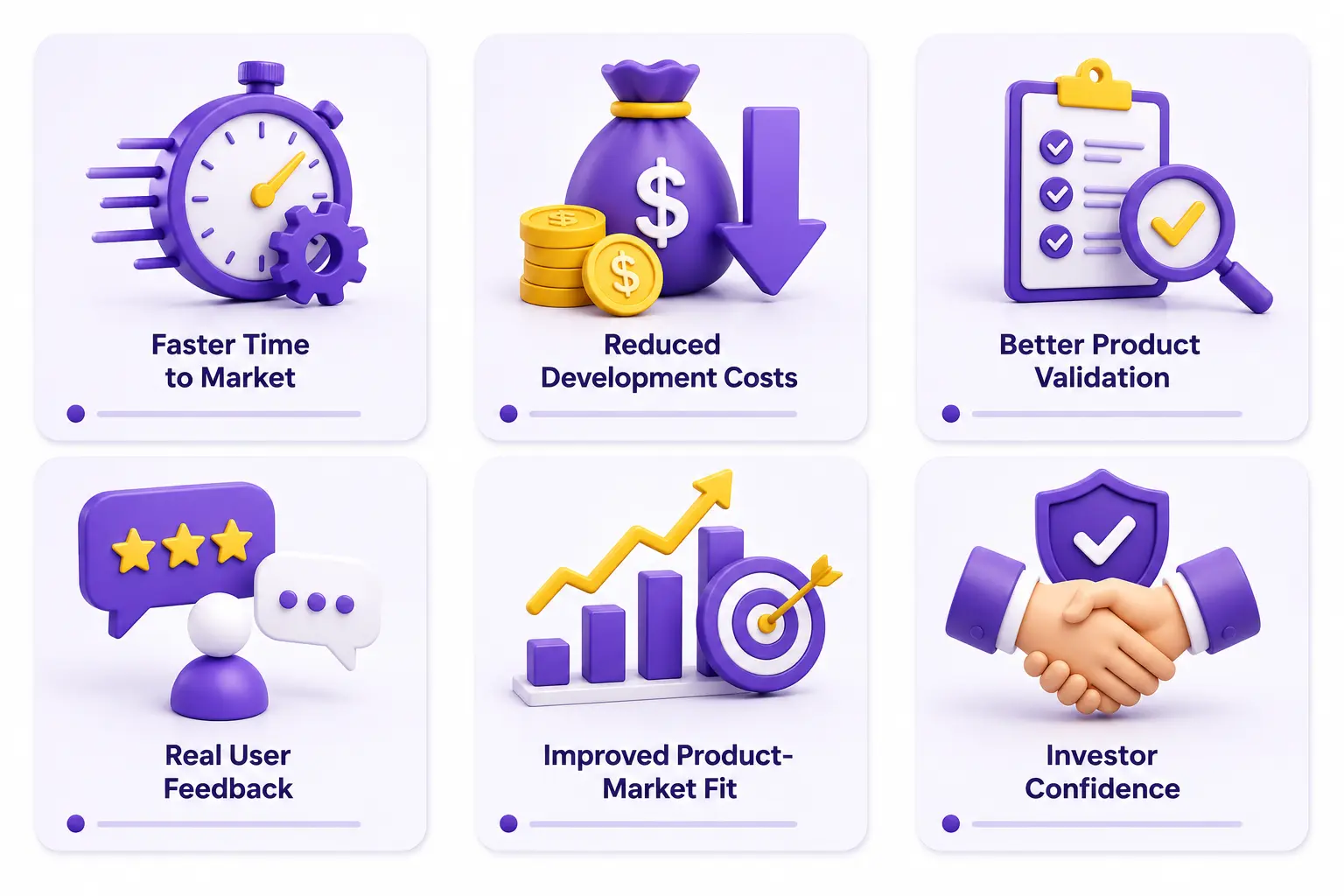
1. Faster Time to Market
One of the biggest benefits of minimum viable product development is speed. Businesses can launch much faster than they would with traditional product development approaches.
Early market entry creates opportunities to capture customers, test assumptions, and gain a competitive advantage. Additionally, launching sooner allows teams to gather market feedback earlier and make improvements before competitors gain momentum.
2. Reduced Development Costs
Building only essential functionality significantly reduces development expenses. Instead of investing heavily in features that users may never need, companies focus their resources on validating demand first.
This lean development approach helps startups preserve capital and allocate budgets more effectively as the product evolves.
3. Better Product Validation
An MVP enables startups to validate whether customers genuinely need the proposed solution.
This process minimizes uncertainty and reduces the risk of building products nobody wants. By testing real market demand early, businesses can make data-driven decisions and avoid costly development mistakes.
4. Real User Feedback
Real users provide insights that no internal brainstorming session can replicate.
Feedback gathered during MVP testing helps businesses understand:
- User expectations
- Pain points
- Feature priorities
- Usability challenges
- Purchase behavior
5. Improved Product-Market Fit
Many successful products achieve strong product-market fit through multiple MVP iterations.
Continuous feedback allows teams to align product offerings with actual customer needs rather than assumptions. As a result, businesses can refine their value proposition and increase customer satisfaction over time.
6. Investor Confidence
Investors are often more interested in traction than ideas. An MVP demonstrates market demand, user engagement, and growth potential, making fundraising conversations more compelling.
Real-World MVP Examples
Some of the world’s most successful companies started with remarkably simple MVPs.
Airbnb
Airbnb’s founders began by renting out air mattresses in their apartment to conference attendees who could not find hotel accommodations. Instead of building a sophisticated marketplace, they tested whether people would pay to stay in someone else’s home. The positive response validated the business concept before major investments were made.
Dropbox
Dropbox initially launched with a simple demonstration video showcasing how the product would work. The video generated massive interest and validated customer demand before extensive development efforts began. This approach allowed the company to confirm market interest and build a waiting list before investing heavily in product development.
Uber
Uber’s first MVP was a basic application that allowed users in a single city to request rides from a limited pool of drivers. The company focused solely on solving transportation accessibility before expanding features and markets. By starting small and testing in a controlled environment, Uber was able to refine its service model and validate user demand before scaling globally.
Facebook launched exclusively for Harvard students before expanding to other universities and eventually becoming one of the world’s largest social networking platforms. By targeting a specific audience initially, Facebook was able to gather valuable feedback, improve engagement, and validate its growth potential before broader expansion.
By targeting a narrow audience initially, the company validated user engagement and demand before scaling globally. Similar examples of MVP development demonstrate how startups can test market acceptance with a focused user base, gather meaningful feedback, and refine their products before pursuing large-scale growth.
What is a Prototype?
A prototype is an early representation of a product idea created to visualize concepts, test usability, and gather feedback before development begins. Unlike an MVP, a prototype is not necessarily a functional product. Instead, it demonstrates how the product might look, feel, and operate.
The primary purpose of a prototype is concept validation. Before investing time and resources into engineering, teams use prototypes to evaluate whether the product experience aligns with user expectations.
A clear understanding of MVP vs Prototype helps teams decide whether they should validate design or market demand first.
Understanding Product Prototypes
A product prototype serves as a bridge between an idea and a working product. It transforms abstract concepts into tangible experiences that stakeholders, investors, designers, and potential users can interact with. A prototype can answer important questions such as:
- Is the user experience intuitive?
- Do navigation flows make sense?
- Are users able to complete key tasks?
- Does the product concept solve the intended problem?
- Are stakeholders aligned on the product vision?
By addressing these questions early, startups reduce costly redesigns later in the development cycle.
Types of Product Prototypes
Different types of prototypes are used depending on project goals and maturity.
1. Low-Fidelity Prototype
Low-fidelity prototypes are simple visual representations of product ideas.
Examples include:
- Hand-drawn sketches
- Paper prototypes
- Basic wireframes
These prototypes are quick to create and useful for brainstorming and concept exploration.
2. Medium-Fidelity Prototype
Medium-fidelity prototypes introduce greater detail and interactivity.
They often include:
- Clickable wireframes
- Defined user flows
- Structured navigation
These prototypes help teams evaluate functionality and user journeys.
3. High-Fidelity Prototype
High-fidelity prototypes closely resemble the final product.
They typically include:
- Detailed visual design
- Realistic interactions
- Brand elements
- User interface components
High-fidelity prototypes are commonly used for investor presentations and advanced user testing.
4. Interactive Prototype
Interactive prototypes simulate actual product behavior.
Users can navigate screens, perform actions, and experience workflows without requiring backend development.
This type of prototype provides valuable usability insights before coding begins.
Why Startups Build Prototypes
Prototyping has become an essential part of modern startup product development because it helps teams validate ideas quickly and cost-effectively.
1. Early Idea Validation
A prototype enables teams to test assumptions before committing to development.
This significantly reduces the risk of building unnecessary features.
2. Better Stakeholder Alignment
Product visions can be interpreted differently by founders, designers, developers, and investors.
Prototypes provide a shared visual reference that improves communication and alignment.
3. Improved User Experience
User testing conducted during prototyping often reveals usability issues that would otherwise remain undiscovered until after launch.
4. Faster Iteration
Making changes to a prototype is far easier and less expensive than modifying a fully developed product.
5. Stronger Investor Presentations
Investors frequently prefer seeing a realistic product demonstration rather than reviewing abstract concepts. A polished prototype can effectively communicate vision and market opportunity.
Many startups accelerate concept validation, allowing teams to gather feedback and refine ideas before entering development. This approach aligns with how startups validate product ideas with prototypes, enabling them to test assumptions, identify usability issues, and reduce development risks early in the product lifecycle.
MVP vs Prototype: Key Differences Explained
Although MVP vs Prototype are often discussed together, they serve fundamentally different purposes in the product development process. Understanding the difference between MVP and Prototype helps startups choose the right validation method at the right time, reducing risk, improving decision-making, and improving product outcomes.
At a high level, a prototype focuses on validating ideas, user experiences, and design concepts, while an MVP focuses on validating market demand and business viability.
A prototype helps answer the question: “Does this concept make sense?”
An MVP helps answer: “Will people actually use and pay for this solution?”
Both are valuable, but they solve different problems.
MVP vs Prototype Comparison Table
| Criteria | Prototype | MVP |
| Purpose | Validate product concepts and user experience | Validate market demand and business assumptions |
| Primary Audience | Internal teams, stakeholders, investors, test users | Real customers and target users |
| Functionality | Limited or simulated functionality | Functional product with core features |
| Development Effort | Low to moderate | Moderate to high |
| Cost | Relatively low | Higher than prototyping |
| User Testing | Focuses on usability and design feedback | Focuses on customer behavior and adoption |
| Revenue Generation | Not intended for revenue | Can generate revenue |
| Market Validation | Limited | Strong |
| Investment Readiness | Demonstrates vision | Demonstrates traction |
| Time to Market | Days or weeks | Weeks or months |
| Technical Complexity | Lower | Higher |
| Product Maturity | Early-stage concept | Early-stage product |
The MVP vs Prototype comparison shows that both approaches support product validation but serve different business objectives.
Difference Between MVP and Prototype
When comparing MVP vs prototype, several distinctions become clear.
1. Functionality
A prototype may not contain any actual backend functionality. It simply demonstrates how users will interact with a product. An MVP, however, is a working solution with enough functionality to solve a real problem.
2. Validation Objective
A prototype validates product assumptions and usability. An MVP validates customer demand and product-market fit.
3. Development Investment
Prototypes require less time, effort, and budget because they focus on design and interaction. MVPs require engineering resources because they are functional products released to actual users.
4. User Involvement
Prototype testing often involves a small group of users or stakeholders. MVP testing involves real customers interacting with the product in real-world environments.
5. Business Outcomes
A prototype helps determine whether a concept is worth building. An MVP helps determine whether a business opportunity is worth scaling. These distinctions explain why startups should avoid treating prototypes and MVPs as interchangeable approaches.
Prototype vs MVP: Which Should You Build First?
One of the most common questions startup founders ask is whether they should build a prototype or an MVP first. The answer depends on the level of uncertainty surrounding the product idea.
In many situations, building a prototype before an MVP is the safest and most efficient approach. However, some products can move directly to MVP development if the concept has already been validated.
Let’s examine both scenarios.
When to Build a Prototype
A prototype should be your first step when major assumptions still exist around the product concept, user experience, or feature requirements.
You Need to Validate Product Ideas
If your idea is innovative or introduces a new user behavior, a prototype helps determine whether users understand and value the concept.
User Experience Is Critical
Applications with complex workflows often require extensive usability testing before development begins.
Examples include:
- Healthcare applications
- FinTech platforms
- SaaS products
- Enterprise software
- Marketplace platforms
Multiple Design Directions Exist
When several approaches could solve the same problem, prototypes allow teams to compare alternatives quickly.
Stakeholder Alignment Is Needed
Prototypes provide a visual representation of the product vision, helping founders, designers, developers, and investors align around shared goals.
Development Budgets Are Limited
Investing in prototyping first can prevent expensive development mistakes later.
Many startups discover major usability issues during prototype testing, saving thousands of dollars in rework.
Startups that prioritize early testing and iteration are better equipped to adapt to changing market needs. As a result, the benefits of Rapid Prototyping for startups extend beyond validation to include cost savings, improved user experiences, and stronger product-market fit.
When to Build an MVP
An MVP becomes the preferred option when the core concept is already validated and market feedback is the next priority.
Market Demand Needs Validation
The primary objective of an MVP is determining whether customers genuinely want the product.
Revenue Testing Matters
Unlike prototypes, MVPs can test:
- Pricing models
- Subscription plans
- Purchase behavior
- Customer acquisition strategies
Real User Feedback Is Required
An MVP enables startups to observe actual customer behavior rather than relying solely on opinions.
Competition Is Increasing
Speed can become a competitive advantage.
Launching an MVP quickly helps businesses establish market presence before competitors gain traction.
Product-Market Fit Is the Goal
An MVP provides valuable insights into:
- Customer retention
- Engagement levels
- Usage patterns
- Feature demand
The ability to build MVPs faster gives startups a competitive advantage by enabling them to validate ideas, gather user feedback, and adapt to market demands more efficiently.
Situations Where Both Are Required
In most startup journeys, prototypes and MVPs complement each other rather than compete. While a prototype helps validate ideas, user experiences, and workflows, an MVP validates market demand and business viability.
Using both approaches in sequence enables startups to reduce uncertainty, gather meaningful feedback, and make informed product decisions before committing significant resources. A common workflow looks like this:
Step 1: Product Idea
The startup identifies a problem worth solving. Every successful product begins with a clearly defined problem or unmet market need. Founders often observe customer pain points, industry inefficiencies, or emerging opportunities and develop ideas for potential solutions.
At this stage, the focus is on understanding the problem rather than designing features or building technology. The goal is to determine whether the problem is significant enough to justify creating a new product.
Step 2: Product Discovery
Research validates market opportunities, user needs, and business goals. Many successful founders begin this stage through professional product discovery services to establish a clear product strategy.
During product discovery, teams conduct market research, competitor analysis, customer interviews, and business assessments. This process helps identify the target audience, validate assumptions, define product requirements, and establish measurable business objectives.
A thorough discovery phase reduces development risks and ensures the product is built around genuine customer needs rather than assumptions.
Step 3: Wireframing
User flows and screen structures are designed. Professional wireframing helps define intuitive customer journeys before visual design begins.
Wireframes provide a blueprint of the product’s structure, navigation, and information architecture. They help teams visualize how users will move through the application and complete key tasks. Because wireframes focus on layout rather than aesthetics, they allow stakeholders to refine functionality and user flows early in the design process. This stage creates a strong foundation for future design and development efforts.
Step 4: Prototype Development
Teams build interactive prototypes to validate usability and stakeholder alignment. At this stage, wireframes are transformed into clickable and interactive experiences that simulate how the final product will function. Users can navigate screens, test workflows, and provide feedback on usability without requiring backend development.
Prototype testing helps uncover navigation issues, user frustrations, and design improvements before significant engineering resources are invested. It also helps founders, designers, developers, and investors align around a shared product vision.
Step 5: MVP Development
Once assumptions are validated, development teams build a functional MVP for market testing. The MVP includes only the essential features required to solve the primary user problem and deliver value to early adopters. Unlike a prototype, an MVP is a working product that real users can access and use in real-world environments.
The objective is to gather measurable data related to user engagement, adoption, retention, customer satisfaction, and revenue potential. Feedback collected during this phase helps teams prioritize future improvements and validate product-market fit.
Step 6: Product Scaling
Successful MVPs evolve into full-scale products through continuous iteration. Once market demand has been validated, businesses begin expanding functionality, improving performance, and enhancing the overall user experience. Product teams analyze customer feedback, usage data, and business metrics to determine which features should be developed next.
Many businesses also invest in product scaling services to strengthen application architecture, optimize performance, and prepare the product for long-term growth.
As the user base grows, the product becomes more robust, scalable, and capable of serving broader market segments. This stage often includes infrastructure upgrades, advanced features, integrations, automation, and geographic expansion. This progression significantly reduces risk while improving product quality and market readiness.
MVP in Product Development Lifecycle
MVPs and prototypes are most effective when integrated into a structured product development process. Modern startup product development services generally follow four major stages.
Stage 1: Idea Validation
Every successful product begins with identifying a genuine market problem.
During this phase, teams focus on:
- Market research
- Customer interviews
- Competitor analysis
- Opportunity assessment
- Business model exploration
The objective is validating whether the problem is worth solving.
Many startups engage professional product discovery to establish a strong foundation before investing in design or development.
Stage 2: Prototype Development
Once the opportunity is validated, teams begin visualizing solutions.
Key activities include:
- User journey mapping
- Wireframing
- UI/UX design
- Interactive prototyping
- Usability testing
At this stage, teams focus heavily on usability rather than functionality.
Stage 3: MVP Development
After design assumptions have been validated, startups move into MVP development.
The objective is simple:
Launch quickly, learn rapidly, and improve continuously.
Activities include:
- Feature prioritization
- Backend development
- Frontend development
- Product testing
- Market launch
Organizations often partner with an experienced MVP app development company to accelerate development while maintaining scalability and performance.
Stage 4: Growth and Optimization
Once the MVP enters the market, the learning process intensifies.
Teams monitor:
- User engagement
- Customer retention
- Revenue metrics
- Feature adoption
- Product-market fit indicators
Feedback collected from actual customers drives future development priorities.
The product gradually evolves from an MVP into a mature, scalable solution capable of supporting long-term business growth.
This continuous cycle of testing, learning, and iteration represents the foundation of modern digital product strategy.
How Startups Use Prototypes and MVPs Together
The most successful startups rarely treat prototypes and MVPs as separate or competing approaches. Instead, they use both strategically throughout the product development lifecycle to reduce uncertainty, validate assumptions, and accelerate growth.
A prototype and an MVP serve different purposes, but when combined, they create a powerful framework for product validation and innovation.
Rather than investing heavily in development from the beginning, startups can progressively validate their ideas at every stage. This approach minimizes risk while ensuring that product decisions are based on evidence rather than assumptions.
Validation Workflows
Modern startup teams often follow a structured validation workflow that moves from concept validation to market validation.
A typical process includes:
- Idea Generation
- Market Research
- Product Discovery
- Wireframing
- Prototype Creation
- User Testing
- MVP Development
- Product Launch
- Continuous Optimization
Each stage builds upon the previous one and provides valuable insights that improve decision-making.
For example, a prototype may reveal usability issues that require design changes before development begins. Similarly, an MVP may uncover customer preferences that influence future product enhancements.
This iterative approach helps startups avoid investing resources in features or solutions that users may not value.
users may not value.
Agile Product Development
The combination of prototypes and MVPs aligns perfectly with agile development methodologies.
In an agile environment, teams focus on:
- Rapid experimentation
- Continuous feedback
- Incremental improvements
- Customer-centric development
- Faster learning cycles
Rather than spending months building a complete product, startups release small iterations, gather insights, and make data-driven improvements.
By collaborating with experienced mobile app developers for startups, businesses can accelerate MVP development, validate ideas faster, and adapt products based on real user feedback.
This approach enables businesses to respond quickly to changing market conditions while maintaining development efficiency. As a result, agile development MVP strategies have become standard practice across startup ecosystems and technology companies worldwide.
User Feedback Loops
One of the greatest advantages of using prototypes and MVPs together is the ability to establish continuous feedback loops.
During prototype testing, feedback typically focuses on:
- Navigation
- User flows
- Visual design
- Product usability
- Feature comprehension
Once the MVP launches, feedback shifts toward:
- Customer behavior
- Engagement patterns
- Retention metrics
- Revenue performance
- Product satisfaction
By collecting feedback throughout the product journey, startups gain a clearer understanding of customer needs and expectations.
This ongoing learning process significantly improves product quality and customer experience.
Product-Market Fit Testing
Achieving product-market fit is one of the most important milestones for any startup.
A prototype helps determine whether users understand the product.
An MVP helps determine whether users actually want the product.
Together, they create a validation system that supports faster product-market fit discovery.
Common indicators include:
- High user retention
- Strong engagement rates
- Positive customer feedback
- Organic referrals
- Revenue growth
Startups that consistently test assumptions and iterate based on customer feedback are far more likely to achieve sustainable growth.
Common Mistakes Founders Make
Despite the availability of proven validation frameworks, many startups continue to make costly product development mistakes.
Understanding these common pitfalls can help founders avoid unnecessary risks and improve their chances of success.
Building an MVP Too Early
One of the most common mistakes is rushing directly into MVP development without validating the concept first.
Many founders become excited about an idea and immediately begin development.
However, without proper validation, teams often discover critical usability issues after significant investments have already been made.
Building a prototype first can reveal:
- User experience challenges
- Feature gaps
- Navigation problems
- Workflow inefficiencies
Addressing these issues early is significantly cheaper than fixing them after launch.
Confusing Wireframes with Prototypes
Another frequent mistake is assuming wireframes and prototypes are the same thing.
Wireframes represent structure and layout.
Prototypes simulate interactions and user experiences.
While both play important roles, they serve different purposes within the design process.
Professional wireframing services help establish information architecture and user journeys, while prototypes validate usability and interactions. Understanding the distinction improves validation accuracy and design quality.
Overengineering the MVP
Many startups misunderstand the concept of a minimum viable product.
Instead of focusing on essential functionality, they attempt to include every feature from their long-term vision.
This often results in:
- Increased costs
- Delayed launches
- Longer development cycles
- Reduced flexibility
The goal of an MVP is not perfection.
The goal is learning.
By focusing only on core functionality, startups can launch faster and gather meaningful feedback sooner.
Ignoring User Feedback
Collecting feedback is only valuable if it influences decision-making.
Some founders become emotionally attached to their original ideas and ignore customer insights that contradict their assumptions.
Successful startups treat feedback as a strategic asset.
They continuously analyze customer behavior and use data to guide future development priorities.
Skipping Product Discovery
Perhaps the most expensive mistake is bypassing product discovery altogether.
Without adequate research, startups often struggle with:
- Unclear business goals
- Poor feature prioritization
- Misaligned customer needs
- Increased development risk
Professional product discovery helps businesses validate assumptions, identify opportunities, and establish a clear product roadmap before development begins. Similarly, product prototyping enables startups to validate concepts quickly and cost-effectively. Understanding common rapid prototyping mistakes can further help teams avoid validation setbacks, reduce rework, and improve product outcomes.
Conclusion
Understanding MVP vs prototype is essential for startups and businesses looking to build successful digital products while minimizing risk and maximizing learning. Although both approaches support product validation, they serve distinct purposes within the product development journey.
A prototype helps validate ideas, user experiences, workflows, and design assumptions before development begins. It enables teams to visualize concepts, gather stakeholder feedback, and identify usability challenges early in the process. On the other hand, an MVP focuses on validating market demand by delivering a functional product to real users and collecting actionable feedback from actual usage.
The most successful startups rarely view prototyping and MVP development as competing approaches. Instead, they use them strategically as part of a structured product development roadmap that moves from idea validation to market validation and eventually to scalable growth.
By understanding the difference between MVP and prototype, founders can avoid costly mistakes, prioritize investments effectively, and build products that solve real customer problems.
For startups looking to further explore how rapid validation techniques can improve product outcomes and accelerate innovation, the rapid prototyping guide offers valuable insights into reducing uncertainty, improving collaboration, and bringing better products to market faster.
FAQs
1. What is the difference between MVP and Prototype?
The primary difference between MVP vs Prototype is their purpose. A prototype helps validate ideas, user experiences, and design concepts before development begins, while an MVP validates market demand by delivering a functional product to real users and collecting actionable feedback.
2. Should startups build a prototype before an MVP?
In most cases, yes. A prototype helps identify usability issues, validate workflows, and gather feedback before development begins.
3. What is an MVP product?
An MVP product is the simplest version of a solution that contains enough functionality to solve a core user problem while collecting valuable user feedback for future development.
4. What are the benefits of minimum viable product development?
Key benefits include:
- Faster time to market
- Lower development costs
- Reduced business risk
- Better product validation
- Faster product-market fit
- Improved user feedback collection
These advantages make MVP development a preferred strategy for startups.
5. How much does MVP development cost?
The cost of MVP development varies based on project requirements, feature scope, technology choices, and team structure. A clear understanding of MVP development cost considerations enables businesses to make informed investment decisions throughout the product development journey.
6. What is proof of concept vs prototype vs MVP?
A Proof of Concept validates technical feasibility, a prototype validates usability and design assumptions, and an MVP validates market demand and customer adoption.
7. How long does it take to build an MVP?
The timeline varies depending on project scope and complexity. Most MVPs take between 6 and 16 weeks to develop. Businesses seeking faster launches can learn strategies to build MVPs faster.
8. Can a prototype be used as an MVP?
Generally, no. A prototype is designed for concept validation and often lacks functional backend systems. An MVP is a working product that users can actively use and evaluate.
9. What are the benefits of rapid prototyping for startups?
Rapid prototyping helps startups validate ideas quickly, improve stakeholder communication, identify usability issues, and reduce development risks.
10. What mistakes should founders avoid during prototyping?
Founders should avoid overcomplicating designs, skipping user testing, ignoring customer feedback, and moving into development too early.
SHARE
WRITTEN BY

Ishan Gupta
CEO & Founder
Ishan Gupta is a seasoned entrepreneur and CEO with extensive 8+ years of experience in business and mobile app development landscape. He believes that the right digital product allows companies to focus on what they do best, while technology handles the rest. With deep exposure to global markets, he understands what makes an app succeed. His approach translates business needs into clear product strategies, ensuring that every feature contributes to measurable ROI.
View All Articles

 India
India USA
USA Australia
 Canada
 UK
UK UAE
UAE